

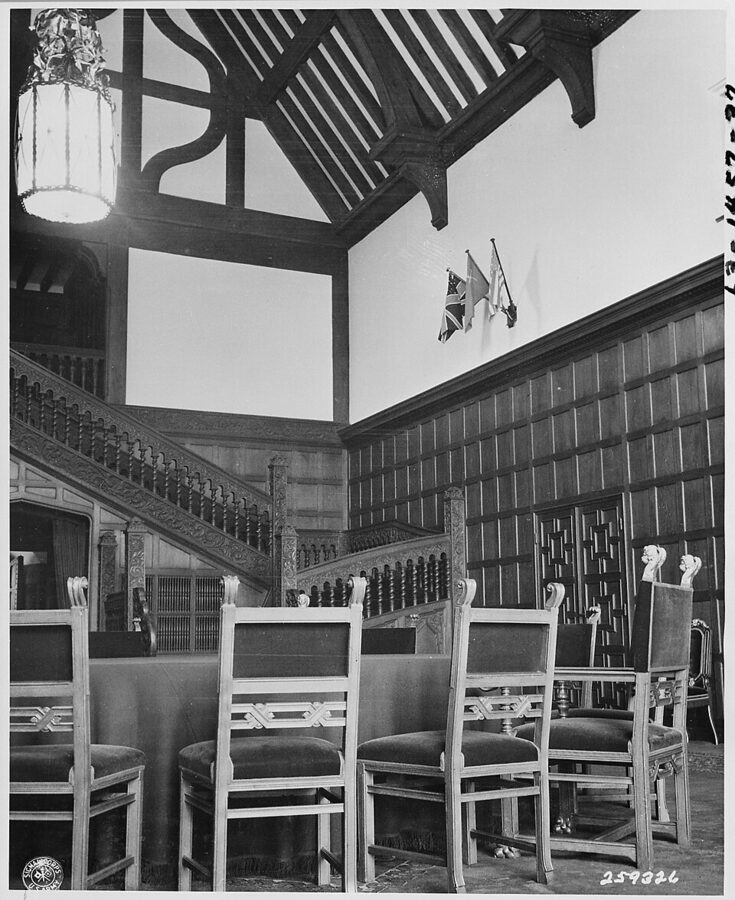
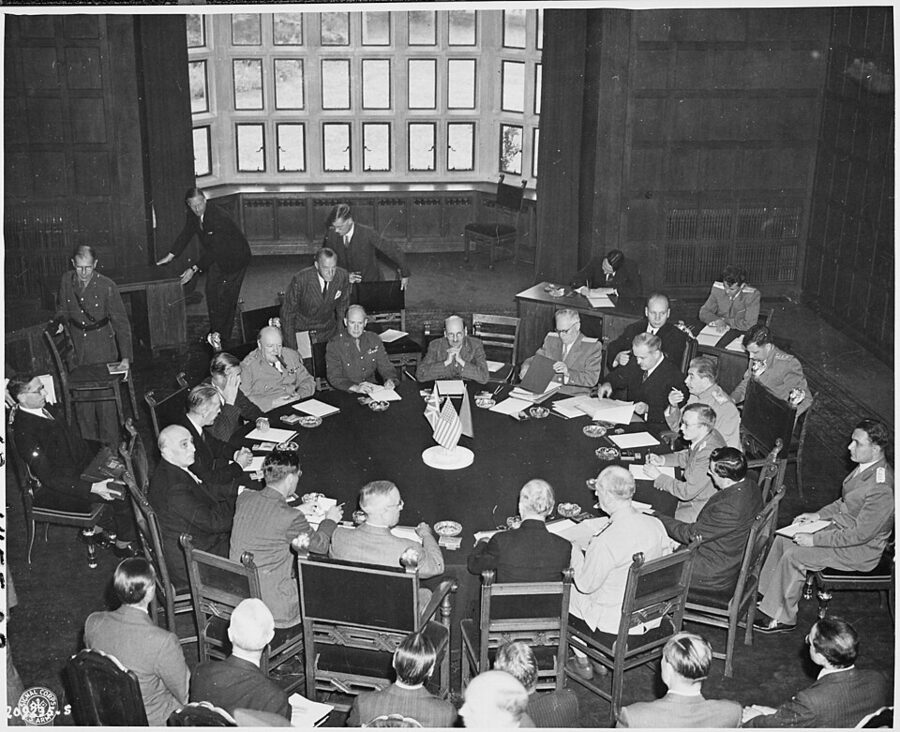
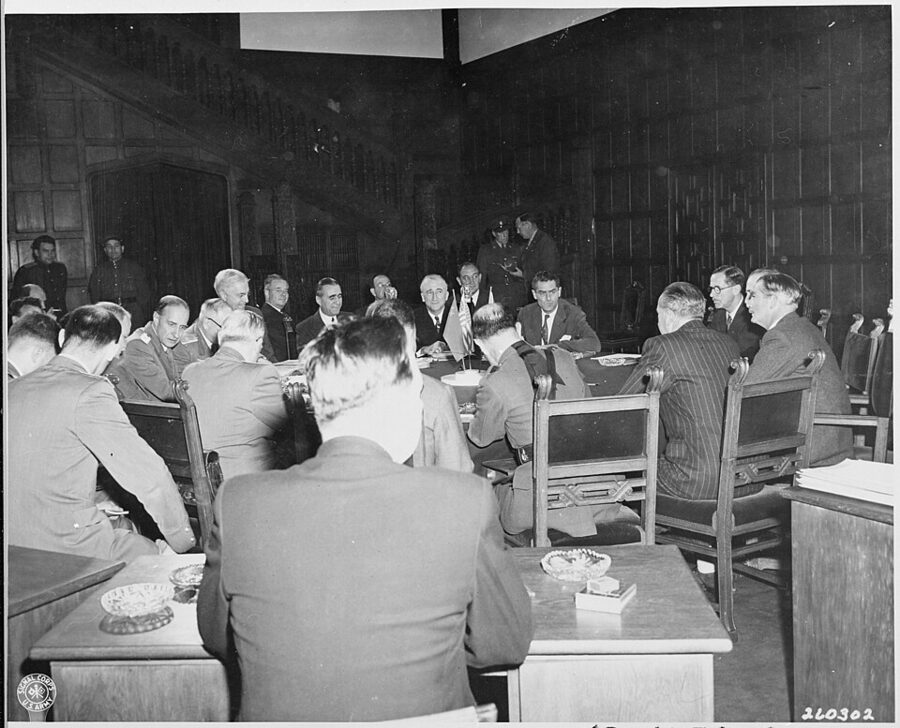
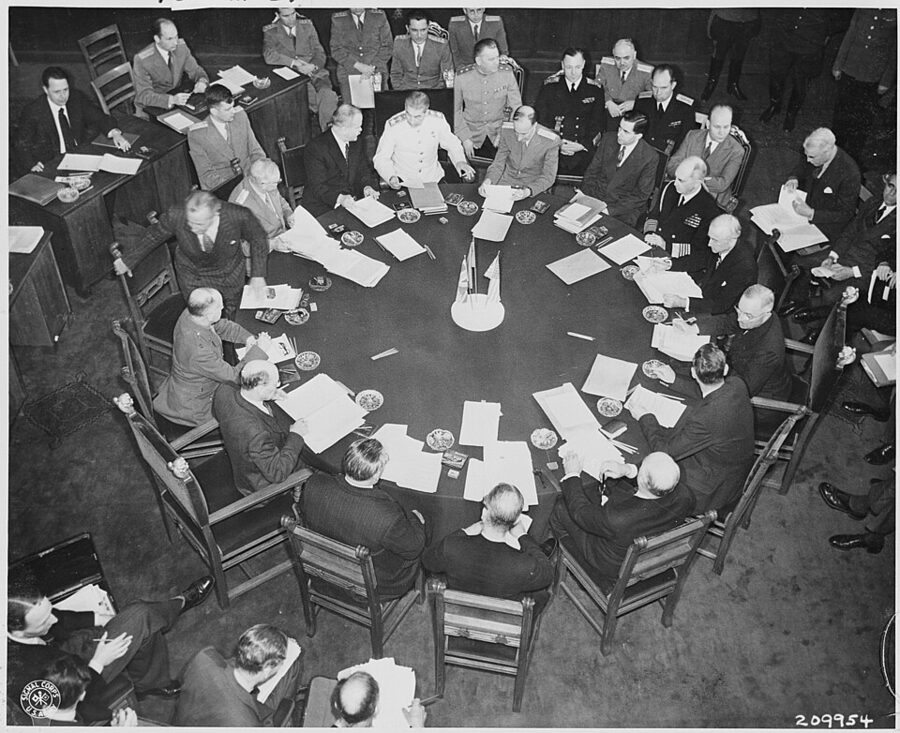
At the end of the afternoon session on July 24, 1945, Harry Truman got up from the round table in the Great Hall of Cecilienhof, walked around it to Joseph Stalin and mentioned, as casually as he could manage, that the United States now had a new weapon of unusual destructive force. Stalin said he was glad to hear it and hoped it would be put to good use against the Japanese. Truman went back to his seat puzzled by how little interest the man had shown.
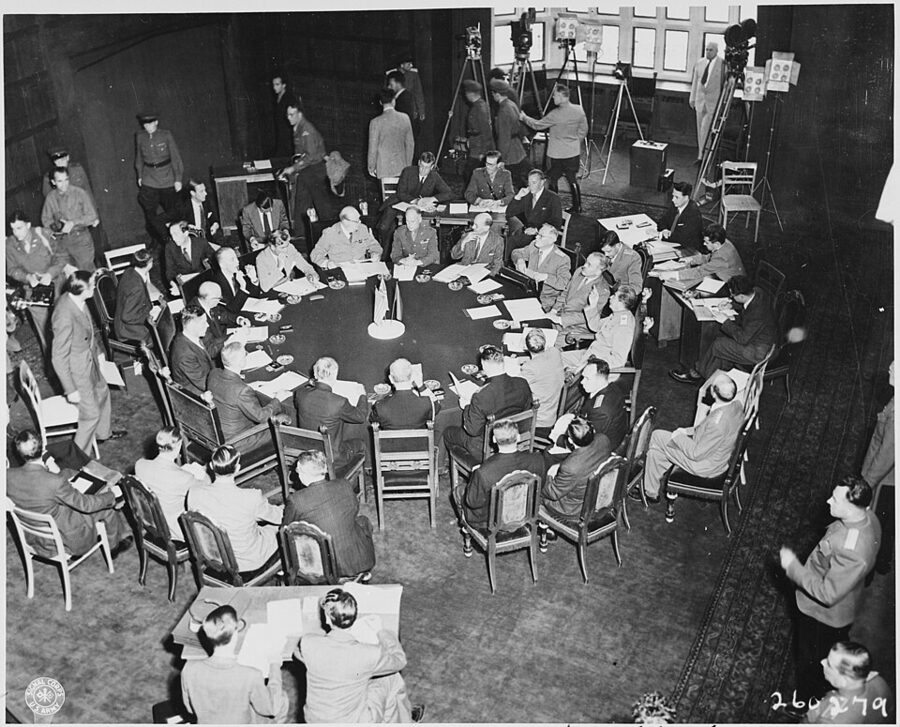
Stalin had no need to look interested. Soviet agents inside the Manhattan Project had kept Moscow informed for years, and the bomb Truman was hinting at had gone off in the New Mexico desert eight days earlier. Afterwards Stalin had the Soviet bomb program pushed harder. That exchange, a few sentences beside a table ordered from a Moscow furniture maker, is the Potsdam Conference in miniature: allies still smiling for the cameras, each one working out what the other already knew.
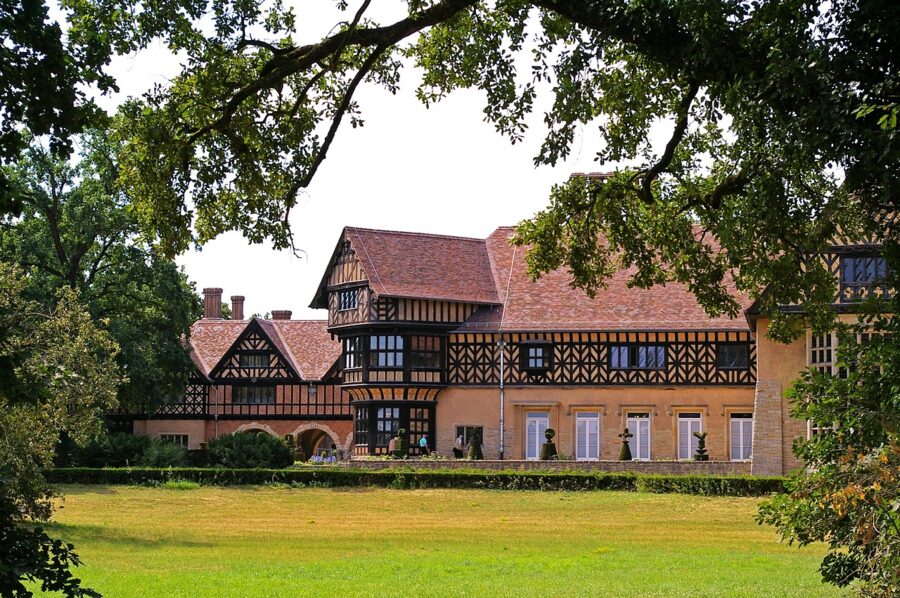
For seventeen days, from July 17 to August 2, 1945, the leaders of the three powers that had just beaten Nazi Germany sat in this mock-Tudor country house in the Neuer Garten and slept in requisitioned villas on the Griebnitzsee, about 6 km away by road. Between them they settled how Germany would be occupied, moved Poland’s border west to the Oder and Neisse rivers, issued the ultimatum that came before Hiroshima, and went home trusting one another less than when they arrived.
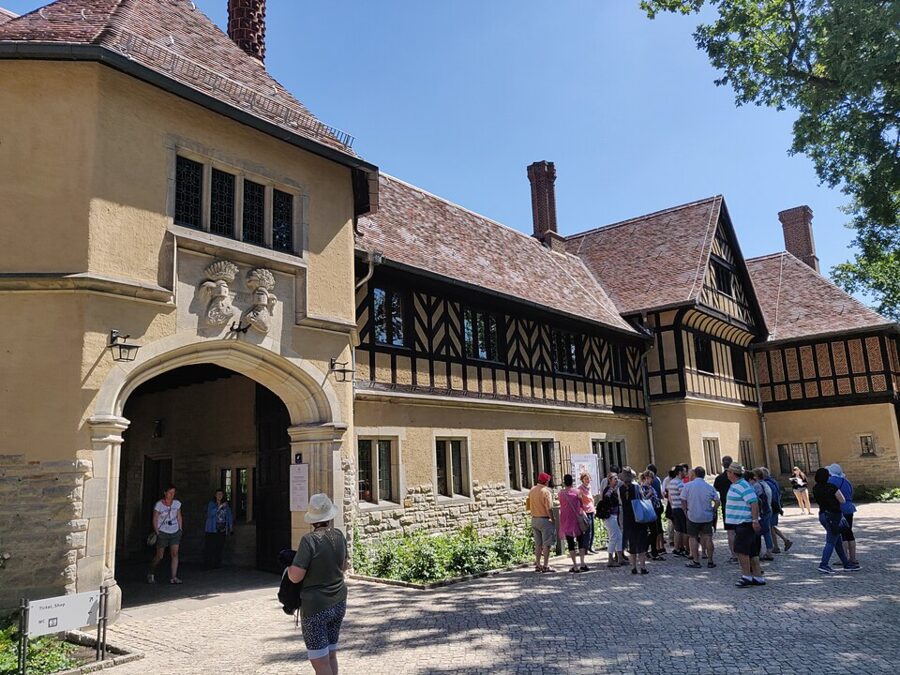
The conference room itself has been shut for restoration since November 2024, in a project the foundation schedules to run until 2029. Almost everything else in the story can still be stood in front of: the three villas on one quiet street, the lake the Americans patrolled by boat, the bridge the delegations drove across, the park around the house, and a prison the Soviets opened around the corner after the leaders left.
Contents8 parts
Why a crown prince’s country house
Churchill had pressed for a meeting of the “Big Three” as soon as the fighting in Europe stopped, because he believed time was working for the Soviet Union. Truman wanted to get the budget through Congress first, which took until June 30, and Stalin was busy with the victory parade in Moscow on June 24. Stalin also never went to a summit outside territory his army held, so the meeting had to be near Berlin, where each delegation could be housed in its own sector. The code name was Terminal.
Berlin itself was a field of rubble, and Potsdam was not much better at its center: the Royal Air Force had burned out much of the old town on the night of April 14, 1945. The answer lay on the northern edge of town. Cecilienhof, in the Neuer Garten beside the Jungfernsee, had come through almost untouched, it was easy to guard, and the villa suburb of Neubabelsberg on the far side of the Havel could house the delegations.
The house carried meaning of its own. Cecilienhof was the last palace the Hohenzollerns built, for the heir of Wilhelm II, and the crown prince and his wife lived there until they fled in early 1945. Potsdam was the old garrison town of the Prussian kings, and German historians point to the symbolism: it was seen as the cradle of Prussian militarism, and in March 1933 Hitler had staged the “Day of Potsdam” there.
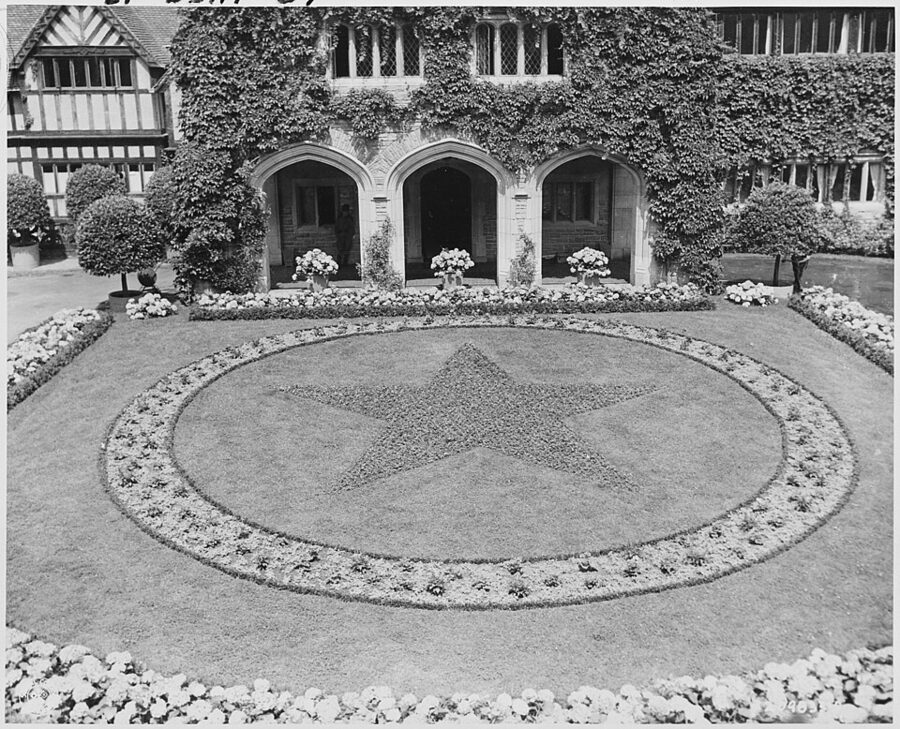
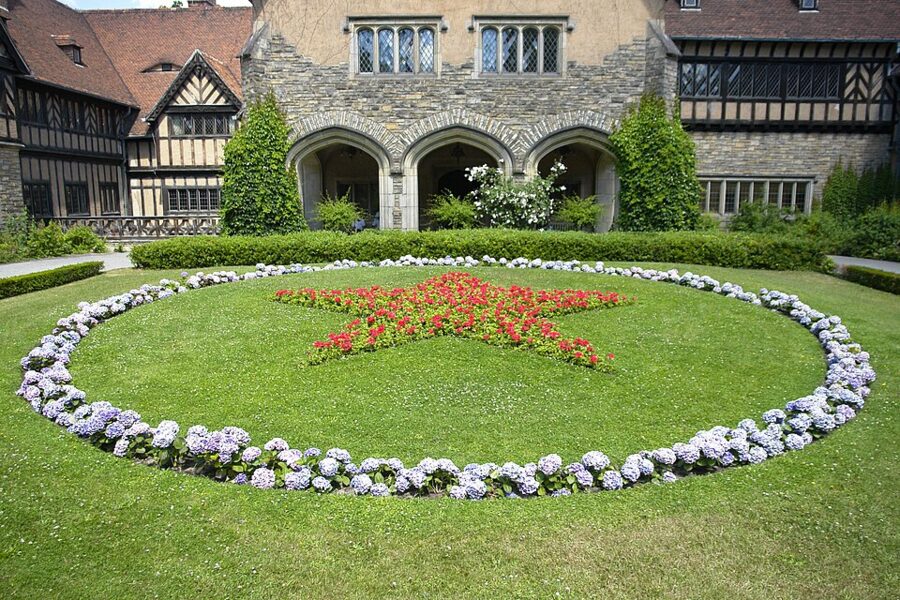
The Red Army treated the conference as its own production. Soldiers repaired the roads from Babelsberg, threw a pontoon bridge across the Havel beside the wrecked Glienicke Bridge, and planted trees, shrubs and flower beds, among them the five-pointed red star in the courtyard that tells you to this day who the host was. Inside, 36 rooms and the Great Hall were done up for the guests.
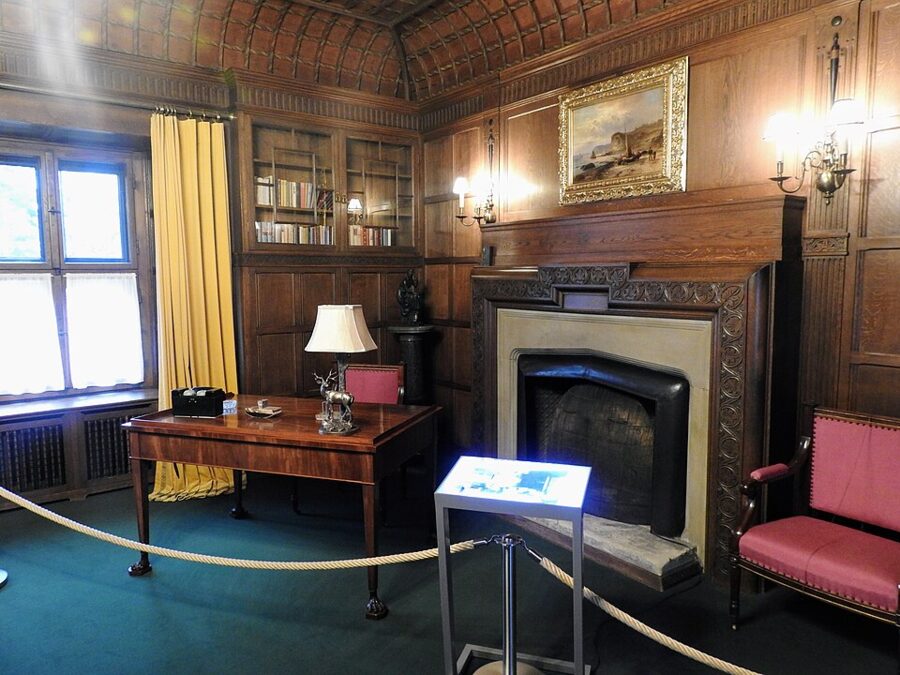
The crown prince’s own furniture went into storage in the Meierei, the old dairy at the north tip of the park, where it burned on July 25, 1945, in the middle of the conference. In its place came pieces chosen for each leader from other palaces. Truman’s study got neoclassical furniture from the Marble Palace (Marmorpalais), Churchill’s got neo-Gothic pieces from Babelsberg Palace, and Stalin’s corner room a dark leather couch and a heavy desk. Each delegation had its own wing and its own entrance, so none had to walk through another’s rooms.
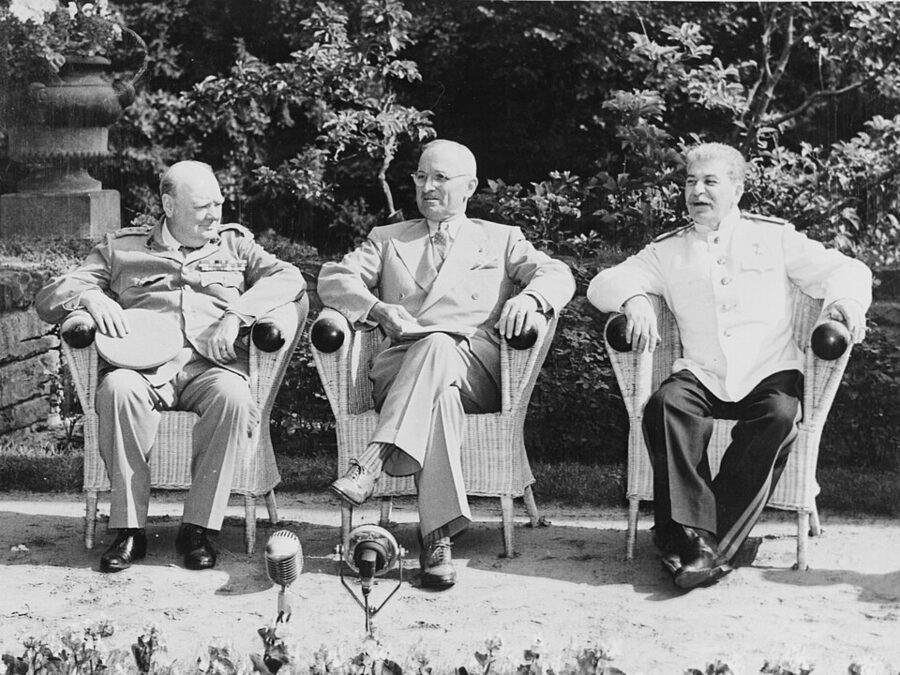
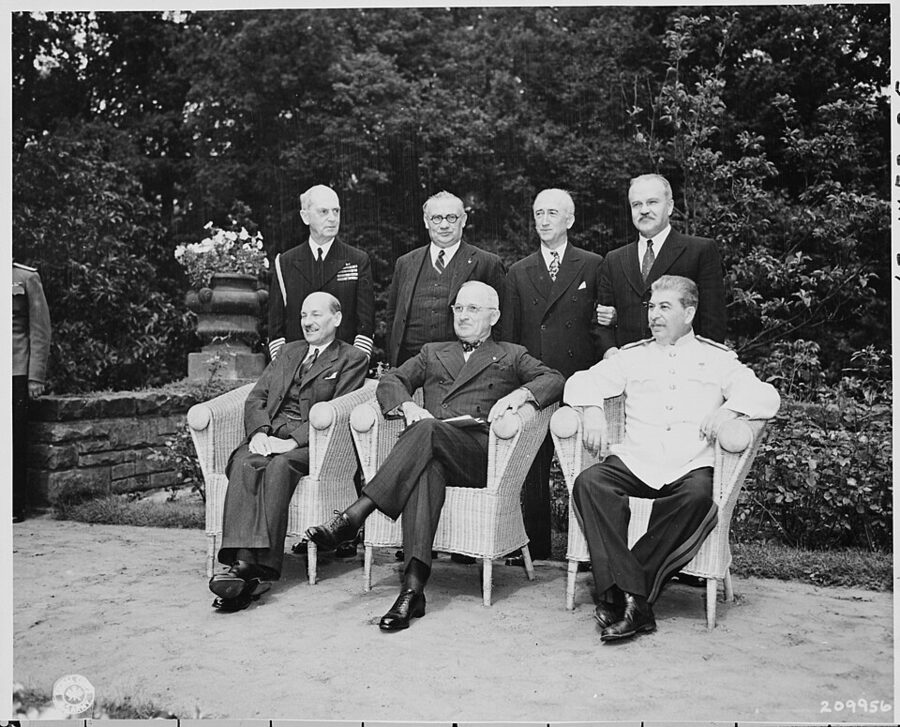
Truman, Stalin, Churchill, and then Attlee
Truman had been president for three months. Franklin Roosevelt, who had run American wartime diplomacy largely from his own desk, died on April 12, and his successor arrived in Europe by cruiser and then plane, landing at Gatow airfield outside Berlin on July 15 with, as he complained in a letter home, a briefcase full of briefing papers. His secretary of state, James Byrnes, had been in office less than two weeks.
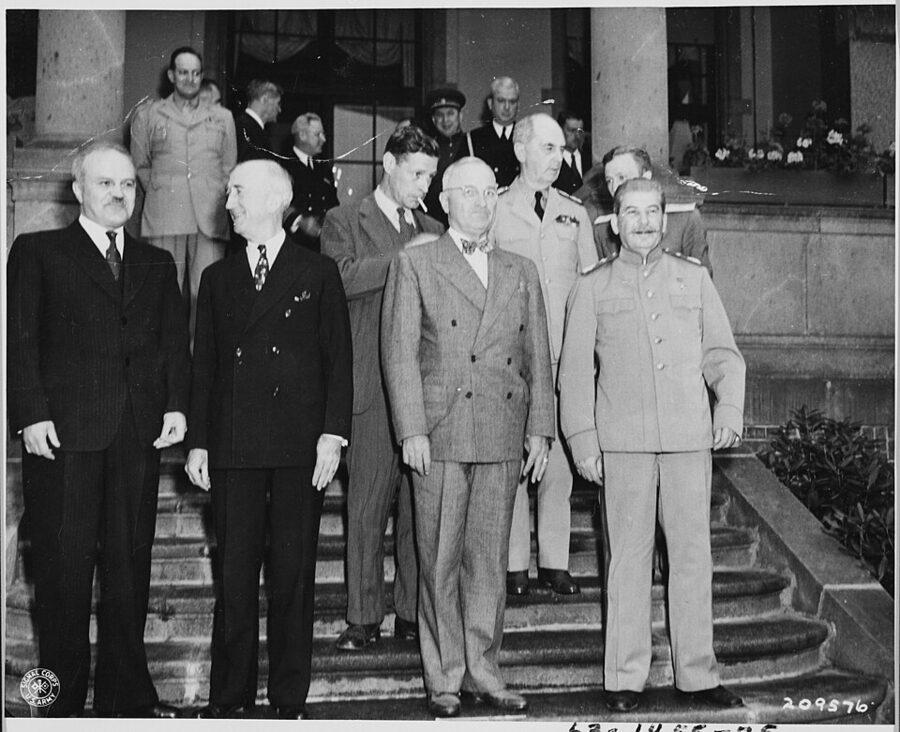
Stalin called on him at noon on July 17 and promised that the Soviet Union would enter the war against Japan on August 15. Truman was delighted, and that evening he wrote in his diary that he could deal with Stalin, a man he found straight but “smart as hell.” At 17:00 the first session opened at Cecilienhof, and Stalin made his first quiet move by proposing Truman as chairman, which put the newcomer in the position of referee between the Soviets and the British.
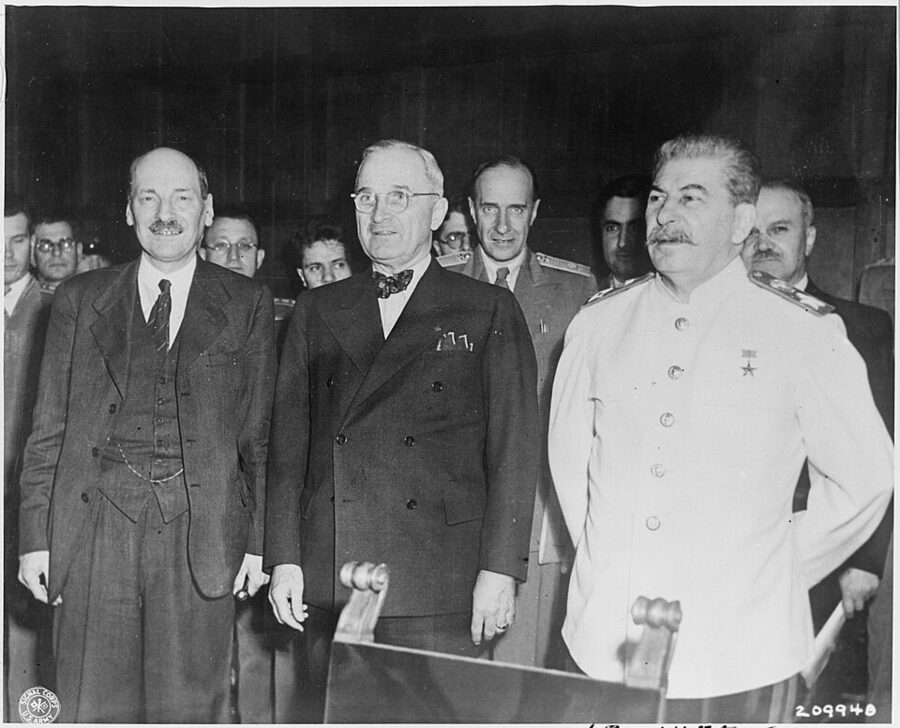
Churchill was not at his best. The British had voted on July 5, but the count waited three weeks for the ballots of servicemen abroad, and he spent the conference worried and tired, telling his doctor he had no energy and wondering if it would come back. Briefings went unread, and his interventions at the table ran long. He had brought along Clement Attlee, the Labour leader, as a precaution, and Attlee sat at the table through the first week.
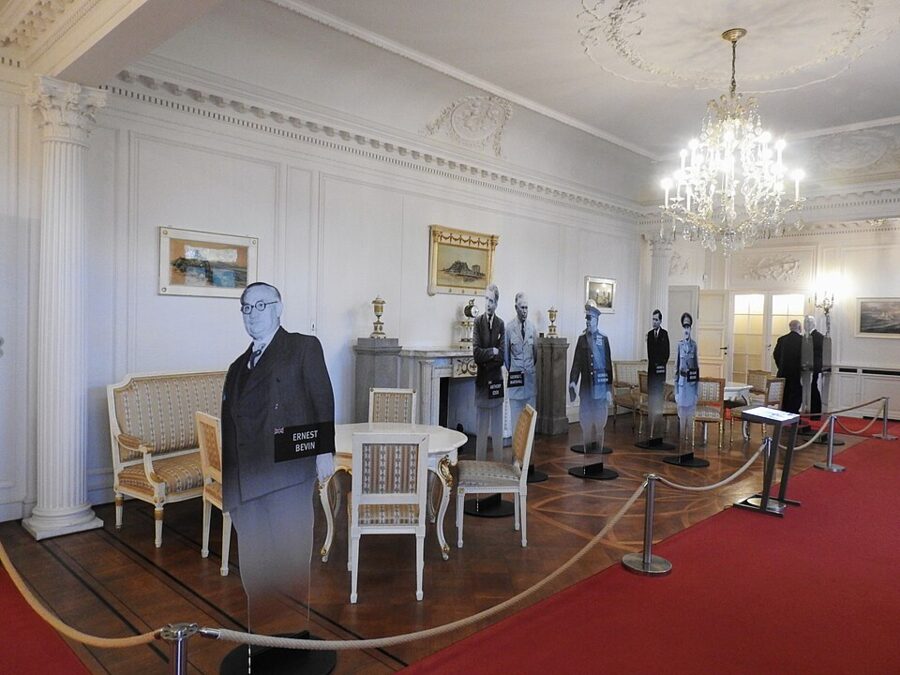
The precaution proved wise. Churchill and Attlee flew home on July 25, the results came in on July 26, and Labour had won by a landslide. On July 28 Attlee came back as prime minister, with Ernest Bevin in place of Anthony Eden as foreign secretary. Of the original leaders, only Stalin and his foreign minister, Vyacheslav Molotov, were left, and by most accounts Stalin took the new men for inexperienced products of a weak system.
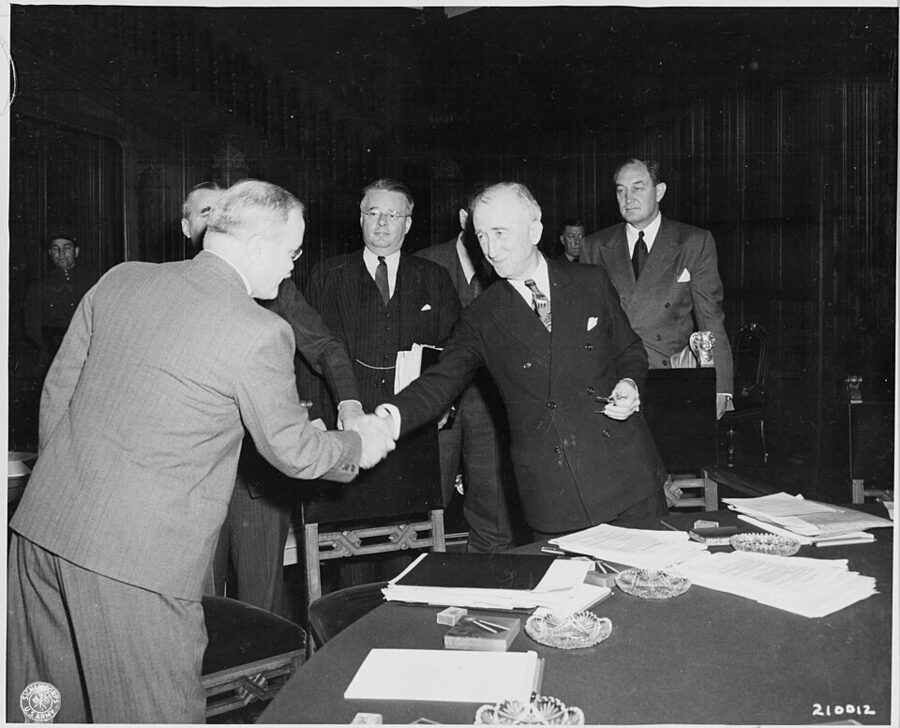
The foreign ministers met every morning in the same hall to clear the ground for the leaders in the afternoon: Byrnes, Molotov, and Eden until Bevin took over. Every word went through interpreters: Charles Bohlen for the Americans, Vladimir Pavlov for Stalin and Major Arthur Birse for the British.
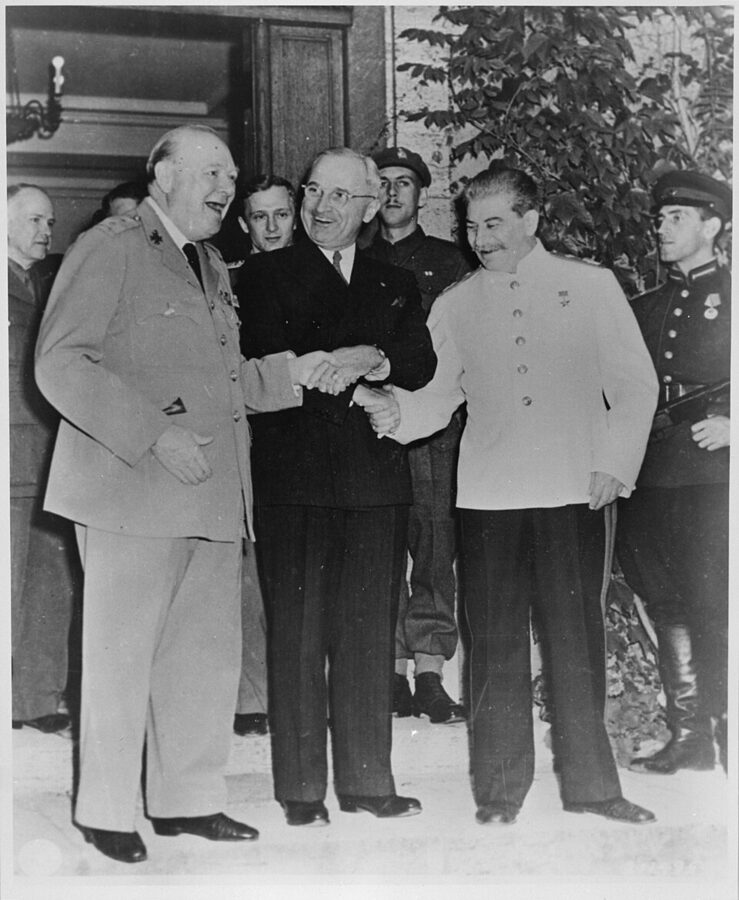
Stalin, in a pale marshal’s tunic, impressed nearly everyone, as he had at Tehran and Yalta, with short sentences and a long memory. Asked whether it gave him satisfaction to be in Berlin, he is said to have replied that Tsar Alexander had got to Paris.
The villas on the Griebnitzsee
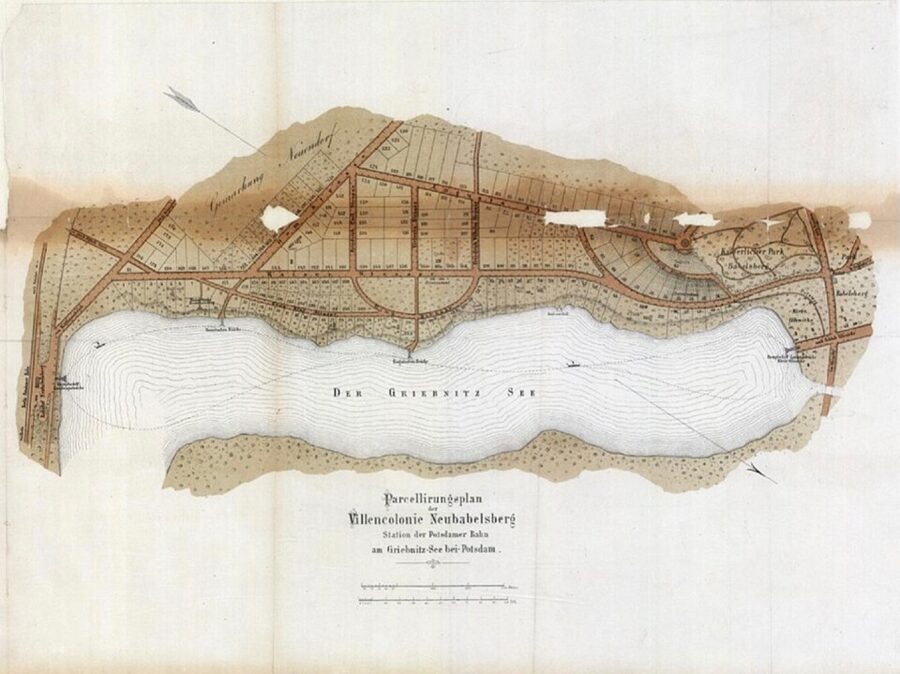
The delegations lived in Neubabelsberg, a colony of bankers’, publishers’ and film people’s villas that had grown up around the railway station on the Griebnitzsee in the 1860s and 1870s. It is the eastern edge of Babelsberg, the Potsdam district of film studios and a royal park. After 1933 many of the Jewish owners had been driven out, and in the spring of 1945 the Soviet army gave the remaining residents a few hours to leave.
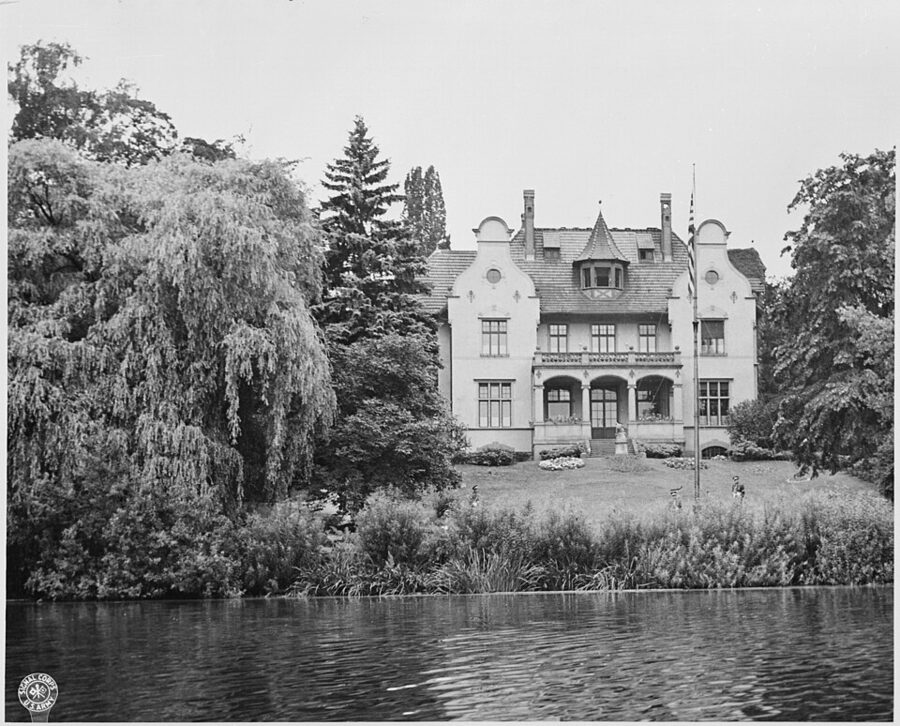
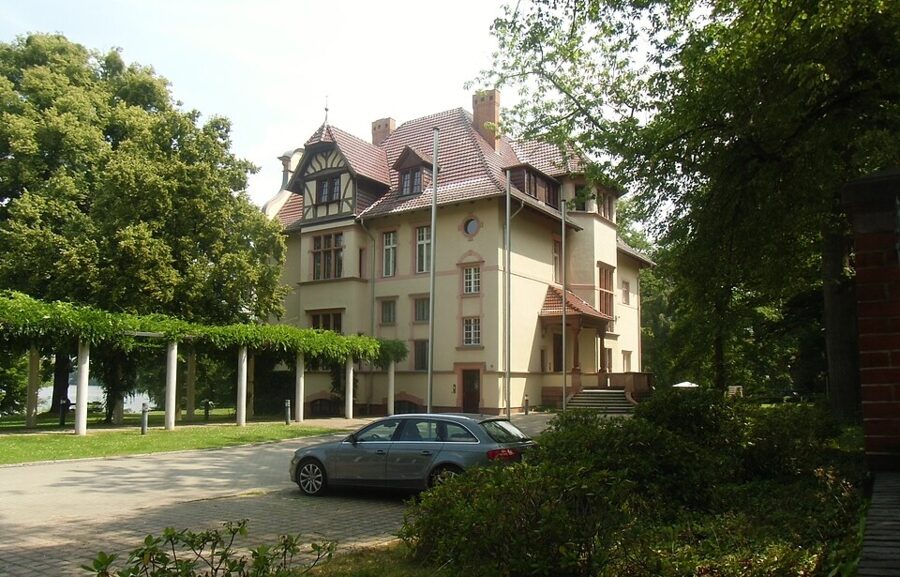
Truman’s house was Haus Erlenkamp, then Kaiserstraße 2 and today Karl-Marx-Straße 2, built in 1891 and 1892 by Karl von Großheim and Heinrich Joseph Kayser for Carl Müller-Grote, the Berlin publisher of Theodor Fontane. The Americans called it the Little White House. Truman moved in on July 15 and stayed seventeen days, and it was here, on July 25, that he wrote in his diary of “the most terrible bomb in the history of the world.”
The house has had a busy afterlife. Marshal Georgy Zhukov used it as his quarters until 1946, then came an East German party school, a school and a furniture store. The Friedrich Naumann Foundation, the liberal political foundation, bought it in 1998, restored it after an arson fire had wrecked much of the interior, and has had its headquarters here since 2001, with a modern office wing beside it.

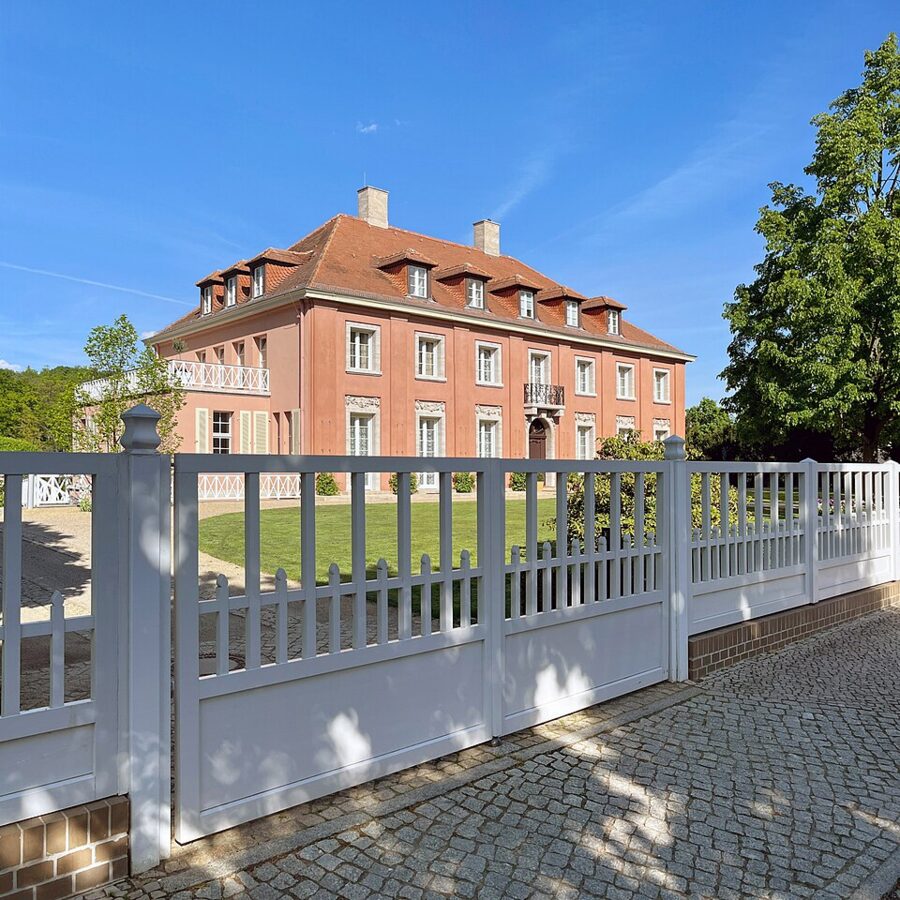
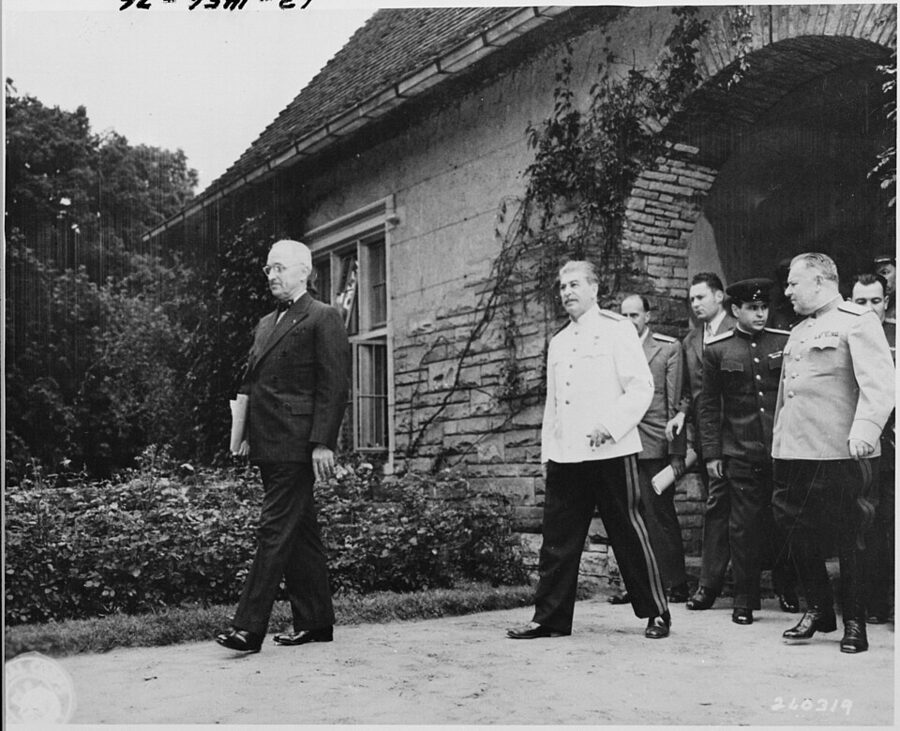
Churchill had the pink Villa Urbig at Virchowstraße 23, which the young Ludwig Mies van der Rohe built between 1915 and 1917 for the banker Franz Urbig, long before the glass boxes he is known for. Its pilasters and garland panels still lean on the Potsdam classicism of the eighteenth century. The triple handshake photograph was taken at its door on July 23, and Attlee moved in after Churchill left. Since 2009 it has belonged to the software entrepreneur and patron Hasso Plattner.

Stalin took Villa Herpich, at Kaiserstraße 27 (now Karl-Marx-Straße 27), which Alfred Grenander designed in 1910 and 1911 for the Berlin furrier Paul Herpich; the family had a few hours to get out. On July 21 Stalin gave a lavish dinner here for the other leaders, after having the furniture cleared out. Only a large sideboard built into the paneling stayed, and it is the one piece of the 1945 interior still in the house.
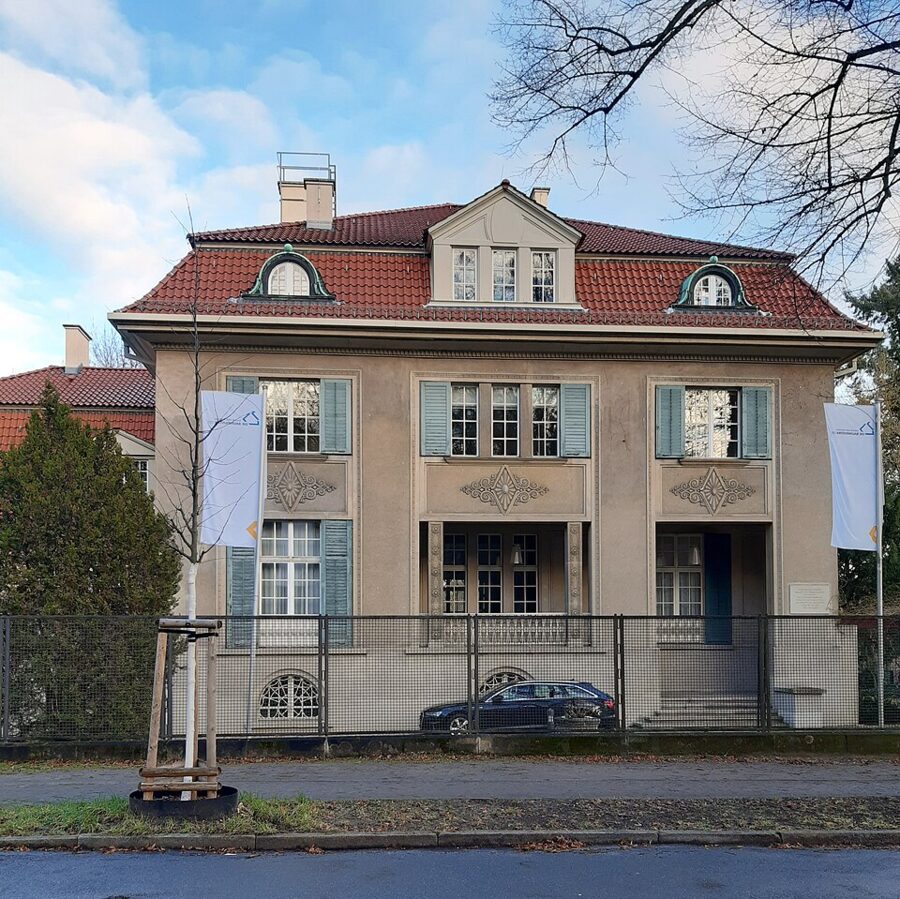

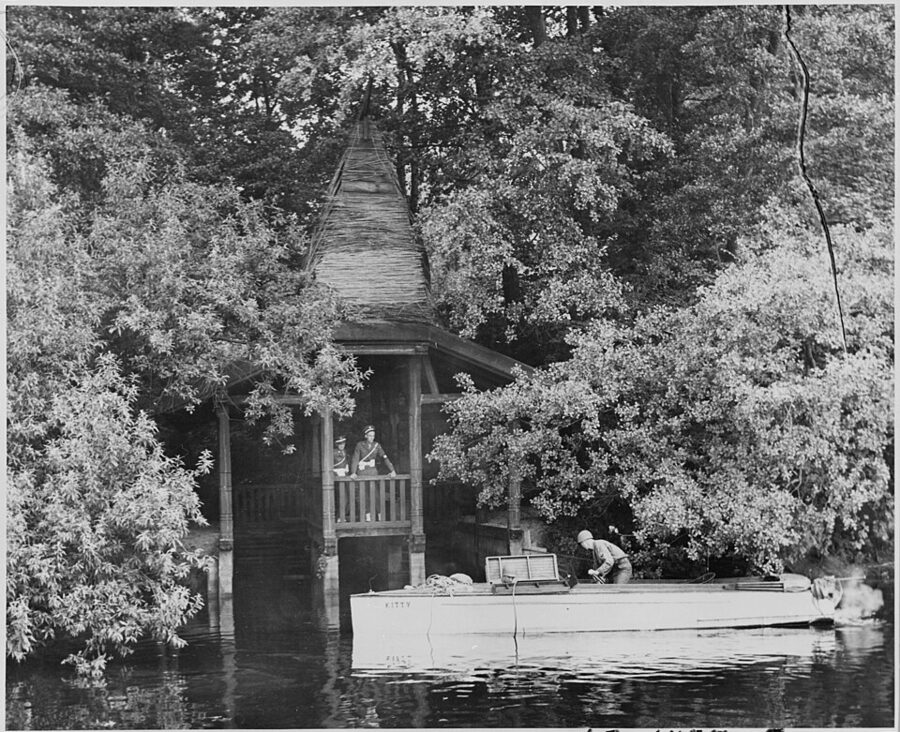
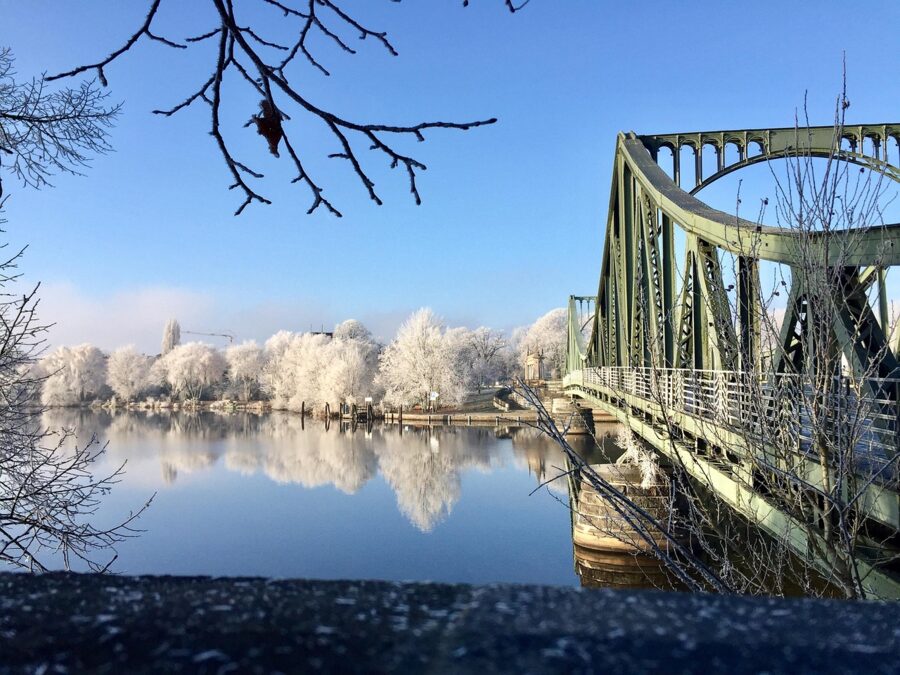
Every afternoon the three motorcades left this street for Cecilienhof, across the Havel on the pontoon at Glienicke and up through the town to the Neuer Garten, a drive of about 6 km on roads the Red Army had cleared and guarded. On the water side, the Americans ran patrol boats along the Griebnitzsee in front of their villas.
Sixteen years later the same gardens became the edge of the world. When the Wall went up in 1961, the border with West Berlin ran down the middle of the lake, and the villas’ lawns ended in fences and a patrol road. After 1990 the patrol road became a lakeside path, but a run of court cases brought by owners has closed much of it again, so the shore is largely private and the villas are best seen from the street.
Thirteen sessions at a round table
Nine sessions ran from July 17 to July 25. Then came the break for the British count, and four more from July 28 to August 1. The last one ended at 00:30 on August 2 with Truman, Stalin and Attlee signing the Protocol of the Proceedings, dated August 1, which is the text people mean by the Potsdam Agreement. A shorter communiqué was published the same day; Germans could buy it as a pamphlet for 30 pfennigs.
“Agreement” flatters it. German constitutional scholars point out that the Protocol was never a treaty and was never ratified by anyone; it was a record of where three governments had got to, with the hard parts left deliberately vague. The Soviet Union later treated it as binding international law whenever that suited its plans for its zone, and the West read it as a statement of intent.
Germany: zones, a Control Council and the four Ds
The occupation zones had been drawn before Potsdam, and France, though not invited, was to have one. The Protocol confirmed that each commander-in-chief ruled his own zone while all four sat together in the Allied Control Council in Berlin for matters affecting Germany as a whole, deciding by unanimity. That one word let any power do as it liked at home, since nobody could outvote it.
The aims became the “four Ds” of German schoolbooks: demilitarization, denazification, democratization and decentralization, with decartelization of industry sometimes counted as a fifth. Germany was to be treated as a single economic unit, with no central government for now but a few central administrative departments. The leaders could not even agree what Germany was: Churchill proposed prewar Germany, Stalin said it was whatever was left after the war, and Truman got the frontiers of 1937 written in as the starting point.
Reparations, and the deal that saved the conference
Stalin came for reparations. At Yalta Roosevelt had accepted a Soviet figure of 20 billion dollars as a basis for discussion, half of it for the Soviet Union, whose western regions the Wehrmacht had laid waste. The Americans, convinced that the reparations after 1919 had helped bring Hitler to power, wanted no repeat.
Byrnes’s answer, first put on July 23, was to split Germany for reparations: each power would take what it wanted from its own zone, with no total set. The Soviet Union would also get 15 percent of surplus industrial equipment from the western zones in exchange for food, coal and other goods, and another 10 percent for nothing. Molotov came back to the idea on July 29, and within a day it was tied to the Polish border, the package Byrnes privately called a little horse trade.
German historians agree on what it meant. Rolf Steininger and Hermann Graml both argue that dividing Germany for reparations divided it economically from the start, whatever the Protocol said about a single economic unit. In May 1946 the American military governor, Lucius Clay, stopped deliveries from his zone because the promised goods from the east had not come.
Poland’s new border and the expulsions
The fiercest arguments were about Poland. The Soviet Union kept the eastern half of prewar Poland, and Poland was to be compensated with German land up to the Oder and the western (Lusatian) Neisse, a line the Soviets had already handed to Polish administration without asking anyone. Truman and Churchill resisted for a week. Churchill reckoned that eight or nine million Germans had lived there, and Stalin claimed, falsely, that they had all gone.
In the end the West accepted Polish administration east of the line, “pending the final determination of Poland’s western frontier” at a peace settlement, and agreed in principle that Königsberg and its area would go to the Soviet Union. Article XII of the Protocol added that the transfer of German populations from Poland, Czechoslovakia and Hungary “will have to be undertaken” and should be carried out “in an orderly and humane manner.”
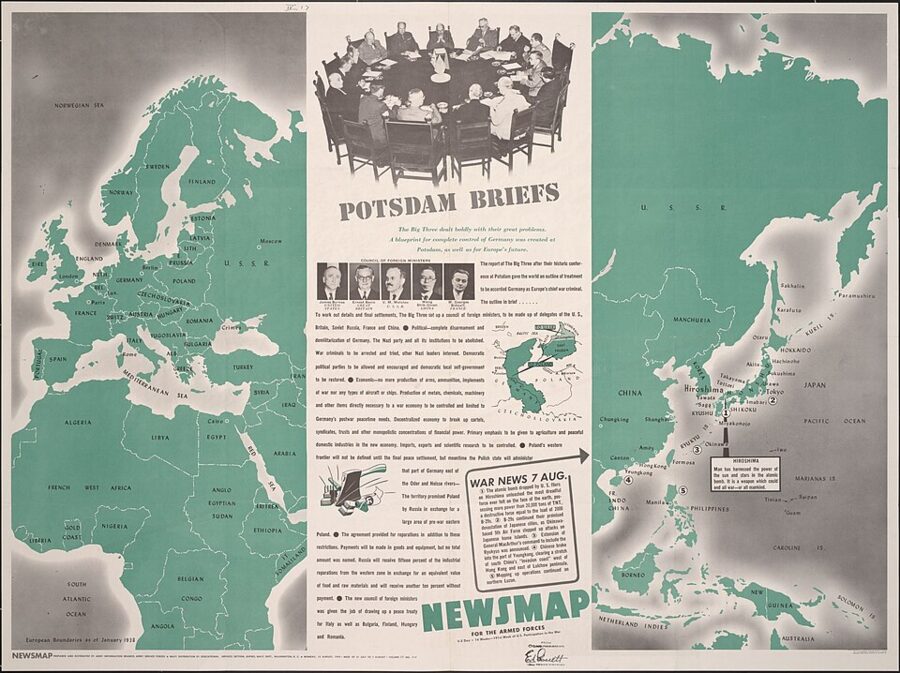
It was neither. The expulsions had begun before the conference and went on for years, and some twelve to fourteen million Germans lost their homes in the east by flight or expulsion. Estimates of the dead range from about 600,000 to more than two million. Graml’s judgment on this part of the deal is that crimes were repaid with crimes.
Austria, the foreign ministers, and the rest
Austria got a short paragraph: the leaders would look at extending the authority of its provisional government once British and American troops had reached Vienna, and no reparations would be taken from Austria. The Council of Foreign Ministers, of Britain, the Soviet Union, China, France and the United States, was set up to write the peace treaties, first with Italy, Romania, Bulgaria, Hungary and Finland. Those were signed in Paris on February 10, 1947. The treaty with Germany, which the council was also meant to draft, never came.
The rest of the Protocol reads like the clearance of a very large desk: the German fleet split three ways, war criminals to be tried quickly, with the first list due before September 1, and Iran, Tangier, the Turkish Straits and the recognition of Bulgaria, Romania and Hungary argued over and mostly passed on to the foreign ministers.
The Potsdam Declaration and the bomb
The first report of the Trinity test reached Potsdam on July 16, and the full account arrived on July 21. On July 25, in the Little White House, Truman wrote that the bomb would be used against Japan before August 10, against military targets and “not women and children,” a line historians have argued over since. The same day the written order went to the Army Air Forces to drop the first bomb as soon as the weather allowed after about August 3.
On the evening of July 26 the Potsdam Declaration was released in the names of the president of the United States, the prime minister of Britain and the president of China; Chiang Kai-shek gave his consent by radio. The Soviet Union did not sign, because it was still bound by a neutrality pact with Japan. The thirteen points demanded the unconditional surrender of Japan’s armed forces, limited Japanese sovereignty to Honshu, Hokkaido, Kyushu, Shikoku and minor islands, and promised that the Japanese would not be “enslaved as a race or destroyed as a nation.”
The last sentence read: “The alternative for Japan is prompt and utter destruction.” It did not mention the bomb, and it did not mention the emperor. A clause that would have let Japan keep its monarchy had been taken out of the draft. The declaration went out by radio rather than through diplomatic channels.
On July 28 Prime Minister Kantarō Suzuki told the press that his government would respond with mokusatsu, a word that can mean to ignore with contempt or simply to withhold comment, and Washington read it as rejection. Hiroshima was bombed on August 6. The Soviet Union declared war on August 8 and invaded Manchuria the next morning, Nagasaki was bombed on August 9, and Japan accepted the terms of the Potsdam Declaration on August 14. The surrender was signed on September 2.
Few questions in modern history have been argued harder. Gar Alperovitz, in Atomic Diplomacy (1965), argued that the bomb was used as much to impress Moscow as to defeat Tokyo, and some German accounts follow him in saying Truman did not want Japan to surrender before it was dropped. Richard Frank, in Downfall (1999), argues that Japan’s leaders were nowhere near accepting surrender, and Tsuyoshi Hasegawa, in Racing the Enemy (2005), that the Soviet declaration of war weighed on Tokyo at least as heavily as the bombs. The documents Truman read at Babelsberg are in the Truman Library’s Potsdam collection, diary pages included.
What Potsdam led to
The unity of Germany that the Protocol talked about lasted a few weeks. France, never invited and never bound in its own eyes, vetoed the central German departments in the Control Council that autumn. The zones went their own ways, Britain and the United States merged theirs into the Bizone on January 1, 1947, and by 1949 there were two German states. In September 1946 Byrnes told an audience in Stuttgart that the eastern border was not final.
The border held anyway. East Germany recognized the Oder-Neisse line in 1950, West Germany accepted it in the Treaty of Warsaw in 1970, and the reunified Germany confirmed it in a treaty with Poland on November 14, 1990, after the Two Plus Four Treaty had stood in, at last, for the peace settlement Potsdam had promised.
The State Department’s own historians note that the three leaders never met together again, and the foundation that runs Cecilienhof presents the house as the symbol of both the end of the war and the outbreak of the Cold War. Most historians put the real break later, in 1946 and 1947, and treat Potsdam as the last time the alliance papered over its cracks. Michael Neiberg, in Potsdam (2015), argues that each leader’s reading of history, Versailles for the Americans, the balance of power for the British, the losses since 1941 for Stalin, shaped what each could accept.
German historians disagree about how much it mattered at all. Wolfgang Benz called the Protocol the Magna Carta of postwar policy toward Germany; Henning Köhler thought it of little importance except as a stick with which the Eastern bloc could accuse the West of breaking it. Benz’s line on the outcome is the one that sticks: the powers came to Potsdam to divide the spoils, and when they left they had divided not only Germany but the world.
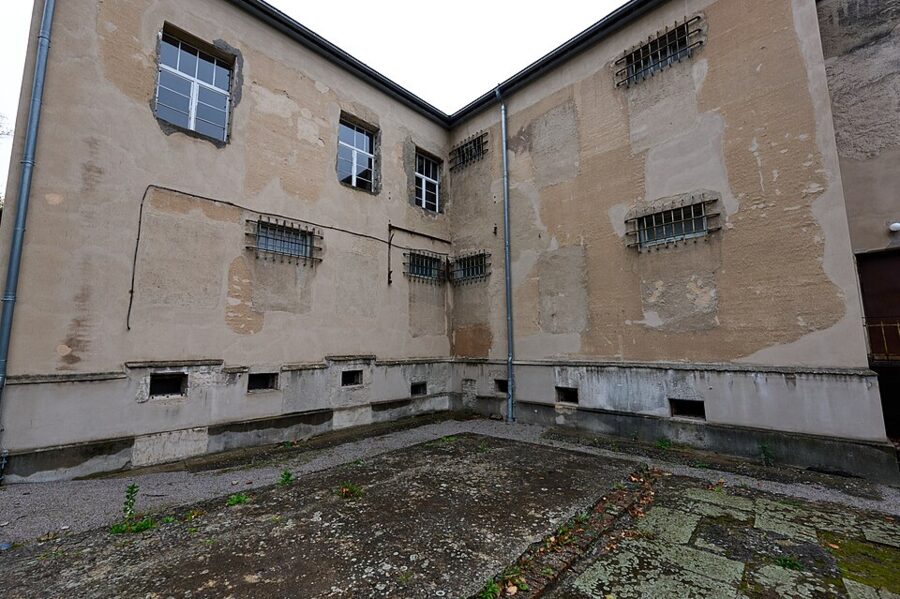
Potsdam felt the results at close range. Later in 1945 the Soviet military counterintelligence took over a block of streets beside the Neuer Garten as a closed town, Militärstädtchen Nr. 7, with a prison at Leistikowstraße 1 that held thousands of Soviet citizens and Germans until 1991. From 1961 the Wall cut through the park beside Cecilienhof and along the Griebnitzsee, and the Glienicke Bridge the delegations had crossed became the bridge where East and West exchanged spies.
Cecilienhof today
Cecilienhof has been closed since November 1, 2024, and the Prussian Palaces and Gardens Foundation (Stiftung Preußische Schlösser und Gärten, SPSG) says only that it will stay shut until further notice. Its project page gives the work a span of 2020 to 2029, with no reopening date. Most of the building is the empty hotel wing, which is being rebuilt with at least 38 rooms, and the museum is getting a new entrance at the west portal so that all the conference rooms on the ground floor will be reachable without steps.
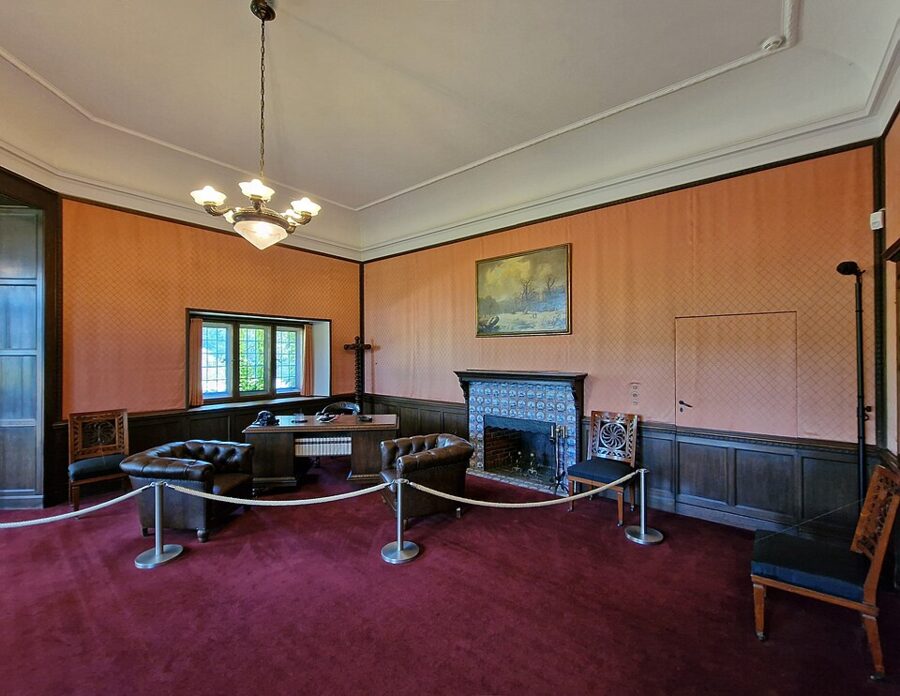

When it reopens, the visit will again be the rooms the delegations used: the Great Hall with the table, the Soviet reception and study rooms in Cecilie’s music salon and writing room, the British study in the crown prince’s library, and the American study in his smoking room. For the 75th anniversary in 2020 the foundation staged a large exhibition here, “Potsdam Conference 1945: The New Order of the World,” with loans that included a bottle and a lunchbox warped by the heat at Hiroshima, from the city’s Peace Memorial Museum.

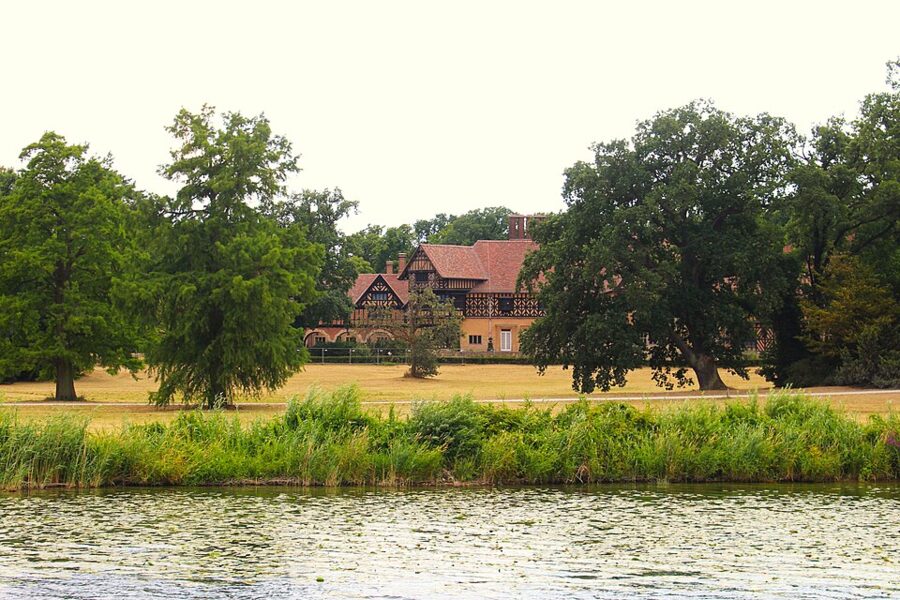
Until then the foundation offers a virtual tour of the conference rooms on Google Arts and Culture, which is better than nothing and worth ten minutes before you go. The park is a different matter. The Neuer Garten is open daily from 08:00 until dusk, free, and you can walk around the outside of the house, see the half-timbered wings and the 55 chimneys, no two alike, and look across the Jungfernsee the way the delegates did between sessions.


A walk from the villas to the conference table
With the house closed, the conference makes more sense on foot than in any single room: start where the leaders slept and end where they sat. Allow about 7 km and three to four hours with stops. From Berlin, the S7 runs to Griebnitzsee, the first stop in Potsdam after Wannsee, on a single ticket Berlin ABC at €5.00 (€5.20 from January 1, 2027); the other ways in are in the day trip from Berlin guide.
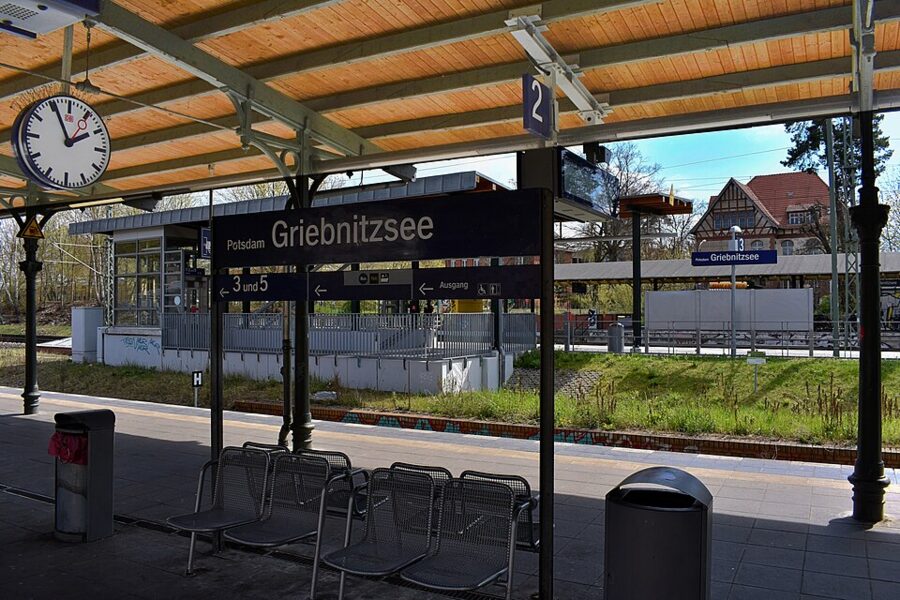

Griebnitzsee station to the Truman-Villa, 5 minutes. Leave the station on the lake side and walk west along Karl-Marx-Straße. Number 2 comes up on the right, behind its trees, about 400 m from the platform.
To Villa Urbig, about 12 minutes. Carry on along Karl-Marx-Straße and turn into Virchowstraße; the pink house at number 23 is the Churchill-Villa. Everyone in Neubabelsberg in 1945 walked these few hundred meters under guard.
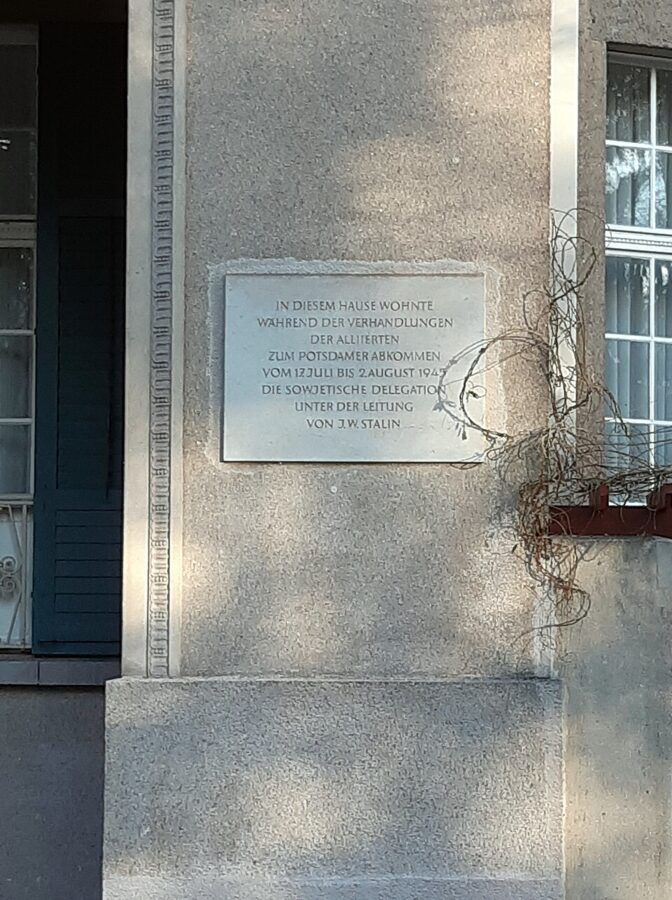
To Villa Herpich, about 10 minutes. Back on Karl-Marx-Straße, keep going west to number 27. The plaque by the entrance still says, in German, that the Soviet delegation led by Stalin lived here during the Allied negotiations on the Potsdam Agreement from July 17 to August 2, 1945.

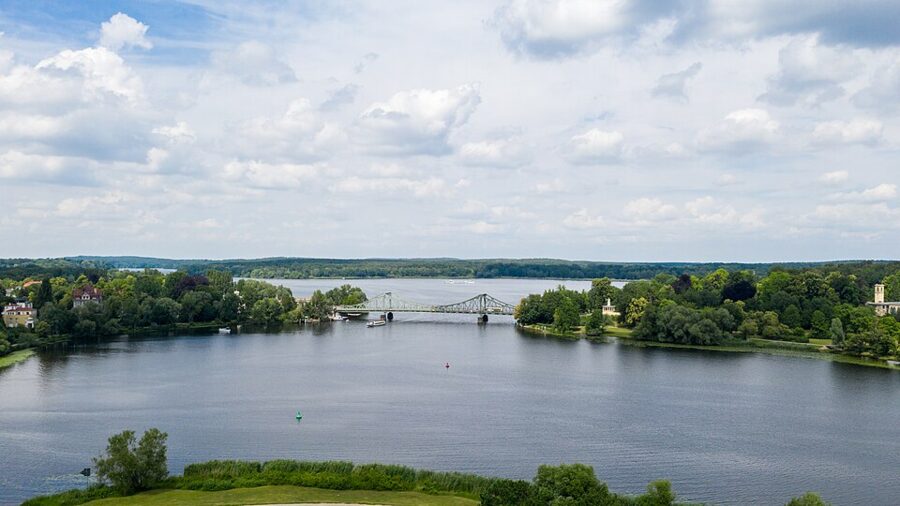
Through Park Babelsberg to the Glienicke Bridge, about 45 minutes. Park Babelsberg begins just west of the villas and is open daily from 08:00 until dusk, free. Keep to the paths along the Havel shore, past Babelsberg Palace, the neo-Gothic summer house of the future Wilhelm I whose furniture ended up in Churchill’s study, to the Parkbrücke over the Teltow Canal. Cross it into Klein Glienicke and walk through the village to Königstraße, where the green steel bridge comes into view. Two path sections near the Havelhaus are closed for works until the end of November 2026, with a signed detour.
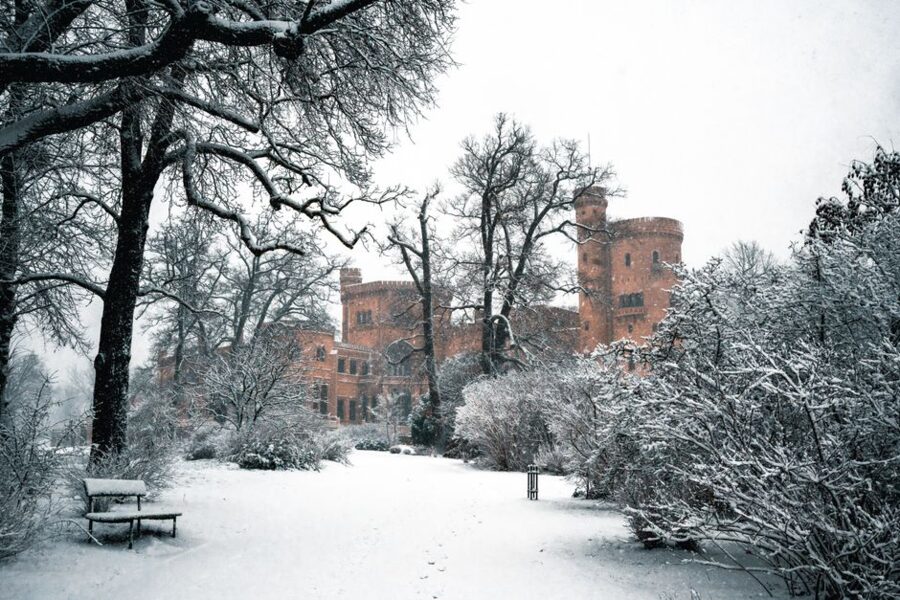
Along the Schwanenallee to Cecilienhof, about 25 minutes. Cross the bridge from the Berlin end, stopping in the middle, where the paint changes shade at the line between Berlin and Brandenburg that was once the border, and on the Potsdam side follow the Schwanenallee north along the water into the Neuer Garten. The house appears across the lawns at the far end, at the edge of the Jungfernsee.

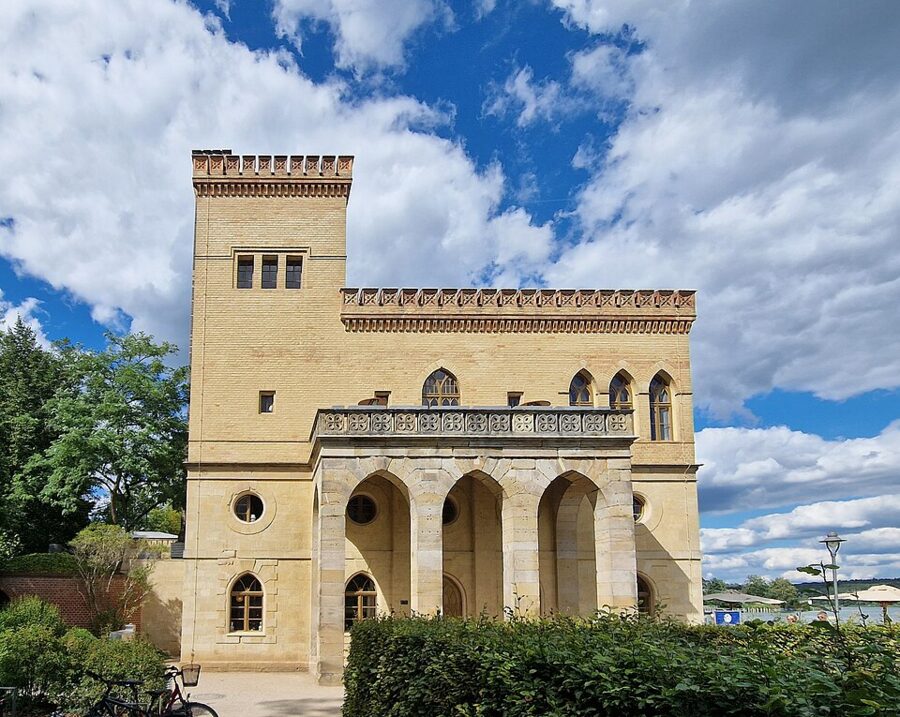
The Meierei, 5 minutes north. The old dairy at the tip of the park, where the crown prince’s furniture burned in July 1945, is now the Meierei brewery and inn on the water. It is closed Monday and Tuesday, opens from 15:00 on Wednesday and from midday or 13:00 later in the week, and is closed for staff holidays through November 2026, so plan on December or later.

The Leistikowstraße memorial, about 10 minutes west. The Gedenkstätte Leistikowstraße, at Leistikowstraße 1 just outside the park, is the remand prison of the Soviet military counterintelligence, its cells kept in their bleak original state. It is open Tuesday to Sunday, 13:00–17:00 from November to March and 14:00–18:00 from April to October, closed Mondays, and free. It closes from December 22 to 31, 2026.
Back to the train. Bus 603, direction Höhenstraße, stops at Schloss Cecilienhof and at Glumestraße near the memorial; ride it the other way to Reiterweg/Alleestraße and change to tram 92 or 96 for Potsdam Hauptbahnhof. Inside Potsdam a 24-hour ticket Potsdam AB is €6.30 and a single €3.00, valid for 60 minutes (€6.60 and €3.10 from January 1, 2027); a Berlin ABC ticket covers it anyway.
I’d do the walk in this direction, villas first. It follows the delegations’ own daily route, it ends in the park rather than on a suburban street, and in winter, when dusk comes before 16:30, it gets you to the Leistikowstraße while it is still open. Start by 11:00 from November to February. The tram 92 also stops at Puschkinallee/Alexandrowka, so if there is daylight left, the Russian colony of Alexandrowka is a short detour on the way back, and the rest of the town is in things to do in Potsdam.

When the Great Hall reopens, the table will be where it was on July 24, and you will be able to stand at the spot where Truman got up and walked around it. Until then, the street in Neubabelsberg tells the story better than the room: three houses a few minutes apart, where three men went home each evening to write down what they thought the others knew.