

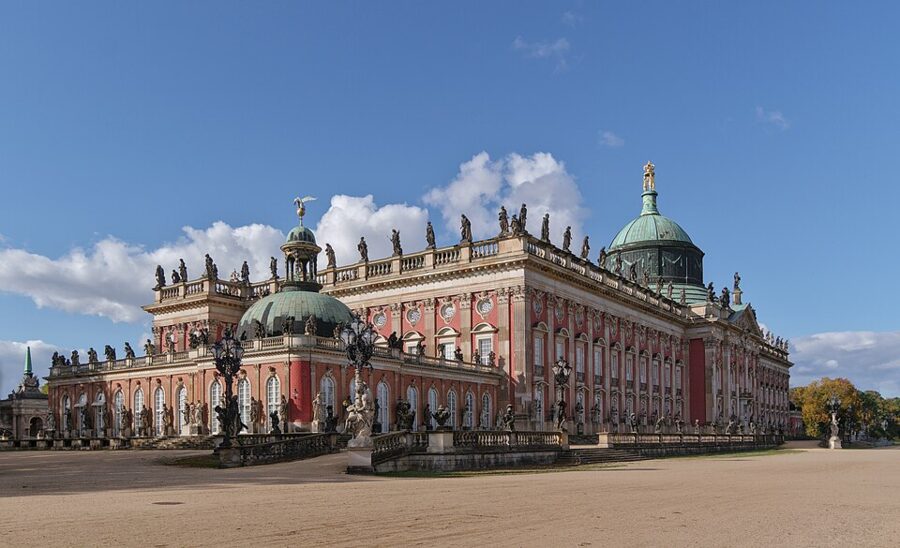
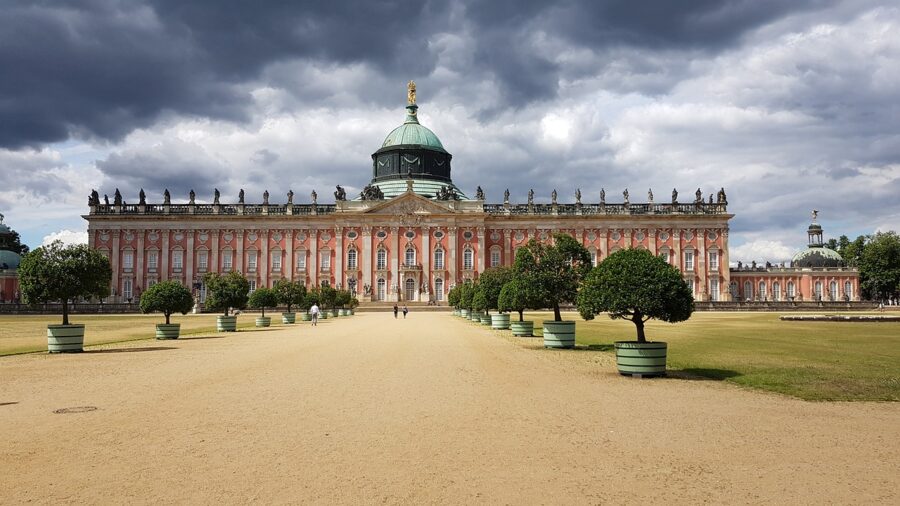
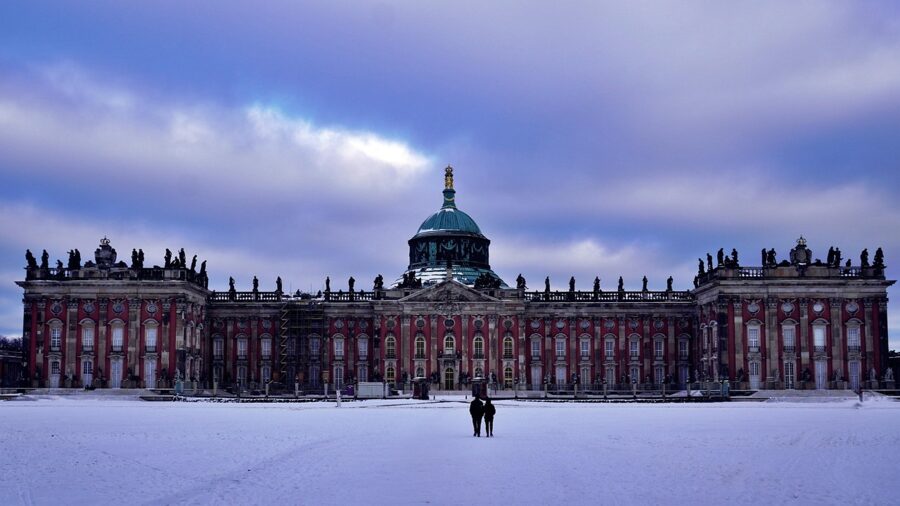
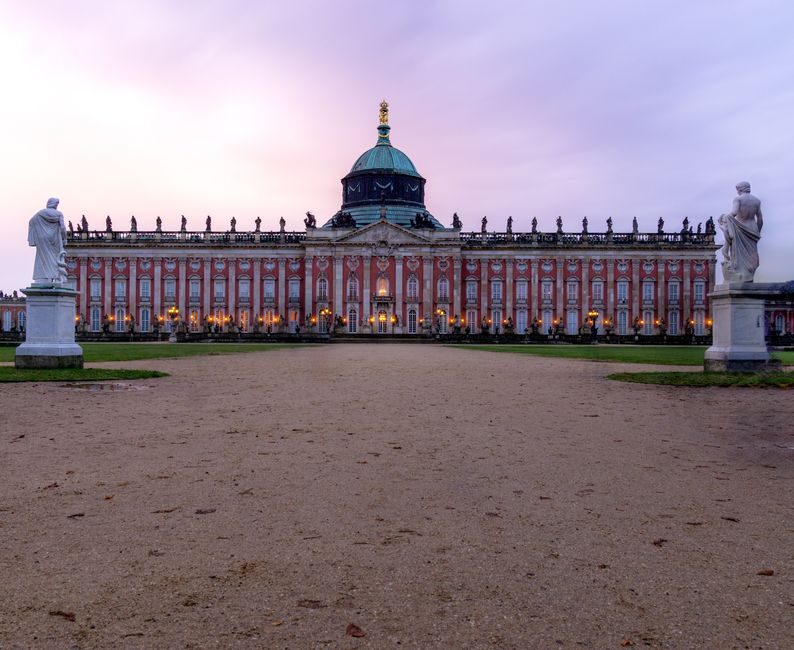
Walk west along the main avenue of Park Sanssouci to its far end and the New Palace (Neues Palais) fills the whole view: a red-brick front some 220 meters long, most of the brick painted on, under a green dome 55 meters high that covers no room at all. Nothing in front of you is quite what it claims to be, and that was the point. Frederick the Great built it straight after a war that had nearly ruined Prussia, and he had a word for it: a fanfaronade, a brag.
It is the biggest palace in the park and, to my mind, the interior most worth a timed ticket after Sanssouci itself. The king’s cottage on the vineyard terraces shows you the man; this one shows you the state he wanted Europe to see. It also carries the last emperor’s family Christmases, a Nazi stage set in the marble rooms, a fake mountain top and two paintings by a woman nobody knew had painted them. And right now it carries a great deal of scaffolding.
Contents8 parts
A brag built in six years
Frederick the Great (Friedrich II) had chosen the site and settled the plan before the Seven Years’ War broke out in 1756. He wanted something different from the light Rococo of Sanssouci: a heavier, Palladian-flavored block in the manner of Castle Howard in England and the Trippenhuis on an Amsterdam canal. In 1756 he even had a town house finished in Potsdam, Am Kanal 41, as a trial of the Dutch look he had admired on a trip to the Netherlands in 1755, with clean brick set off by dressed stone.
Then came seven years of war against Austria, Russia and France, and Prussia came out of it in 1763 exhausted, but still standing and holding Silesia. Building a vast guest palace that same year was a message to every court that had expected Prussia to collapse: Prussia can still afford this. Frederick called the project his fanfaronade, his bragging, and the word has stuck to the building ever since. The cartouches on the central blocks carry the motto Nec soli cedit, “he does not yield even to the sun”, and the sculpture around them casts the king as a victorious general.
Johann Gottfried Büring, who had already built the Chinese House and the Picture Gallery in the park, drew up the plans with Heinrich Ludwig Manger. Büring and the king did not get on. After the quarrels and Büring’s departure, Carl von Gontard took over the whole job from 1764, by which time the shell was well advanced; his hand shows mostly in the layout and decoration of the rooms. Gontard stayed in Potsdam for decades afterwards and later designed the Marble Palace in the Neuer Garten for the next king.
The palace was finished in 1769, astonishingly fast for 200 rooms, four festival halls and a theater. The speed is also the root of most of its troubles. Brick supplies faltered and neat pointing took too long, so most of the outer walls were plastered and painted to look like brick. The timber beams under the main hall were never allowed to dry out properly, its marble floor was ground in such a hurry that the grinding water soaked down into them, rot set in, and the hall has been at risk of collapse more than once since.
In 2025, launching the next round of repairs, the foundation’s deputy director put it plainly: Frederick had bragged too soon, and his building faults have kept the restorers busy for years. I like the place more for knowing that. The swagger is real, and so are the cracks.
Reading the front
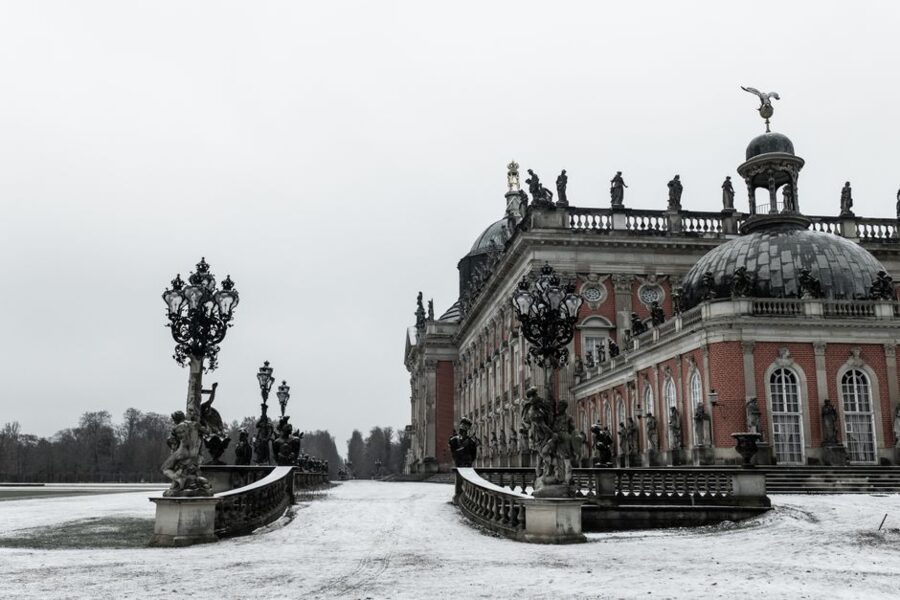
Walk up the last stretch of the avenue and the palace spreads out to both sides: a three-wing block two and a half stories high, its garden front about 220 meters long, close to 300 meters if you count the low side wings. Fluted Corinthian pilasters of sandstone run up the full height, and the roofline is a balustrade crowded with statues. Two smaller domes on the side wings carry gilded eagles.
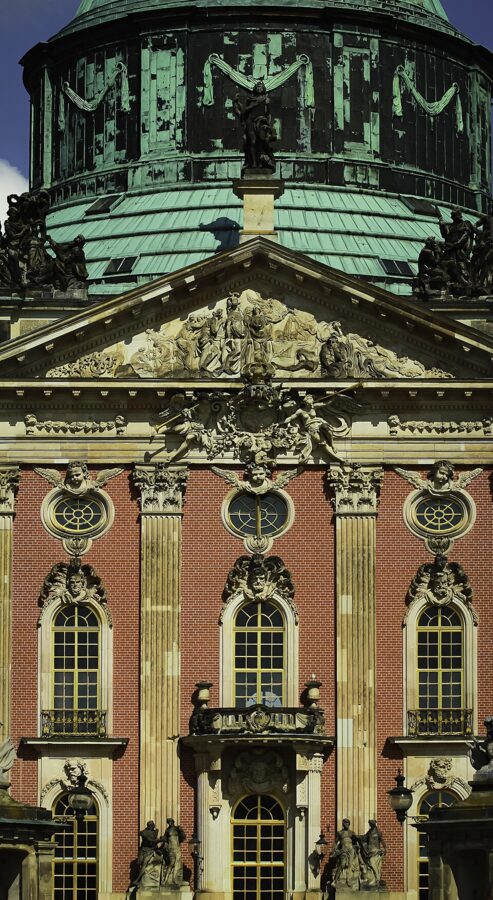
Count the figures and you will lose track, and the counts disagree. One standard tally gives 267 over-life-size statues on the main block, 196 groups of putti on the side wings, 163 more statues in front of the ground-floor pilasters and 244 carved keystones; the foundation’s own figure for the roof of the main block alone is 136. A whole team of sculptors worked on them, among them Johann Peter Benckert, Johann Matthias Gottlieb Heymüller and the brothers Johann David and Johann Lorenz Räntz. Seen from the avenue, the statues read as a crowd come out to watch you arrive.
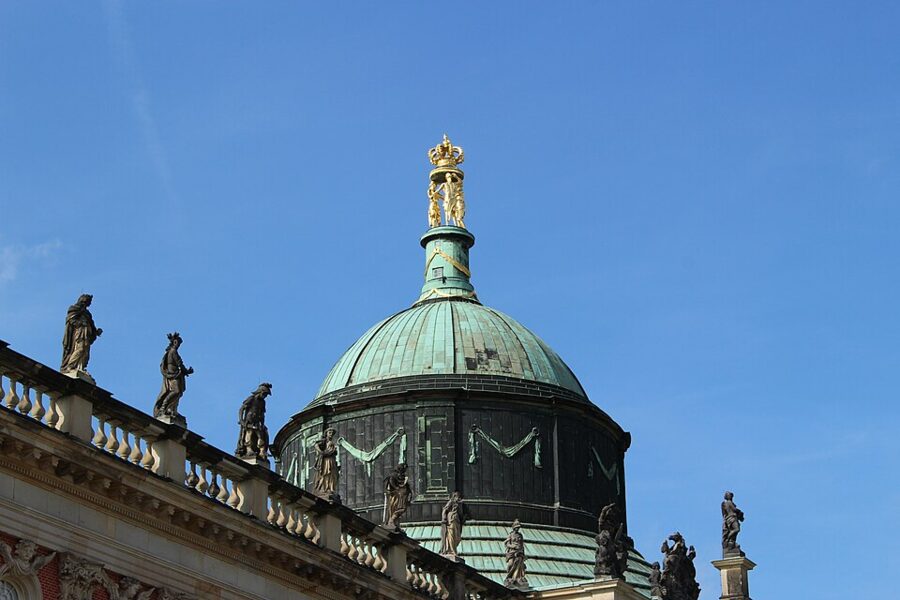
The dome is the biggest bluff of all. From outside it promises a grand domed hall; inside there is only the timber frame that holds it up. It exists to make the palace visible from far away across the park and to give the Three Graces a stage. Frederick wanted his guests to arrive for festivities, and the goddesses of splendor, cheer and celebration were the welcome.
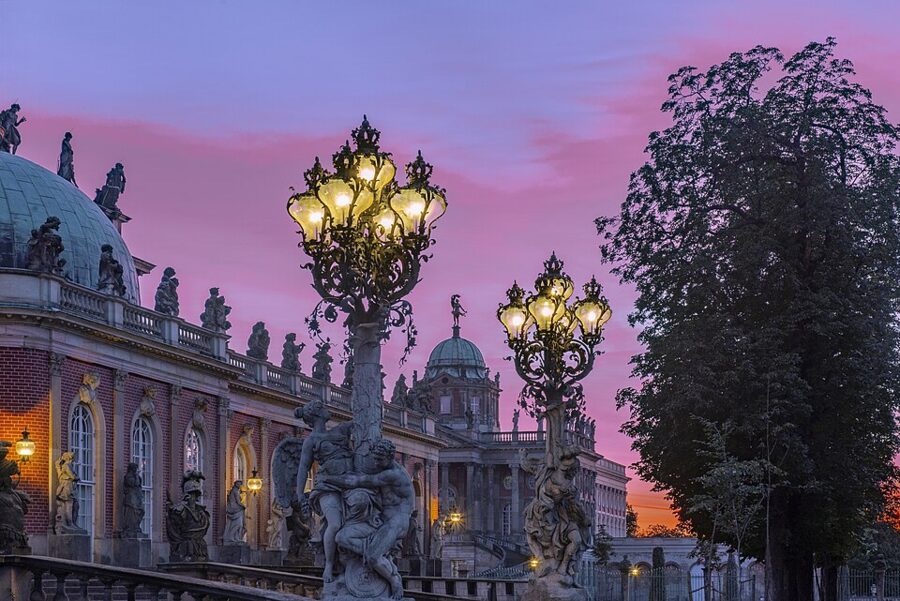
Turn to the east terrace and the balustrade is a later addition. Between 1892 and 1893 Wilhelm II had it lined with 54 sandstone sculptures after models by Walter Schott, and he contributed ideas of his own. Among them are pairs of figures carrying candelabra: Romans, Germanic warriors and two Black men.
The foundation’s research on the Black candelabra bearers on the New Palace terrace reads them against Germany’s African colonies of the time. Until 1914 the emperor inspected guards of honor here with visiting royalty.
The Communs: the kitchens dressed as palaces
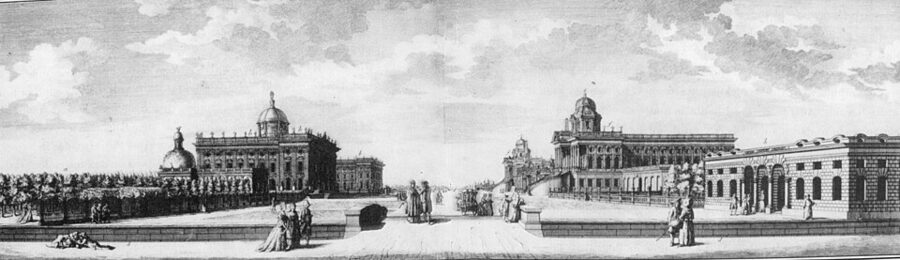
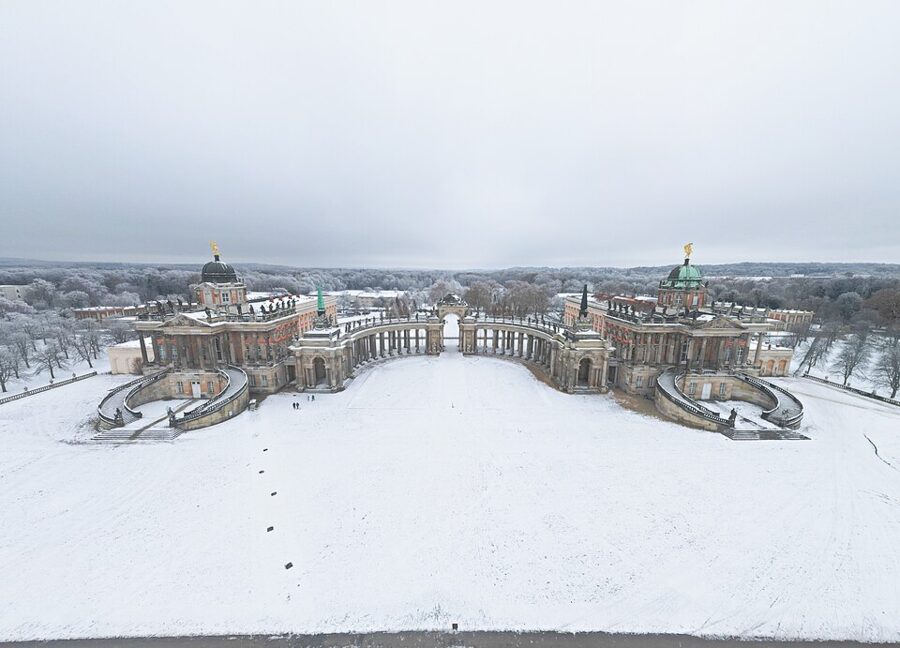
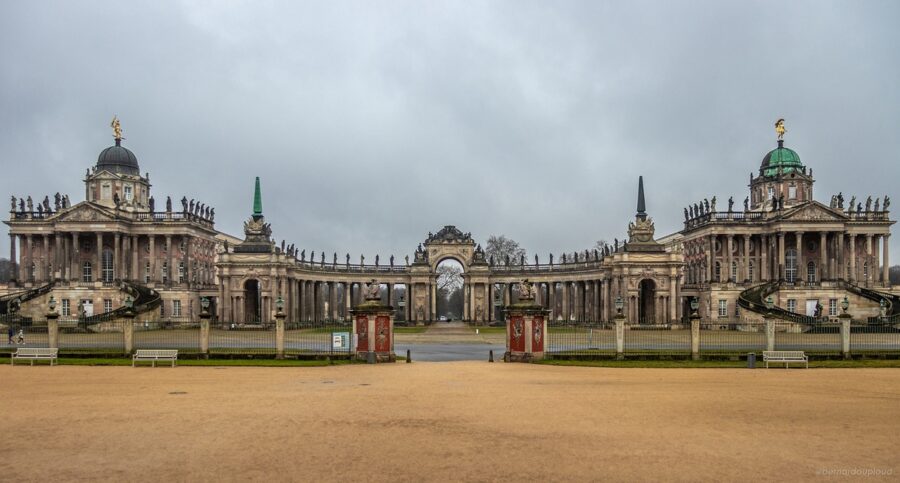
Walk through to the far side of the palace, the court of honor facing west, and you meet a second piece of theater. Across a wide square stand two domed buildings with double flights of outside stairs, porticoes and statues, joined by a curved colonnade and a triumphal gate. They look like two more palaces. They are the Communs, built from 1766 to 1769 by Gontard after designs by the French architect Jean Laurent Legeay, and named after the Grand Commun at Versailles.
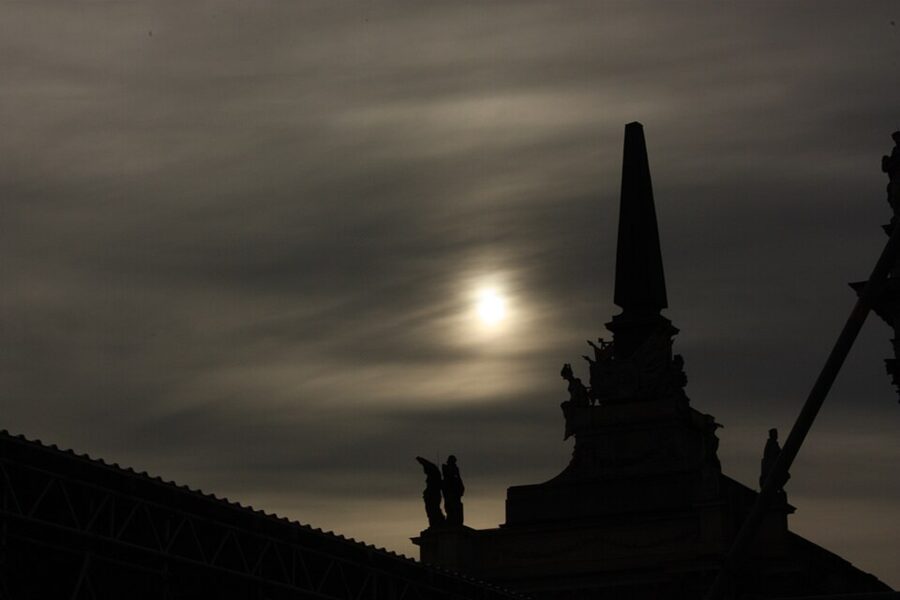
What they hid was work. The kitchens, cellars and staff quarters that every palace needs were moved out of the main building and wrapped in ceremony. They also closed the view to the west, where in Frederick’s day the land beyond was empty woodland, so that the palace faced a finished stage set rather than nothing at all. Small extra buildings for the guard in the south and the castellan in the north followed in 1769.
The square between them is called the Mopke, after its paving of bricks set on edge. The court used it for large festivities and military ceremonies, with the Communs’ stairs and porticoes serving as grandstands. In 1896 Wilhelm II had a passage dug under the Mopke to connect the palace with the pavilions opposite.
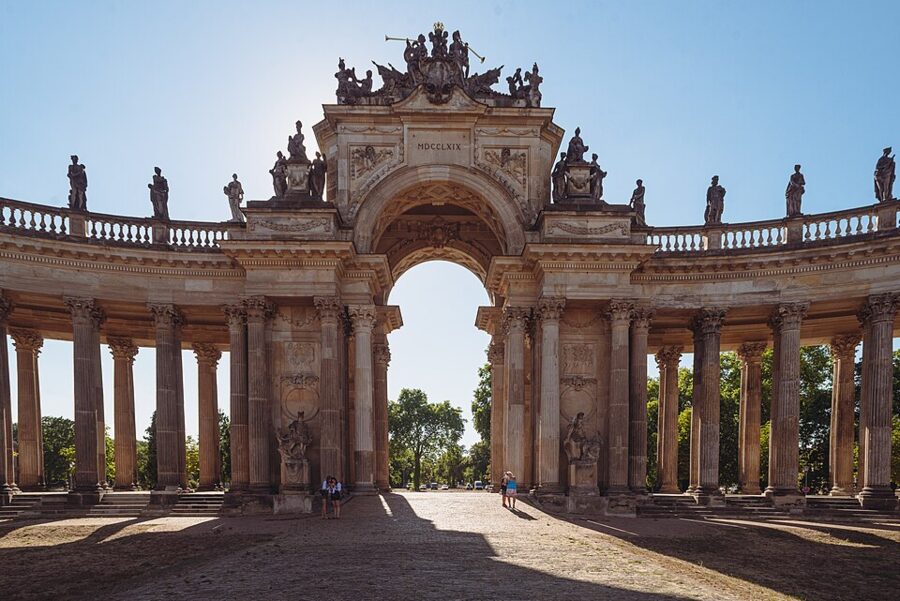
The colonnade has had a hard century. Neglect and poor repairs had already weakened it before the war; under the GDR it decayed so far that parts of the north colonnade had to be taken down in the 1980s. Emergency work began in 1982, but the full restoration, dome included, only came in 2008 to 2014. Today the University of Potsdam has its oldest campus in and around the Communs, so the people crossing the colonnade with laptops are students on their way to class.
Inside on the Grand Tour
The standard ticket is called the Grand Tour, and it covers the four festival halls in the central block and the guest apartments. From April to October you can walk it on your own or join a guided tour; from November to March it is guided only, in German, with written information in other languages. The free SANSSOUCI app has an audio tour of the New Palace in eight languages, English among them. Download it before you come, because the thick walls make Wi-Fi patchy, and bring your own headphones.
The Grotto Hall
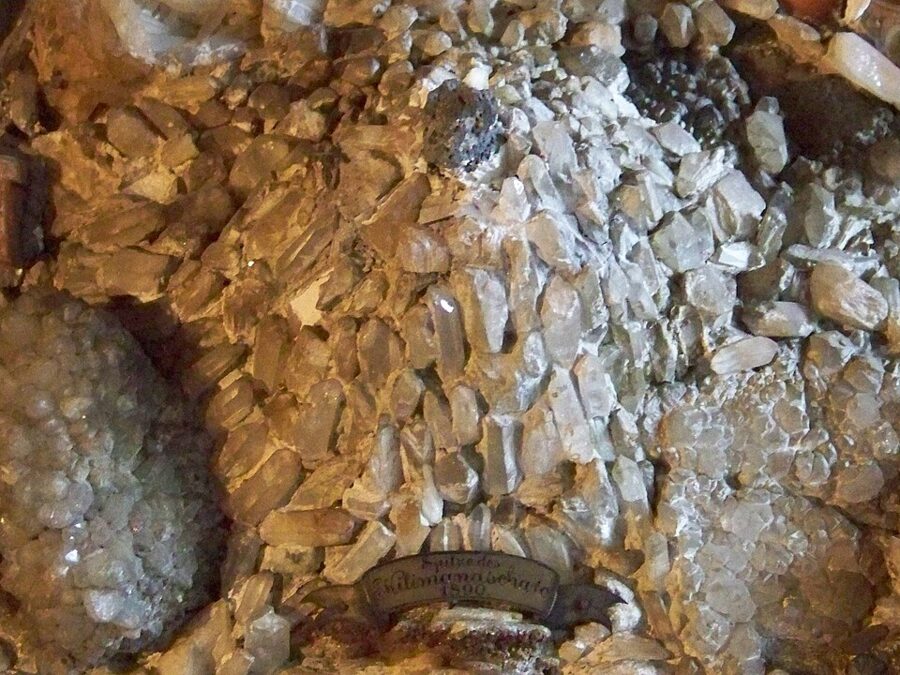
The tour starts at garden level in the Grotto Hall (Grottensaal), and it is the room people remember. Walls and piers are encrusted with shells, glass, quartz and minerals from around the world; the floor is inlaid marble with sea creatures and plants; chandeliers hang in the arches. The model was probably the grotto hall Pöppelmann built in the Dresden Zwinger in 1712 and 1713, and in the nineteenth century fossils, minerals and semi-precious stones were added to the walls.
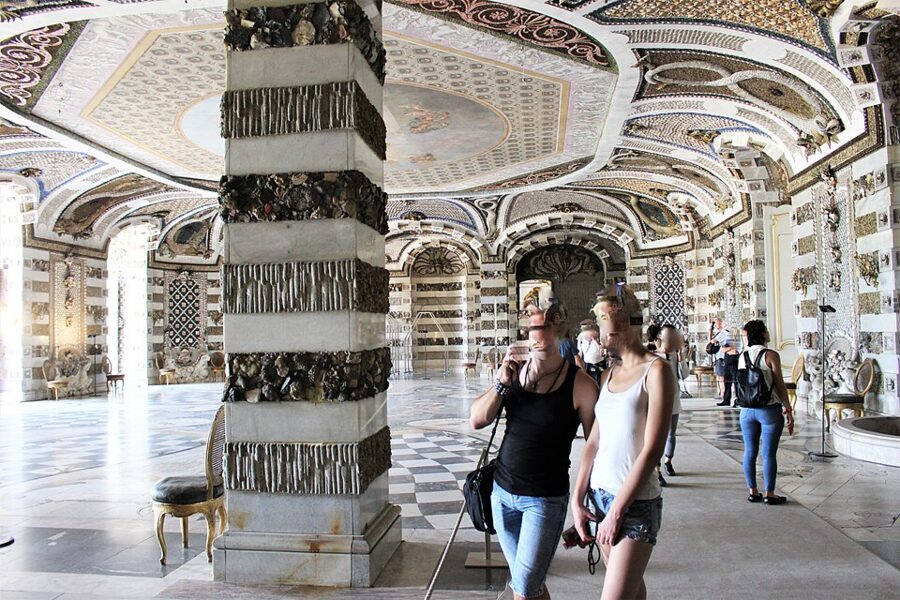
The foundation has fully restored the hall and brought it back into the tour, and when the candles were lit it must have been dazzling. Wilhelm II’s family celebrated Christmas Eve here every year from 1889 to 1917, with the chandeliers and wall lights making the crystal walls flash. His daughter, Princess Victoria Louise, called those evenings the high point of family life.
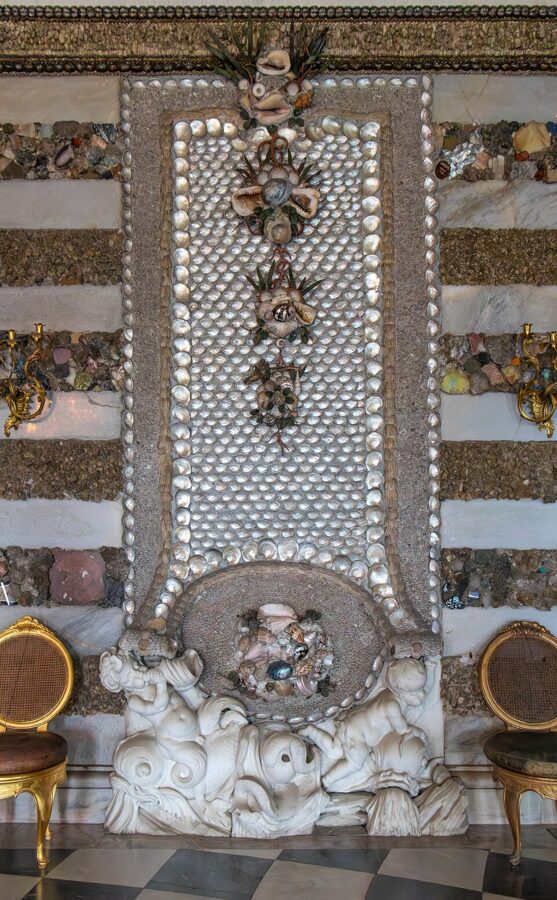
Hunt for one small stone. In 1889 the geographer Hans Meyer made the first European ascent of Kilimanjaro, broke off a piece of rock at the summit and gave it to Wilhelm II as a sign that the mountain now belonged to Germany. The emperor had it set into the Grotto Hall in 1890.
Later analysis found that the “tip of Kilimanjaro” in the wall was not summit lava at all: the original had probably been removed after the war and replaced with ordinary gravel, and in 1985 that was swapped for a rock that really did come from the Kilimanjaro massif. The foundation’s note on the so-called summit of Kilimanjaro treats it as a piece of colonial history rather than a curiosity.
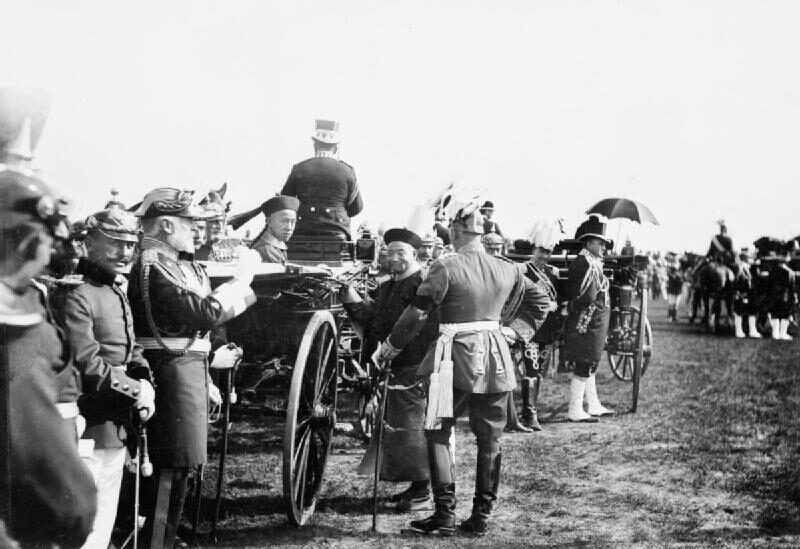
The same room staged a humiliation. On September 4, 1901, Prince Chun, brother of the Chinese emperor, came to the Grotto Hall on a mission of atonement after the killing of the German envoy during the Boxer Rising. Wilhelm II received him seated on a throne, in the uniform of the Garde du Corps with the eagle helmet, answered his statement in a loud voice, and made him leave the hall walking backwards with four bows. The foundation’s account of Prince Chun’s bow before the emperor calls it a deliberately staged humiliation.
The Marble Gallery
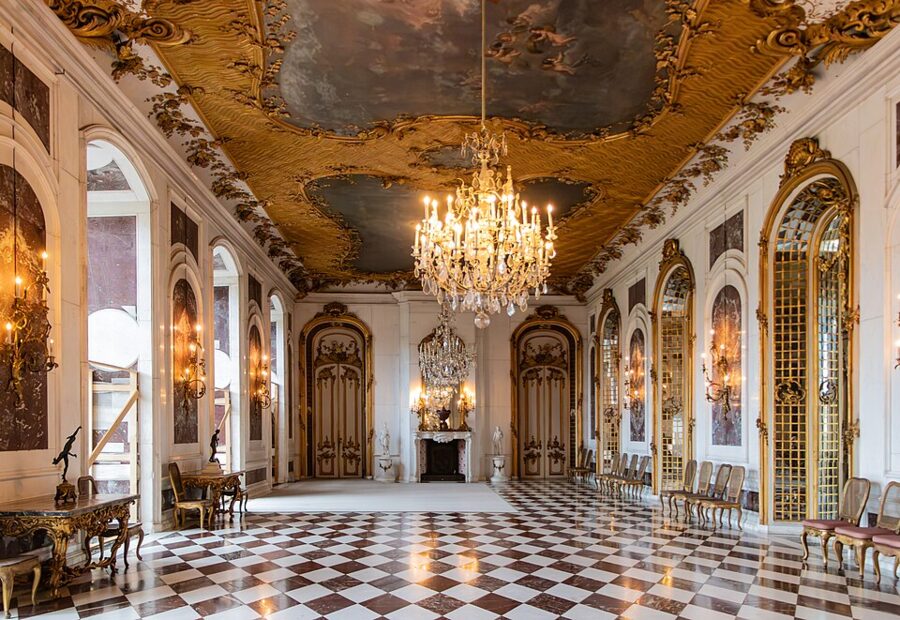
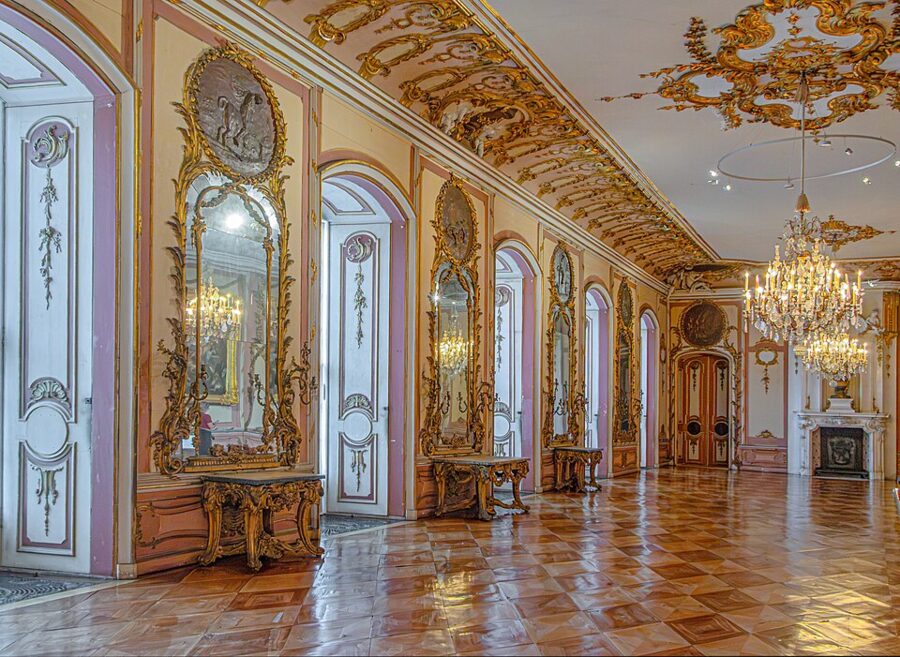
South of the Grotto Hall runs the long Marble Gallery (Marmorgalerie), which once led to the king’s rooms. Red jasper and white Carrara marble cover the walls, tall window doors let in the garden light, and the mirrors opposite double it. Overhead, three ceiling pictures by Bernhard Rode, linked by gilded ornament, run from Night through Morning to Noon, with Apollo driving the darkness away.
That date is part of the tour too. Göring, then Prussian prime minister, laid a wreath at Frederick’s tomb in the Garrison Church on the morning before and then took over the New Palace as the backdrop for his new State Council, claiming Frederick’s legacy for the Nazi state. The council had no real power, met only six times and last sat in 1936. Göring also had the six-room apartment of the Marquis d’Argens next door fitted out as a private retreat; the foundation’s account of the Marble Gallery in 1933 sets out the details.
The Marble Hall
Upstairs, directly above the Grotto Hall, the Marble Hall (Marmorsaal) rises through two floors. It was the main festival hall, ballroom and banqueting room in one, and its windows look east down the avenue toward Sanssouci. The walls and floor are faced with fine marbles, twelve marble statues stand along the walls and four huge mythological paintings, commissioned before the war, hang between them.
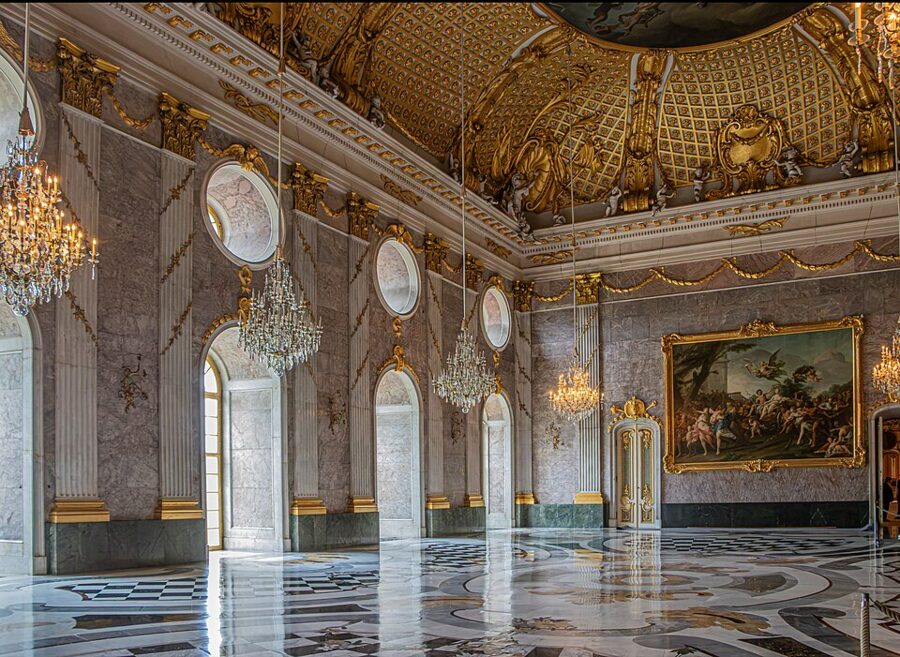
Look up. Charles Amédée Philippe van Loo’s ceiling, finished in 1769, shows the gods of Olympus gathered for a feast and the arrival of Ganymede, and at 240 square meters it is the largest canvas ceiling painting north of the Alps. A gilded iron balcony looks into the hall from the floor above. The four big wall paintings are by Jean Restout, Jean-Baptiste Marie Pierre, Charles André van Loo and Antoine Pesne, the last finished by Rode.
The floor you are standing on is the one that was polished too fast in the 1760s. The foundation has since restored it, together with the ceiling of the Grotto Hall underneath, so the two most famous rooms in the palace are once again sound. I’d stand by the east windows for a minute: the avenue runs straight to Sanssouci, and you can see exactly why the palace stands where it does.
The Upper Gallery and the Gentileschis
Next door, above the Marble Gallery, the Upper Gallery (Obere Galerie) has reopened after more than thirty years closed. The permanent display The Return of the Pictures puts five of the foundation’s six most important paintings back where Frederick had them set into the paneling in 1768. They had rarely been moved or restored since.
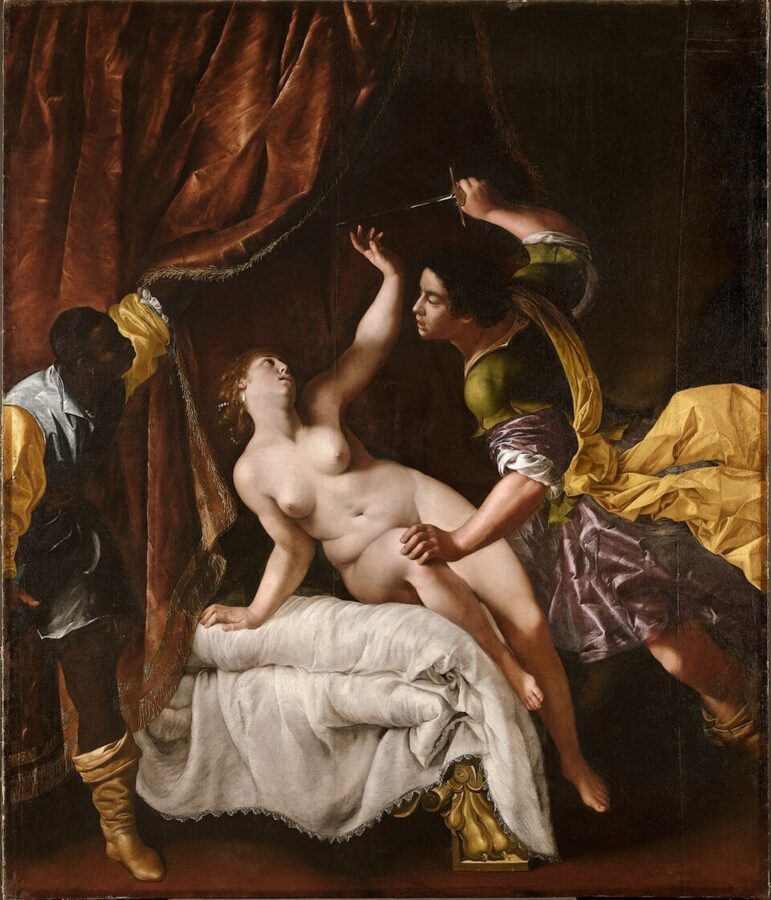
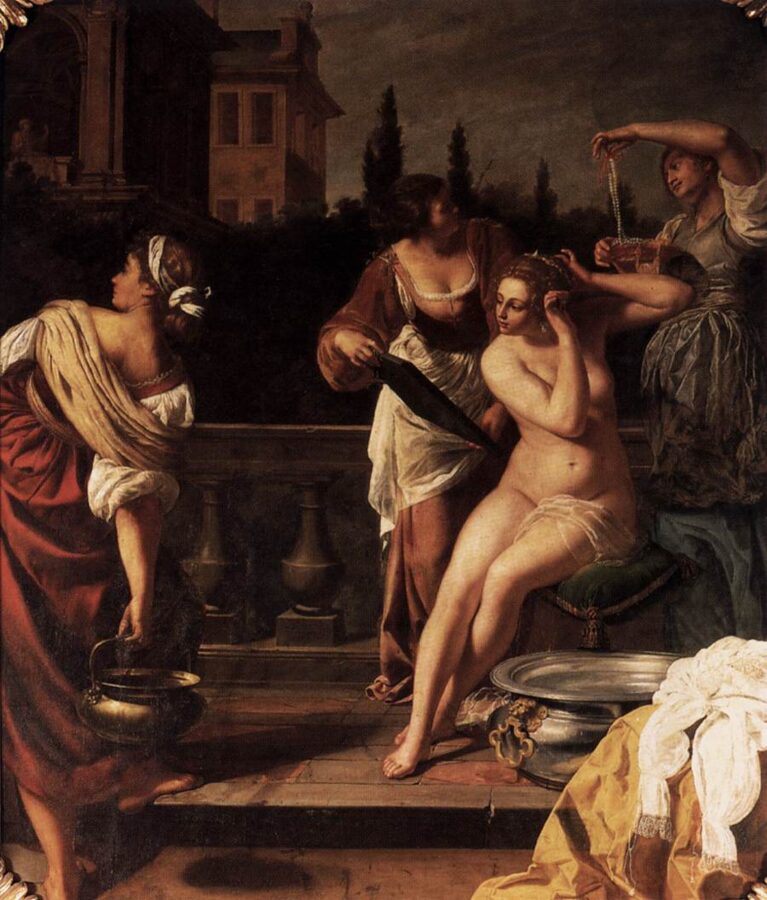
The headline is Artemisia Gentileschi. Only in the twentieth century did scholars realize that two of the gallery’s paintings, Tarquin threatening Lucretia and Bathsheba at her bath, were hers. The king probably bought them without knowing a woman had painted them. Both came originally from the Farnese collection and are among the few works by Gentileschi in Germany.
Beside them hang Guido Reni’s Death of Lucretia and Diogenes in his barrel, and Luca Giordano’s Judgment of Paris and Rape of the Sabine Women. Giordano was nicknamed “Luca fa presto” for how fast he painted, which seems right in a palace built in six years. The paintings and their original frames went through six years of restoration, paid for partly by outside backers including the Museum Barberini.
On the way through, a set of seven questions called The Other Gaze asks you to look again at the many paintings of women’s bodies you pass, from Pesne’s Girl at a Window to Pierre’s Judgment of Paris in the Marble Hall. The answers and background are in the app. It is a small intervention, and it changes how you walk the route.
The guest apartments
Around the halls lie the suites for the family members and princes who came each summer. Frederick’s brothers and sisters and their families, from courts across Germany and Europe, came for festival weeks, together with chosen members of the Berlin court. Queen Elisabeth Christine was never invited, at the king’s own wish, so his unmarried sister Anna Amalia, abbess of Quedlinburg, played hostess from her own apartment. There were rooms for the heir to the throne, for Prince Henry, and for the king’s old companion the Marquis d’Argens.
The richest of them, the Lower Royal Suite (Unteres Fürstenquartier), has been restored. Its Braided Room (Tressenzimmer), Concert Room and Oval Cabinet are, in the foundation’s words, among the most precious interiors in Europe, and I would not argue. After the marble halls the scale drops to rooms you could imagine living in, and the silk on the walls does the work the marble did next door.
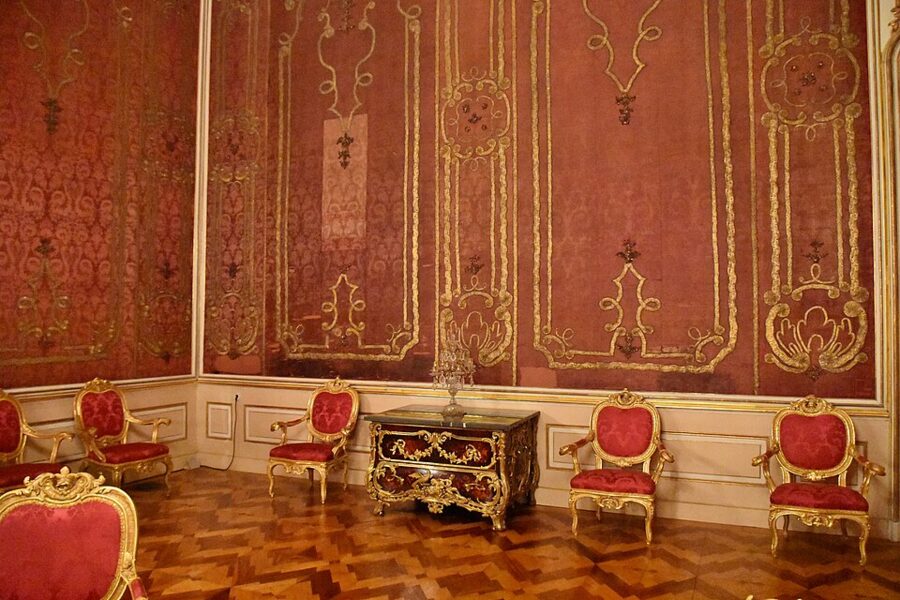
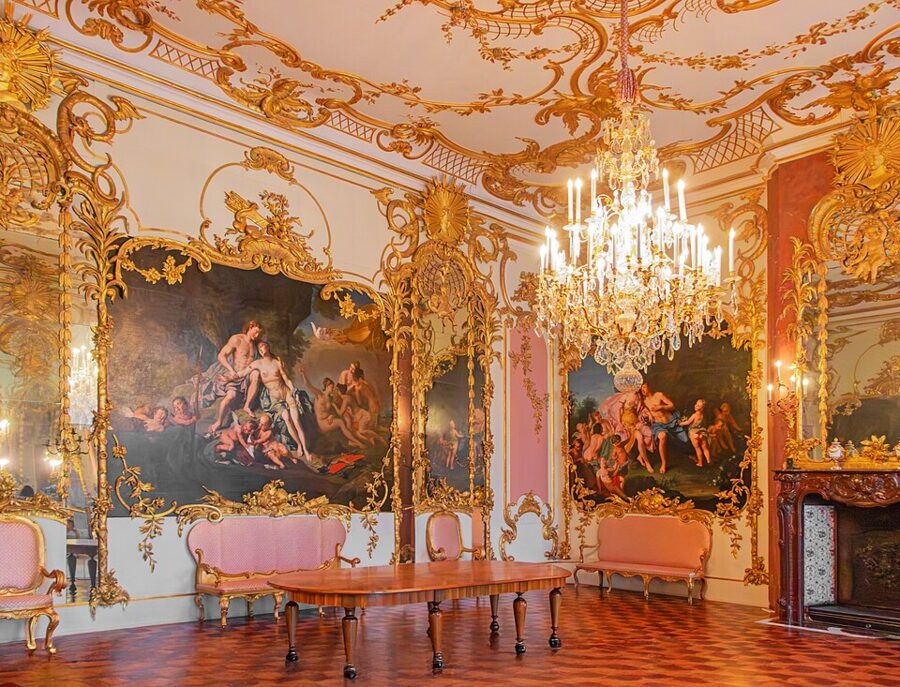
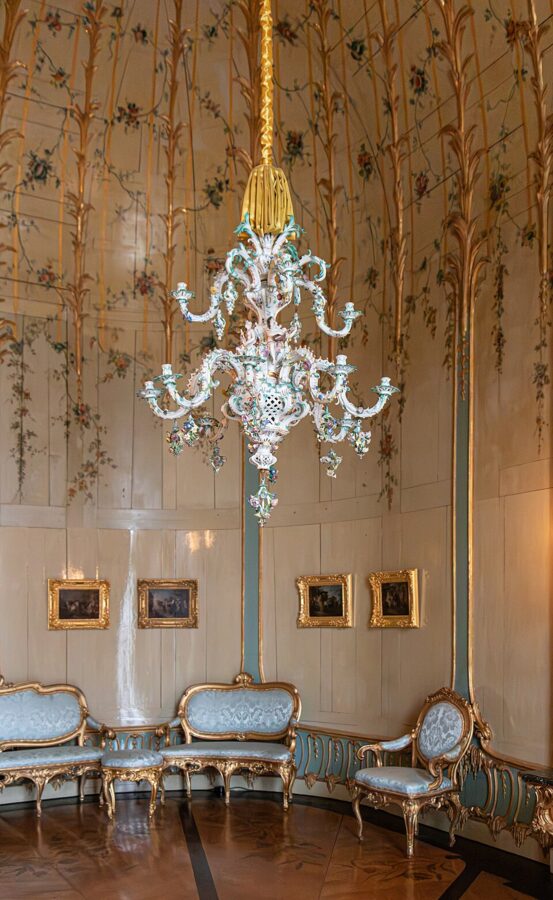
One more apartment needs its own ticket. Frederick fitted out a guest suite for his brother Prince Henry and his wife, Wilhelmine of Hesse-Kassel, with crystal chandeliers, silk wallpapers and two state beds. Prince Henry’s Apartment is shown only on guided tours in German at 13:00 and 15:00 between April and October. Henry spent his life in his brother’s shadow, and here, for once, he gets the rooms to himself.
Frederick’s rooms and the theater, both behind closed doors
The king kept his own apartment in the small south wing, the one built of real brick. Because that wing went up first, he could move in by late summer 1765, two years after the foundation stone, and he used it in July and August when his family and friendly monarchs were staying. The eleven rooms are the most luxurious he ever had made: paneling, colored stucco ceilings, precious textiles, and clocks, chests of drawers, desks and chandeliers of French rock crystal and Berlin porcelain made for these rooms.
Later generations left them alone, and only two largely authentic apartments of Frederick’s survive, at Sanssouci and here. The bad news: the King’s Apartment is closed for renovation until further notice, with no reopening date announced. Frederick rarely stayed in his own showpiece anyway; he preferred his cottage on the hill.
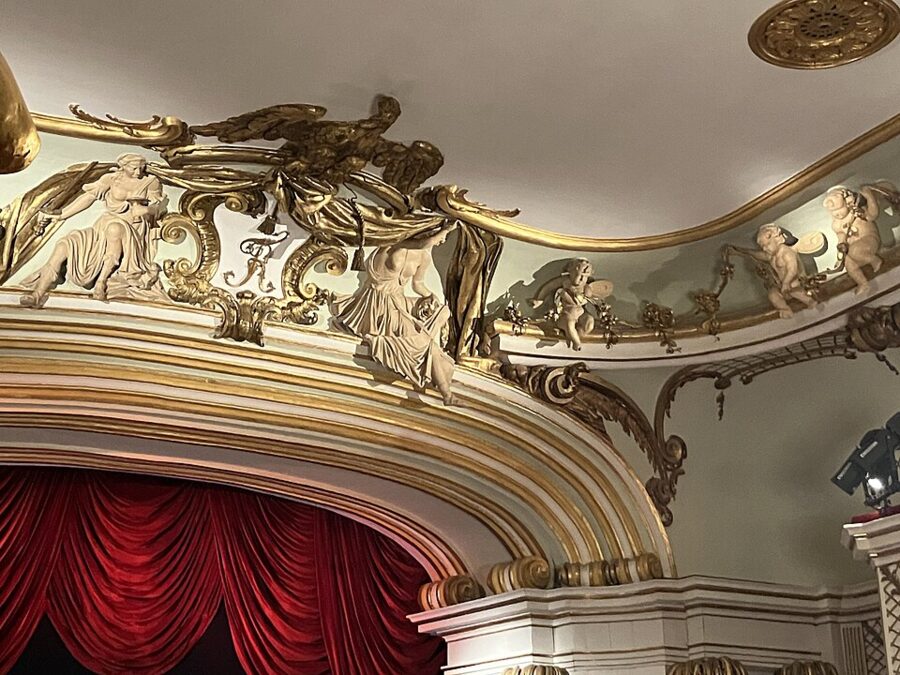
The theater fills the two upper floors of the south wing, and it ranks among the finest surviving theaters of the eighteenth century. Johann Christian Hoppenhaupt designed the interior, with gilded palm trees framing the stage. It opened on July 18, 1768, with an oratorio by Johann Adolf Hasse, and the king, who rated German art low, filled it with Italian and French performers. The original stage machinery is gone, but the room is still a working theater, not a museum piece.
It has been a long run of closures. A renovation from 2017 to 2020 cleared out harmful wood preservatives sprayed during a 1960s and 1970s overhaul and fixed serious fire-safety faults, as the foundation’s page on the theater’s return to use explains. Now it is closed again, from 2025 until summer 2027, while a new entrance and an elevator go in. The Kammerakademie Potsdam moved its winter opera to the Friedenskirche for the 2025/26 season because of the works.
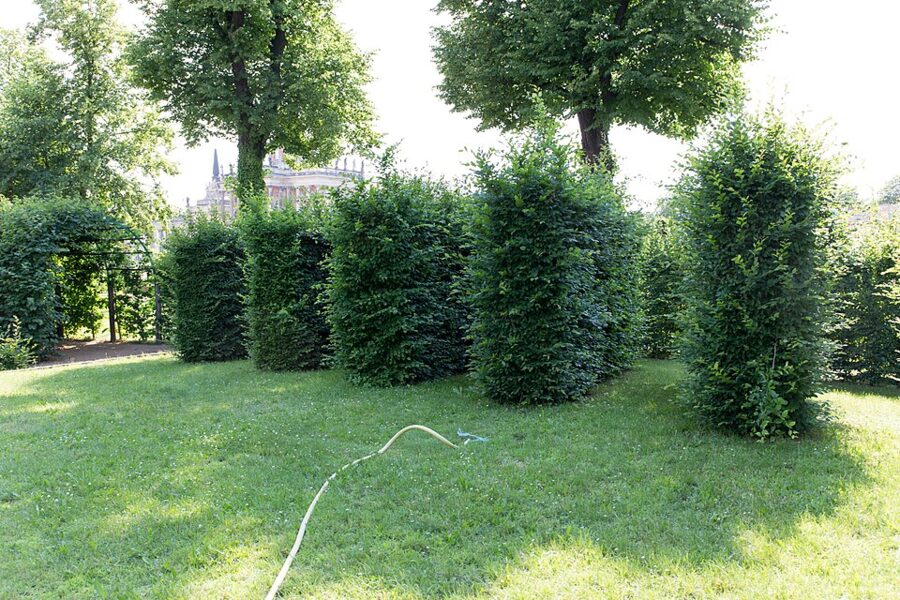
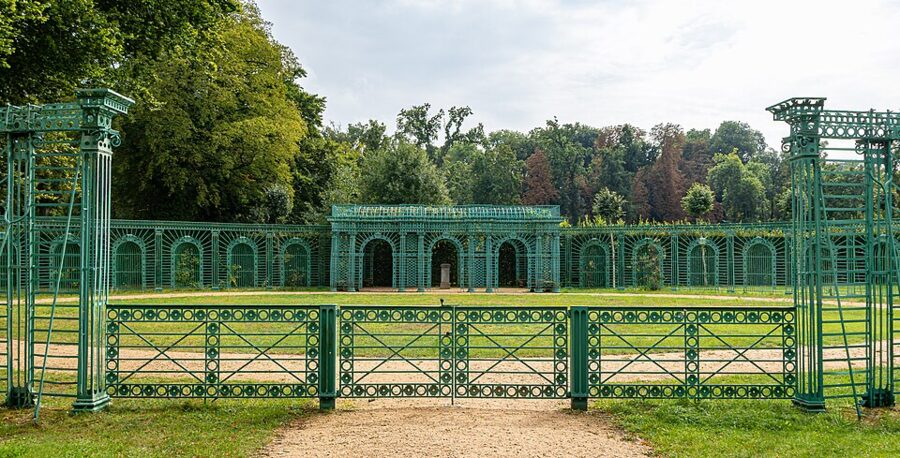
Outside, two garden features from the palace’s first years flank the building. North of it lies the hedge theater, overgrown and forgotten for a long time and now used in summer for plays, concerts and readings; to the south a garden salon with rose-covered arbors mirrors it. If the indoor theater is shut when you come, the hedge theater on a summer evening is the consolation.
The last emperor’s house
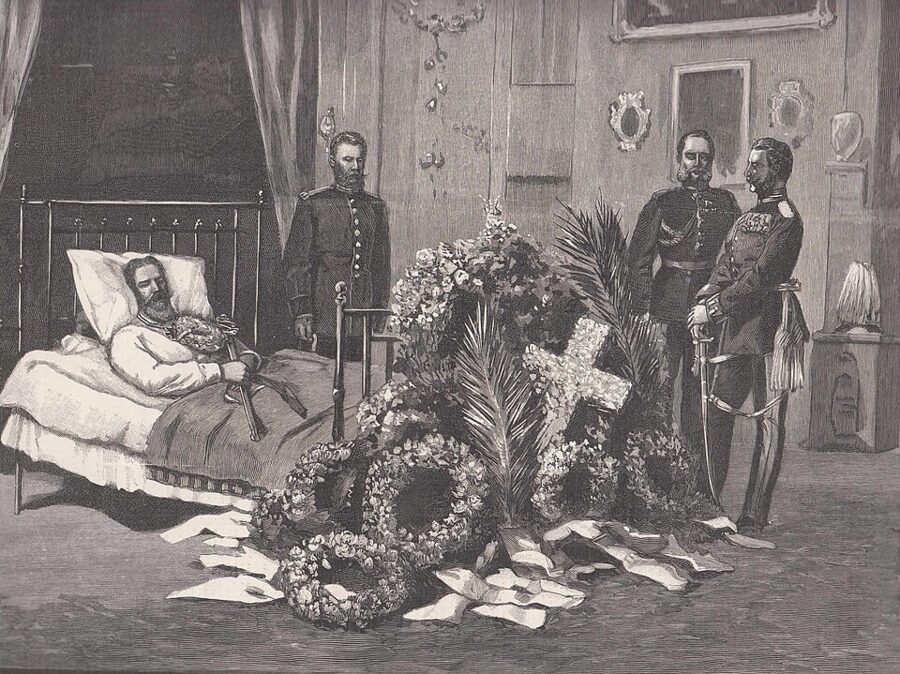
After Frederick died in 1786 the court hardly used the palace. Its second life began in 1859, when Crown Prince Frederick William and his wife Victoria, the daughter of Queen Victoria, made it their summer home. During his reign of only 99 days in 1888 it was renamed Schloss Friedrichskron, a moat around the building was filled in, and Frederick III died here on June 15, 1888.
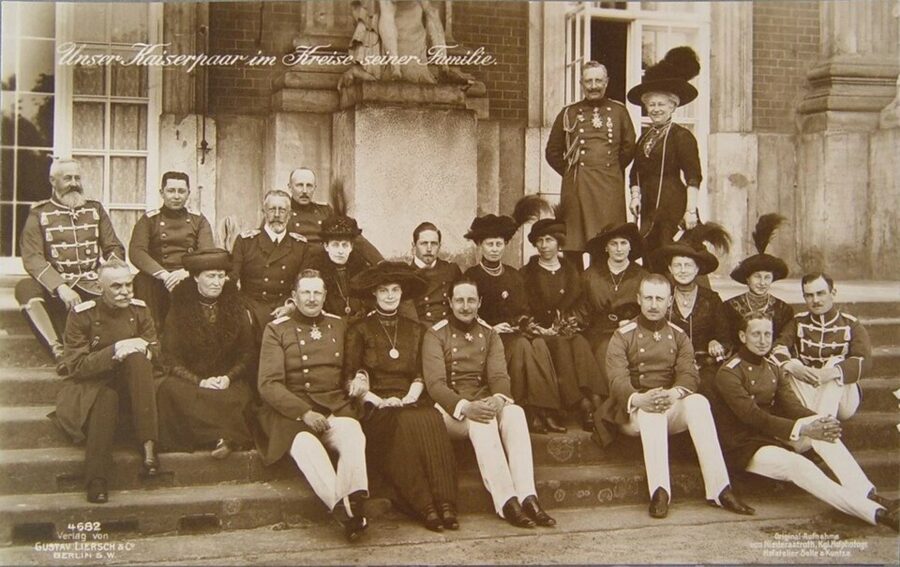
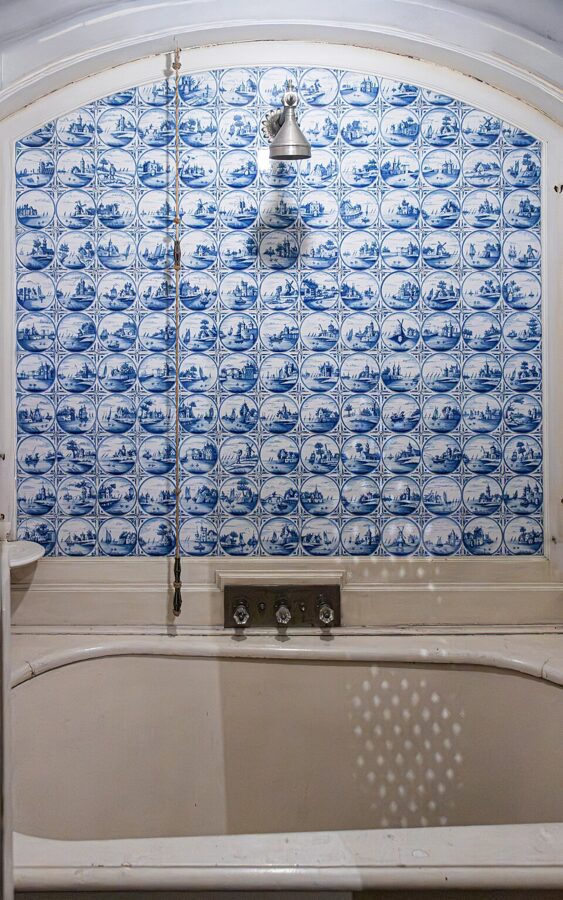
His son Wilhelm II made the New Palace his main residence from 1888 until the November Revolution of 1918, with Empress Auguste Victoria and their seven children. He was the first monarch to live here for several months a year, and he modernized hard: steam heating, electric light, bathrooms and toilets in the apartments, and in 1903 an elevator in the north staircase. While the family was away, and from early January to mid-May, the public could tour the rooms.
The foundation’s Advent tour Imperial Christmas follows this side of the house: what the rooms were used for in Advent, what was served at the Christmas dinner and what presents the couple and their children were given. It costs €16, reduced €14, starts at the visitor center, and by late November most of the 2026 weekend dates had sold out.
After Wilhelm’s abdication the palace became a museum in 1926. So much furniture had gone to the exiled emperor at Huis Doorn in the Netherlands that the imperial rooms upstairs are furnished today from elsewhere. Until the Second World War the palace was still largely fitted out in Frederick’s style; the building itself came through the bombing almost intact, but the Soviet army looted it in 1945. In the Communs opposite, the Nazi Labor Service had run a national leadership school, and one of the Communs burned out in the last days of the war.
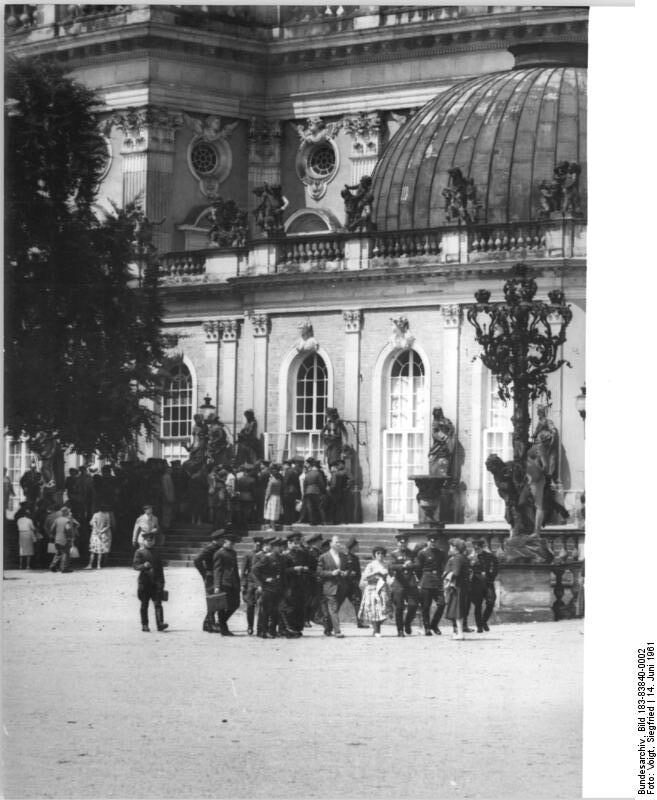
In 1967 the East German leadership planned to turn the palace into a hotel for foreign-currency guests, which would have destroyed much of the original fabric. The idea collapsed because the costs outweighed the return. In 1990 the New Palace became part of the UNESCO World Heritage Site of the palaces and parks of Potsdam and Berlin, and it is now run by the Prussian Palaces and Gardens Foundation Berlin-Brandenburg (SPSG).
The repair bill
The foundation began a full restoration of the New Palace in 2008, and you should expect to see some of it. The building’s base story, waterlogged for decades, was dried out by 2019; the sculptures around the base have been restored; the Marble Hall floor and the Grotto Hall ceiling below are done, as is the Lower Royal Suite, the theater and the roof over the theater wing. The foundation’s 2025 announcement of the next stage of works on the New Palace lists all this, and what comes next.
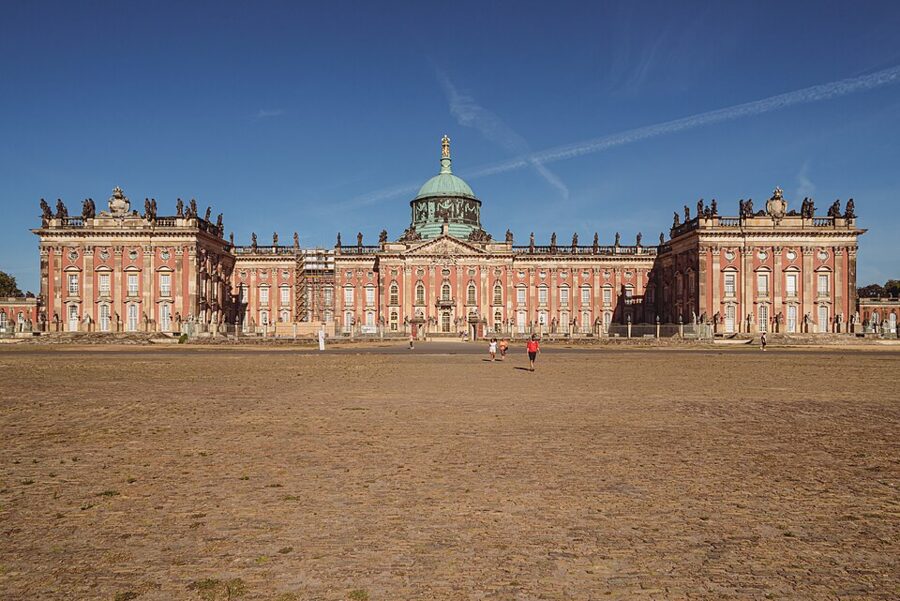
What comes next is the roof. The roof restoration is budgeted at €30.8 million and planned to run until 2029 in six phases, with the museum open throughout. It covers some 6,940 square meters of copper roofing, about 950 meters of stone cornice and balustrade, and the roof sculptures: all 136 statues on the main block, each about 3.5 meters tall and weighing up to four tonnes, come down to be restored in shelters on the Mopke, along with 64 groups of putti from the side wings.
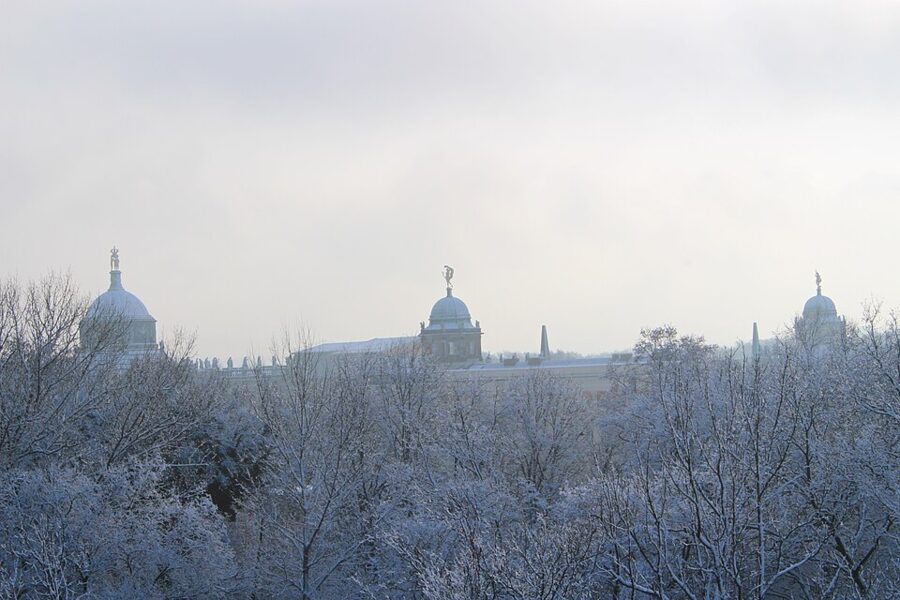
A trial scaffold in 2021 turned up a surprise. The cornice, it turned out, was built as a kind of stone lock: long stones clamp the cross stones, joints that look straight from the front run at an angle behind, with pegs, notches and poured lead holding the courses together like a ring beam. The builders of the 1760s had rushed many things, but not that. The damage came later, from rusting iron clamps and water getting in from above and below.
Inside, the Lower Red Chambers and the Marquis d’Argens apartment are being turned into a new entrance area, with lockers, information, toilets and an elevator that will finally take people who cannot manage stairs up to the first floor and into the theater. Dry rot was found in three of the rooms. The work costs about €8.5 million and is due to finish in 2027.
The deputy director’s line from 2025 sums it up: when restoring a palace takes far longer than building it did, you need patience and reliable partners. Bring patience too. A palace under scaffolding is still a palace, and some of the rooms you can now see were shut for a generation.
Tickets, hours and timed entry
Entry to the New Palace runs on fixed time slots, and the number of tickets per day is limited. The Grand Tour on its own is sold only on the day; the one way to fix a slot in advance is to book the Sanssouci+ ticket online and add a New Palace time, worth doing in summer and at weekends. Same-day tickets are sold at the two visitor centers, at the Historic Mill (Historische Mühle) near Sanssouci Palace and at the New Palace itself. For every combination, see Sanssouci tickets.
| Ticket | 2026 | 2027 |
|---|---|---|
| Grand Tour (four halls and guest apartments) | €14, reduced €10 | €16, reduced €12 |
| Prince Henry’s Apartment (guided, April–October) | €8, reduced €6 | €9, reduced €6 |
| Grand Tour and Prince Henry combined (April–October) | €16, reduced €14 | €20, reduced €16 |
| Sanssouci+ (all open SPSG palaces in Potsdam, one day) | €22, reduced €17 | €24, reduced €20 |
The Sanssouci+ ticket books a fixed slot at Sanssouci Palace and, if you want it, a second slot here, and it gets you the reduced rate at the Belvedere on the Pfingstberg. If you are going inside Sanssouci Palace as well, take it. If the New Palace is your only interior, buy the Grand Tour on its own.
The opening times on the New Palace’s official page follow the season, with last admission 30 minutes before closing:
- April–October: Tuesday to Sunday 10:00–17:30, closed Mondays.
- November and December: Wednesday to Monday 10:00–16:30, closed Tuesdays.
- January–March: Tuesday to Sunday 10:00–16:30, closed Mondays.
Over the holidays in 2026 the palace is closed on December 24 and 25, open on December 26 and for an extra Tuesday opening on December 29, open 10:00–14:30 on December 31 and 11:00–16:30 on January 1, 2027. On other public holidays the weekend hours apply. From November to March every visit is a guided tour in German, so if you need English, come in the summer season or use the app alongside the guide.
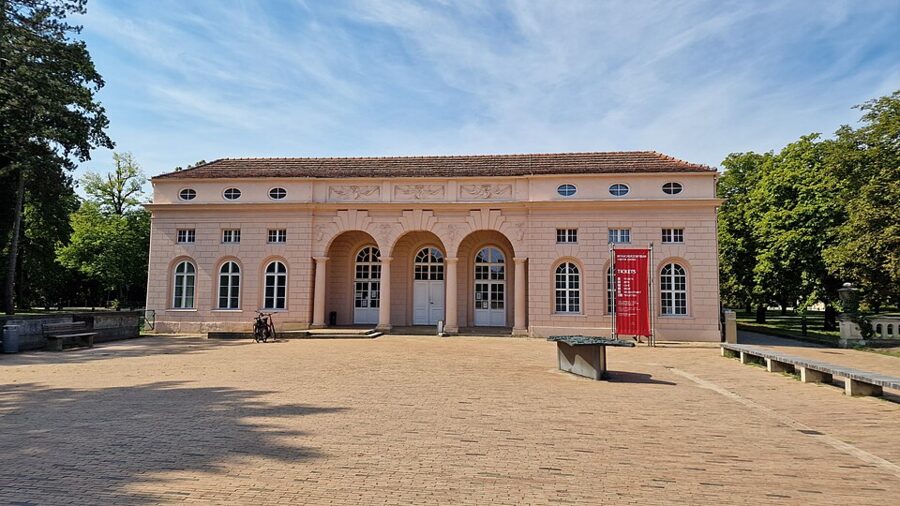
The visitor center Neues Palais sits in the former guardhouse that Gontard built in 1768 and 1769 at the south gate, together with a later imperial building office; it opened as the visitor center in 2013. It has the ticket desk, a large museum shop, lockers, toilets and Café Caroline for coffee and snacks. The visitor center is closed on Tuesdays all year, so on a summer Tuesday buy your ticket at the Historic Mill or book Sanssouci+ online. Lockers in the palace take only small bags up to 35 by 35 by 50 cm, strollers are not allowed in the rooms, and the ground floor is reachable by wheelchair via a ramp.
How long to allow? I’d give the Grand Tour an unhurried hour and a half, add the 45-minute Prince Henry tour in summer, and leave time to walk around to the Communs, which many people skip. With the walk along the avenue from Sanssouci, the New Palace is a solid half day. If you have a single day and want to fit in more, the full list of things to do in Potsdam and the guide to Potsdam’s palaces help you choose.
Getting there, and the walk down the avenue
From central Berlin, take the S-Bahn S7 or a regional RE1 train to Potsdam Hauptbahnhof, the main station; the day trip from Berlin covers the options. You need a single ticket Berlin ABC, €5.00 in 2026, or a 24-hour ticket for €12.90; from January 1, 2027, they cost €5.20 and €13.20. The Deutschlandticket is valid on all of it.
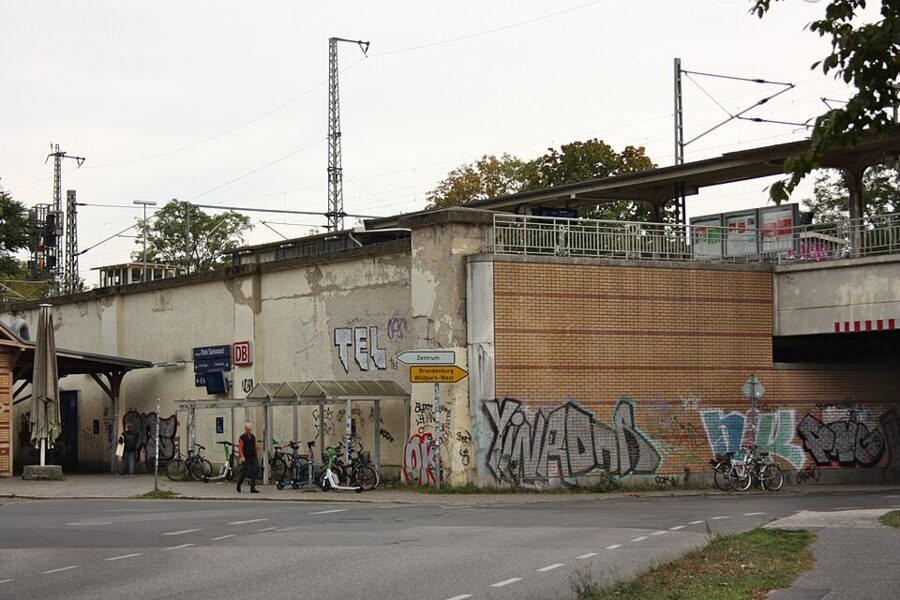
From the main station, bus 605 runs every 20 minutes to the stop “Neues Palais” in about 16 minutes. Quicker on the rails: the regional RB21 and RB22 run two stops from Potsdam Hauptbahnhof to Potsdam Park Sanssouci station in about six minutes, and from there it is a walk of about seven minutes north to the palace and the visitor center. Drivers can use the paid car park P3 Am Neuen Palais.
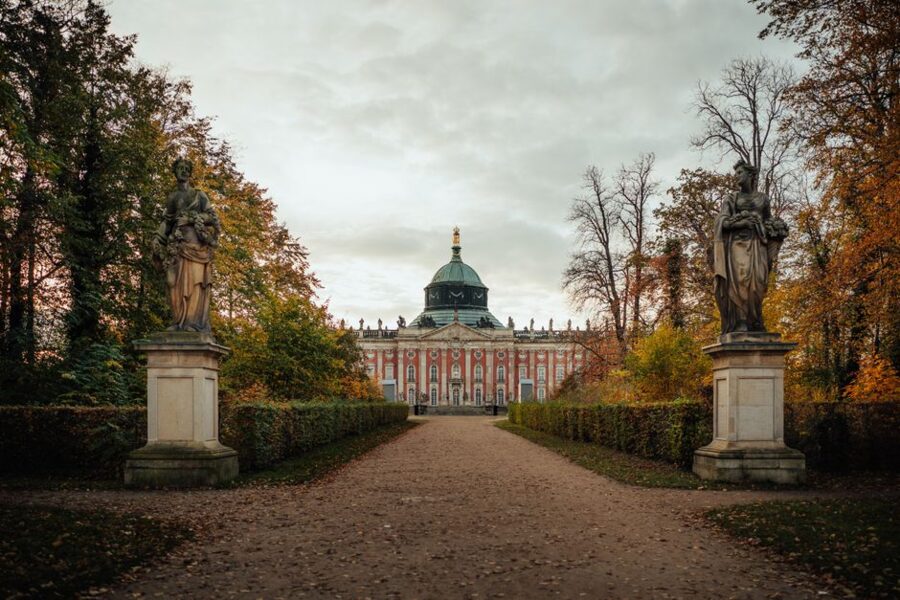
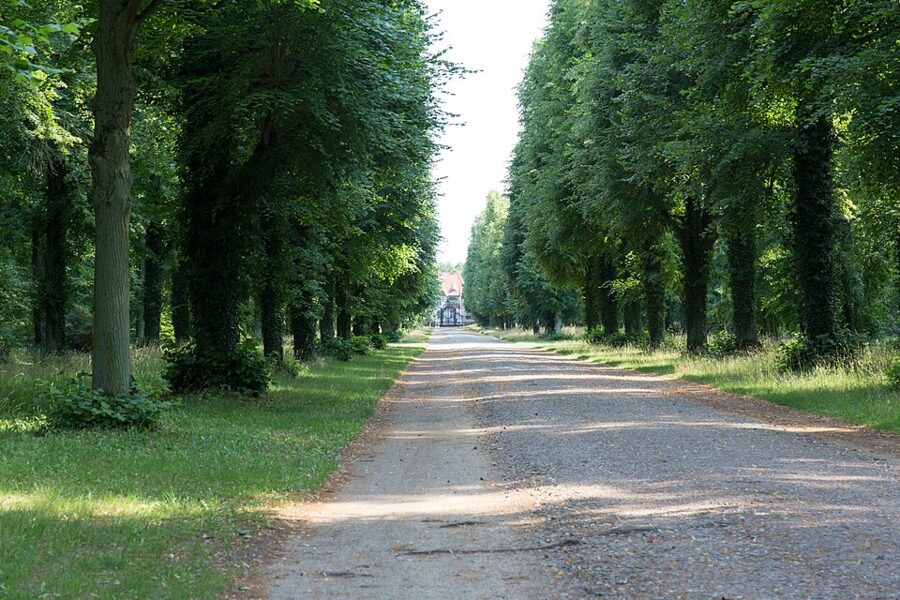
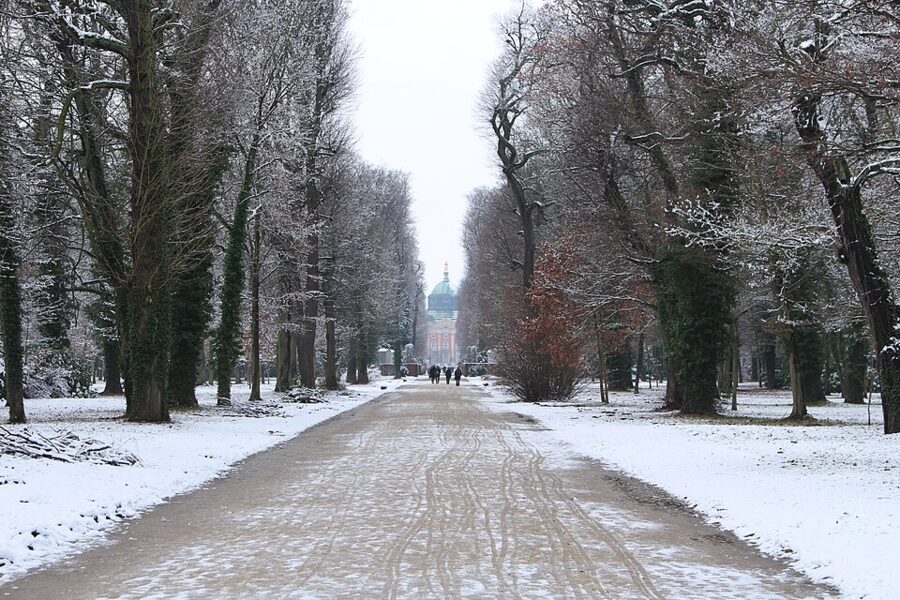
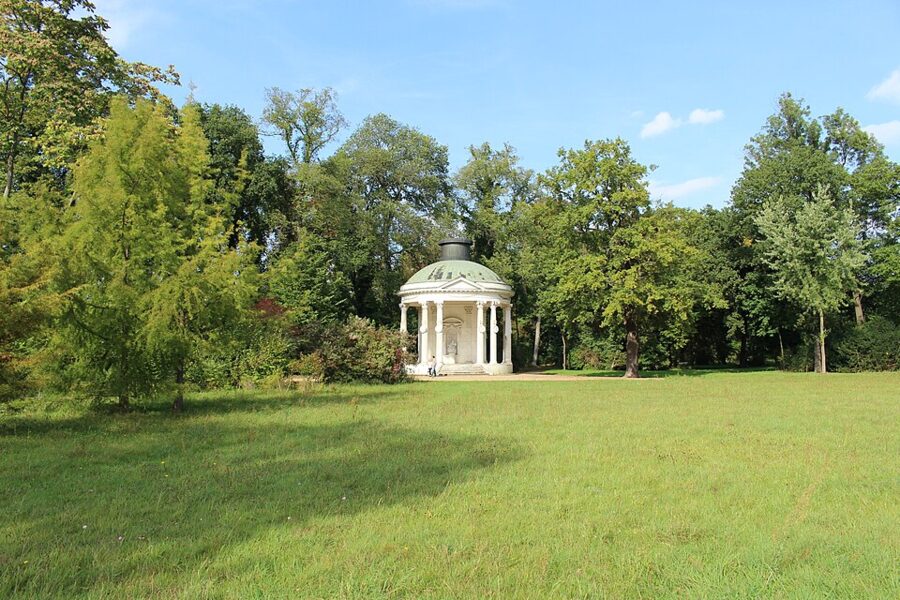
The better way, if you are already at Sanssouci, is on foot. The main avenue (Hauptallee) has linked the two palaces since 1769, running dead straight west from the fountain below Sanssouci’s terraces for about 2 km. It passes the turn south to Charlottenhof Palace on the way, and near the end Gontard’s Temple of Friendship and Antique Temple stand on either side, just east of the palace’s outer wings. Walk it in this direction, toward the dome, and you see the palace the way its first guests were meant to.
Walk back around the palace to the Communs before you leave. The University of Potsdam, founded in 1991 as successor to an East German teacher-training college that had moved in here in 1948, keeps its president’s office and administration and its Faculty of Philosophy in the buildings Frederick put up for his cooks and lackeys. The old imperial stables and riding hall of 1894 next door now hold the main lecture hall. It is a fine joke at the expense of the original plan: the service wing turned into the brains of the place.
For lunch, Café Caroline in the visitor center is the nearest option; for a proper meal, the guide to Potsdam restaurants has more choice, and if a day is not enough, see where to stay in Potsdam. Then take the 605 back from the Neues Palais stop, and look up as it pulls away. The Three Graces are still holding up that crown over a hall that is not there, and the brick behind them is still paint. Frederick’s brag has held for more than 250 years, scaffolding and all.