

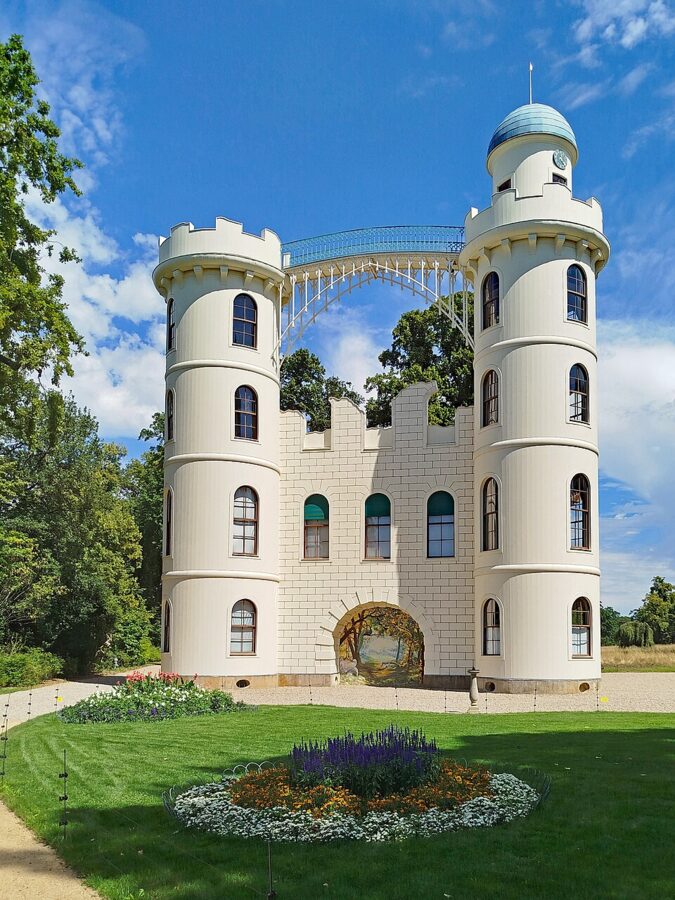
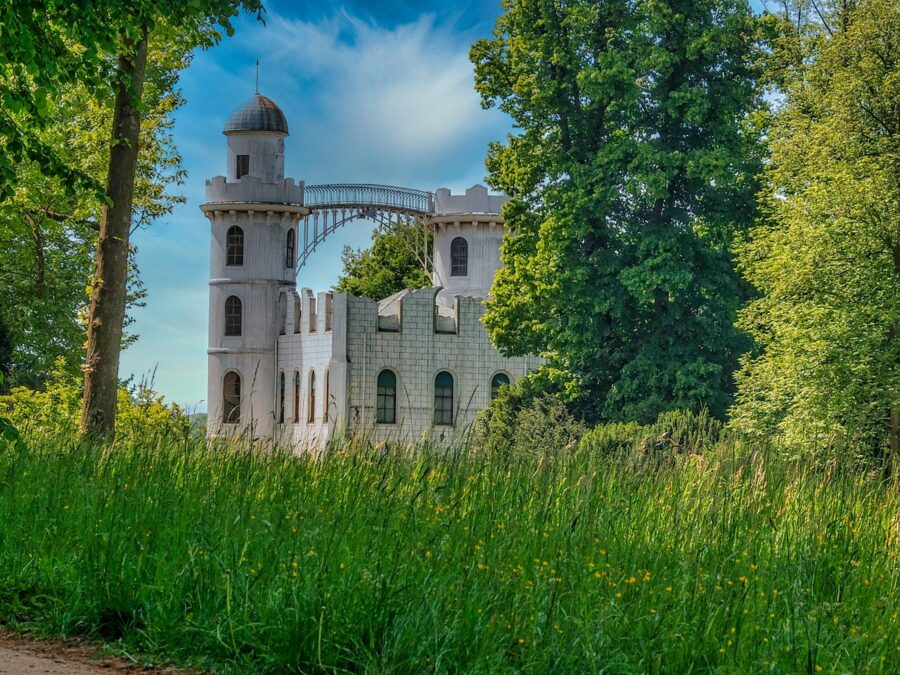
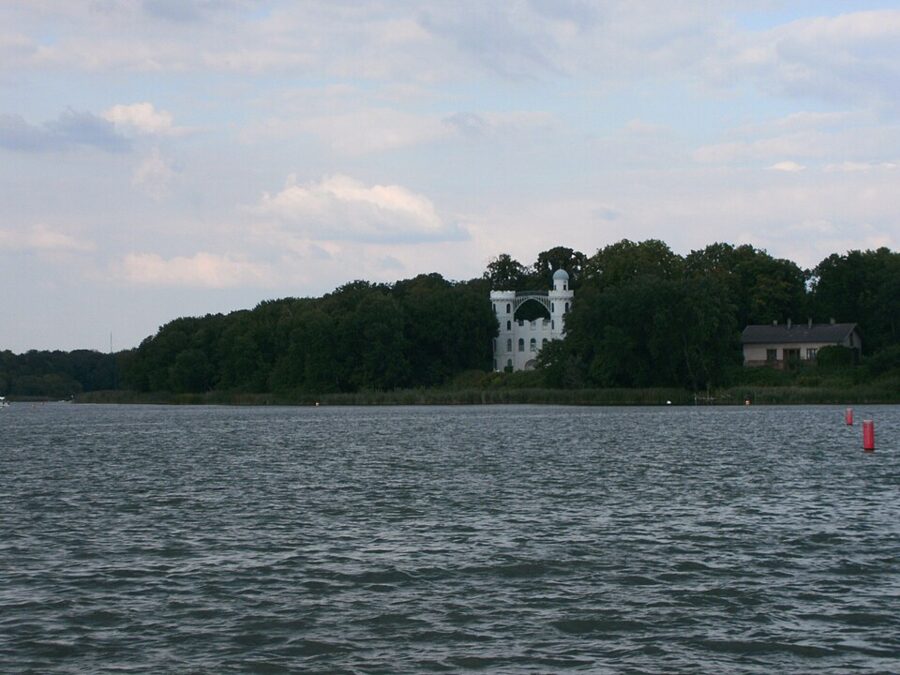
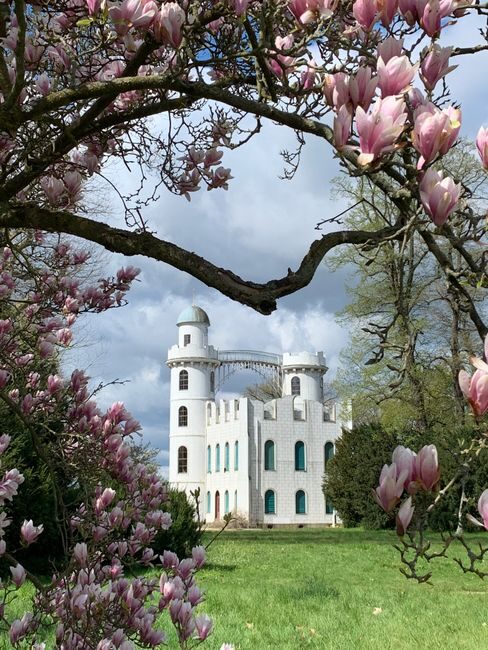
Come up the Havel on the boat from Wannsee and the first thing Peacock Island shows you is a white castle at its western tip: two towers, battlements, a bridge strung between them and a gateway that seems to open onto a sunny valley. None of it is what it claims to be. The walls are wooden planks over a timber frame, the stone blocks are painted on, the valley is a picture, and the whole ruin was new in 1797, built for a king and the woman he never stopped loving.

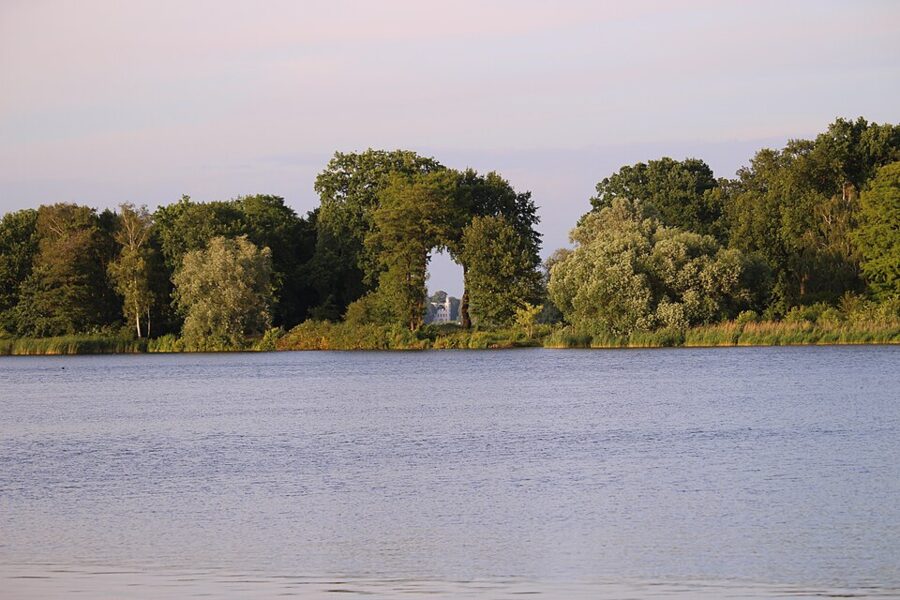
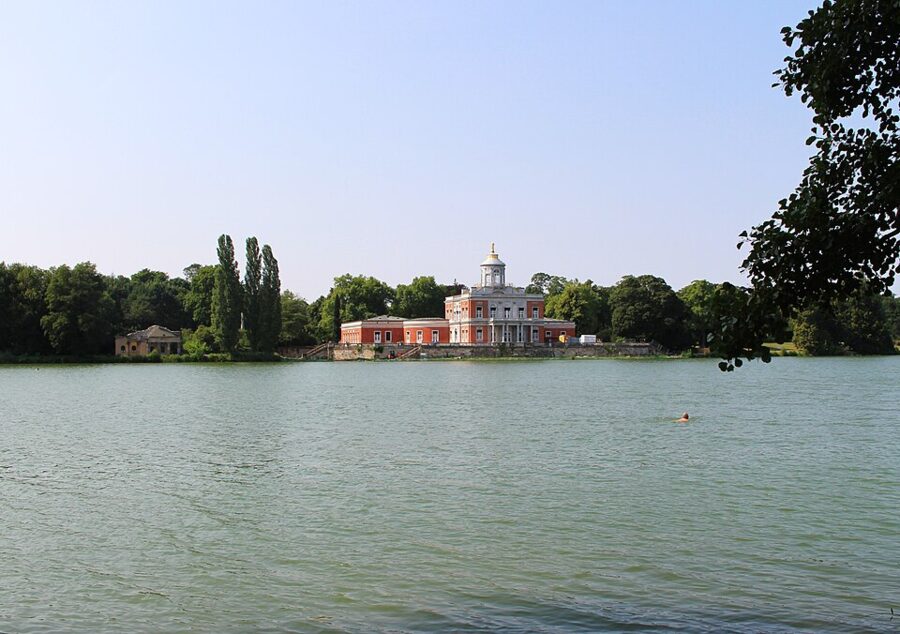
That castle is why Peacock Island (Pfaueninsel) looks the way it does, and why it belongs to Potsdam’s palace landscape although it lies inside Berlin. Frederick William II (Friedrich Wilhelm II) placed it so he could see it from his Marble Palace in the Neuer Garten, a few kilometers up the water. His successors added a farm dressed as a monastery, a Gothic house front shipped from Danzig, a temple to a dead queen, a glass palace for palms and a zoo. Then they gave the animals away, all except the peacocks.

Today the island is 67 hectares of oak meadow, lawn and reed bed, about 1.5 km long, with no visitors’ cars, no bikes and no dogs. The Prussian Palaces and Gardens Foundation (Stiftung Preußische Schlösser und Gärten, SPSG) runs it, and it has been part of the World Heritage site of the Palaces and Parks of Potsdam and Berlin since 1990. The loop of the shore is about 4 km, but allow an afternoon: every bend in the path was laid out to show you something.

Contents8 parts
- A castle painted to look like a ruin
- Before the king: rabbits and an alchemist
- The Dairy, the farm and the fake monastery
- Frederick William III, Queen Luise and Lenné
- The menagerie, the zoo and the peacocks that stayed
- Walking the island
- The ferry, the rules and the seasons
- Getting there from Berlin and Potsdam
A castle painted to look like a ruin
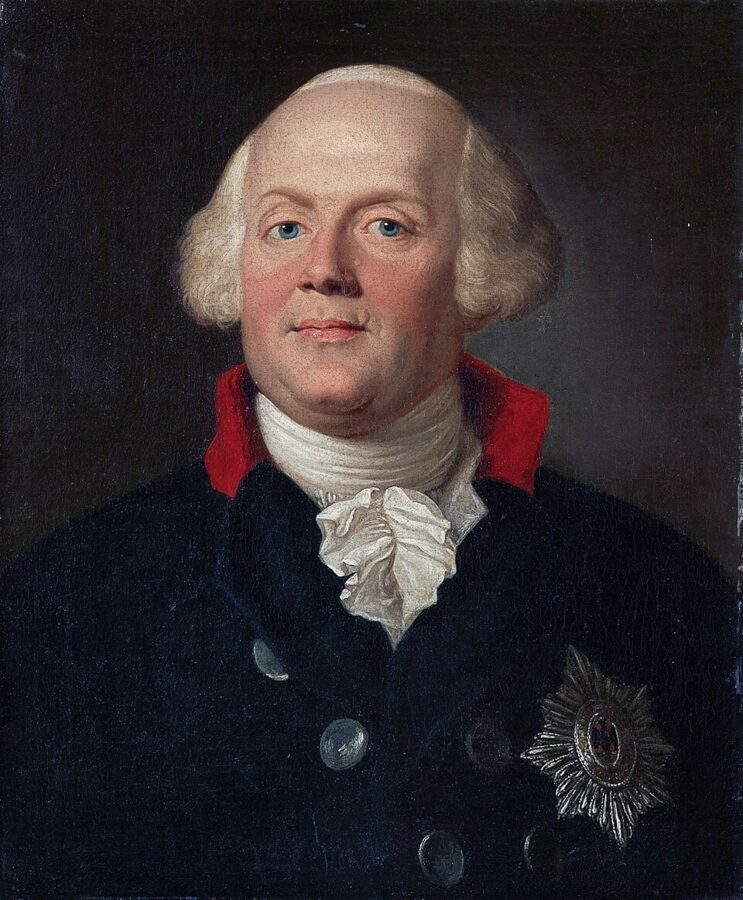
Frederick William II had known the island since he was crown prince. In the 1760s he had himself rowed out to its overgrown shore with Wilhelmine Enke, the daughter of a horn player in the court orchestra. Their affair outlasted two dynastic marriages, and in 1796 he made her Countess Lichtenau.
When he decided to extend his new garden on the Heiliger See in Potsdam, he chose the island he could see from there rather than the fields next door. A cabinet order of November 12, 1793, took the Kaninchenwerder (rabbit island) from the Potsdam military orphanage that owned it, and work began in the spring of 1794. The brief: a small private house for resting after a boat trip and staying the night, built of Prussian timber.
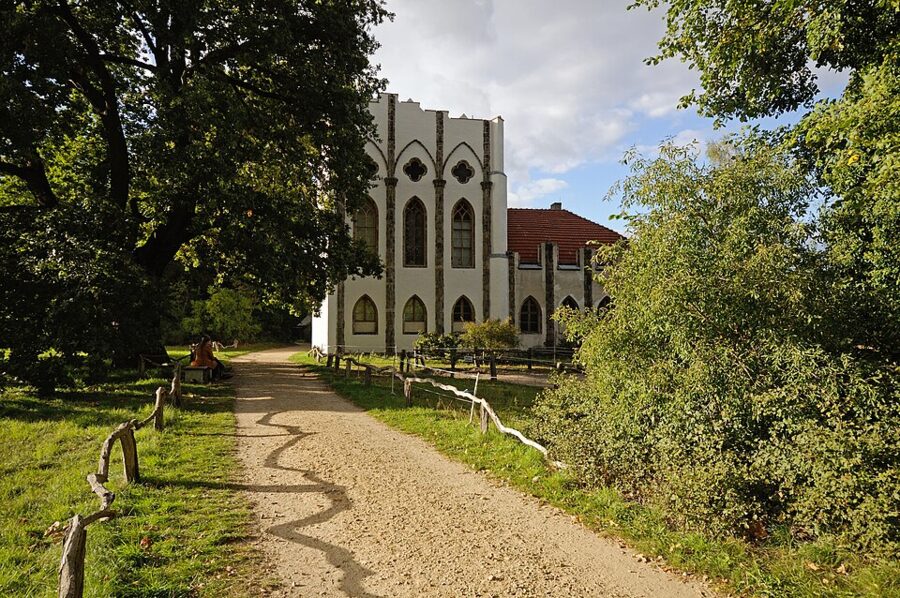
What went up between 1794 and 1797 is a two-story block with a hint of a third, two round towers and a bridge between them, boarded over and painted white with false masonry joints. The court carpenter Johann Gottlieb Brendel built it. Who designed it is less clear: one line of the literature credits the architect Michael Philipp Boumann, another says no architect was hired and Brendel worked straight from the king’s ideas.
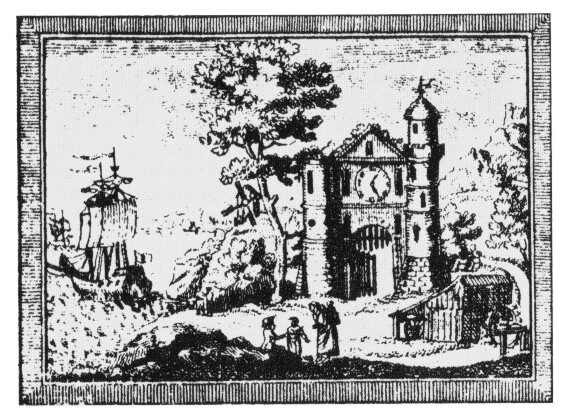
Two clues survive. A magazine of the period sold “English tableaux,” framed pictures with a clock set into them, and one showed a building strikingly like the island palace; the royal library also held a view of Capri with a similar ruin. Wilhelmine helped plan the house and chose most of its furnishings.
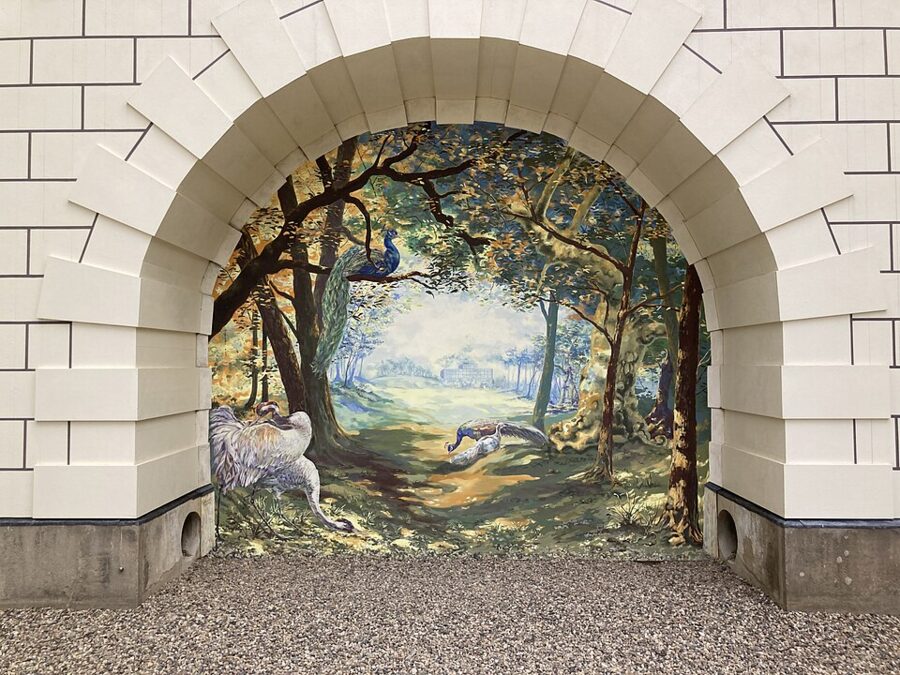
The ruin was never meant to fool anyone into thinking it was old. Contemporaries called it a “ruined Roman country house,” and it was a working house in costume, a set piece in a staged landscape. Walk around to the west front, the side aimed at the Marble Palace, and the gateway between the towers turns out to be painted shut, with a landscape inside the arch.

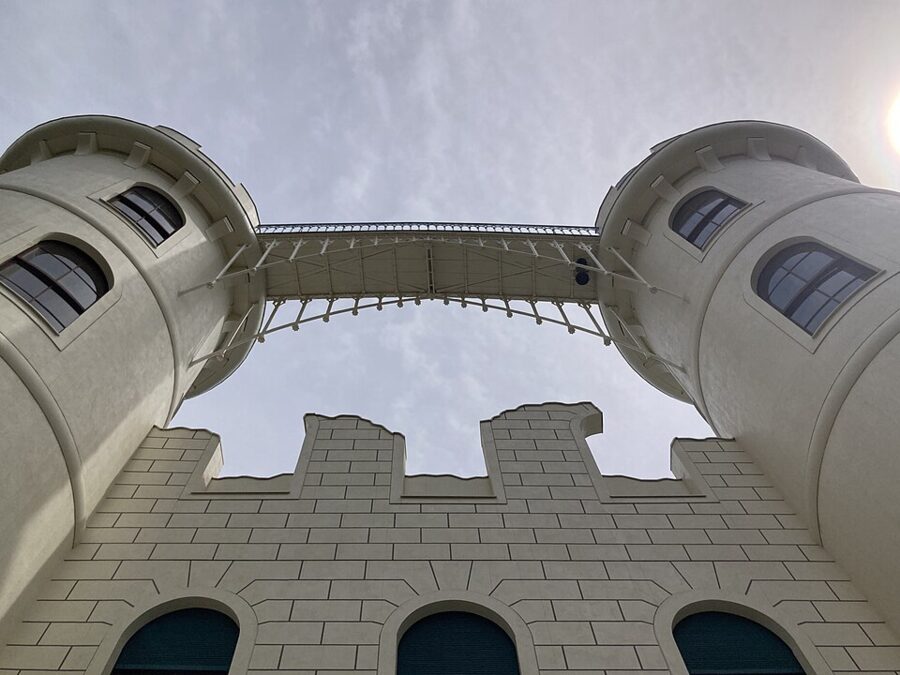
The bridge between the towers is real but just as theatrical. It was wood at first and was replaced in 1807 with one of wrought iron. Seen from below it reads like the last span of a collapsed castle wall.

The king barely used it. When everything was finished in 1797, he died. His successor had the countess tried for enriching herself; she was acquitted and still banished.
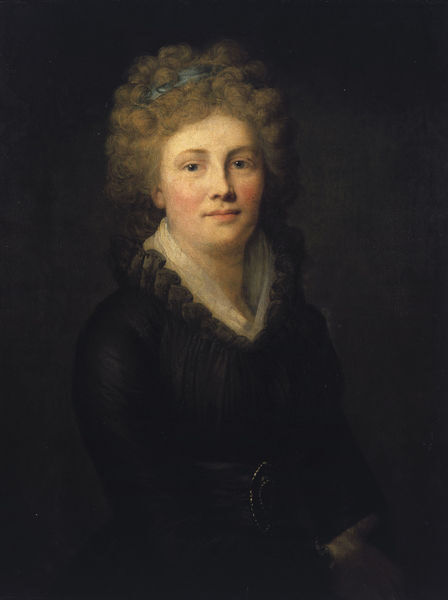
The palace passed to Frederick William III (Friedrich Wilhelm III) and Queen Luise, who spent summers here. Luise was not charmed. She wrote of the “cramped peacock dwelling” where no lock kept out a burglar and the walls were made of paper, and preferred the estate at Paretz.
Inside the palace: the Otaheiti Cabinet and the restored rooms
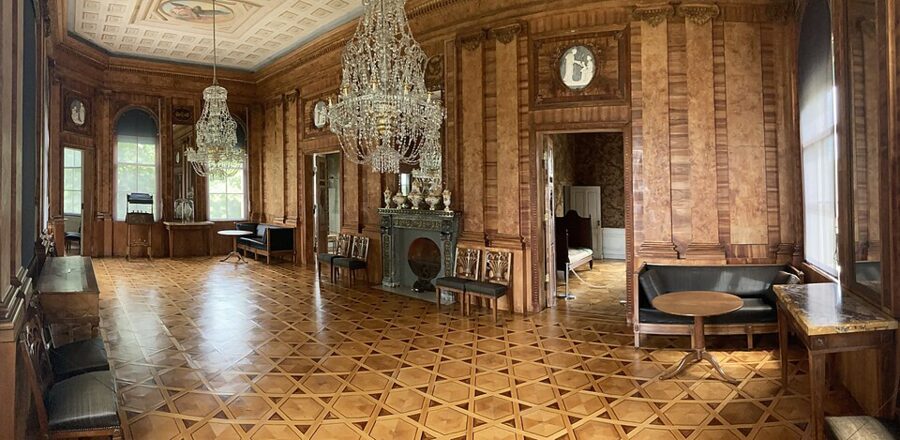
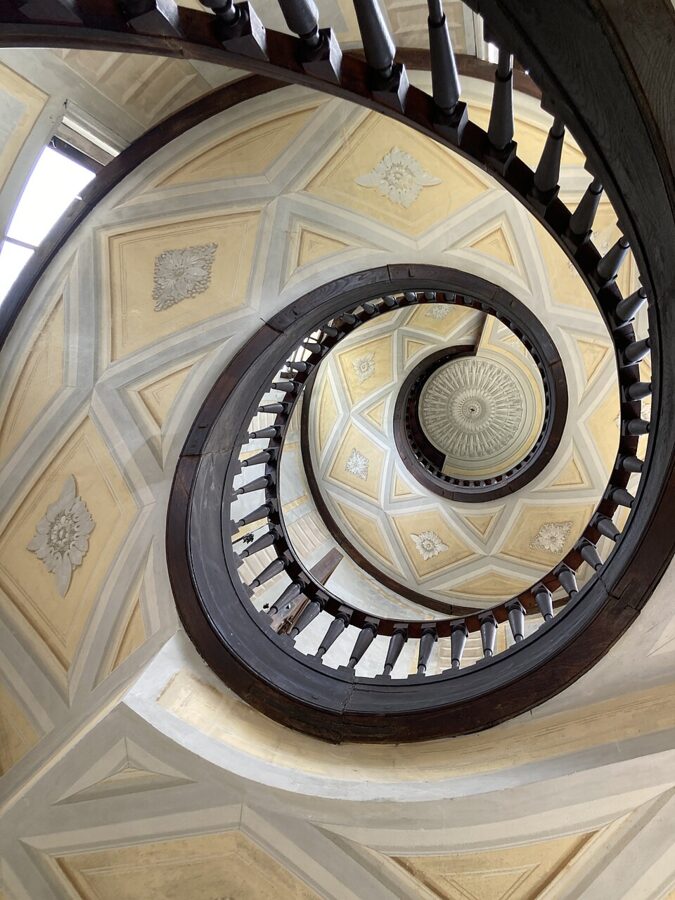
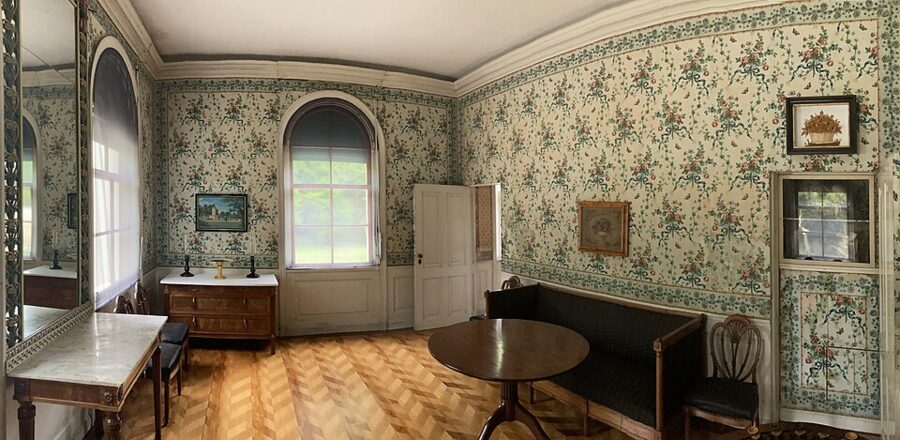
Nobody lived in the palace after 1840, and it escaped fire and war, so almost all of its furnishing is original. There is a silver room in the cellar, small cabinets, two bedrooms, a marble stair tower and, upstairs behind the main front, a hall paneled in fine woods. Paper wallpapers survive too, worn in places.

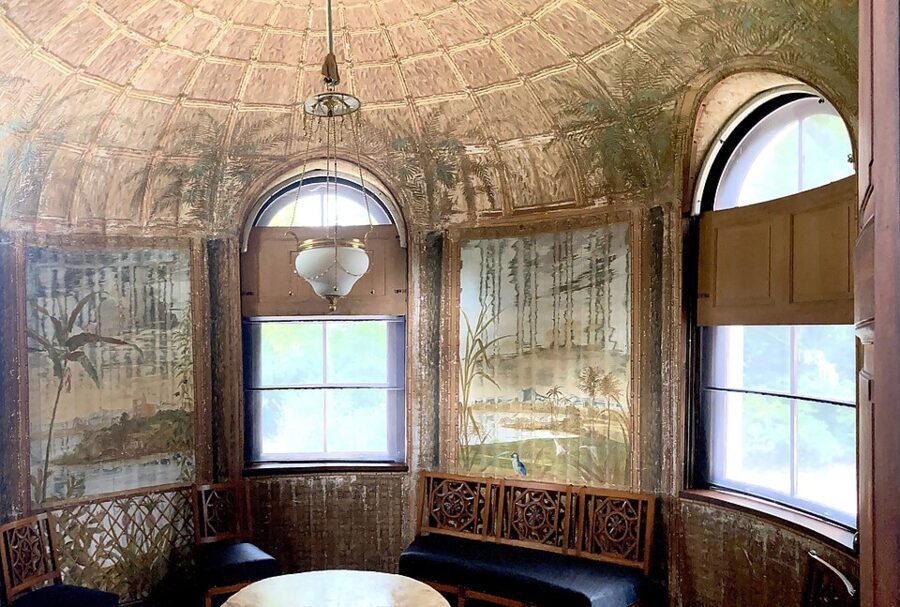
The room everyone remembers is in a tower. The Otaheiti Cabinet (Otaheitisches Kabinett) is painted as a bamboo hut whose painted openings look out on palms, peacocks and the island’s own buildings. Europeans had reached Tahiti, then called Otaheite, about twenty years before, and Louis-Antoine de Bougainville’s account of it was a sensation. The king put his own South Sea island on top of a tower in the Havel.

Restored between 2021 and 2025, the palace is open April–October, Wednesday to Sunday, 10:00–17:30, by guided tour only, in German, with information in other languages. Tickets are sold only on the day, at the Fährhaus by the island’s ferry landing: €8, reduced €6, in 2026, and €9, reduced €6, in 2027. From late October the last tour starts at 16:00, and from November to March the palace is closed.

Is it worth it? Yes, between April and October. The tour is short, the rooms are intimate in a way the big Potsdam palaces are not, and nothing else shows you how this odd little court lived. Buy the ticket at the Fährhaus as you step off the ferry, then walk the island and come back at your time.

Before the king: rabbits and an alchemist
In the late seventeenth century the Great Elector, Frederick William of Brandenburg, kept a rabbit warren here, with a keeper’s house roughly where the palace stands; 800 rabbits brought in 200 thalers a year. Old documents call the island Kaninchenwerder, Pauwerder or Pfau-Werder, though no peacocks are recorded yet. Pfaueninsel has been its name since 1795.
In 1685 the Elector gave the island to Johann Kunckel, an alchemist and glassmaker who had already made Brandenburg’s glass works competitive. Kunckel had turned an unreliable recipe for gold ruby glass into a product, and that deep red glass was a luxury export. Behind a ban on visitors he ran a glass works and laboratory in the island’s northeast, and the Elector came over from Potsdam to experiment for hours.
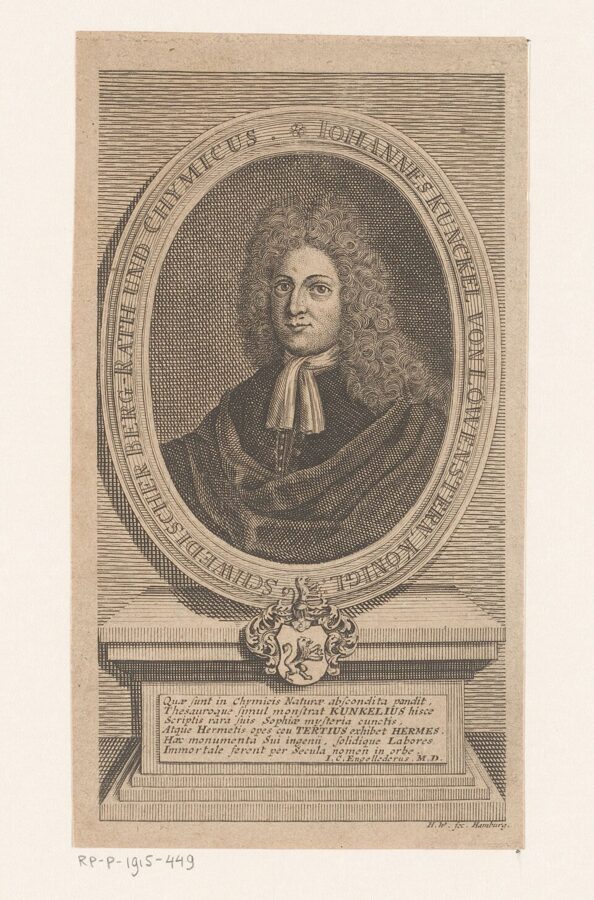
On the mainland, people watched the smoke, smelled the fumes and talked of gold making and black magic. In 1689 the works burned to the ground. The Elector’s successor took Kunckel to court for 8,000 thalers, and when asked what the experiments had been good for, Kunckel said the late Elector had loved rare and beautiful things; what use that was, he could not say. In 1692 he left for Sweden.
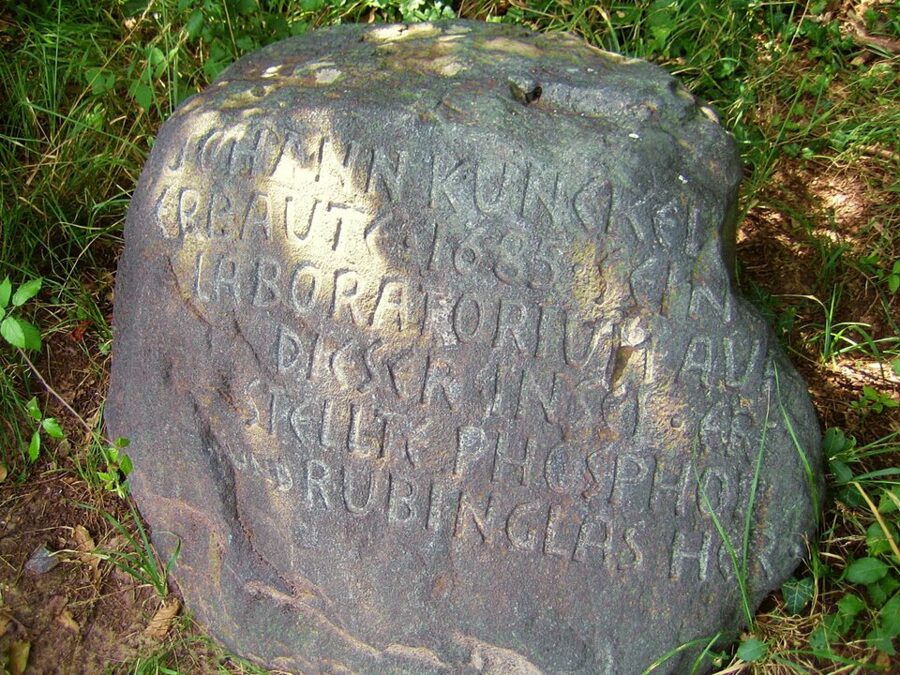
Digs here have turned up fragments of colored glass beads, the kind Brandenburg made for its trading company on the West African coast, a trade that included enslaved people. The foundation now shows them in that context. After the fire the island lay idle for about a century.
The Dairy, the farm and the fake monastery
At the island’s northeastern end stands the second building of 1794–1795, and it is a better joke than the palace. The Dairy (Meierei) looks like the ruin of a small Gothic monastery. Inside it was a working dairy, the heart of an ornamental farm with cows, horses and sheep, modeled, according to the standard account, on a little priory on William Shenstone’s estate, The Leasowes, in England.
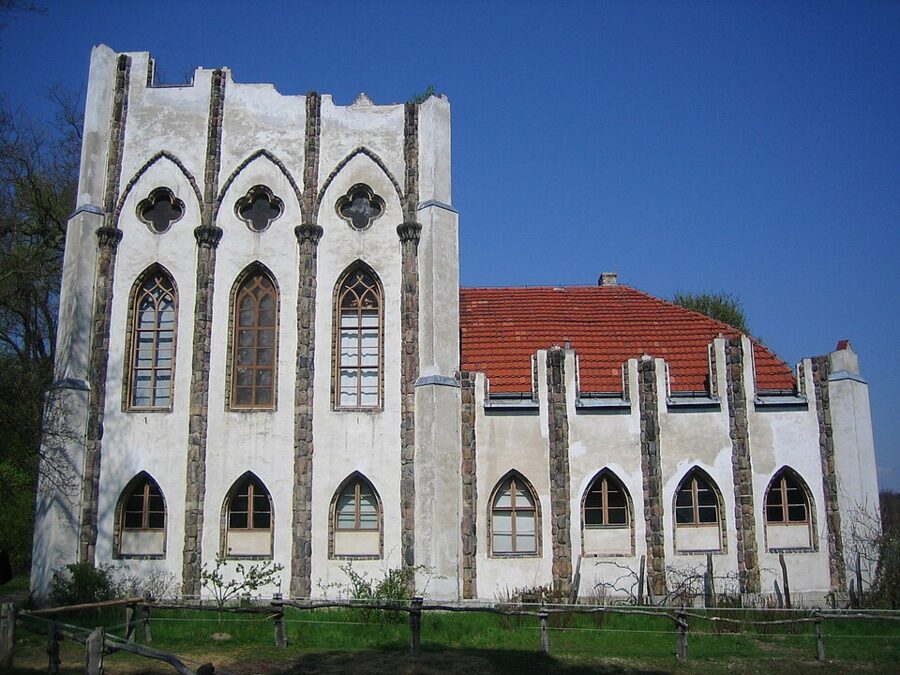
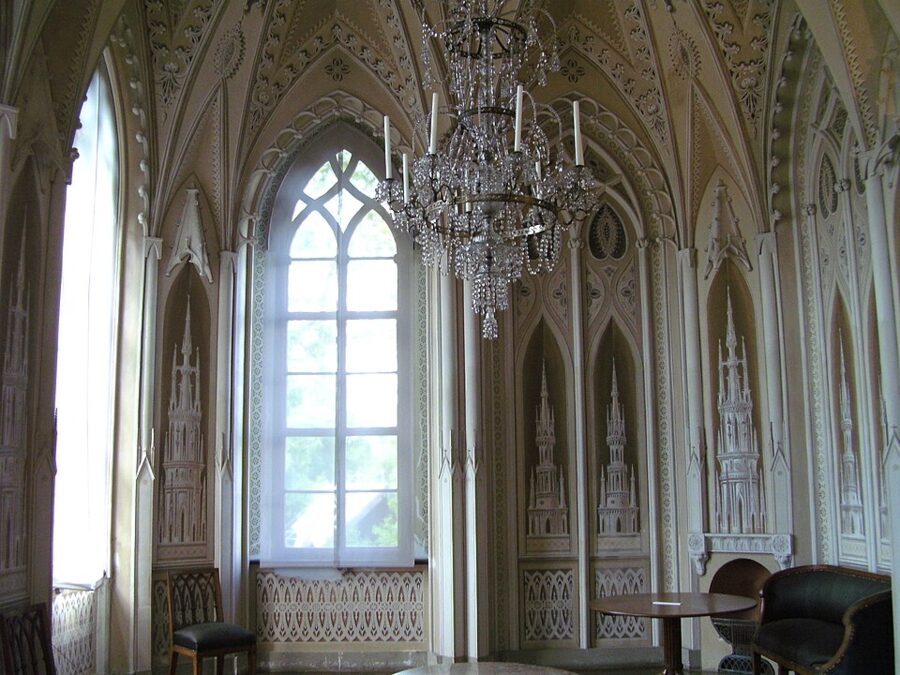
Rousseau’s call to return to nature had the European aristocracy building farms to play in. The king and the countess milked well-groomed cows here. The dairy room still holds the butter churn Wilhelmine is said to have used and wooden butter molds shaped like peacocks. Upstairs is the Gothic Hall, painted by Bartolomeo Verona after designs by Boumann.

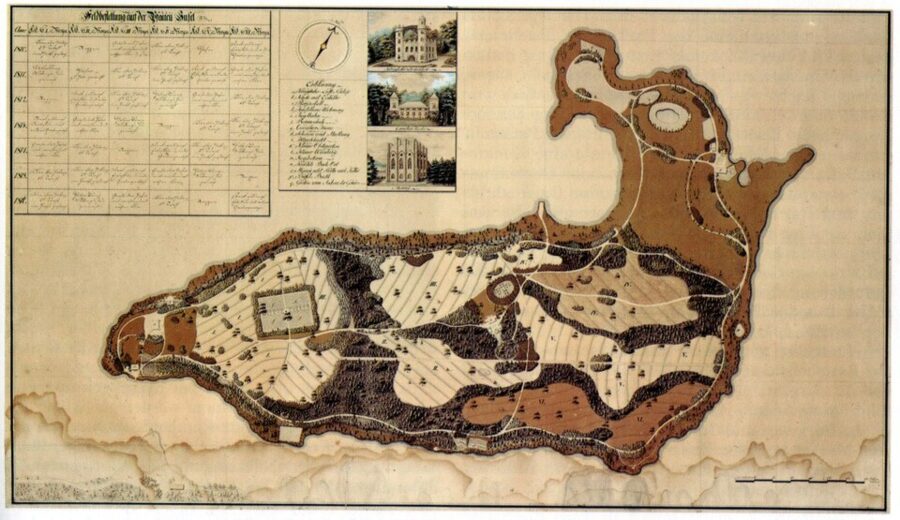
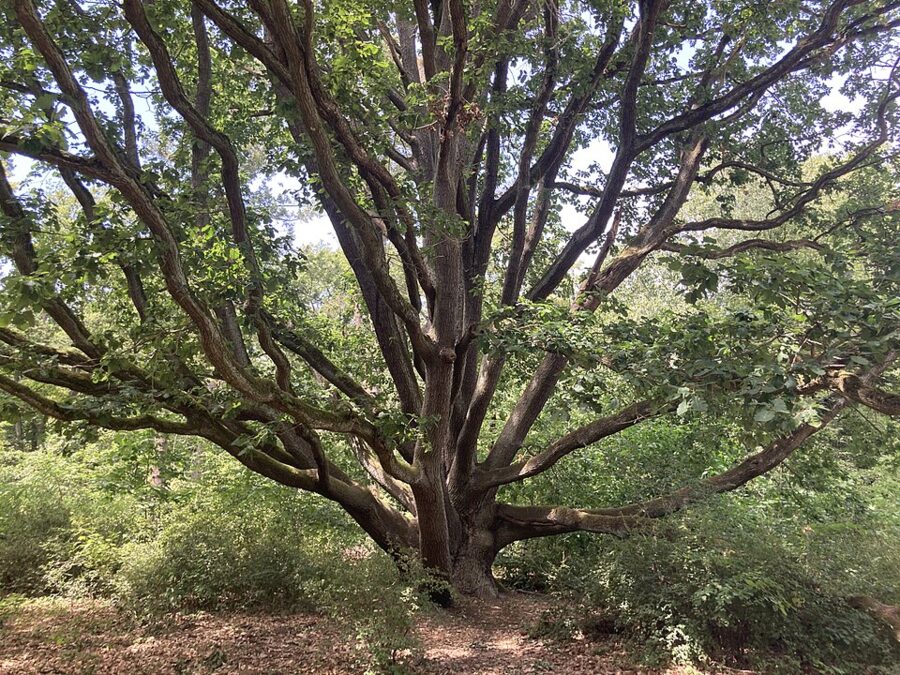
Frederick William III took the farm idea further. From 1804 his court gardener Ferdinand Fintelmann turned wooded parts of the island into fields, partly because food grew short after Napoleon occupied Prussia in 1806. He left the old oaks standing in the plowland, and the result was a model ferme ornée, an ornamental farm laid out like a garden.

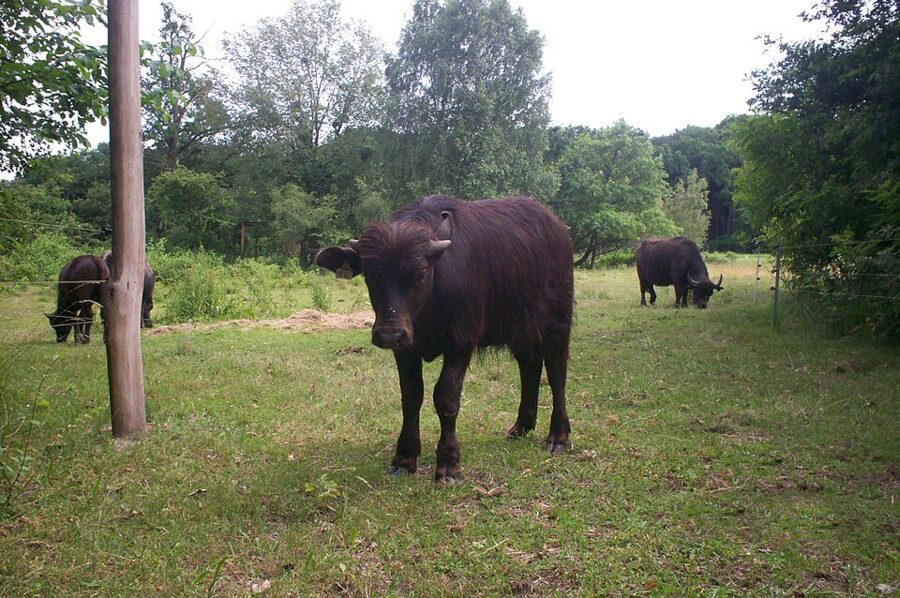
Farming still goes on. In summer, water buffalo graze the Hechtlaichwiese between the Dairy and the Luisentempel, the silted-up channel that once split the island in two.

Frederick William III, Queen Luise and Lenné
After 1815 Frederick William III spent more and more time on the island, which he treasured as a picture of the calm years before the wars. In 1816, 1818 or 1821, depending on the source, he brought in the garden designer Peter Joseph Lenné. The big change began in 1821 and ran through the 1820s.
Lenné kept the island’s best asset, about 300 oaks that were already centuries old, and worked around them. He gave the west a garden mood, with the palace, the rose garden and later the Palm House, and the east a country mood, with the Dairy and meadows. Sightlines hold it together, and you still walk his plan.
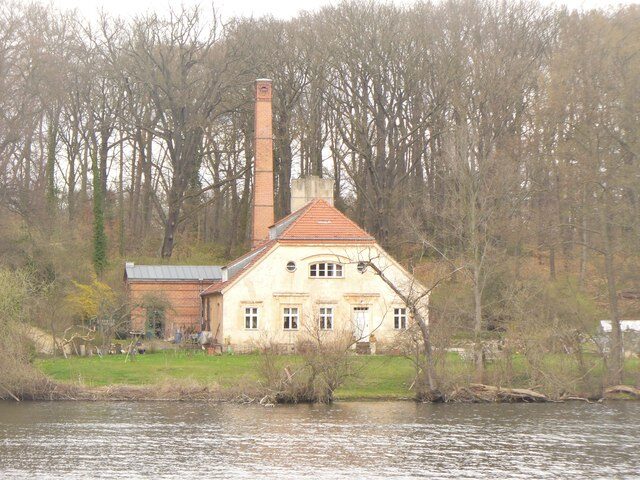
To water the gardens, a steam engine went into an engine house on the south shore in 1822. It pumped Havel water to the island’s highest point, and clay pipes carried it to the beds, the ponds and a fountain.

The Kavaliershaus and its Gothic front from Danzig
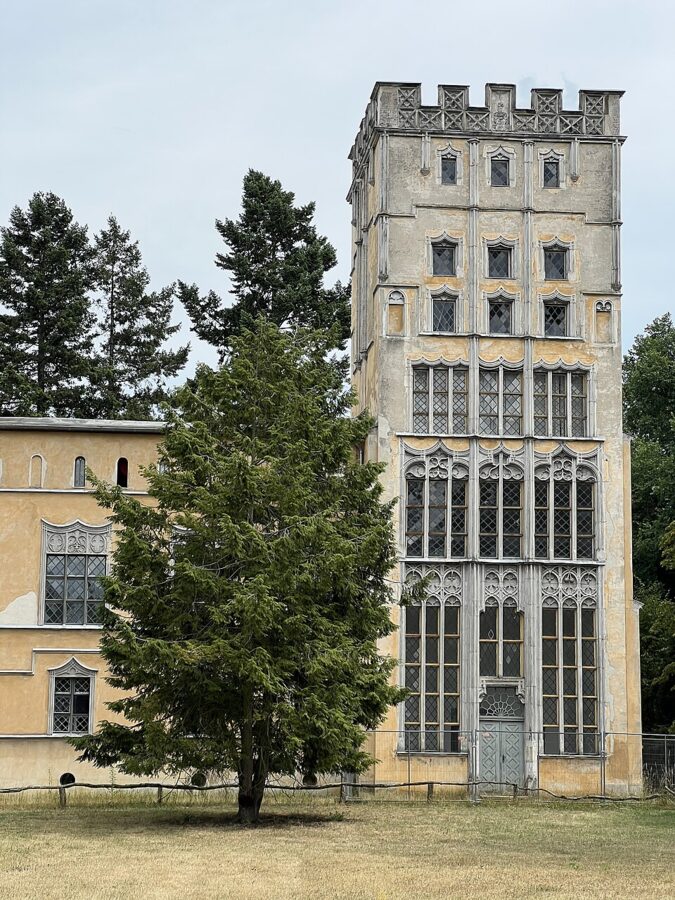
A guest house, the Kavaliershaus, had stood on the island since 1804. In 1822 the king heard that the Schlieff house in Danzig, with a late Gothic front of 1520, was to be torn down. He bought the facade for 300 thalers and had it shipped here in numbered pieces. Between 1824 and 1826 Karl Friedrich Schinkel rebuilt the Kavaliershaus with an extra story and set the old facade in front of one tower.
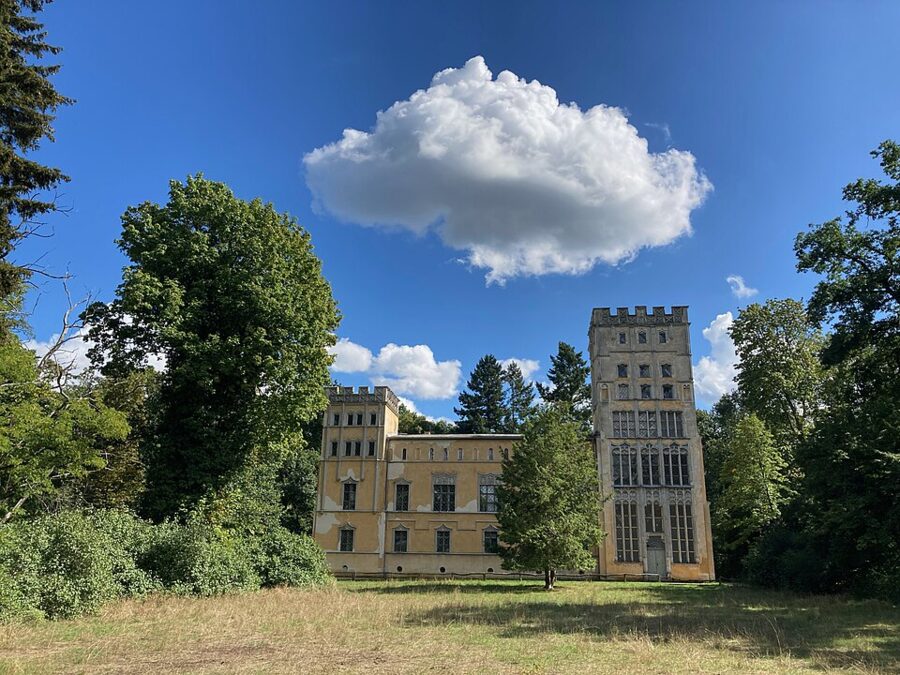

The story told since says the stonework was first made for a house in Nuremberg in the fourteenth century and moved to Danzig around 1480, which may be more legend than record. When Gdańsk rebuilt its old town after 1945, it reconstructed the Schlieff house by measuring the original here. The copy stands in Poland; the original stands in Berlin.

The Luisentempel
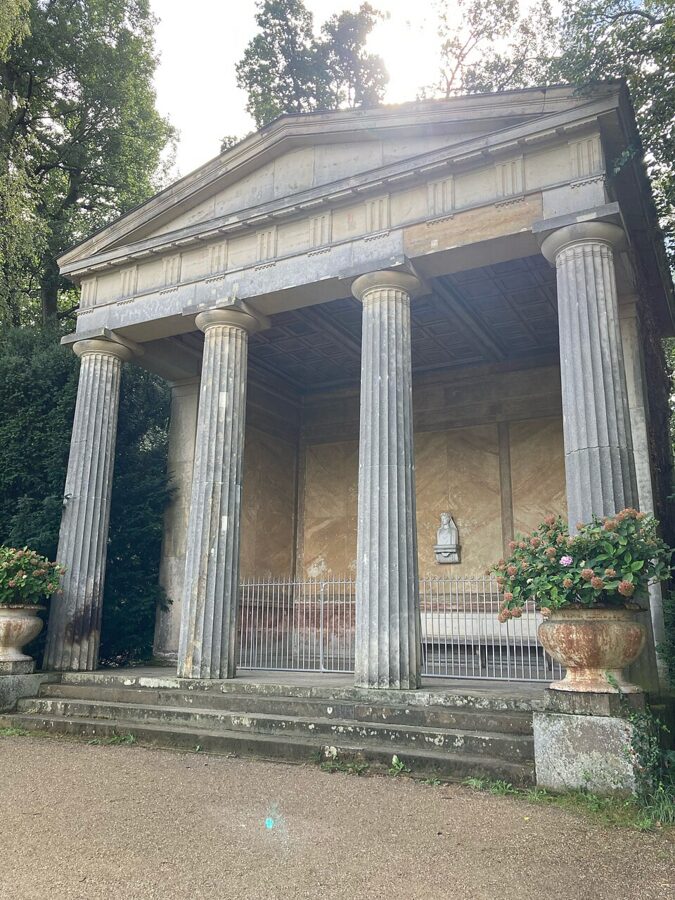
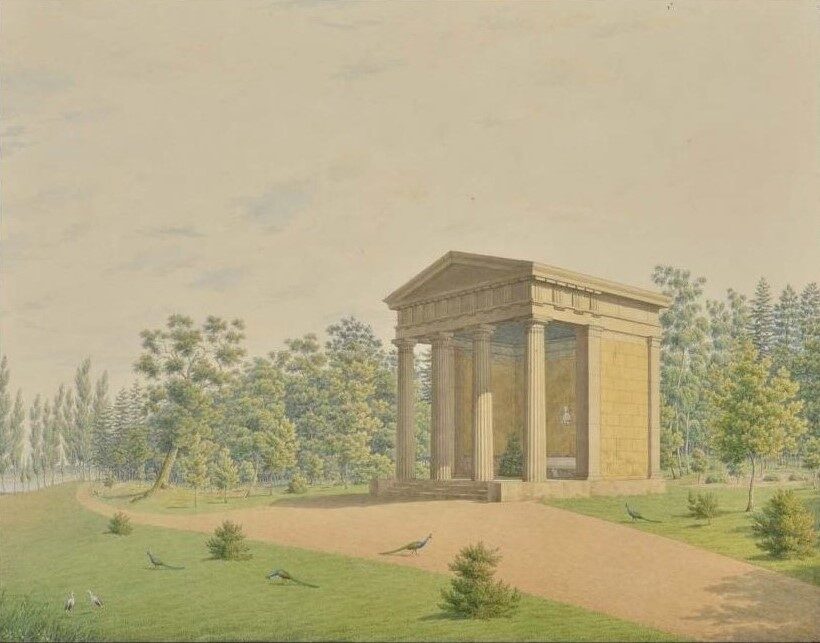
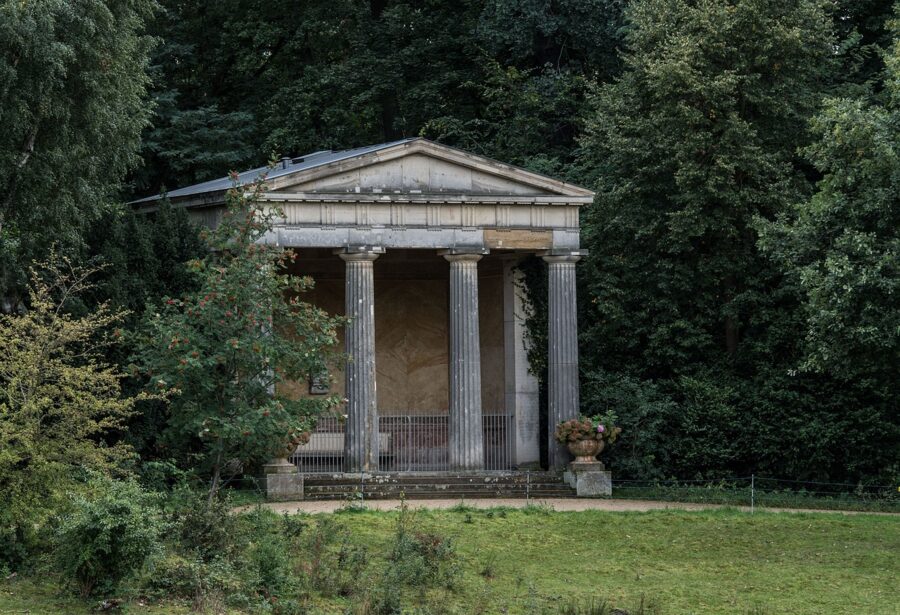
Queen Luise died in 1810, aged 34. Her first mausoleum at Charlottenburg had a sandstone portico; when it was rebuilt in granite, the old front came to the island and was set up in 1829 as a temple in the meadow, most likely to Schinkel’s design. A sightline joins it to the Dairy. It is a temple front with nothing behind it, which suits an island of facades.

The Palm House that burned
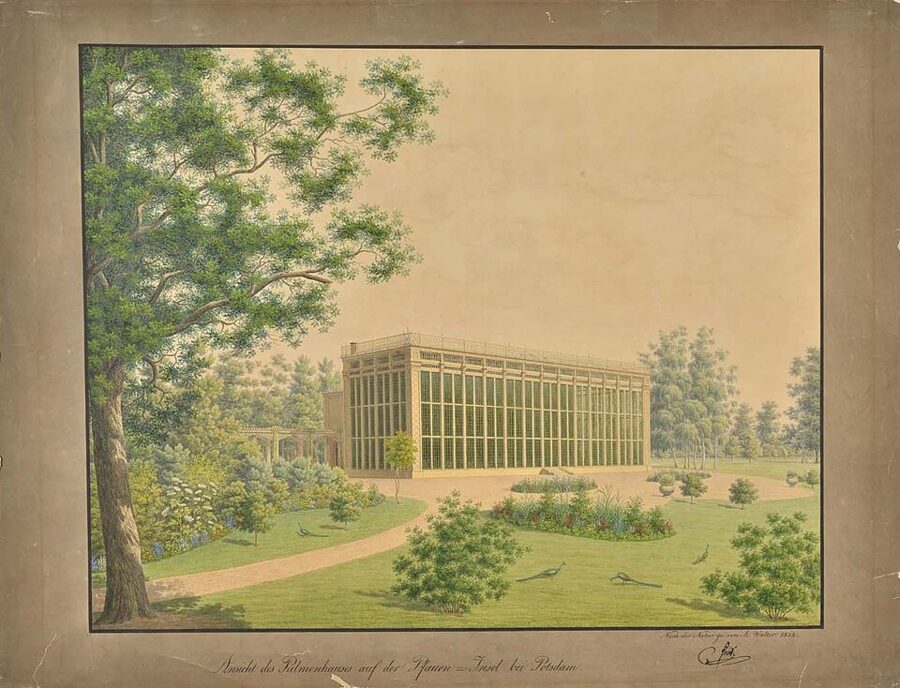
In 1829 a famous palm collection came up for sale in Paris. The king bought it, and Schinkel designed a heated glass house for it, built by 1831: 126 identical bays in slim wooden frames, 34.5 m long and 14 m wide and high, a building that looks a century ahead of its time.
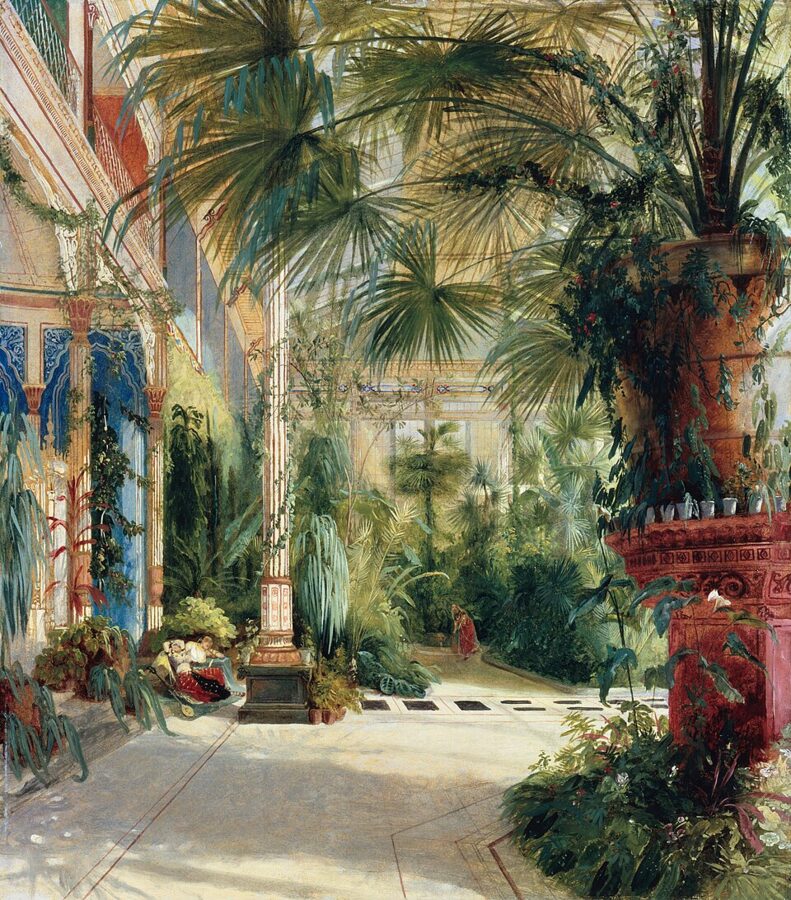
Inside stood a small marble pagoda from Bengal, British war booty, with fountains and a goldfish pool among date palms, bananas, pineapples and coffee plants. The central fan palm grew so fast that the roof was raised with an Indian-style dome. Carl Blechen painted the interior between 1832 and 1834; versions hang at Charlottenburg, in the Alte Nationalgalerie, in Hamburg and in Chicago.
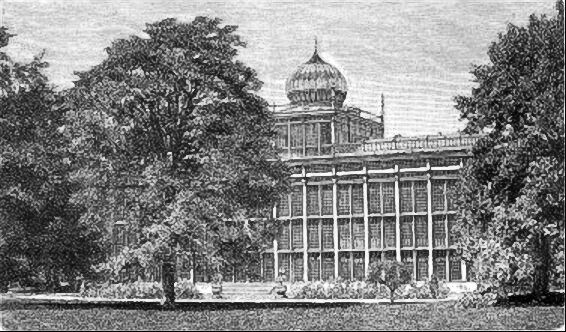
A rebuild was discussed and money set aside, then spent elsewhere, and in 1882 the ruins were leveled. Stone markers outline the footprint now, and in summer beds of large-leaved plants fill it.
The rose garden, the frigate and the hunting blind
The rose garden near the palace was the first in Prussia, planted in 1821 with a collection bought for 5,000 thalers. It grew to 2,000 plants in 140 varieties, decayed, and was restored in 1989; the foundation calls it Berlin’s oldest.

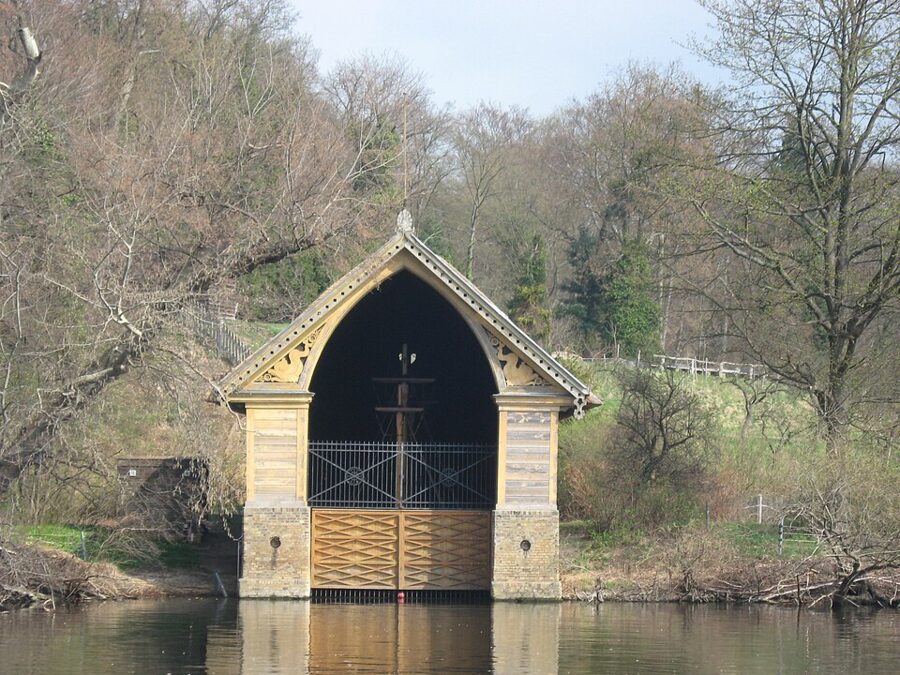
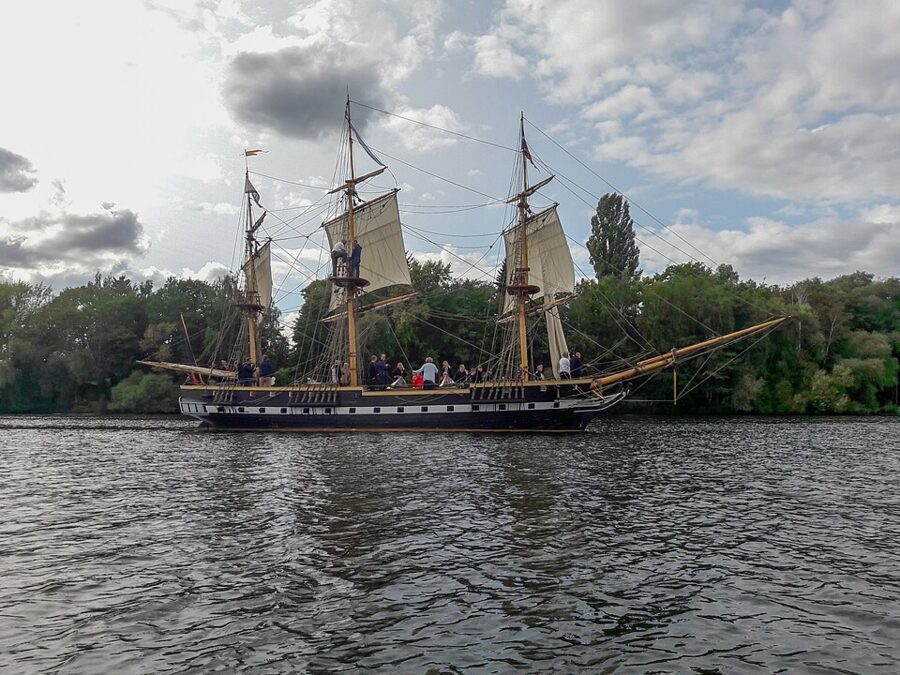
On the east shore stands the Fregattenschuppen, a boathouse Albert Dietrich Schadow built in 1833 for the Royal Louise, a miniature frigate about 18 m long given by William IV of Britain. The original was destroyed after the Second World War. A replica built in 1997–1999 has sailed since 2004 and winters in the same shed.


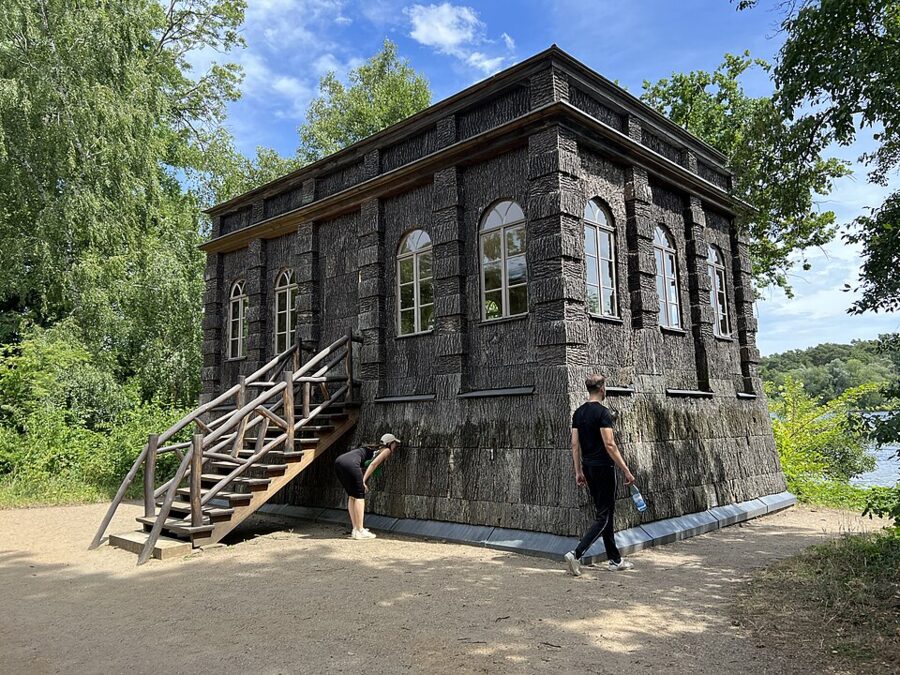
Further north, two bridges cross to an artificial islet and the Beelitz hunting blind (Beelitzer Jagdschirm), which Brendel built near Beelitz in 1796 and the king moved here. Clad in oak bark, it hid hunters who shot waterfowl from its dark lower story. The paths to it, cut off for years after the Gothic Bridge was damaged, were restored from 2008.

The menagerie, the zoo and the peacocks that stayed
Frederick William III saw the Jardin des Plantes in Paris in 1815 and wanted one of his own. Once his taste was known, live presents poured in: llamas, monkeys, lions, kangaroos, beavers, deer and birds of every kind. Two Hawaiian geese arrived in 1834, and in 1836 reindeer from the King of Sweden, with two Sámi herders. By 1832 the menagerie had 847 animals.

His son Frederick William IV did not share the passion. In 1842 most of the animals went to the new Zoological Society of Berlin and became the founding stock of the Berlin Zoo, which opened in 1844 as Germany’s first.
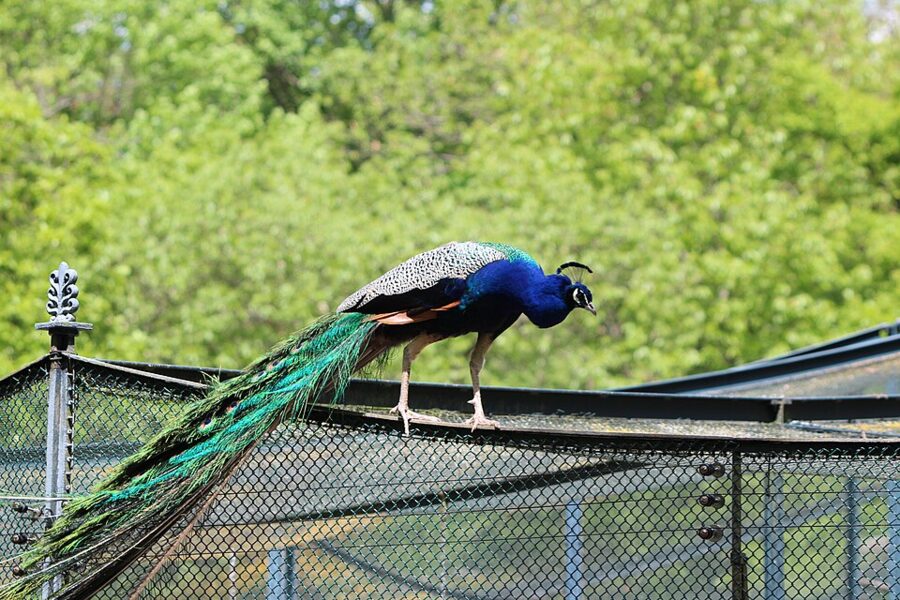
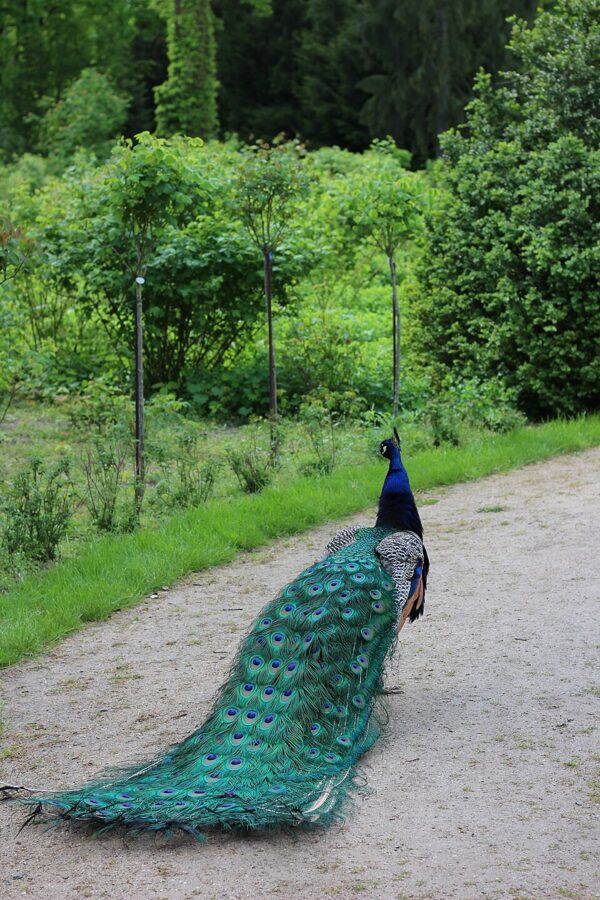
The peacocks never left. The first ones came from the Sacrow estate across the water in 1795, and the foundation now keeps about 55, blue and white. They live in small family groups, and a rearing enclosure built in 2003 keeps their numbers steady.
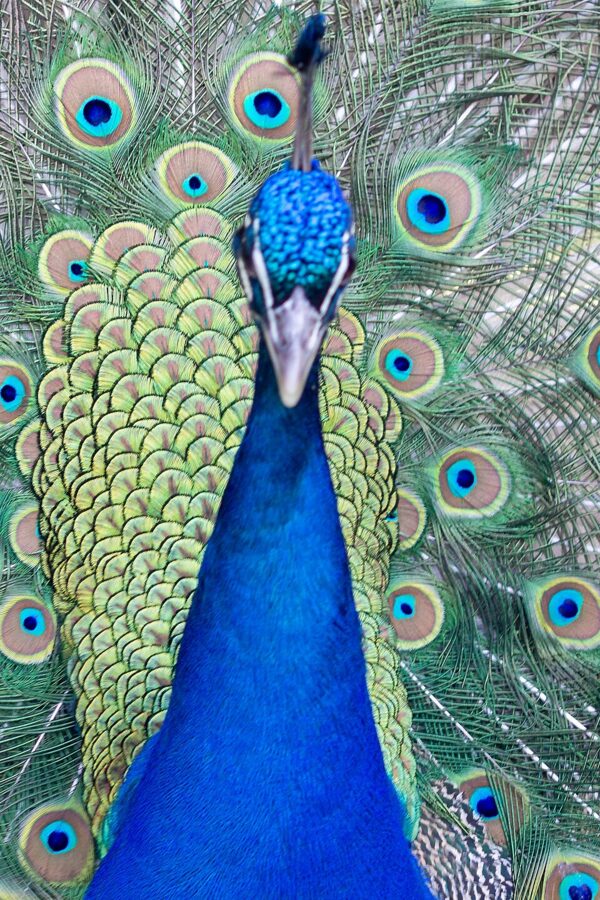

They spend half the day eating and the rest preening and sunbathing, often near the palace. You hear them before you see them: the call is a long, raw shriek that carries across the water. The foundation offers a year’s sponsorship of a peacock for €200.

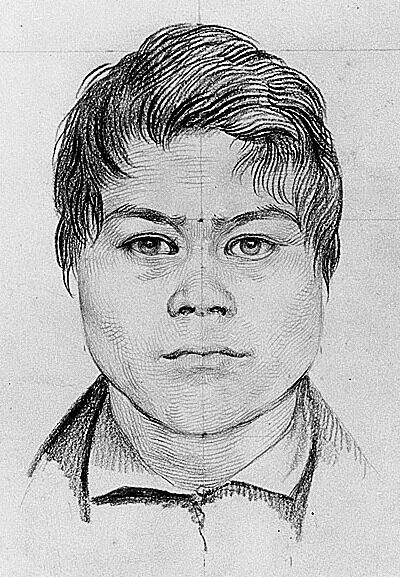
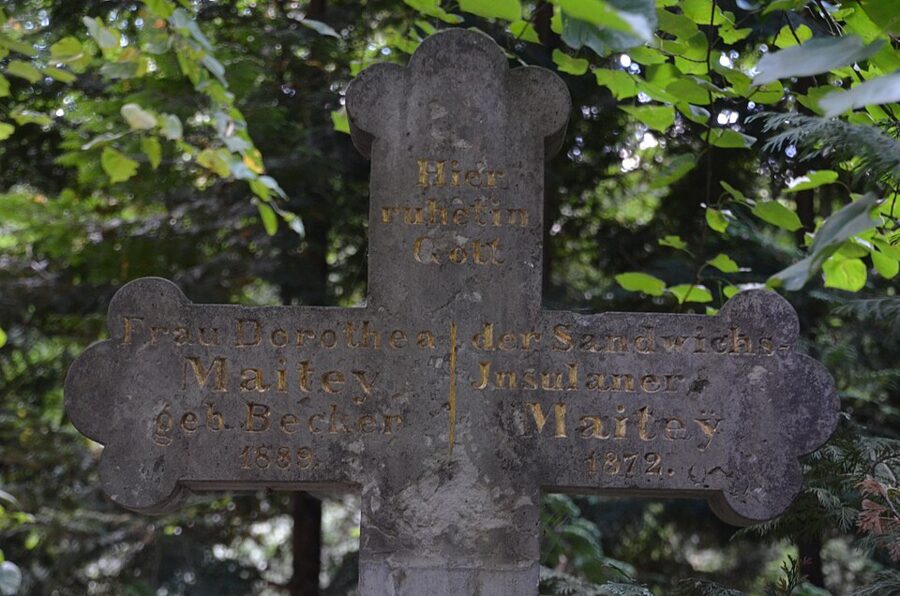
One man of the menagerie years deserves his own stop. Harry Maitey, born in Hawaii around 1807, reached Prussia in 1824 on the ship Mentor and was taken into the king’s care. In 1830 he became assistant to the island’s engine master, who trained him as a turner and joiner, and Wilhelm von Humboldt interviewed him about the Hawaiian language. Maitey married, settled in Klein-Glienicke and died there in 1872.
Walking the island
The paths go clockwise as naturally as a museum one-way system, and that is how I would walk. The loop is about 4 km: an hour and a quarter at a steady pace, three hours with the palace tour and a coffee. In winter, when the last ferry back leaves at 16:00, start by 13:00.
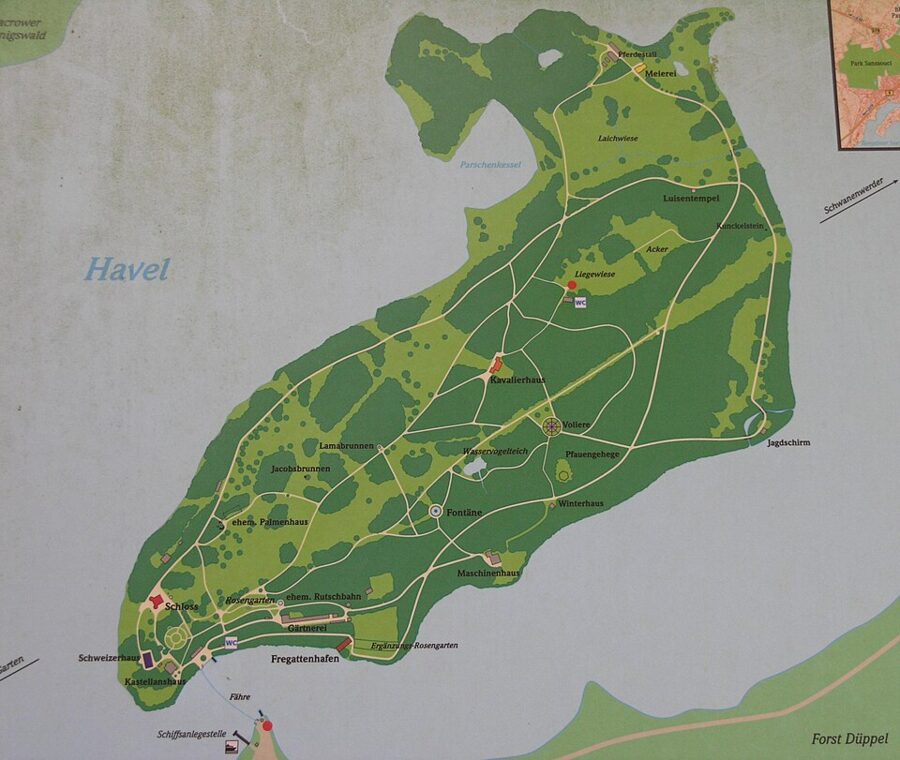

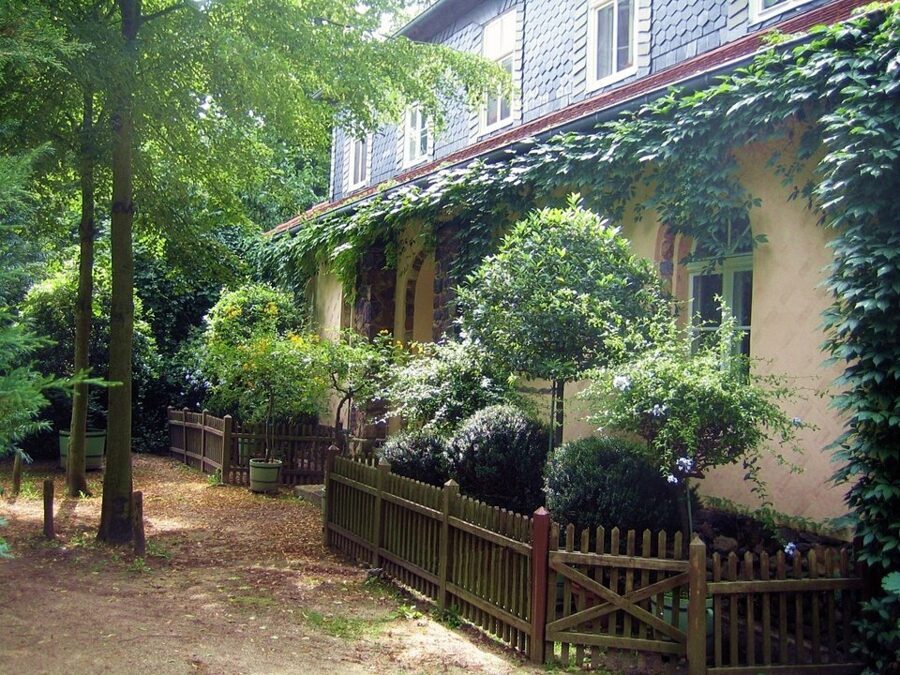
From the landing, the path passes the Kastellanhaus and climbs under an arbor between the Round Garden (Runder Garten) of 1822 and the Swiss House (Schweizerhaus) of 1829–1830 by Schinkel and Schadow. About 300 m from the ferry the trees open on the palace, with the Havel behind it.
Stand on the lawn at the western tip. Across the narrow water is Sacrow, on the Brandenburg shore, and down the long reach of the Havel lies Potsdam; the island’s west end was designed as the far point of the Marble Palace’s view. For 28 years this was also the edge of West Berlin, with the Wall on the Sacrow shore opposite.

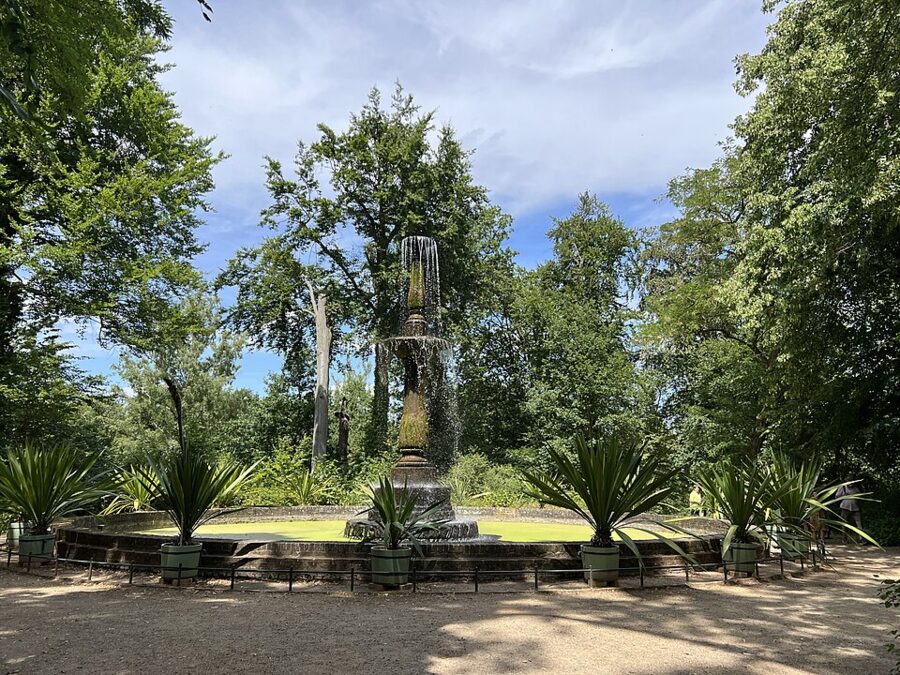
The path then runs northeast past the Palm House site, the fountain and the Llama Well, named for the menagerie’s llamas, to the Parschenkessel, a reed-fringed bay where cormorants nest. Dead oaks are left lying on purpose here as homes for rare beetles, among them the hermit beetle and the great capricorn beetle.

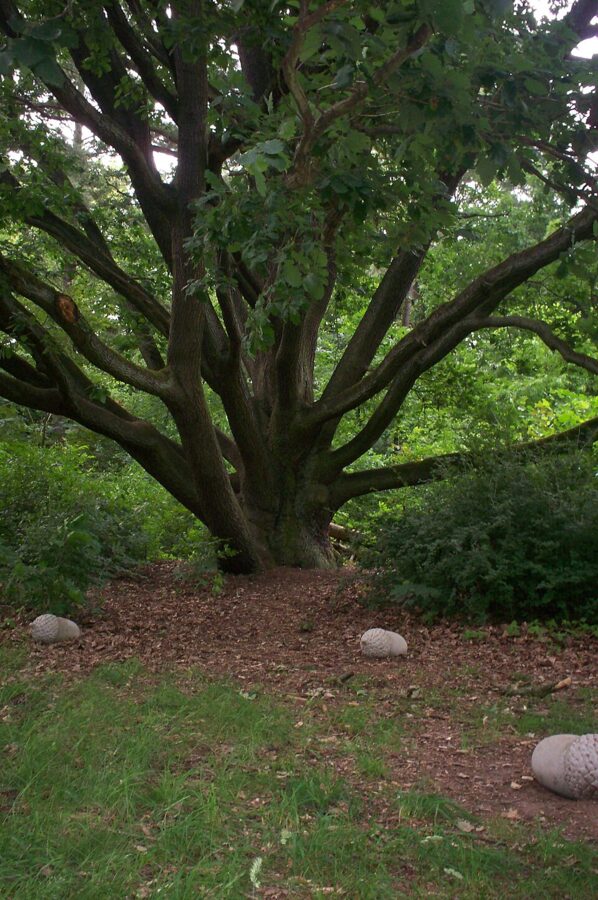
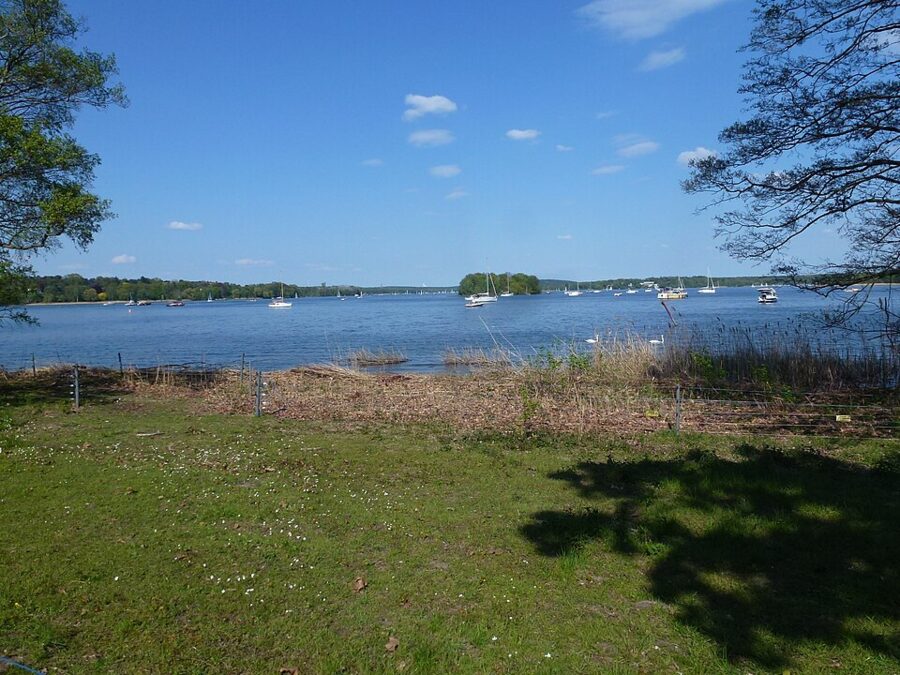
About 1.5 km from the ferry you reach the Dairy. Turn back along the meadow, past the sightline to the Luisentempel, a grove of oaks with large stone acorns, and the Kunckel stone. The path then follows the high east shore south, past the hunting blind, the boathouse, the aviary and the rose garden, back to the ferry. From the bank the views run north and east over the Havel toward Kladow and the islet of Kälberwerder.



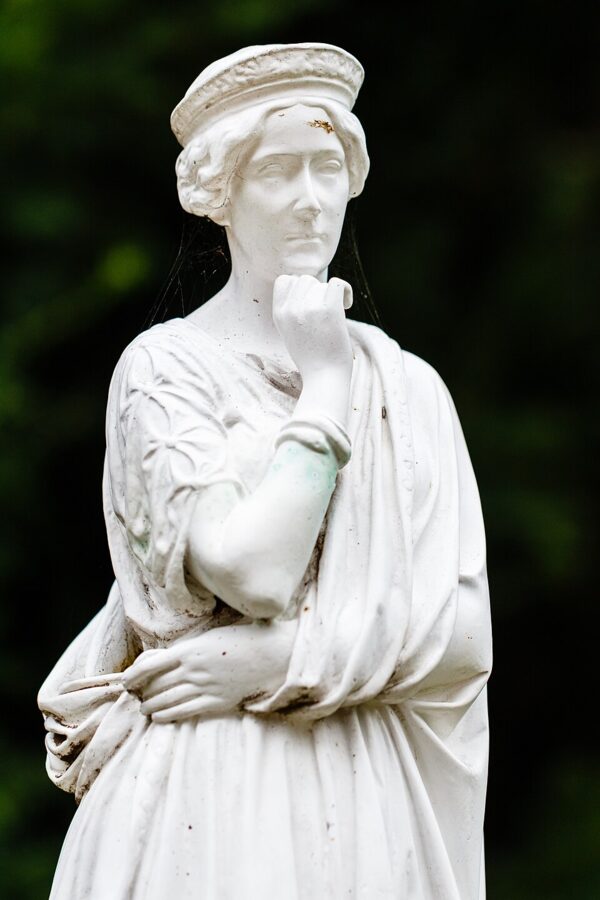
Near the palace stands a marble statuette of the French actress Rachel. On July 15, 1852, Frederick William IV wanted her to perform on the island for his brother-in-law, Tsar Nicholas I. She refused to act outdoors without a stage (“Am I a tightrope walker?”), then gave in and recited from Racine’s Athalie. Theodor Fontane tells the story in his Wanderungen.
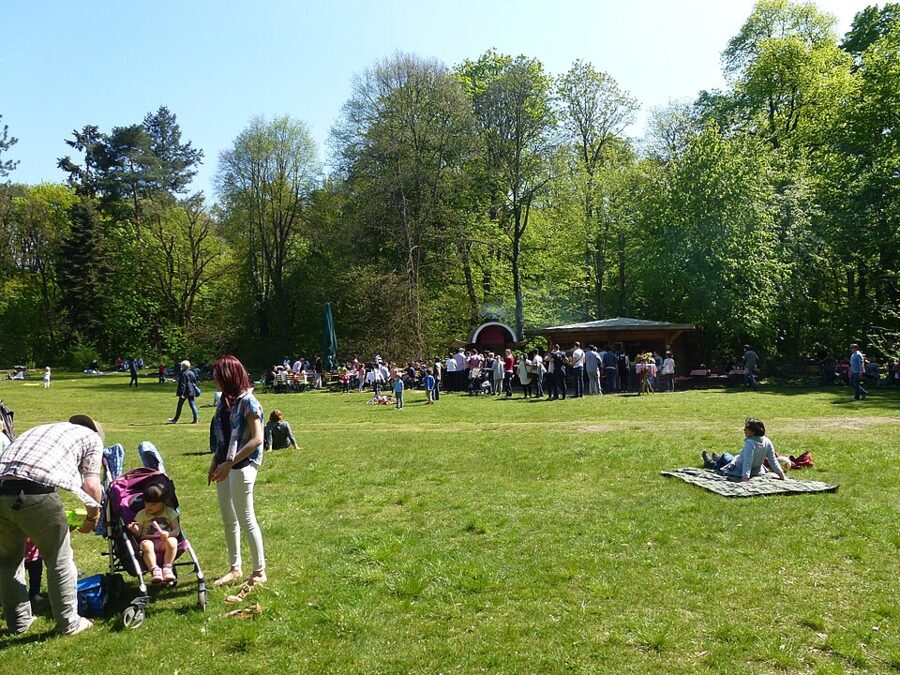
The Liegewiese, the big lawn in the middle, is the only place you may sit on the grass. Its Kaffeegarten serves coffee, cake and grilled sausages daily from April to October in good weather, cash only. In other months, bring food and eat it there.

The dark chapters are plain facts here. On August 15, 1936, Joseph Goebbels closed the Berlin Olympics with an “Italian Night” for about a thousand guests on the island, with fireworks so loud the French ambassador likened them to artillery. In late April 1945, couriers from Hitler’s bunker tried to reach planes sent to the island to fly his papers out, and failed. Nothing on the island marks either.
The ferry, the rules and the seasons
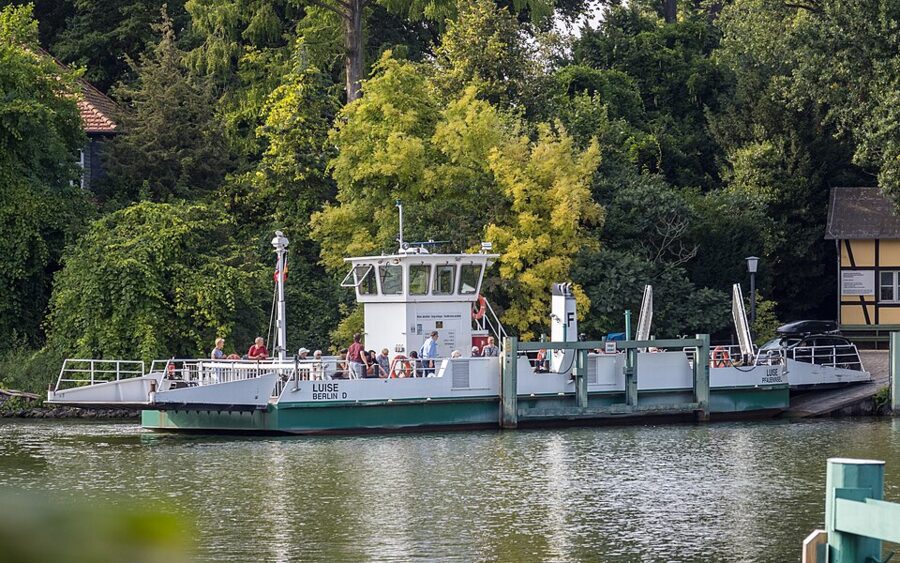
The island is reached only by the foundation’s ferry, and its hours are the island’s hours: daily 10:00–18:00 in March–October, 10:00–16:00 in November–February, and 11:00–16:00 on New Year’s Day. The last crossing to the island leaves 45 minutes before closing. The ferry also runs over Christmas and New Year’s Eve, according to the foundation’s holiday hours.
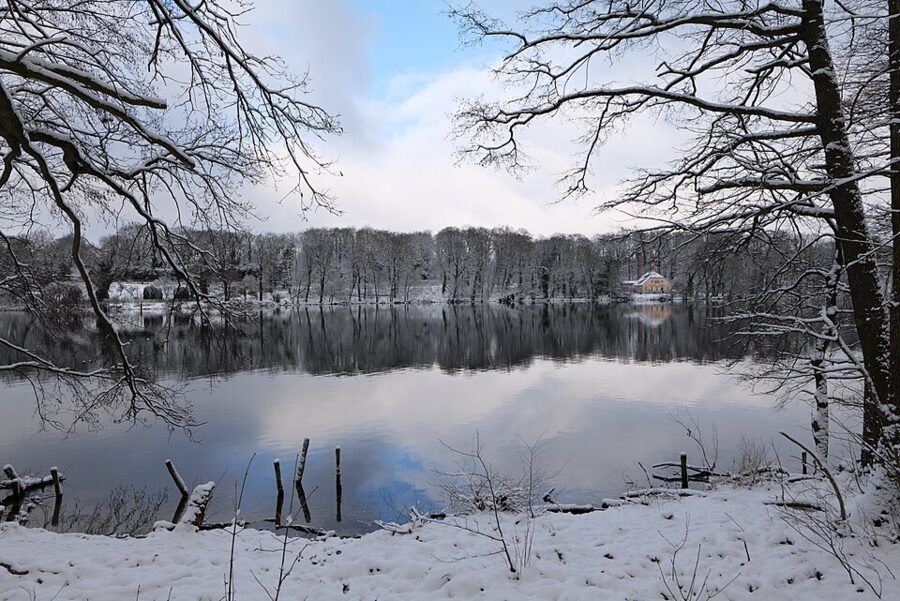
The ferry fare covers the island: €6, reduced €5. A family ticket for two adults and up to four children under 18 costs €12 in 2026 and €13 in 2027. Buy online or at the machine by the landing, which takes Visa, Mastercard and Girocard, or coins only. The crew sells no tickets.
Because the island is also a nature reserve, protected since February 28, 1924, its rules are stricter than in any other park the foundation runs. The island’s park rules ban, among other things:
- dogs and other animals (assistance dogs are welcome)
- bicycles, inline skates and skateboards
- smoking, fires and barbecues
- leaving the paths, and picking plants
- camping, music, ball games and other sports
- swimming, fishing and landing boats
- sledding, skiing, drones, trading and demonstrations
The smoking ban has a plain reason: the island is full of historic timber buildings and dead wood, and dry summers have made the fire risk constant. Bikes stay on the mainland. Serious breaches can get you sent off the island.
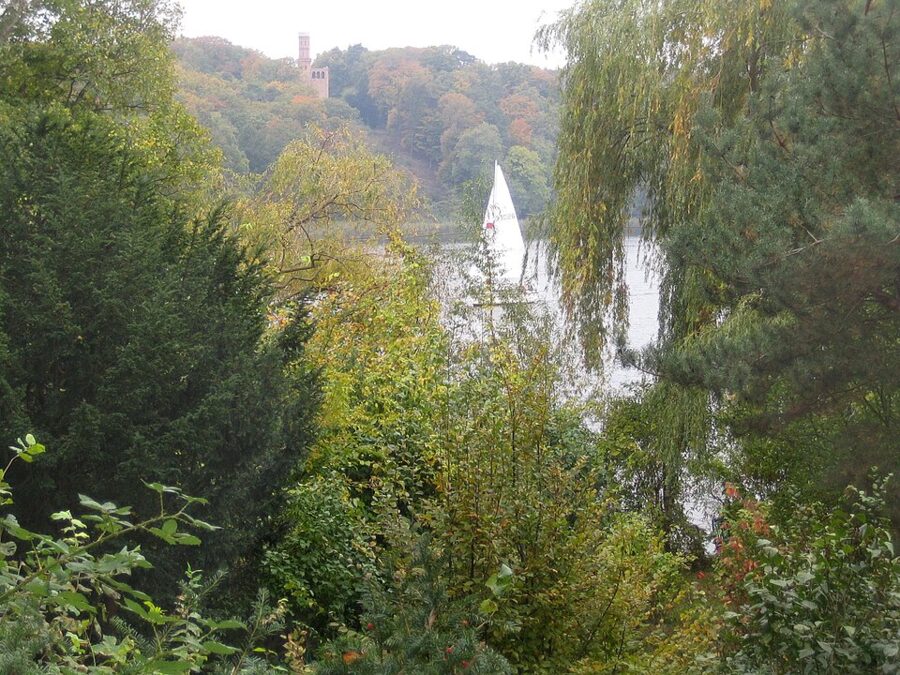

The paths suit wheelchair users with a companion, though the road beside the Fährhaus climbs at 15 percent; there is an accessible toilet at the Fährhaus. Come in late April to June for the peacocks and the young oak leaves, late June for the roses, and October for color and quiet. Winter has bare trees and empty paths, but the palace and the Kaffeegarten are shut.
Getting there from Berlin and Potsdam
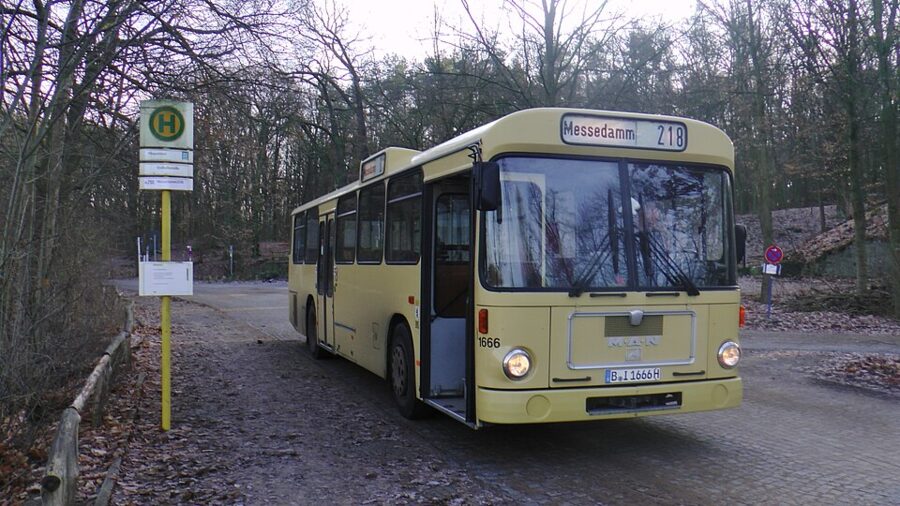
From central Berlin, take the S1 or S7 to Wannsee, then bus 218 to its last stop, Pfaueninsel, about ten minutes. The ferry is about 170 m from the stop, past the inn. The trip stays in fare zones A and B: a single ticket Berlin AB costs €4.00 in 2026 and 2027, and a 24-hour ticket Berlin AB €11.20, then €11.50 from January 1, 2027. The Deutschlandticket covers it.
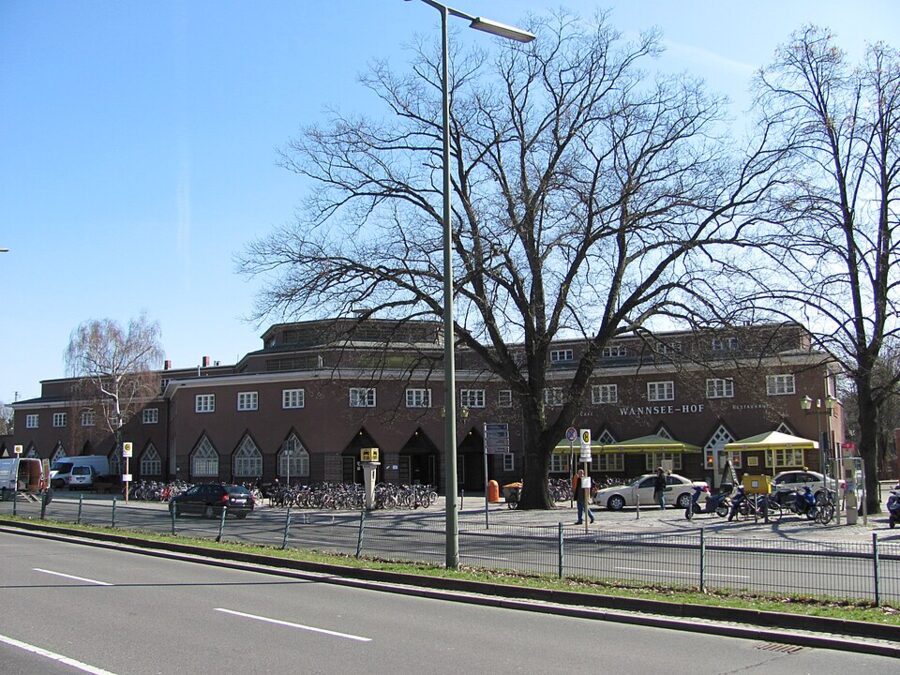

Bus 218 starts at S Messe Nord and runs the Havelchaussee through the Grunewald, past the Grunewald Tower, before Wannsee; the timetable gives 47 minutes end to end. On a fine day, ride the whole line for the river views.

From Potsdam Hauptbahnhof (main station), take the S7 to Wannsee and change to the 218. Potsdam is in zone C, so buy a single ticket Berlin ABC, €5.00 in 2026 and €5.20 from 2027, or a 24-hour ticket Berlin ABC, €12.90 then €13.20. From the Glienicke Bridge, bus 316 runs past Glienicke Palace to the Nikolskoer Weg stop, where a quiet forest road of that name leads north to Nikolskoe and the ferry.
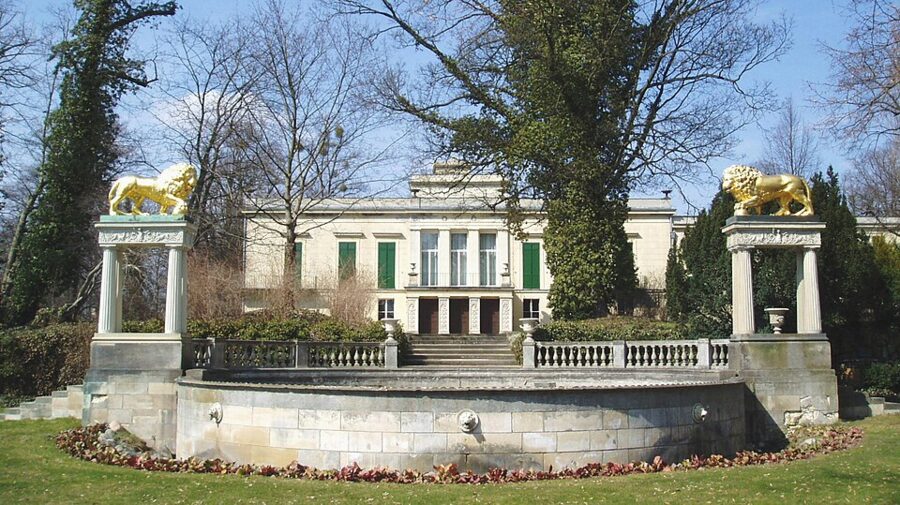

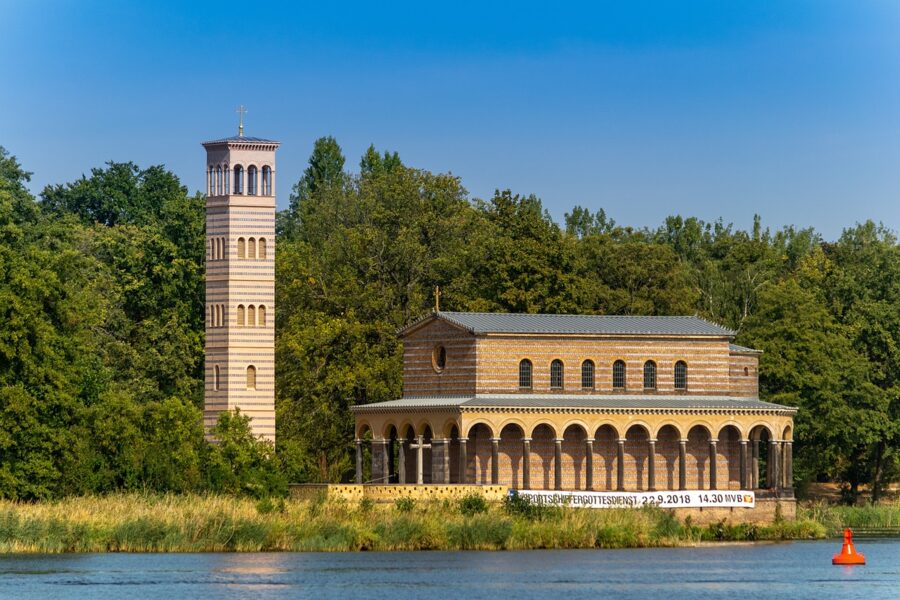
Nikolskoe, a short climb above the ferry, is the best way in, with the church of St. Peter and Paul (1834–1837) and the Blockhaus Nikolskoe; the restaurant opens Wednesday, Thursday and Sunday 12:00–18:00 and Friday and Saturday 12:00–20:00, closed Monday and Tuesday except on holidays. Frederick William III built the log house in 1819 for his daughter and her husband, the future Tsar Nicholas I. Before Alexandrowka went up in Potsdam, it was the main token of Prussia’s love of Russia.
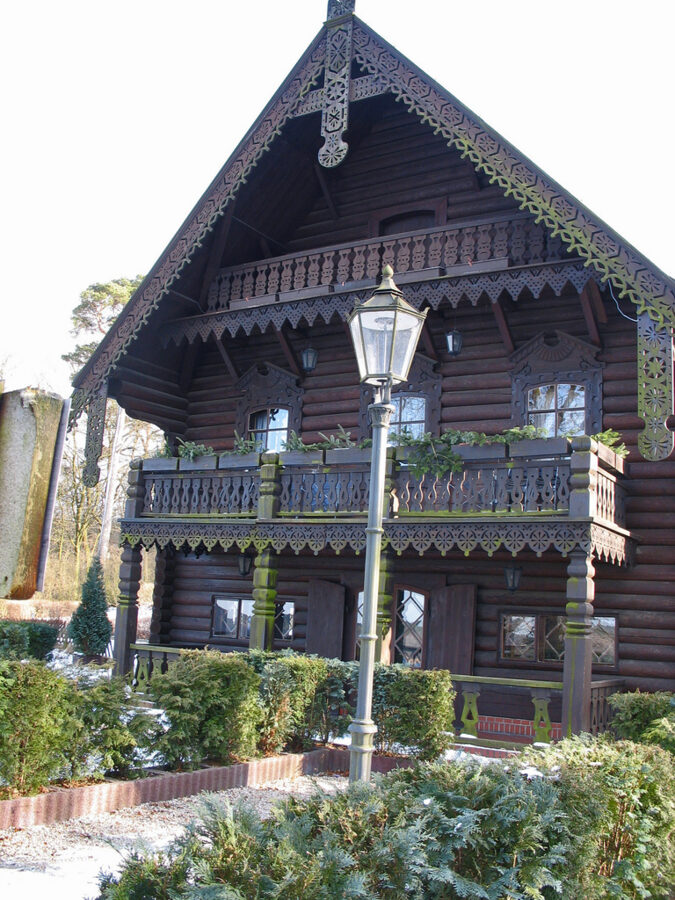

From the terrace a path drops through the beeches to the ferry in 10 to 15 minutes. Harry Maitey’s grave is in the small cemetery near the church.

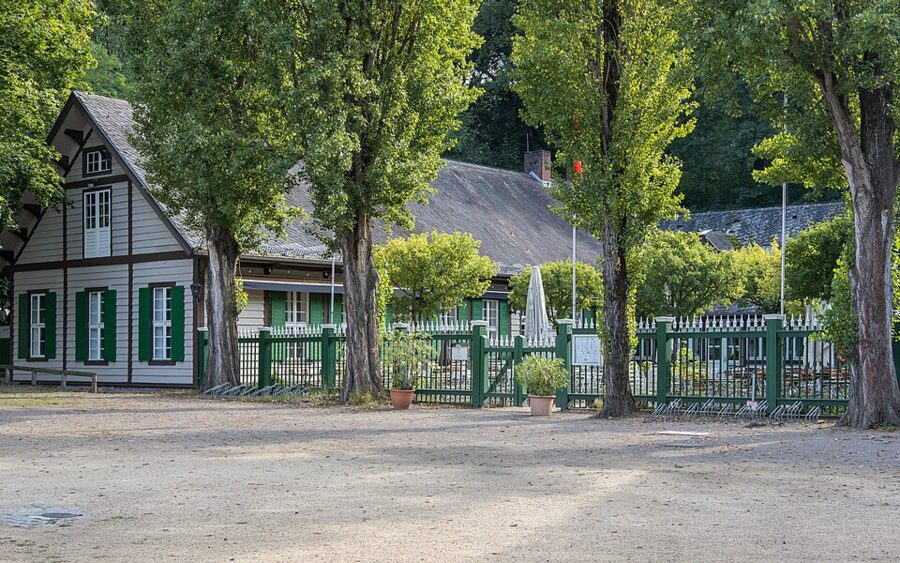
By the mainland landing, the Wirtshaus zur Pfaueninsel serves German food with a seasonal menu, Wednesday to Sunday, 12:00–18:00, the place to wait out a shower.

By water, the Stern und Kreis company’s World Heritage cruise from Wannsee calls at Pfaueninsel on its way to Potsdam, stopping at Kladow, Cecilienhof and Potsdam’s Lange Brücke, and again on the way back. On March 20, the first sailing day listed for 2027, boats leave Wannsee at 11:15 and 14:20 and reach Pfaueninsel 40 minutes later. Tickets start at €24.50 for the round trip of about 2 hours 45 minutes; you can also board at the Lange Brücke and sail to the island.
The island fits a day on the Berlin edge of the palace landscape: walk from the Glienicke Bridge through Glienicke park and along the Havel to Nikolskoe, about an hour, then spend the afternoon on the island and take the 218 home. My overview of Potsdam’s palaces sets the island against the rest, and the Potsdam day trip from Berlin shows how to pair a day here with Sanssouci.

Frederick William II was the nephew of Frederick the Great, and the contrast is the point of coming. His uncle built for posterity in stone and gilt on the terraces of Sanssouci; he built a painted wooden ruin on an island for a woman the court despised, and it outlasted most of what he made. Go back to the lawn at the western tip before the last ferry. The castle catches the late light exactly as it did from the boat, and now you know it is planks and paint, made to be looked at across the water.