

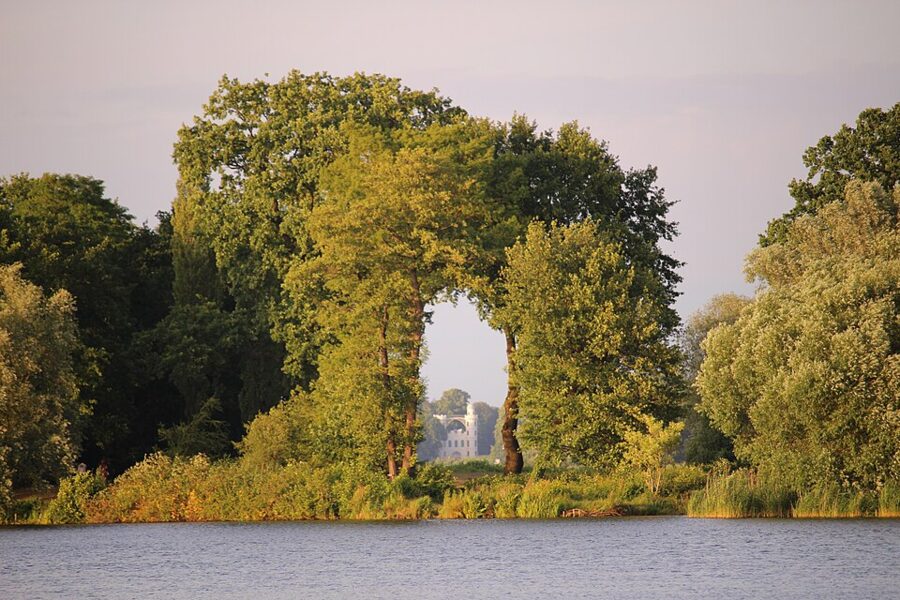
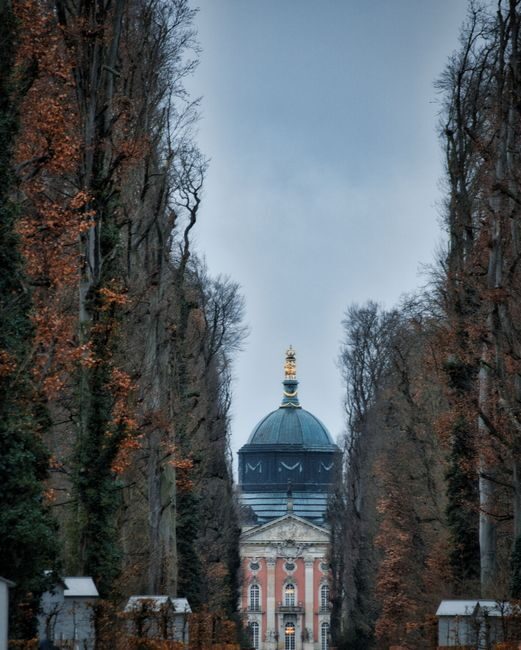
Stand on the lawn beside the Marble Palace in the Neuer Garten and look north along the shore. A lane has been cut through the trees, and at the far end of it, about 4 km away across the Jungfernsee and the Havel, a small white palace with two towers sits on an island. Nobody stumbled on that view. A king’s gardener cleared it so that one royal house could see another, and the whole of Potsdam’s palace country works the same way.
More than a dozen palaces stand in three park landscapes in Potsdam, two more on the Berlin side of the water and a few outliers, and no one sees them all in a day. Some interiors are among the finest rooms of their century and need a timed ticket; some palaces are shut for restoration and are best enjoyed from the path; and some of the best things here are not palaces at all but the views between them. The famous one, Sanssouci, is only the start.
The parks ring the lakes: Sanssouci west of the old town, the Neuer Garten and the Pfingstberg to the north, Babelsberg to the east, Glienicke and Peacock Island across the water in Berlin, Sacrow on the far shore, Caputh and Stern to the south. By the station stands the palace that was blown up and built again.
Contents11 parts
- How the palace landscape fits together
- Park Sanssouci
- The Neuer Garten: Marble Palace and Cecilienhof
- Park Babelsberg
- The Pfingstberg: Belvedere and Pomona Temple
- Across the water in Berlin: Glienicke and Peacock Island
- Sacrow and the Church of the Redeemer
- Caputh and the Jagdschloss Stern
- The palace that came back: the Stadtschloss and the Marstall
- Which interiors are worth a ticket
- How to combine them
How the palace landscape fits together
The Hohenzollerns, electors of Brandenburg and later kings of Prussia and German emperors, built here for about two and a half centuries. The oldest surviving house is Caputh, remodeled from 1662 for the Great Elector’s court, and the last is Cecilienhof, finished in 1917 for a crown prince who never reigned. UNESCO counts 150 buildings put up between 1730 and 1916 in some 500 hectares of parks, and the full World Heritage area now covers 2,064 hectares.
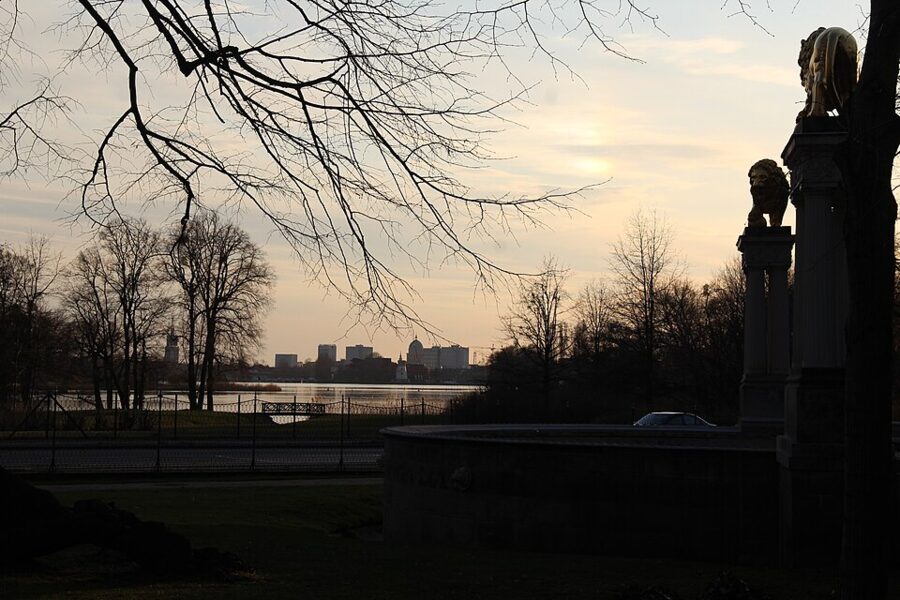
Water ties it together. Potsdam sits on a chain of lakes formed by the Havel: the Templiner See to the south, the Tiefer See and Glienicker Lake to the east, the Jungfernsee to the north, and the smaller Heiliger See inside the Neuer Garten. Nearly every palace faces one of them, and the lakes carry the eye from one estate to the next.
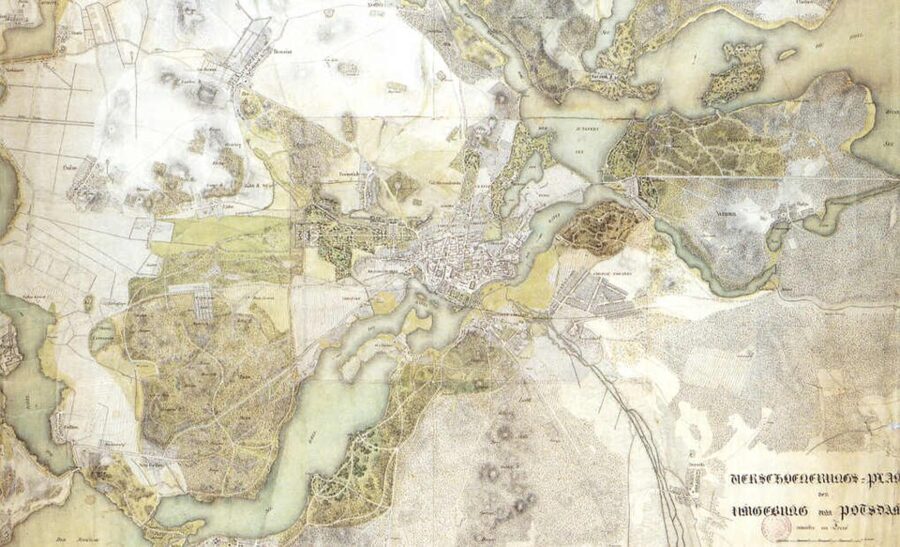
The man who made a system of it was the garden designer Peter Joseph Lenné, who worked in Potsdam from 1816 until his death in 1866. He took up an old idea from the electors’ time, the “island of Potsdam,” and in 1833 drew his Verschönerungsplan (beautification plan) for the whole country around the town. Lenné’s habit was to cut fans of views from one garden to the others: from Sacrow you look to the hunting lodge and the round pavilion at Glienicke, to the Flatow Tower in Babelsberg and to the skyline of Potsdam, and the Neuer Garten opens its lawns toward Sacrow, Peacock Island, Glienicke and the Pfingstberg.
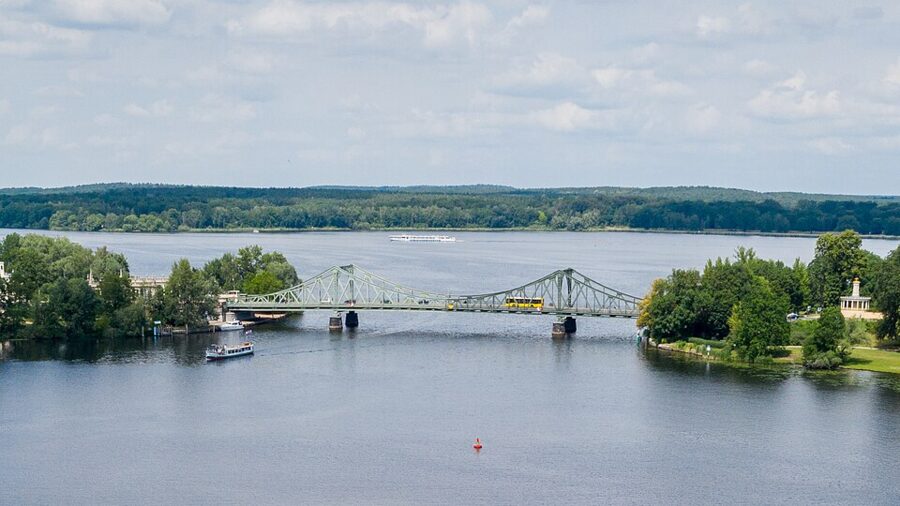
The modern map cut the set in two. From 1961 the Berlin Wall ran along the shores of Sacrow, Babelsberg and the Neuer Garten, and the German Democratic Republic turned some 30 hectares of historic waterfront into a border strip with walls, dog runs and watchtowers. The East German state applied for World Heritage status for the Potsdam parks in 1989; after the Wall fell, West Germany added Glienicke and Peacock Island, and the Palaces and Parks of Potsdam and Berlin went on the list together in December 1990.
Sacrow and its church joined in 1992, and in 1999 the listing took in the Pfingstberg, the Russian colony of Alexandrowka, Lindstedt Palace, the village of Bornstedt and several connecting avenues. Berlin’s monuments office keeps an account of the Berlin share of the World Heritage site, which runs from the Glienicke Bridge to Nikolskoe and Peacock Island.
One body runs almost all of it: the Prussian Palaces and Gardens Foundation Berlin-Brandenburg (Stiftung Preußische Schlösser und Gärten, SPSG). It sets the hours, sells the tickets and restores the rooms, which is why several famous buildings are shut at any given time. The parks themselves are free and open from 08:00 until dusk.
Park Sanssouci
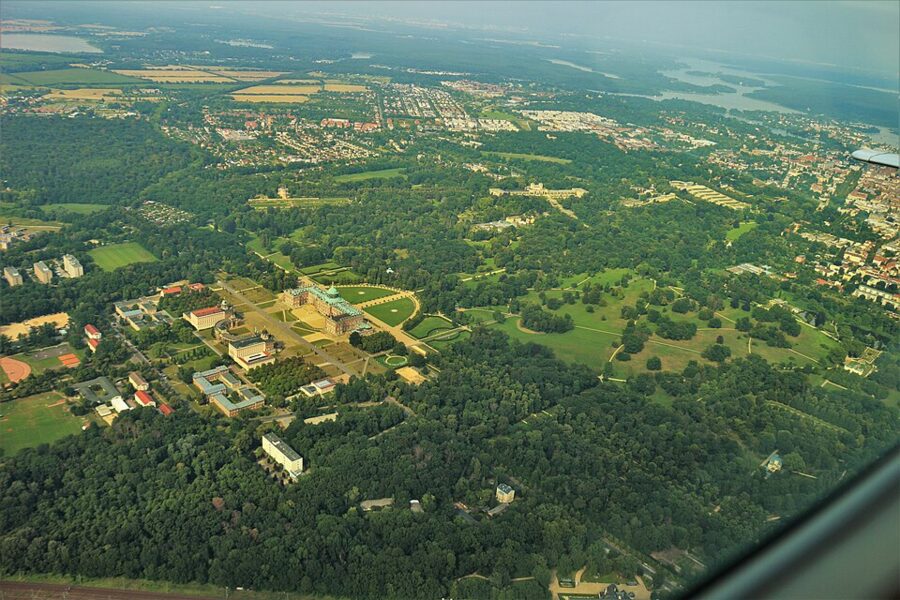
Sanssouci is the largest of the parks and the one most people come for. A straight main avenue runs about 2 km from an obelisk at the eastern gate to the New Palace at the western end, and Frederick the Great (Friedrich II) and later Frederick William IV (Friedrich Wilhelm IV) filled the ground on either side with palaces, temples, a picture gallery, a windmill and a Chinese tea house.
Sanssouci Palace
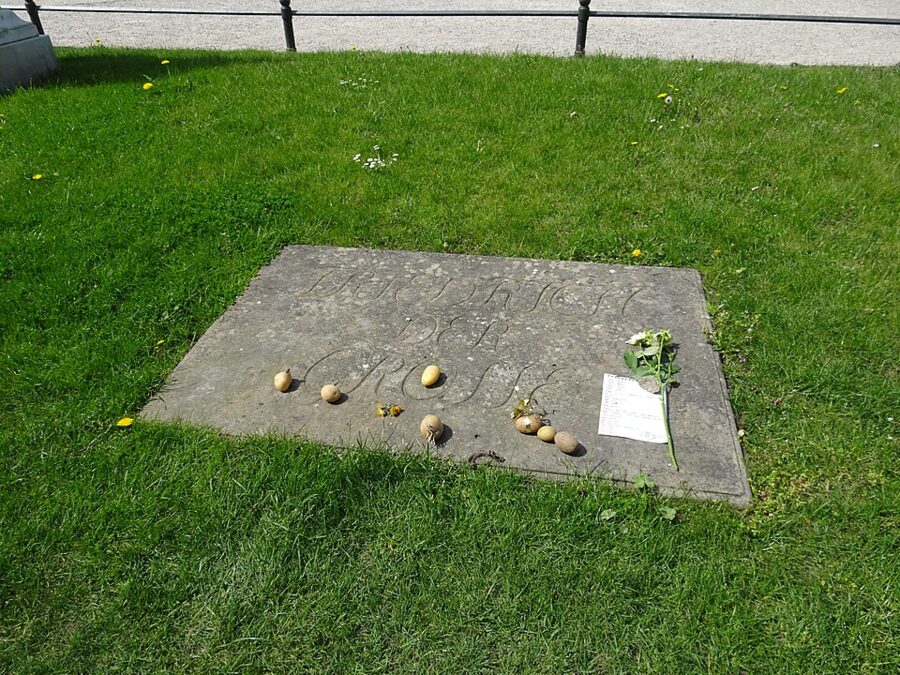
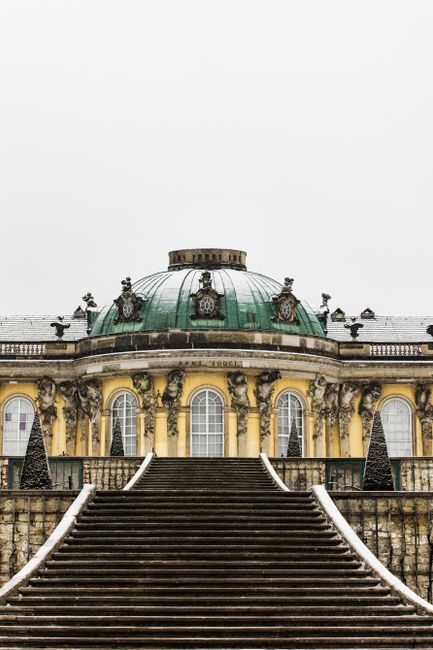
Georg Wenzeslaus von Knobelsdorff built the single-story summer palace in 1745–1747 at the top of six curved Weinbergterrassen (vineyard terraces), to ideas sketched by the king himself. It is small, a row of rooms behind a yellow front, and that was the intention: this was where Frederick withdrew with his greyhounds and his books. He wanted to be buried on the top terrace, and in 1991 he finally was.
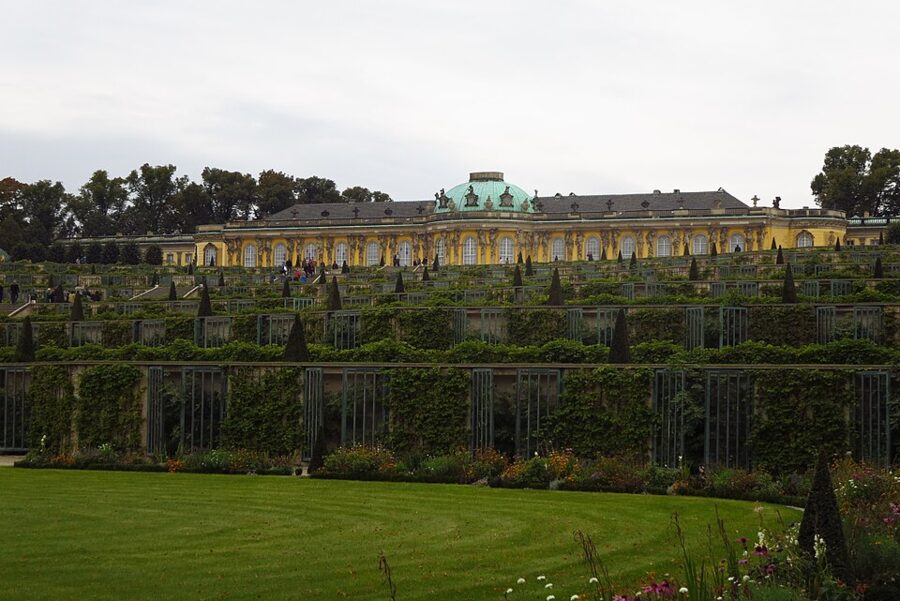
Entry is by timed slot only. Sanssouci Palace opens Tuesday to Sunday, 10:00–17:30 from April to October and 10:00–16:30 in winter, and costs €14 (reduced €10). The day’s tickets go on sale at the Historische Mühle visitor center 30 minutes before opening, numbers are capped, and on a summer weekend the slots are gone early, so book ahead.
The New Palace
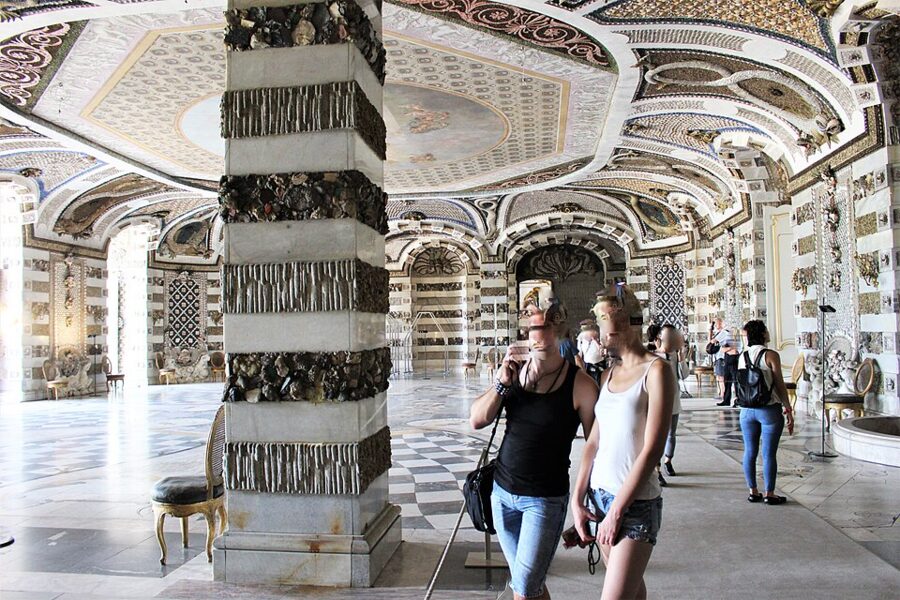
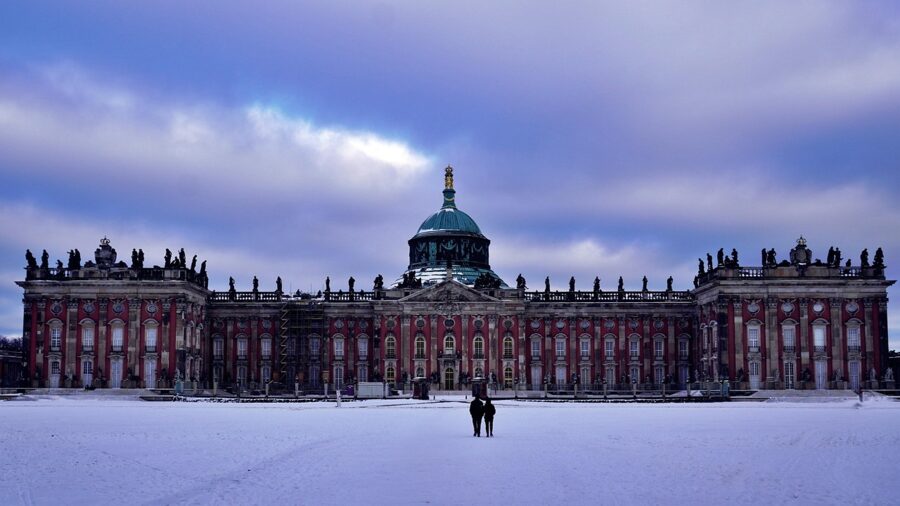
At the other end of the avenue, the New Palace (Neues Palais) is everything Sanssouci is not. Frederick built it in 1763–1769, straight after the Seven Years’ War, to show Europe that Prussia could still afford a 220 m front, a 55 m dome and 267 larger-than-life statues on the roofline; he called it his Fanfaronade, a piece of bragging. Inside are four state halls, guest apartments, a rococo theater and the Grotto Hall, its walls set with shells, minerals and glass, newly restored and back on the route.
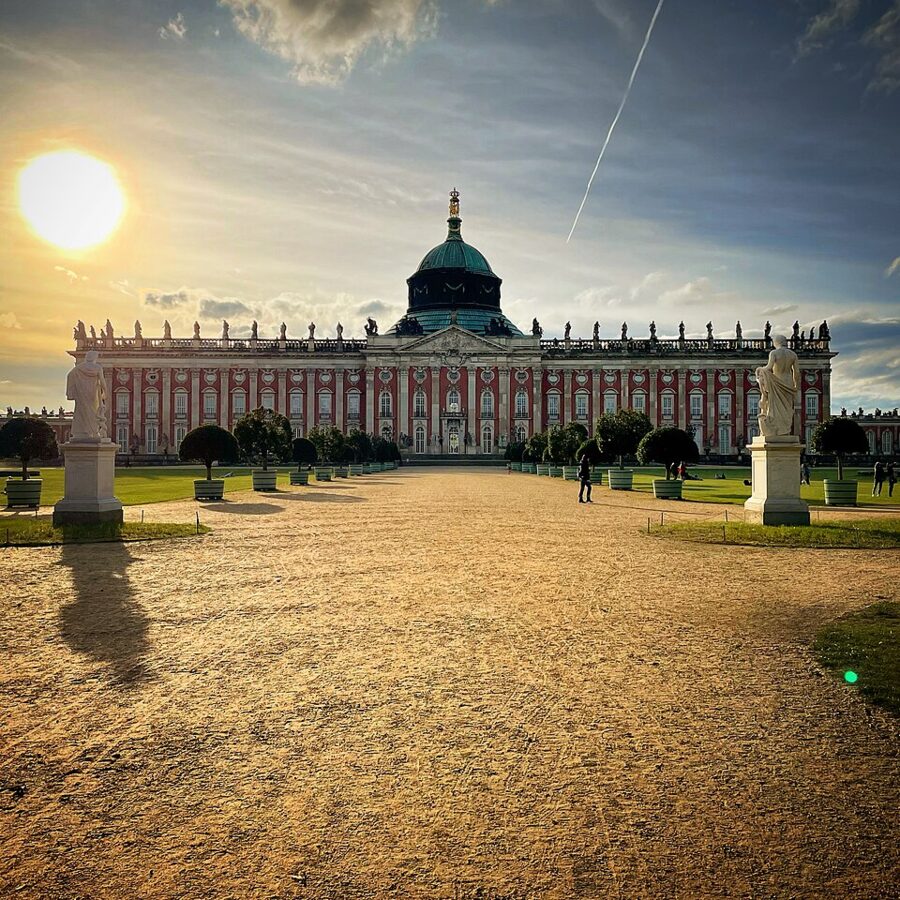
Like Sanssouci it runs on timed slots, Tuesday to Sunday, 10:00–17:30 from April to October and 10:00–16:30 in winter, except in November and December, when it opens on Mondays and closes on Tuesdays instead. The “Grand Tour” ticket costs €14 in 2026 and €16 in 2027; from April to October you can walk through on your own, and from November to March the visit is by guided tour in German. Wilhelm II, the last emperor, made it his family’s main home.
Charlottenhof and the Orangery
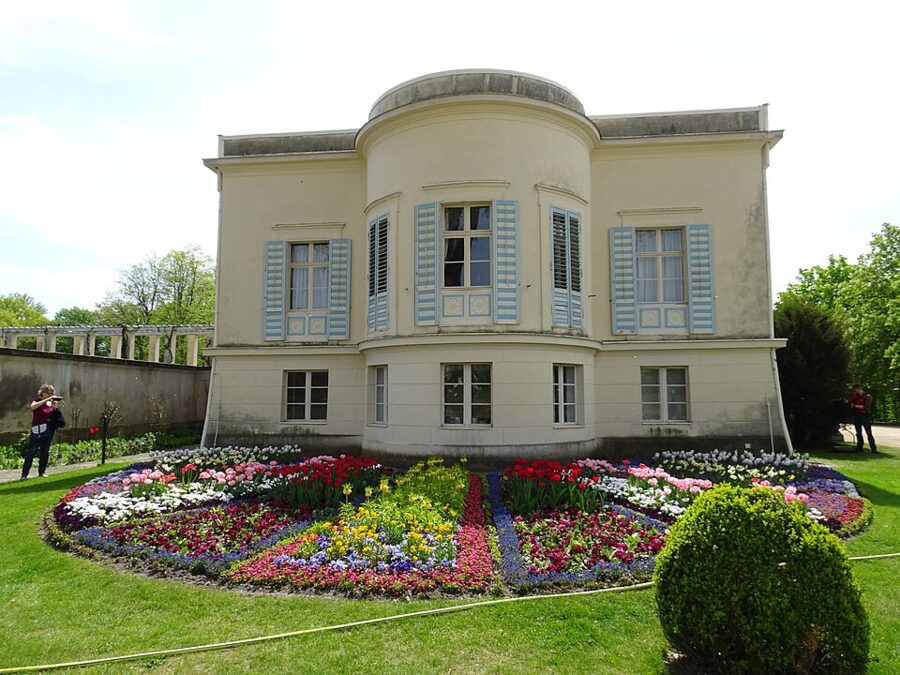
In the south of the park, Charlottenhof Palace was a Christmas present: Frederick William III gave the old farmhouse to his son, the crown prince, in 1825, and the son had Karl Friedrich Schinkel and Lenné turn it into a small Roman-style villa from 1826. Schinkel designed most of the furniture, and the striped corner room is painted to look like the inside of a tent. It opens only from April to October, Wednesday to Sunday, by guided tour.
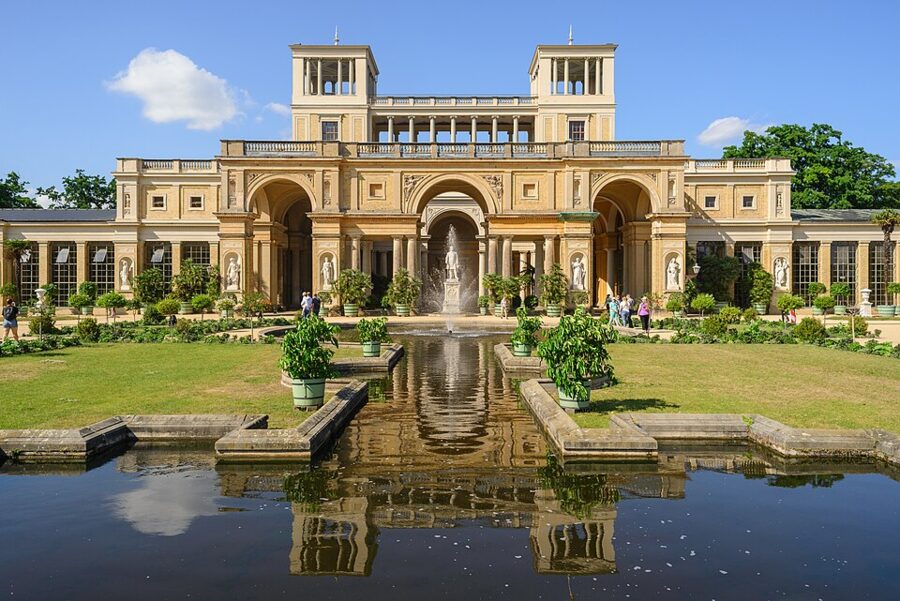
Along the northern ridge, the Orangery Palace (Orangerieschloss) is the last and largest building in the park: more than 300 m long, built in 1851–1864 for Frederick William IV in the manner of an Italian Renaissance villa, with plant halls in which the park’s potted citrus and palms still spend the winter. It is closed for restoration until further notice, so for now it is a facade and a terrace with a view over the town.
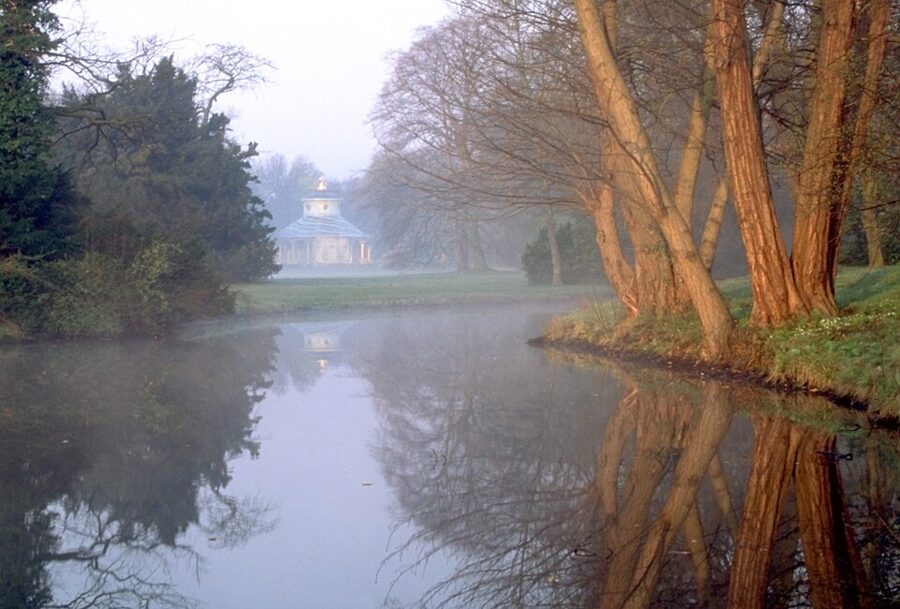
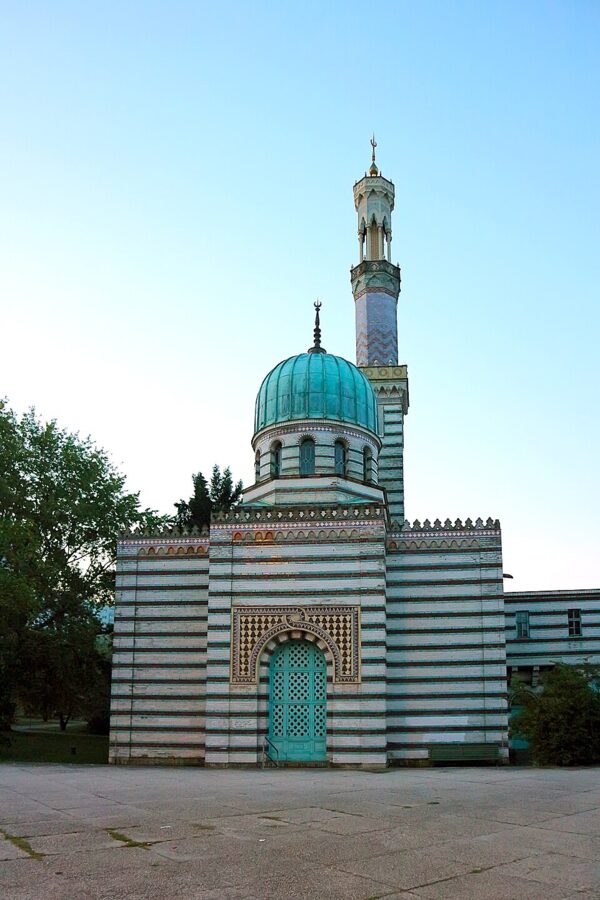
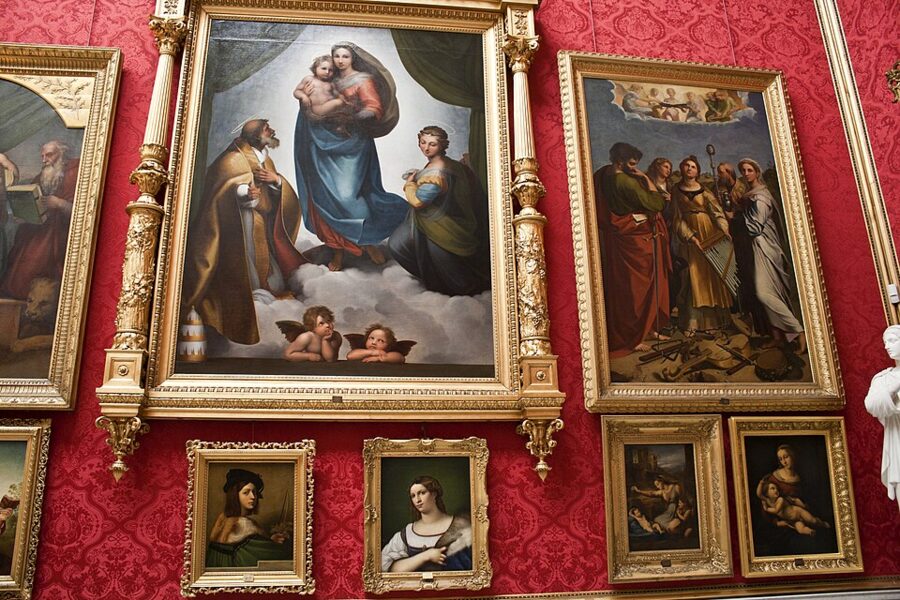
The Picture Gallery next to Sanssouci is the oldest surviving purpose-built gallery in Germany and still hangs Caravaggio’s Doubting Thomas and seven paintings by Rubens; the New Chambers beside it are a guest palace with a jasper hall; and the “mosque” on the Neustädter Havelbucht is a steam-engine house built to pump water to the fountains. The smaller houses all close from November to April.
The Neuer Garten: Marble Palace and Cecilienhof
The Neuer Garten is a deliberate rejection of Sanssouci. Frederick William II (Friedrich Wilhelm II) bought land on the Heiliger See in 1787, a year after he succeeded his uncle, and called in Johann August Eyserbeck from the gardens at Wörlitz to lay out an English landscape park of 102.5 hectares instead of a baroque one. Its small buildings set moods: a kitchen dressed as a Roman temple ruin, a Gothic library, a pyramid that is really an ice cellar, a shell grotto.
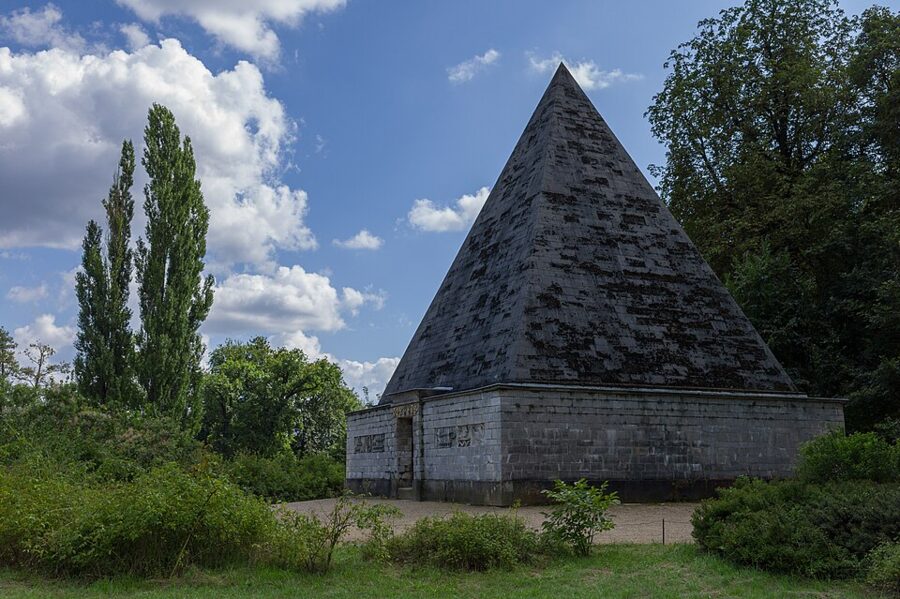
Much of the north shore lay in the border zone from 1960 to 1990, and the foundation has since restored about 13 hectares of it. The old dairy at the north end now houses the Meierei, a brewpub that makes its own beer and closes on Mondays and Tuesdays.
The Marble Palace
The king’s summer house, the Marble Palace (Marmorpalais), stands on a terrace right at the water’s edge. Carl von Gontard built it in 1787–1793, faced in red brick and gray-white Silesian marble, the first and only Prussian royal palace in early neoclassical style, and Carl Gotthard Langhans designed much of the interior. Frederick William II died here on November 16, 1797.
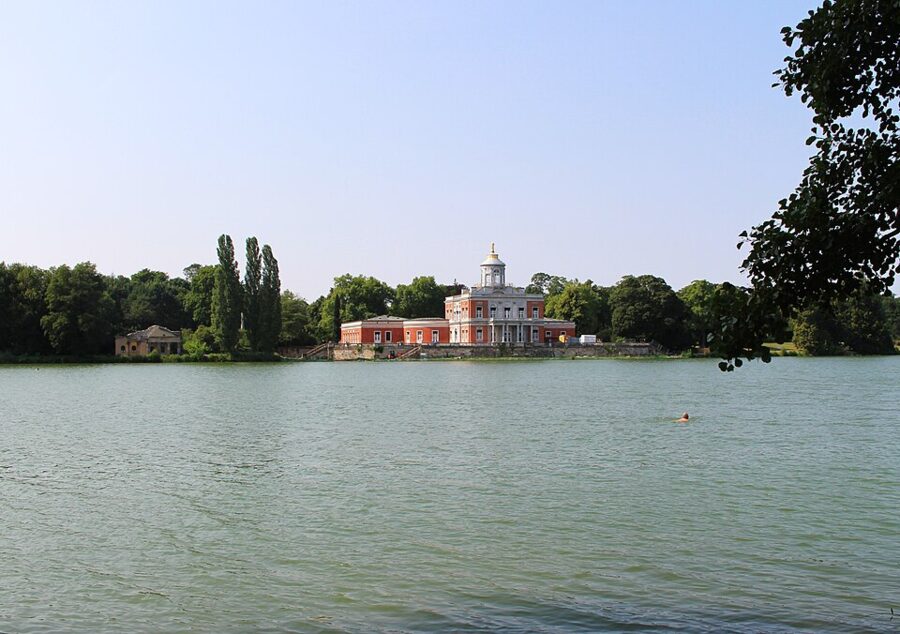
Inside are marble fireplaces bought in Italy, inlaid floors in local woods, two clocks that belonged to Madame de Pompadour and a large collection of Wedgwood. From 1961 the East German army ran its military museum here. A new exhibition in the south wing covers the king, his companion Wilhelmine Enke and the politics of the 1790s, in German, English and Polish.
From April to October it opens Wednesday to Sunday, 10:00–17:30; from November to March only on Saturdays and Sundays, 10:00–16:00. Visits are guided, in German. A single ticket costs €8 in 2026 and €9 in 2027, and a combined ticket with the Belvedere on the Pfingstberg costs €12, on sale from April to October.
Cecilienhof
At the north end of the garden, Cecilienhof is the last palace the Hohenzollerns built: an English country house of brick and timber, put up in 1913–1917 to designs by Paul Schultze-Naumburg for Crown Prince Wilhelm and Crown Princess Cecilie. To hide its 176 rooms, the architect grouped the wings around several courtyards. From July 17 to August 2, 1945, Truman, Churchill (and then Attlee) and Stalin met here for the Potsdam Conference, and the red star planted in the front courtyard for that summer is still there.
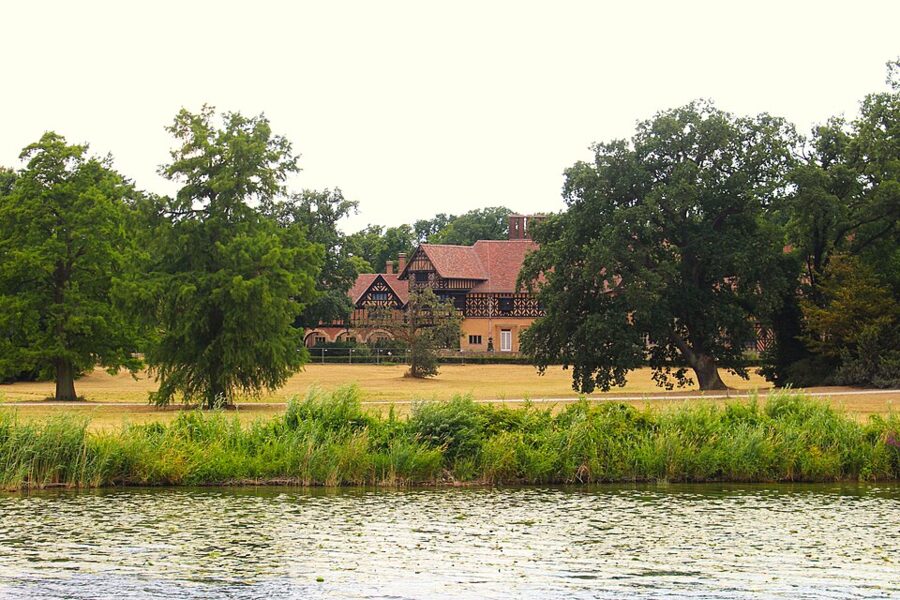
For now, Cecilienhof is closed for restoration until further notice, with virtual tours online in the meantime. The outside and the shore path stay open.
Park Babelsberg
Across the Glienicke narrows to the southeast, Park Babelsberg is the third great park and the one people most often leave out. It was laid out from 1833 for Prince Wilhelm, the later Emperor Wilhelm I, and his wife Augusta, first by Lenné and then by Hermann von Pückler-Muskau, the prince who turned landscape gardening into an art of paths. The result is the best walking park in Potsdam: hilly, wooded, cut with views to the Glienicke Bridge, the Havel and the town.
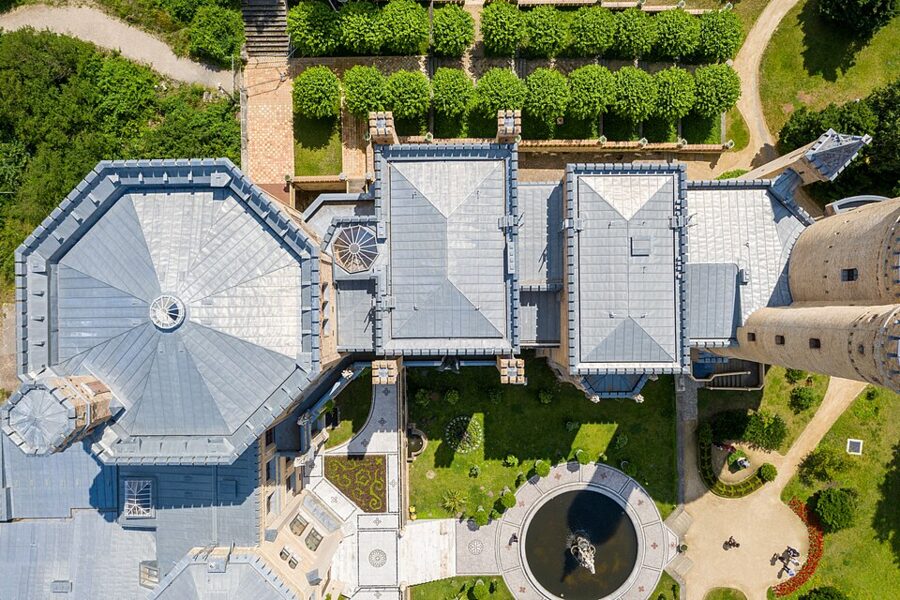
Schinkel’s first house here, of 1833–1835, was the size of a cottage. When Wilhelm became heir to the throne in 1840 he needed something grander, and Ludwig Persius and Johann Heinrich Strack enlarged it in 1844–1849 into the turreted English Gothic castle you see. The facade and terraces were restored by 2016, but Babelsberg Palace is still under restoration inside and opens only for special events.
The building to climb is the Flatow Tower (Flatowturm), a 46 m neo-Gothic lookout modeled on a medieval gate tower in Frankfurt and paid for with the income of an estate called Flatow that belonged to Wilhelm. It opens on Saturdays and Sundays from April to October, 10:00–17:30, for €5, and the view from the platform takes in the whole lake country.
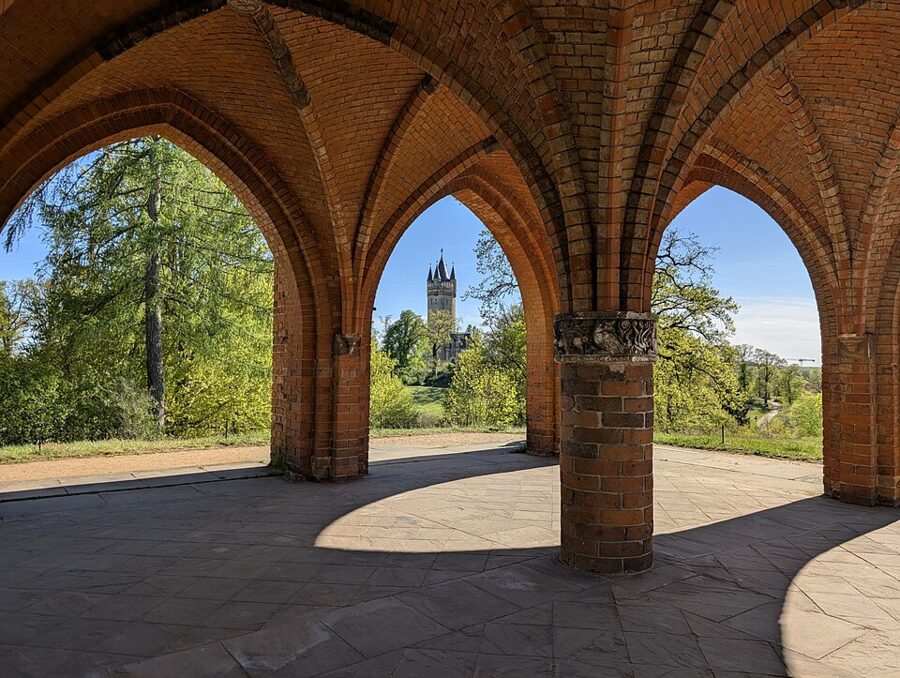
The park itself is free. Its northern shore carried the border fortifications until 1989, and the path along the water, now restored, is the most pleasant way to walk from the Glienicke Bridge to the palace.
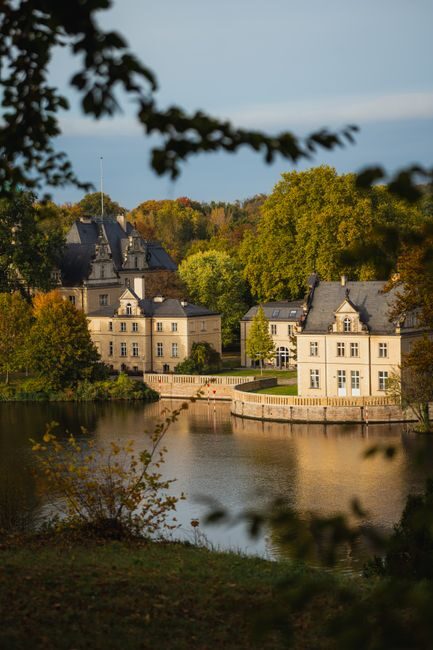
The Pfingstberg: Belvedere and Pomona Temple
North of the old town, beyond the villas of the Nauener Vorstadt, the Pfingstberg rises 76 m, the highest point in the western half of Potsdam. Frederick William IV loved the view from it and from 1847 began a hilltop pleasure palace modeled on the Casino of the Villa Farnese at Caprarola, north of Rome. Money ran out, the Orangery took priority, the king fell ill and died in 1861, and only the double towers with their colonnades and courtyard were finished in 1863.
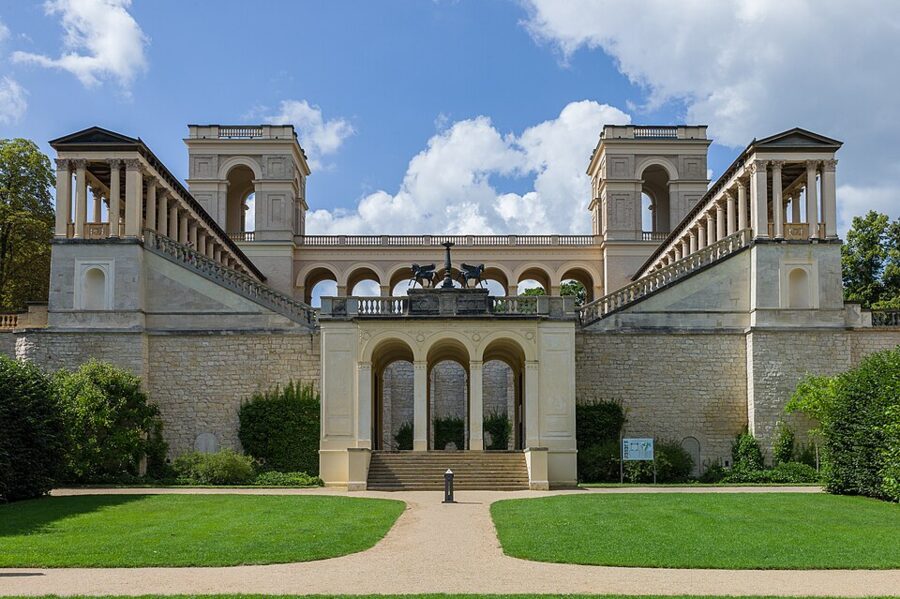
The Belvedere on the Pfingstberg had a hard twentieth century. After the war Soviet officers lived in the villas below; after 1961 the towers were closed because you could see the border and West Berlin from them, and the building fell to pieces. In 1987 a group of young Potsdam residents began clearing it, held a festival on the hill in June 1989, and became the association that still runs it, the only monument in the World Heritage site operated by a private society.
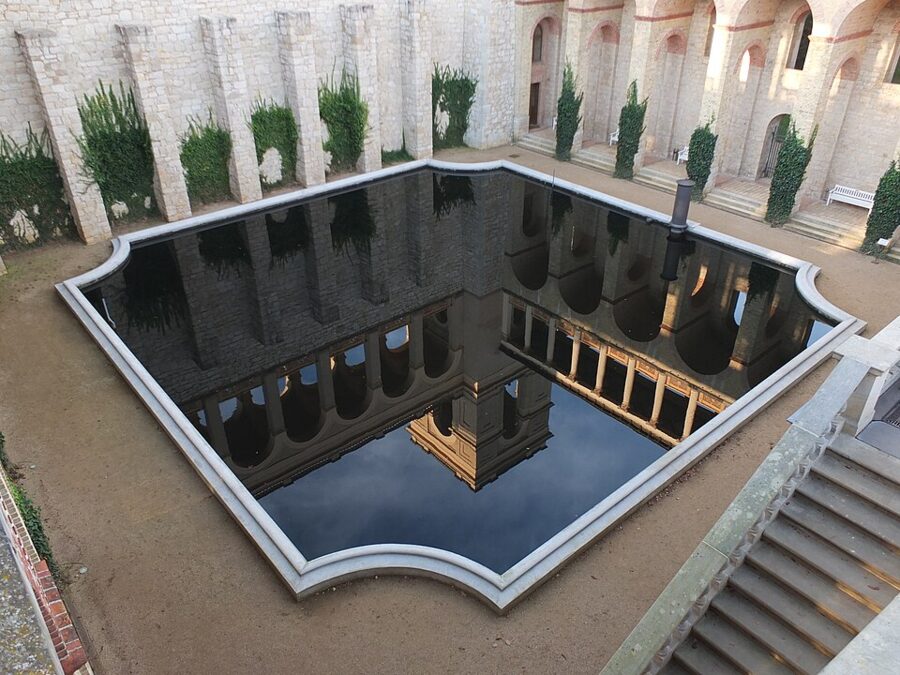
It opens from April: Tuesday to Friday 10:00–17:00, weekends 10:00–18:00, and until 19:00 at weekends from July to September. It is closed from November to February. Admission is €8 (reduced €6), and holders of the sanssouci+ ticket pay the reduced price.
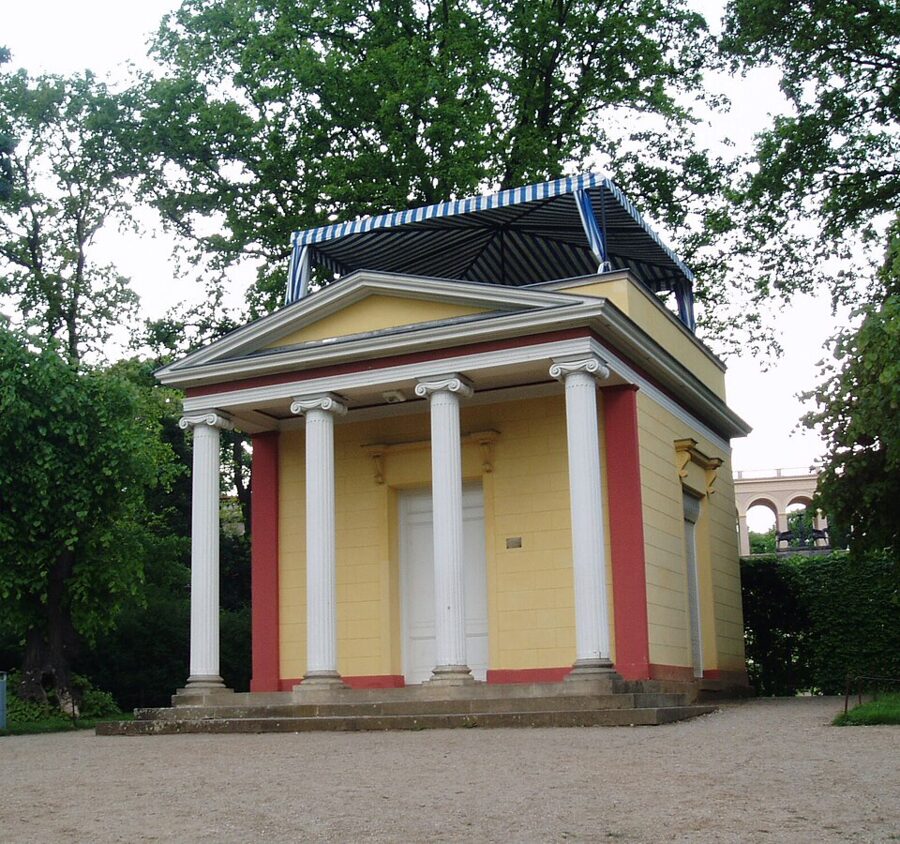
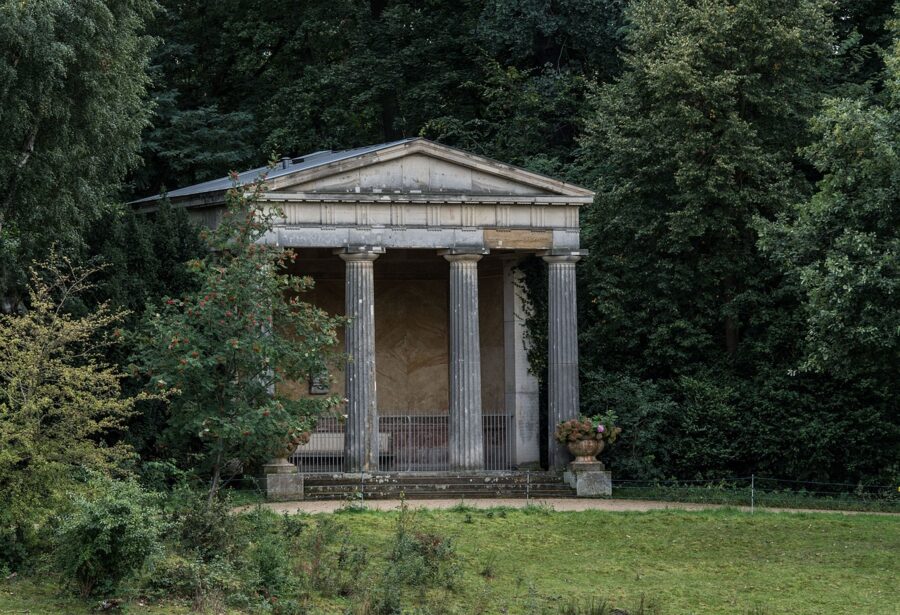
Below the Belvedere, the small Pomona Temple (Pomonatempel) was the first building Schinkel ever designed, a tea pavilion put up around 1800 for the owner of the vineyard here when he was 19. It was a ruin by the 1980s and was rebuilt by 1993; entry is free when it is open. Had the king’s full Pfingstberg plan been built, the temple would have been demolished to make room for it.
Across the water in Berlin: Glienicke and Peacock Island
Walk east over the Glienicke Bridge and you are in Berlin, in Steglitz-Zehlendorf, and still in the same garden: the same family and the same gardener made Glienicke and Peacock Island, and both were designed to look back at Potsdam.
Glienicke Palace and park
Prince Carl of Prussia came back from his first journey to Italy in 1823, aged 21, wanting an Italian villa. He bought Glienicke, a country house whose grounds Lenné had already laid out for the state chancellor Hardenberg, and from 1825 Schinkel rebuilt the house as a small classical palace with a casino on the shore and two lookout pavilions on the road, the Large and Small Curiosity (Große and Kleine Neugierde). Carl collected ancient sculpture and set fragments of it into the walls, which gives the place its Mediterranean air.
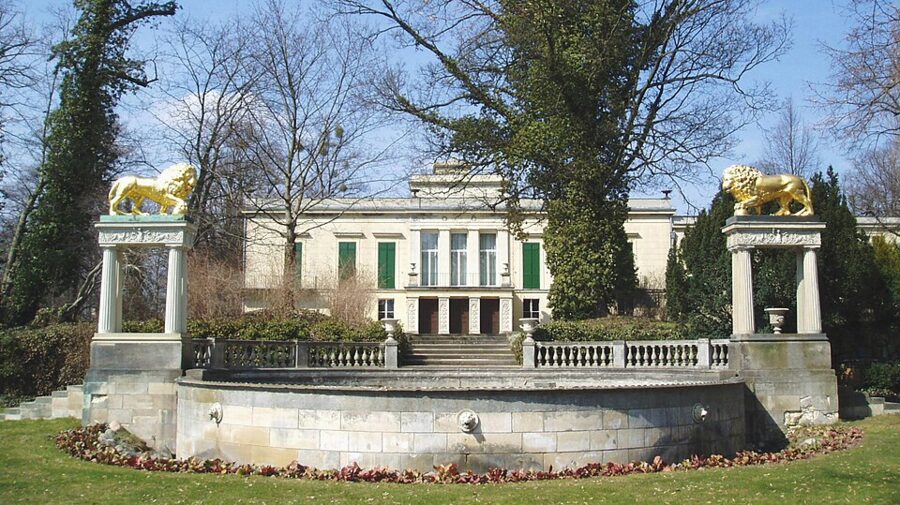
Inside Glienicke Palace the upstairs rooms are Schinkel’s: a Red Hall, a green salon, a turquoise bedroom and a deep-blue library. The west wing has housed a museum of the court gardeners since 2006, the first of its kind in Europe. In November and December it opens only on Saturdays and Sundays, 10:00–16:00, with guided tours at set times, and admission is €8.
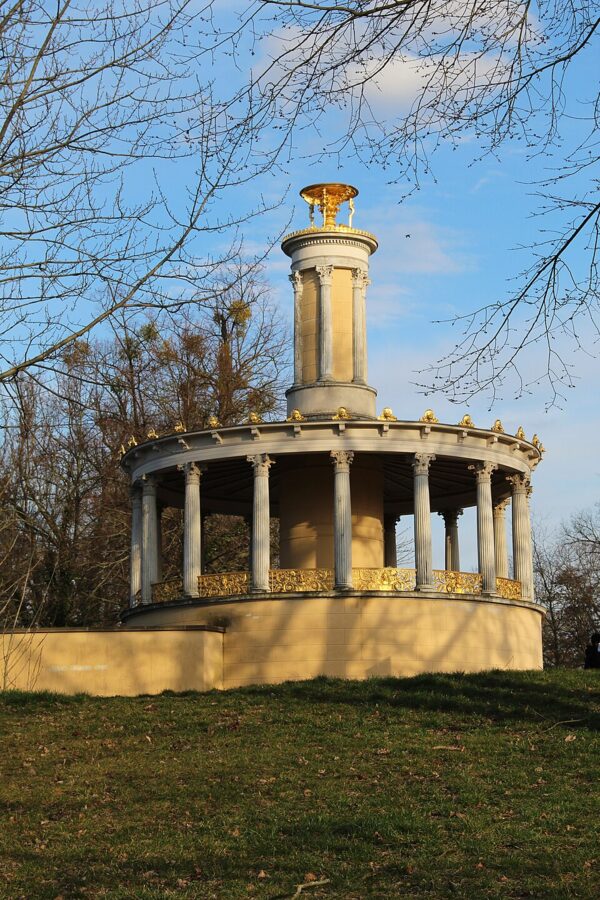
The free park is the reason to come: Lenné’s flower garden, pleasure ground and wilder park, circled by a carriage path that keeps opening views to Babelsberg and Potsdam.
Peacock Island
A few kilometers downstream, Peacock Island (Pfaueninsel) is reached only by a short ferry. Its history is pleasantly odd: in 1685 the Great Elector gave it to the alchemist and glassmaker Johannes Kunckel, a century later Frederick William II and Wilhelmine Enke made it their hideaway, and under Frederick William III and Queen Luise it became an ornamental farm with a menagerie whose animals went to found the Berlin Zoo in 1842. Lenné turned it into a landscape park from 1818 and planted a rose garden in 1821, now the oldest in Berlin.
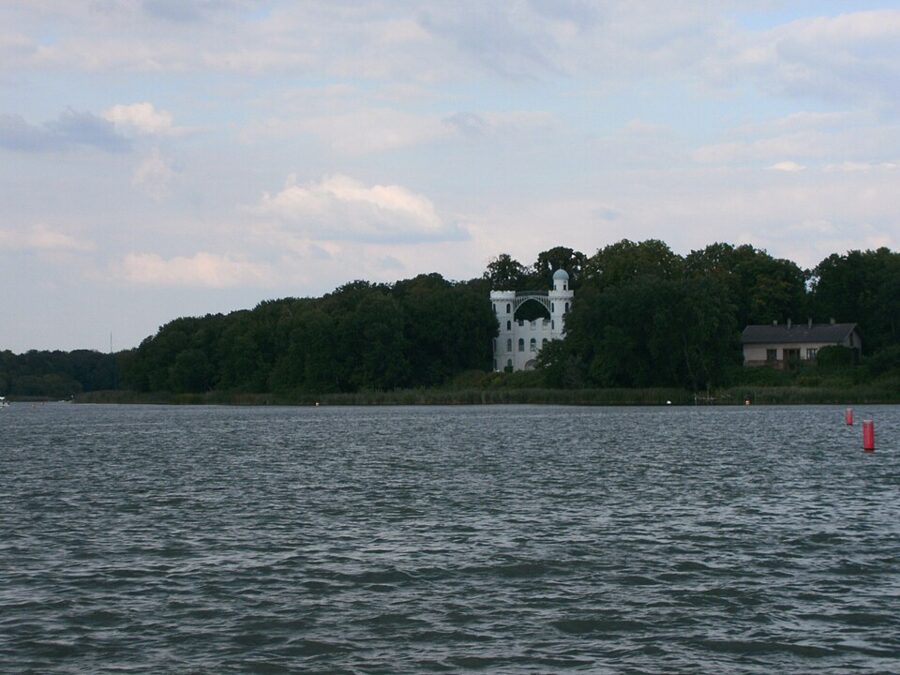
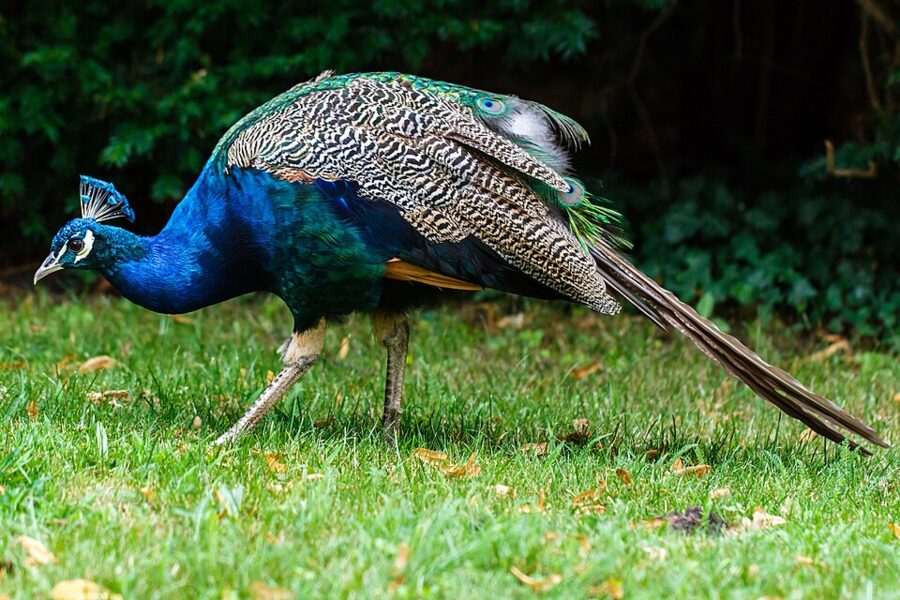
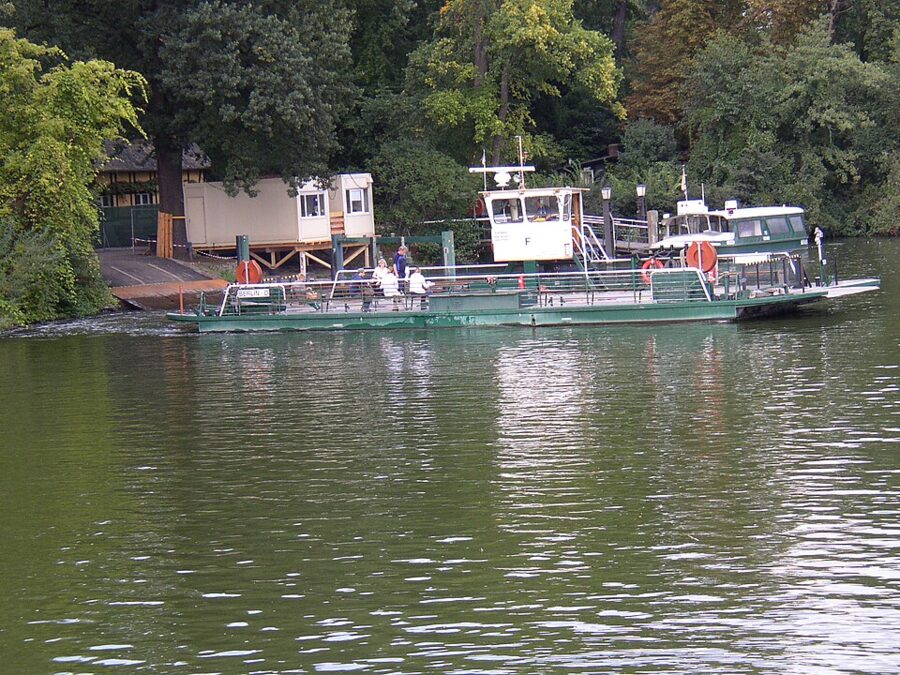
The island covers 67 hectares of land with about 400 old oaks and is a nature reserve as well as a garden, so the island rules exclude bicycles and dogs. The ferry runs daily, 10:00–16:00 in November and December and longer in summer, with the last crossing to the island 45 minutes before the end of service. The fare is €6 (reduced €5) and must be bought online or at the machine on the jetty, which takes cards or coins only.
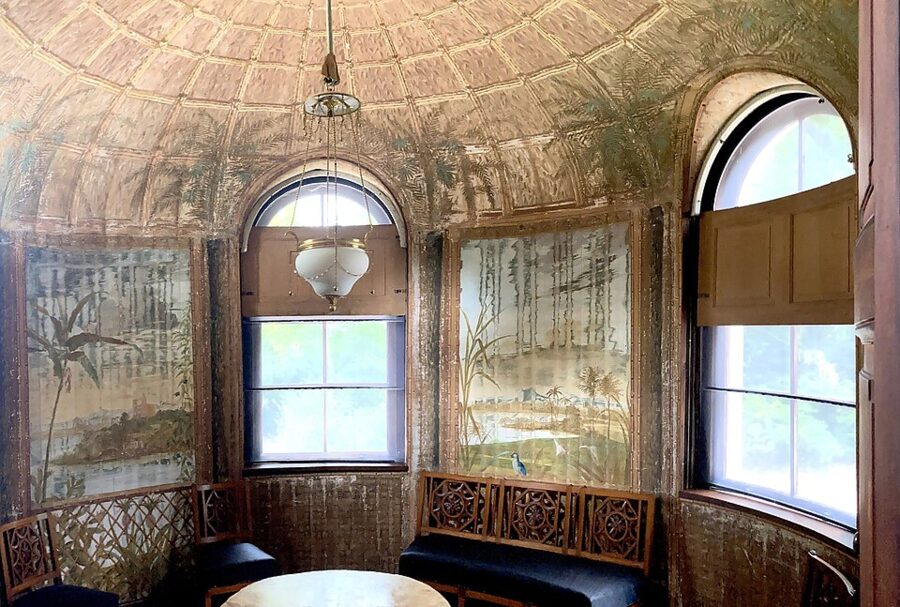
The palace on Peacock Island opens from April to October, Wednesday to Sunday, 10:00–17:30, by guided tour, with tickets sold only on the day at the ferry house for €8 in 2026 and €9 in 2027. The early neoclassical rooms are largely original. The tower room is painted as a bamboo hut in Tahiti, with palms around the windows, a South Seas fantasy dreamed up some 20 years after Europeans first reached the island.
The island has a darker evening in its record too. On August 15, 1936, Joseph Goebbels closed the Berlin Olympics with an “Italian Night” here for thousands of guests, with army engineers laying a pontoon bridge across to the island, the opera ballet dancing by torchlight and a fireworks display he wanted to be the largest the world had seen.
To get here, take the S7 or a regional train to Berlin-Wannsee and bus 218 to its terminus at the Pfaueninsel jetty.
Sacrow and the Church of the Redeemer
On the northern shore of the Jungfernsee, facing Glienicke and the Neuer Garten, Frederick William IV bought the Sacrow estate in 1840, the year he took the throne. He had Ludwig Persius build a church on a spit of land running into the water, in the form of an early Christian basilica with a freestanding bell tower, from his own sketches. The Church of the Redeemer (Heilandskirche) was consecrated on July 21, 1844; a third of its cost went into the timber piles that hold it up in the reeds.
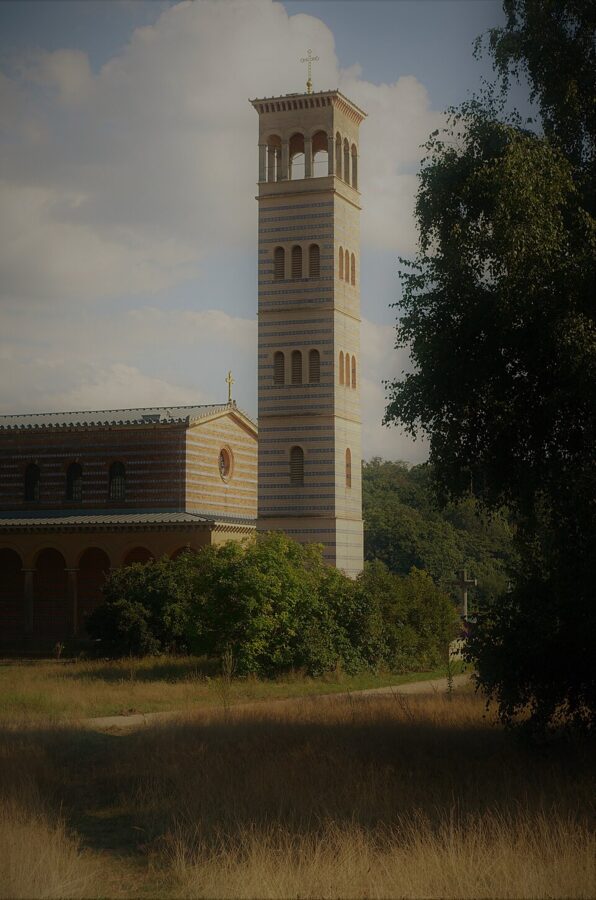
The Wall went straight through the churchyard. Services continued until Christmas Eve 1961; days later the border troops wrecked the interior, and the church stood sealed in the death strip for nearly three decades. West Berliners, watching it decay from the opposite bank, pressed for a repair of the outside in 1984–1985, and on Christmas Eve 1989 a service was held there again. The interior was restored in 1993–1995.
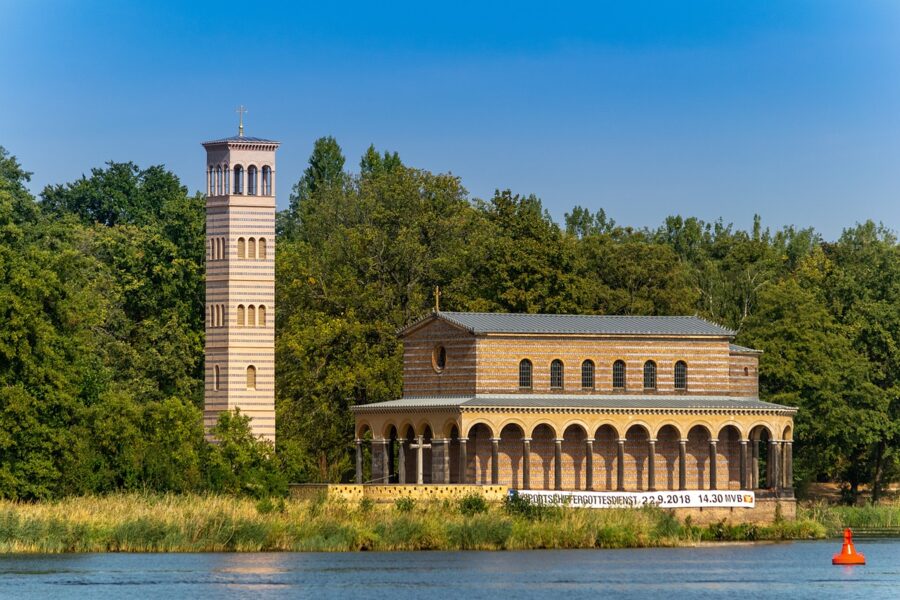
Volunteers from the Ars Sacrow association open the church, and its opening hours change by the month: from May to August on Thursdays 11:00–16:00 and Friday to Sunday 11:00–17:00, in spring and autumn Friday to Sunday 11:00–16:00, and in winter only on Saturdays and Sundays, 11:00–15:30. You can reach it only on foot through the park.
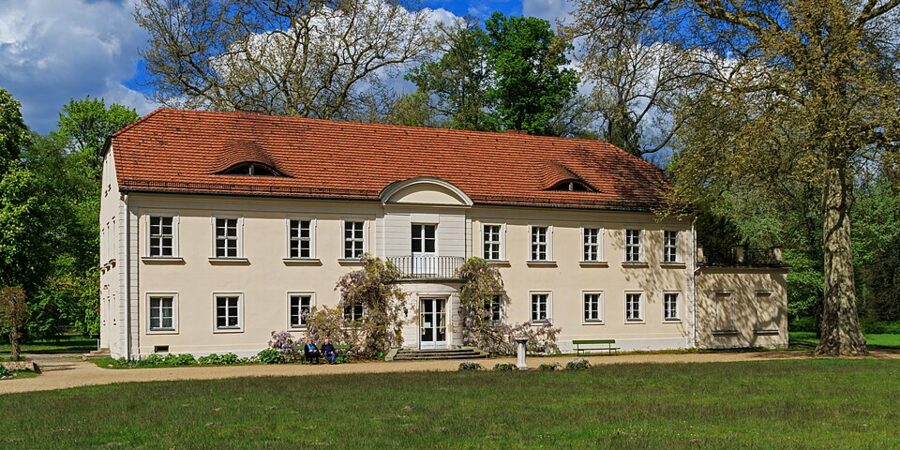
The park at Sacrow holds one of Lenné’s finest fans of views, opening from the garden side of the palace toward the hunting lodge and the Große Neugierde at Glienicke, the Flatow Tower and the Potsdam skyline. Eight hectares of it were bulldozed for the border; the paths and views have been restored since 1994. Bus 697 runs to the Schloss Sacrow stop, and from March to October boats call at the church.
Caputh and the Jagdschloss Stern
Caputh Palace
South of the town, in the village of Caputh on the Templiner See, stands the oldest of the set. Caputh Palace (Schloss Caputh) was rebuilt from 1662 for the elector’s quartermaster Philippe de la Chièze and from 1671 embellished by Electress Dorothea, the Great Elector’s second wife. It is the only palace from the Great Elector’s time left in the Potsdam landscape, and it came through the following three centuries nearly unchanged.
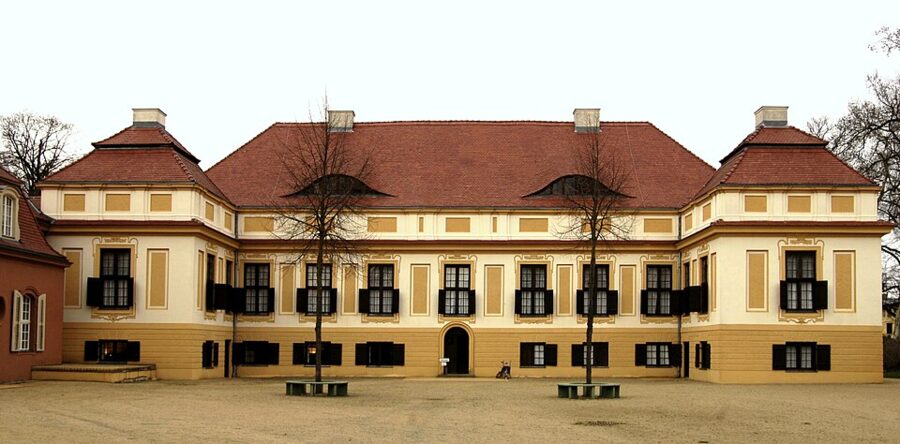
The rooms keep their late seventeenth-century stucco and painted ceilings, and the basement holds the summer dining room that Frederick William I, the “Soldier King,” lined with about 7,500 Dutch tiles. It was a vocational school from 1947 and became a museum in 1999. In winter it opens on Saturdays and Sundays, 10:00–16:00, by guided tour; in the main season, Wednesday to Sunday, 10:00–17:30. A ticket costs €8 in 2026 and €9 in 2027, sold separately from the Potsdam combination tickets.
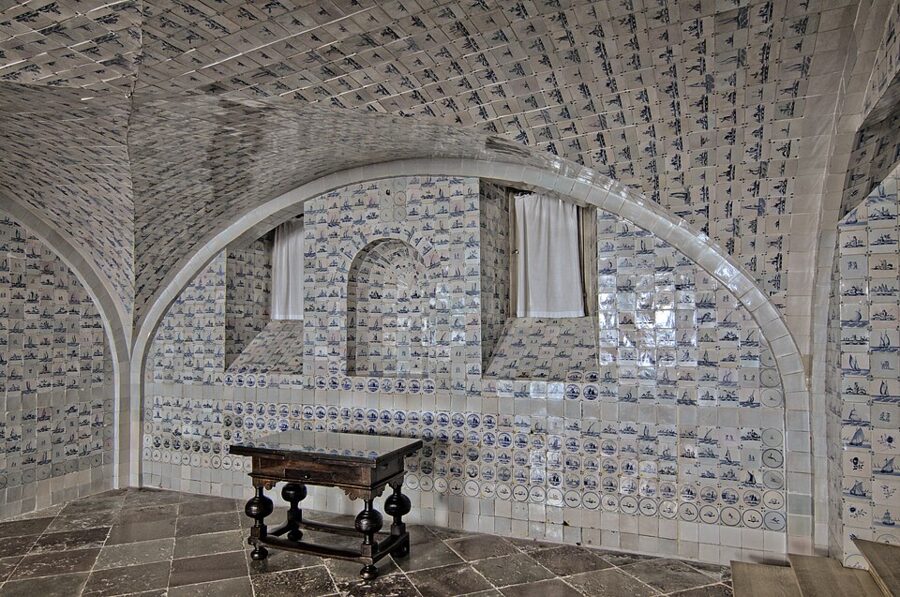
Bus 607 from Potsdam Hauptbahnhof stops at Caputh, Schloss, and in summer boats from the Lange Brücke call at the palace landing.
The Jagdschloss Stern
The Soldier King built the Jagdschloss Stern in 1730–1732 as a plain hunting lodge in the style of a Dutch townhouse, at the edge of a star of 16 rides cut through the Parforceheide forest for hunting stag with hounds. It survives almost as built, with its paneled hall, bedroom, adjutant’s room and kitchen. A local association looks after it and opens it only for events, when entry is free; at other times an audio guide on your phone tells the story outside.
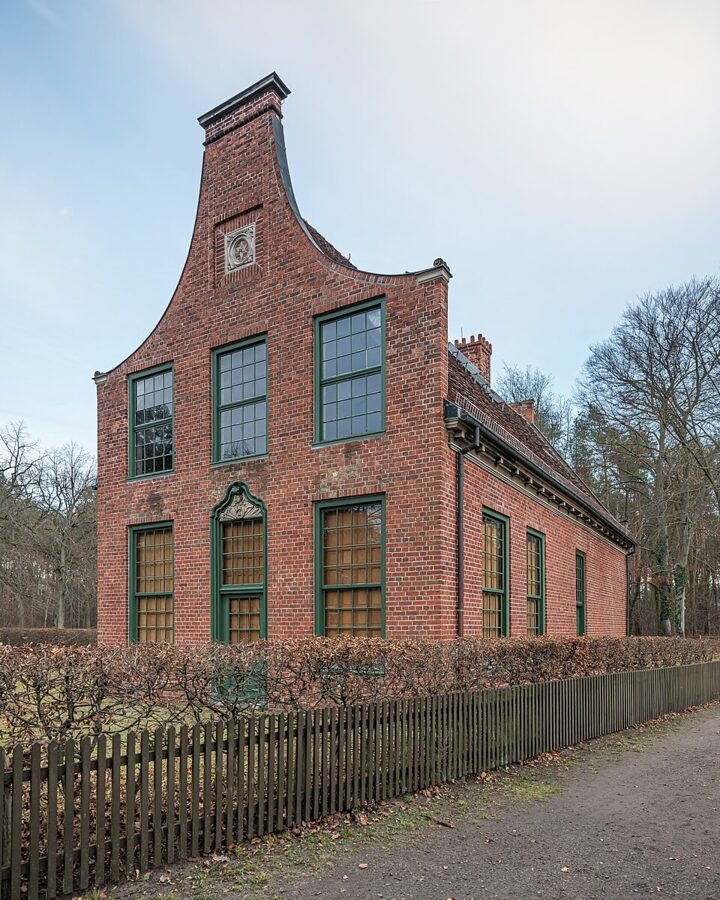
Go only on an open day. Buses 690 and 694 and trams 92 and 96 stop at Gaußstraße nearby.
The palace that came back: the Stadtschloss and the Marstall
The palace most people pass without a glance stands a bridge away from the station. Potsdam’s City Palace (Stadtschloss) on the Alter Markt was the electors’ and kings’ town residence, remodeled by Knobelsdorff for Frederick the Great around 1750. A British air raid on April 14, 1945, burned it out, and in May 1959 the East German Politburo decided to clear the ruin. It was blown up between December 1959 and April 1960, and much of the rubble went to fill in the Lustgarten next door.
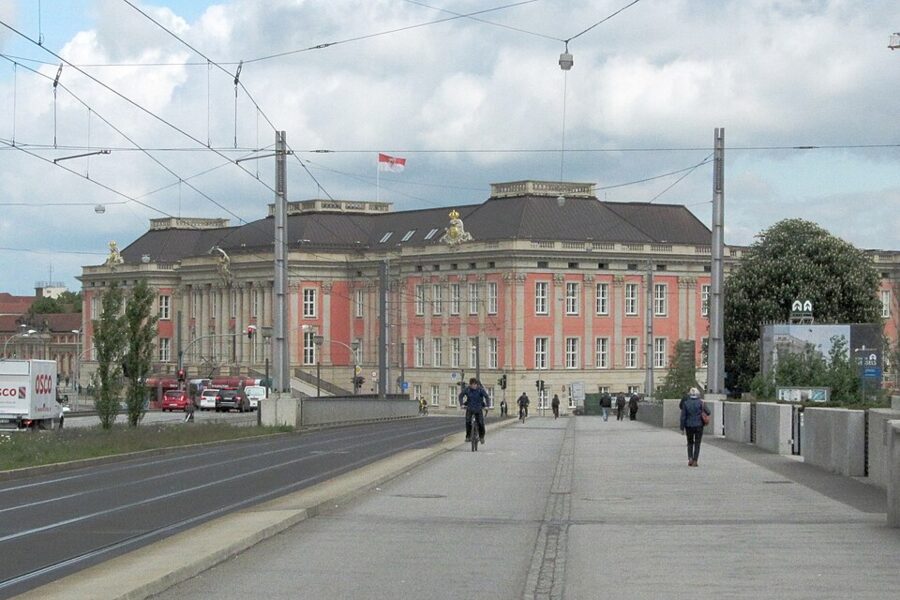
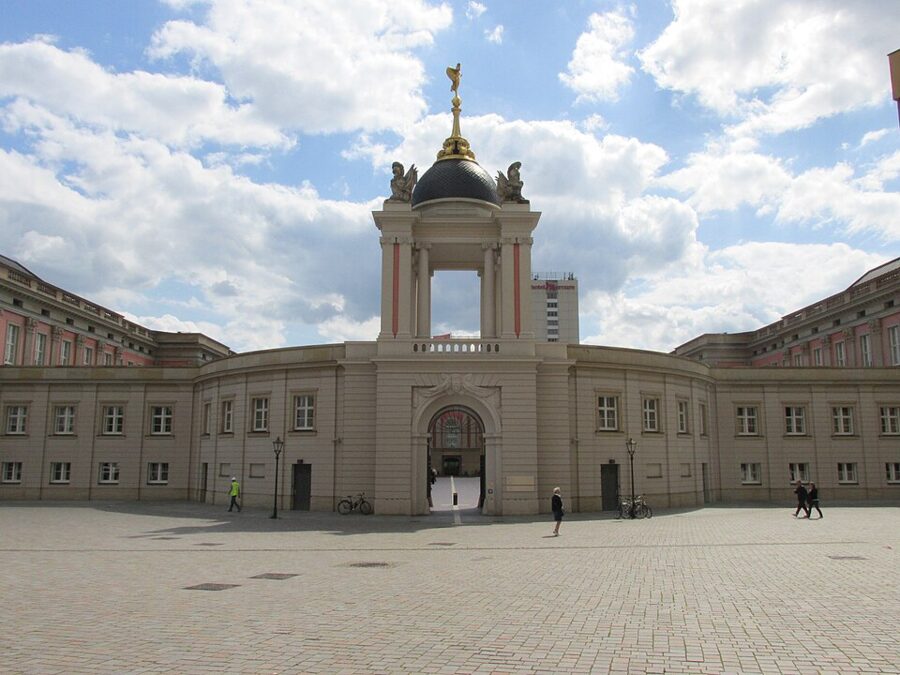
The first piece back was the Fortuna Portal, the gate facing the square, paid for partly by the television host Günther Jauch. In 2005 the state parliament voted to build its new home within the old palace’s outline, and the software founder Hasso Plattner gave €20 million so the facades could be rebuilt in the historic style.
Building began on March 25, 2010, and the Brandenburg state parliament moved in on January 21, 2014. Peter Kulka designed the building, with the old facades and Knobelsdorff’s staircase rebuilt. On the west front, large letters say Ceci n’est pas un château, “this is not a palace,” in a nod to Magritte. The inner courtyard is open to anyone who walks through the Fortuna Portal.
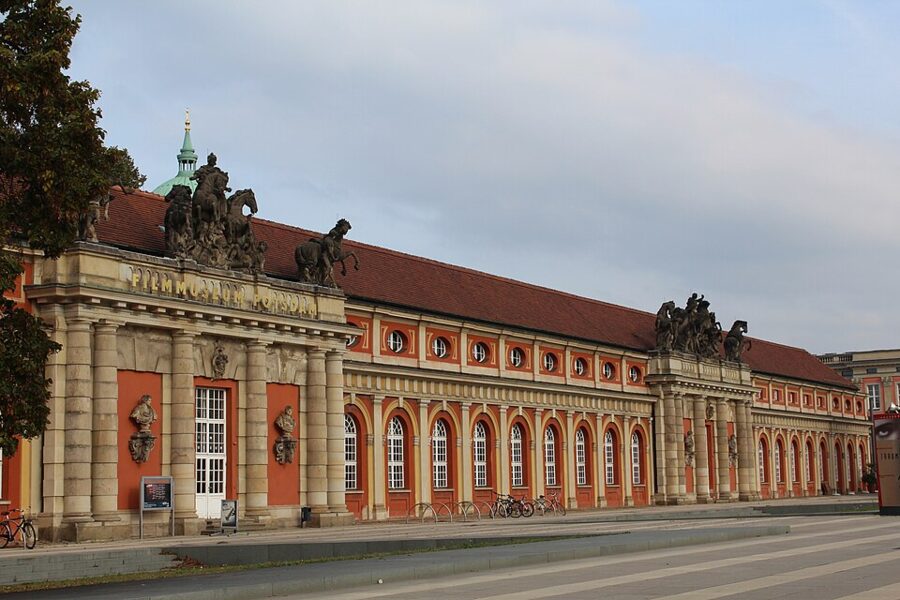
Across the road, the long, low Marstall is the oldest building in the center of Potsdam and the only large part of the palace precinct to survive. It began in 1685 as an orangery for the Great Elector, became the royal stables under the Soldier King in 1714 and was lengthened by Knobelsdorff in 1746. Since 1981 it has been the Filmmuseum Potsdam, open Tuesday to Sunday, 10:00–18:00, for €12.
Which interiors are worth a ticket
With limited time, I’d go inside three palaces and walk past the rest. Sanssouci, for the rooms Frederick actually lived in; the New Palace, for the Grotto Hall and the scale of the state rooms; and one of the smaller houses by the water, either the Marble Palace or, in summer, the palace on Peacock Island. The rooms in these three are mostly original, which is rarer here than you might think.
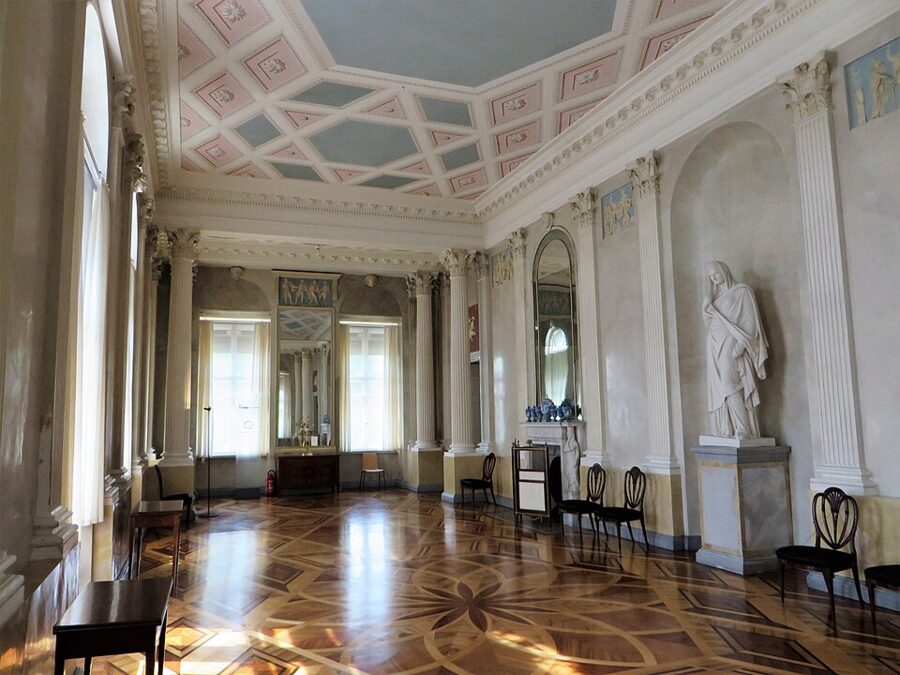
Charlottenhof is my pick for a fourth, a short tour of rooms that are almost entirely Schinkel’s. Glienicke is for those who already love Schinkel, Caputh for the tile hall and a lakeside afternoon, and the New Chambers and the Picture Gallery for an hour left over on a combination ticket.
Some decisions are made for you. Cecilienhof, the Orangery Palace and the Roman Baths are closed for restoration, Babelsberg Palace opens only for events, and the King’s Apartment in the New Palace is shut as well. In each case the garden is open and is the better half of the visit anyway: the Neuer Garten for Cecilienhof, the terraces for the Orangery, Park Babelsberg for its palace.
Babelsberg, Sacrow and Glienicke are walks first and palaces second, and the Neuer Garten is worth an afternoon with every door shut. The Belvedere you climb for the view.
Seasons, Mondays and closing days
Most interiors close on Mondays, but in November and December the New Palace opens on Mondays and closes on Tuesdays instead. The visitor center at the Historische Mühle closes on Mondays and the one at the New Palace on Tuesdays, all year. Several houses open only from April to October, and in winter the larger palaces shorten their hours and switch to guided tours.
| Palace | April–October | Winter | Single ticket 2026 |
|---|---|---|---|
| Sanssouci Palace | Tue–Sun 10:00–17:30, timed entry | Tue–Sun 10:00–16:30 | €14 |
| New Palace | Tue–Sun 10:00–17:30, timed entry | 10:00–16:30, guided; closed Tue (not Mon) in November and December | €14 |
| Charlottenhof, Chinese House, Picture Gallery, New Chambers | Wed–Sun 10:00–17:30 | Closed | €10 Flanierkarte for all |
| Marble Palace | Wed–Sun 10:00–17:30 | Sat–Sun 10:00–16:00 | €8 |
| Belvedere on the Pfingstberg | Tue–Sun from 10:00 | Closed November–February | €8 |
| Flatow Tower | Sat–Sun 10:00–17:30 | Closed | €5 |
| Palace on Peacock Island | Wed–Sun 10:00–17:30 | Closed | €8 plus €6 ferry |
| Glienicke Palace | Check before you go | Sat–Sun 10:00–16:00 | €8 |
| Caputh Palace | Wed–Sun 10:00–17:30 | Sat–Sun 10:00–16:00 | €8 |
The sanssouci+ ticket and the others
If you plan to see Sanssouci and at least one other palace on the same day, buy the sanssouci+ ticket. It costs €22 in 2026 (reduced €17) and €24 in 2027 (reduced €20), covers one visit to every open SPSG palace in Potsdam on a single day, and includes a timed entry at Sanssouci and, if you choose, at the New Palace. The family version costs €49 for two adults and up to four children. It does not cover Sacrow, the Jagdschloss Stern or special exhibitions, and at the Belvedere it gets you the reduced price.
The foundation’s other combination tickets fill the gaps. The Flanierkarte, a “strolling ticket,” costs €10 for the palace kitchen, the New Chambers, the Picture Gallery, the Chinese House and Charlottenhof on one day; the Kombiticket Potsdam costs €18 for all Potsdam palaces except Sanssouci, sold from April to October; and the annual pass costs €80 and includes the Peacock Island ferry.
How to combine them
For getting to Potsdam from Berlin, the trains and which ticket to buy, see the day trip from Berlin guide. Inside the palace country, one ticket does it all: a 24-hour ticket for Berlin ABC costs €12.90 and covers Potsdam, Wannsee and Peacock Island, against €5.00 for a single ticket Berlin ABC, and the Deutschlandticket is valid on every bus, tram and regional train mentioned here.
By tram and bus
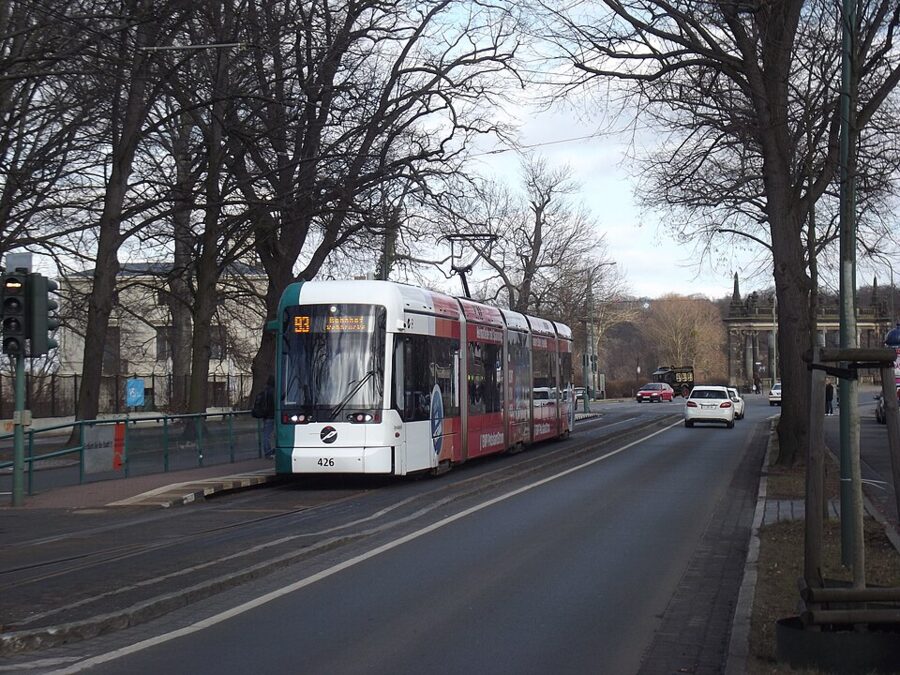
Almost everything starts from Potsdam Hauptbahnhof, the main station. Bus 695 runs to Schloss Sanssouci, buses 605 and X5 go on to the Neues Palais stop, and trams 91 and 94 stop at Schloss Charlottenhof. Trams 92 and 96 run north to Puschkinallee and Am Schragen for the Pfingstberg, bus 603 serves the Marble Palace and Cecilienhof, and tram 93 ends at the Glienicke Bridge.
For Babelsberg, take trams 94 or 99 to Alt Nowawes, or bus 616 to Schloss Babelsberg. Bus 697 reaches Sacrow, bus 607 Caputh, and buses 218 and 316 leave from Berlin-Wannsee station for Peacock Island and Glienicke.
By bike
A bike suits this landscape better than anything else: the parks lie a few kilometers apart, too far to walk between more than once or twice in a day and easy on two wheels. Potsdam per Pedales rents bikes and e-bikes from its stations at Potsdam Hauptbahnhof and Griebnitzsee station. Inside the parks, the park rules for Sanssouci allow cycling only on the signed routes, and the foundation’s park map marks them and the bike racks; on Peacock Island, the island’s rules ban bikes altogether.
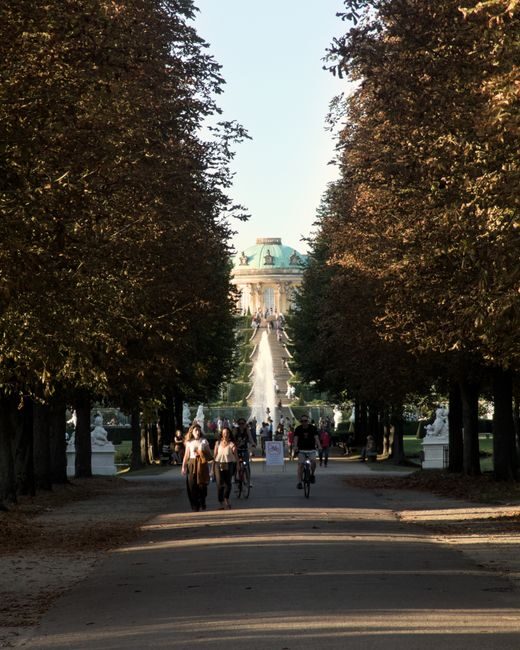
A good loop runs from Sanssouci along the Voltaireweg to the Neuer Garten, about 3 km, then past the Glienicke Bridge into Park Babelsberg.
By boat
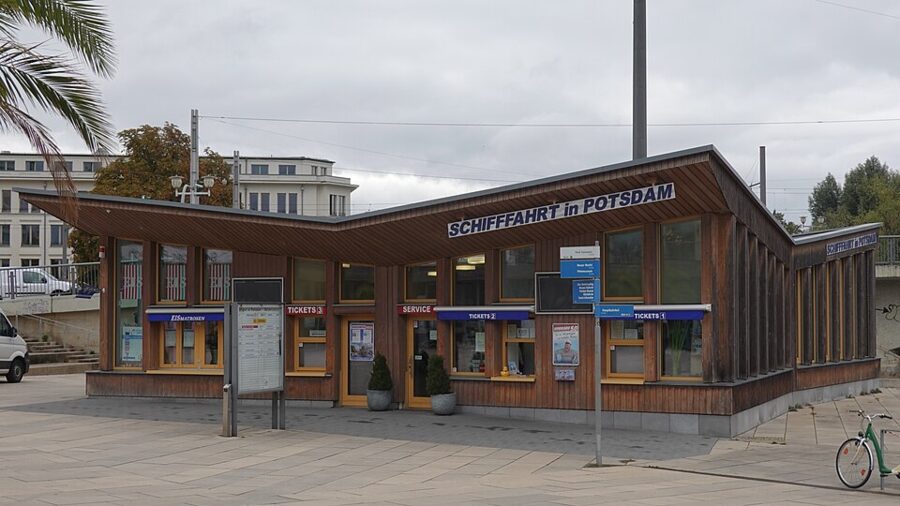
From the Lange Brücke landing, below the rebuilt City Palace, Schifffahrt in Potsdam runs a 90-minute palace cruise that passes Babelsberg, goes under the Glienicke Bridge and out onto the Jungfernsee, from €23. It shows the waterfronts as they were designed to be seen, from the lake. In season the same company’s scheduled boats also call at landings for the Neuer Garten, Sacrow church, Glienicke, Peacock Island and Caputh, so a boat can be your transport as well as a tour.
A one-day plan
Book a morning slot at Sanssouci, ideally for when it opens at 10:00, and walk down the terraces afterward. Cross the park on the main avenue past the Picture Gallery, the Chinese House and, in summer, Charlottenhof, to the New Palace for an early-afternoon Grand Tour. Then take a bus back toward the center and bus 603 north to the Neuer Garten, for the Marble Palace if it is open and the lakeshore walk to Cecilienhof. One sanssouci+ ticket covers every interior on the route; avoid Mondays, and in November and December Tuesdays.
A two-day plan
Day one as above. On day two, start with the Belvedere on the Pfingstberg in the morning light, walk down through the Neuer Garten to the Glienicke Bridge, cross into Berlin for Glienicke Palace and its park, then go on by bus to Peacock Island for the afternoon. Or stay in Potsdam and swap the Berlin half for Park Babelsberg and the Flatow Tower on a summer weekend.
Go back to the lawn by the Marble Palace at the end of the second day, when the light comes low across the Heiliger See. The white palace on Peacock Island is still there at the end of its lane in the trees, and now you know who cut the lane, who lived at the far end and what the view was for. You have also stood at the other end of it, which was always the idea.