

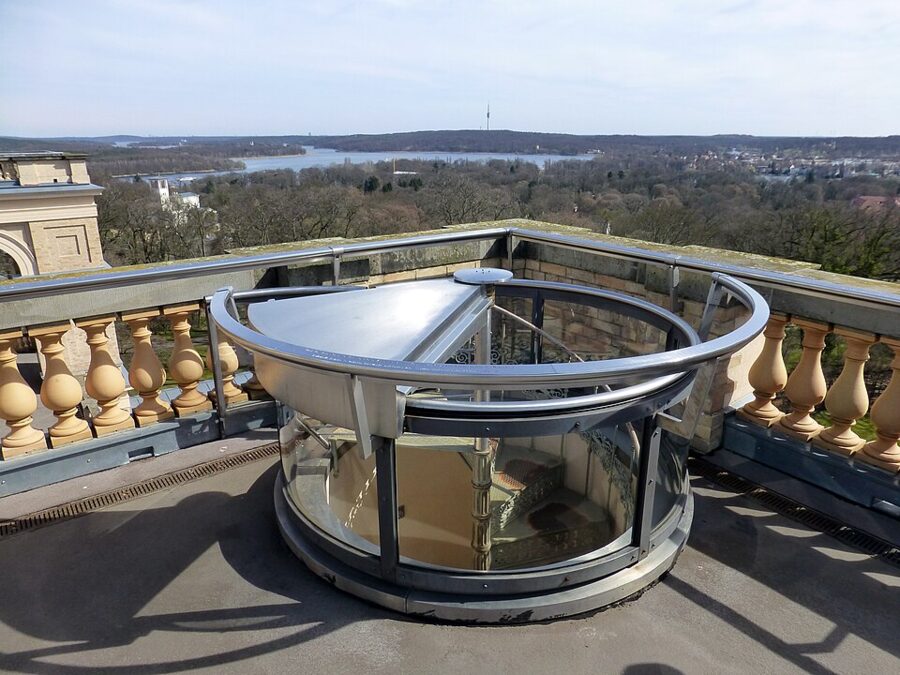
Climb the cast-iron spiral stair to the roof of the Belvedere’s west tower and Potsdam opens on every side: the green dome of the Nikolaikirche to the south, the Jungfernsee to the east, woods and water running off toward Berlin. In 1961 this roof was closed to everyone, and it was forty years before the public stood on it again. The view took in the border, the Soviet garrison and the direction of West Berlin, so the towers were sealed, the windows were concreted over and the palace was left to rot.
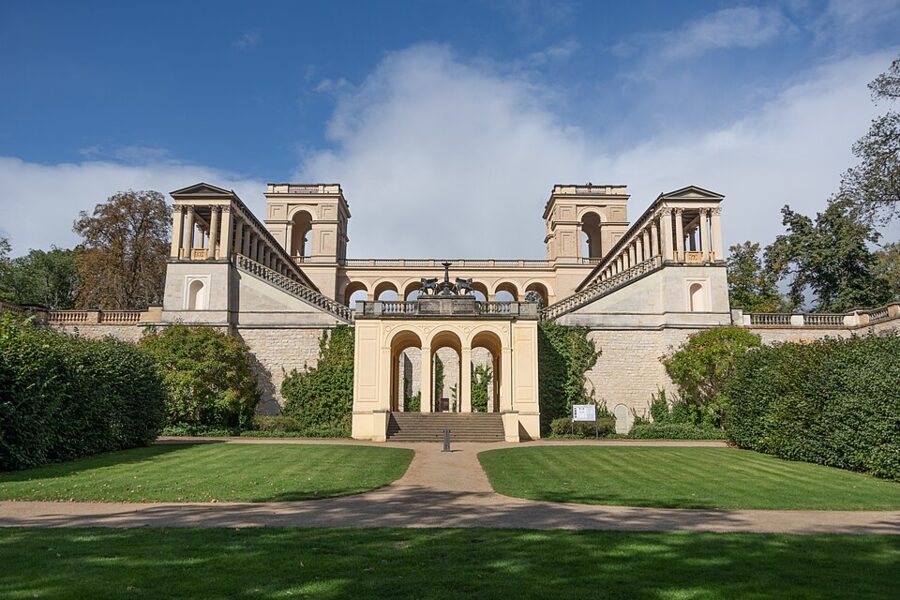

Frederick William IV (Friedrich Wilhelm IV) built the Belvedere on the Pfingstberg for exactly this view. He sketched it himself after the villas he had seen in Italy, began it in 1847 and died in 1861 with only a fraction of his plan standing. What you visit is that fraction: two towers, a ring of colonnades, a courtyard with a long pool, and the best view in Potsdam.
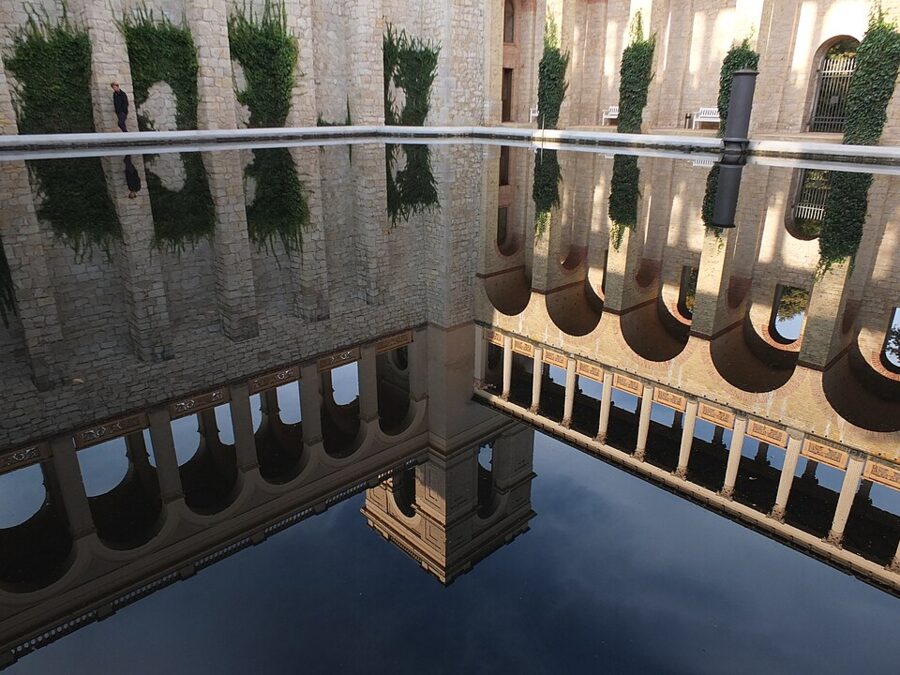
The pool is the punchline. It is a reservoir, and it still feeds the fountains of the Neuer Garten below.

The palace is also the only monument in Potsdam’s World Heritage ensemble run by a private society, the Förderverein Pfingstberg, which a group of young Potsdamers founded in GDR times to save the ruin. Below it stands the small Pomona Temple (Pomonatempel), the first building the architect Karl Friedrich Schinkel ever designed, and around both runs a park laid out by Peter Joseph Lenné. The season runs from March to October, admission is €8, and trams 92 and 96 from Potsdam Hauptbahnhof (the main station) bring you to the foot of the hill in about ten minutes.

Contents9 parts
The hill before the palace
The Pfingstberg rises 76 m above sea level, the highest point in the part of Potsdam west of the Havel. It has had three names. On a map of 1683 it is the Eichberg, the oak hill, a town wood where citizens could cut timber for their houses free of charge. In 1743 Frederick the Great (Friedrich II) gave Potsdam’s Jewish community a plot on its southern slope for a cemetery, far outside the town and hard to reach across a ditch that often flooded, and the hill became the Judenberg.

The first king who wanted a lookout up here was Frederick the Great’s nephew, Frederick William II (Friedrich Wilhelm II), who laid out the Neuer Garten at the foot of the hill. In 1793 he considered a belvedere on the summit, and the master builder Michael Philipp Daniel Boumann the Younger drew him a “Gothic tower with an attached Gothic hall.” Word of the royal interest got around, the landowners raised their prices, and the plan died on paper.
Much of the slope by then was a vineyard. Its owner was Carl Ludwig von Oesfeld, a privy councillor and map-maker born in Potsdam in 1741, who grew grapes on the south side of the hill and died on his estate there in 1804. In 1817 Frederick William III (Friedrich Wilhelm III) bought the property, temple and all, and the hill took its present name. The foundation’s page for the temple gives the year of purchase as 1807; the reference works and the foundation’s other material say 1817.
Why Pfingstberg, “Pentecost hill,” comes down to two stories. The prettier one says that Queen Luise dined at Oesfeld’s vineyard at Pentecost in 1804, enjoyed herself and suggested a new name, and that her widower made the change in 1817 in her memory. The plainer one says the king simply visited the hill at Pentecost in 1817. Neither is documented well enough to choose between them, and I prefer the first.
Schinkel’s first building: the Pomona Temple
Long before any king built on the summit, Oesfeld put up a tea pavilion lower down the slope. A small “Temple de Pomona,” named for the Roman goddess of fruit, already stood in his vineyard. According to the association that runs it today, Oesfeld had it taken down and rebuilt on a higher, more exposed spot as a present to his wife, to a new design by a nineteen-year-old who had never built anything: Karl Friedrich Schinkel.
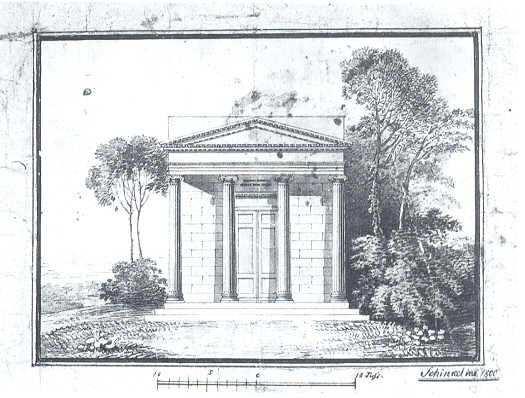
The date depends on whom you ask. The Prussian Palaces and Gardens Foundation (Stiftung Preußische Schlösser und Gärten, SPSG), which owns the temple, dates it to around 1800, and Schinkel’s own drawing of it carries that year. The association and the entry for Oesfeld in the German reference works say 1801. Schinkel, born in March 1781, was nineteen either way, and within a generation he would be the architect who gave Berlin its classical face.
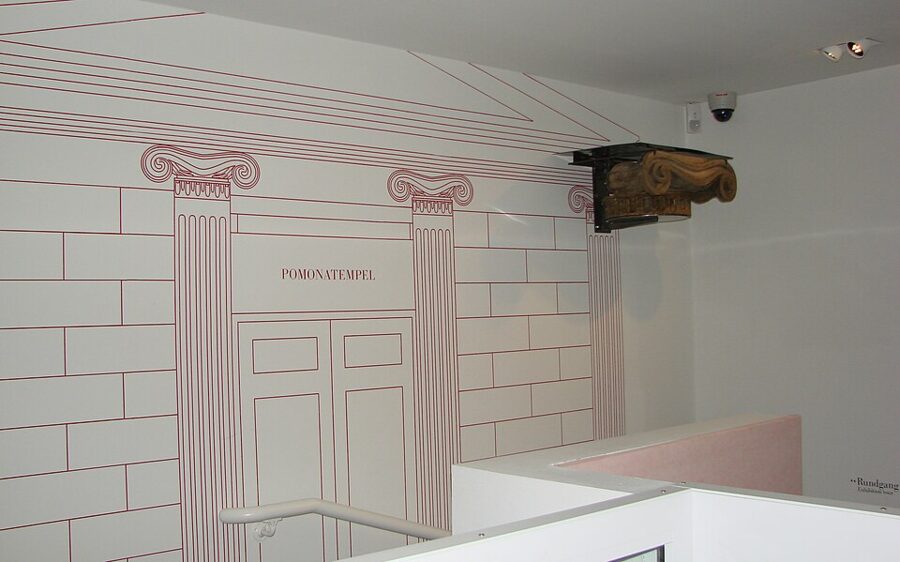
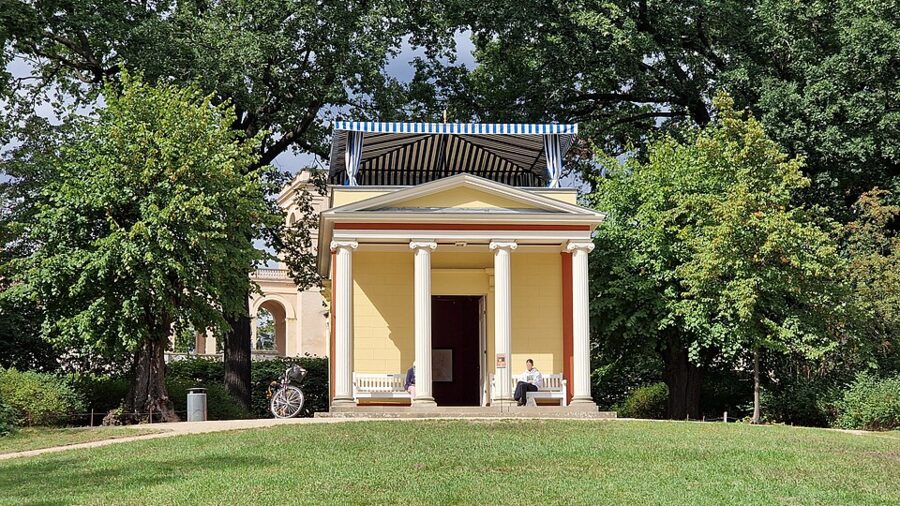
For his first job he chose a Greek temple, and a particular one: the north porch of the Erechtheion on the Acropolis in Athens. Four wooden Ionic columns carry the cornice of a portico in front of a nearly square block with a single room inside. A fireplace faces the door between two tall, narrow niches, and French windows in the side walls let in the light. A spiral stair in a round annex at the back leads up to a flat roof terrace behind a parapet.
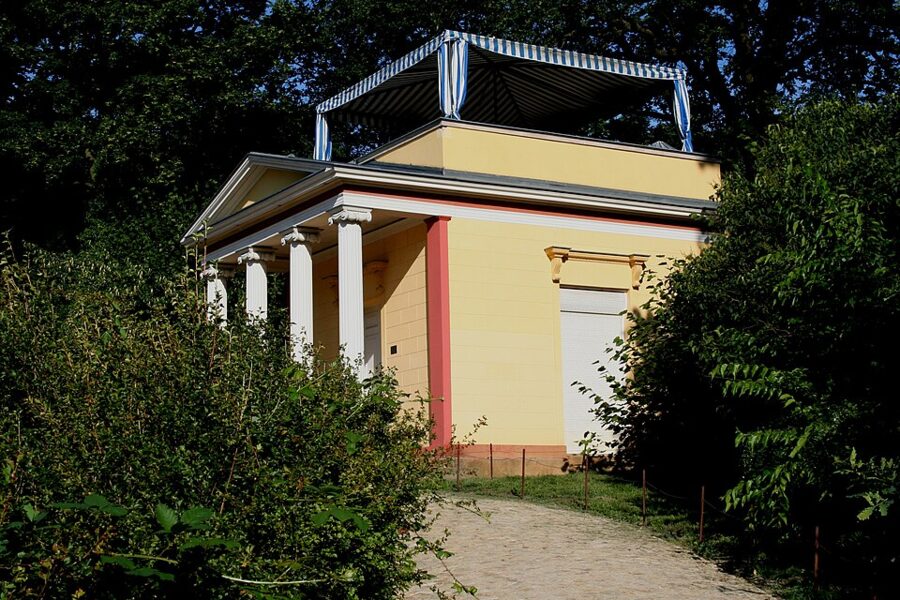

The roof is where the temple earned its keep. From 1817 a blue and white striped awning is recorded up there in summer, a tent for tea with a view, and it still goes up every season. The association thinks it was added for social occasions some years after the temple was built, in the same taste as the striped tent room at Charlottenhof Palace in Park Sanssouci.
The royal family used the temple now and then after 1817, and in 1935 and 1936 it was repaired for the Olympic Games. It came through the Second World War almost unharmed, although anti-aircraft gunners used it as their guardroom. Then it fell apart. After 1945 it lay beside a closed military zone, and by the end of the 1980s only its walls were standing, overgrown and roofless.
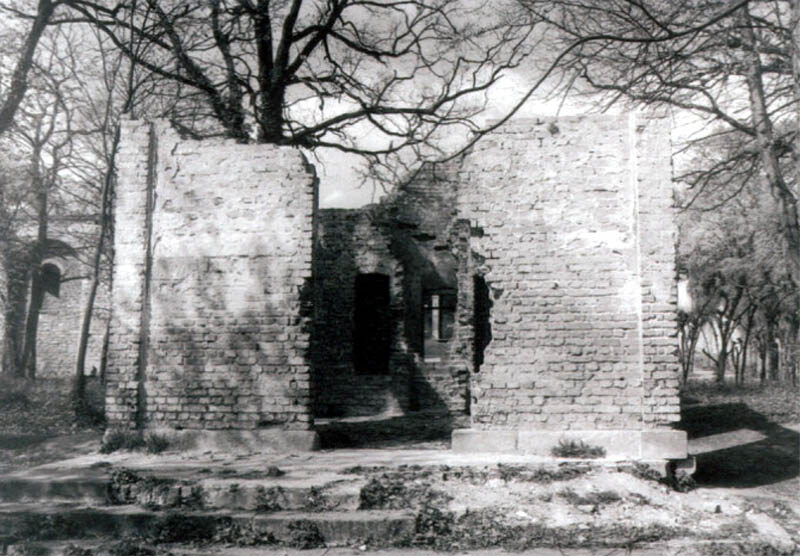

It was rebuilt in 1992 and 1993 with money from the Hermann Reemtsma Stiftung, a Hamburg foundation, and reopened at Pentecost in 1993. Inside, the single room is painted in light blues, the work of the Berlin artist Elisabeth Sonneck in 2011.
From May to October the association fills the room with changing art exhibitions and opens it on Saturdays and Sundays from 14:00 to 17:00, free of charge. The 2027 exhibition program is already set: cyanotypes and ceramics by Kathrin Schöning from May 1 to June 20, collages and abstract painting by Verena Goerschel from July 3 to August 22, and work by children and teenagers made with the artist Heike Isenmann from September 4 to October 24.

A king’s Italian dream
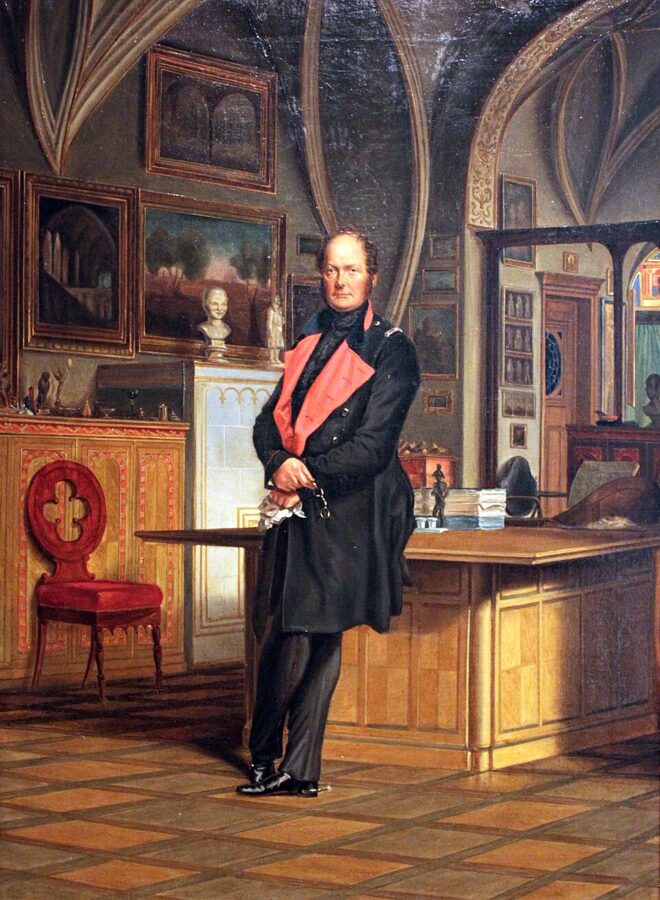
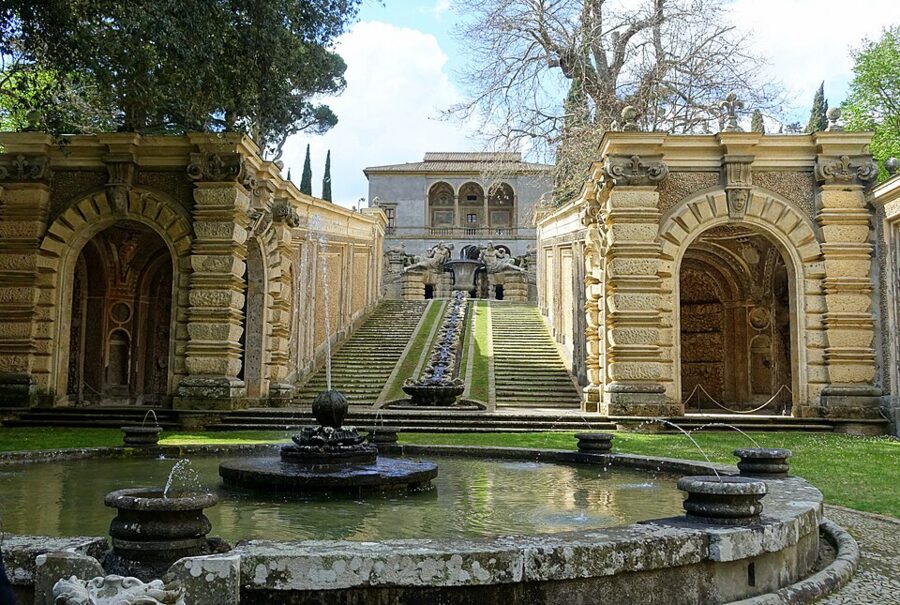
Frederick William IV loved the view from the Pfingstberg as crown prince. He was an artistically gifted king and a compulsive draftsman, and he drew this building again and again, changing it each time. His models were the Renaissance villas he had seen in Italy: the towers of the Villa Medici in Rome, the terraces and fountains of the Villa d’Este at Tivoli, and above all the casino of the Villa Farnese at Caprarola, north of Rome, built around 1585, which he had visited at 33 on his first Italian journey in 1828.
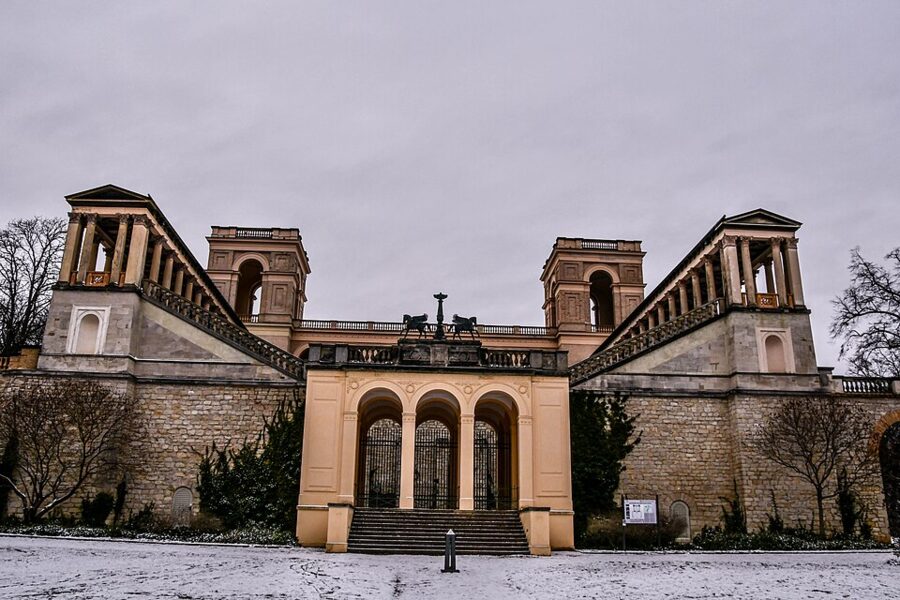
Caprarola won. The king copied its garden casino almost whole and set a massive pair of towers behind it, the whole composition climbing the south slope of the Pfingstberg in terraces. Three architects turned his sketches into building plans. Ludwig Persius, Schinkel’s pupil and the king’s court architect, worked on the design but died in July 1845, two years before construction started; Friedrich August Stüler and Ludwig Ferdinand Hesse carried it on.
Work began in 1847 and was pushed through in only five years, straight through the revolution of 1848. In 1852 the king stopped it. Money was short, and he wanted the Orangery Palace in Park Sanssouci, begun in 1851, finished first; the Pfingstberg would resume afterward.
It never did in the form he meant. A series of strokes left him unable to rule, his brother Wilhelm took over as regent in 1858, and the king died in 1861.
Wilhelm, king from 1861, had Stüler close off the fragment rather than complete it. Stüler added an entrance hall and two wing walls, the work ended in 1863, and the royal family used the result for afternoon tea.
What was built and what was not
The best picture of the full plan is a watercolor of 1856 by the architect Ferdinand von Arnim. It shows a two-storey casino directly in front of today’s entrance, a horseshoe-shaped double stair running down from its terrace with a fountain in the middle, and below that a broad path split by a water stair and ending between two pavilions at the foot of the hill. Hanging gardens and cascades were to fill the slope.
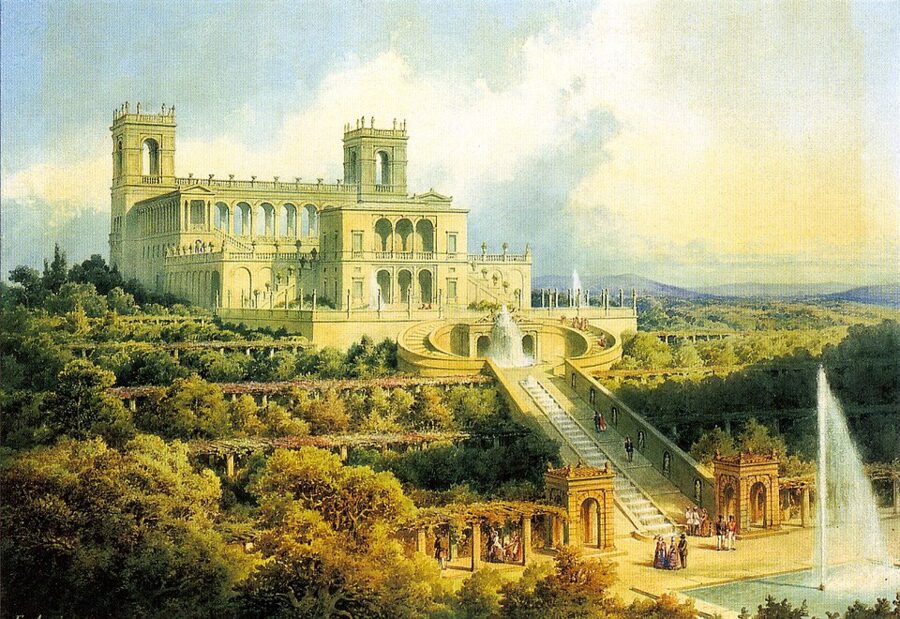
Only the part at the very back of that picture was built: the two towers and the courtyard behind the casino. Had the rest gone up, the Pomona Temple would have been demolished, because it stood in the way of the staircase. The king’s money trouble is the reason Schinkel’s first building survives, and Lenné later used it to hide what was missing.
Inside the fragment: towers, colonnades and a water tank
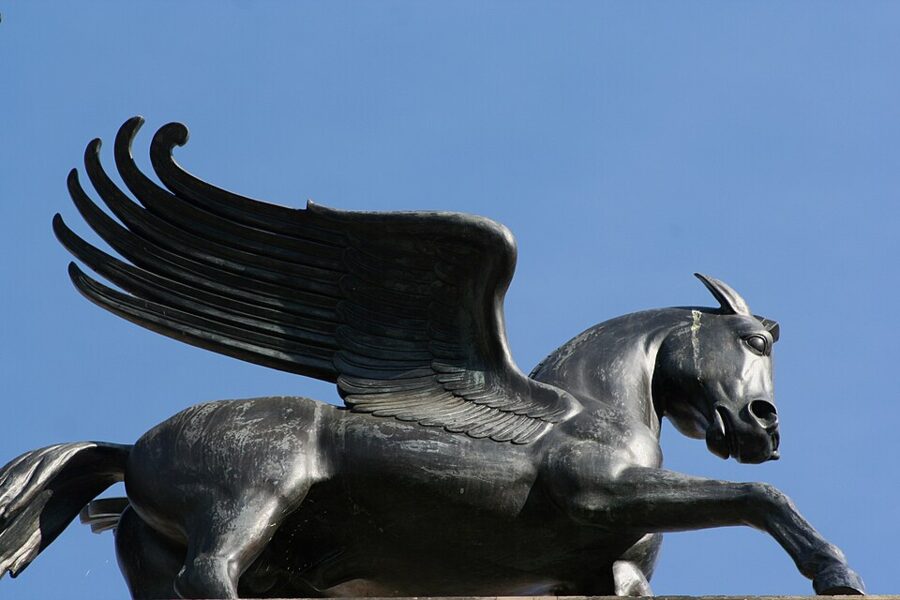
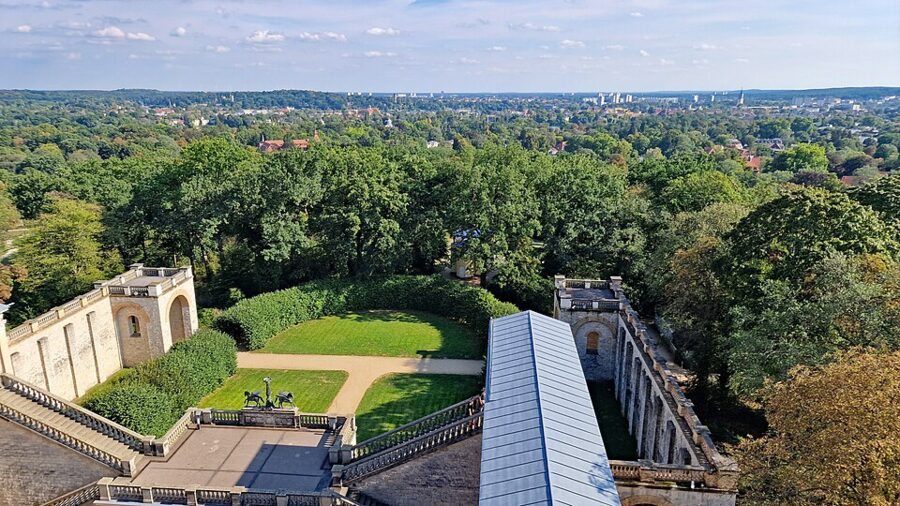
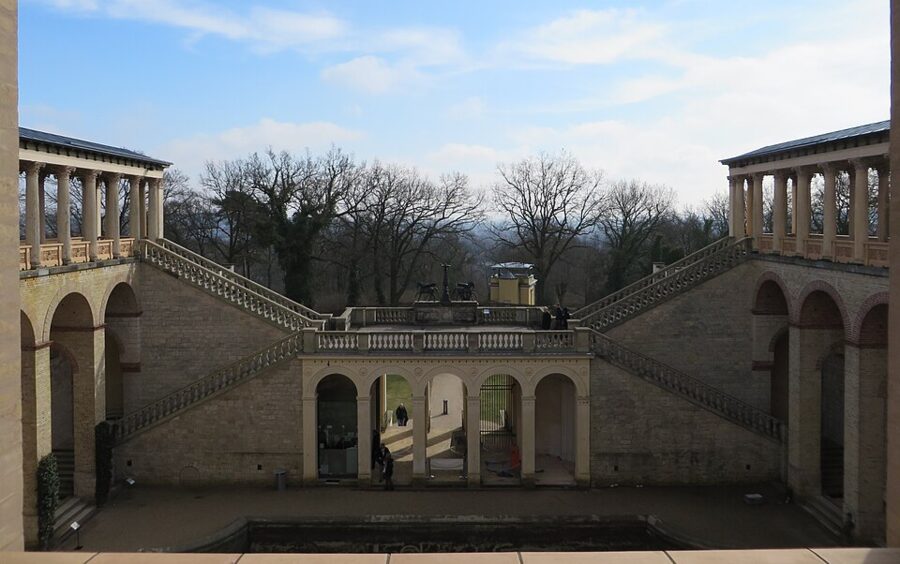
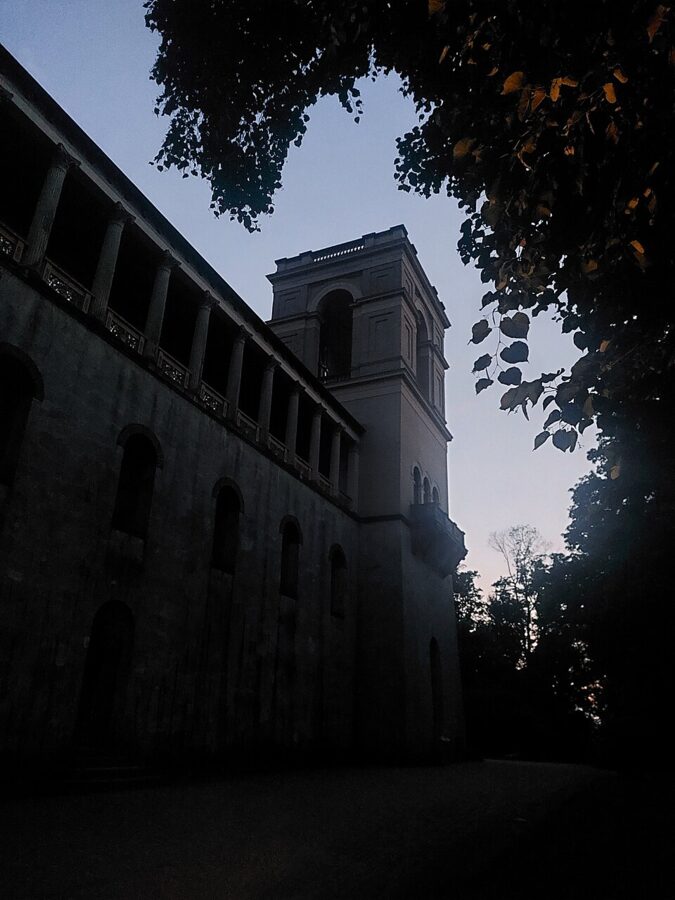
What stands today is almost square in plan. You come in from the south through Stüler’s entrance hall, under a terrace where two winged horses flank a tall vase: the Pegasus group, on a platform renovated in 2023. Inside is a large courtyard. The twin towers, 25 m high, close its north side, a double flight of stairs rises opposite them on the south, and colonnades run along the east and west.
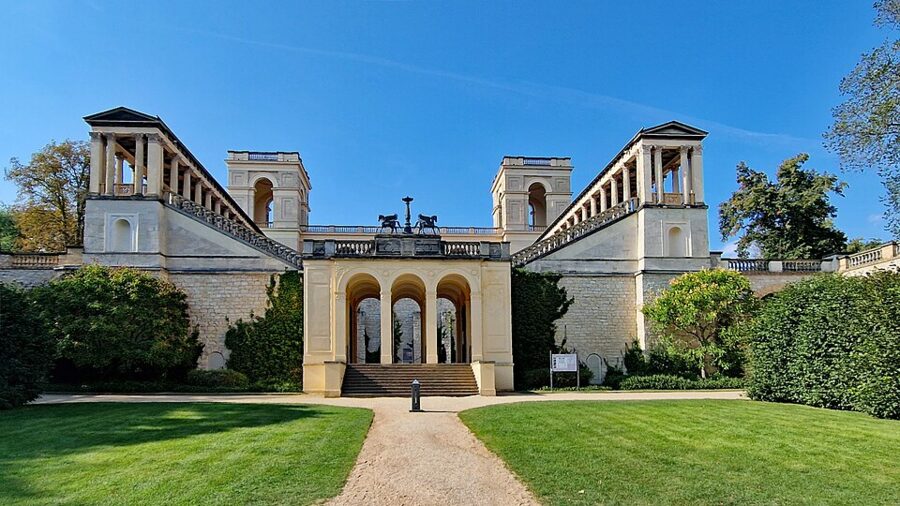

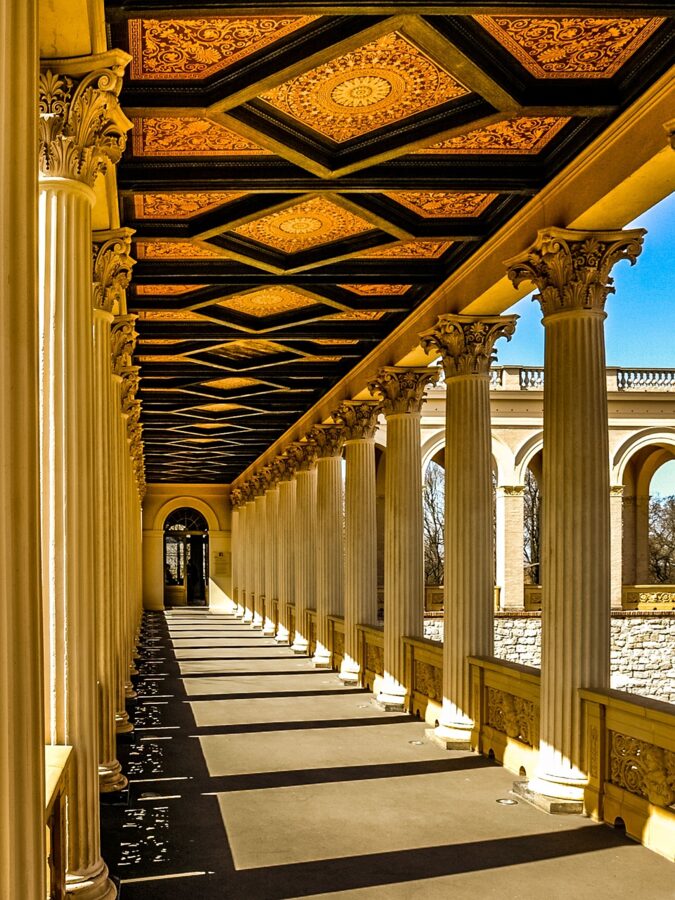
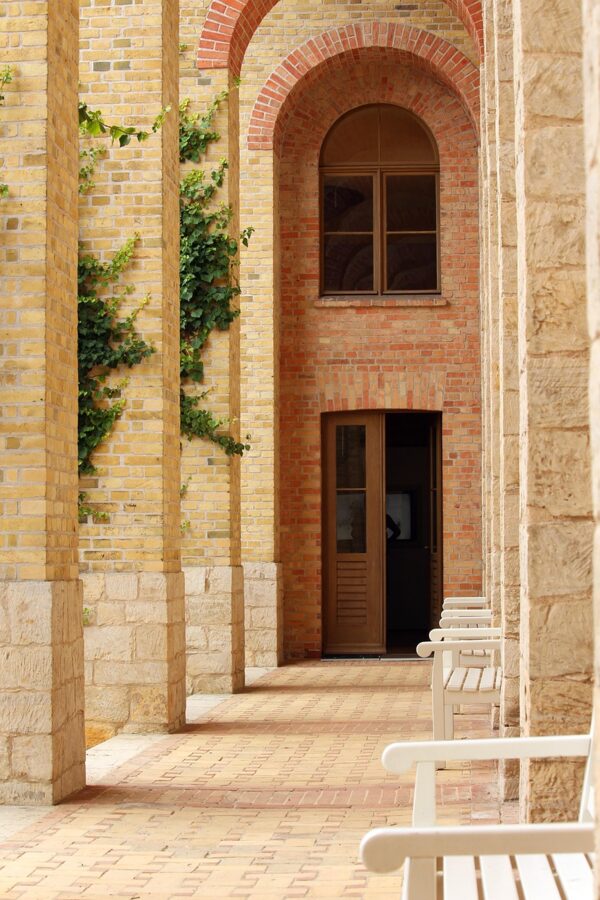
From the courtyard, the stairs lead up to the terrace over the entrance and on to the east and west colonnades, which are the way into the towers. The colonnades are the part everyone photographs: long, open walks of honey-colored columns under coffered wooden ceilings, with the treetops at the level of your elbows. Two of the three ranges are Corinthian; the third runs on plain round arches.

The pale sandstone and the arcades fool the eye for a moment into thinking you are south of the Alps, as the association puts it, and then the Brandenburg sky puts you back. Look closely at the walls. When the building was restored, some of the names and dates Soviet soldiers had painted on them in the 1980s were deliberately kept.
The basin is a reservoir
Look down into the long pool in the middle of the courtyard. Its stone rim, the reflections of the arcades and the stage that is sometimes built into it for concerts all suggest a Roman garden. In fact it is a high-level water tank.
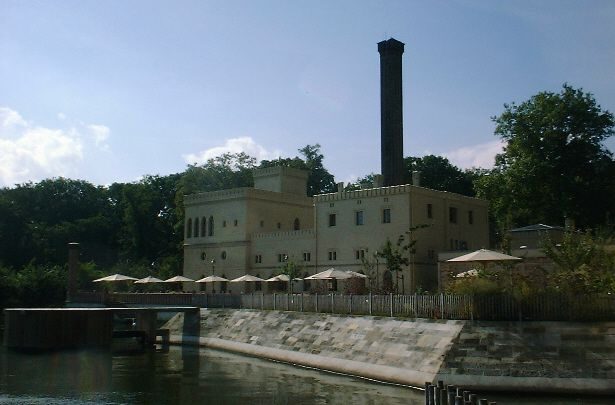
It is filled from the machine house added after 1861 to the old royal dairy, the Meierei, on the shore of the Jungfernsee at the far end of the Neuer Garten, and from here the water runs back down to the fountains of the Neuer Garten. It still works that way today.
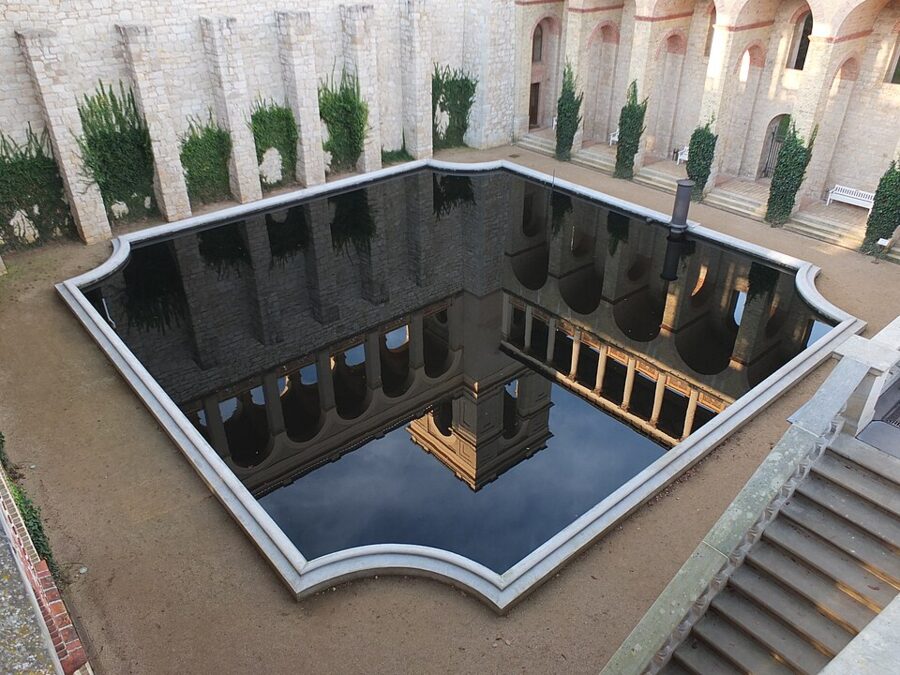

Potsdam is full of royal plumbing in costume, from the “mosque” that pumps the fountains of Sanssouci to the ruins on the Ruinenberg that frame another reservoir. The Pfingstberg version is the most elegant of them. The king wanted a view, the gardens below needed a head of water, and the hill gave both. The Pegasus group over the entrance makes a fitting guard: in the myth, the stamp of the winged horse’s hoof opened a spring on the mountain of the Muses.
The Moorish and Roman cabinets
Each tower holds one richly decorated room, and they could hardly be less alike. The Moorish Cabinet (Maurisches Kabinett) in the east tower was designed by Carl von Diebitsch, an architect who had studied the Alhambra in Granada. Its walls are covered in glazed tiles in red, blue and gold, some of them gilded, under a painted ceiling and above a marble floor. Potsdam’s registry office holds civil weddings in it from late April to early October, and 82 couples married there in 2025.
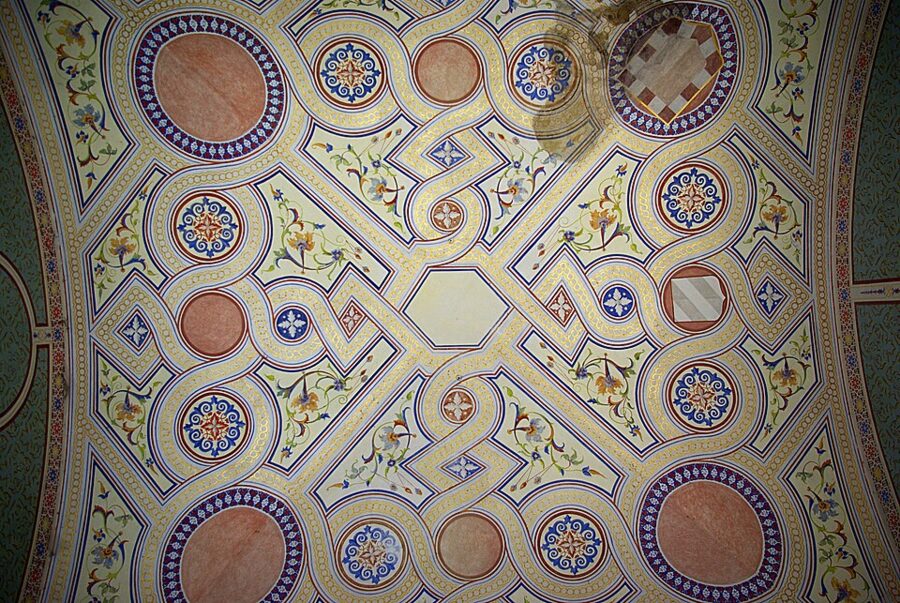

The Roman Cabinet (Römisches Kabinett) in the west tower answers it with a red ground painted with genii, swans, winged lions, porticoes and figures. An arcade gallery joins the two rooms along the north front. From the Roman Cabinet a cast-iron spiral stair winds up to the level above the arcade and on to the viewing platform on the roof; in the east tower a second spiral rises from above the Moorish Cabinet, reached across the walkable roof of the arcade.
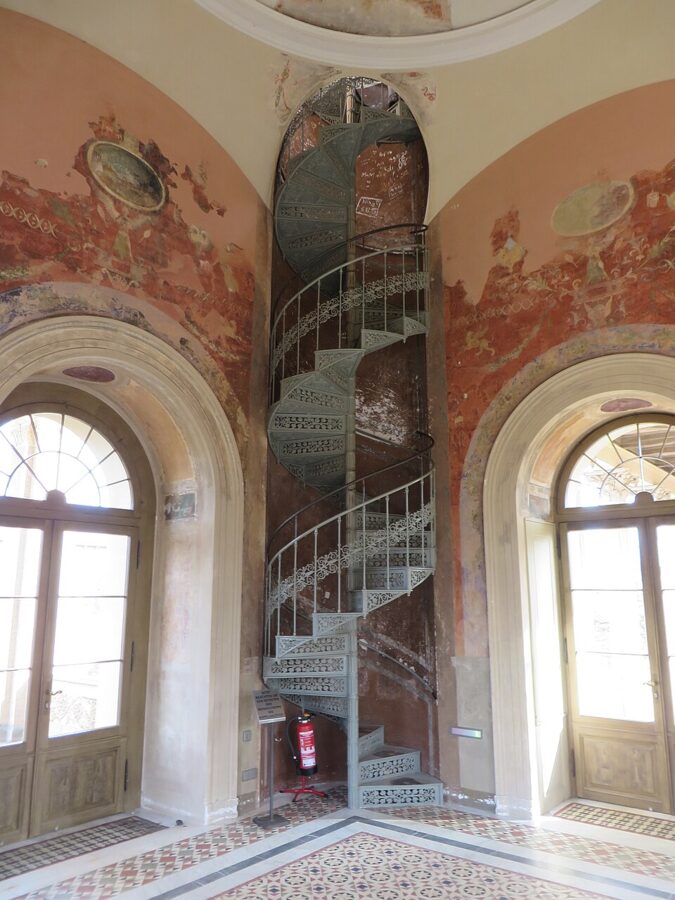

The stairs are narrow and steep, and on a busy summer weekend you wait your turn. They are also the only way to the view. The trees of the park are tall now, and from the courtyard you see mostly leaves.
On the ground floor under the north arcade, two exhibitions tell the building’s story in German and English. “Potsdamer Visionen mit Ausblick” follows the hill from the vineyard to the restoration, with lit plans and drawings. “Zwischen Gartenlaube und Russenmagazin,” opened in 2020, is built from interviews with people who lived around the Pfingstberg between 1945 and 1994, with Soviet soldiers as neighbors and a Soviet shop down the road. It is the better of the two, and the reason to give the ground floor half an hour before you climb.
Lenné’s park and the views, tower by tower
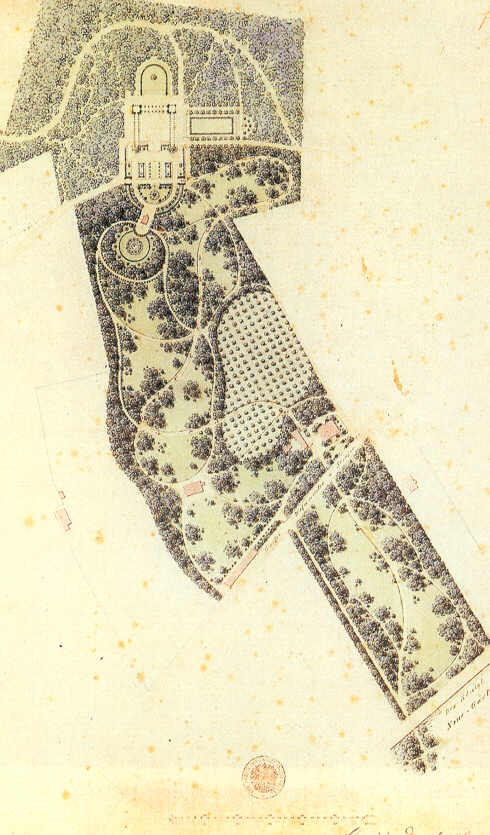
Once it was clear that the casino, the stairs and the cascades would never be built, Wilhelm I gave the grounds to Peter Joseph Lenné, the garden director who had been shaping Potsdam’s parks since 1816. His task was awkward. He had to fit a half-finished palace and an eighteenth-century tea temple into one design, joined as a garden but not lined up with each other, because the temple stands off the palace’s axis.
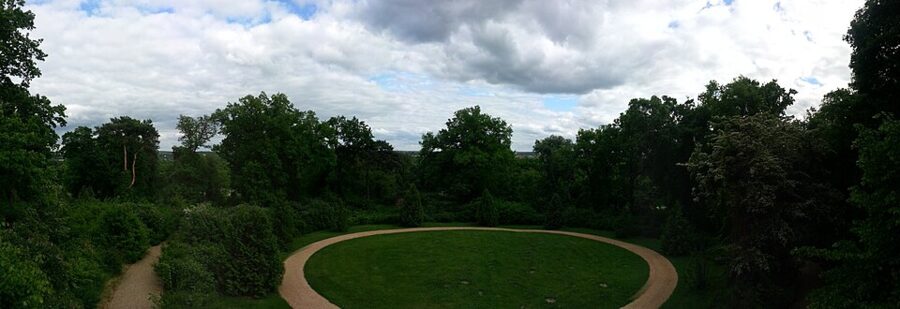

Lenné surrounded both buildings with lawns, round, half-round and rectangular. He closed off the space south of the palace with a semicircular arbor walk, a Laubengang, and it is a neat piece of stagecraft: the curve hides the fact that the Pomona Temple does not face the Belvedere square on, and at the same time it leads you around to it. Beyond it the ground falls away toward the temple, where a big round lawn was once laid out with elaborate flower beds.

From there a long serpentine path winds down the hill. At its foot, along Große Weinmeisterstraße, Lenné laid out an orchard meadow planted in a grid, and more paths lead on through the Mirbachwäldchen, a small wood, into the Neuer Garten. The park was looked after until the Second World War, ran wild after 1945, and was largely restored by the foundation’s garden department from 1995.
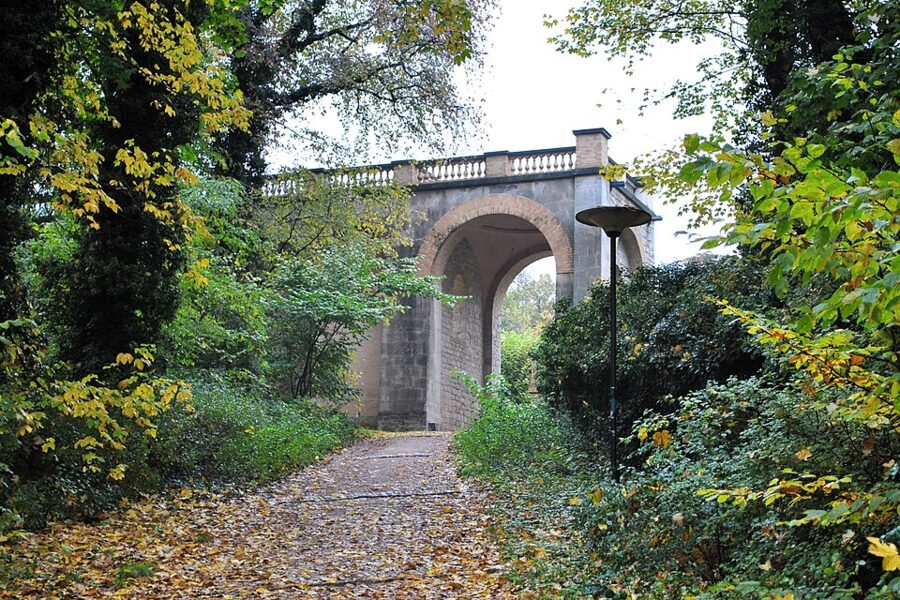

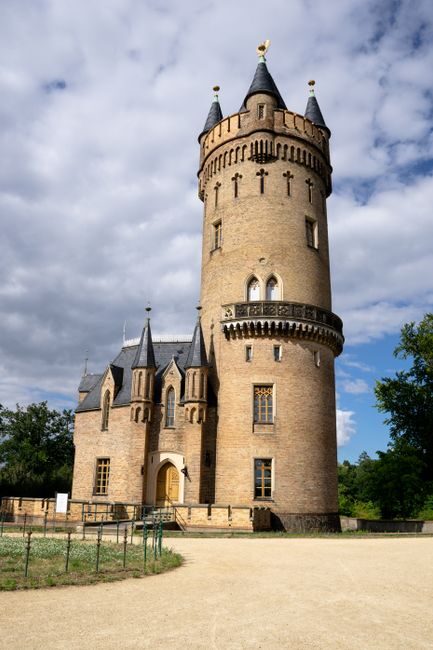
The real works of art here are Lenné’s sightlines. He cut them into the woods like windows, and through them you see Peacock Island (Pfaueninsel), the casino and Glienicke Palace, Babelsberg Palace and the Flatow Tower, the Nikolaikirche and the old town, and once the Heilig-Geist-Kirche, which no longer stands. The association compares them to paintings by Caspar David Friedrich, and on a misty October afternoon that is not far off.
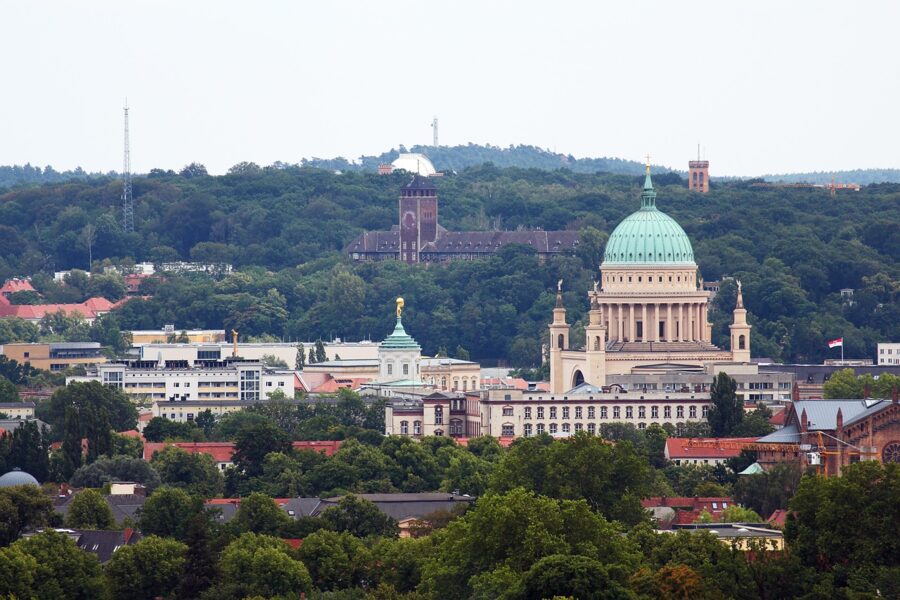
From the towers you see it all at once. Facing south from the west tower you look straight down on the Pegasus group and the arbor walk, then over the roofs of the northern suburbs to the green dome of the Nikolaikirche and the wooded Brauhausberg across the Havel behind it. This is the classic picture, the one the association calls Potsdam’s most beautiful view, and on this point I agree with it.
Turn east and the Jungfernsee fills the gap between the trees, with the telecommunications tower on Berlin’s Schäferberg standing over the far shore. To the northeast the east tower rises in front of the Villa Henckel and the water. On a clear day the Havel lakes go on toward Berlin until the haze takes them.
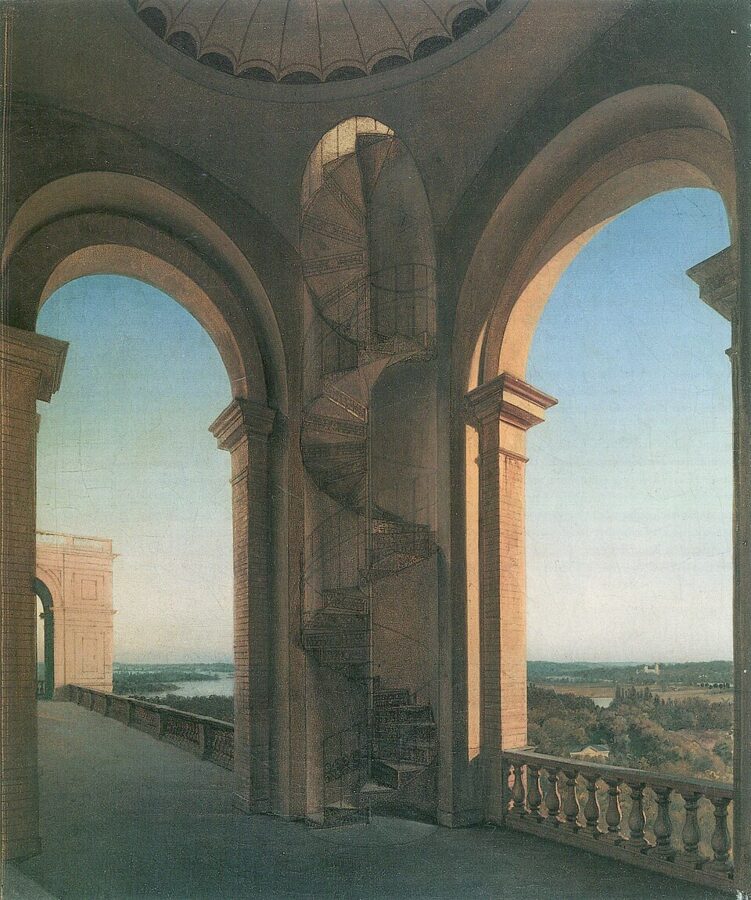
The painter Eduard Gaertner worked up here around 1865 and painted the Havel landscape with Babelsberg Palace, then still new, across the water, framed by the arches of the Belvedere’s own arcade. The trees have grown up since, and today you need the towers to see as much.
The hill has had one modern quarrel. In 2014 the media executive Mathias Döpfner, who had bought the neighboring Villa Henckel, agreed to pay €1.8 million to restore the villa’s 6.3-hectare part of the grounds, which belong to the foundation; in return the foundation gave him about 1.5 hectares of it for his private use for sixty years. Potsdamers protested on the hill against a private park inside the World Heritage site, and years of argument over public access followed. The restoration was finished in April 2023.
Closed: the Soviet years
Around 1900 the Belvedere was one of the favorite outings for Berliners and Potsdamers, and stacks of postcards prove it. Anyone could stroll the colonnades, provided they left their dog and their tobacco at home.
In 1927 the ensemble passed to the state palaces administration, and in 1936, for the Olympic Games, the Belvedere was renovated once more. Little else is known about the Nazi years. Filled-in trenches nearby point to fighting at the end of the war, but the palace came through almost undamaged.
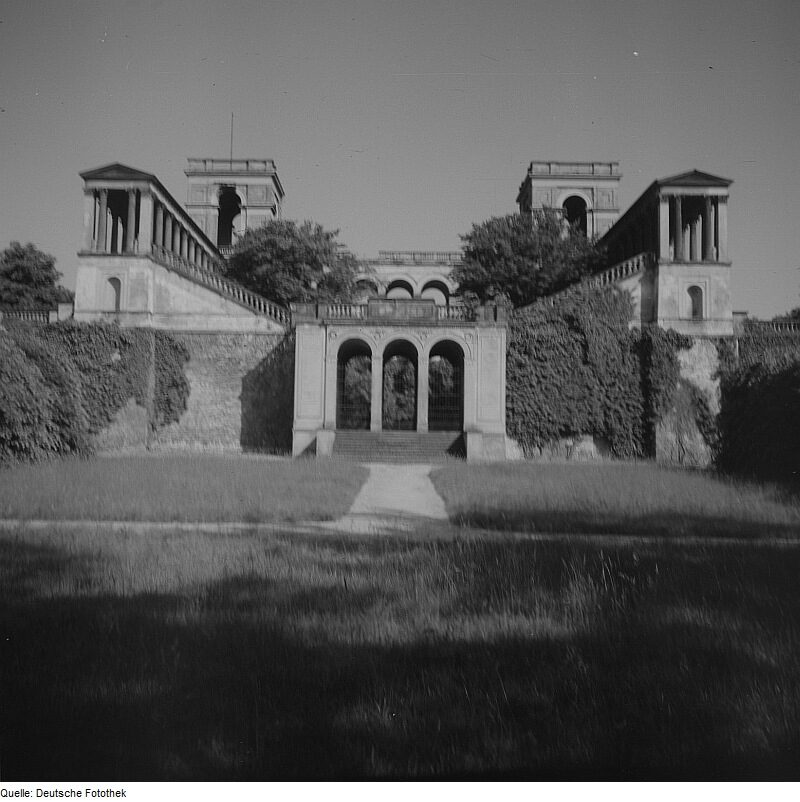

What happened next was decided just down the hill. In July 1945 Truman, Stalin and Churchill, later Attlee, met at Cecilienhof Palace in the Neuer Garten for the Potsdam Conference. In August the Soviet Military Administration seized the villa quarter between the Neuer Garten and the Pfingstberg, ordered every resident out and fenced about a hundred houses into a closed zone of 16 hectares known as Military Town No. 7 (Militärstädtchen Nr. 7).
It became the German headquarters of Soviet military counterintelligence, from 1954 part of the KGB, home to some 150 officers and their families. The streets were renamed in Russian, and Große Weinmeisterstraße became Uliza Zentralnaja, Main Street. At the center of the zone, a former parsonage at Leistikowstraße 1 served as a remand prison until 1991. Soviet citizens and Germans were held and questioned there, often for months without a lawyer, before military tribunals sent them to camps, to the gulag or to execution.
The Belvedere, on the hill above, stayed open into the 1950s. The Wall ended that in 1961. From the towers you could see the new border installations and into the Soviet garrison, so the palace was closed.
The widow of the last castellan, who had lived in a flat in the north front, moved out in 1964. Windows were concreted up and doors barricaded, vandals did the rest, and in 1980 the Pfingstberg ensemble was left off the city map altogether.
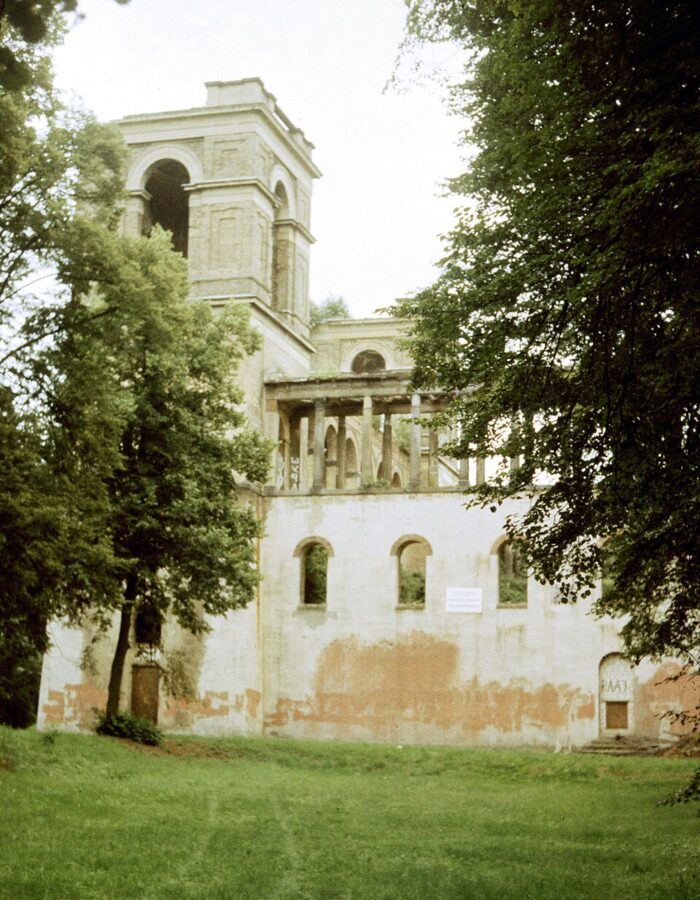

People went anyway. Many photographs survive from the 1970s and 1980s of Potsdamers who slipped into the ruin in secret, which was dangerous in itself, because nothing in it had been made safe. The association’s history of the closed decades collects some of them, and the free audio guide includes the grandson of that last castellan describing his grandparents’ life in the Belvedere.
The rescue
In 1987 a group of young Potsdamers decided they would not watch the place fall down. In 1988 they organized under the umbrella of the Kulturbund, the GDR’s official cultural federation, as the Arbeitsgemeinschaft Pfingstberg, and the Stasi watched them from the start: the hill lay near the border with West Berlin and right next to the KGB town. They met every two weeks to cut back the brambles, uncovered the lawns in front of the temple and the palace, and pruned and replanted the arbor walks. The Belvedere itself was still off limits, the view from its towers still too good.
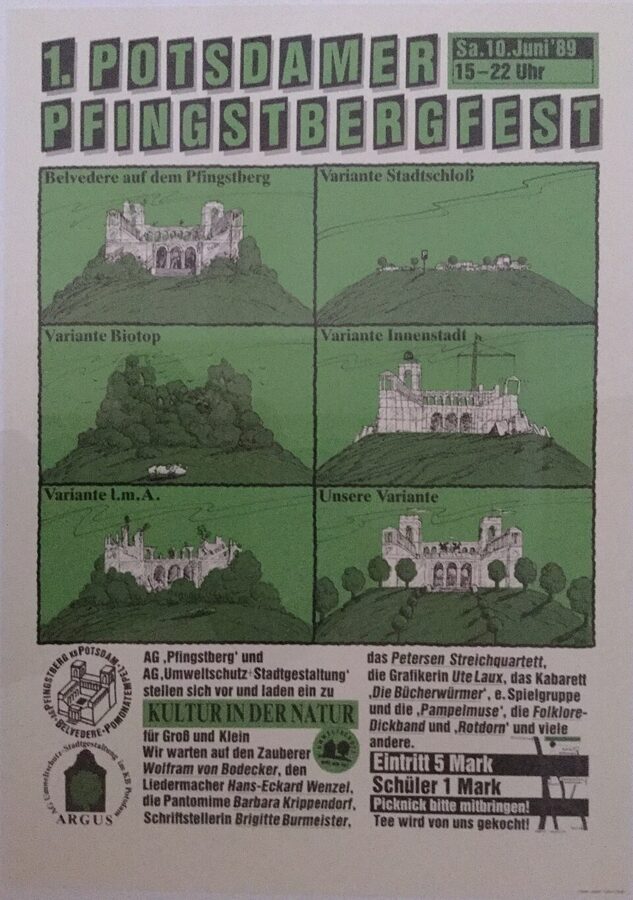

On June 10, 1989, together with ARGUS, an environmental and town-planning group, they held the first Pfingstbergfest around the Belvedere and in front of the temple, with music and information stands. More than a thousand Potsdamers came, many of them seeing the palace up close for the first time. Matthias Platzeck, a cofounder of ARGUS and later Minister-President of Brandenburg, was among the organizers. Five months later the Wall fell, and the association’s own history counts that festival among the things that gave Potsdamers the nerve to speak up in the autumn of 1989.
On September 22, 1990, the working group became a registered association, the Förderverein Pfingstberg in Potsdam, and the money began to follow. The Hermann Reemtsma Stiftung took on the Pomona Temple in 1991, hoping it would become the starting point for the rest, and the association used the reopened temple to raise funds for the palace. The Soviet army left Military Town No. 7 on August 15, 1994, and that year the foundation commissioned plans for the Belvedere. In 1998 major gifts from the Reemtsma foundation and from Werner Otto, founder of the Otto mail-order company, made the work possible, and it began that November.
In April 2001, during the federal garden show in Potsdam, the west tower opened to the public and the association took over running the whole ensemble; it celebrated 25 years of the reopening in July 2026. Another donation from Werner Otto paid for the rest of the building, restored by 2003, and the end of the work was celebrated in May 2005. In 1999, meanwhile, UNESCO had added the Pfingstberg to the World Heritage site of the Palaces and Parks of Potsdam and Berlin.
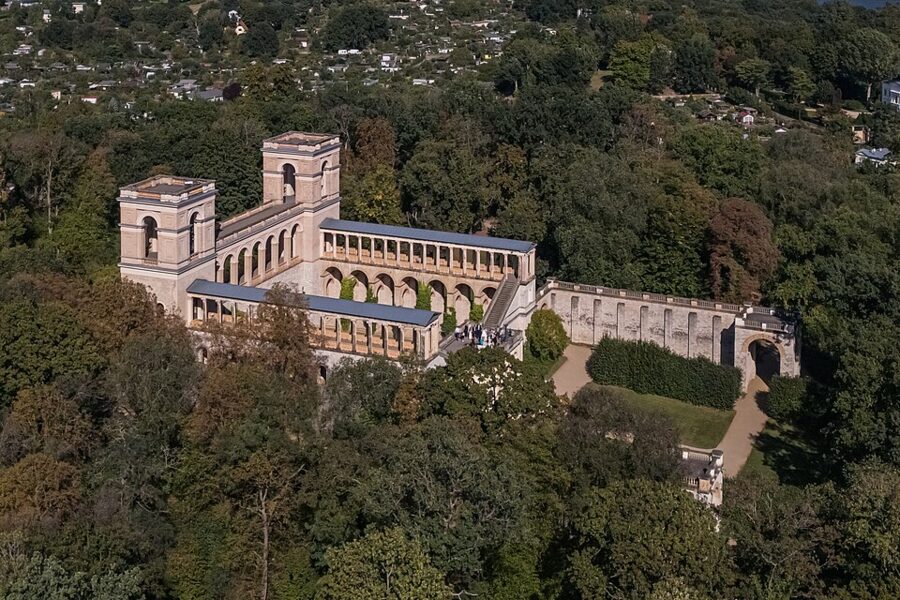

The work is not finished. About 70 active members and about as many supporting members keep the place going, lead the tours and help tend the park, and they are collecting donations for the next repair, to the eastern apses of the building. The association works on the principle of preservation through use, which is why most summer weekends bring a wedding, a concert or both.
Visiting the Belvedere
The Belvedere opens from March to October and closes completely from November to February. In March it opens on Saturdays and Sundays only, 10:00–16:00.
From April to October it is open Tuesday to Sunday: 10:00–17:00 on weekdays, and at weekends 10:00–18:00 in April, May, June and October and 10:00–19:00 from July to September. It is closed on Mondays, and public holidays follow Sunday hours. You do not need to book; tickets are sold at the entrance.

Admission costs €8, reduced €6 for students under 30, trainees and several other groups, and children under 7 go free. A family ticket for two adults and up to three children costs €17, or €10 with one adult. If you already hold the foundation’s Sanssouci+ ticket (€22, reduced €17, in 2026; €24, reduced €20, in 2027), the Belvedere lets you in at the reduced price of €6. The foundation’s annual palace pass, the Berlin WelcomeCard and a Potsdam water taxi ticket also earn a discount; the Belvedere’s hours and prices list them all.
Two combined tickets are sold from April to October. One with the Marble Palace (Marmorpalais) in the Neuer Garten costs €12, reduced €10; one with the Museum Alexandrowka in the Russian colony below costs €10.50, reduced €7.50. If you are walking up from the colony, the second is the obvious buy.
Free audio guides for adults and for children play on your own phone at eleven stations, via QR codes, in German and English. The children’s version sends them around the palace with Frederick William IV and a small Pegasus. From April to October, association members lead a public tour of the whole ensemble on the first Sunday of each month. Groups can book a 90-minute tour, €150 for up to 10 people, or a longer one that adds the Museum Alexandrowka; the association asks for four weeks’ notice.

Allow about an hour and a half for the courtyard, both towers, the exhibitions and a slow loop of the park, more if the temple is open. I’d come on a weekday morning in May or September, when the stairs are quiet, or on a summer Saturday in the last hour before 19:00, when the light drops low over the west tower.
Events on the hill
The association programs the hill like a small theater. Four or five times a year it holds a Mondnacht, a moon night, with the palace lit up and music and wine while the sun sets and the moon rises over the towers. In summer a series called Kultur in der Natur brings concerts and storytelling to the park and the temple roof every two weeks, and an Italian evening in the courtyard has become a fixture. Sunrise tours and open-air yoga fill in the gaps.

Outside the season the palace opens on two occasions. The Advent weekend runs on Saturday, December 12, 2026, 15:00–19:00, and Sunday, December 13, 15:00–18:00, with choirs in the entrance hall, winter tales in the Moorish Cabinet, mulled wine and grilled sausages, and an hour of carol singing on the Saturday from 18:00; admission is €8, reduced €6. The association runs it without market stalls or piped music on purpose, as a quiet counterpoint to the Christmas markets in town.
On New Year’s Day, January 1, 2027, the palace and its exhibition open 11:00–15:00 for €8, reduced €6, and a saxophone trio plays on the steps in front of the entrance hall from 12:00, free. Members are up there from 10:00 clearing away the fireworks debris, and the towers open if the weather allows; in bad weather the day is called off.
Food, access and practicalities
There is no café on the hill. Bring water in summer and plan lunch around the walk: the garden café of the Museum Alexandrowka in the colony below opens with the museum from April to October, 10:00–18:00 except Wednesdays, and the Meierei on the Jungfernsee, at the far end of the Neuer Garten, brews its own beer and is open from Wednesday to Sunday; it closes for staff holidays throughout November 2026. For more choice, see my guide to restaurants in Potsdam.

Access is limited. A stair lift takes wheelchair users into the courtyard, and the courtyard and the ground floor with the exhibitions are step-free, but the towers and the two cabinets can only be reached by several flights of stairs. There is an accessible toilet on the Pfingstberg.
Strollers are not allowed in the exhibition rooms, there is nowhere to leave large luggage, and assistance dogs are welcome. The Pomona Temple is not wheelchair accessible.
There is no parking at the Belvedere. Drivers with limited mobility can arrange to park at the palace through the ticket desk; everyone else uses the public car parks at the Volkspark or at Cecilienhof, each about 15 minutes’ walk away.
Getting there, and the walk on
From Potsdam Hauptbahnhof, trams 92 and 96 run north through the old town and out through the Nauener Tor to the Puschkinallee stop on the edge of the Russian colony, and both also stop at Am Schragen on its west side. Bus 603 stops at Höhenstraße. Potsdam lies in fare zone C, so from Berlin you need a Berlin ABC ticket, which covers the tram as well: a single ticket Berlin ABC costs €5.00 in 2026 and €5.20 from January 1, 2027, and a 24-hour ticket €12.90, then €13.20.
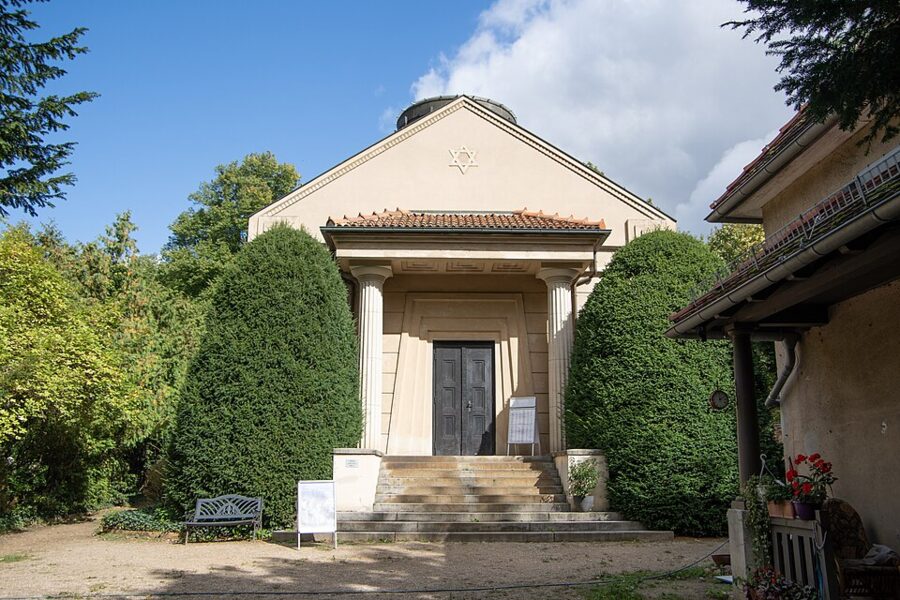

The best way up is on foot from Alexandrowka, the colony of Russian-style log houses that Frederick William III built in 1826 for the last singers of a Russian soldiers’ choir; my guide covers the houses, the museum and the church. From Puschkinallee, walk straight on to the Kapellenberg and the onion domes of the Alexander Nevsky church, then follow the road uphill along the wall of the Jewish cemetery of 1743. Allow about 20 minutes from the tram to the Belvedere.
If you would rather walk from town, the association suggests a route of about 5 km from the station, an hour on foot, through the old town and the colony; coming from the Dutch Quarter, you simply follow the tram tracks north up Friedrich-Ebert-Straße. A longer route starts at Sanssouci, crosses the Ruinenberg, Alexandrowka and the Volkspark and reaches the hill in about 75 minutes.
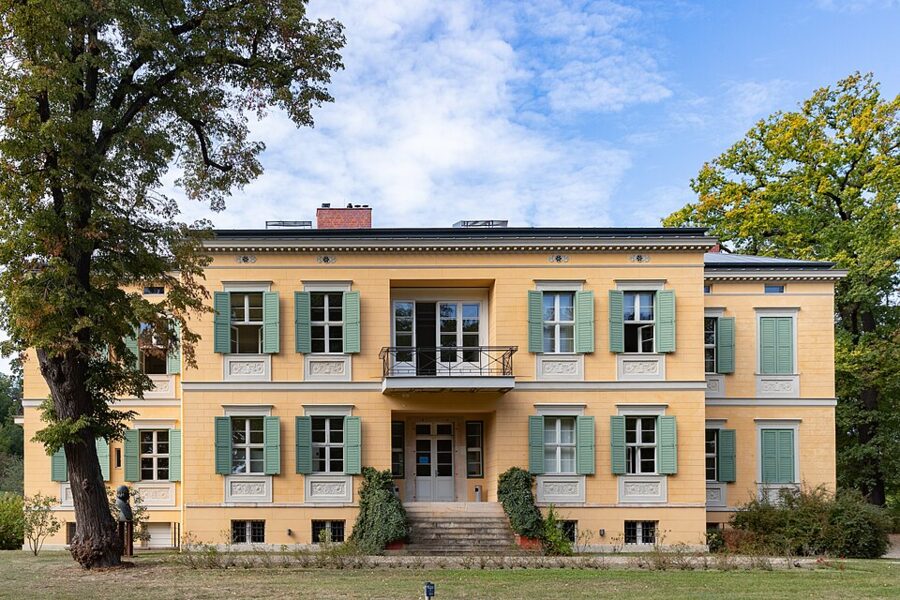

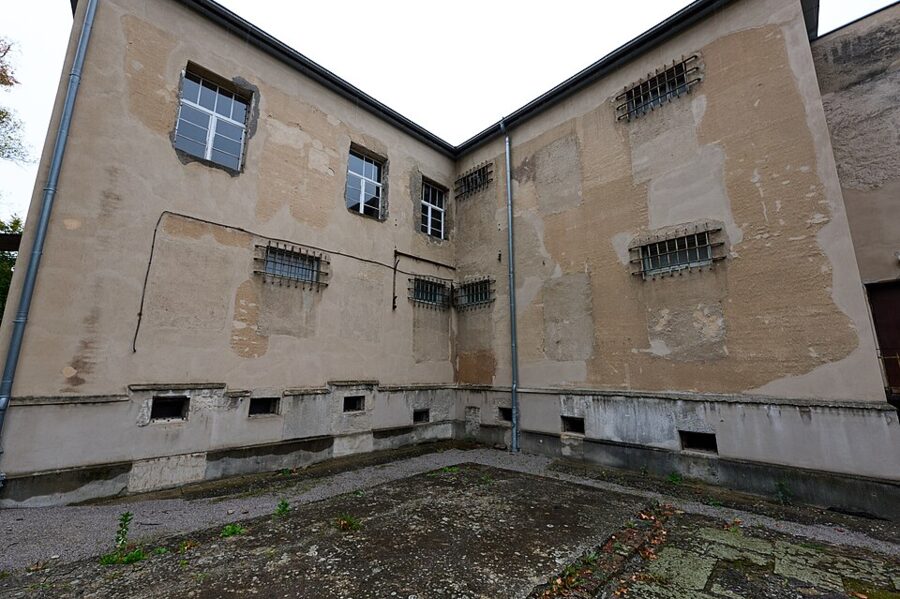
From the Belvedere, go on downhill to the east. Lenné’s paths bring you out on Große Weinmeisterstraße, the old Main Street of the KGB town. Here stand the Pfingstberghaus, a former gardener’s house that the Soviet secret service used as a garage and store and that the association restored in 2006 and 2007 as its office, and the Villa Quandt, which Frederick William IV bought in 1841 and which has housed the Theodor Fontane Archive since 2007. Close by, at the end of Leistikowstraße, is number 1, the former prison, now the Leistikowstraße Memorial (Gedenkstätte Leistikowstraße).
The memorial opens Tuesday to Sunday, 14:00–18:00 from April to October and 13:00–17:00 from November to March, and it is free; the memorial’s opening times also list its Christmas closure from December 22 to 31. It is a hard hour after the colonnades, and it belongs on the same walk: the view that closed the Belvedere was a view of places like this.
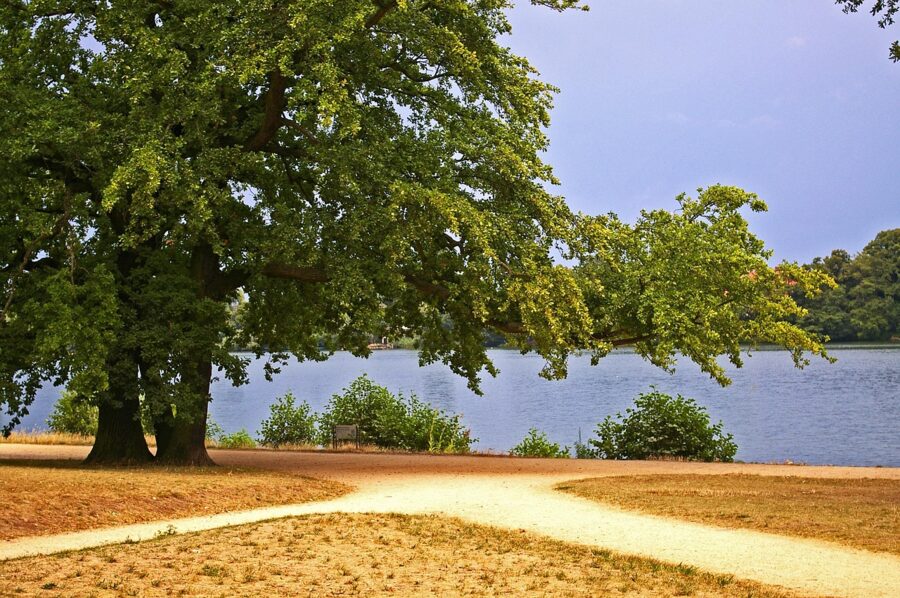
From Leistikowstraße it is a few minutes to the Neuer Garten, where Lenné’s meadows run down to the Heiliger See and the Jungfernsee. Cecilienhof, where the conference sat, is closed for restoration until further notice, but the Marble Palace is on the combined ticket.
Walk north through the park to the Meierei and look up at the tall chimney of its machine house: this is where the water for the courtyard pool on the hill begins its climb. Bus 603 takes you back toward the town center, and if you have a second day, my lists of Potsdam’s palaces and things to do in Potsdam pick up from there.
Better still, save the climb for the end of the day. On a summer Saturday the Belvedere stays open until 19:00, and the last hour, with the sun low in the west, is the time to be on the roof of the west tower. The Nikolaikirche, the Jungfernsee and the far Havel are all in that light at once: the view a king built a palace to frame and a city was forbidden to see for forty years, for the price of an €8 ticket.