

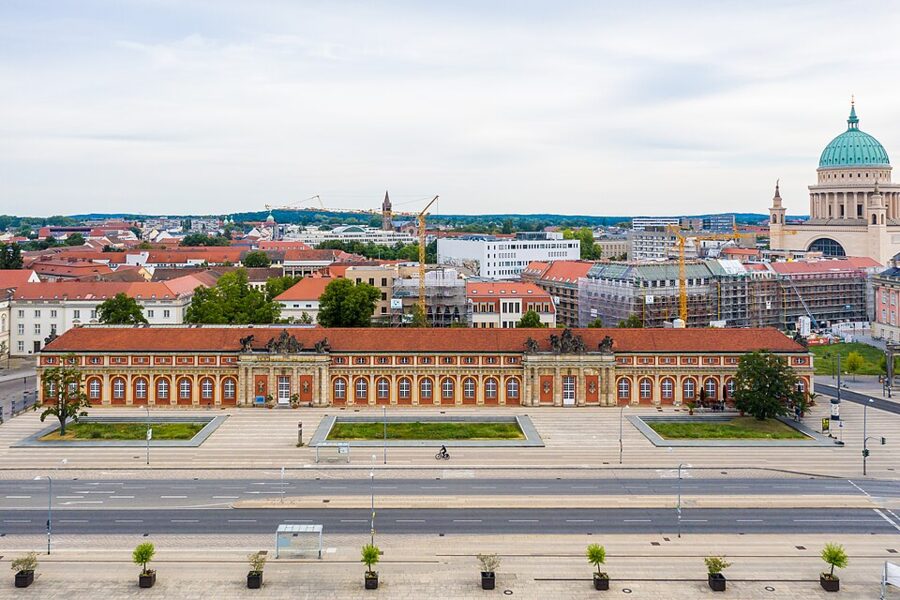
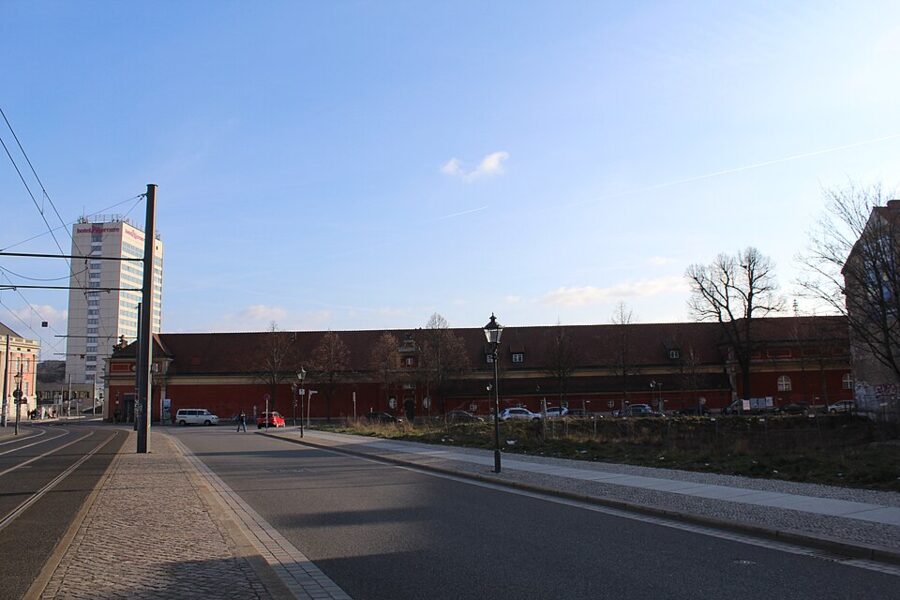
The oldest building in the middle of Potsdam was put up to keep orange trees alive through Brandenburg winters. In the three and a half centuries since, it has sheltered a king’s riding horses, a garrison museum, a wartime cipher office and, since 1981, the films of Babelsberg. It is the Marstall, the long, low, salmon-colored stable block on Breite Straße, and it survived the bombs of 1945 and the demolition crews of 1960 that took away the palace next door.
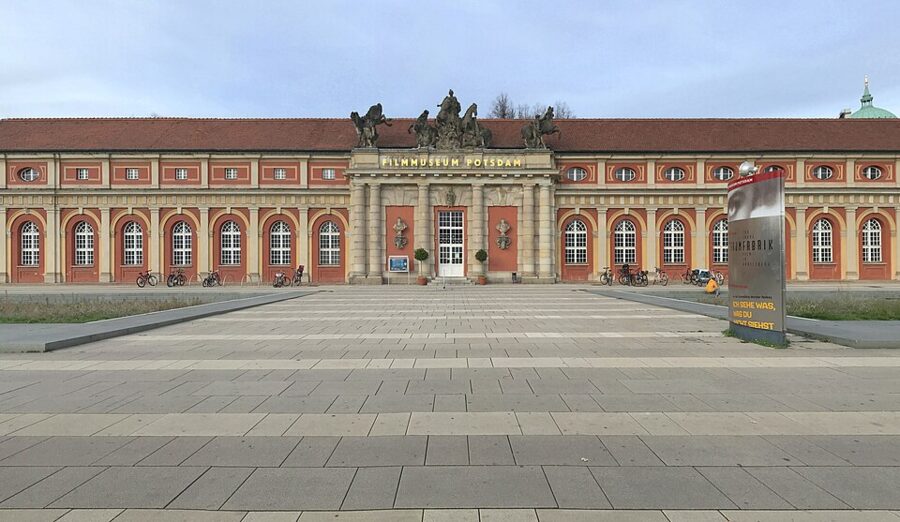
Inside is the Filmmuseum Potsdam: a permanent exhibition that walks you through the making of a film using a century of objects from the studio lot in Babelsberg, a changing exhibition upstairs, a free foyer with the projector that gave Germany its first public film show, and a cinema that still plays silent films to a Welte organ from 1929. It belongs to the Film University Babelsberg (Filmuniversität Babelsberg KONRAD WOLF), and it keeps more than a million objects in a separate archive building across town.
If you have one free hour in Potsdam and an interest in film, spend it here rather than at the theme park out in Babelsberg. The exhibitions are open Tuesday to Sunday from 10:00 to 18:00, a museum ticket costs €12, and anyone under 18 gets in free. The tram stop Alter Markt/Landtag is about 75 meters from the door.
Contents9 parts
- An orangery for the Great Elector, a stable for the Soldier King
- The building that was left standing
- A film museum for the GDR, then for Babelsberg
- The Dream Factory, room by room
- The free foyer: Skladanowsky's Bioscop and the special object
- Upstairs: the changing exhibition
- The cinema and its Welte organ
- The study collection in Babelsberg
- Planning your visit
An orangery for the Great Elector, a stable for the Soldier King
In 1685 the Great Elector, Frederick William of Brandenburg (Friedrich Wilhelm, der Große Kurfürst), had his court architect Johann Arnold Nering build a long orangery on the north side of the palace garden. It was a single story of tall, round-arched windows between Tuscan pilasters, 13 bays long, with a heating corridor along its north wall so that the bitter oranges and lemons in their tubs could winter behind glass. The Germans of the day called it the Pomeranzenhaus, the bitter-orange house.
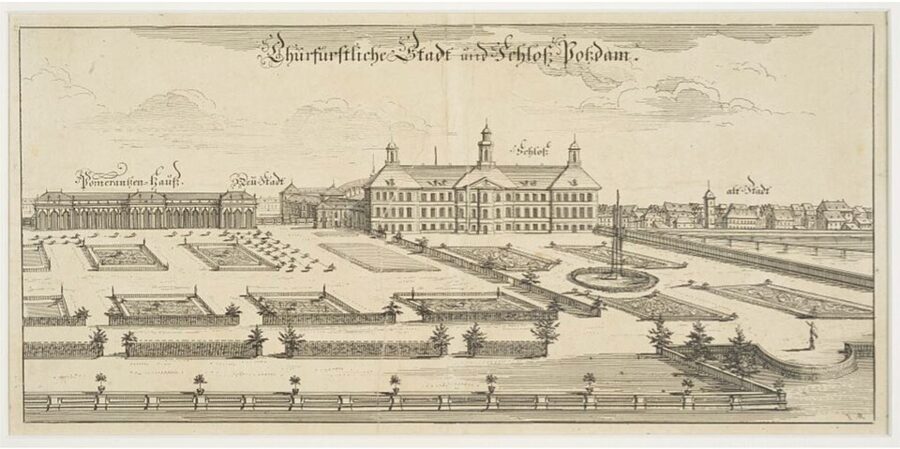
The orangery lasted 29 years. When Frederick William I (Friedrich Wilhelm I) came to the throne in 1713, the king who preferred tall soldiers to oranges, he had the garden’s flower beds leveled into a parade ground and in 1714 turned the orangery into a stable for the royal riding horses. The orange trees were moved to a glasshouse in the Marlygarten, today part of Park Sanssouci. So the building has been a Marstall, a royal stable, since 1714, which is earlier than most short accounts say.
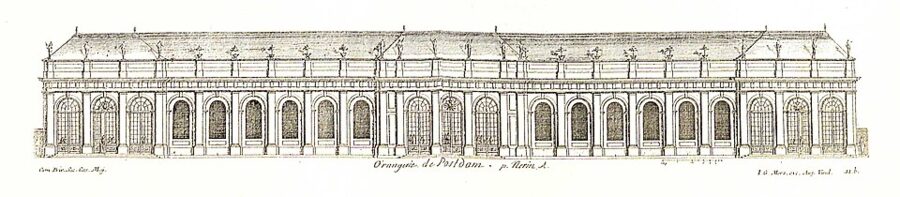
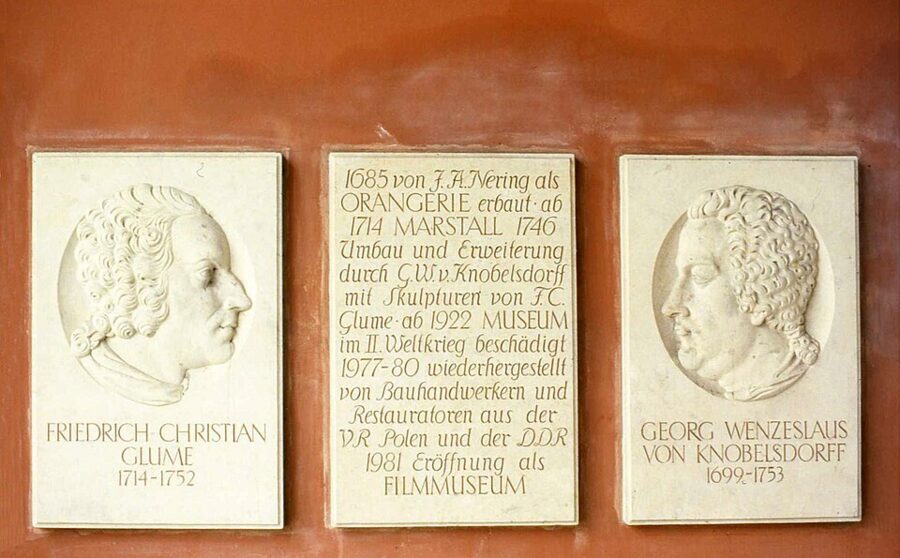
The building you see today is mostly the work of the next king. In 1746 Frederick the Great (Friedrich II) had the stable rebuilt to designs by Georg Wenzeslaus von Knobelsdorff, the architect of Sanssouci, with the builder Andreas Krüger carrying out the work. They kept Nering’s rhythm of arches and simply repeated it westward until the front ran to 33 bays, then added a second sandstone centerpiece so the long elevation would balance. Knobelsdorff was remodeling the palace across the garden at the same time, and the stable was meant to be seen from its windows.
The horses on the roof
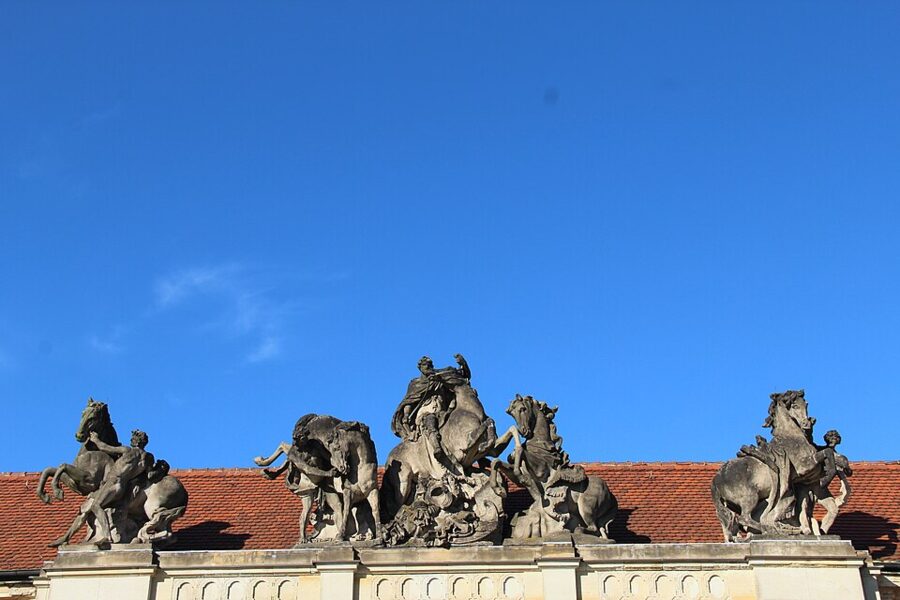
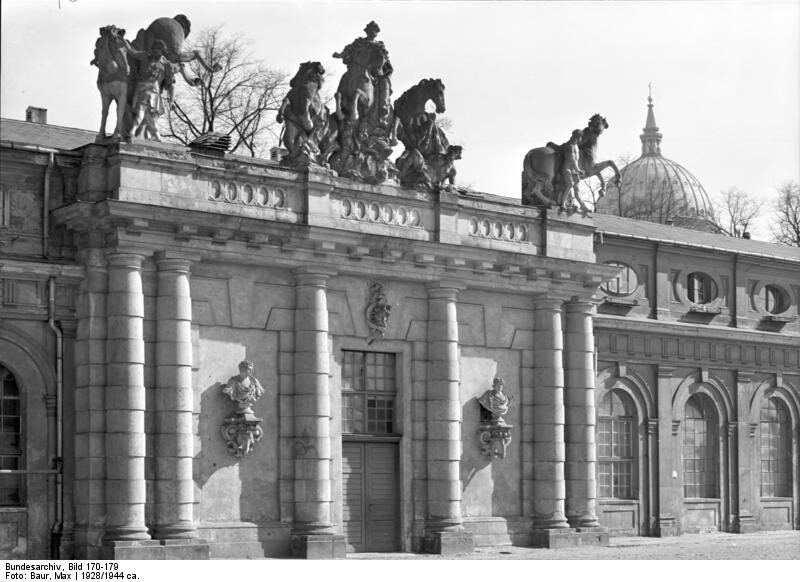
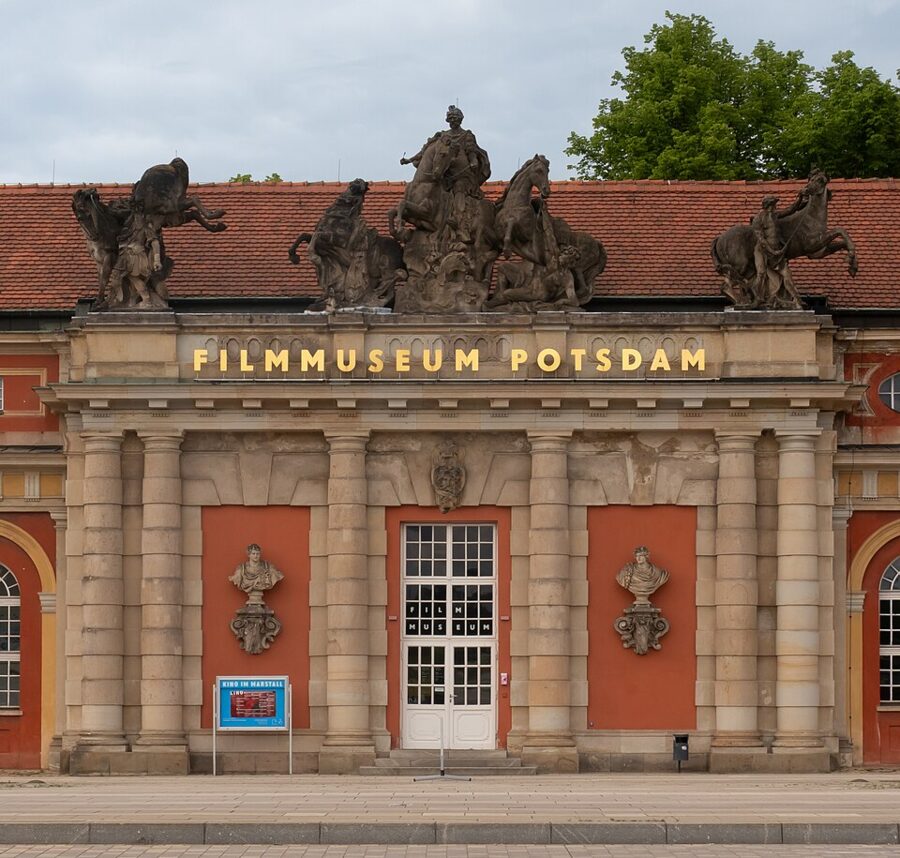
Knobelsdorff’s centerpieces and the side portals carry the building’s best feature: groups of rearing horses and the men wrestling them, carved by Friedrich Christian Glume, a Berlin sculptor who died in 1752 at 38. Glume also worked on the figures of the colonnade that linked the stable to the palace, and on the Obelisk portal in the Sanssouci park. The horse tamers are classical in subject and Rococo in mood, all twisting manes and flying cloaks, and they were the eighteenth century’s way of putting a sign over a stable door.
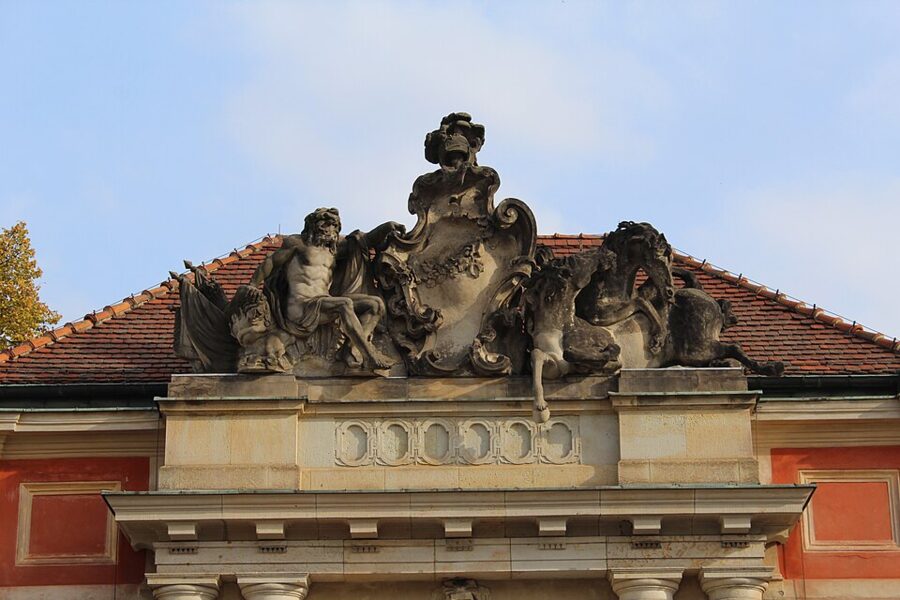
To read the building, stand on the Lustgarten side of Breite Straße and look along it. The two projecting centerpieces with their half-columns and attic groups mark the old and new halves; the portals are framed with rusticated columns and decorated with busts and keystones carved as masks. The rear, on Schlossstraße, is plain: it was changed in 1895 and was never meant to be looked at.
The building that was left standing
When the monarchy fell in 1918 the royal horses went, and in 1922 the empty stable became Potsdam’s garrison museum. From 1939 the Luftwaffe used it as the seat of its cipher office. On the night of April 14, 1945, British bombers burned out the old town and the City Palace (Stadtschloss) beside the stable; the Marstall’s roof and its horse sculptures were badly damaged, but the walls stood.
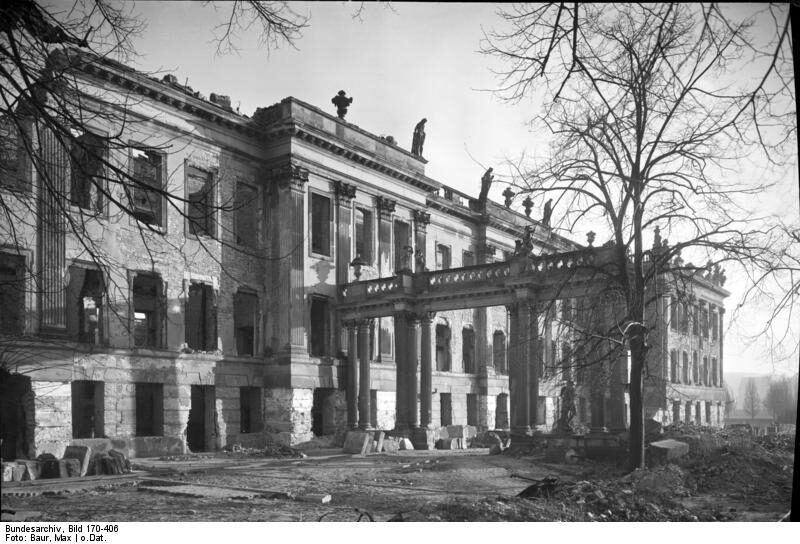
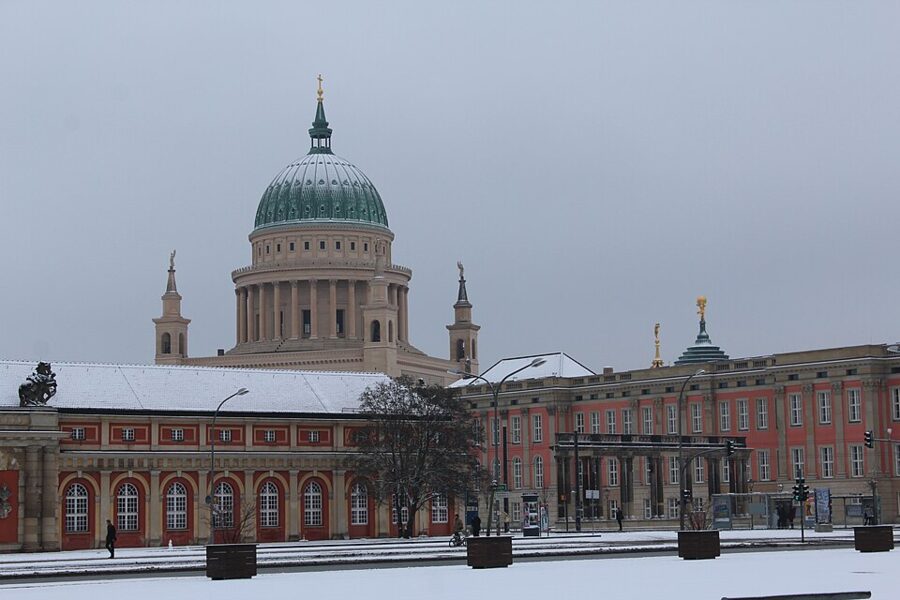
The palace went because the ruling Socialist Unity Party wanted the space for a socialist city center, and its rubble was used to fill in the old palace garden. The stable was on the list too. It was kept because the city plan changed, and in the 1960s the idea of putting a film museum into it gave it a use. The Marstall is now the only large building of the palace precinct to have come through both 1945 and 1960.
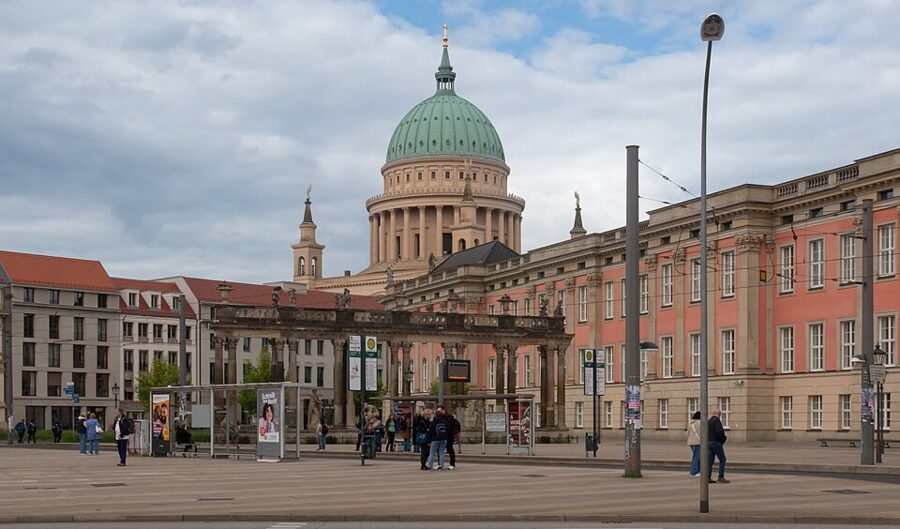
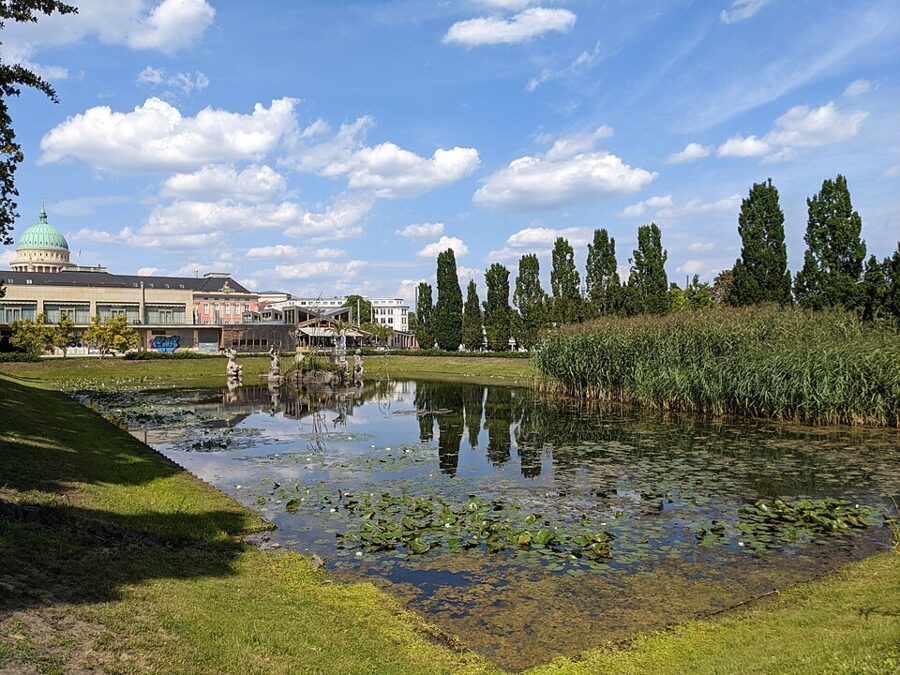
The garden in front had a hard twentieth century as well. After the war a sports stadium was built over much of it, and in the 1960s the tall Interhotel, today’s Mercure, went up at its southern end. For the federal garden show of 2001 the stadium was demolished and the Neuer Lustgarten laid out, much of it paved for fairs, with the Neptune basin restored. The view of the City Palace came back in 2014, when the rebuilt palace opened as the seat of the Brandenburg Landtag.
A film museum for the GDR, then for Babelsberg
Potsdam’s city council decided on a film museum in 1977, and the run-down stable was restored from 1977 to 1980 to take it. It opened in April 1981 as the Film Museum of the GDR (Filmmuseum der DDR) with an exhibition on film technology. At first its whole collection was cinema equipment from the East German state film archive, and the museum was run as a department of the state palaces administration at Sanssouci. A second show, on the history of Ufa and DEFA, followed in 1983.
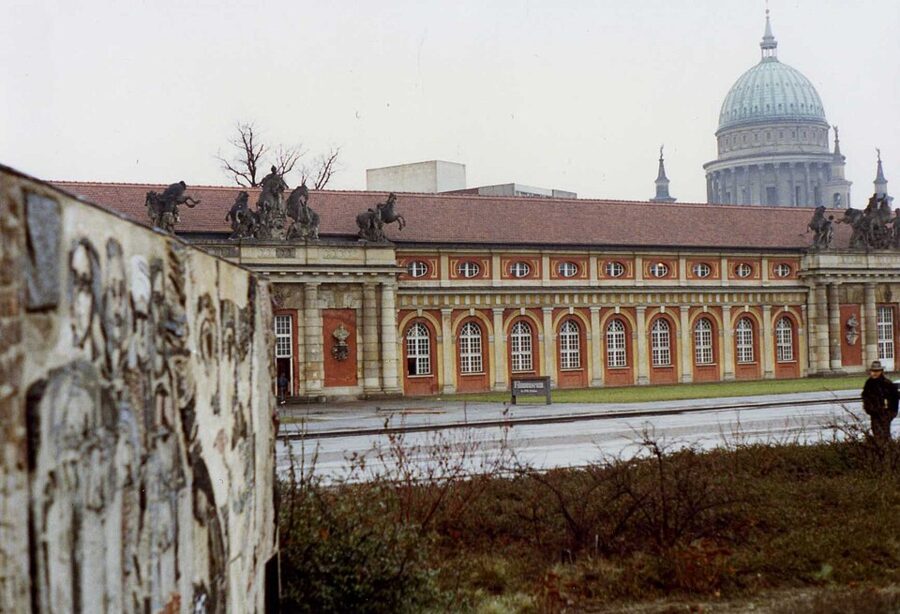
Everything changed with reunification. In 1990 the museum took its present name and began a collection of its own, and when the DEFA studios were wound up and cinemas across eastern Germany closed, their papers, props, posters and projectors came to it in quantity. The state of Brandenburg took the museum over in 1991. In 1993 the interior was modernized and a restored Welte cinema organ was built into the auditorium, and in 1995 the growing collections moved into their own rooms in the north of the city.
In July 2011 the museum became an institute of the film school in Babelsberg, then the Hochschule für Film und Fernsehen “Konrad Wolf”, which became Germany’s only film university in 2014. The museum calls itself the oldest film museum in Germany; the more careful claim, which German reference works make, is that it is the oldest with its own collection and exhibitions. Since October 30, 2019, Potsdam has also been a UNESCO Creative City of Film, and the museum is one of the places the city points to.
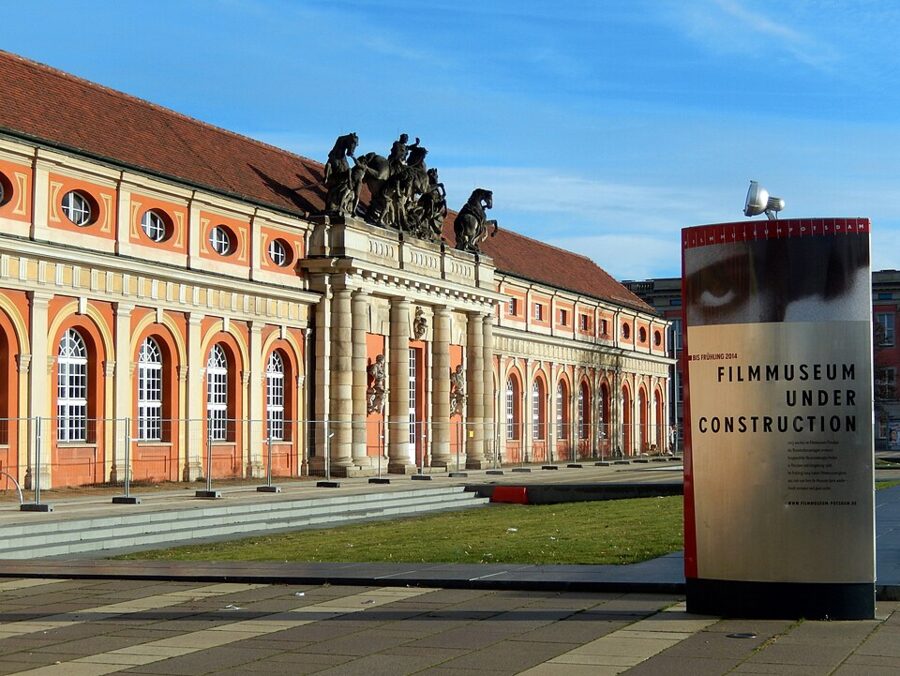
The building’s owner, the Prussian Palaces and Gardens Foundation (Stiftung Preußische Schlösser und Gärten, SPSG), paid for the works, which also made the building accessible, and the museum reopened in 2014 with a family exhibition based on a children’s animated series. Since 2022 the archive and the restorers have worked in a new building in Babelsberg, and the Marstall is left for what visitors come for: exhibitions, the cinema and the shop.
The Dream Factory, room by room
The permanent exhibition is called Traumfabrik: 100 Jahre Film in Babelsberg, which the museum’s English pages give as The Dream Factory: 100 Years of Film in Babelsberg. It opened on November 3, 2011, exactly a hundred years after the Deutsche Bioscop company was given permission to build its first glass studio in Neubabelsberg. More than 3,000 films have been made on that lot since the first one in 1912, under five political systems: the Empire, the Weimar Republic, the Nazi state, the GDR and the Federal Republic. The Filmpark Babelsberg tells the same story as a theme park beside the working studio; this is where the objects are.
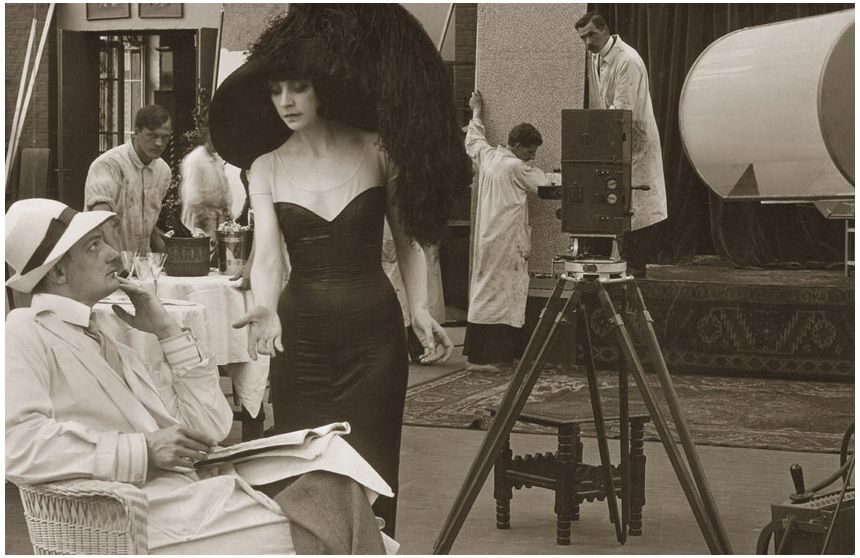
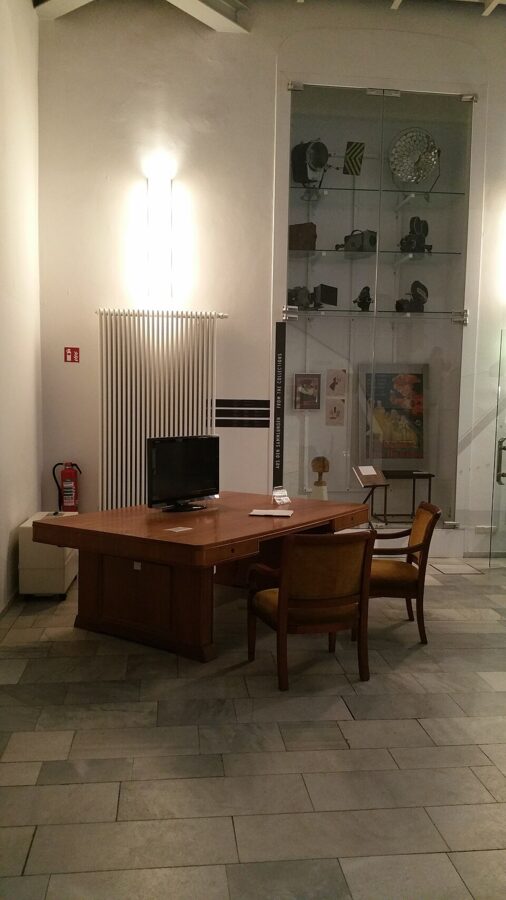
The designers decided not to tell the story by decade. Instead the seven rooms follow a film from the first idea to opening night, because, as the curators put it, the process has hardly changed since 1912 and anyone can follow it without having seen a single Babelsberg film. The exhibition fills 460 square meters with more than 500 objects, more than 1,000 photographs and about 350 film clips, and every text is in German and English. Give it 90 minutes; the casting box and the singing booth will take longer if you have teenagers.
The museum’s own list is the best guide to what to look for. The rooms were laid out like this when the exhibition opened, and objects are swapped for conservation and loans, so not every piece below is on show every month.
Ideas, scripts and producers
The first room, the Ideenschmiede (idea forge), shows how 20 films got from an idea to a script and a budget. Nine of them have their own lecterns with the full story, among them The Student of Prague (1913), often called the first art film; Jud Süß (1940), the best-known propaganda film of the Nazi years; Solo Sunny (1980), Konrad Wolf’s one big popular hit about contemporary life in the GDR; and the storyline department that writes the daily soap Gute Zeiten, schlechte Zeiten, produced on the lot since 1995. The photo collages on the wall boxes are by Steffen Mühle.
Look in this room for the production designer Otto Hunte’s drawings for Fritz Lang’s Die Nibelungen (1924), which the museum lists among its most beautiful pieces, and for the working photographs tucked into the books.
Actors, make-up and costume
The second room, Mimen & Masken, is about the faces. Fifteen men and fifteen women stand for the stars Babelsberg made, from Marlene Dietrich and Angelica Domröse to David Kross, Christoph Waltz and Kate Winslet. Three collections of casting stories, one each from Ufa, DEFA and Studio Babelsberg, tell how unknowns were discovered, and the screen test Dietrich shot for The Blue Angel (1930) runs here.
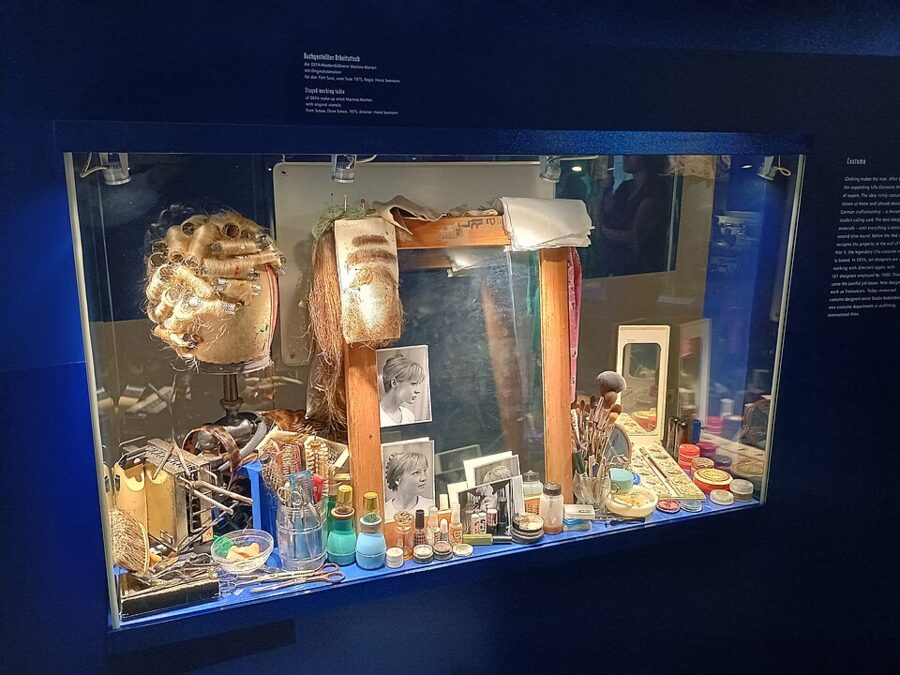
In the casting booth you can read for a part and have yourself copied into scenes from Sonnenallee (1999), the DEFA western Die Söhne der großen Bärin (1966) or the 1931 Emil und die Detektive, and the clip is sent to you by email. The costumes include a royal robe from a DEFA film of a folk tale and a dress Diane Kruger wore in Inglourious Basterds (2009).
Sets and set builders
Room three, Filmbaumeister, makes the case that set building is Babelsberg’s oldest strength. It follows three designers: Otto Hunte, who designed Die Nibelungen and later worked on both Jud Süß and the first postwar DEFA film, The Murderers Are Among Us (1946); Alfred Hirschmeier, the great DEFA designer of I Was Nineteen (1968) and Goya; and Uli Hanisch, who designed Tom Tykwer’s The International (2009). Models recall the many lives of the Berliner Straße, the big street set on the backlot.
The largest object in the museum is here: the castle model for the DEFA children’s film Gritta von Rattenzuhausbeiuns (1985) by Hirschmeier and Gisela Schultze, 3.3 meters wide.
On set: three directors, three eras
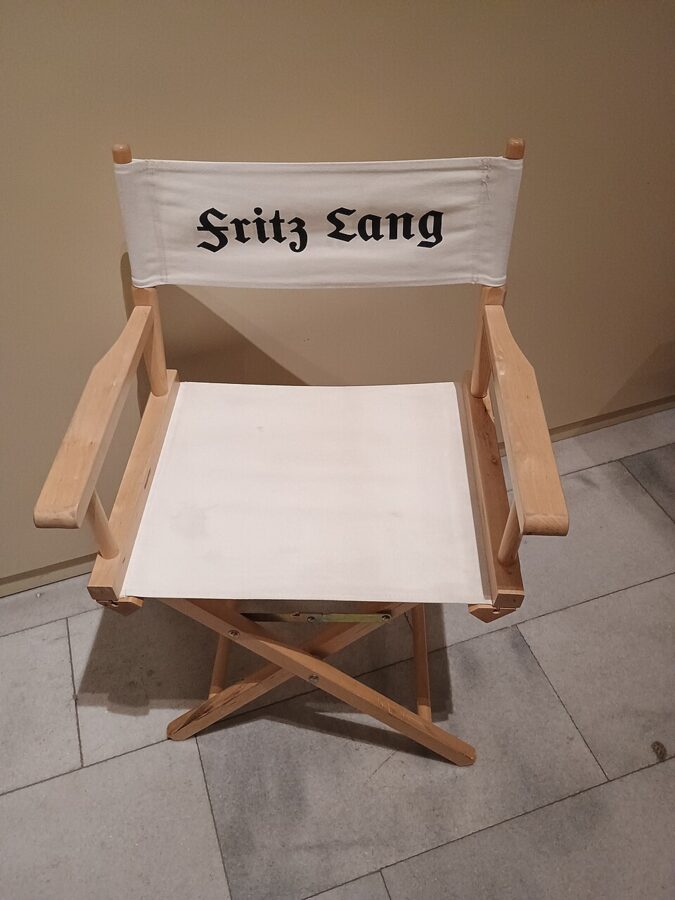
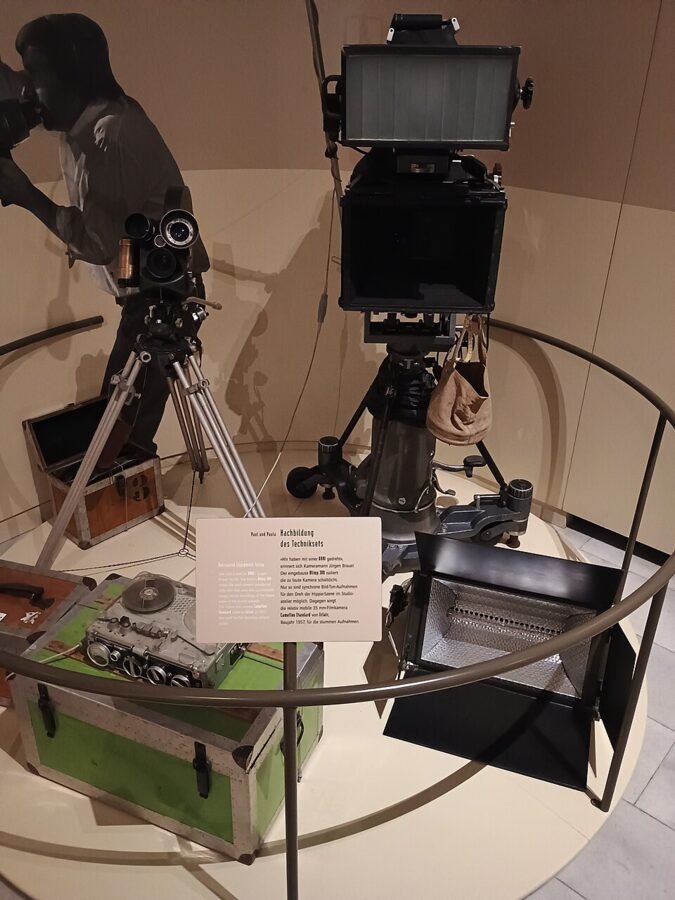
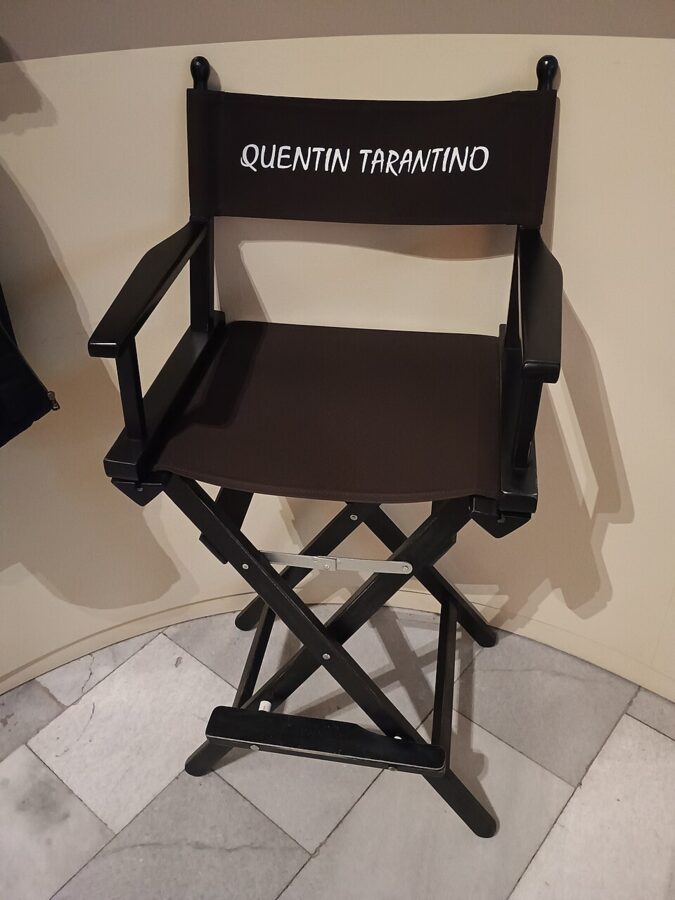
The fourth room, Achtung Aufnahme! (Quiet, rolling!), sets three shoots side by side: Fritz Lang’s Die Nibelungen (1924), Heiner Carow’s The Legend of Paul and Paula (1973) and Quentin Tarantino’s Inglourious Basterds (2009). Each gets its crew, its cameras and its making-of, with audio plays recorded by film school students to give the sound of a set.
Editing, and the stars’ leftovers
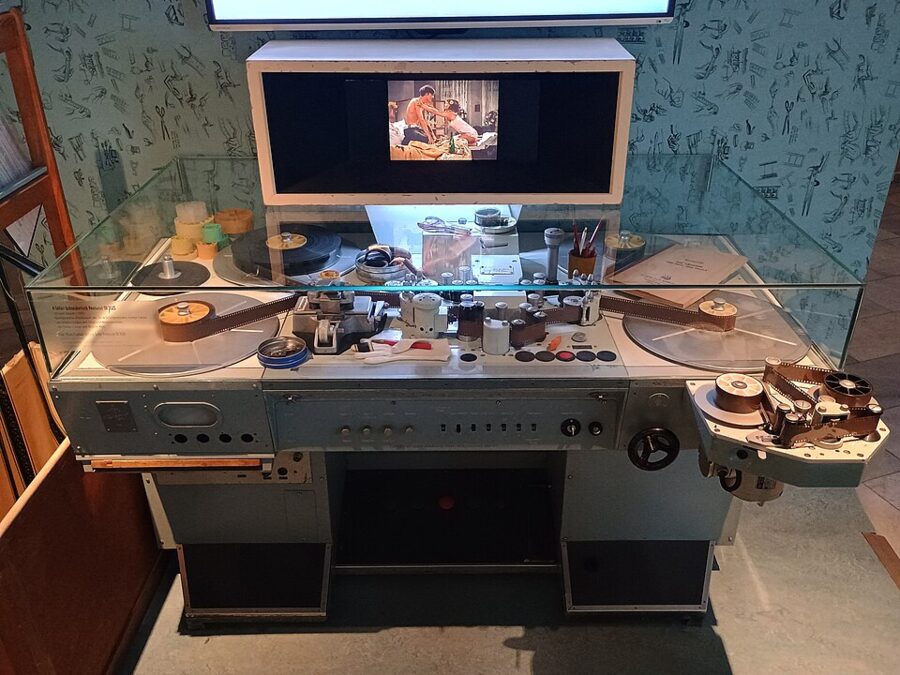
Room five, Montage, is about the cutting room, where the museum points out that most of the work was done by women. Flora Franke was Bioscop’s first “gluer” in 1912, the job later called film editor; Evelyn Carow cut all of her husband Heiner Carow’s films; Sally Menke was Tarantino’s editor. A flatbed editing table from 1965 is the centerpiece, and editors explain their craft on screen.
Between the rooms stands Rainer Sperl’s star sculpture, golden at the front and hollow at the back, with real film awards lit behind it, including the Golden Bear won by Rainer Simon’s Die Frau und der Fremde in 1985, the first Berlinale Golden Bear for a DEFA film. Nearby are relics for Ufa fans: Asta Nielsen’s death mask, a toupee of Hans Albers, Jenny Jugo’s handbags, fan letters to Zarah Leander and a bead necklace of Ilse Werner’s. The museum files Werner’s coat hanger and a schnapps bottle with Albers’s head under “silly exhibits”, and it is right.
Music and sound
Room six, Musik & Ton, has a soundproofed booth where you can sing along with Zarah Leander in Es war eine rauschende Ballnacht (1939) or with Renate Krößner as Sunny, listen to each section of the Babelsberg film orchestra on its own, and hear what a change in the sound design does to a scene. The display cases are where to slow down.
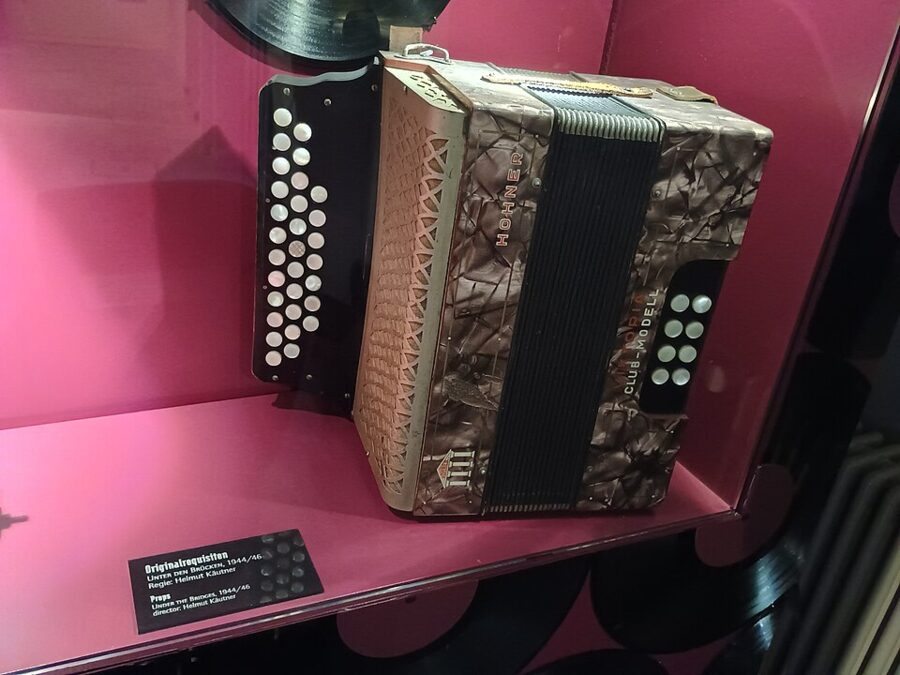
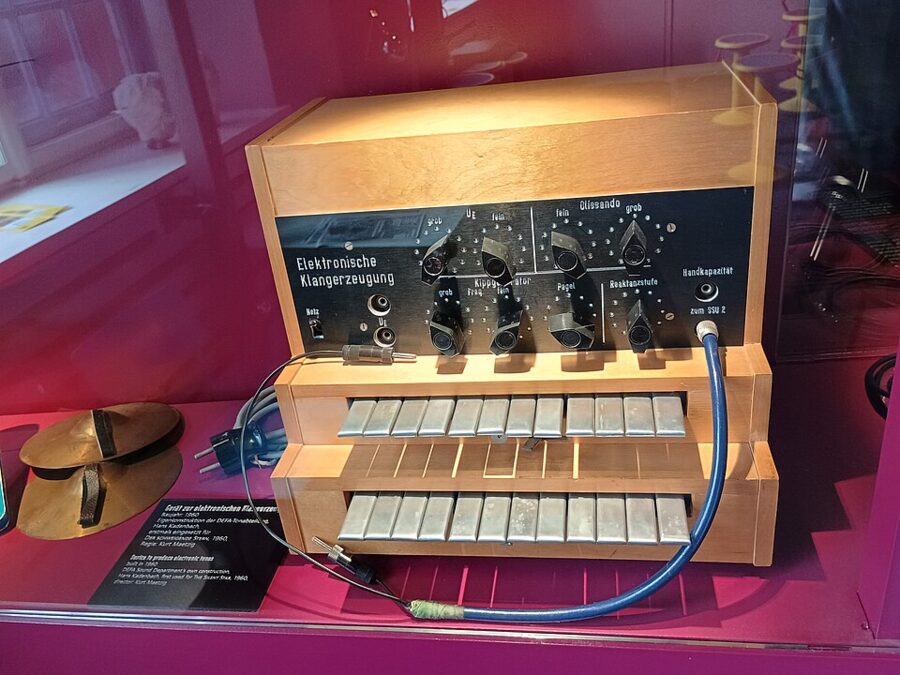
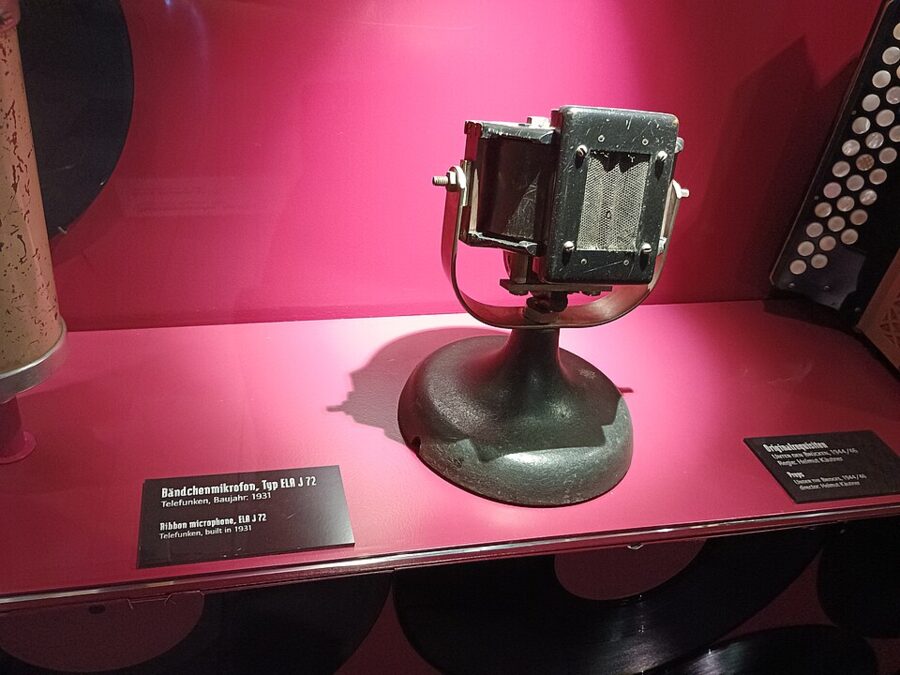
Opening night
The last room, Premiere!, is a small cinema fitted with seats and projectors from the 1910s, 1930s, 1950s and 1990s, with a film of Babelsberg clips running on the screen. There are invitations and tickets for the premieres of Die Nibelungen, Paul and Paula and Inglourious Basterds. Among the projectors in the exhibition are the museum’s oldest object, an Ernemann Imperator from about 1910, and its heaviest, a Dresden D21 of about 1960 from the GDR’s State Council building, weighing around 400 kilograms, on which Walter Ulbricht, Erich Honecker and later Chancellor Gerhard Schröder watched private screenings.
A hidden room under the cinema is given to film laboratory work, a trade the digital age made redundant. At the end of the exhibition a last room invites you to stay and make something, a good place for children to finish.
The free foyer: Skladanowsky’s Bioscop and the special object
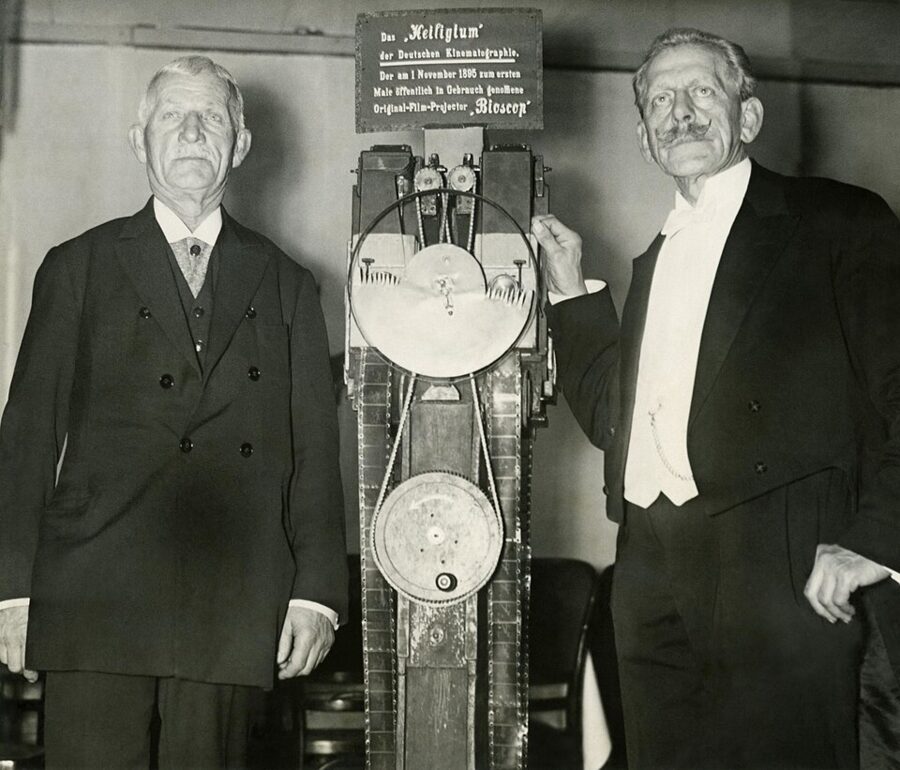
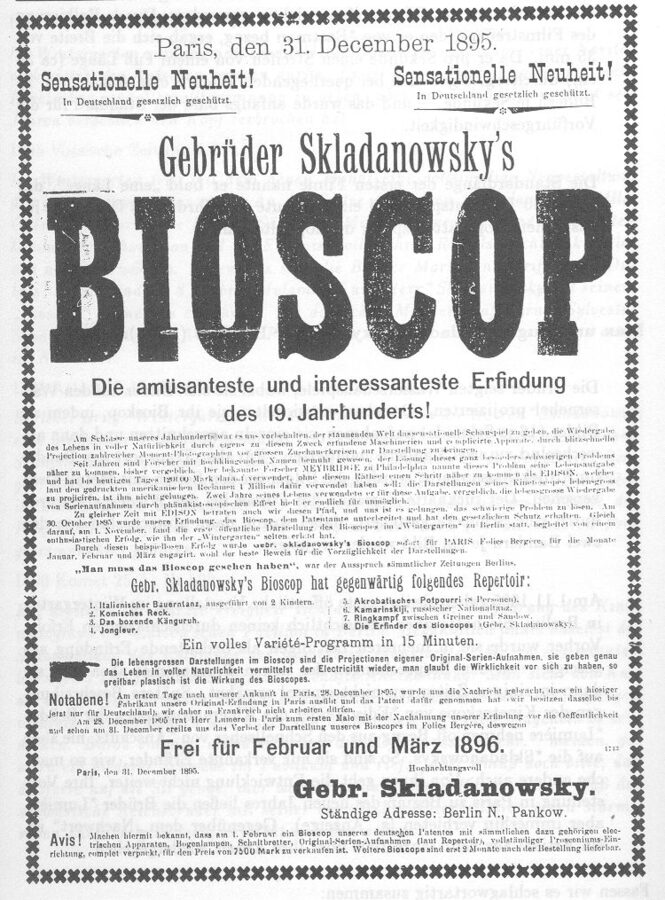
You do not need a ticket for the ground-floor foyer, which the museum uses for a free exhibition, a single changing display case and its historical film technology. The star is a projector. On November 1, 1895, the brothers Max and Emil Skladanowsky used their Bioscop to show films they had shot themselves at the Wintergarten variety theater in Berlin, the first public film screening in Germany, a few weeks before the Lumière brothers’ famous show in Paris.
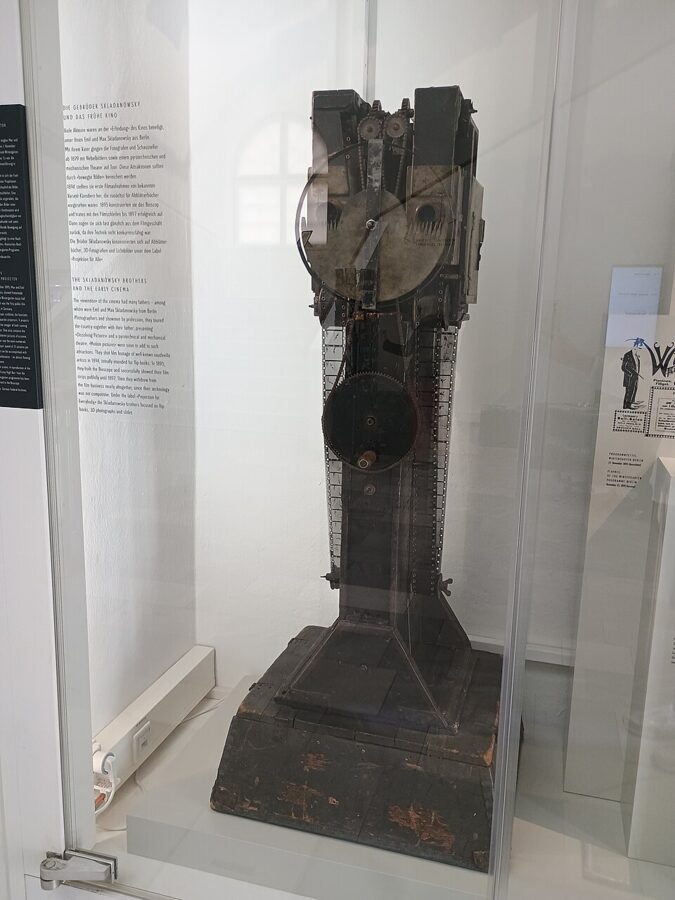
The museum is frank about it: Skladanowsky’s technology lagged behind what other inventors were already doing, and needing two strips of film was a dead end. The machine is still the founding object of German cinema, and it was Brandenburg’s centerpiece at the EXPO 2000 in Hanover. Every film had to be cut apart frame by frame, reordered into two rows and joined with metal eyelets before it could be shown.
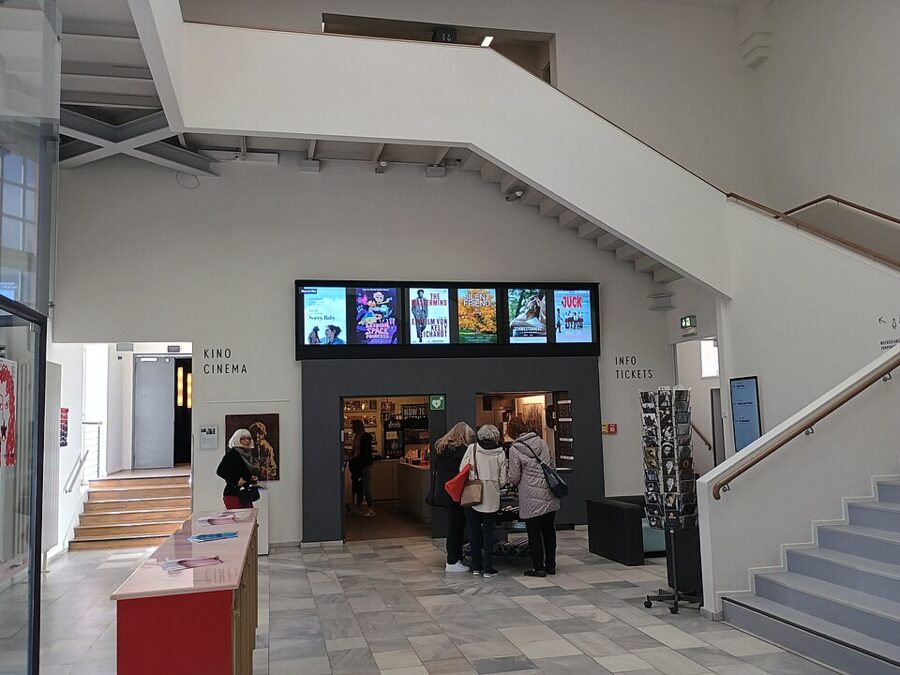
The current foyer exhibition, Diene ehrlich friedlichem Aufbau (roughly, serve peaceful rebuilding faithfully), runs until May 2, 2027. It starts downstairs with the Babelsberg studio around 1949–50, documented building by building for its Soviet owners, and continues on the gallery with eight films made between 1945 and 1951 that tried to deal with German guilt. It ends with Das Beil von Wandsbek, withdrawn in 1951 shortly after its premiere, the first DEFA film to be banned.
In one case near the entrance the museum has shown Das besondere Objekt, the special object, since the end of 2015: a single treasure from the collections, changed every so often. From November 16, 2026, it is a microphone in an egg, linked to the nature filmmaker Siegfried Bergmann.
Upstairs: the changing exhibition
The upper floor holds the temporary exhibitions, and the museum ticket covers them. Until May 2, 2027, the special exhibition is Ohne Frühstück. Ohne Diskussion. 80 Jahre DEFA-Filme (No breakfast. No discussion. 80 years of DEFA films), marking the founding of the East German state film company in Babelsberg on May 17, 1946.
Between then and 1992 DEFA made about 750 feature films and thousands of documentaries and animations, but the exhibition leaves out the fairy tales, westerns and science fiction that are best remembered and sticks to the so-called Gegenwartsfilme, films about the present. It groups them by the subjects of ordinary life: emancipation, rebellion and retreat, housing and fun, freedom and wanderlust, sex and love, food and drink, the church, fashion. Each station includes a film for children or teenagers, which makes this a better family visit than the subject suggests.
The objects are the reason to climb the stairs. The museum found originals in the studio’s costume store and prop store: the jeweled dress Jenny Jugo wore in Träum’ nicht, Annette!, Renate Krößner’s dressing gown and leather jacket from Solo Sunny, Katrin Sass’s show dress from Zum Teufel mit Harbolla and the typewriter from Einer trage des anderen Last. A film series and a six-part podcast accompany the show.
The lift to the upper floor is a little hidden, the museum says; ask at the desk if you need it. When the DEFA show closes in May 2027, the museum’s exhibitions page is the place to see what replaces it.
The cinema and its Welte organ
The Kino im Marstall is the only cinema in Potsdam’s historic center, and it plays every day except Monday. Evening screenings start from 17:00, and on Saturdays and Sundays a children’s film runs at 15:00, with extra morning shows in the school holidays. The program mixes film history, documentaries and recent releases, often in the original language with German subtitles, marked OmU, and filmmakers regularly come for a talk afterwards.
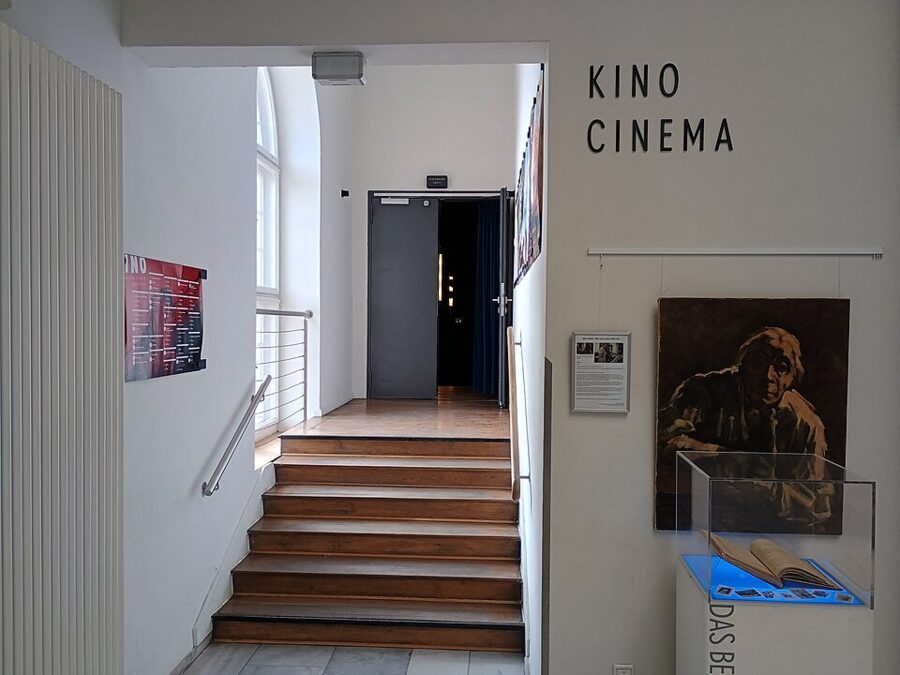
The monthly program repays a look before you plan an evening. In November 2026 it has a series called Fast verpasst (almost missed) for recent films that left the multiplexes too fast, evenings for the DEFA anniversary, and from November 26 to 29 a film heritage festival, Als Queer schwarz-weiß war, on queer lives in the films of the Nazi years and the 1950s. From December 2026 to February 2027 a series called Genial gezeichnet accompanies the Impressionism exhibition at the neighboring Museum Barberini.
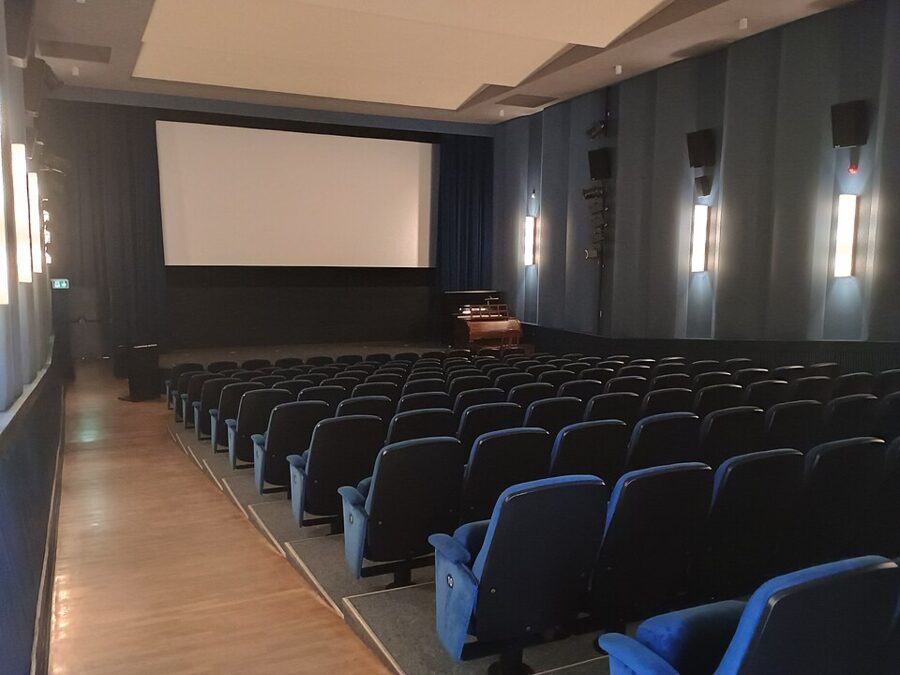
Cinema tickets cost €8 for adults and €5 reduced, and children’s films €5 for ages 4 to 17. Silent films with live music cost €14, or €10 reduced, and films over 140 minutes carry a €1 supplement, €2 over 170 minutes. You can reserve seats through the program pages, and where online reservation has closed the museum points you to remaining tickets at the box office. A Freundschaftsabo-Karte for €30 gives a year of reduced entry to both the exhibitions and the cinema.
Some current films come with audio description and subtitles through the GRETA and STARKS smartphone apps; they are marked in the program. If you are visiting from abroad, the OmU screenings of foreign films are the easy choice, since the original soundtrack is often English.
The organ from Chemnitz
The organ is the reason to choose a silent-film night. It was built by the firm of M. Welte & Söhne and installed in 1929 in the Luxor-Palast cinema in Chemnitz, at the very moment sound film was arriving to put cinema organists out of work. It was altered several times after the 1950s, played until the late 1960s, taken out in 1979 and handed to the film museum then being set up in Potsdam.
The Dresden organ builders Jehmlich restored it in 1992–93, bringing it largely back to its original state, and it was built into the auditorium in 1993. It has 44 stops and three effects stops, electro-pneumatic action, and a box of noises that a 1920s cinema needed: thunder, storm, rain, a ship’s siren, a locomotive whistle, a railway train, bird song, a telephone, castanets and sleigh bells. Every pipe rank can be played from every keyboard.
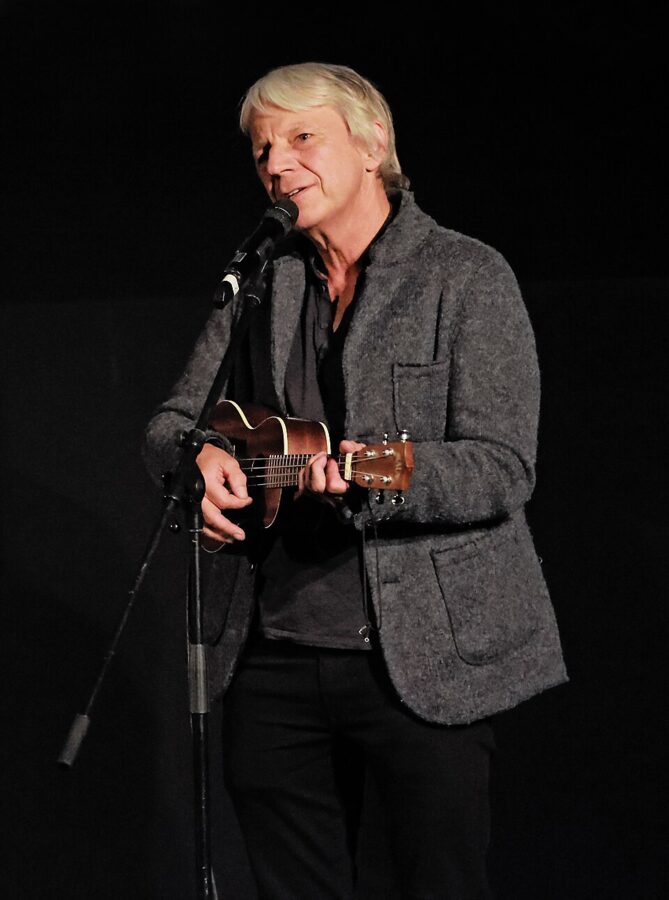
On November 28, 2026, for instance, Peer Kleinschmidt is at the organ for a program that opens with Eine moderne Jungfrau von Orléans (1914), a 15-minute film by Max Skladanowsky, the man whose projector stands in the foyer. That is the Marstall at its best: the first German film machine downstairs and one of his films with its own live accompaniment a few meters away. The museum also arranges special screenings with the organ for groups.
The study collection in Babelsberg
The Marstall shows a fraction of what the museum owns. The collections hold more than a million objects: scripts, set and costume designs, production papers, photographs, models, props, costumes, film awards, posters and programs, the papers of about 250 filmmakers, records of more than 700 firms that made film and cinema equipment, and a collection of patents. Since 2022 they have been kept in a new archive building of more than 5,500 square meters on Marlene-Dietrich-Allee in the Medienstadt Babelsberg, across the street from the film university’s main building and close to the studio.
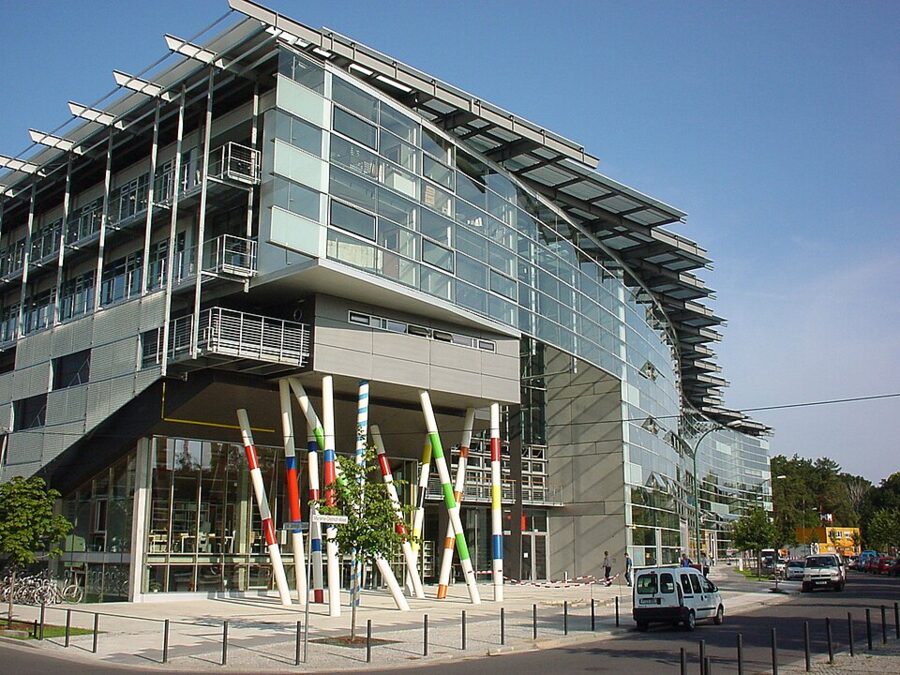
Part of the new building is open to the public as the Schaudepot, an open store. It shows about 750 objects and 400 documents, among them 377 pieces of film technology, 121 three-dimensional set pieces, around 149 set designs and four costume pieces, together with four hands-on stations drawn from the film technology collection and the collection of the filmmaker Werner Nekes. The display is also about the archive itself: how an object gets into a collection, how it is packed and stored, and who decides what is kept.
Individual visits are by booked one-hour slot only, on Thursdays from 15:00 to 17:00 (not on public holidays) and on Sundays from 11:00 to 15:00. Tickets are sold only through the museum’s page on Eventbrite, at €6 for adults and €4 reduced, and under-18s are free; groups book a guided tour by email. The Schaudepot is closed, like the Marstall, on December 24, 25, 26 and 31 and on January 1.
It pairs naturally with a Sunday at the Filmpark or a walk round Babelsberg, since the same buses and trains serve both. The museum also owns the Little Sound Film Museum (Kleines Tonfilmmuseum) that Ulrich Illing, head of sound at DEFA and later at Studio Babelsberg, opened on the studio lot in 2010: about 250 recording and playback machines, most of them still working, bought after his death and put into store. The museum planned to bring highlights back into public view in the new building, so ask whether any are out when you book.
Planning your visit
The exhibitions are open Tuesday to Sunday from 10:00 to 18:00, and the museum shop opens at 10:00 and stays open until the last film. Both the Marstall and the Schaudepot close on Mondays and on December 24, 25, 26 and 31 and January 1. The museum’s opening times and prices page has any changes.
The museum ticket, which covers the permanent and the changing exhibition, costs €12, reduced €8, and children and teenagers under 18 go free. Groups of ten or more pay €10 each, or €8 reduced, plus a flat €70 for a guided tour. Reductions apply to students, apprentices, people on unemployment benefit, Berlinpass holders and holders of a German disability card, whose companion goes free with the “B” mark; pensioners get the reduction for the exhibitions only.
The museum is accessible throughout, by ramp or lift. There are accessible toilets in the foyer and behind the cinema, folding stools to borrow, and head torches at the desk for the darker rooms. Assistance dogs are welcome, there is no induction loop, and the films in the exhibition are only partly subtitled.
Food and drink
The museum has its own restaurant at the east end of the building, towards the Alter Markt tram stop: the GenussWerkstatt, run since 2015 by the cooks Ralph Junick and Kay Fock. It serves homemade pasta, risotto, salads and soups with a good run of vegan dishes, under the stable’s high ceilings, with tables outside in the warm months. Its own site gives the hours as Tuesday to Sunday, 09:00 to 22:00, which covers lunch before the exhibition or dinner after a film.
The foyer also has a vending machine for snacks and drinks. For more choice, the restaurants of the old town and the Dutch Quarter are 10 to 15 minutes’ walk north; my guide to Potsdam restaurants has them.
Getting there
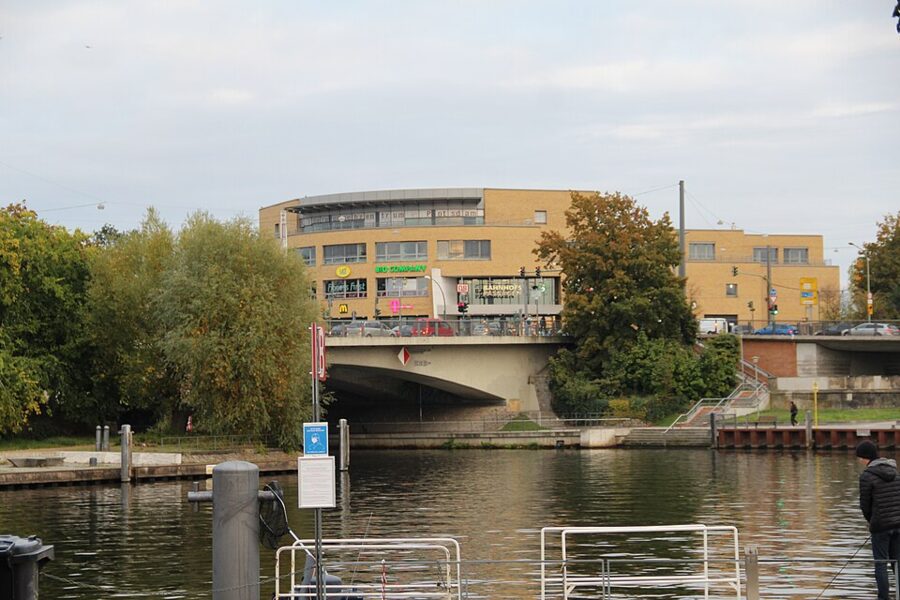
From Berlin take the S7 (every ten minutes), the RE1 (three times an hour) or the RB23 to Potsdam Hauptbahnhof, the main station. From there it is about 900 meters to the museum, 10 to 15 minutes on foot across the Lange Brücke over the Havel, or take any of trams 91, 92, 93 and 96 or buses 605, 631, 650 and 694 to Alter Markt/Landtag. The museum stands beside the stop, just west of the Landtag.
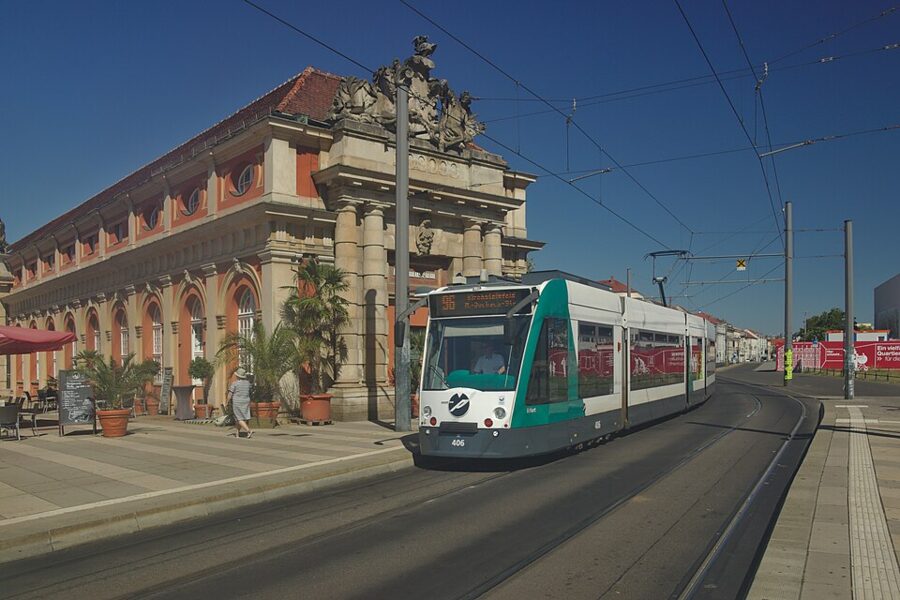
The fare from central Berlin is a single ticket Berlin ABC at €5.00 each way in 2026, or the 24-hour ticket Berlin ABC at €12.90 if you will ride trams in Potsdam as well; the Deutschlandticket covers all of it. From January 1, 2027, VBB’s new fares raise the single ABC ticket to €5.20 and the 24-hour ticket to €13.20, and a single ticket within Potsdam to €3.10. By car, parking near the museum is scarce and paid; the nearest garage is under the Neuer Markt, entered from Werner-Seelenbinder-Straße, and there is a disabled space behind the museum on Schlossstraße.
What to pair it with
The museum sits at the edge of Potsdam’s old town, and the Alter Markt with the Landtag, the Nikolaikirche and the Museum Barberini is a two-minute walk east. West along Breite Straße, about ten minutes away, the rebuilt tower of the Garrison Church stands on the site of the soldier king’s church. For a day of indoor sights, my guide to the museums in Potsdam sets this one against the others, and the full list of things to do in Potsdam covers the rest.
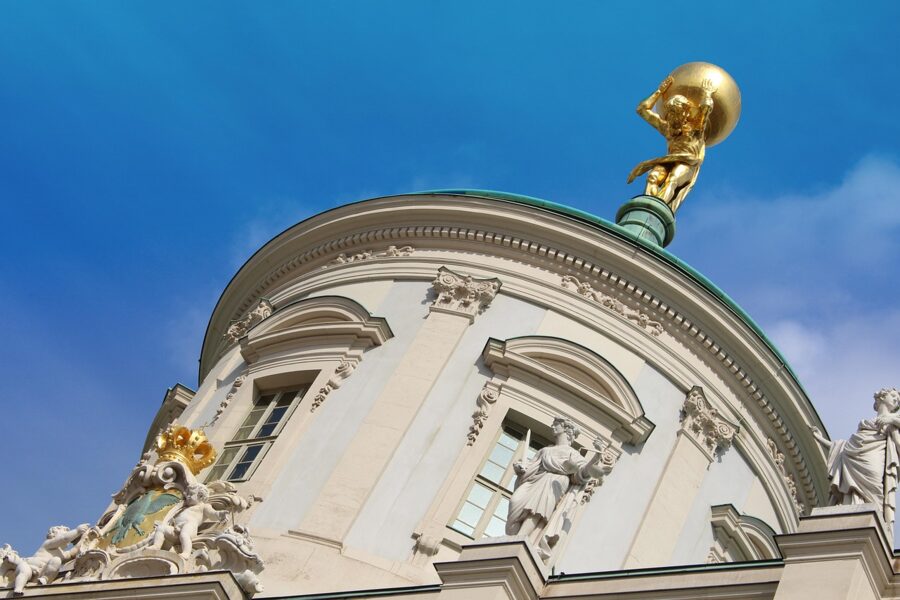
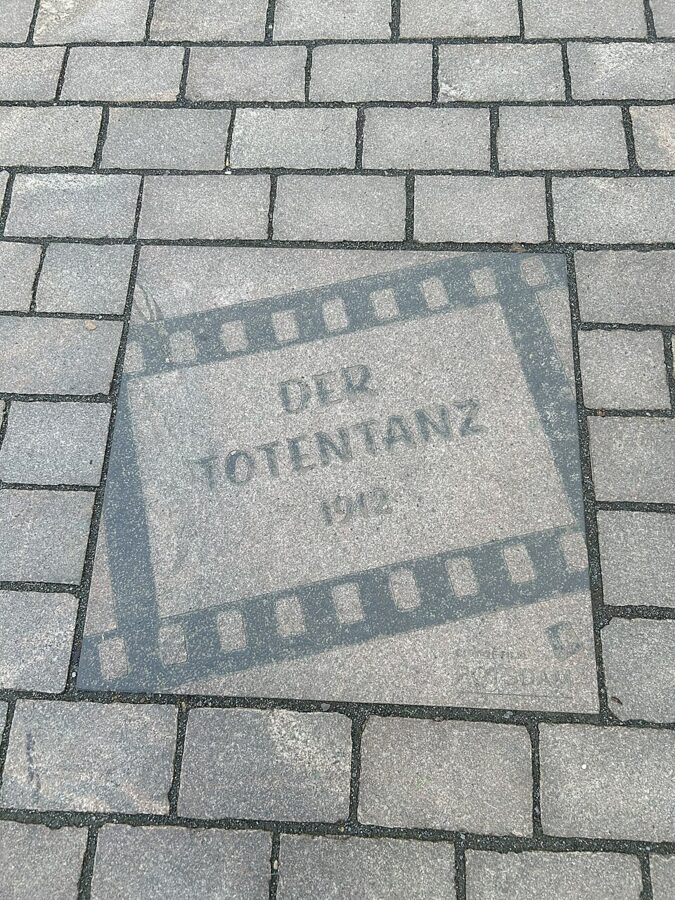
In Advent, the city’s main Christmas market fills Brandenburger Straße, ten minutes north, and the 55 plaques of the city’s new Boulevard of Film are being set into the same street, one for each film made in Potsdam that the city chose to honor. A walk up it to the Brandenburg Gate makes a good end to a film afternoon.
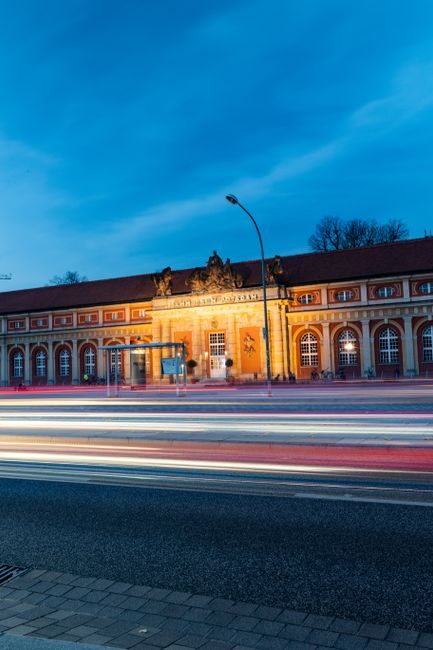
Come back to Breite Straße after a silent film, then, when the organ has stopped and the foyer is emptying. Glume’s horses are lit against the dark above the door, still rearing over a stable that has had no horses for a century, and tram 96 is a few steps away to take you back to the station.