

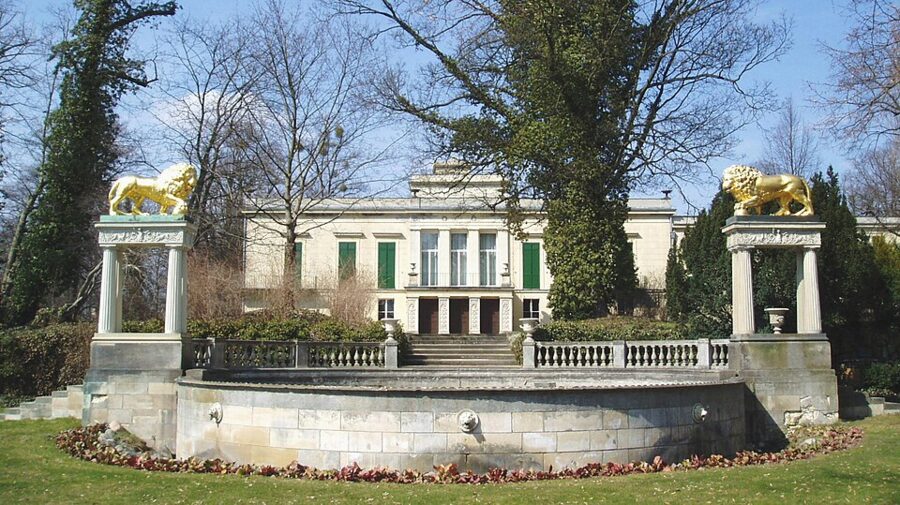
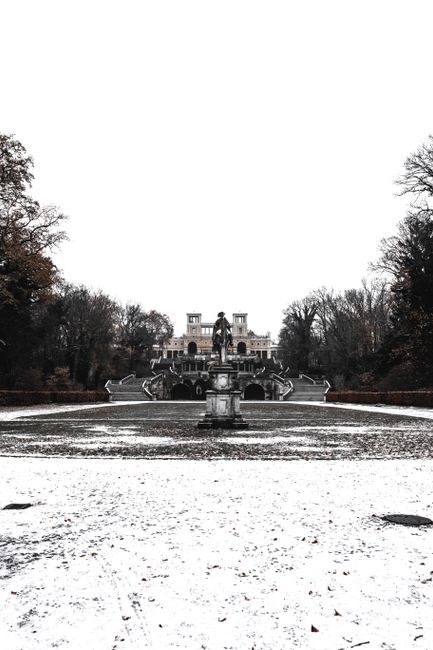
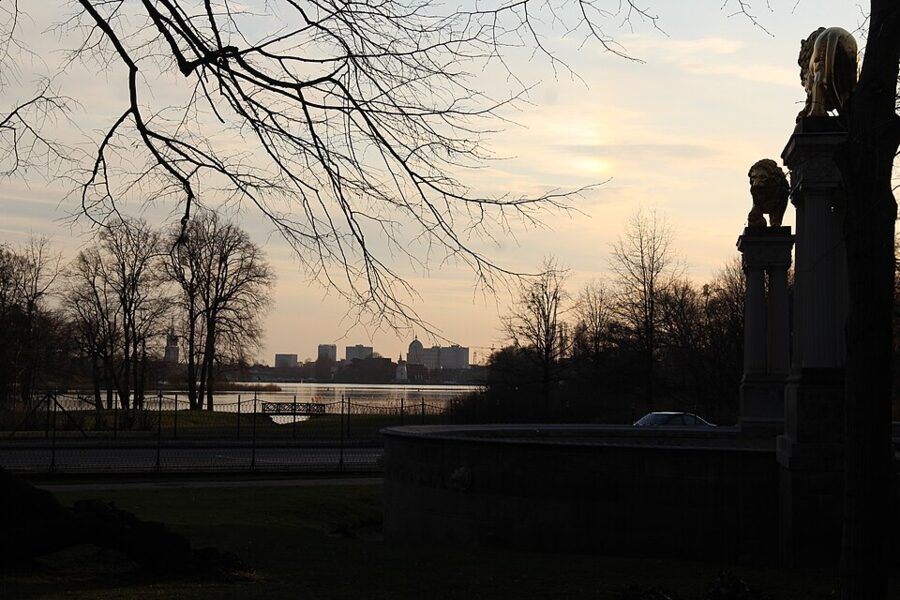
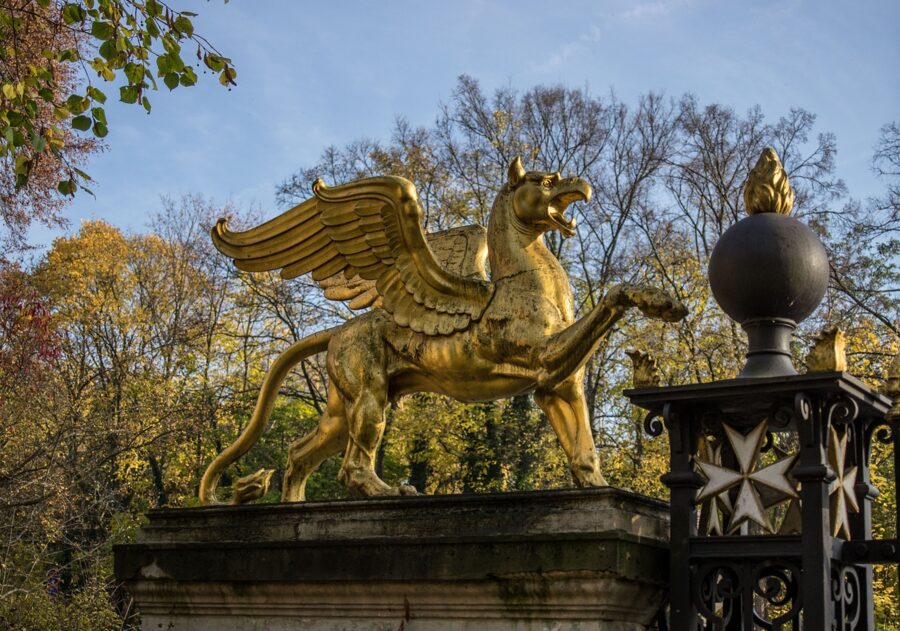
Two gilded lions sit on bundles of white columns at the foot of Prince Carl’s garden, staring past a fountain at the traffic on the Königstraße. They are casts of a pair of Medici lions in St. Petersburg, sent by his sister the tsarina for his thirtieth birthday in 1831, and on June 2, 1838, when she and the tsar came to visit, the jets between them leapt for the first time.
Steam pumped the water. Sanssouci, a few kilometers west, would wait several more years for fountains that worked.
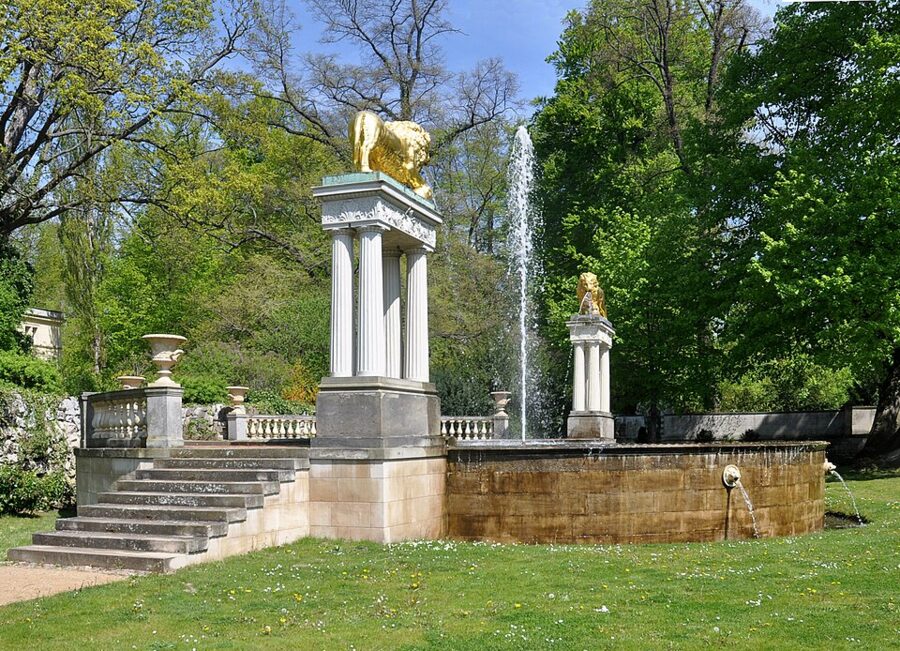

That is Glienicke in one view: a royal younger son with time, money and a sister on the Russian throne, building himself an Italy on a sandy bank of the Havel. Carl once wrote to his father, after a hard journey south, that if you wanted to go on loving Italy you should study it in pictures and books rather than look at it yourself. Then he came home and had Karl Friedrich Schinkel, Ludwig Persius and Peter Joseph Lenné make him one secondhand, with real Roman marble set into the walls.
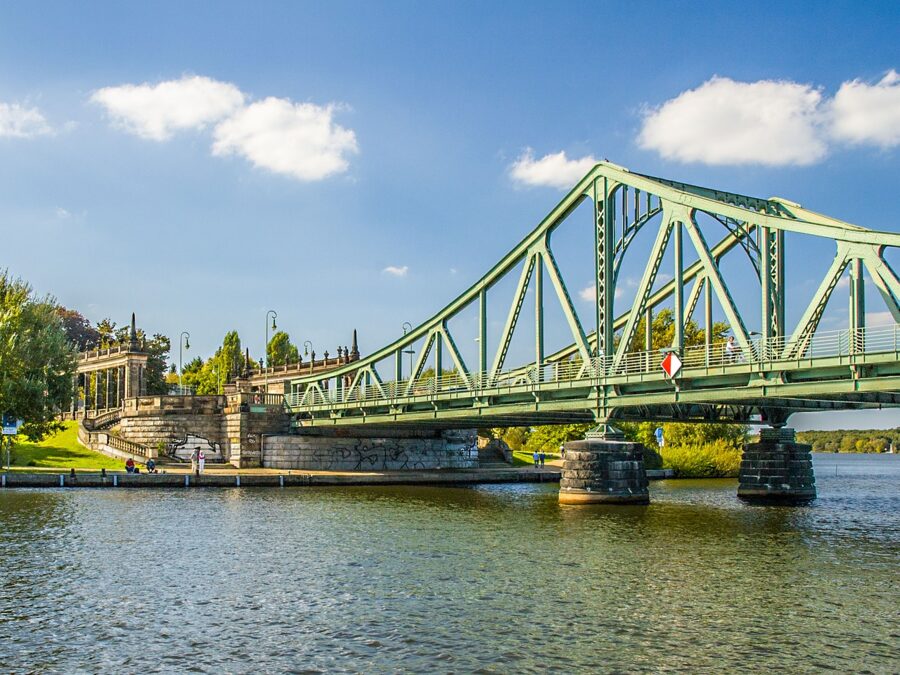
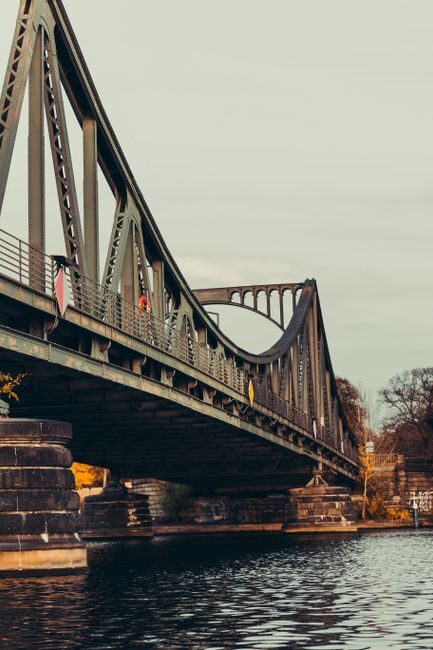
The estate stands on the Berlin bank, in Wannsee, a few steps from the Glienicke Bridge (Glienicker Brücke), the old crossing into Potsdam. It is still one of the Prussian palaces of the Potsdam ensemble, on the World Heritage list since 1990. The foundation’s English signs call the house Glienicke Villa; most people call it Glienicke Palace (Schloss Glienicke), and the German word for it was always a little grand for what Carl built.

Give it two hours if you only walk the garden, which is free and open every day from 08:00 until dark. Give it half a day if you take the guided tour of the house, which runs only in German and only on certain days, and then cross the water to Babelsberg, where Carl’s brother Wilhelm built his own summer palace in full view of this one. I’d do both, in that order, and leave the bridge for last.

Contents9 parts
- A prince comes home from Italy
- Schinkel turns a manor into a villa
- Inside: the rooms on the tour
- The Casino and the two lookouts
- Venice by the back door: the Klosterhof
- Lenné's ground and Carl's wild park
- After Carl: neglect, Lippert, war and the Wall
- The hunting lodge and Klein Glienicke
- Visiting Glienicke
A prince comes home from Italy
Carl was the third son of King Frederick William III and Queen Luise, born at Charlottenburg on June 29, 1801. His mother thought him her handsomest child. The sculptor Christian Daniel Rauch, meeting him at fourteen, found him lively and charming; his tutor Heinrich Menu von Minutoli, who raised him after Luise died, gave him a lifelong appetite for antiquities. By the end of his life Carl collected Roman sculpture, Byzantine carving, medieval treasury pieces, armor, carriages, boats and glacial boulders, which he had hauled in from as far away as Westphalia to dress his park.
His eldest brother, the future Frederick William IV (Friedrich Wilhelm IV), drew buildings for fun and later summed up the four brothers in a line the family never forgot: born the sons of a minor official, he said, he would have become an architect, Wilhelm a sergeant, Albrecht a drunk, and Carl would have ended up in prison. The family also called Carl “Sir Charles Glienicke” for his love of English fashions and English gardens. He signed some letters that way.
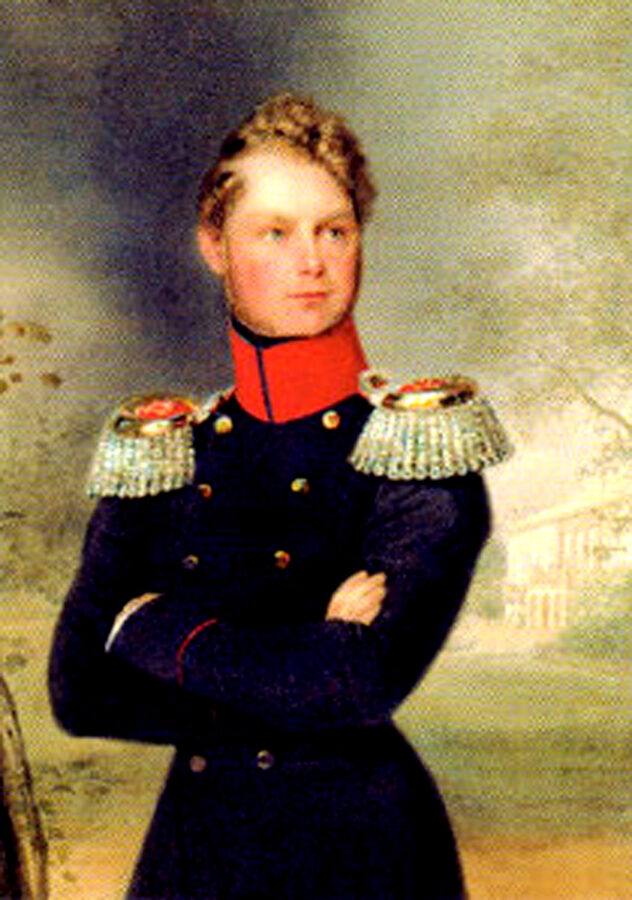
The journey that set everything in motion began on September 15, 1822. The king took Wilhelm and the 21-year-old Carl south, half incognito, by way of the Congress of Verona, Venice and Rome to Naples, where they spent four mild winter weeks and walked the excavations at Pompeii and Herculaneum. Alexander von Humboldt came along and sometimes played tour guide. They were back in Berlin on February 1, 1823, and Carl had decided he wanted a villa with a southern view of his own.
Before Carl: a brickworks, a count and a chancellor
The site he found had already been improved twice. A Berlin physician named Johann Jakob Mirow, who ran the military hospital in the old hunting lodge across the road, bought the land in 1747, put up a brickworks in 1751 and a manor house in 1753, plus a small billiard house on the bank of the Jungfernsee. In 1796 the Prussian master of horse, Count Carl von Lindenau, paid 23,000 thalers for it and turned the fields into a ferme ornée, an ornamental farm, with sixteen avenues of trees and some 3,000 shrubs brought from his famous park at Machern near Leipzig. He also built a tea pavilion on the highway from which you could watch the coaches without being seen.
Napoleon ruined Lindenau: after 1806 the estate would not sell, and the Prussian state chancellor Karl August von Hardenberg rented it for a couple of summers before he could afford it. In 1814, newly made a prince, he bought Glienicke, and in the autumn of 1816 he gave the garden to a 27-year-old gardener’s assistant on trial at the royal gardens in Potsdam. It was Peter Joseph Lenné’s first private commission. Lenné talked him into buying a cottager’s plot on the highway and modeled the slope between house, road and river into a pleasure ground in the English manner, and Hardenberg, who already knew Schinkel, set the two of them to work side by side for the first time.
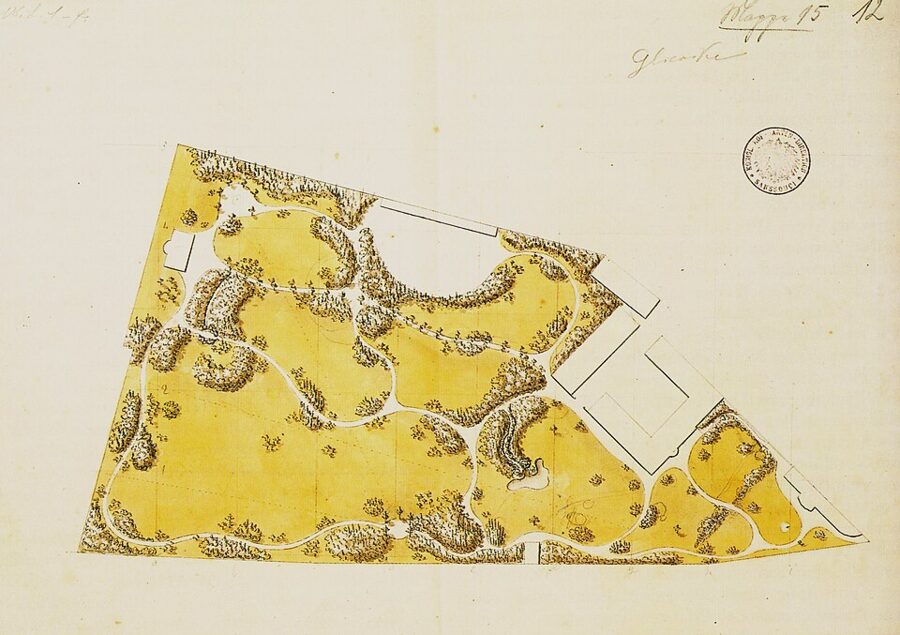
Hardenberg died unexpectedly in Genoa in November 1822. His heirs waited for a buyer who would respect the work and found one in the king’s unmarried third son. Terms were agreed on March 23, 1824, at 50,000 thalers, and Carl took possession on May 1. He was the first of the king’s sons with an estate of his own; Frederick William got Charlottenhof in 1826, and Wilhelm started on Babelsberg in 1833.
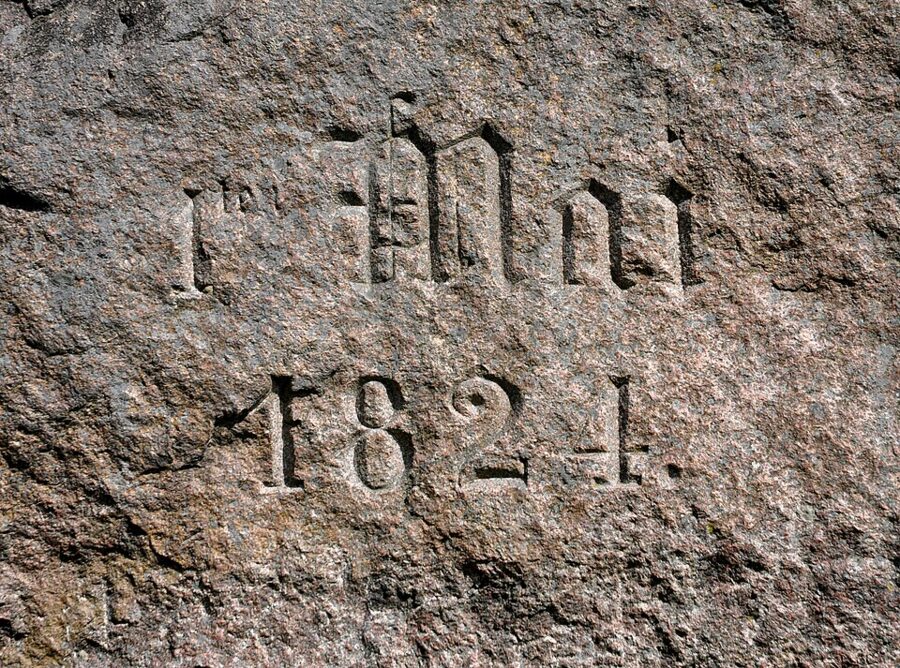

On May 7, 1824, a week after moving in, Carl had a sign put up at the main gate forbidding the public to enter. Later he relented. Visitors could walk the park after announcing themselves at a lodge, and when the flag was down and the family away, the castellan would show the pleasure ground and some rooms. By 1882 a local historian could call Glienicke a place of pilgrimage for thousands.
Schinkel turns a manor into a villa
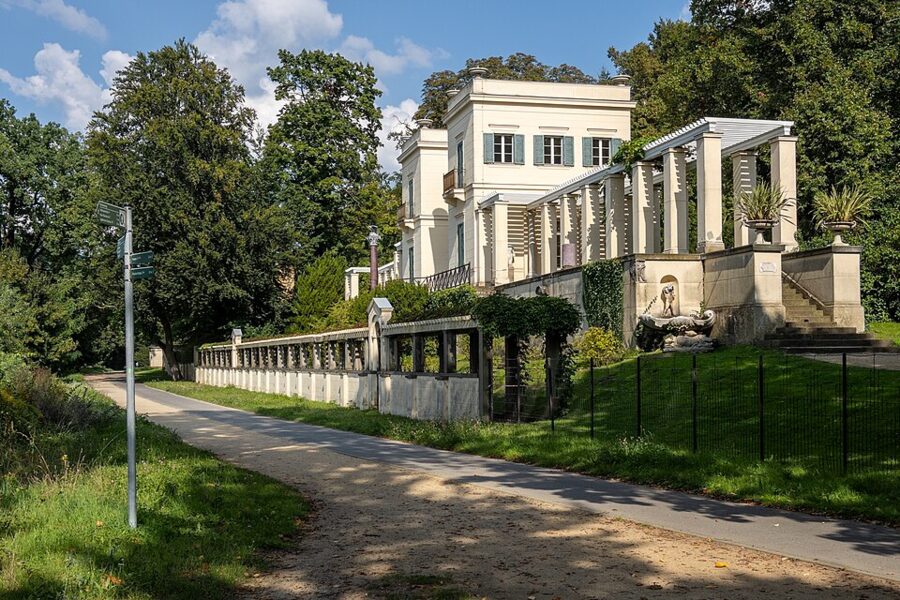
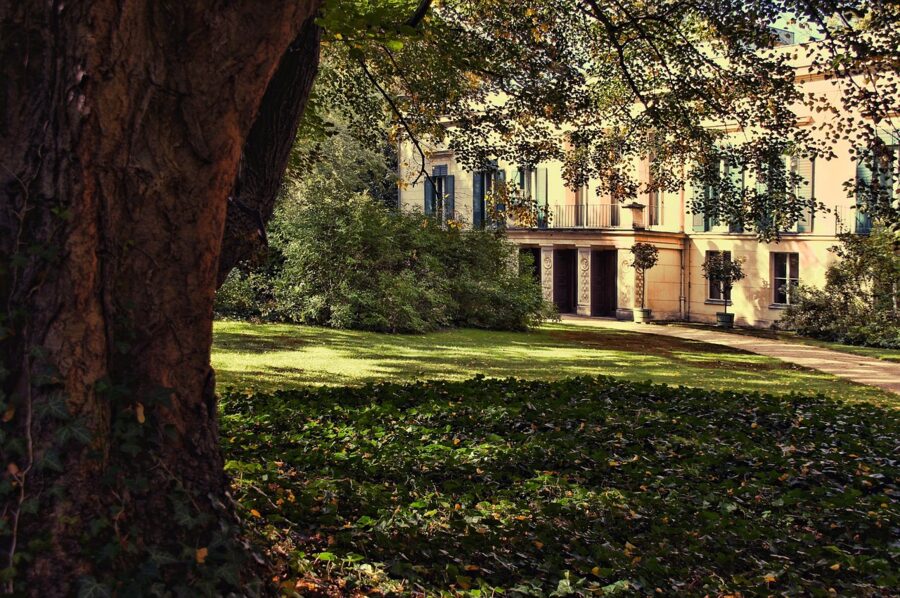
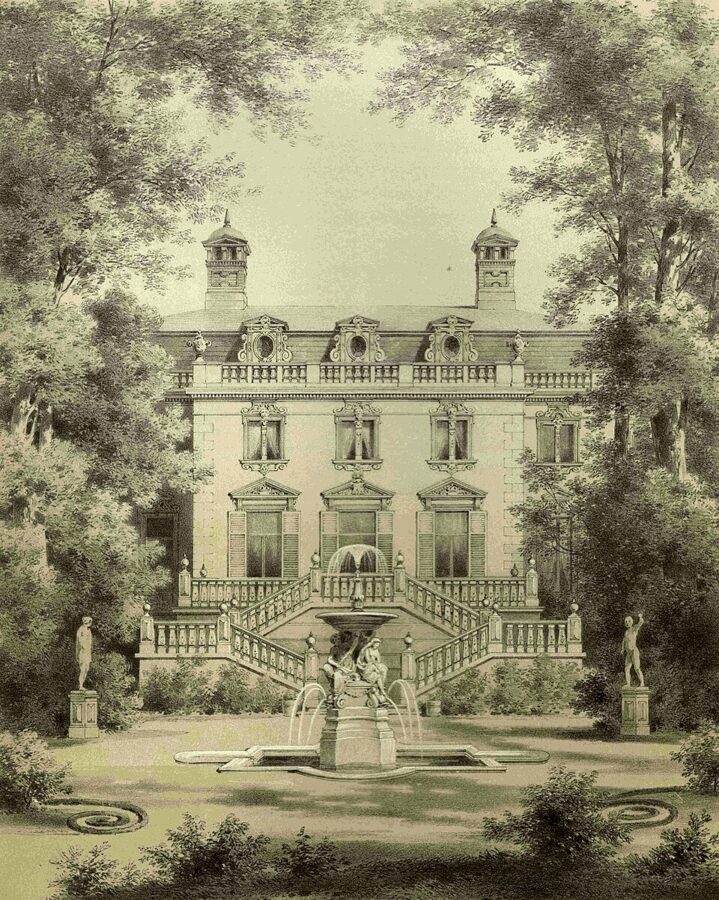
Schinkel had already worked here twice, for a merchant who bought the house in 1812 and then for Hardenberg, adding a round garden room and balcony on the south side. For Carl he went further. Persius drew the plans to Schinkel’s instructions in January 1825, and between 1825 and the summer of 1827 the high hipped roof came off, a flat roof hidden behind an attic parapet with zinc urns went on, the old house was joined to the ladies’ wing on the east side, and the walls were scored to look like dressed stone. The half-round balcony became a square one on two pillars, with three tall windows above.
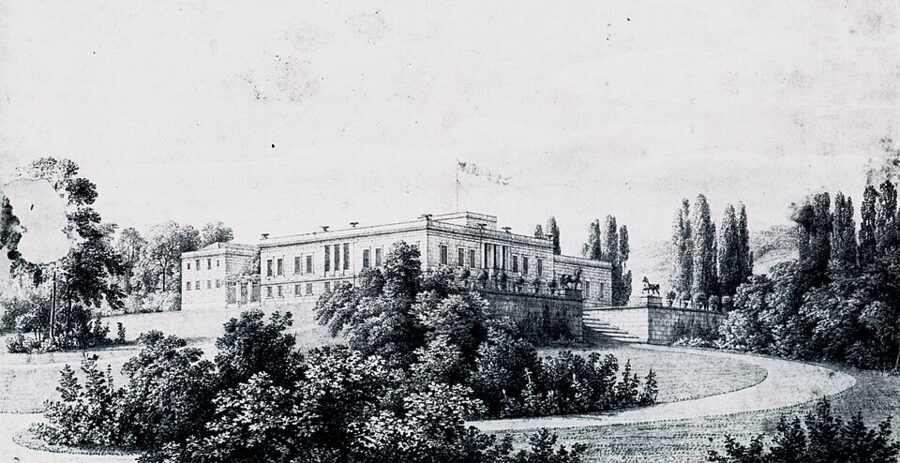
The result is less a palace than a large, very correct country house, and that was the point. Carl hosted grand receptions at his town palace on the Wilhelmplatz in Berlin. Glienicke was for summers, tea on the lawn and guests who could be trusted with informality. He married Princess Marie of Saxe-Weimar on May 26, 1827, and on June 5 the king brought her to Glienicke to military music and installed her as co-owner of a house that had been finished, room by room, while they were engaged.

Persius kept adding to the house, first on Schinkel’s instructions and later on his own. In 1832 a five-story tower with a lookout went up between the stable wing and the carriage house, raised by a further story in 1871–1872. In 1840 he put a little Doric porch with a pediment, a propylon, in front of the courtyard entrance so that guests could find the way in. In 1844 he raised the ladies’ wing to match the main block, with cast lion supports in the mezzanine windows copied from a Roman folding table.
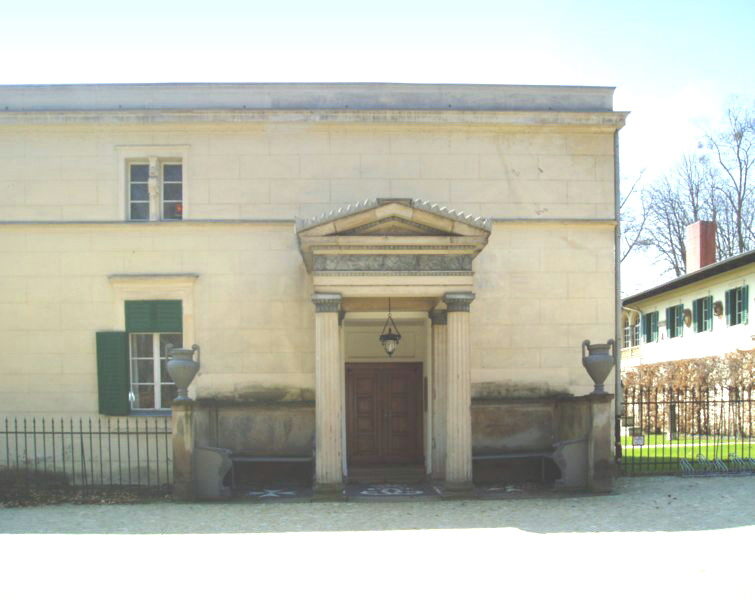

The courtyard and its fragments
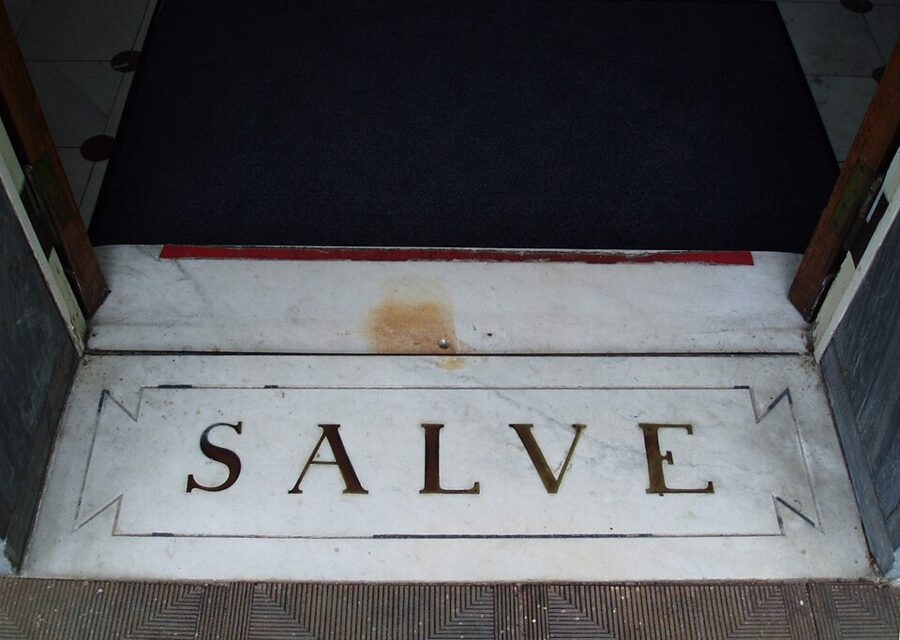
Schinkel hid the front door. You arrived by carriage at a plain row of pillars, walked into a pergola that ran around three sides of the courtyard, and found the entrance almost tucked away under the vines, with SALVE in brass letters on a white marble threshold. He took the idea from the letters of Pliny the Younger, who described a villa reached by a small hidden door off a colonnade around a garden. The same reading of Pliny went into Charlottenhof and the Roman Baths at Sanssouci a few years later.

Helmuth von Moltke, later the field marshal, lived in the stable wing in 1841 as Carl’s adjutant and described the view from his window to his fiancée: a courtyard with a fountain rising from grass like green velvet, and a veranda thick with passion flowers and Dutchman’s pipe. Both climbers still grow on the pergola. The cast-iron pergola itself was replaced after 1945 by a wooden one in roughly Schinkel’s form.
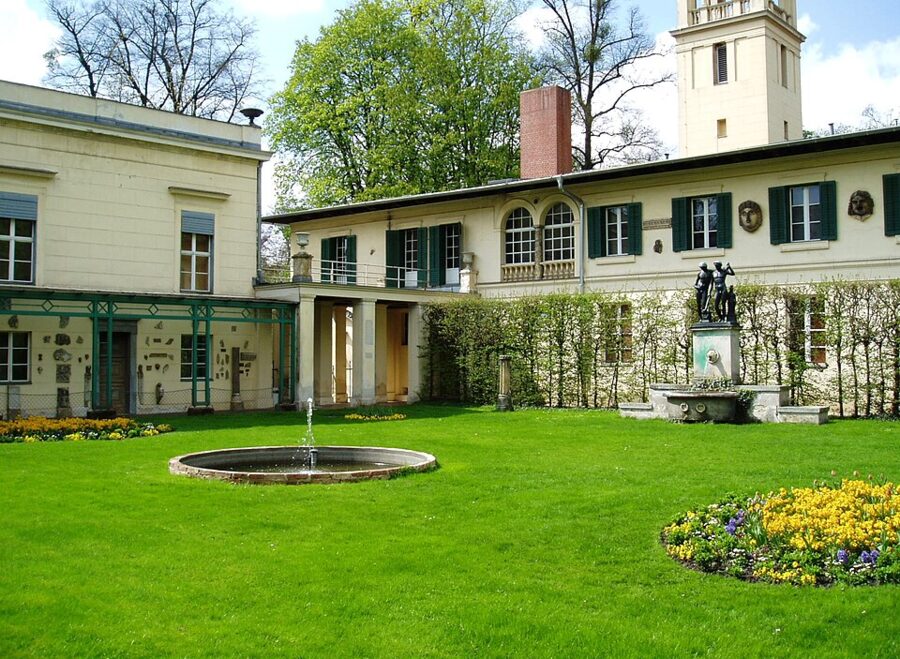

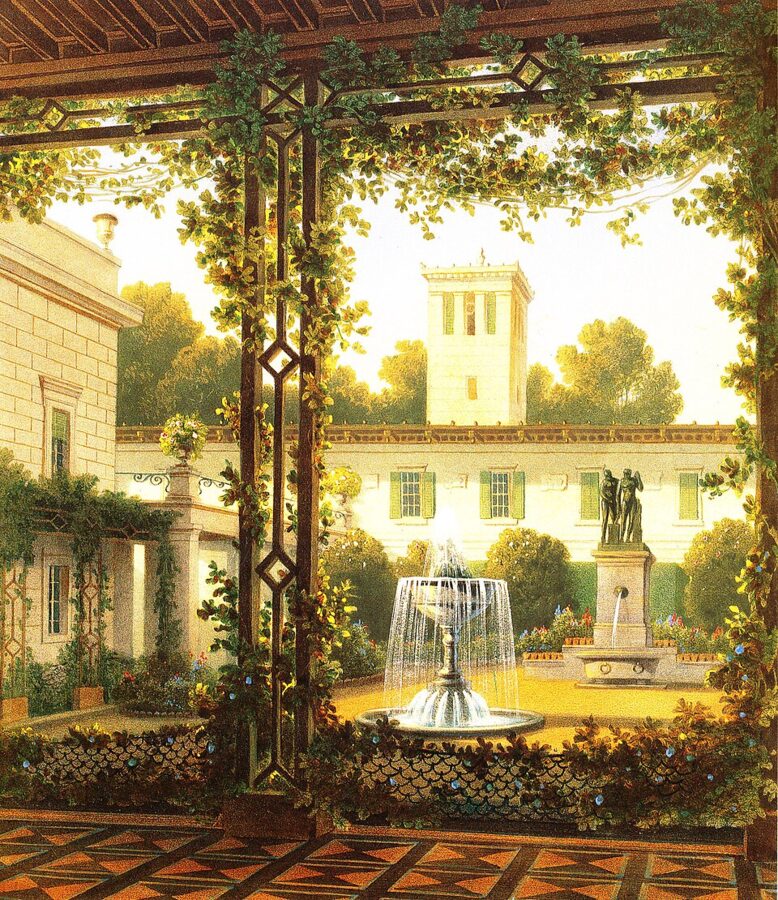
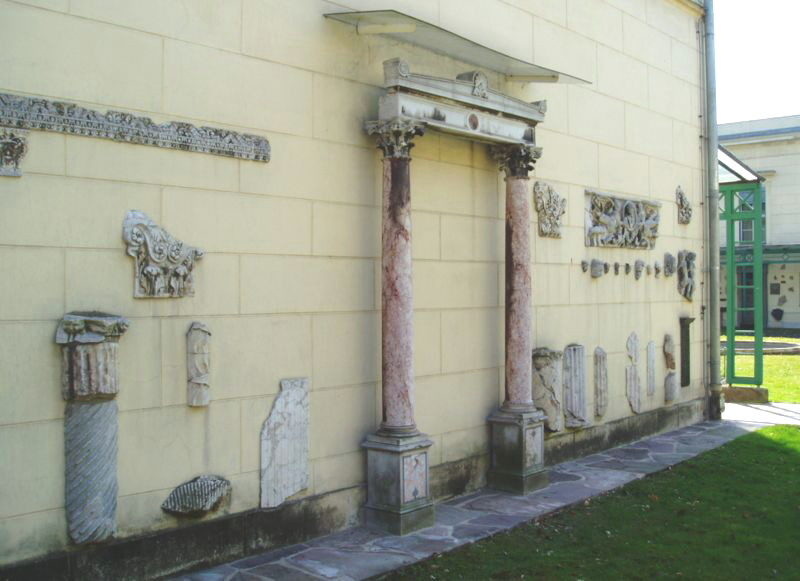
Then there is the marble. Carl bought Roman reliefs, sarcophagus fronts, theater masks and inscriptions through dealers, and Rauch set them into the plaster of the courtyard walls for effect rather than scholarship, as if the builders had dug them up on site. The collection never stopped growing. After a journey to Italy in 1874, 33 crates of antiquities arrived at once; one fragment brought home by Carl’s son is labeled, in an engraver’s careful spelling, as coming from “Troga.”

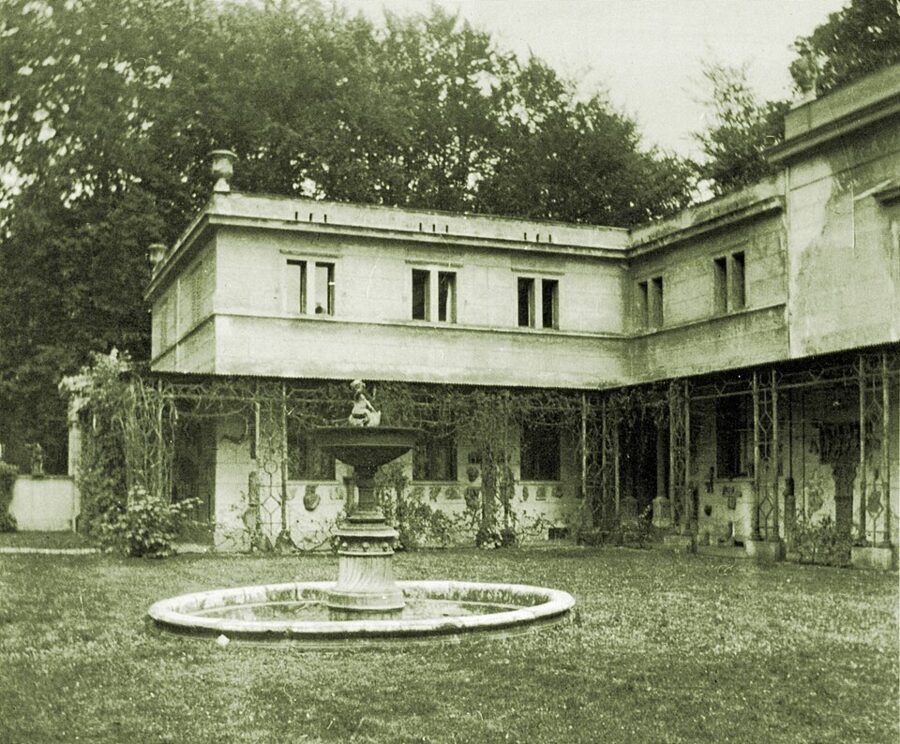
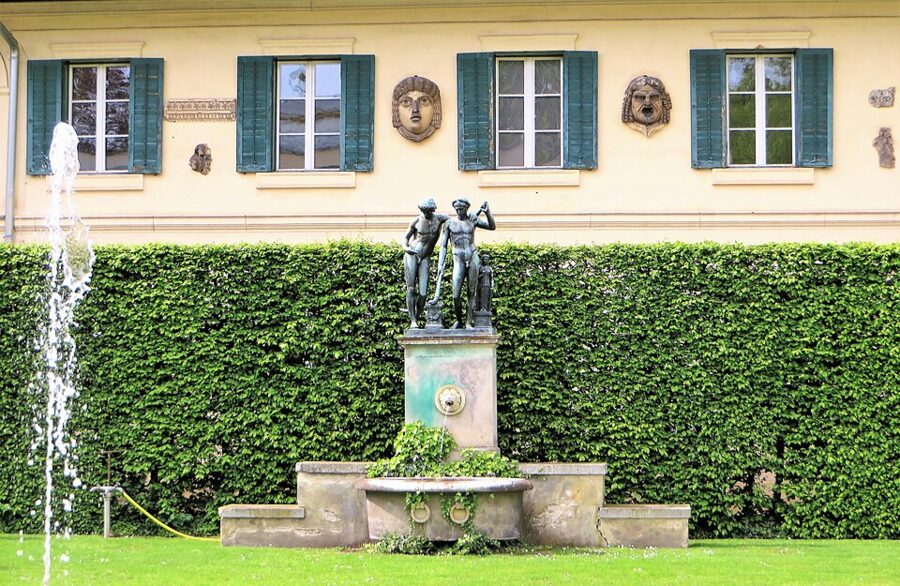
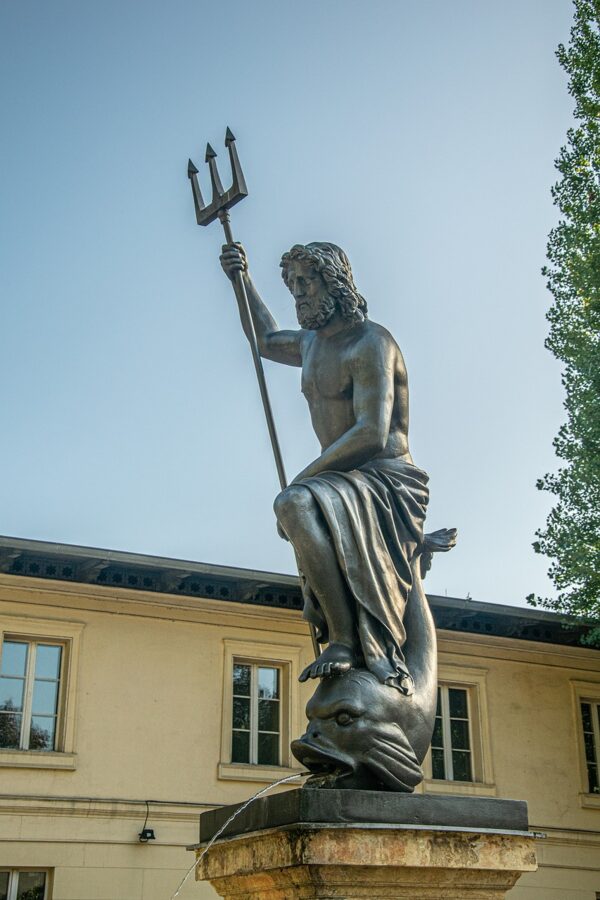
The stable wing on the north side, which the family called the cavalier wing, faces the courtyard with a bronze cast of the Ildefonso group, two laurel-crowned youths whose meaning scholars still argue about, over a running fountain. Marie knew the same arrangement from Weimar. Behind it, in the carriage-house yard, stands a Neptune that Frederick William III gave his son for his birthday on June 23, 1838, in a shell basin taken from a marble colonnade at Sanssouci that had been demolished in 1797.

The Lion Fountain
Carl inherited a modest cast-iron fountain from Hardenberg and found it too small. Once a steam engine was in place, he met Schinkel, Persius and Lenné on October 23, 1837, to decide how the bronze lions would look best, and Schinkel drew a new fountain on the axis of the south front, with steps down from the terrace and a curving balustrade, which got terracotta children representing trade, science, art and the army around 1855. The zinc founder Moritz Geiß cast the column bundles under the gilded lions and sent his bill on May 26, 1838.
From the highway the fountain was the image of Glienicke, the view everyone painted: bed, basin, steps, the balcony with its awning drawn down and the flag on the roof. It was a sightline, not a path. Stand on the pavement of the Königstraße at the gate and you see it exactly as the painters did.
Inside: the rooms on the tour
Be clear about what you are paying for. Almost none of the original furniture was left by the 1930s, and the 1950s conversion into a sports hotel stripped out the remaining doorframes, parquet and plaster. The art historian Johannes Sievers, photographing the empty rooms in 1942, noted that not a single file or letter survived to say how Schinkel had furnished the house. What you see is a careful reconstruction from those photographs, filled with Schinkel furniture from Carl’s Berlin palace and elsewhere, and a good number of objects that really were here.
The tour climbs to the upper floor, where the rooms run in a strong-colored line. At the center is the Red Hall, only about 6 by 10 meters, which tells you how small this summer house was.
The Red Hall holds the family portraits, a bust of Carl at about thirty, and a large equestrian picture of Frederick William III posed in the manner of David’s Napoleon crossing the Alps. On the table stands a silver centerpiece modeled on the Warwick Vase, made by the court goldsmith Johann George Hossauer to Schinkel’s design for Carl’s wedding in 1827. Carl’s great-grandson sold it after the Second World War; the foundation bought back twenty pieces of the wedding service in 2008.
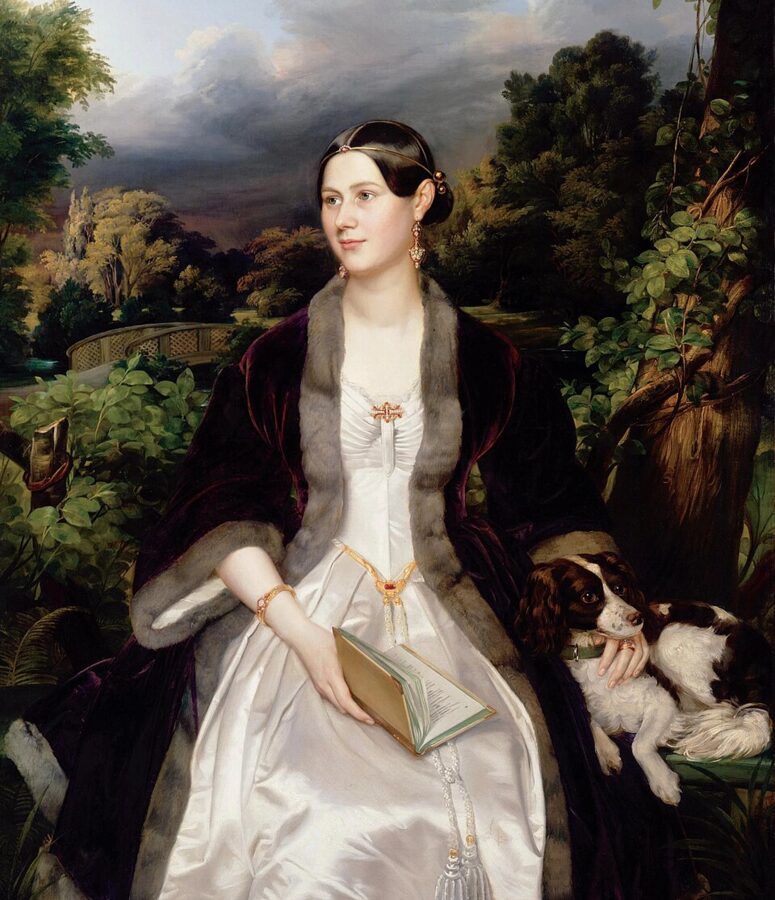
To the east lie Marie’s two rooms, a green salon and the bedroom that was once turquoise. To the west are Carl’s: the White Salon, or Marble Room, with copies of Schinkel’s built-in corner sofas and plaster busts of Marie, Lenné and Schinkel, and then the deep blue corner room that was his library and study.
In a small bookcase there is an inkwell made from the hoof of his hunting horse Agathon, engraved with the horse’s dates, 1822 to 1854, and topped by a forked branch carrying Carl’s monogram as a pen rest. Krüger’s painting of Carl’s favorite horse hangs on the north wall. Nearby is Constantin Schroeter’s portrait of the servant known at court as Achmed, the Black attendant Carl dressed in an oriental costume; when the first man to hold the post was replaced, the next was given the same name.
The west wing once had a corridor papered with a French panoramic wallpaper, Les Vues d’Italie of 1818, so that on one side you walked past painted Italian landscapes and on the other looked out at the Italian courtyard. It is gone, known only from 1937 photographs. The corridor now leads to the museum that fills the rest of the wing.
The Court Gardeners’ Museum
Opened on April 22, 2006, the Court Gardeners’ Museum (Hofgärtnermuseum) is the only one of its kind in Europe, and it suits a house that was really about its garden. It deals with the people who did the work: the Prussian court gardeners, a profession of drawing, surveying, flower growing and estate management that passed down through dynasties. Portraits of the Salzmann, Nietner, Sello and Fintelmann families line the corridor, and the garden hall downstairs hangs views of the Potsdam landscape from the eighteenth and nineteenth centuries.
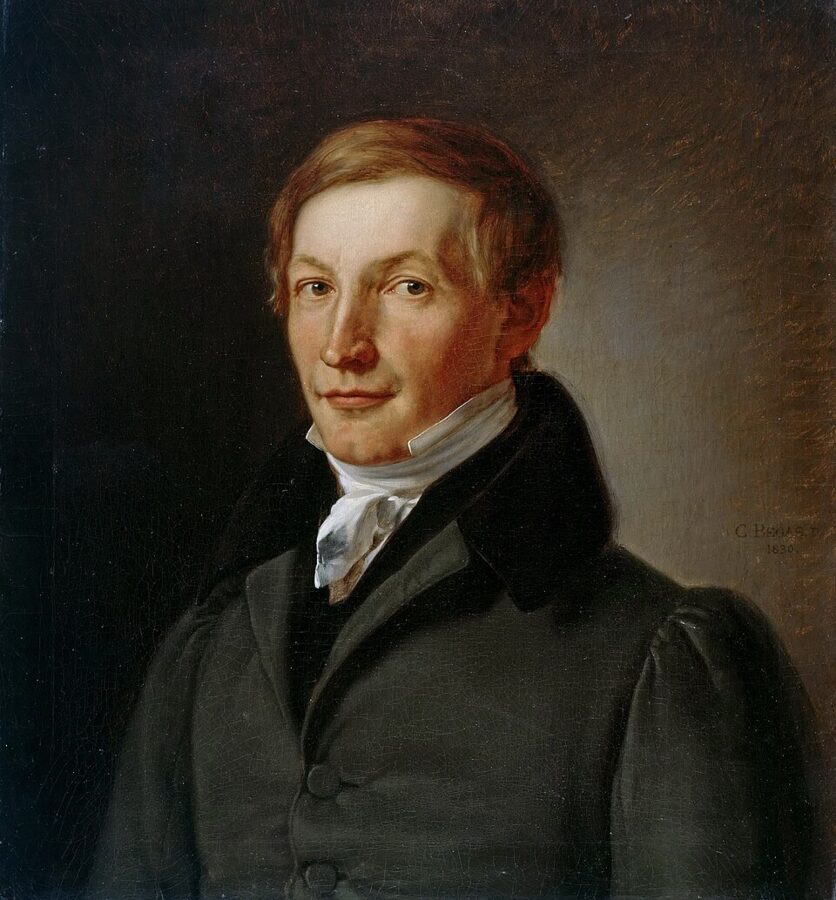
The case I’d look for holds Lenné’s own things: his tobacco pipe, his letter of honorary citizenship from the city of Potsdam, and a bowl with the laurel wreath he received for fifty years in royal service. Measuring instruments, plans and the furniture of a well-off court gardener’s household fill the rest. You see it as part of the general palace tour, not separately.
The Casino and the two lookouts
Walk down through the pleasure ground to the water and the long, low Casino closes the view along the shore. Schinkel made it in 1824, his first job for Carl, out of Mirow’s single-story billiard house, adding an upper floor for a small guest apartment and two long pergolas that step down the bank under vines. It was meant to recall the country houses on the Bay of Naples. Guests were always walked down here to admire it, and important ones slept upstairs; when the tsar and tsarina came, Carl and Marie sometimes moved into the Casino and gave them the house.
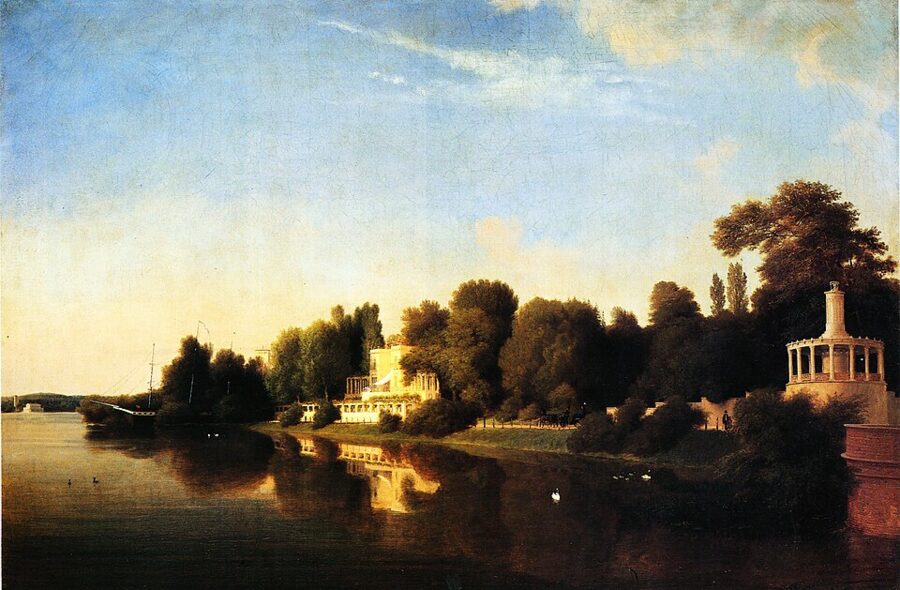
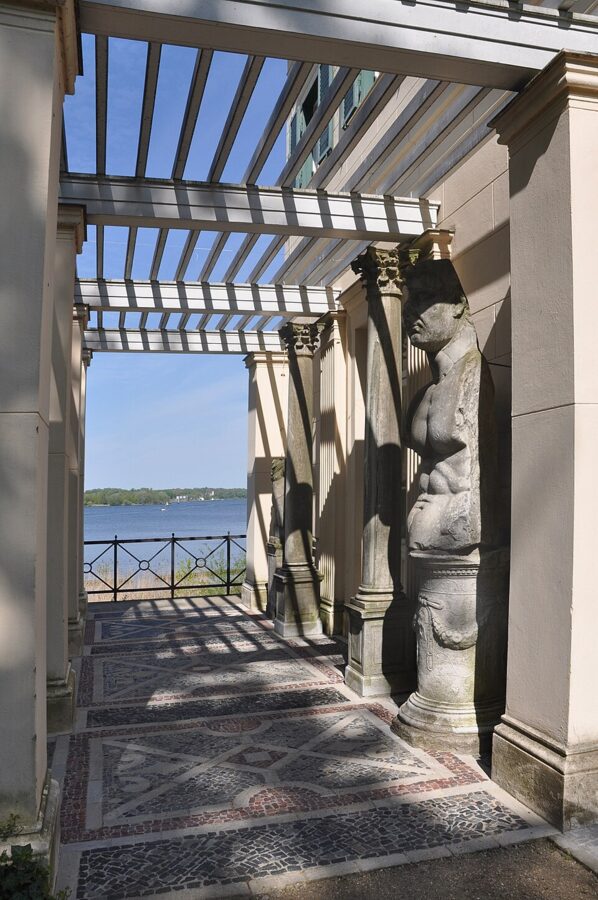

The ground floor kept Carl’s best antique sculpture, in rooms with costly wall finishes and Venetian marble floors, and from the windows you look over the Jungfernsee to the Belvedere on the Pfingstberg and across to the Neuer Garten. You will most likely see those rooms only from outside. The Casino opens only for special events. The building you are looking at is largely of 1963: fighting in the last days of April 1945 destroyed it down to its foundation walls, and it stood roofless for years before it was rebuilt on the old walls.
Just north of the Casino, on a spit of land made for loading bricks, Carl kept a mock frigate, a timber hull with three tall masts that were dressed with flags on feast days. It served as the boat shed of his miniature navy, which cruised the Jungfernsee on family birthdays and turned out when the king’s boat passed on its way to Peacock Island (Pfaueninsel). The crews lived in the park, in a house of their own. Nothing of the frigate survives.
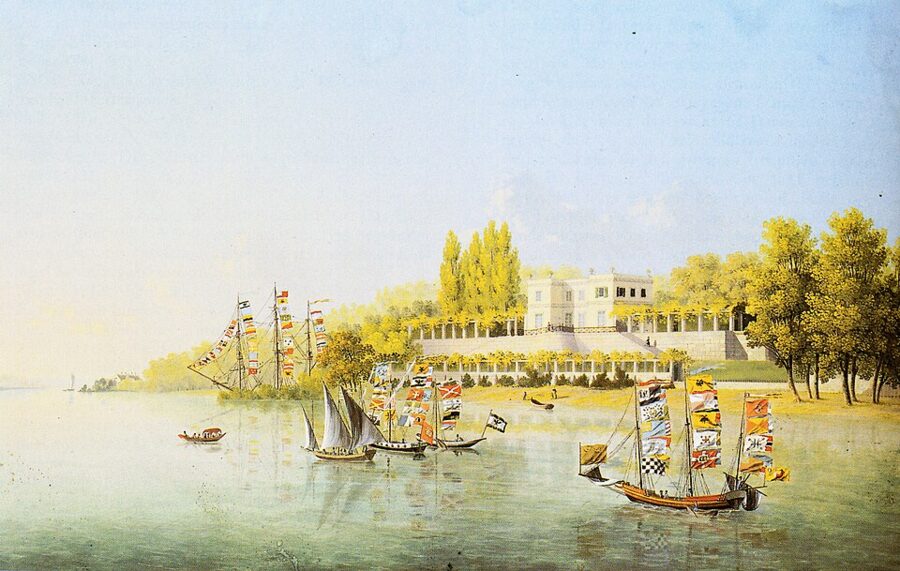
The Kleine Neugierde
The two lookouts are both called curiosities, and the older one, by the road near the palace, explains the name. Lindenau built it as a tea pavilion after 1796, a place to sit behind blinds and stare at the traffic on the Berlin highway without being stared at. In 1825 Schinkel gave it a severe Doric face with a two-column porch, so grave on the garden side that it looks almost like a tomb, while Julius Schoppe painted the inside in a light Pompeian manner. The court marshal’s journal records the first tea there on August 20, 1827.
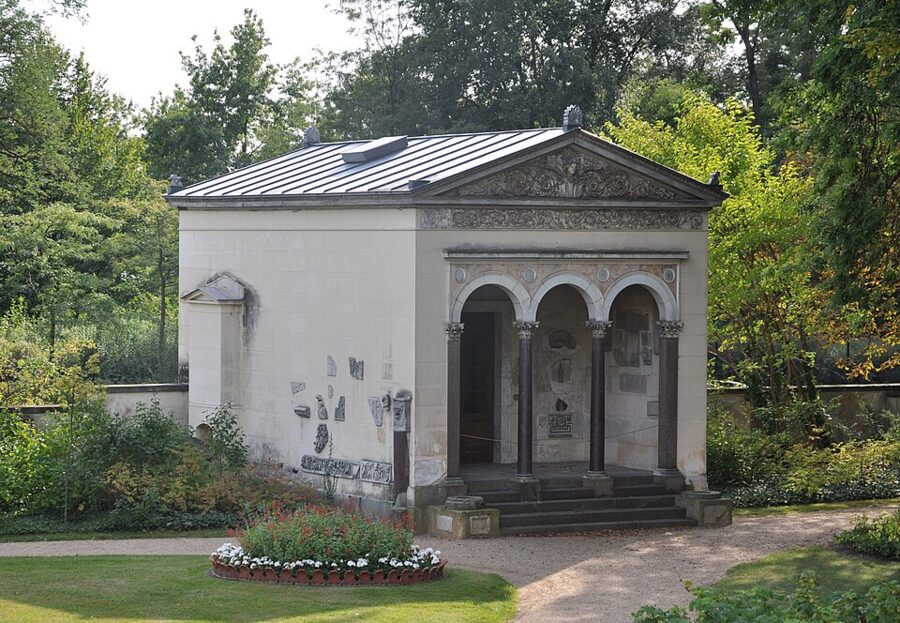

Around 1848 Carl turned the porch into another showcase, setting ancient mosaics, scraps of wall painting and inscribed tablets into its walls, and put a Florentine Renaissance arcade in front of it. The pavilion was restored to that state after the war and thoroughly again in 2015–2016.
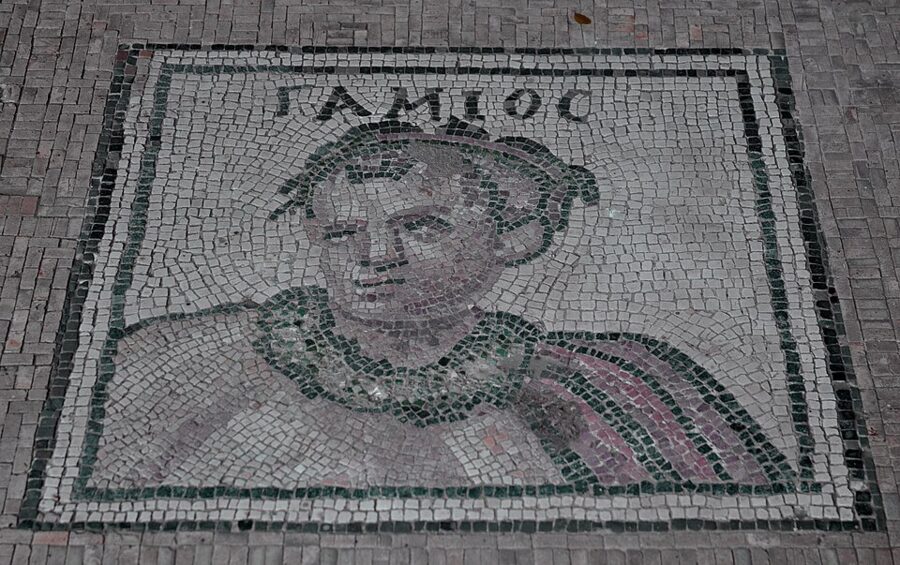

The Große Neugierde
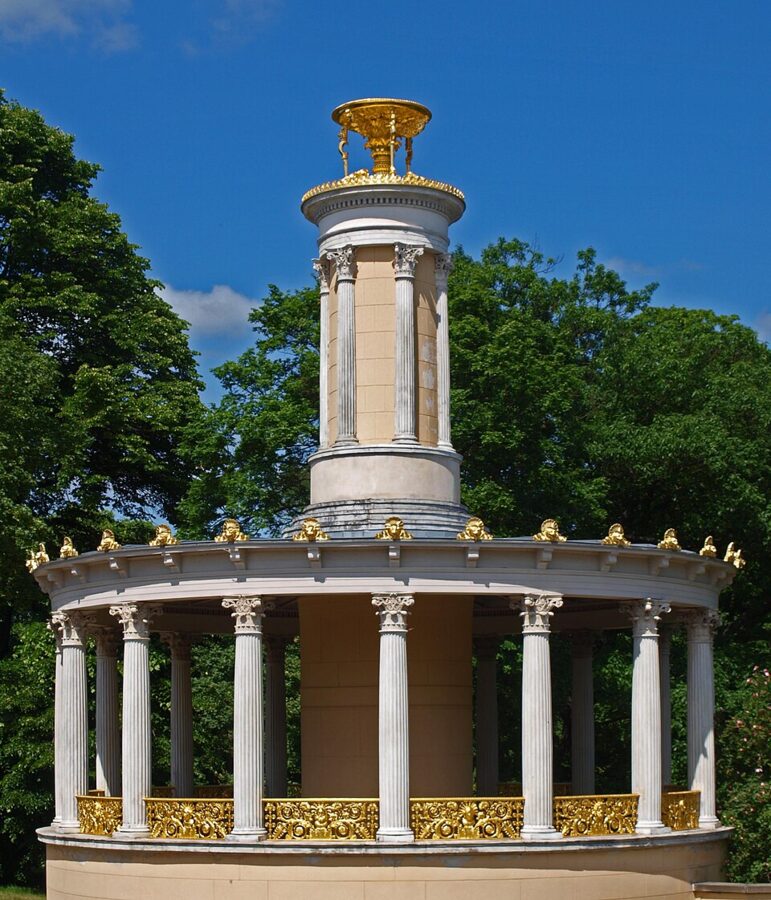
When Schinkel’s new brick Glienicke Bridge went up in 1831–1834, the road moved south and the old tollkeeper’s corner fell to Carl’s garden. His brother the crown prince sketched a round arbor for it in January 1835, and Schinkel turned the idea into a pavilion of sixteen columns on a raised vault, first used for tea on July 2, 1835. In 1836–1837, at Carl’s wish, it was crowned with an almost archaeologically exact copy of the choragic monument of Lysicrates in Athens, cast in zinc by Geiß, with a tripod on top.
Unlike the Kleine Neugierde, this one was built to be seen. Carl took his birthday congratulations here, in full view of the road, which rather sped the ceremony up. Look at the gilded railings between the columns: they alternate a head of Jupiter with a head of Juno, and tradition says Juno has Marie’s face.
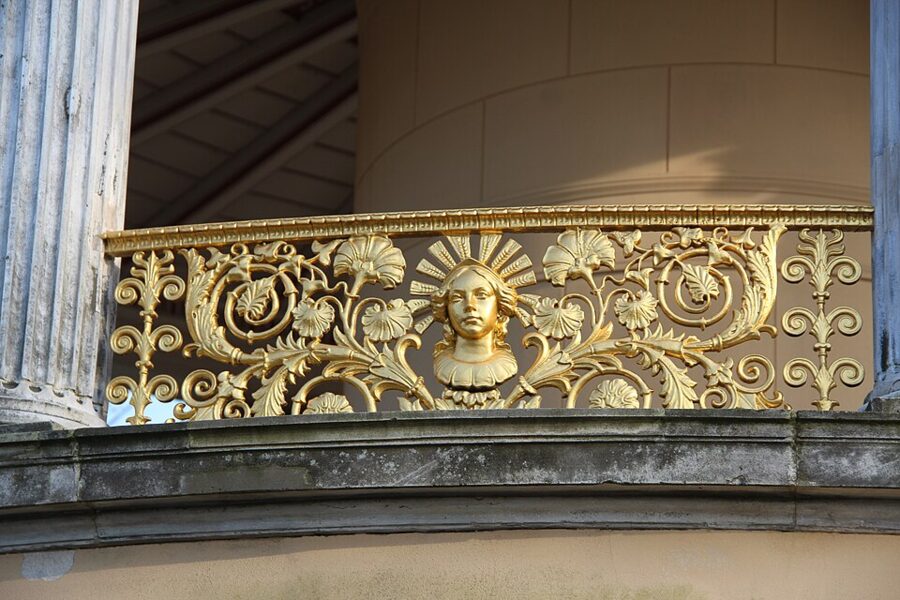
The bridge has been unkind to it: when the steel bridge replaced Schinkel’s in 1907, the new ramps forced the pavilion to be taken down and rebuilt higher, probably with sandstone columns replacing the terracotta ones. In 1938, when the road became part of the Reich highway, it was moved again, 4.5 meters into the park, and reassembled slightly twisted. A correction in 1980–1981 and a restoration finished in 2009 put the details right, but the old view down the roadway of the bridge is gone. What remains is the look south across the Havel to Babelsberg Palace.
The Stibadium
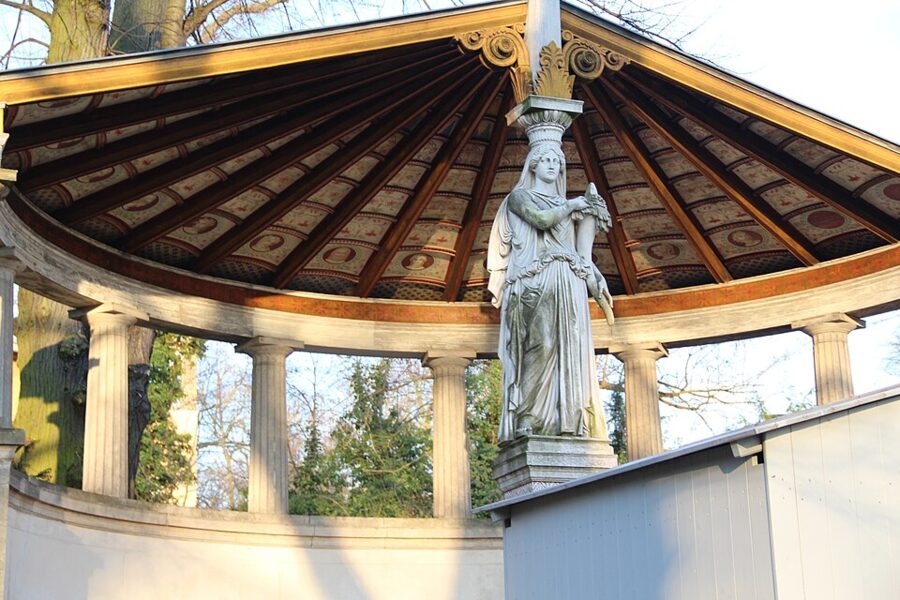
Beside the Lion Fountain sits Persius’s Stibadium of 1840, a half-round temple with a wooden roof whose underside is painted with fourteen gods: the twelve Olympians plus Bacchus and Amphitrite to fill the extra fields. A marble copy of Rauch’s figure of Public Happiness holds up the front. The name comes from Pliny again, but Carl’s household just called it the Roman bench.
Venice by the back door: the Klosterhof
Schinkel died in 1841 and Persius in 1845, and Carl’s buildings passed to his court architect Ferdinand von Arnim. The strangest of them went up in 1850 between the Casino and the greenhouses: the Klosterhof, a small cloister. Carl wanted somewhere to keep his medieval treasury pieces and Byzantine sculpture, which had been crowding the armory of his Berlin palace, and he had dealers in Venice buy old building parts to construct it from.
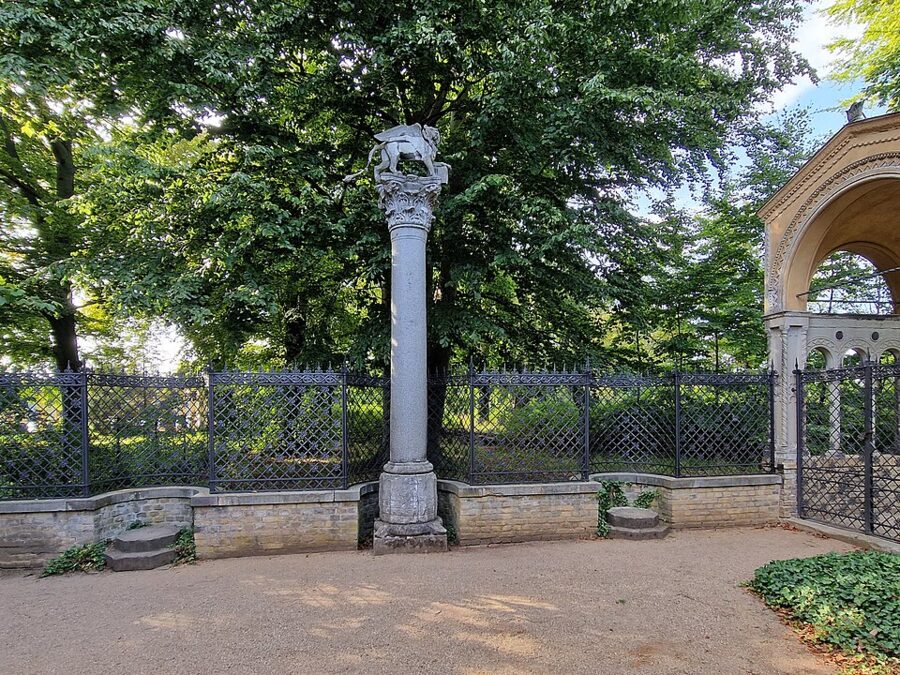

The twin Gothic columns of the arcades come from the monastery of Sant’Andrea della Certosa near Venice. A capital with monkeys at one corner of the wall is a fragment from the bell tower of Pisa, the one that leans. Carl’s Byzantine pieces made this, by one scholar’s reckoning, the first collection of Byzantine art in modern Europe.
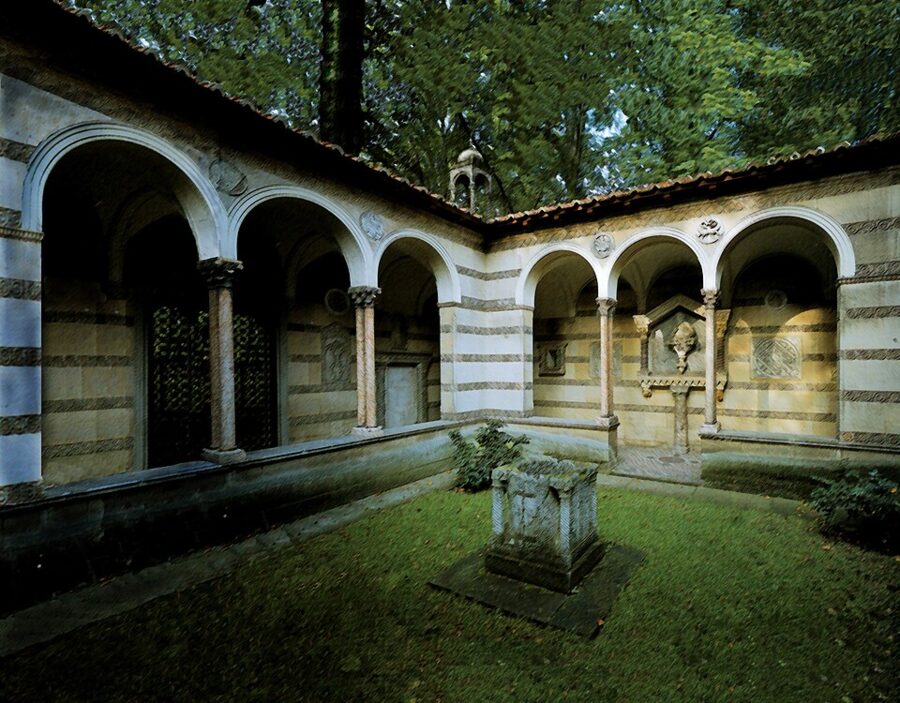

Nobody knows exactly who designed it. Books usually name von Arnim, who supervised the building in 1850, but there are no drawings, no accounts, no mention of an opening in the court journal, and Carl himself said it was built to his own instructions. The first record is a letter from his son on August 12, 1851: when the weather allows, Mama usually has breakfast in the little cloister, where it is really charming.
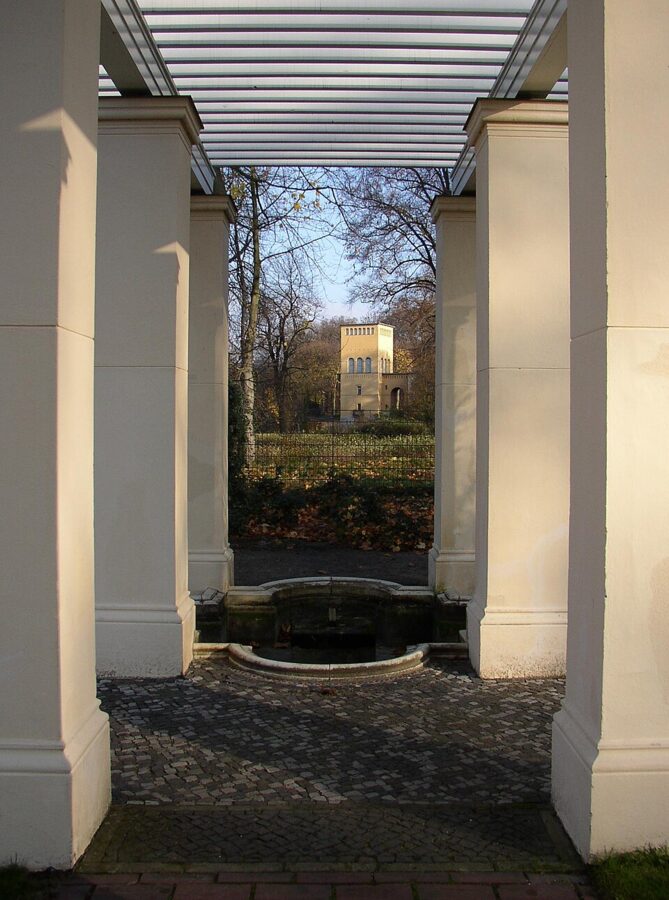
From the Casino’s north pergola your eye runs to a tall Italianate tower. That is Persius’s court gardener’s and machine house of 1836–1838, his first building of his own, where a steam engine by the Berlin firm Egells pumped Havel water up into a tank under the roof to feed the fountains. It was the first water tower around Berlin and Potsdam. The engine would be a prized technical relic today; it was stolen after the Second World War.

Lenné’s ground and Carl’s wild park
The pleasure ground, Lenné’s work from 1816, looks like a natural fold of land running down to the river. None of it is natural. He modeled every hump, and under the turf ran cast-iron pipes to feed the fountains and water the beds every day. It was closed off from the park by buildings, a fence along the highway and an invisible fence, a sunken barrier, along the shore road, because sheep grazed the park beyond and would have eaten the flowers.
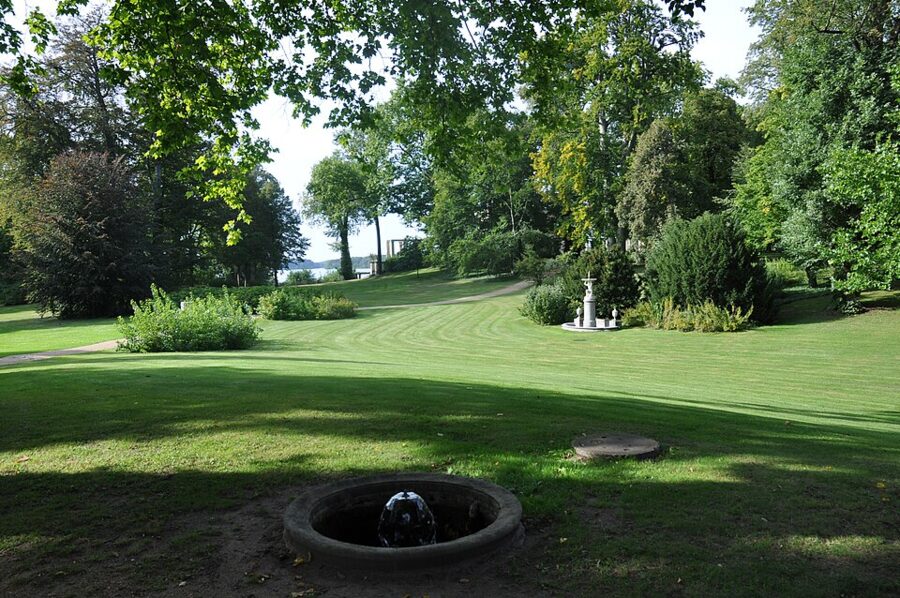

Look for the beds. The round and oval “tart” beds have terracotta palmette edging, ten basic types, reproduced from originals found in the cellar of the Kleine Neugierde. Directly under the window of Carl’s bedroom is a bed shaped like a fleur-de-lis, for his youngest sister Louise, who married into the Dutch royal house and kept Glienicke supplied with bulbs. Citrus trees in tubs stood on the terraces from Hardenberg’s day; his son wrote into the sale contract of 1824 that he could take four small orange trees, four large ones and two lemon trees with him.
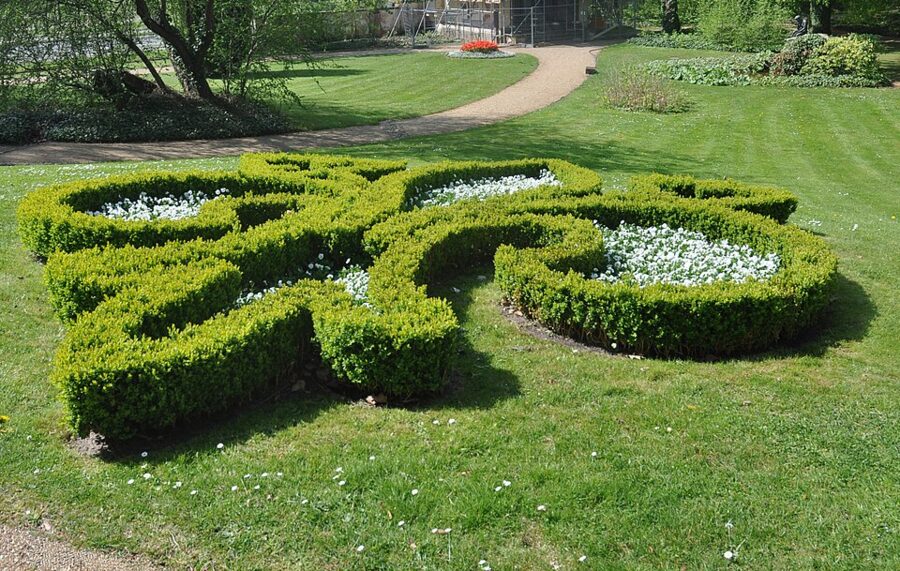

Garden historians credit Glienicke with one small entry in European garden history. In 1822 John Adey Repton, son of the English landscape designer Humphry Repton, spent about a week here with Prince Pückler, and back in England he designed a rose bed in a wooden basket for a client and called it the “Hardenberg basket.” The garden historian Michael Seiler thought Repton had seen one at Glienicke.
The park and the shore path
Beyond the pleasure ground the park, about 116 hectares, gets wilder as you go north and east. Carl kept extending and reshaping it for almost sixty years, with Lenné’s advice until 1866 and his own taste increasingly in charge. Its parts are a broad central meadow, a path along the high bank of the Havel, the hunting grounds around the Jägerhof in the north, a steep wooded hill district the family called the Carpathians, and a set of wooded valleys to the east. Since the 1930s it has belonged to the city, and today the borough of Steglitz-Zehlendorf looks after it while the foundation runs the house and pleasure ground.
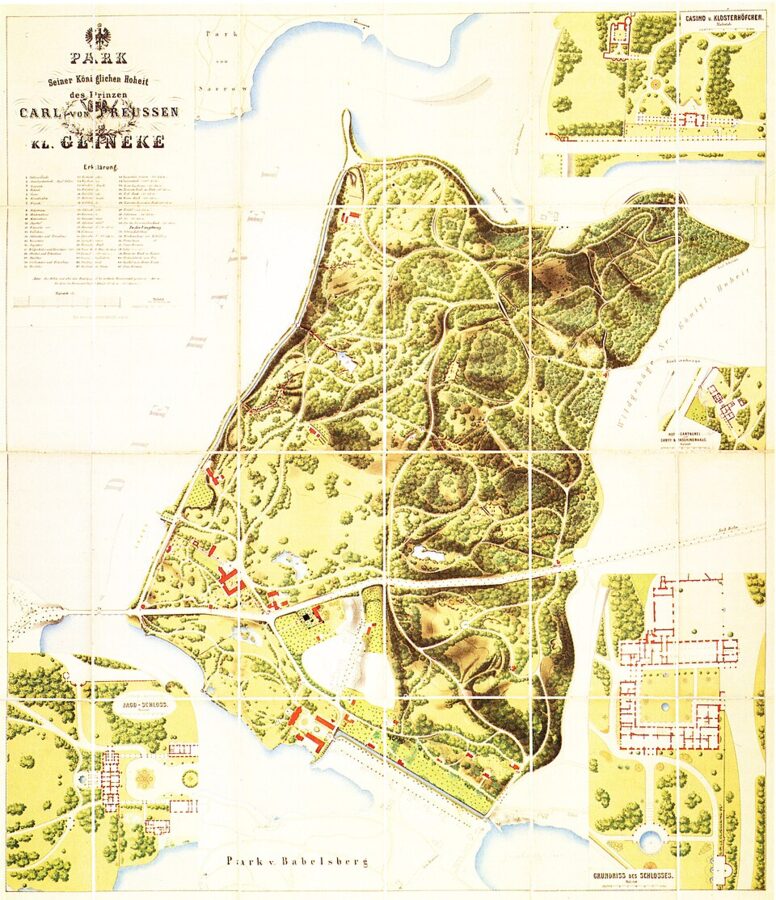
The court journal, which the marshal kept every day, lets you watch the place in use. Breakfast was often outdoors, dinner always in the house, and tea, the evening meal, was taken each day at a different spot in the garden or park, so that the family saw the estate from as many angles as possible. Marie went out by carriage, Carl on horseback, often inspecting the work and changing his mind on the spot. Queen Victoria and Prince Albert came on August 14, 1858, and walked through the garden, the house, the Kleine Neugierde, the Casino and the Klosterhof; the journal noted it in two lines.
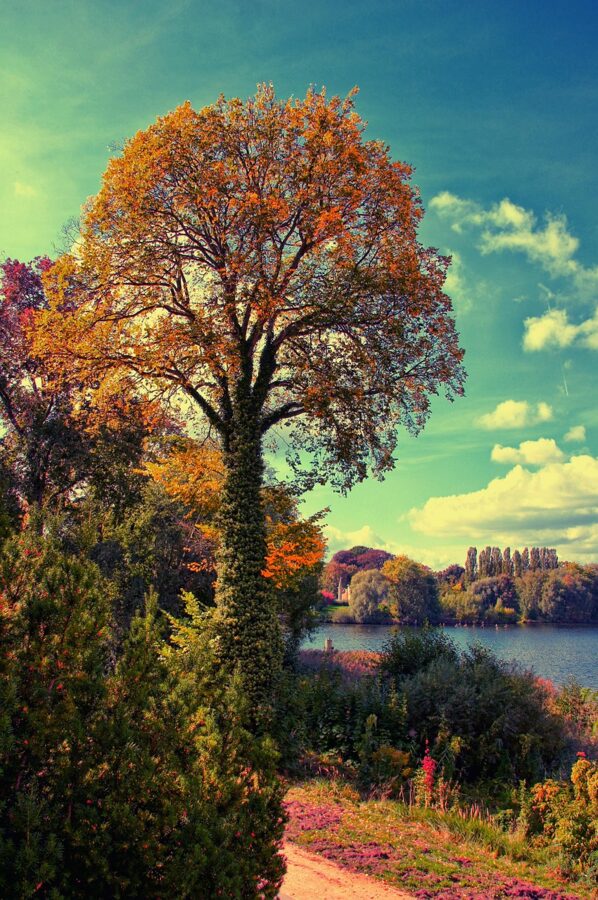
For views, take the path along the high bank of the Havel north from the Casino. It was laid out with help from the landscape painter August Wilhelm Ferdinand Schirmer, and from it the water opens toward the Neuer Garten, the Church of the Redeemer at Sacrow, and the Havel lakes that frame the whole Potsdam landscape. Excursion boats pass below; several of the Potsdam boat tours run along this shore.
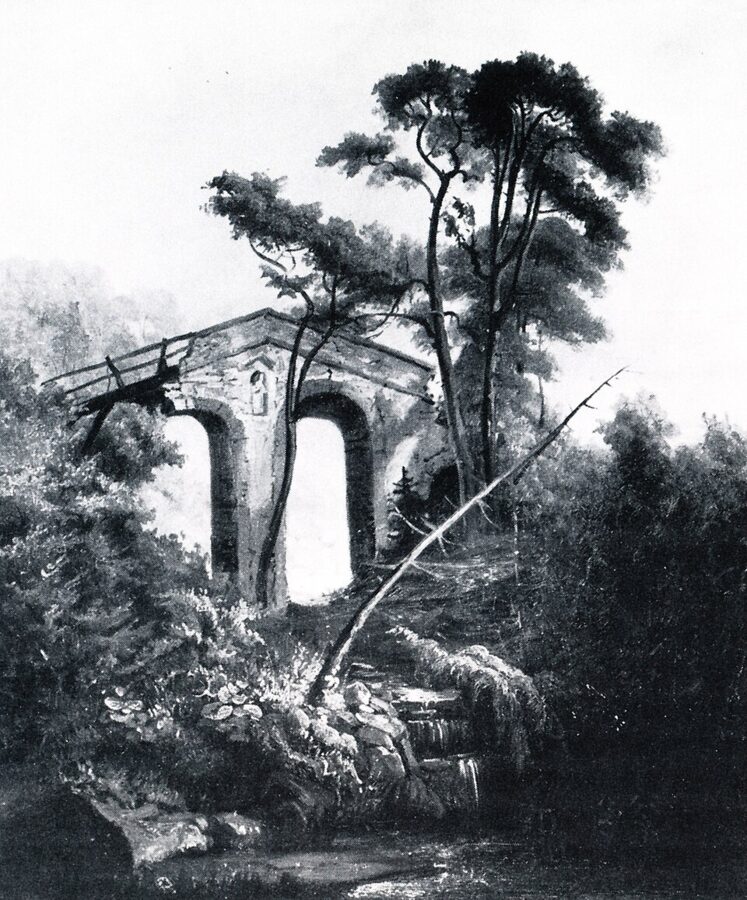
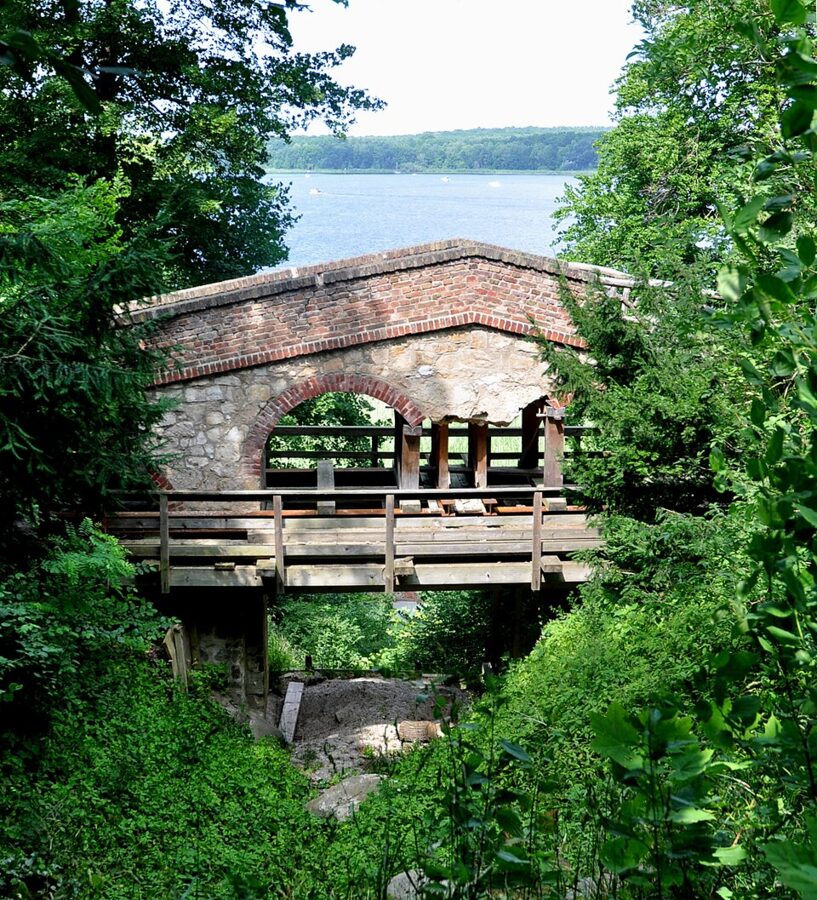
Along the way are Carl’s set pieces. In 1837 Persius built him a Devil’s Bridge, a deliberate ruin of a stone arch over a gully piled with boulders, in imitation of the famous bridge on the St. Gotthard road that was damaged in a battle in 1799. When important guests approached, gardeners opened a sluice upstream and a sudden torrent poured over the rocks.
Lippert’s men in the 1930s “repaired” the ruin, which spoiled the effect, and today even that is in poor shape. A rebuild was planned for 2013–2014 and stalled when the foundations proved too weak to carry it.

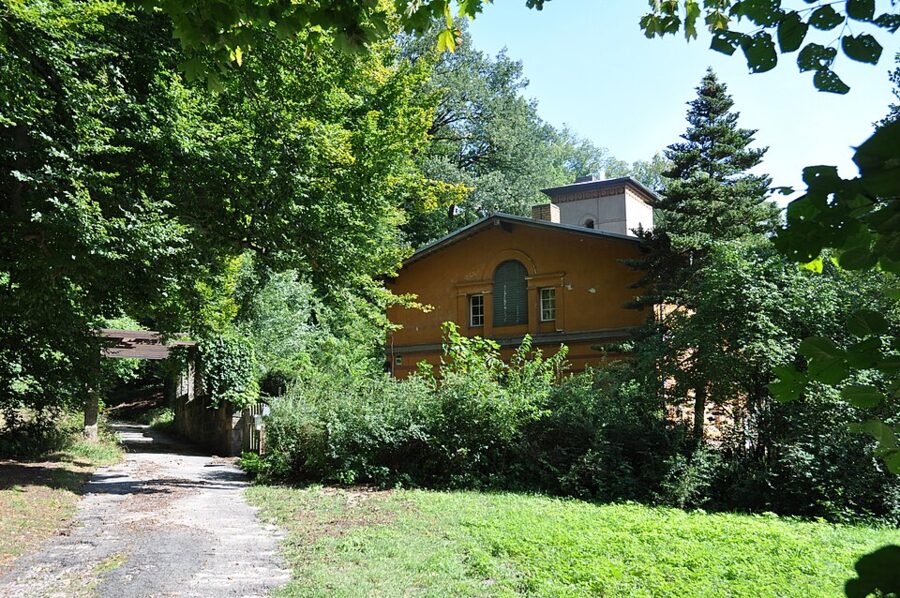
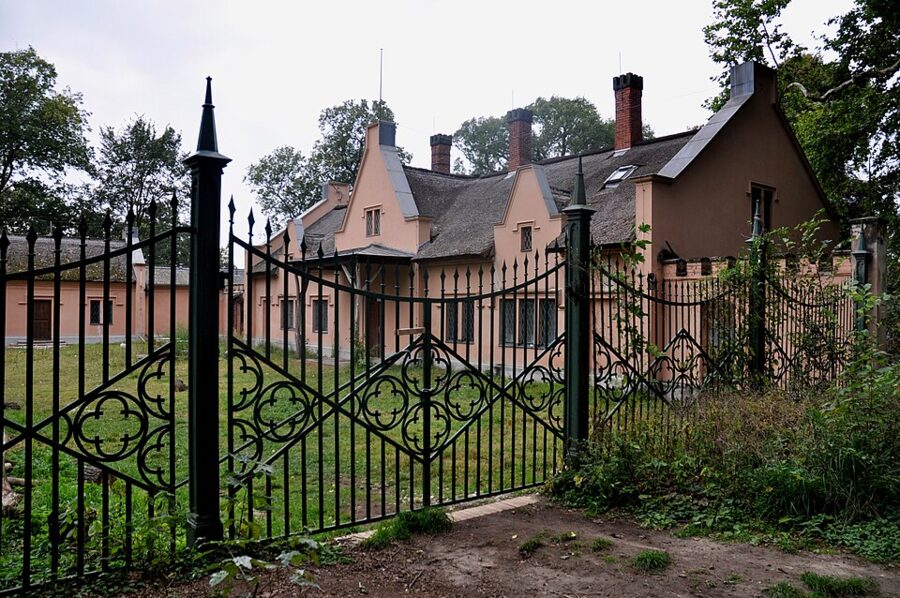
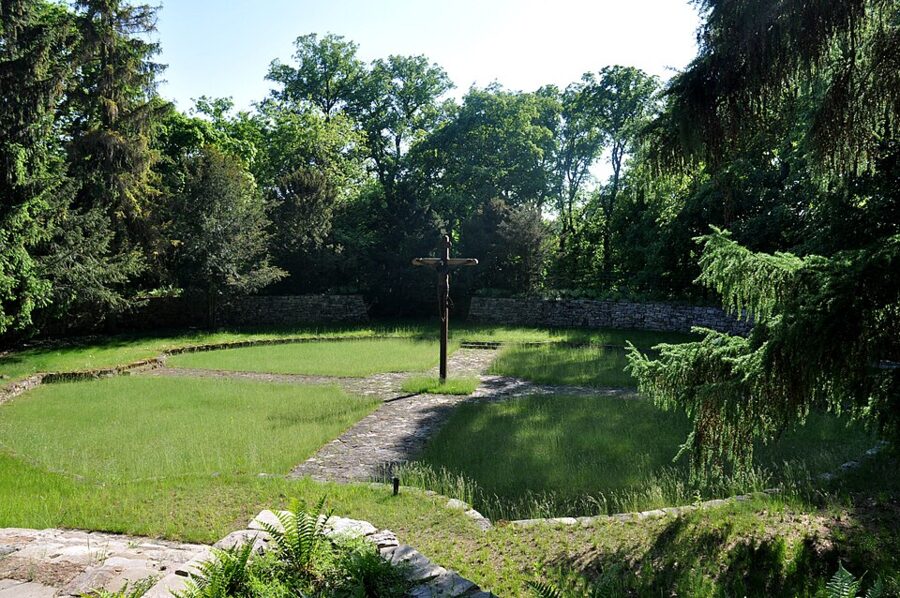
Near the meadow stands the Matrosenhaus, the sailors’ house, which Persius made in 1840 from Mirow’s old vintner’s cottage for the crews of the prince’s boats, with a tower once tipped with a narwhal tusk and a dolphin on the gable. Further north is the Jägerhof, the kennel and huntsmen’s house in an English Gothic style for the pack of hounds with which Carl revived the parforce hunt in Prussia. And on a rise above the meadow, in a sunken circle, lies the Hohenzollern family cemetery that Carl’s grandson laid out after his son was killed in 1917. It is still used.



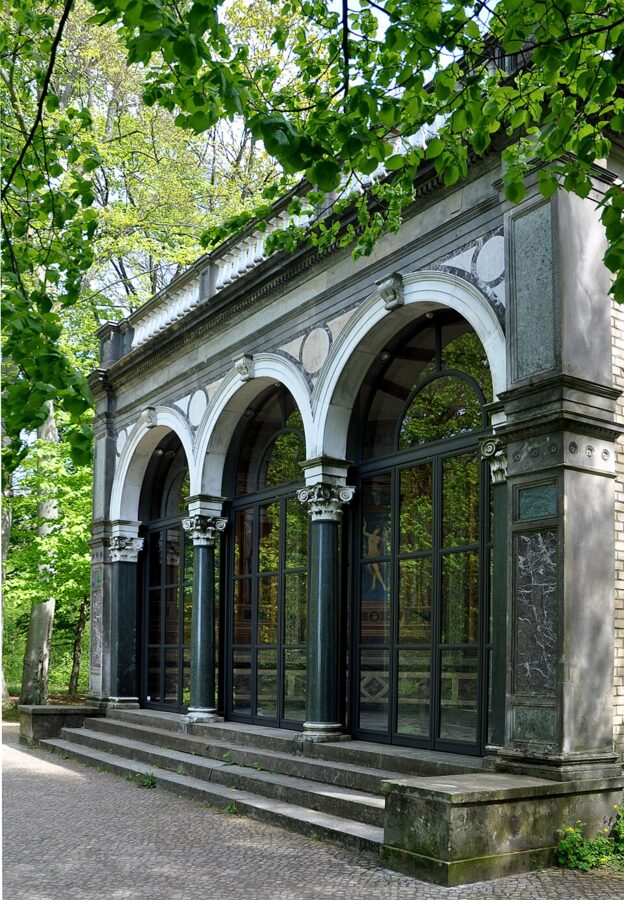
South of the Königstraße, on the Böttcherberg, Carl built the Loggia Alexandra in 1869–1870 in memory of his sister Charlotte, the tsarina, who had died in 1860. The court sculptor Alexander Gilli designed a three-arched Renaissance pavilion with a painted apse and a marble bust of her, and the journal records the first tea there on July 14, 1870.

After Carl: neglect, Lippert, war and the Wall
Carl died on January 21, 1883. His will required his heirs to spend at least 30,000 marks a year on the buildings and park, but his son Friedrich Karl died two years later, and the grandson, Friedrich Leopold, had no feeling for the place. He closed the park to visitors, moved into the hunting lodge, quarreled with his cousin the Kaiser, and in 1911 put a concrete wall around his garden.
Unpruned hornbeam hedges grew into trees and shut the views. After 1918 he moved to Lugano, taking furniture and art, and sold much of the rest at auction in Berlin in 1930–1931 to pay his debts.
The darkest chapter came next. Julius Lippert, a Nazi newspaper editor whom Göring had made state commissioner for Berlin in 1933, was charged with driving Jewish people out of the city’s business and administration. He extorted shares in the Engelhardt brewery from its Jewish main shareholder, Ignatz Nacher, far below their value, and exchanged them with the Dresdner Bank for the Glienicke park, which had passed to the bank from the estate of the late prince. On Hitler’s birthday in 1935 he opened it as a “people’s park,” the Volkspark Glienicke, a name still on maps, and had the thatched Jägerhof rebuilt for himself as a country house with a terrace, garages, a boat landing and a bathing hut.
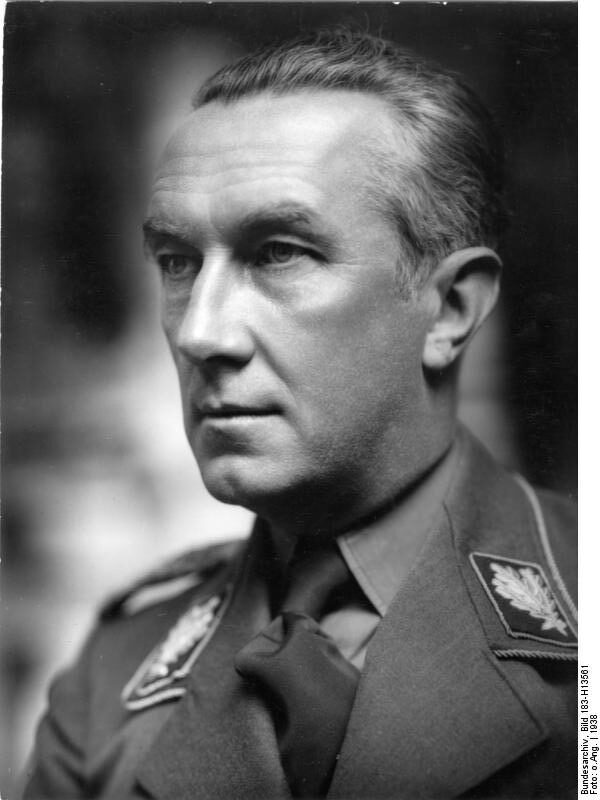

In 1937, now lord mayor, he went after the palace and the hunting lodge. Carl’s descendants would not sell; Lippert threatened expropriation, and in 1939 Carl’s great-grandson sold both, also far below value. Lippert lost a power struggle with Albert Speer and left office in 1940 before he could move in.
During the war the palace became a military hospital. In the last days of April 1945, German troops on the island of Wannsee fought a pointless last stand, artillery wrecked the trees along the shore, the Casino was destroyed, and Soviet soldiers briefly kept horses on the upper floor of the palace.
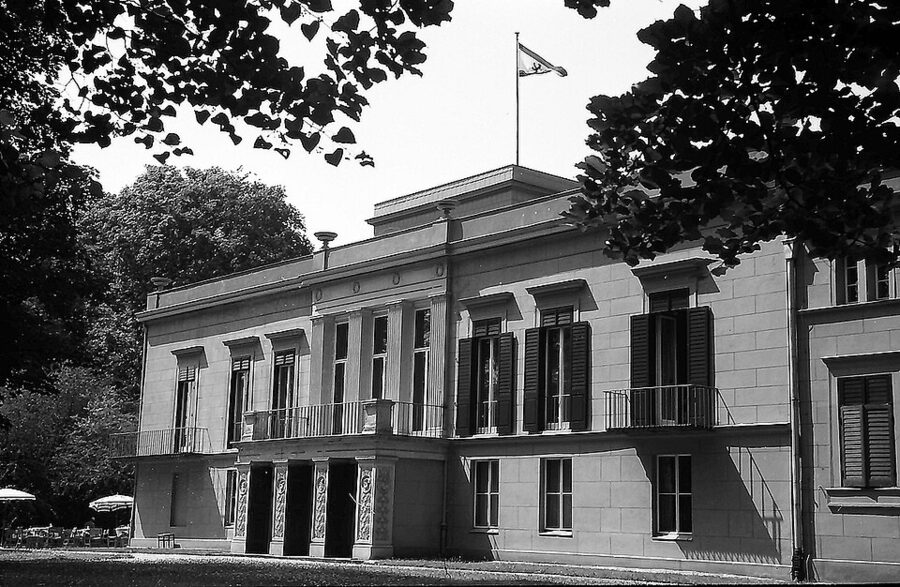

West Berlin toyed with turning the park into a sports ground; instead the palace became a sports hotel, then from 1976 to 1986 a residential adult-education college. The border ran along the water and around the village next door, and the palace stood at the edge of the western world: from the Große Neugierde you looked across at a bridge closed to almost everyone. The Wall did one odd favor. With the road leading nowhere, the Königstraße, widened to 29 meters in the 1930s at the cost of the hunting lodge garden, could be narrowed again almost to its old width, which would hardly have been possible after 1989.
Restoration began as a passion of a few people. The West Berlin palaces director Martin Sperlich saw Glienicke as a work of garden art rather than a set of Schinkel buildings in a park; the surveyor Michael Seiler wrote its garden history; and Klaus von Krosigk, who set up Berlin’s garden conservation office in 1978, ran excavations in the pleasure ground and the hunting lodge garden that drew international attention. The Schinkel anniversary of 1981 paid for a rebuilt orangery. Sperlich also traced Baron Fritz Cerrini, the companion of Carl’s great-grandson, who left the furniture and the estate journal they had taken to Austria to the palace administration, and the museum opened in 1987 for Berlin’s 750th anniversary.
The hunting lodge and Klein Glienicke
Across the Königstraße from the palace stands the older building that gave the area its royal start. The Great Elector had the Glienicke Hunting Lodge (Jagdschloss Glienicke) built by Charles Philippe Dieussart from 1682, a plain block with two service wings and a garden of carp ponds in the marsh. It went downhill fast. The Soldier King made it a military hospital, Frederick the Great gave it in 1763 to the oilcloth and wallpaper maker Isaac Levin Joel for his factory, and from 1832 the educator Wilhelm von Türk ran an orphanage in it.
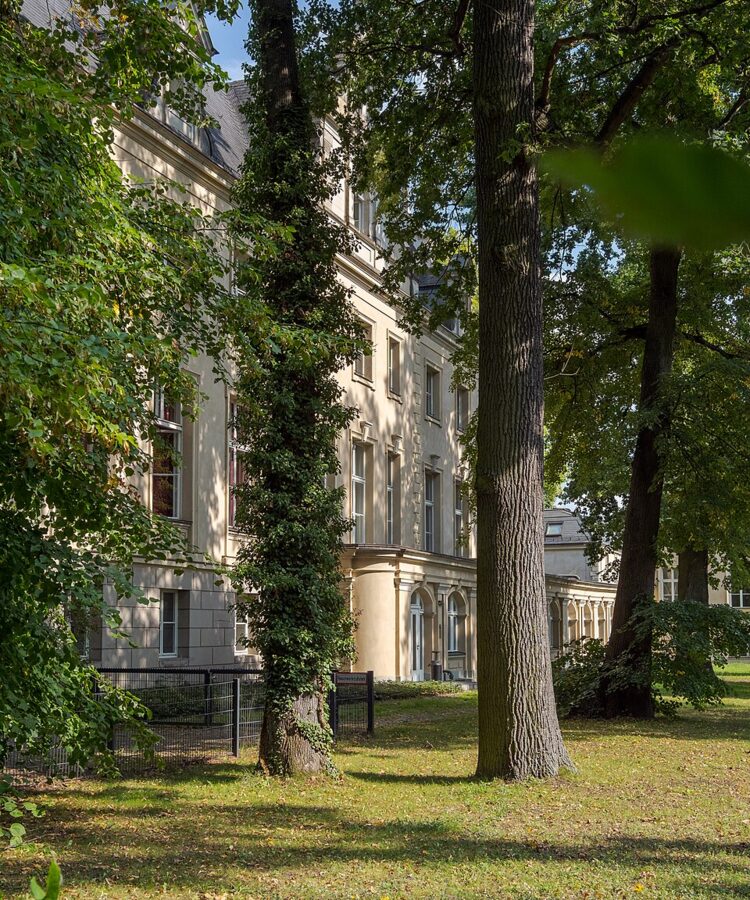

Carl bought it in 1859 and had von Arnim rebuild it by 1862 for his son, the general Friedrich Karl, in a lavish historicist style, usually described as neo-baroque, that stands alone in the Potsdam landscape, probably inspired by what Carl had seen around St. Petersburg. His grandson added the onion-domed tower in 1889.
After 1945 it housed families evicted from Babelsberg for the Potsdam Conference, a youth hostel and part of the UFA film studios’ stock. In 1963–1964 the architect Max Taut gave it a glazed bay on the garden side, because the Wall had cut off the old entrance. A fire in the south wing on March 31, 2003, led to a long restoration finished in 2012.
Beyond the lodge lies Klein Glienicke, a village first mentioned in 1375, and the oddity is that it belongs to Potsdam while the palace, park and lodge around it belong to Berlin. It is the only part of Potsdam on the Berlin side of the Havel and the Teltow Canal, about 28 hectares with roughly 560 residents, joined to the rest of the city by a single narrow bridge to Babelsberg.
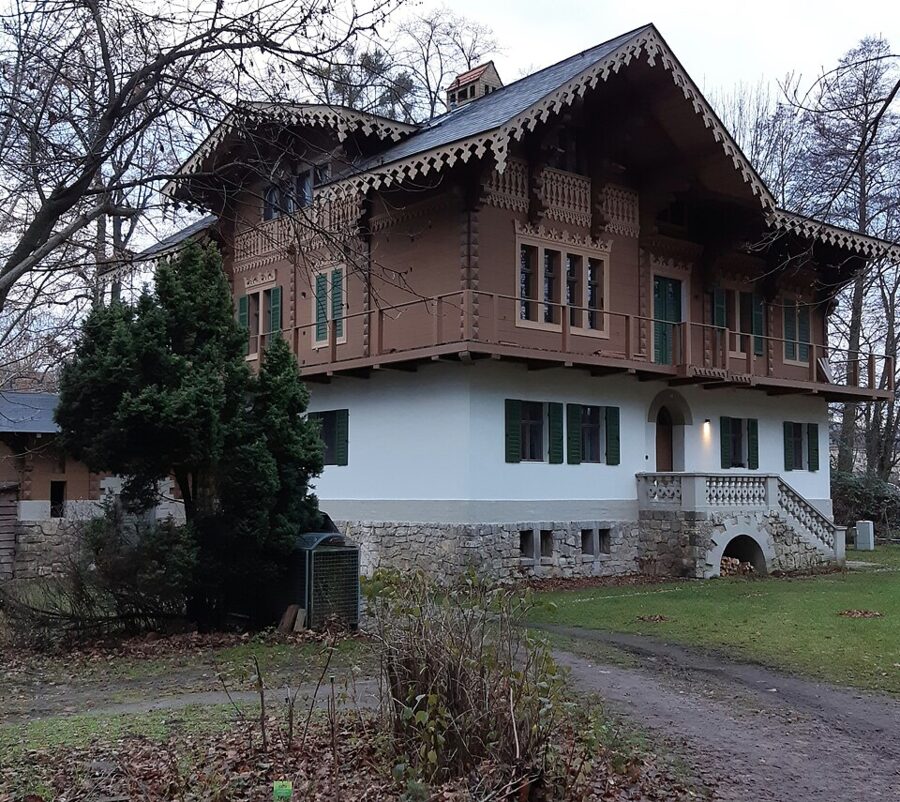
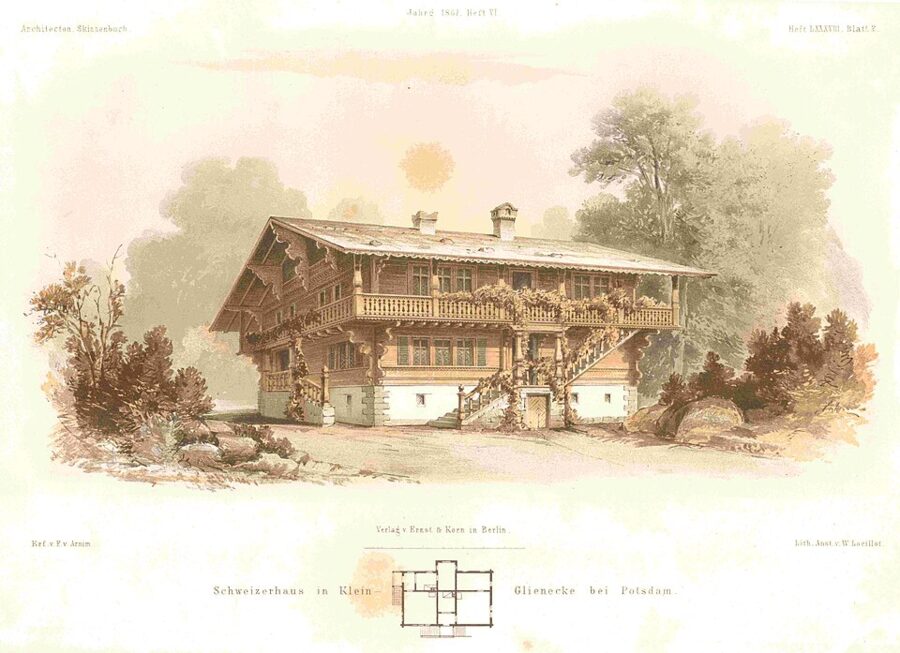
Carl wanted the land between his park and his brother’s to look the part. Between 1863 and 1887 von Arnim built him ten houses in a Swiss chalet style around the Böttcherberg, stone ground floors with timber upper stories and outside stairs. They were meant to be let as a business, but tenants were hard to find, and mostly court staff lived in them. The fashion for Switzerland went back to Rousseau’s novel of the Alps and the sentimental fiction that followed it, and Carl had seen real chalets on a trip there in 1861.

From 1961 the Wall ran right around the village. At its narrowest the East German strip of Klein Glienicke was 15 meters wide, and it was nicknamed the appendix of the GDR. Only the residents and holders of passes could enter.
People escaped anyway, often over the Wall on ladders, so every ladder in the village had to be chained up; in 1973 a 19-meter tunnel dug here carried the last successful tunnel escape from East Germany. To clear the strip the authorities pulled down several Swiss houses and, in 1975, the large White Villa that Carl had built as a guesthouse opposite the palace.
Walk through today and it is a quiet, expensive suburb with no shops and no bus line. Look for the chalets along Louis-Nathan-Allee, then cross the narrow park bridge over the canal toward Babelsberg Park.
Visiting Glienicke
From April to October the house opens Tuesday to Sunday, 10:00–17:30. From November to March it opens at weekends only, 10:00–16:00, and it is closed on December 24 and 25 and on December 31. Visits are by guided tour only, in German, with written information in other languages; in November and December 2026 the tours start at 10:20, 11:40, 12:50, 14:00 and 15:20, and group bookings can take over a slot. Check the times on the foundation’s Glienicke page before a weekday trip in spring or autumn.
Admission from the Prussian Palaces and Gardens Foundation (SPSG) is €8, reduced €6, and a Glienicke family ticket for two adults and up to four children under 18 costs €16. The house is not accessible to wheelchair users, strollers are not allowed in the rooms, and there are a few lockers for bags up to 35 by 35 by 50 centimeters; nothing can be left in the entrance. The tour slots are spaced roughly 70 minutes apart, which tells you how long to allow.
The garden is free and open daily from 08:00 until dusk. Come in late May or June for the beds in flower, in October for the park, or on a winter weekend when the house is quiet and you can see the bones of Lenné’s landforms under the bare trees.
Getting there
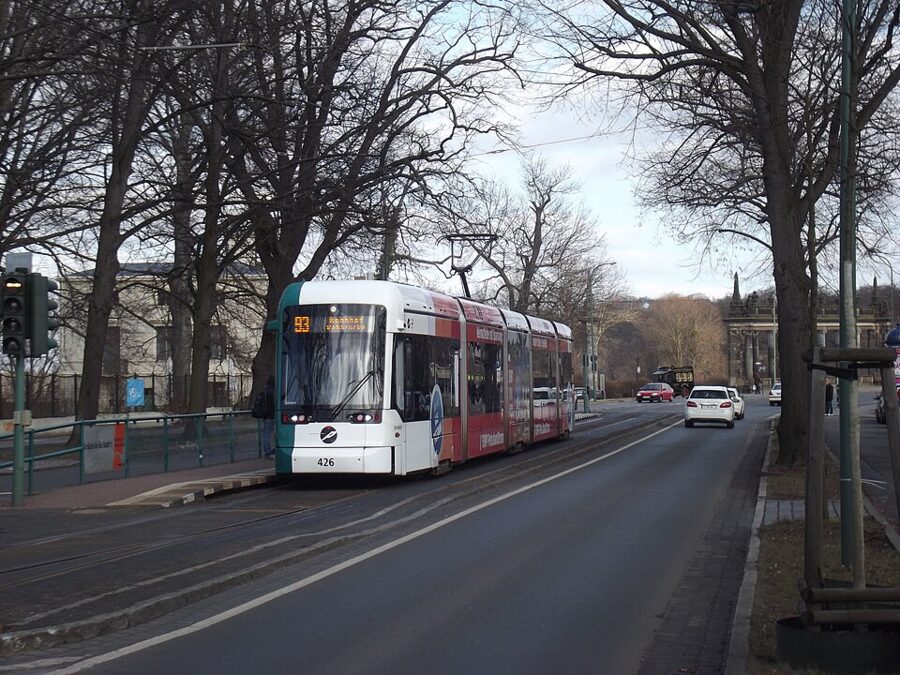
From central Berlin, take the S-Bahn S1 or S7 to Wannsee and change to bus 316, which runs along the Königstraße to the stop Schloss Glienicke (Berlin) at the gate. The whole trip stays inside Berlin, so a single ticket Berlin AB is enough, €4.00 in 2026. From Potsdam, take tram 93 from Potsdam Hauptbahnhof, the main station, to the end of the line at Glienicker Brücke and walk across the bridge; the Große Neugierde is on your left as you step off it on the Berlin side, and the palace gate a few minutes along the road.

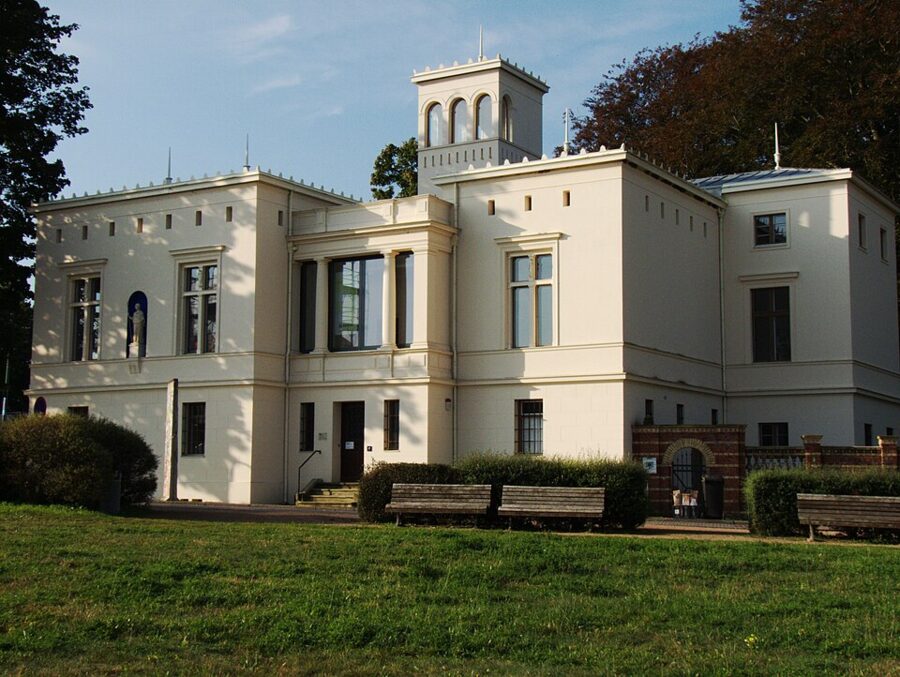
If you are joining Glienicke to a day in Potsdam, buy all three fare zones: a single ticket Berlin ABC costs €5.00 and a 24-hour ticket Berlin ABC €12.90 in 2026, rising to €5.20 and €13.20 from January 1, 2027. For coffee, there is the pedales-Café in the Villa Schöningen, at the Potsdam end of the bridge, and for a proper lunch you are better off in town; my picks are in the Potsdam restaurants guide.

Making a day of it
The best walk links three Prussian gardens on foot. Start at Glienicke when the house opens, see the pleasure ground and the Casino, then follow the Königstraße past the hunting lodge into Klein Glienicke, cross the park bridge and climb through Babelsberg Park to Wilhelm’s palace. Coming back along the Babelsberg shore, you look across the water at the Große Neugierde and the Casino exactly as Carl meant his brother to see them. Peacock Island is a bus ride from Wannsee; it makes a separate half day.
For the wider picture, the things to do in Potsdam list puts Glienicke in context, and if you want to sleep closer than Berlin, see where to stay in Potsdam.
End where the prince did, at the foot of the garden by the lions. On summer days the fountain plays between them; behind you the bus to Wannsee comes along the Königstraße, and across the road the light goes down over the bridge toward Potsdam. Carl took his tea somewhere different every evening. On your way out, give the gate a minute and look back up the axis he left you: bed, basin, steps, balcony, flag.