

Buy one 24-hour ticket Berlin ABC and up to three children aged 6 to 14 travel on it with you, free, for the whole day: out on the S7, round Potsdam on every tram and bus, and home again after dark. Children under six never need a ticket at all. The adult ticket costs €12.90 in 2026 and €13.20 from January 1, 2027, so the journey is the cheapest part of a family day in a town where the film theme park sold its 2026 family ticket online for €84.

That fare rule says a lot about Potsdam. With children it is easy in the obvious ways: compact, green, wrapped in water, with parks that cost nothing and a tram network that reaches most of what a family wants. It is harder in the ways nobody mentions until you are standing at a palace door with a stroller, a five-year-old and a timed ticket.

So the plan below sorts Potsdam by what children actually do here. Most of the palace interiors are for older children and patient ones. The parks are for everyone, but the royal ones come with rules written for statues, not for toddlers. And the best rainy-day half of the town is modern: a tropical hall, a science center and a natural history museum with a cellar full of fish.

Contents7 parts
How Potsdam works with children
One ticket, and who rides free
The rules of the Verkehrsverbund Berlin-Brandenburg (VBB) are simple once you know them. Children under 6 ride free, children from 6 to 14 pay the reduced fare, and from their 15th birthday they pay as adults. A reduced single ticket Berlin ABC is €3.50 in 2026 and €3.60 from January 2027, against €5.00 and €5.20 for an adult, as the VBB single-ticket page lists them.
The real saving is the rule I opened with. The VBB 24-hour ticket at the regular fare, for Berlin AB, Berlin ABC or Potsdam AB, includes up to three children aged 6 to 14, as long as the holder is at least 15. A family of two adults and three school-age children coming out from Berlin therefore needs two 24-hour tickets Berlin ABC and nothing else. If you are already staying in Potsdam, the 24-hour ticket Potsdam AB costs €6.30 in 2026 (€6.60 from January) and carries the same three children.
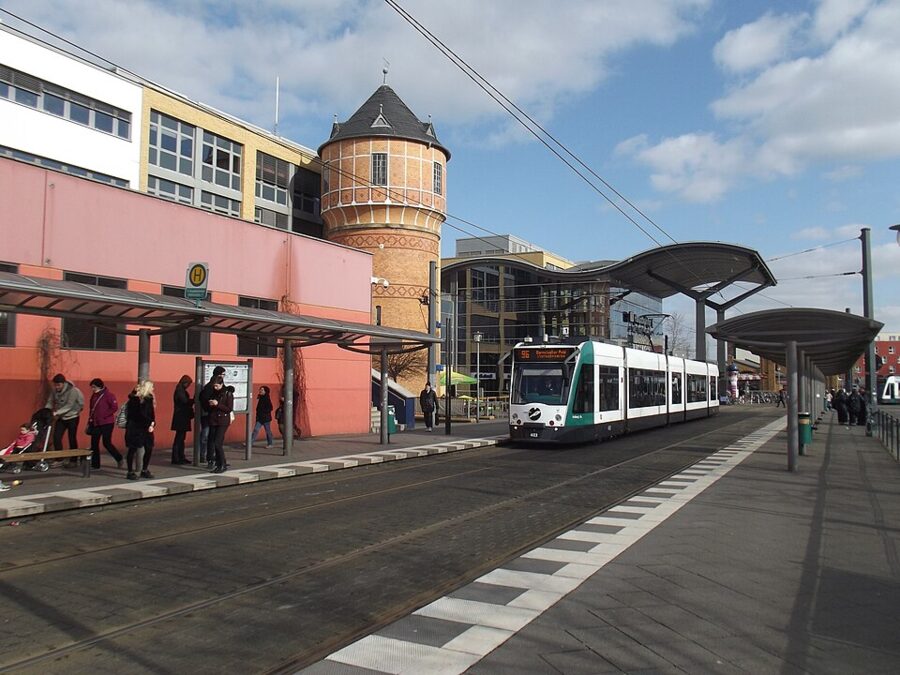
From central Berlin, the S7 runs every ten minutes or so to Potsdam Hauptbahnhof, the main station, and the RE1 regional train does it faster with fewer stops; my day trip from Berlin guide has the train detail. Strollers travel free on all of it. In town, tram 96 runs north to the Volkspark, bus 695 climbs to the top of Park Sanssouci at the Schloss Sanssouci stop, and tram 92 ends at Kirschallee, a short walk from the Krongut.

Distances, strollers and gravel
Potsdam looks small on a map and walks big. Park Sanssouci alone covers about 300 hectares and runs more than 2 km from east to west, and most of its paths are packed sand and gravel: fine for a sturdy stroller with big wheels, tiring for a city buggy, and miserable for a scooter. If your child is between stroller and walking, bring the stroller. You will use it as a bench, a bag carrier and, at about 15:00, a bed.
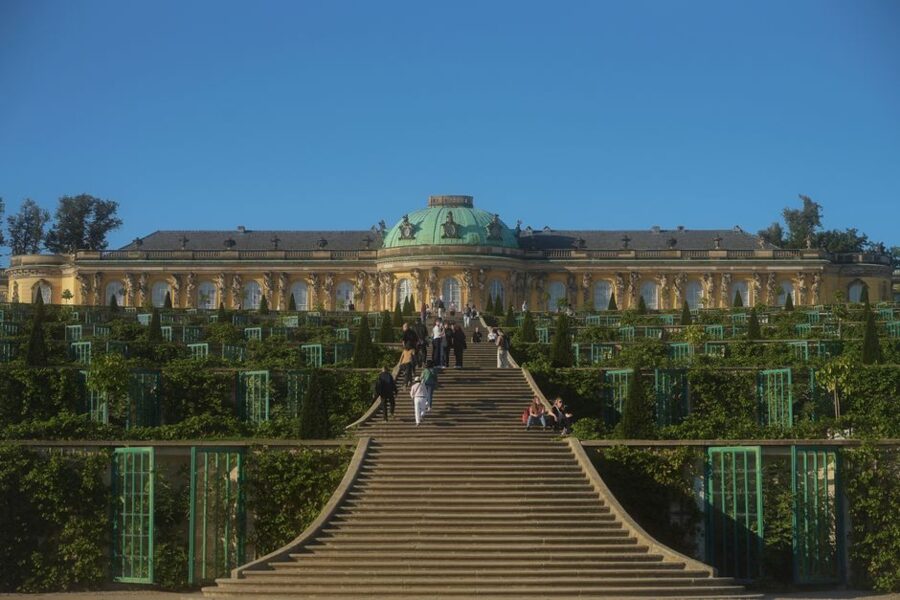
Inside the palaces, strollers stop at the door. The foundation that runs them, the Prussian Palaces and Gardens Foundation (Stiftung Preußische Schlösser und Gärten, SPSG), does not allow them in the exhibition rooms of Sanssouci Palace, the New Palace (Neues Palais) or the other houses, for conservation reasons. Sanssouci has nowhere to leave bags at all, and the New Palace has only a few small lockers for pieces up to 35 by 35 by 50 cm. A baby carrier solves both problems.
The park rules are the other surprise. The park regulations for Sanssouci forbid leaving the paths, ball games, climbing on sculptures or garden buildings, lounging and picnicking on the lawns, swimming, sledding, and cycling except on the signposted routes, and they warn that the fountains do not carry drinking water. The park is free and open daily from 08:00 until dusk. Small children should know before they go in that the grass is for looking at.
For toilets in Park Sanssouci, the foundation’s park page lists accessible ones at the Historic Mill, at the Affengang near the Grünes Gitter entrance, at the Kuhtor near the Roman Baths and in the New Palace visitor center, with more inside the visitor center at the mill. That is roughly one at each end and two in the middle. Plan the day around them.
When to go
The family year in Potsdam splits cleanly in two. From April to October everything is open: the Filmpark, the Historic Mill every day, the boats, the water taxi and, from late April to mid-September in good weather, the two city lidos. That is when Potsdam is at its best with children, and the summer holidays are when it is fullest.
From November to March the outdoor half closes or shrinks. The Filmpark’s rides stop at the end of October, the mill opens only at weekends and closes completely in December, the New Palace can only be seen on a guided tour, and the boats go into winter quarters. What stays open is the warm half: the tropical hall, the museums, an indoor ice rink and the Christmas markets. My guide to the best time to visit Potsdam goes through the year month by month.
Indoors: a jungle, a film park and the museums
The Biosphäre
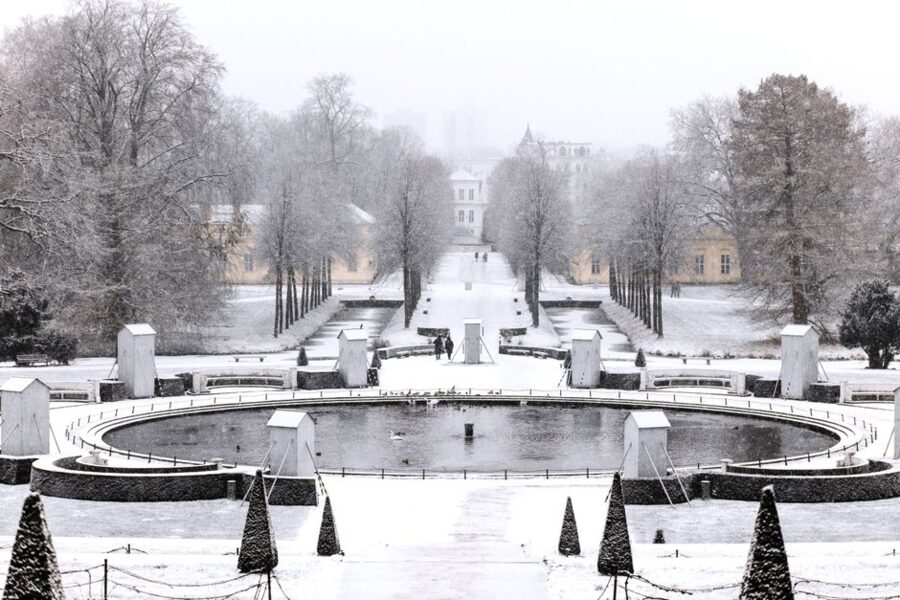
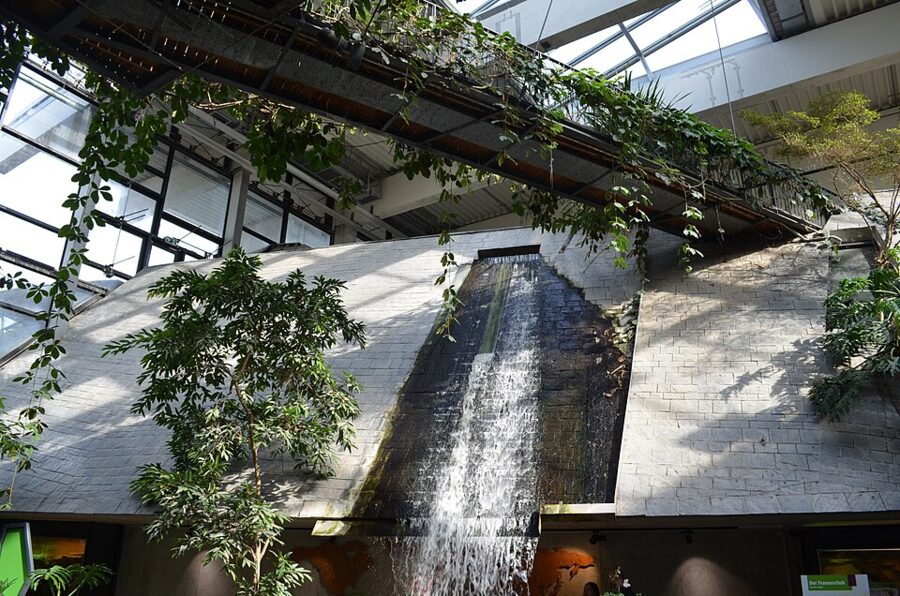
The Biosphäre is a tropical hall at the edge of the Volkspark with a rainforest, a waterfall, a butterfly house, free-flying birds and an aquarium, and on a grey day it is the best thing in Potsdam for small children. Day tickets at the door cost €20 for adults, €13 for children aged 6 to 17 and €9 for ages 3 to 5, under-threes go free, and a family ticket for two adults and up to three children is €42, according to the Biosphäre’s ticket page. It opens Monday to Friday 09:00–17:00 and at weekends 10:00–17:30. The paths take strollers, and the hall has lifts.

Filmpark Babelsberg
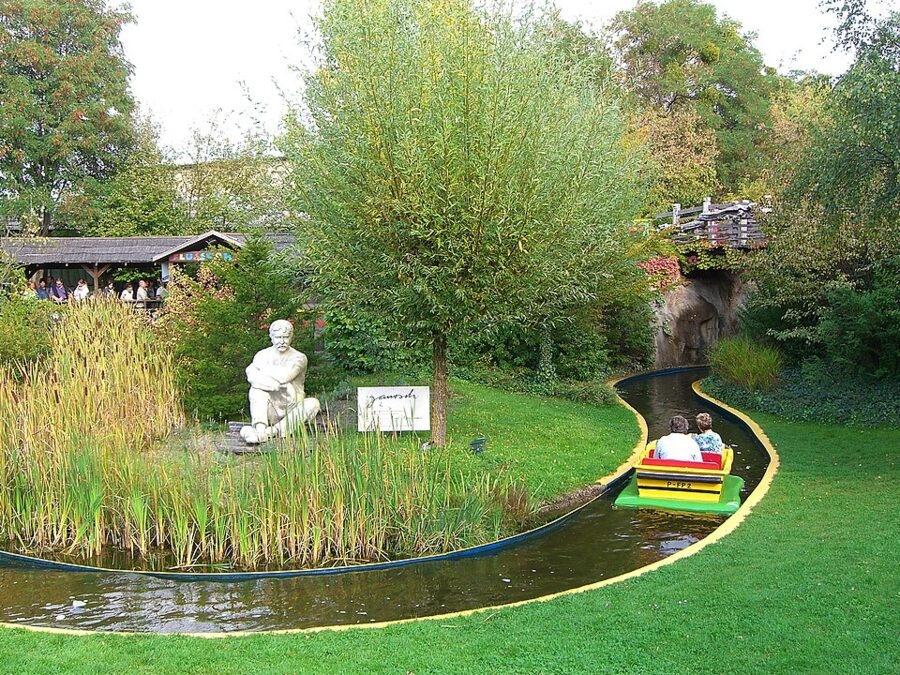
Filmpark Babelsberg is the seasonal theme park on the old film studio lot, with a stunt show in an artificial volcano, walk-through sets and rides for small children, open from about Easter to the end of October. In 2026 an online day ticket cost €25 for adults and €18 for children aged 4 to 16, under-fours went free, and the family ticket for two adults and up to three children was €84 online or €93 at the gate, as the Filmpark’s ticket page shows. Prices and dates for 2027 were not out by late November 2026. The stunt show is loud, and I would not take a child under five to it.

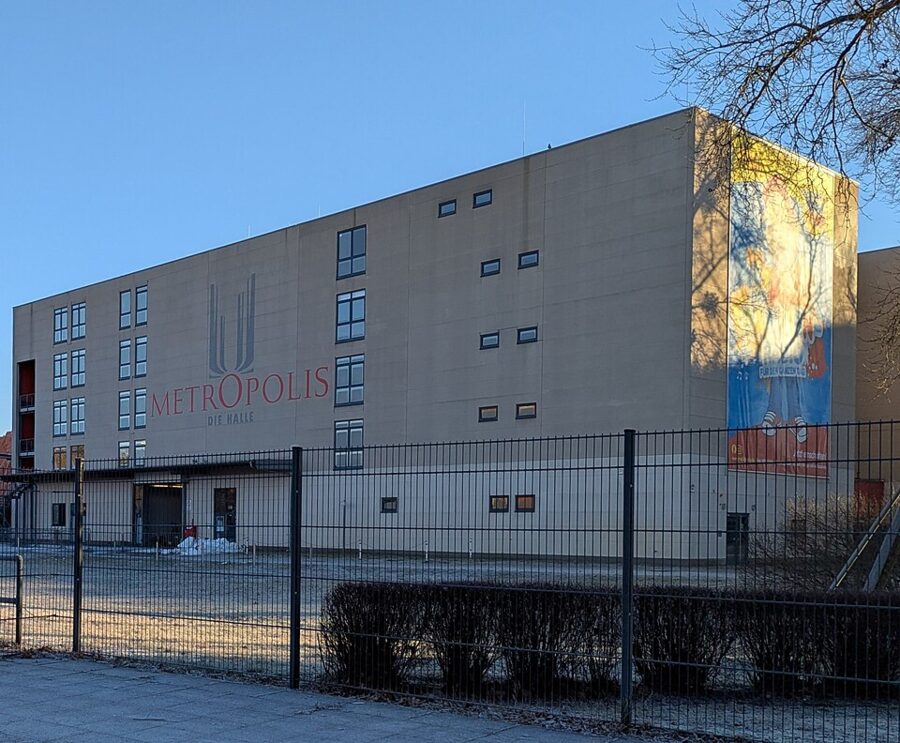
In winter the park’s event hall, the Metropolis-Halle, turns into an indoor rink with 650 square meters of real ice. The Filmpark ice rink runs from December 6, 2026 to February 6, 2027 in two-hour sessions at €10 for adults and €7 for children up to 16. Skates rent for €7 a pair, a skating aid for wobbly beginners for €6, and parents who only watch get in free.

The Natural History Museum
If I had one hour of bad weather and a child between three and ten, I would spend it at the Natural History Museum (Naturkundemuseum Potsdam) on Breite Straße. It is about the animals of Brandenburg, on four floors, from ladybirds to a brown bear called Tapsi who greets you in the foyer, with an elk, a wolf and a beaver on the way up. In the cellar more than 40 kinds of native fish swim in the aquarium, and that is the room small children refuse to leave.
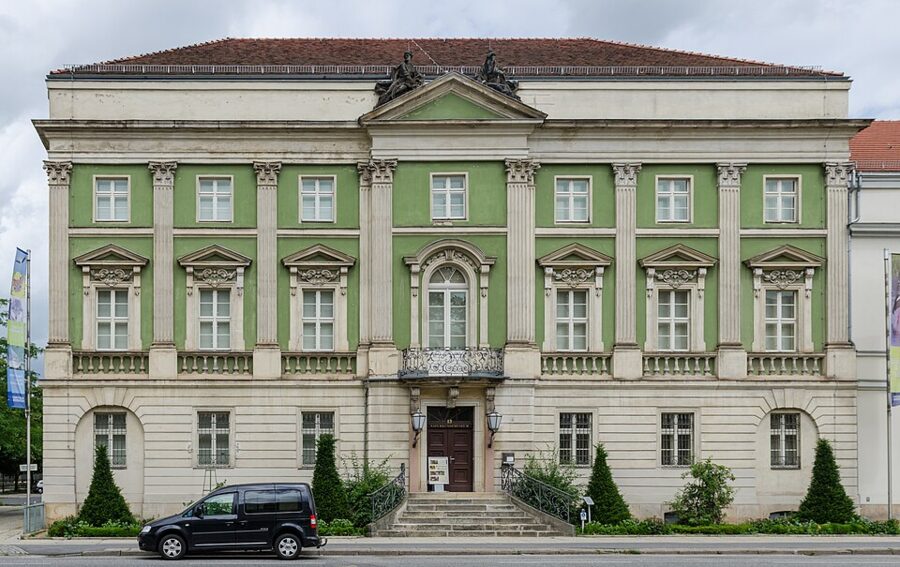

Admission is €4 for adults and €2 for children and teenagers from 6 to 18, which makes it the cheapest hour in town. The museum’s visitor page gives the hours as Tuesday to Sunday 09:00–17:00, plus the first Monday of each month. Free activity rallyes for children and families lie ready in the foyer, and the building has a lift to every exhibition floor.
The Filmmuseum
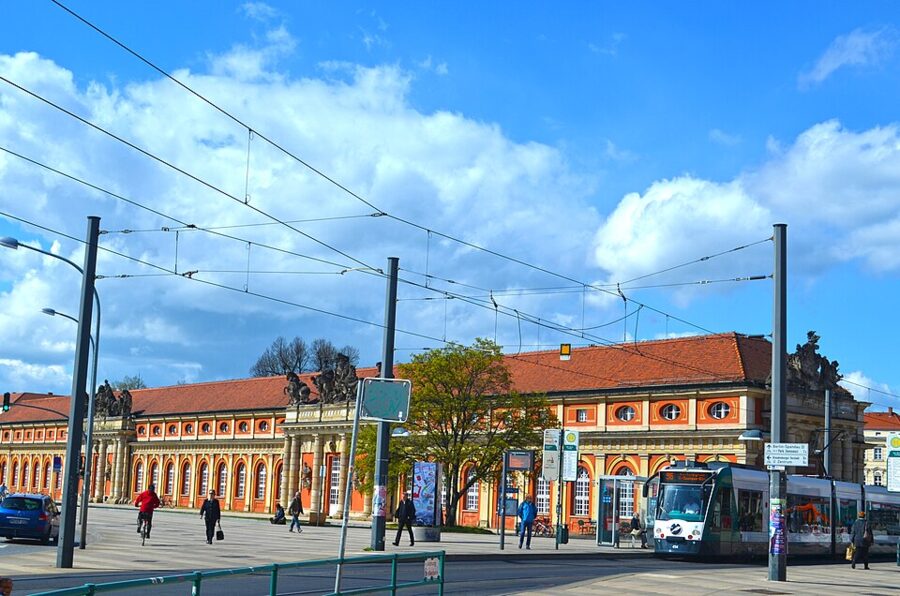
Across the road from the Lustgarten, the Filmmuseum Potsdam tells the story of the Babelsberg studios in its permanent exhibition and runs a cinema in the same building. For families the details are kind: children and teenagers under 18 get in free, adults pay €12, and on Saturdays and Sundays the cinema shows a children’s film at 15:00. The exhibitions are open Tuesday to Sunday 10:00–18:00, according to the Filmmuseum’s hours and prices.
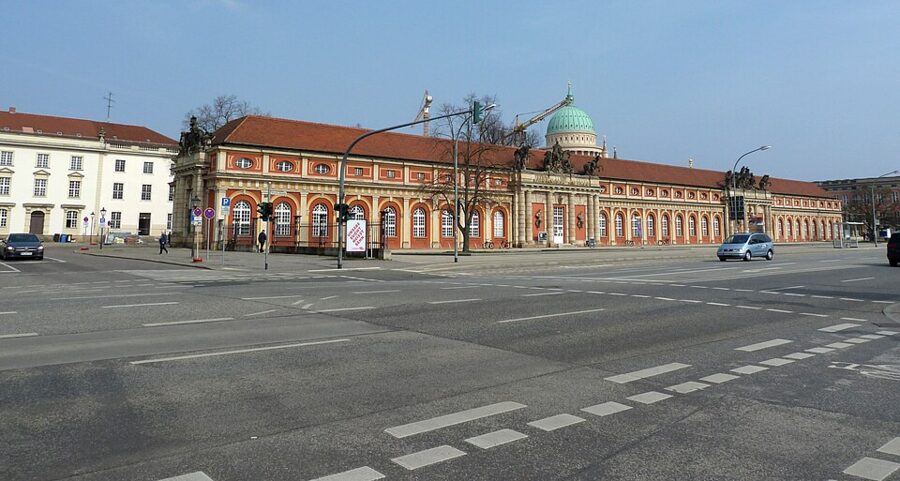

I’d take children from about eight. The exhibition follows a film from the first idea to the premiere, and younger ones will enjoy the costumes and the cinema more than the rooms. Teenagers who care about films get the most out of it, and they pay nothing.
NANO, the hands-on science center
The NANO science center on Am Kanal is where children press buttons, and it is the old Extavium under a new name: a group of Potsdam parents founded it in 2004, it moved to Am Kanal 57 in 2015 and took the name NANO in April 2024. More than 80 exhibits let children steer a spacecraft to the space station, build bridges that hold and pop chocolate marshmallow kisses in a vacuum pump. From October to December 2026 the demonstrations are about magnetism, and on Sundays children mix their own slime.
The hours matter, because they are short. Families can come Tuesday to Thursday 09:00–13:00 and Friday to Sunday 09:00–17:00, with no opening on Mondays, as NANO’s opening hours show. During the Christmas school holidays it opens daily 09:00–17:00, except December 24 to 26 and December 31 to January 1. Tickets are sold through its own shop, and the prices were not shown on its pages when I checked, so look before you go.
Free under 18: the city museum, the Barberini and a four-museum card
Several of Potsdam’s art and history museums let children in free, which changes the arithmetic of a rainy day. At the Potsdam Museum on the Alter Markt the permanent exhibition on the city’s history is free for everyone and special exhibitions are free up to 18, according to the Potsdam Museum’s visitor page. The same page sells a joint card for four museums in the center (the Potsdam Museum, the Brandenburg Museum, the Filmmuseum and the Natural History Museum) for €14, good for one adult with two children for one visit to each within a year.
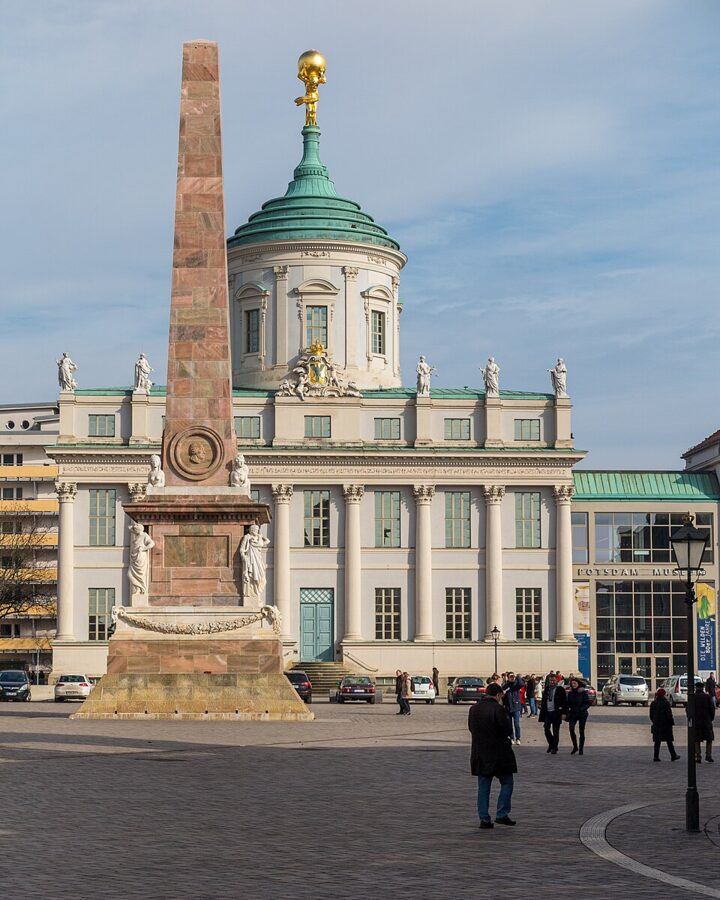

At the Museum Barberini under-18s are also free, but they still need a free timed ticket, all bags and jackets go into the cloakroom, and the museum is closed on Tuesdays, as its visit planner explains. With children who draw or paint, I’d go. With children who run, I’d go to the fish.
Outdoors: parks, playgrounds and a royal farm
The Volkspark, where the rules flip
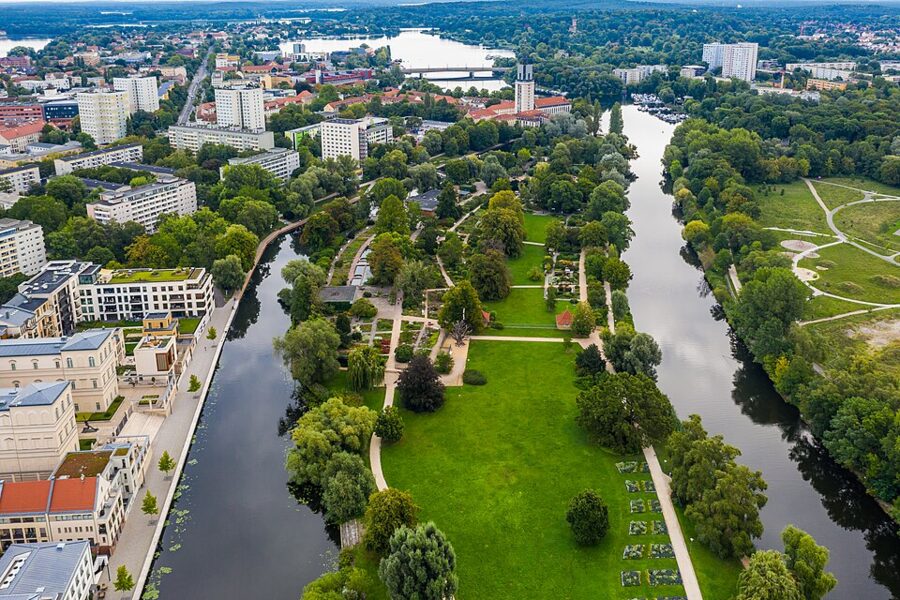
Everything the royal parks forbid, the Volkspark was built for. Laid out on the former Soviet military ground of the Bornstedter Feld for the 2001 federal garden show, it is the city’s modern park, with a 12-meter slide tower in the Waldpark whose tubes spread out like an octopus, four trampolines, a rope-climbing playground called ZickZack under old oaks, a skate park and a big sandpit at the Nedlitzer Holz playground for the smallest. The summer star is the water playground, a 900-square-meter pool with wooden rafts, a sand beach, water-spitting fish and a lighthouse; in late 2026 its pool is out of service for repairs, and the rest of the playground is only partly usable.
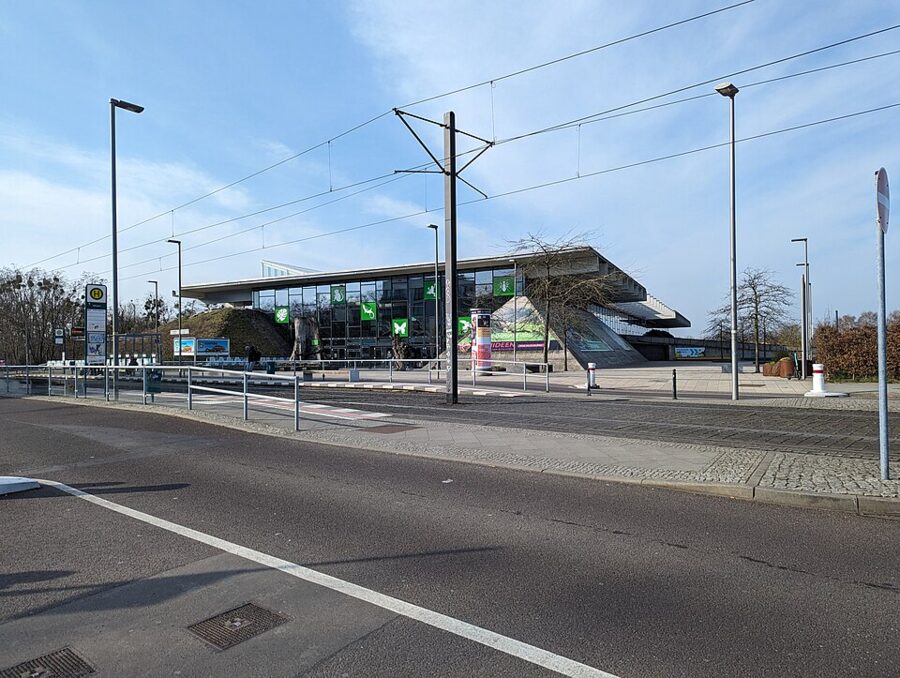

The park charges adults a small fee, which surprises people who know the free royal gardens. According to the Volkspark visitor information, a day ticket is €1.50 from March to November and €0.50 from December to February, and everyone under 18 gets in free. The gates are open daily 05:00–23:00. A combined day ticket with the Biosphäre costs €21 and is the obvious buy for a family day in the north of town.
In the cold months, the park’s four phone-guided Actionbound trails through the Remisenpark and the Waldpark keep primary-school children moving, and the minigolf course runs from late March to the end of October. The full story of the park, from Soviet military ground to garden show, is in my guide to the Volkspark Potsdam.
Park Sanssouci with children
Park Sanssouci works with children if you give them a mission instead of a walk. The foundation’s free Actionbound park game for families with children from six sends you round the park with GPS, quizzes and small physical challenges in about one and a half to two hours, with Flora and Pomona, the Roman goddesses of flowers and fruit, as guides, according to the foundation’s Actionbound page. You need a phone and the free Actionbound app, and the same game exists for Park Babelsberg and Peacock Island. The foundation’s own SANSSOUCI app adds a children’s rally through the park for ages 6 to 10, in German, so download it at home and bring your own headphones.
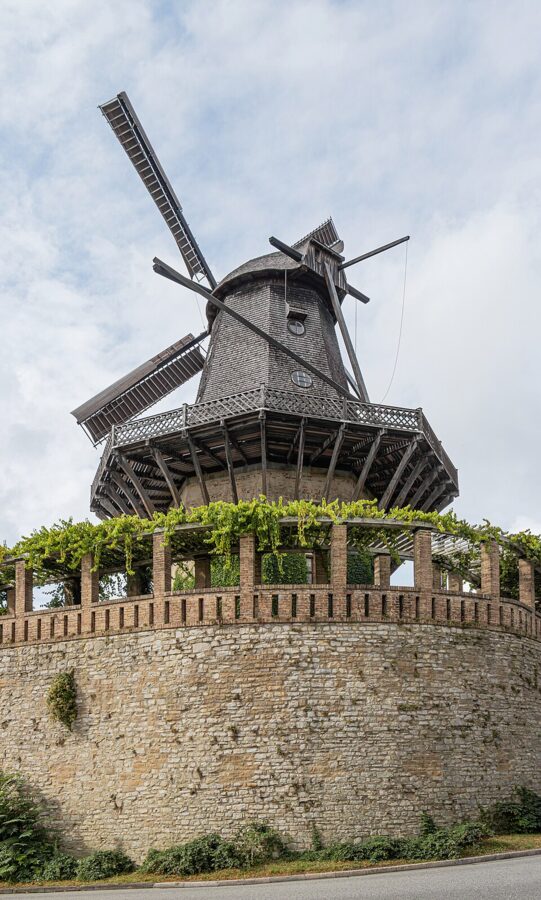
Then give them the places with a story. The Historic Mill next to the palace is a working Dutch windmill with an exhibition inside and a view from the top; tickets are €5 for adults, €3 for children from seven and €15 for a family. It is open daily 10:00–18:00 from April to October and only at weekends in November and from January to March, and it stays shut through December, as the foundation’s page on the mill lists. The legend of the miller who would not move for the king is told in my piece on the Historic Mill of Sanssouci, and it is the right story for a seven-year-old with a sense of injustice.
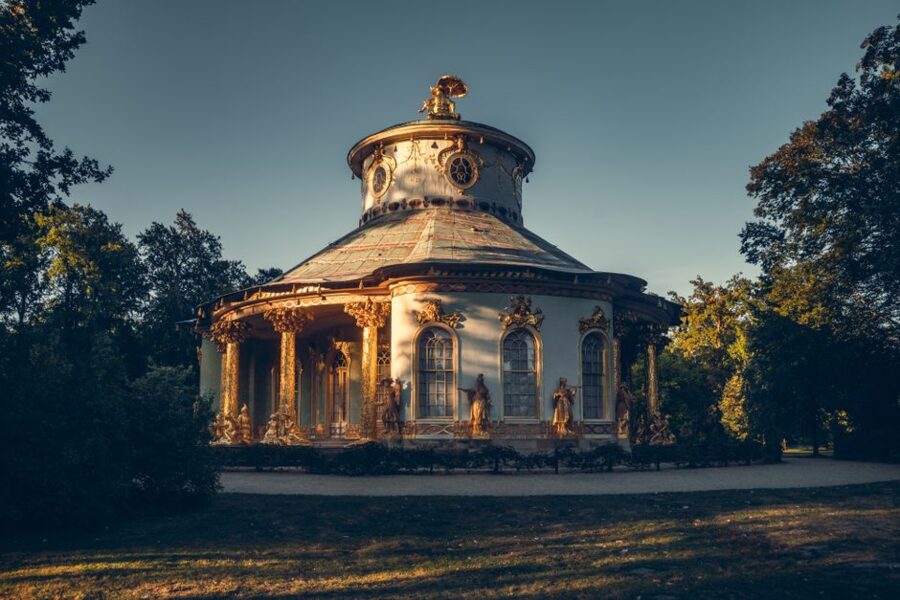
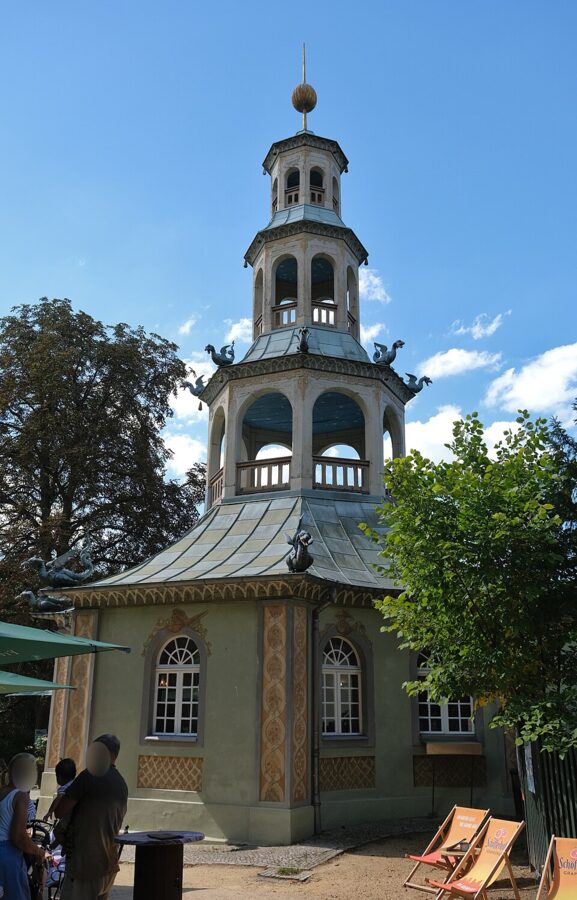
The Chinese House, ringed with gilded figures, and the Dragon House (Drachenhaus) on the Klausberg, a pagoda with dragons on the roof corners, are the two buildings children remember. Between them, the Neptune Grotto and the fountains make good targets for a walk with small legs. Leave the full circuit to the New Palace for older children; it is a long way back.
The Neuer Garten
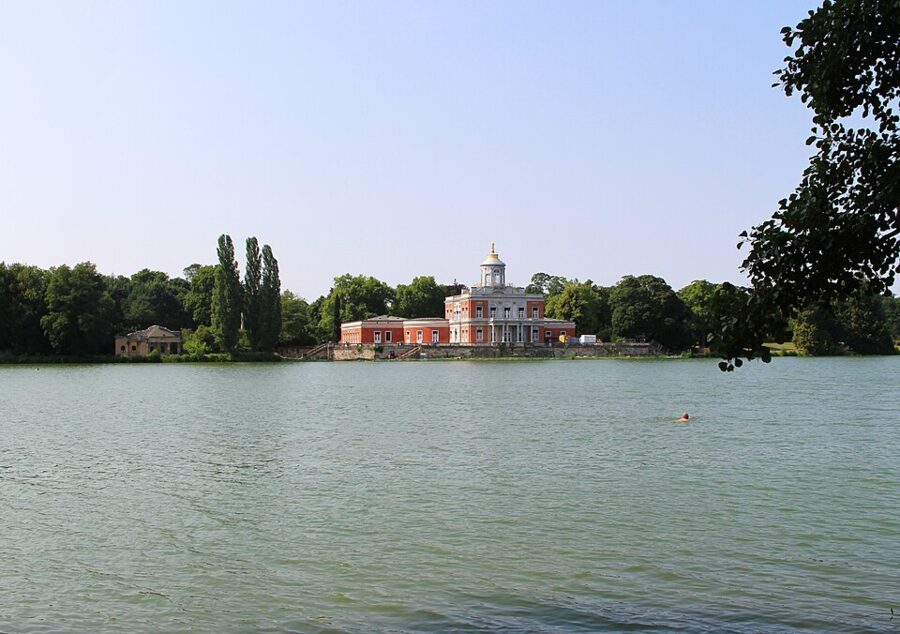
The Neuer Garten on the Heiliger See is the calmer royal park, and the one where children may at least get their feet wet. The park rules for the Neuer Garten forbid swimming in the Heiliger See except in the signposted bathing area and lying down except on the signposted lawns, which tells you that both exist. Ball games are banned here too. The paths along the lake are flatter than those in Sanssouci, and the walk from the south gate to the Marble Palace is short enough for a four-year-old.

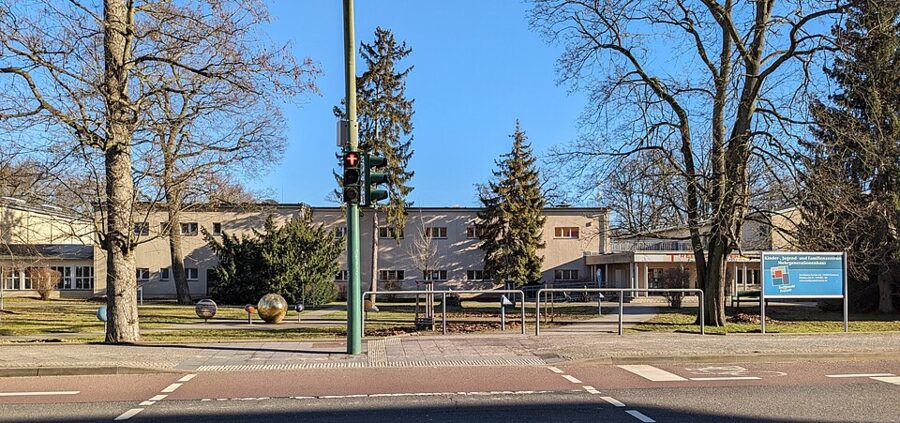
Just outside the south entrance, Café Midi in the Treffpunkt Freizeit, a leisure center for children and young people, is the easiest family stop on this side of town. It opens Monday to Friday 09:00–18:00 and at weekends 10:00–18:00, as its contact page shows, and it posts a lunch dish every day, lately at €7.50 to €9.90.

Playgrounds by name
Potsdam has 149 municipal playgrounds, according to the city’s playground page, 16 of them in the city center. You will not need many. These are the ones that fit a visitor’s day.
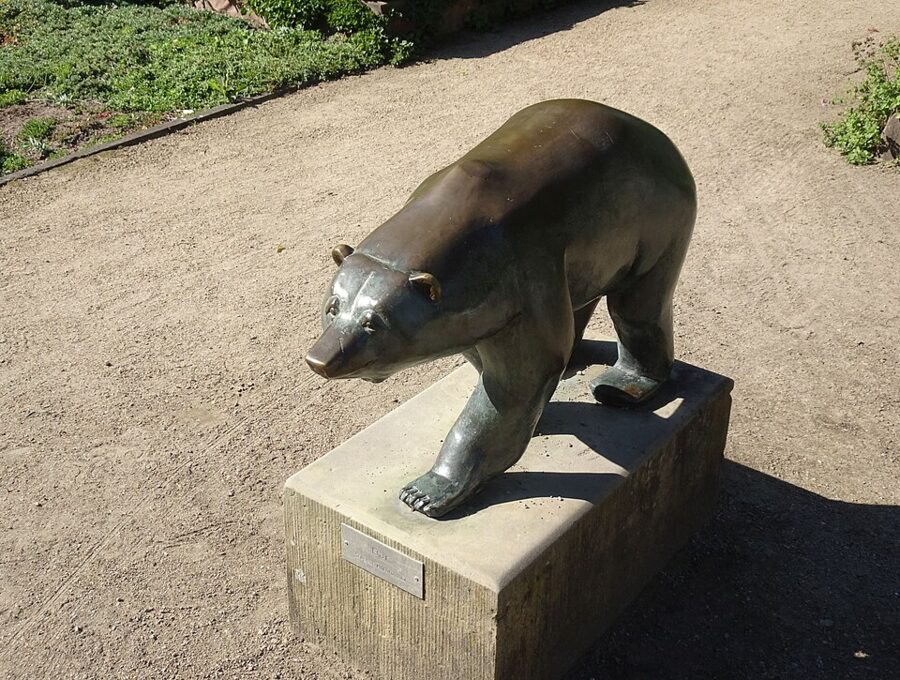
The Freundschaftsinsel, the island in the Havel between the station and the old town, has the most central playground in Potsdam, themed on a stranded wooden ship as a nod to the boatyards that once stood here. Around it lie lawns, a water garden, a perennial garden laid out from the late 1930s by the plantsman Karl Foerster and a scatter of East German sculptures that children like more than adults do: a bear and a young fox by Stephan Horota, set up in 1966, and a pony by Heinrich Drake. The city’s page on the island’s sculptures lists the rest. The inner, fenced garden closes at sunset, a café sits by the pavilion, and in summer a boat hire opens on the Alte Fahrt arm of the river.

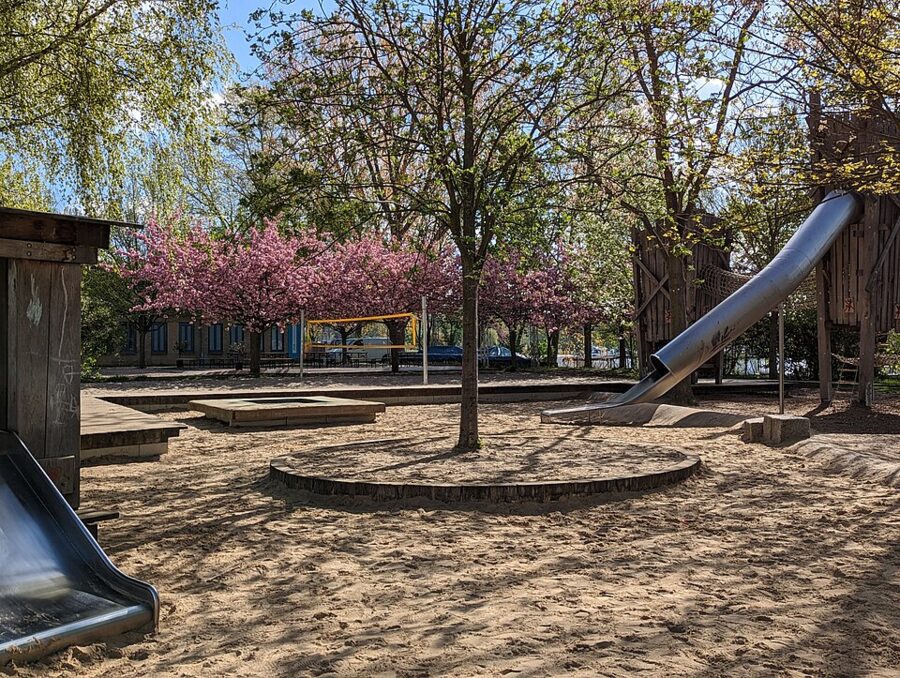

On the far side of the Havel, the Schiffbauergasse playground sits by the Tiefer See next to the theaters, a good stop before a boat trip or the lakeside walk toward Babelsberg. In the north, the whole Volkspark is one long playground.
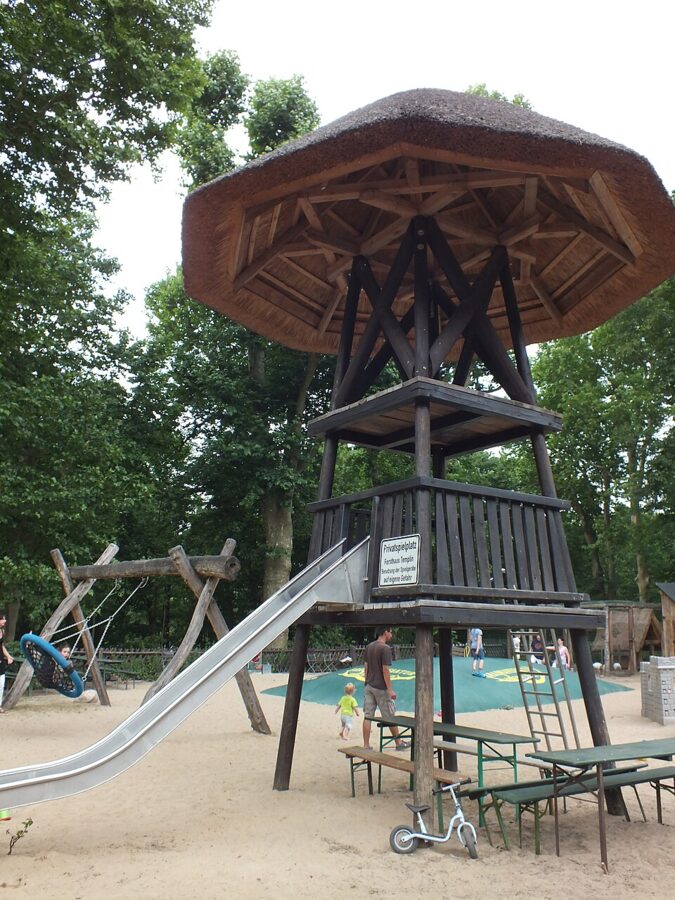
In the south, the Braumanufaktur at Forsthaus Templin, an organic brewery in an old forester’s inn on the Templiner See, has a big playground with a bouncy cushion and a climbing tower in sight of the beer garden. Its beer garden page gives Wednesday to Sunday hours until December 27, 2026, then a break until February 4, 2027. It is my favorite answer to the question of where the adults eat while the children play.

Krongut Bornstedt
Just north of Park Sanssouci, Krongut Bornstedt was the royal home farm, rebuilt in an Italian village style, where the later Emperor Frederick III and his English wife, Crown Princess Victoria, lived and ran a model farm. Today it is a courtyard of event barns and a rose garden on the Bornstedter See, with a playground and a café, the HofBrasserie, open Friday to Sunday and selling cakes and its own roasted coffee; the brewery restaurant is closed for now. It is a good place to end a Sanssouci day with children, because they can run in the courtyard while you sit.
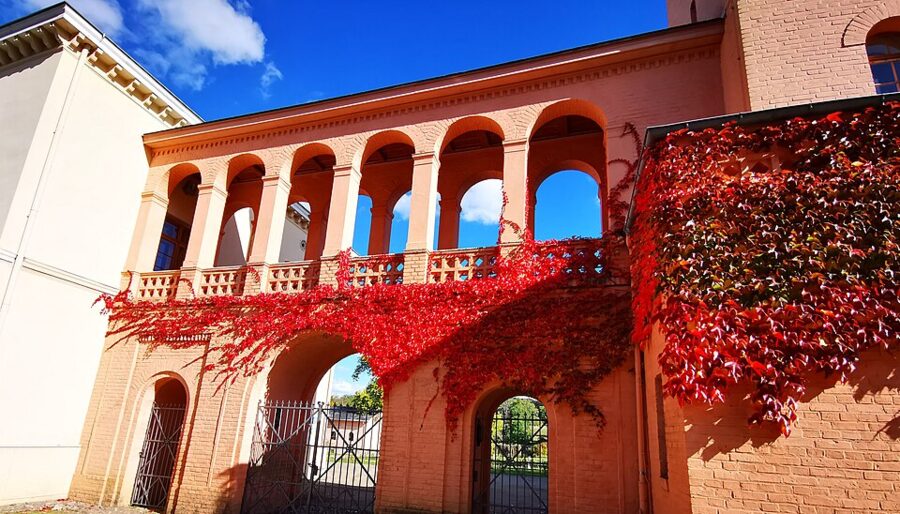

The Krongut’s own site lists an Advent village among its seasonal events. Check the dates there before a December visit.
On the water
Boat tours
Potsdam sits almost entirely in water, and a boat is the easiest way for a child to see that. The Weiße Flotte’s Schlösserrundfahrt (palace round trip) leaves from the Lange Brücke harbor next to the main station and takes 90 minutes, past Park Babelsberg and under the Glienicke Bridge onto the Jungfernsee. Adult tickets start at €23 on the palace round trip page, and the boats have food and drink on board. My guide to Potsdam boat tours compares every route.
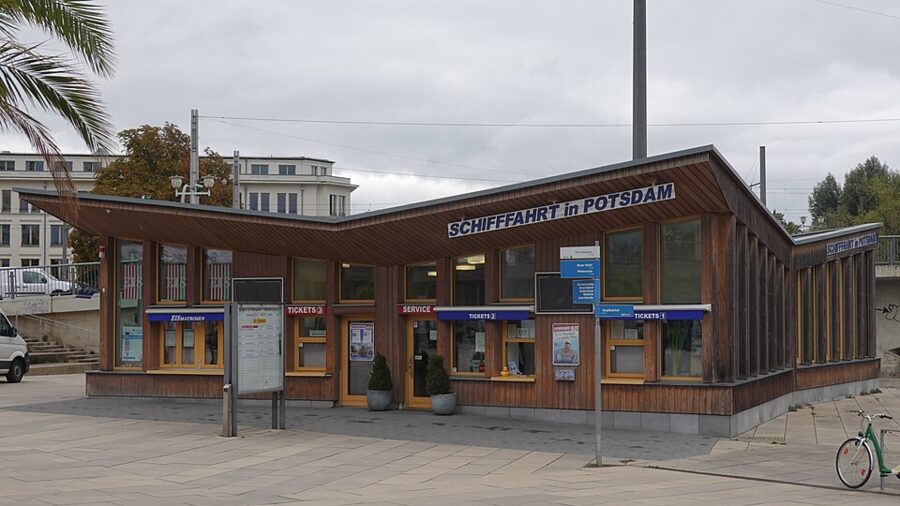

For families, the company’s two family tickets are the thing to know. According to the Weiße Flotte’s discounts page, parents with up to five children up to 14 pay from €57.50, and one parent with up to three children from €34.50, on all scheduled trips. Ninety minutes is about the limit for children under six; for them, a shorter hop by water taxi or the Caputh ferry is better. The winter break runs into late February, when the timetable shows the palace round trip again from February 27, 2027.
The water taxi
The Potsdam water taxi runs a hop-on, hop-off line between the main station and Peacock Island, past the Glienicke Bridge, the Neuer Garten and the Church of the Redeemer (Heilandskirche) at Sacrow. A hop between two neighboring landings costs €5, a longer single €9, the whole route €19 and a day ticket €34, according to the water taxi fares page. Children under 6 ride free, up to five per paying adult, and children from 6 to 14 pay the reduced fare. It runs in the warm season only; in late November 2026 its timetable showed no departures.
The Caputh ferry
The best five minutes on the water for a small child cost fifty cents. At the village of Caputh, south of Potsdam, the cable ferry Tussy II pulls itself across the Havel at the Caputher Gemünde, a crossing of a little over 80 meters that a ferry has worked since 1853. Adults pay €0.50, a bike with rider €1, and children up to 10 ride free, according to the Caputh ferry’s timetable and fares.
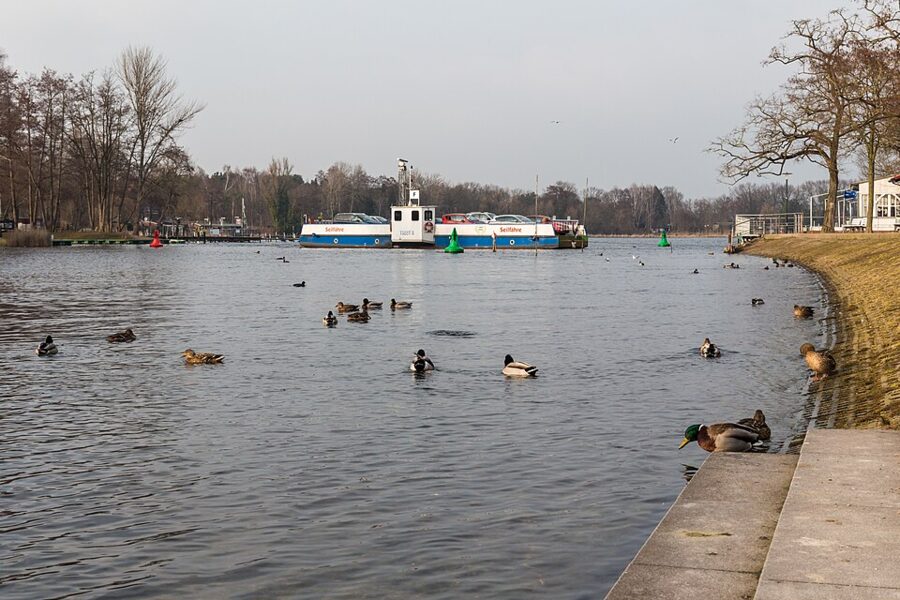

It runs from April to October Monday to Friday 06:00–22:00 and at weekends from 07:00, and from November to March until 20:00. Make a summer day of it: the Weiße Flotte’s Havel lakes boat to Caputh, the palace or a swim, then the ferry over to Geltow and back.
Lidos and swimming lakes
Swimming in the Potsdam lakes is a summer plan with two good answers for children. The Stadtbad Park Babelsberg on the Tiefer See has a sandy beach, a water slide and play equipment, but no car park, because it sits inside a World Heritage park. The Waldbad Templin on the Templiner See, in the woods toward Caputh, has a sandy beach and pedal boats and a car park.
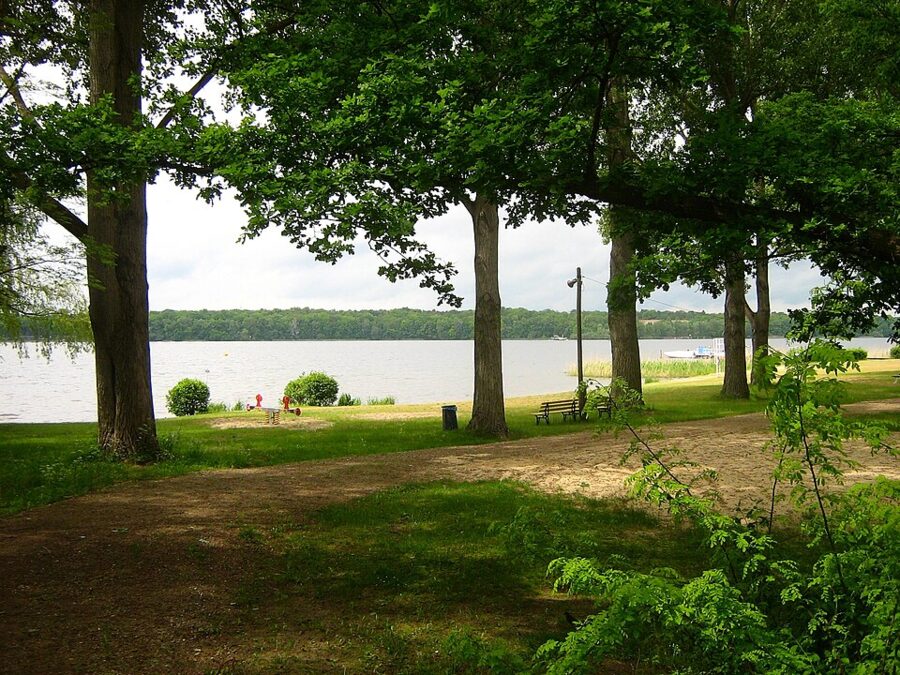
Prices are the same at both. On the Stadtbad’s price list a day ticket costs €6.50 for adults, €4.50 after 17:00 and €2.50 for children from 2 to 16, and the family and small-group ticket at €14.50 covers up to eight people with no more than two adults, with €2 for each extra child. The Waldbad Templin’s price list adds pedal boats at €13 an hour for a small one and €17 for a large one, each with a €5 deposit. Both lidos open in good weather from late April to mid-September.
Watch the water in high summer. In warm weather the Havel lakes can grow blue-green algae, and the city’s advice for the bathing season is to stay out if you cannot see your feet in knee-deep water and to keep small children from splashing where the scum washes up, since they swallow the most. The same notice asks swimmers to avoid weedy shallows in the mornings, where tiny flatworm larvae cause itchy skin, and reminds everyone that feeding ducks and other wild birds is forbidden in Potsdam. Elsewhere, the royal parks forbid swimming outright, except at the signposted spot on the Heiliger See.
Palaces with children
What children pay
Children under 7 go free in all the foundation’s palaces and need no ticket. Older pupils and students pay the reduced price with proof, and the family tickets count everyone under 18 as a child. The full rules are on the foundation’s combined tickets and discounts page, and my guide to Sanssouci tickets works through the sums for adults.
| Ticket (2026) | Price | What it covers |
|---|---|---|
| Sanssouci Palace, single | €14, reduced €10 | One timed visit, sold only on the day at the desks |
| New Palace, Grand Tour | €14, reduced €10 | The festival halls and guest apartments; €16 and €12 in 2027 |
| Sanssouci+ | €22, reduced €17 | Every open foundation palace in Potsdam for a day; €24 and €20 in 2027 |
| Sanssouci+ Family | €49 | The same for up to two adults and four children under 18 |
| Family ticket Potsdam (Familienkarte Potsdam) | €30 | Every open Potsdam palace except Sanssouci Palace for a day; €39 in 2027 |
| Historic Mill, family | €15 | Two adults and their children |
The family Sanssouci+ is the bargain. Two adults and two children of 8 and 11 would pay €78 on individual Sanssouci+ tickets and €49 on the family one, with a timed slot at Sanssouci Palace and, if you want it, the New Palace. It is the only kind of foundation ticket you can book online, the family version included, and in summer I would.
Sanssouci Palace: short, timed, and no strollers
Frederick the Great’s summer palace is small, which is good news with children: the rooms run in a single line, and the visit is short. Entry is by timed slot, and day tickets go on sale at the Historic Mill visitor center from 30 minutes before the palace opens. It opens Tuesday to Sunday, 10:00–17:30 from April to October and 10:00–16:30 in winter, according to the foundation’s Sanssouci Palace page.
Children get their own audio tours in the foundation’s free SANSSOUCI app: one for ages 6 to 9 in German, and one for ages 10 to 13 in German and English. The adult tour comes in a dozen languages. Bring headphones, because none are lent out, and download the tours at home.
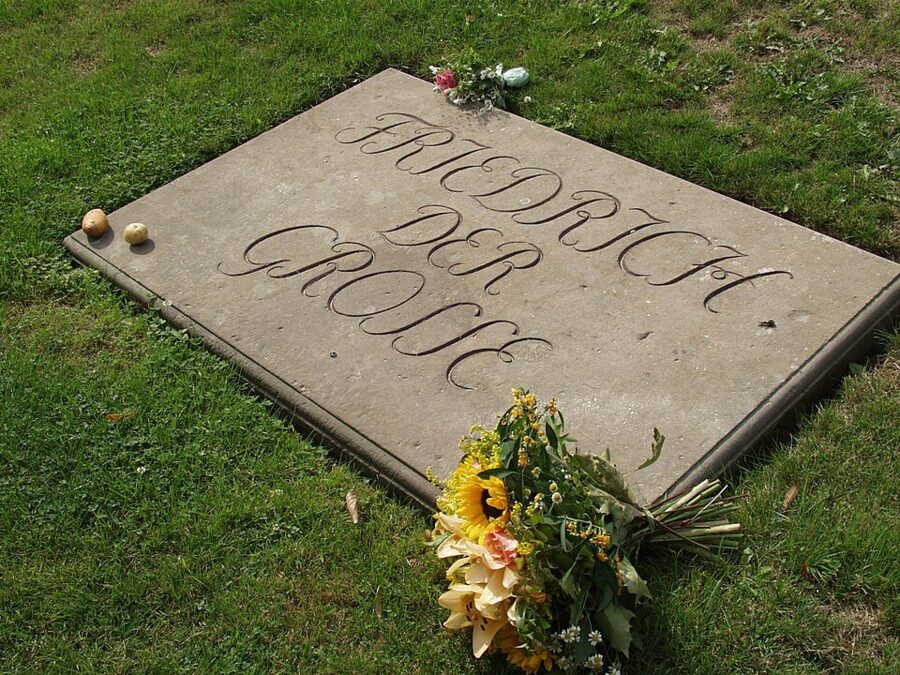
Then take them outside to the king’s grave on the top terrace. Frederick the Great lies beside his greyhounds under a plain slab, and visitors leave potatoes on it, because he pushed the crop on his farmers. No child forgets a grave with potatoes on it.

The New Palace and the Grotto Hall
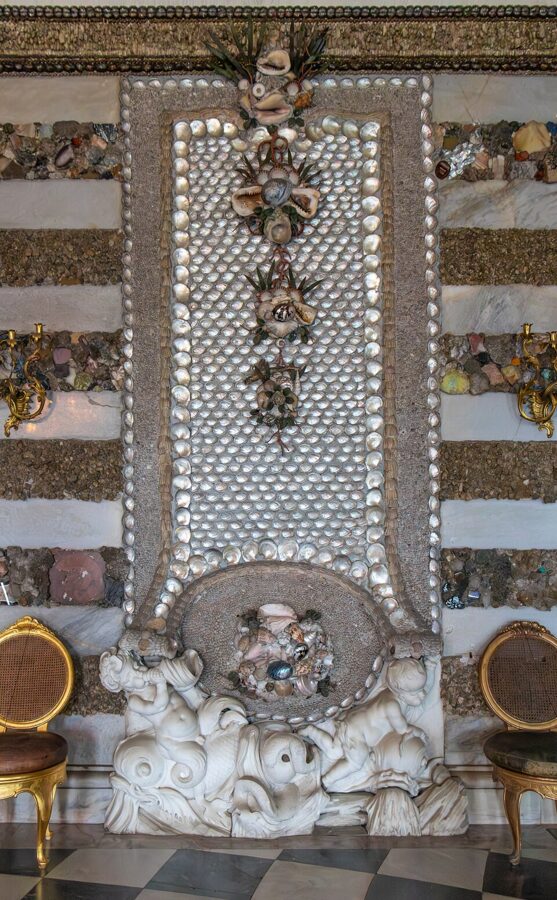
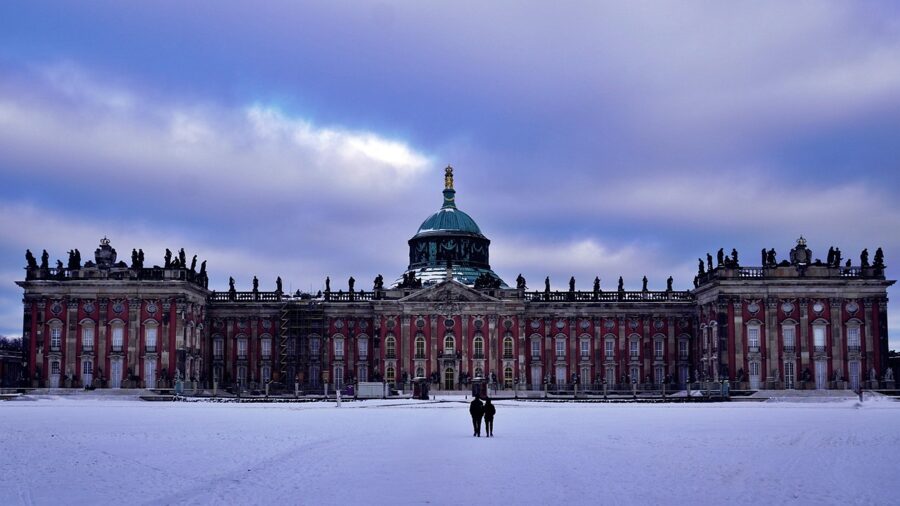
The New Palace at the west end of the park is the one palace interior I’d pick for school-age children, because of one room. The Grotto Hall has walls and pillars covered in shells, glass and minerals from all over the world, an underwater cave on the ground floor of a palace, and after years of restoration it is back on the tour route. The foundation’s New Palace page lists two audio tours in the app made for children: “With Konrad the castellan through the New Palace” for ages 6 to 9, in German and English, and a German one for ages 10 to 13.

Know the calendar before you go. The New Palace is closed on Mondays from January to October and on Tuesdays in November and December, and from November to March it can only be seen on a guided tour in German, with information sheets in other languages. That is a long tour for a seven-year-old. In winter, I’d do it only with children over ten who already like the place.
The Marble Palace and the castle dragon
The Marble Palace in the Neuer Garten is a guided-tour house too, but it is small and the foundation runs family tours here. On December 6 and 20, 2026, a tour for families with children from six, led by a castle dragon named Johann Ludwig von Fauch, starts at 11:10 and 14:00. Over the winter the palace opens only on Saturdays and Sundays, 10:00–16:00; tickets are €8 (reduced €6) in 2026 and €9 in 2027, on the foundation’s Marble Palace page.
The foundation’s family offers page collects these events, together with children’s birthday parties in the palaces and the free self-guided material. Most of the events are in German, and many book out; the December list shows several marked as full a fortnight ahead.
Peacock Island and Caputh Palace
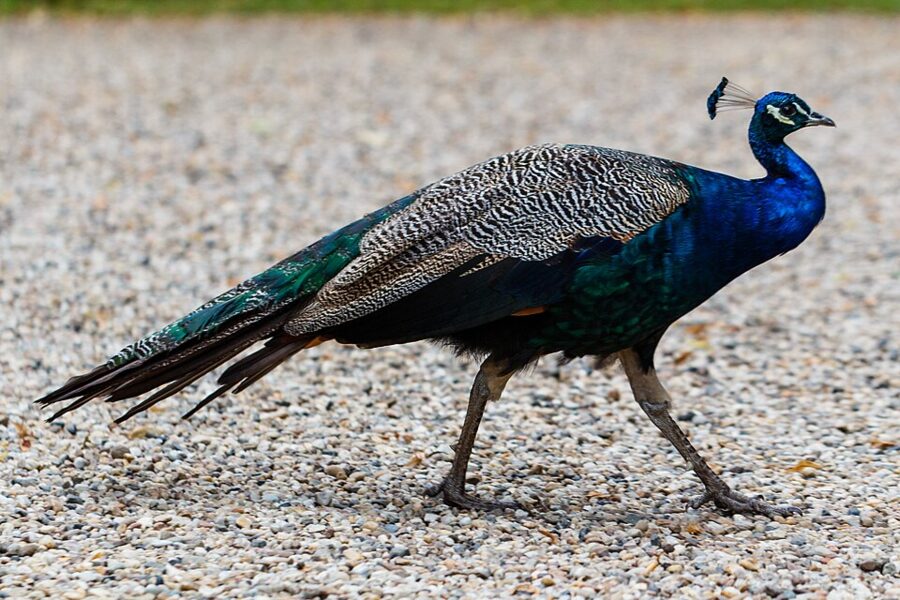
Two foundation sites have free activity booklets for children aged 7 to 12. Peacock Island (Pfaueninsel), just across the Berlin line in the Havel, is the obvious one for young children: a short ferry crossing, a car-free island and peacocks walking on the paths. The foundation’s family ticket for the ferry is €12 in 2026. The other booklet is a quiz tour for Caputh Palace, a small Baroque house with a hall of Dutch tiles.
What is closed
Plan around the gaps. Cecilienhof, the Orangery Palace and the Roman Baths are closed for restoration until further notice, so the Potsdam Conference rooms cannot be visited, and Babelsberg Palace opens only for events. The park around Babelsberg Palace is open, and it has its own Actionbound game.
Food, breaks and where to sit down
Potsdam feeds families well if you know where the playgrounds are, and my full guide to Potsdam restaurants covers the rest. In Park Sanssouci, the foundation lists Café Caroline in the New Palace visitor center, the Theaterklause near the Grünes Gitter entrance, Café Repin near the Picture Gallery and the Dragon House as the places to eat inside or at the edge of the park. The Dragon House is the one with the view and the dragons; check its winter days before you climb up.
In the north, the café das haus im park sits next to the Volkspark’s water playground and opens daily 12:00–18:00 from April to October, at weekends only in November and not at all in December. The Biosphäre’s Restaurant Urwaldblick looks out over the jungle, but on its late-2026 timetable it opens on Mondays, Tuesdays and Thursdays 10:00–16:30 and at weekends, so Wednesday and Friday lunches need another plan.
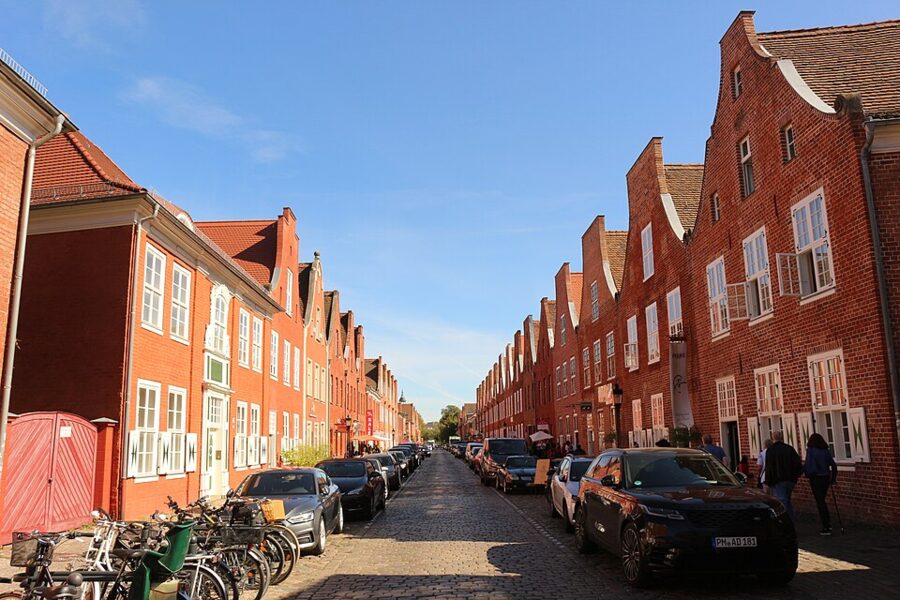
In town, the Dutch Quarter is where most families end up for cake, and the Poffertjes en Pannekoeken café on Mittelstraße sells the small Dutch pancakes that children eat by the plateful. The Krongut’s HofBrasserie (Friday to Sunday) and Café Midi by the Neuer Garten are the other easy stops, both with room to move.

Picnics belong in the Volkspark and on the Freundschaftsinsel, not in Park Sanssouci, where the rules ban lounging on the lawns. Bring water bottles: the park fountains are not drinking water, and the foundation says so on its park pages.
Day plans by age
Toddlers and preschoolers (under 6)
Keep the palaces for another trip and build the day around the north of town. Take tram 96 to the Volkspark, spend the morning in the Biosphäre while it is quiet, eat at the Urwaldblick or in the park, and give the afternoon to the Volkspark’s sandpits and slides. Under-sixes ride free and walk into the Volkspark free; at the Biosphäre only the under-threes go free, and three- to five-year-olds pay €9.
On a wet day, swap the park for the Natural History Museum’s fish cellar in the morning and the Filmmuseum’s 15:00 children’s film at the weekend. In summer, swap it for the Freundschaftsinsel playground and the shortest boat you can find, or the Caputh ferry, which a three-year-old will want to ride four times.
Primary-school ages (6 to 11)
This is the age that gets the most out of Potsdam. Between April and October, start at the Historic Mill when it opens at 10:00, play the Actionbound game across Park Sanssouci with the Chinese House and the Dragon House as waypoints, and finish at the New Palace with the Grotto Hall and Konrad the castellan in the app. Buy the Sanssouci+ Family ticket if you want Sanssouci Palace in the same day, and keep the palace visit short.
In the same season, give a second day to Filmpark Babelsberg, and in winter give it to the ice rink in the Metropolis-Halle. A rainy day at this age is the NANO in the morning, the Natural History Museum after lunch and the Biosphäre if anyone still has energy.
Teenagers
Teenagers want height, speed and a story. Give them the tower of the rebuilt Garrison Church: a lift or 365 steps to a viewing platform 57 meters up, €8 for the view (reduced €6), a family combined ticket for the view and the exhibition at €20, and children up to 6 free, according to the Garrison Church’s visit page. It opens Monday to Friday 11:00–15:00 and at weekends 10:00–17:00, and the tower’s cap is due in summer 2027.
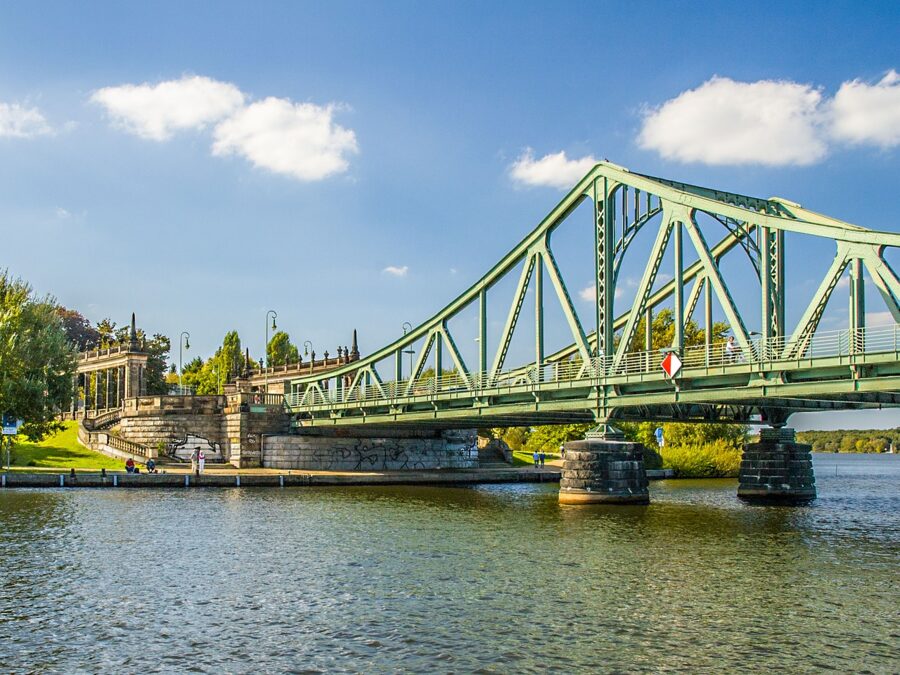
Then the Glienicke Bridge, where the Cold War’s spies were swapped, and a bike. Potsdam per Pedales rents bikes from its bike station inside the main station building, and kayaks and paddleboards from its paddling station at Griebnitzsee station. Under-18s pay nothing at the Filmmuseum, the Barberini or the Potsdam Museum, which helps if they want an hour indoors on their own terms.
Older teenagers can do the full palace day, the New Palace included, with the 10-to-13 audio tours as a joke they will secretly follow. Fourteen is also the last year they ride on your 24-hour ticket, so make the most of it.
Which brings you back to the station at dusk. The S7 back to Berlin leaves every ten minutes or so, the children ride on your ticket for one last time today, and if one of them falls asleep before Wannsee, the day worked.