

In May the rhododendrons flower in the Waldpark, more than 200 of them, and they grow in a set of shallow hollows that were dug as hiding places for tanks. That is the Volkspark Potsdam in one sentence. Much of what you walk over here, the long grass banks, the sunken beds, the copses of old oak, was made by an army first and handed to gardeners later.
The park fills the middle of the Bornstedter Feld, the open ground north of Sanssouci where Prussian kings reviewed their cavalry, where Orville Wright flew in 1909 and where the Soviet army sat behind a fence for more than four decades. It became the main site of the federal garden show in 2001 and turned 25 in 2026. Today it covers about 60 hectares, charges adults €1.50 to get in (€0.50 in winter), and lets you do what the royal parks mostly do not: lie on the grass, ride a bike along its paths and let children loose in water and sand.

I would not cross Potsdam for the flower beds alone. I would come for the combination: an hour or two in a park built for using rather than admiring, the tropical hall of the Biosphäre on its edge, and a walk south over the Ruinenberg into Sanssouci. With children it is the easiest half day in the city. Without them, it is the place to understand how much of north Potsdam was barracks and drill ground until the 1990s.

Contents9 parts
A drill ground behind Sanssouci
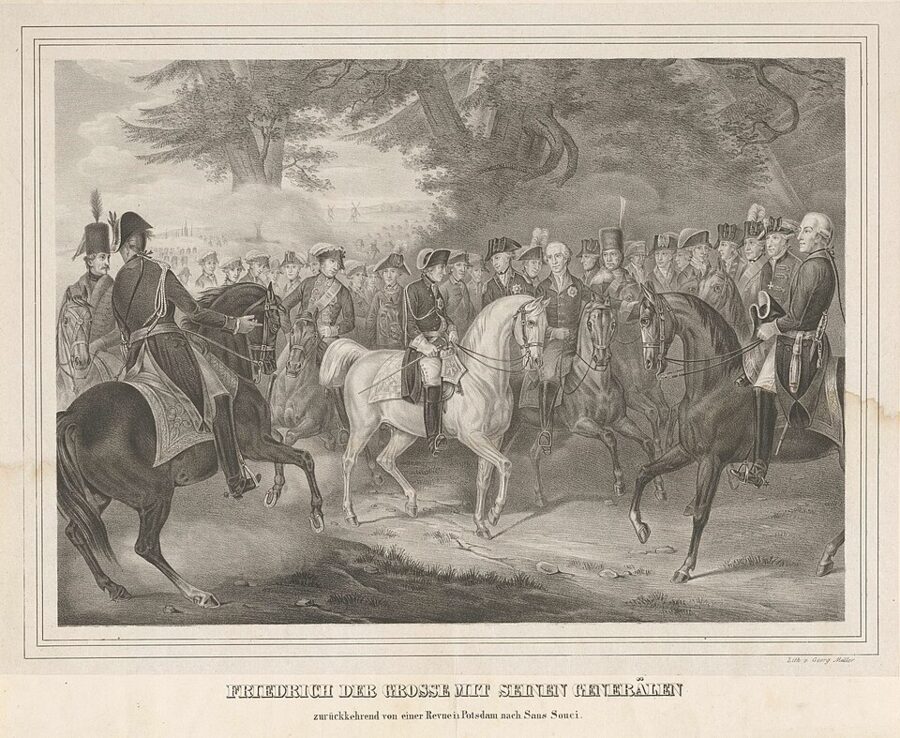
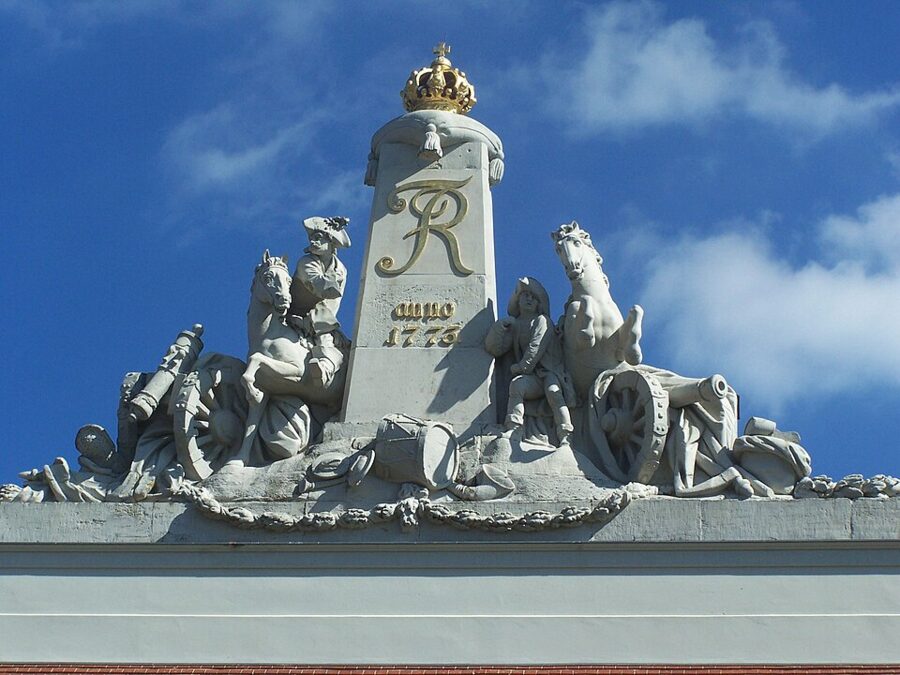
The army did not start here. Frederick William I (Friedrich Wilhelm I), the Soldier King, drilled his regiments in the Lustgarten in the middle of town. It was his son, Frederick the Great (Friedrich II), who moved the exercises out to the Bornstedter Feld, probably after the Second Silesian War of 1744–1745, when the army had grown too big for any square.
He did it cheaply. Bornstedt farmed on the three-field system, so every year one field lay fallow, and from around 1750 the king simply declared the fallow ground a drill field for the cavalry. The village’s farmers had to put up with it, and so did the soldiers. Frederick’s great reviews on the Bornstedter Feld and on Tempelhof Field near Berlin became famous in the eighteenth century and drew high-ranking guests from all over Europe.
Before the soldiers came the game. In 1745 Frederick released deer and partridges in the woods north of his new palace, and a plan of 1746 turned the area into a baroque hunting ground. Two copses planted as cover for the game, the Viereckremise and the Fünfeckremise (the square and the pentagonal copse), date from those years. The square one is still there, at the north end of the Volkspark, and its oaks are the oldest trees in the park, more than 200 years old.
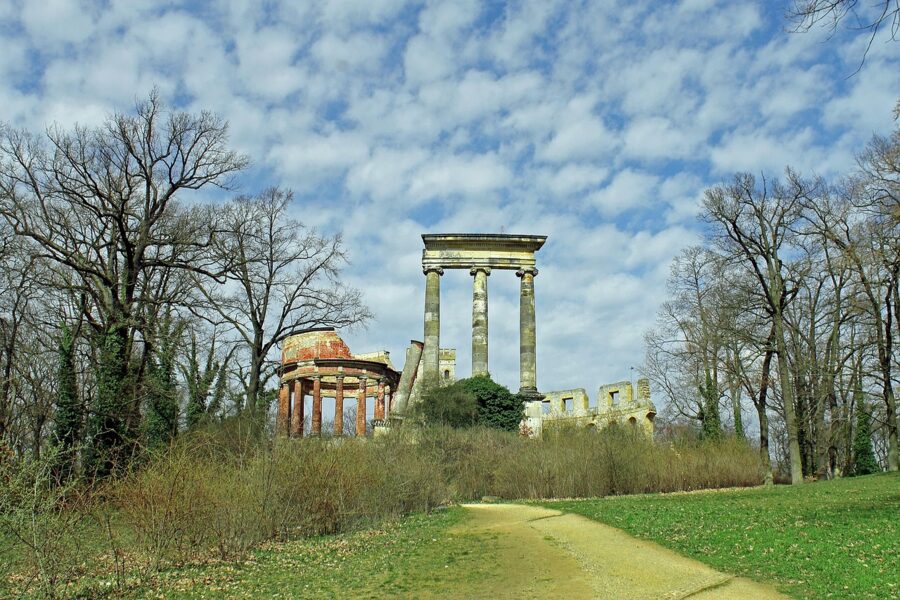
The hill between the palace and the field got its own job. In 1748 Frederick had a reservoir built on top of it to feed the fountains of Sanssouci, and when the pumps failed he dressed it up with fake classical ruins instead. That is the Ruinenberg, and it is still the best way to walk from the palace to the park.
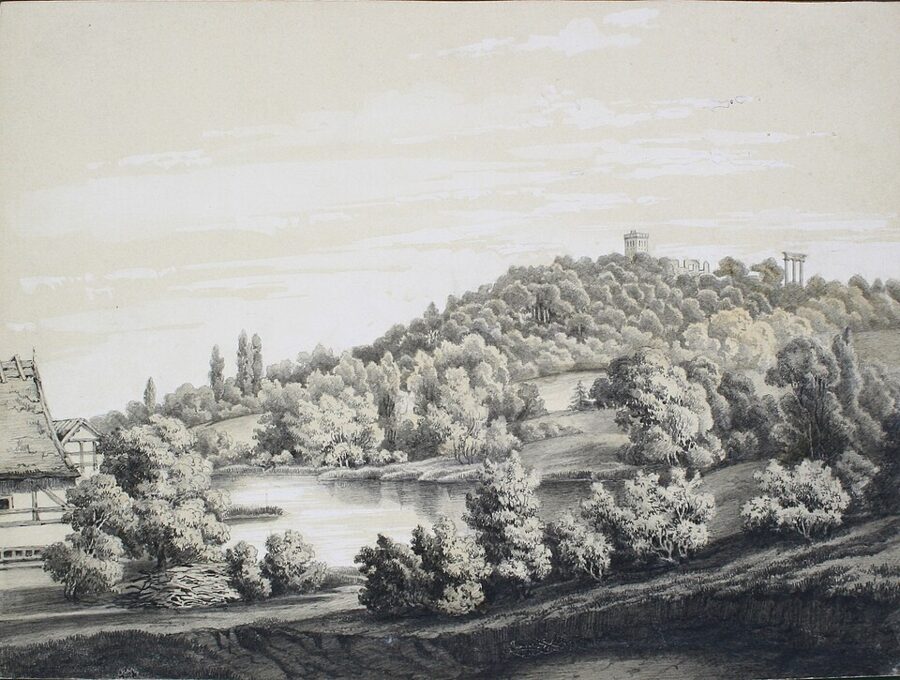
A king who did not want to see soldiers
Frederick William IV (Friedrich Wilhelm IV) had other ideas for the north side of Sanssouci. He wanted a beautiful countryside, not a parade ground, and in 1841–1842 he drew a straight line across the map to separate the farmland from the drill field. The line became a road planted with Canadian poplars, which is why it is still called the Pappelallee, the poplar avenue.
Lenné hedged the fields, bent the new Hamburg road along the Bornstedter See for its views and laid out paths over the hills. A guidebook of the time called the result “a new park, or the Bornstedt field.” The army was pushed back to a riding ground on the Jägerallee, screened by planting from the king’s own road.
It came back as soon as he and Lenné were dead. The barracks of the 3rd Guard Uhlans went up on the Jägerallee in 1867–1868, the 1st Guard Uhlans got theirs on the Königsweg, today’s Voltaireweg, in 1885–1889, and a garrison hospital followed. The land still belonged to the crown and was only leased to the military.
The largest of them stands on the eastern edge of the park. The Rote Kaserne (Red Barracks) was built in 1892–1895 for two regiments of Guard Field Artillery, to designs by the garrison architect Robert Klingelhöffer, in red brick with stepped gables meant to recall the town gates of medieval Brandenburg. The building still carries a piece of their old Berlin home.

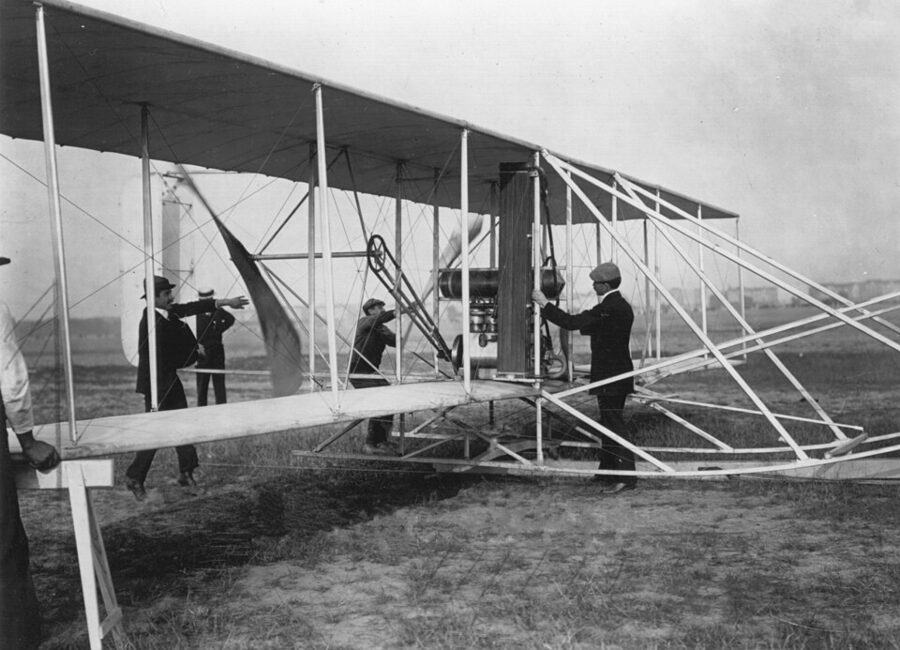
Orville Wright over the Bornstedter Feld
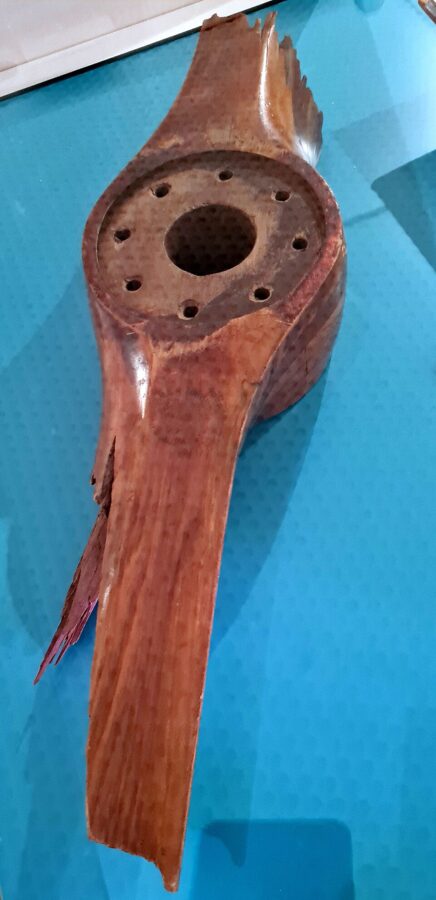
In September 1909 Orville Wright came to Berlin, flew almost daily over Tempelhof Field and set a height record there of 172 m. A few days later he moved his machine to the Bornstedter Feld, climbed to 275 m and trained Paul Engelhard, a retired naval officer, as the first pilot for the German Wright company. Engelhard and Robert Thelen were among the first pupils Wright taught on this field.
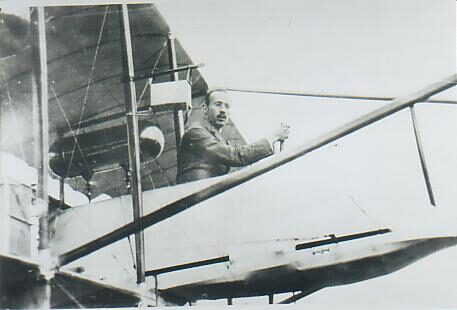
Sources disagree on one famous passenger. German accounts put Crown Prince Wilhelm in the seat beside Wright on the Bornstedter Feld; English ones place the crown prince’s flight at Tempelhof. Either way, for a few years the field was an airfield, and a pastor’s son born in Bornstedt in 1887, Werner Alfred Pietschker, a grandson of Werner von Siemens, used it as a landing ground; he was killed at Johannisthal in November 1911 on the first flight of a monoplane he had built himself.
At the end of the First World War a fighter squadron was stationed on the slope of the Ruinenberg to defend Berlin from the air. After 1918 the Treaty of Versailles shrank the army, the training ground was reduced and the Siedlung Vaterland, a housing estate, went up on the Am Schragen side. Sport fliers used the field, children sledged down the Ruinenberg, and an industrial works in nearby Golm used it as its airfield.

The 1930s barracks on the edges
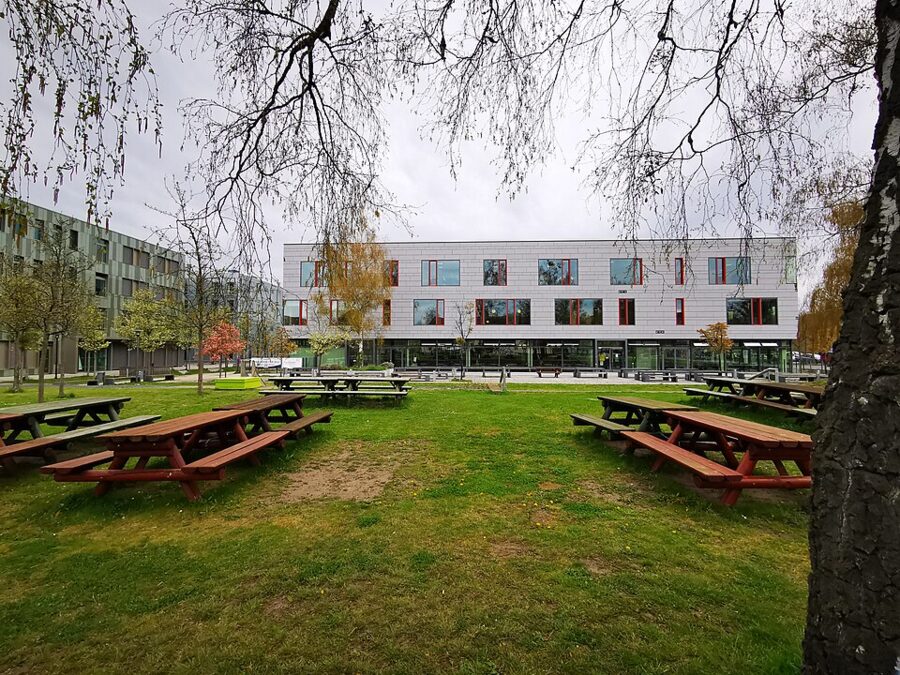
Rearmament brought the army back in force. Between 1934 and 1941 a new barracks for Infantry Regiment 9 rose on the Pappelallee, named the Adolf-Hitler-Kaserne in 1938; it is now the campus of the Fachhochschule Potsdam, the university of applied sciences. The Ludendorff-Kaserne went up on the Nedlitzer Straße, the Hohenlohe-Kaserne south of it in the woods, and a new war school on the Kirschallee.
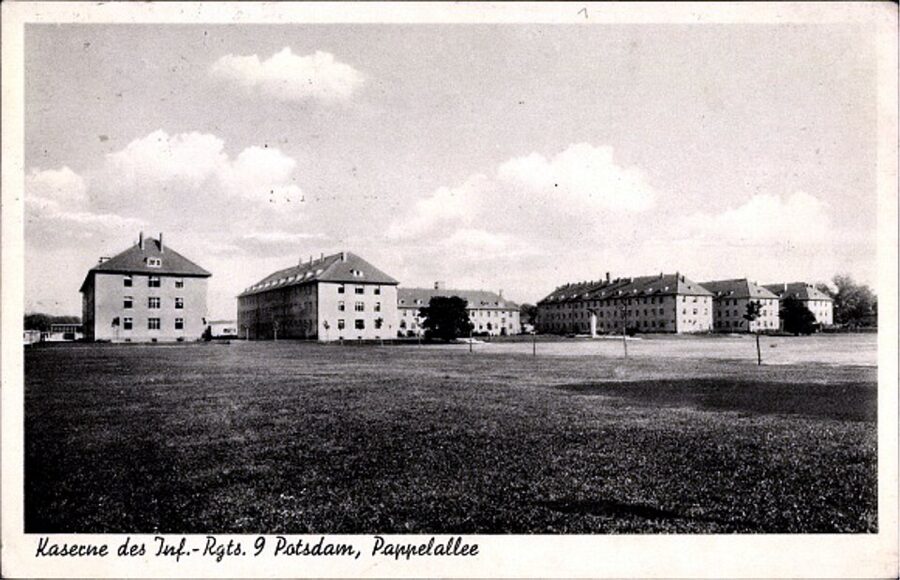

All of them were built on the outer rim of the field, and that was deliberate. Potsdam’s mayor from 1934, Hans Friedrichs, wanted to keep the farmland of the town’s north and refused to let the war school go up directly below the Ruinenberg. Thanks to him the view from the hill north over the open field survived the decade, which is part of why a park could be laid out on it sixty years later.
More than four decades behind a fence
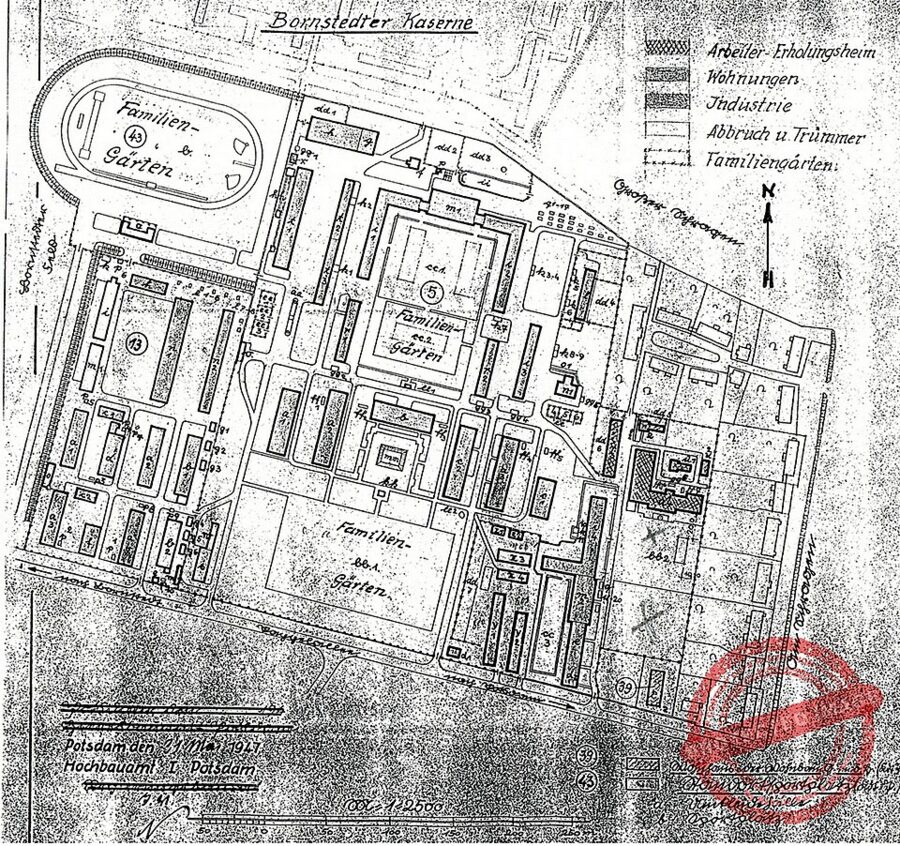
When the war ended in 1945 the barracks stood empty and for two years anyone could walk onto the field. The city’s building department drew up a plan in May 1947 to turn the whole complex into a civilian “military town” of housing and workshops. It never happened.
The Soviet army took over the entire area and fenced the Bornstedter Feld north of the Pappelallee; from then on it was closed to the people of Potsdam. A Soviet tank brigade was stationed here, an artillery division moved into the Rote Kaserne, and the open ground became a training area again. Some of what you see in the park comes straight from the military years: the sunken hollows of the rhododendron grove were tank hideouts, and the long embankments in the middle of the park are former firing ramparts.
One of the artworks commissioned for the garden show marks a spot where, according to the artist’s statement, soldiers practiced killing in hand-to-hand combat. The Bornstedt neighborhood history project, which is putting up a trail of signs through the district, says the remains of a Lenin statue from those years are still in the Waldpark.
The Russian troops left in 1993 and 1994. What they left behind was some 300 hectares of barracks, garages and training ground soaked with fuel, oil and munitions. By the development agency’s own count, about 428,000 tonnes of contaminated soil, household waste, asbestos and roofing felt and 127 tanks were removed before most of the new district could be built, and the ground had to be cleared of munitions first.

From garden show to people’s park
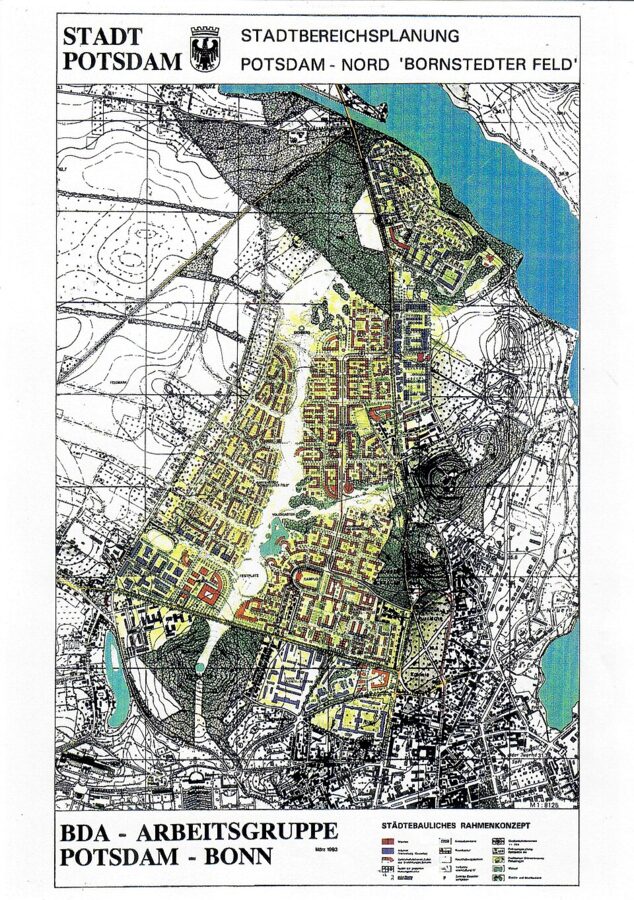
On December 4, 1991, the city decided to build a whole new district on the abandoned military land of the Bornstedter Feld. The framework came from architects in Bonn and Potsdam, the two cities being twinned, and it was adopted in 1993: about 7,000 homes, space for 5,000 jobs, and a continuous green corridor of the character of a Volkspark, a people’s park, to tie the royal gardens to the farmland further northwest.

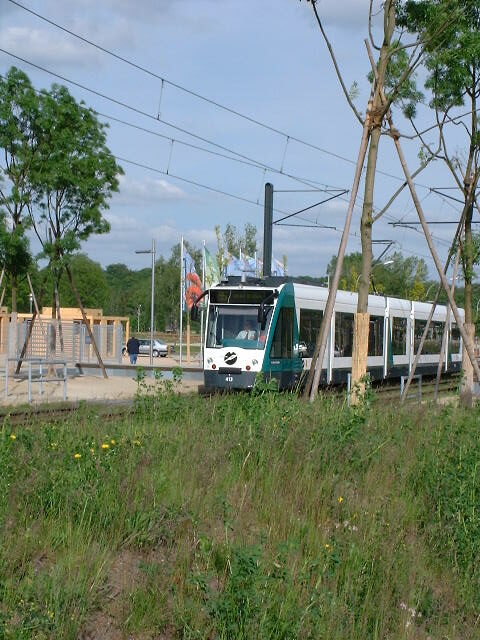
The park came first because Potsdam had won the federal garden show, the Bundesgartenschau or BUGA, for 2001. Chancellor Gerhard Schröder opened it on April 20, 2001, and the gates were open to the public from the next day until October 7. The theme was “garden art between yesterday and tomorrow,” a pointed choice in a city of royal parks, and the main ground on the Bornstedter Feld covered 73 hectares. More than two million people came, and trams were extended up the new avenues to carry them.
The designers kept what they found. Instead of leveling the ground they rebuilt the military embankments, the Wälle, as grassed ramparts, kept as many of the old trees as they could and planted about 2,200 new ones between 1998 and 2000. Eight footbridges of steel with timber decks, 2.5 m wide and spanning up to 50 m, link the tops of the ramparts so you can cross the park at the height of the old firing banks; they were finished in late summer 2000, and the whole “In den Wällen” section cost about 23 million Deutschmarks.
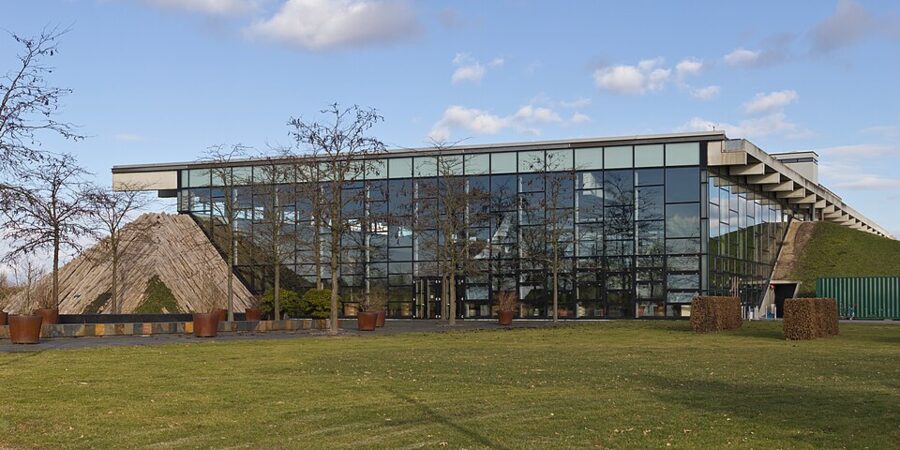
The art followed the same idea. Six projects were commissioned under the theme “the art of camouflage and exposure,” all of them about what the ground had been used for, and four were built to stay. The show’s flower hall was a long glass box set between the ramparts, and after the show it was rebuilt as a tropical hall. That is the Biosphäre, which reopened in 2002 as a rainforest hall.

Twenty-five years of the BUGA-Park
After the show the grounds reopened under the name Volkspark Potsdam from 2003, though most Potsdamers still say BUGA-Park, and the city’s direction signs for drivers and cyclists still point to it that way. The park was meant from the start to stay open for the people moving into the new district, and they came: the Bornstedter Feld had about 14,500 residents in 2022. According to the park’s 2026 program booklet, 94 percent of them called the park important or indispensable and seven in ten said they use it every week.
Outsiders come too. The park counted about 400,000 visits a year in 2014, when the German garden show society gave it a prize for sustainable park management, and about 425,000 in 2026. Most of the changes since 2001 have been about use rather than display: a minigolf course in 2011, a 15-hole disc golf course, a small artificial-turf pitch in 2020, a school garden in 2019, more beach volleyball courts, a rebuilt skate park in 2026 and new toilets at the main gate.
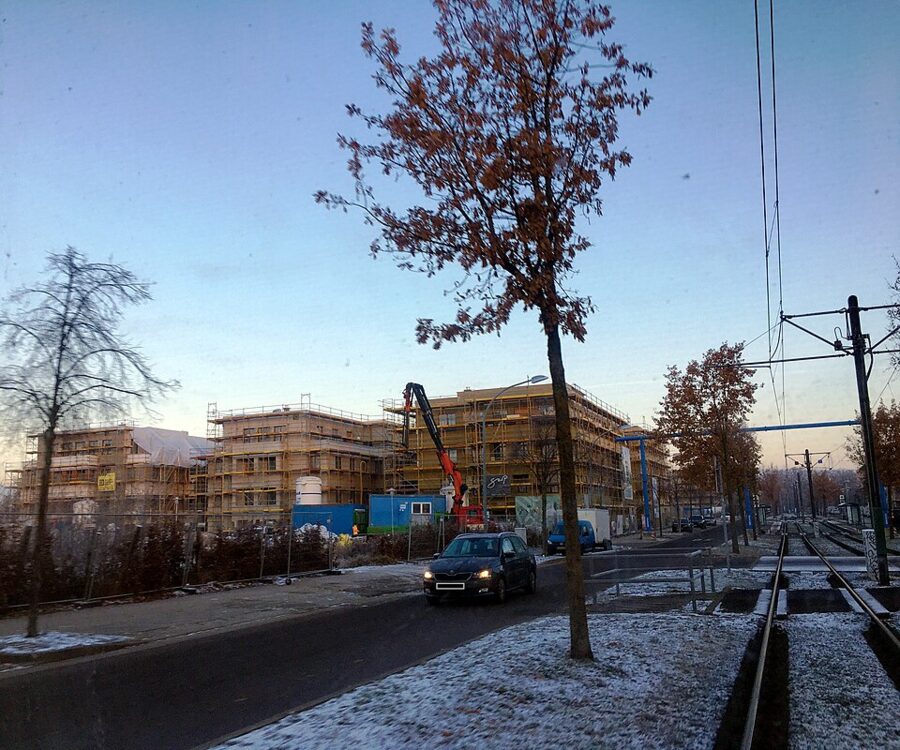

The park has also got smaller. The show ground was 73 hectares; the development agency now gives the park as about 60. Five building plots were carved out of the park grounds, blocks such as the 66 apartments at Rote Kaserne West went up right against its edge, and in late 2019 work began on a new entrance with seating on the Hermann-Kasack-Straße, to make up for the ground the park was losing. Residents petitioned against further building in 2020, and the argument has not gone away.
So has the entrance fee, which no other big park in Potsdam charges. On March 1, 2023, the city council voted to make the park free “for the new season”; the operator pointed out that a park open all year has no season and kept charging, and the fee is still in place in 2026. It is small, and the operator argues that it pays for a level of care, toilets and play equipment that the free parks do not try to match.
Walking the park, part by part
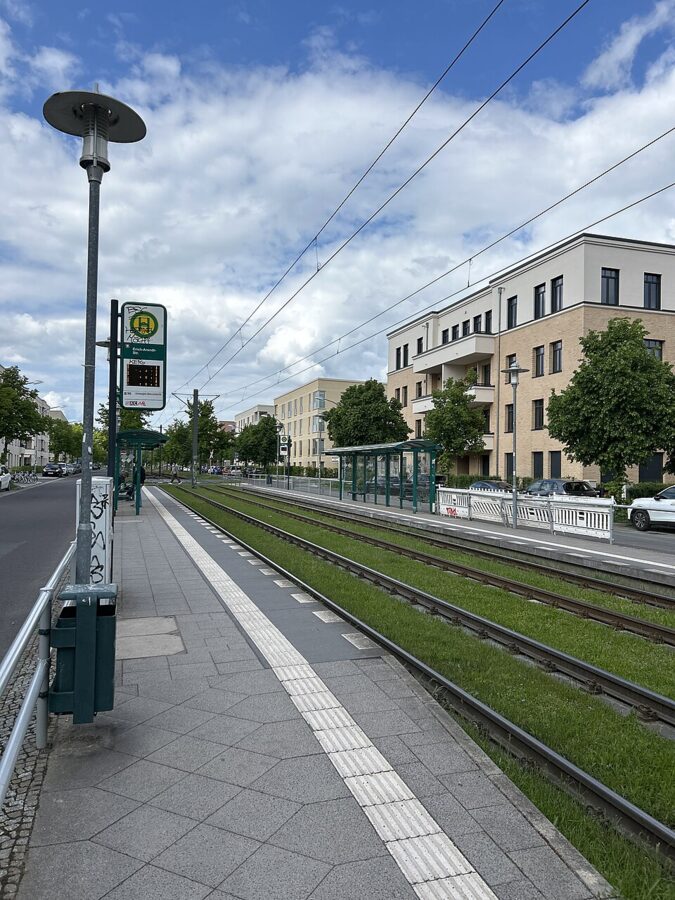
The park divides into five areas, and the names are on the signposts: In den Wällen in the middle, the Großer and Kleiner Wiesenpark (big and small meadow park), the Waldpark (wood park) around the old oaks of the Schragen and the Remisenpark in the north around the old game copse. A 4 km asphalt loop runs around the whole thing, and with 25 entrances you can start almost anywhere. The main gate is on the Georg-Hermann-Allee, opposite the Volkspark tram stop.
In den Wällen: roses, ramparts and the pyramid gardens
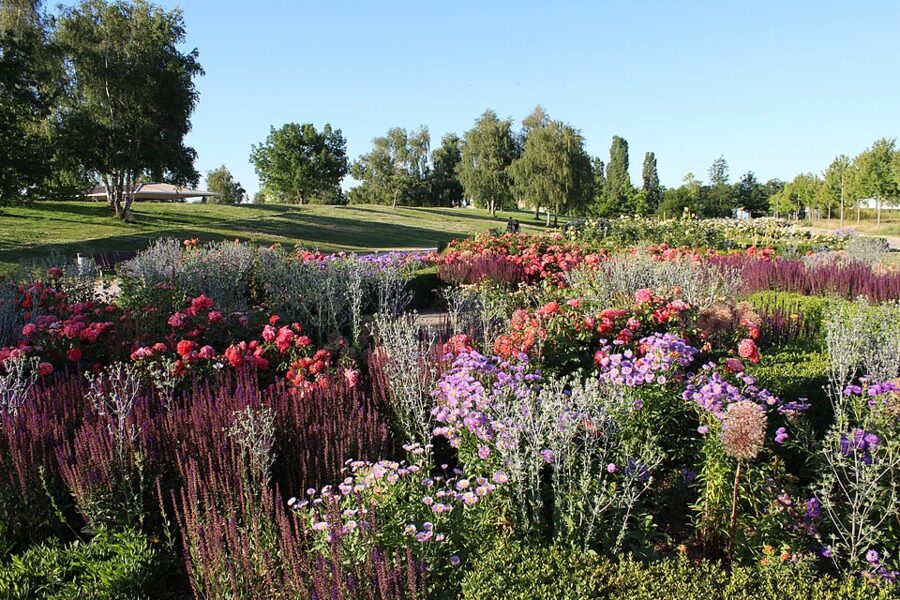
The main gate opens onto the rose garden: more than 6,000 roses in over 100 varieties, planted by color in nine giant rose-flower shapes edged with low box hedges. From there the paths climb onto the ramparts and the bridges, and the park reads like a map below you. In June the sage-covered banks turn purple; in July the lavender rampart flowers; in October the Virginia creeper on the slopes turns red.
Between the ramparts lie the themed gardens. The Pyramidengärten (pyramid gardens) are 52 dry-stone sculptures of shell limestone set at an angle in the grass, planted with gray and silver perennials and grasses, most of them from the Mediterranean. The Irisgraben (iris ditch) at the lowest point of the park starts the year with daffodils and bergenias and fills with irises in summer.
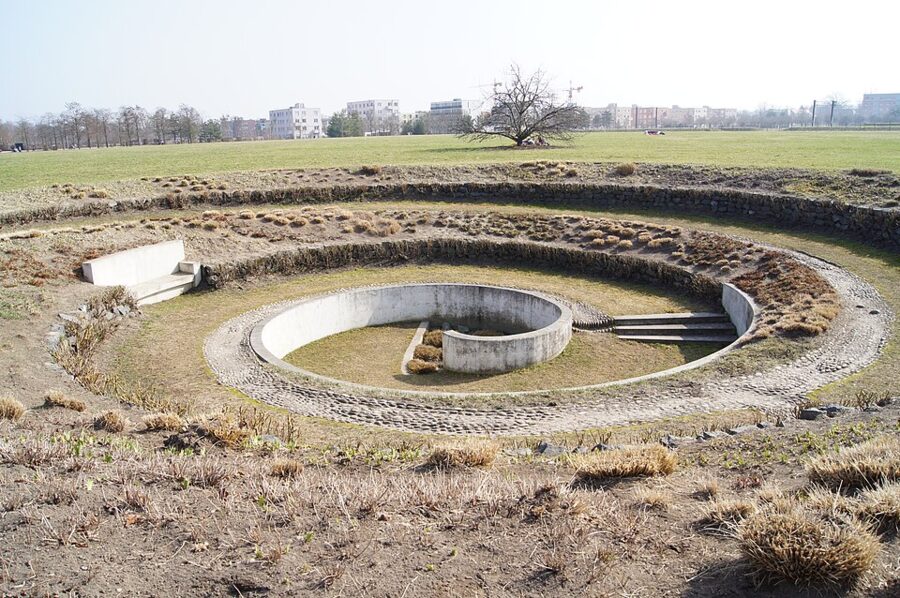

The central rampart is the Veranstaltungswall, the event rampart, with a lawn pitch, three streetball hoops (one at child height) and a colored court under a roof that you can play on in the rain. Where the ramparts cross, at the Wallkreuz, there is a shallow pond with bubbling water jets and seating under big oaks. A small Asian food stall works there in the season.
The meadows
The Großer Wiesenpark is the big open lawn beside the ramparts and the stage for almost every big event, from the Easter bonfire to the kite festival. Mown grass is for sitting, lying and playing on; the long meadow grass is not. The park’s five beach volleyball courts are in this part, and there is a small artificial-turf pitch in the Kleiner Wiesenpark that has been playable all year since 2020.
On a weekday morning in spring you can have most of it to yourself, and the kite festival is held here for a reason. On a hot Sunday in July it is a picnic field. I would plan around that: come early if you want the space, come late afternoon if you want the atmosphere.
The Waldpark: old oaks, rhododendrons and a slide tower
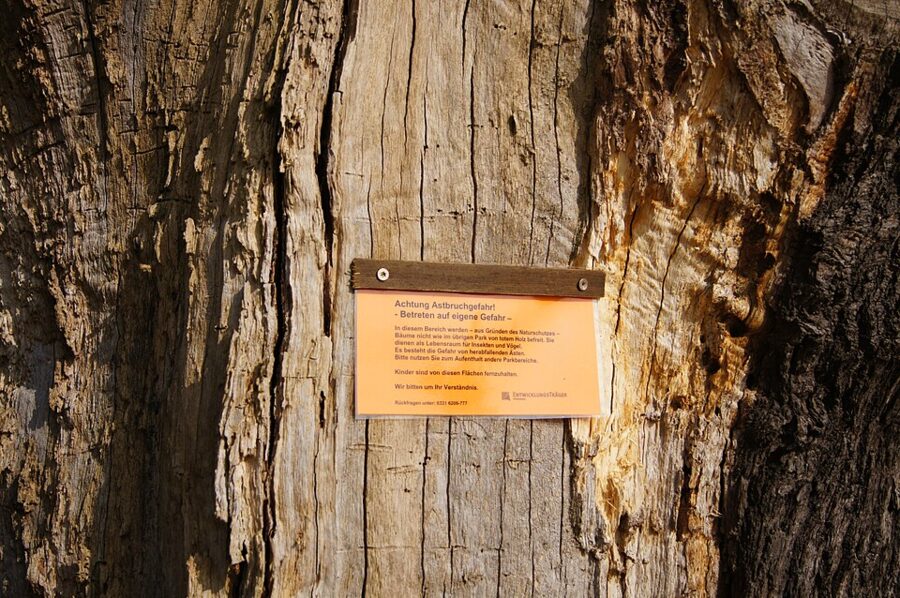
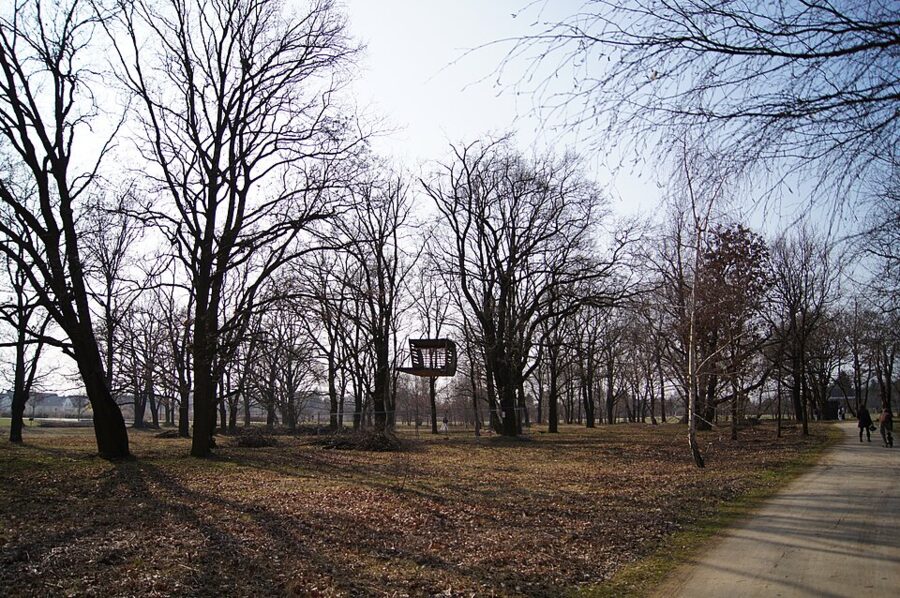
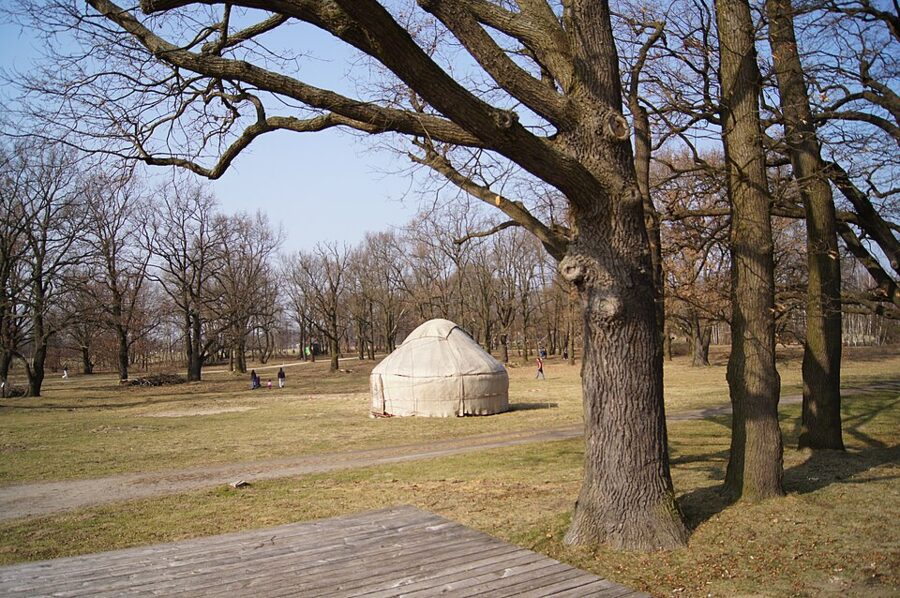
Beyond the ramparts the planting gives way to old trees. In three fenced “wild islands” nature is left to itself; the area has been leased by the conservation group BUND for an indefinite period, and the edges are marked by hedges of stacked trunks and dead wood. Away from the main paths the park makes no promise about falling branches, which is the price of keeping the dead wood that beetles and birds live in.
This is where the rhododendron grove flowers in May, in its old tank hollows. It is also where most of the climbing is. The rustic ZickZack playground spreads under old oaks with a little grotto, a herd of wooden horses and a nest swing big enough for a family; a five-meter horseshoe-shaped bouldering wall wraps around a sand pitch for barefoot football; four trampolines sit in the southern part; and a 12 m tower sends tube slides out like the arms of an octopus, with a roped climbing wall on its back.
Two patches of old oak, the Großer Schragen and the Viereckremise, each about 4 hectares, are protected under the European habitats directive for the great capricorn beetle, which lives in old oaks. The Großer Schragen was largely fenced in 2016 so that young oaks can grow up undisturbed. You will see the fences; that is what they are for.

The Remisenpark: orchard, bees and disc golf
The northern part of the park is wrapped around the Viereckremise, Frederick’s square game copse. Next to it is an orchard of tall fruit trees planted in 2000, 120 at the start and 115 now, in 33 varieties chosen for being rare or old; most carry a small sign with the name of the variety. In spring they flower, from May the meadow around them is sown in colored strips, and in autumn you can taste the fruit.

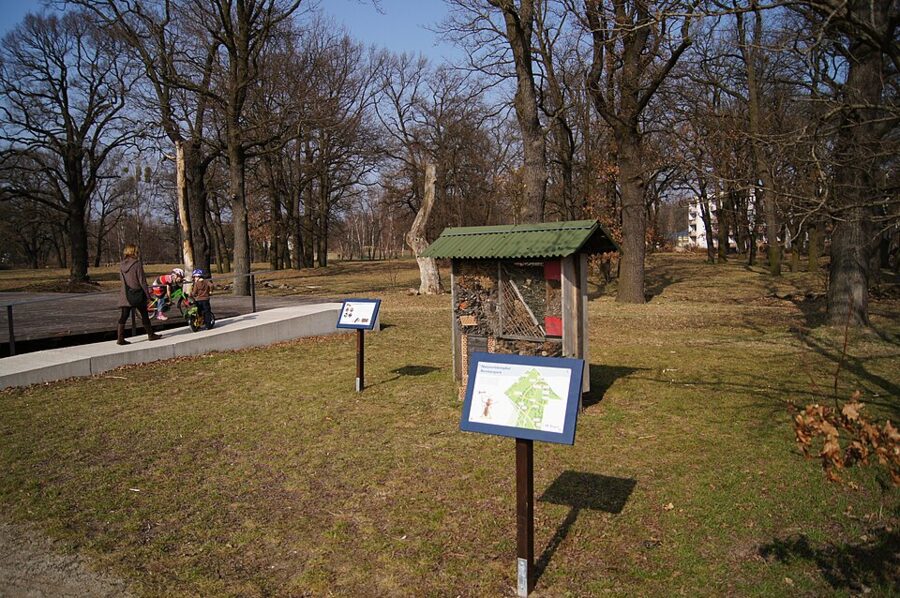
In 2024 the park counted eight bee colonies by the orchard, and in 2023 the gardeners built a “bee bank” at its edge, a low mound of earth and logs from felled trees that looks like nothing much and houses wild bees and ground beetles. The school garden, the Wilde Möhre (wild carrot), was replanted in the winter of 2019 for children to garden in under supervision, and the green classroom runs lessons for school groups through the year.
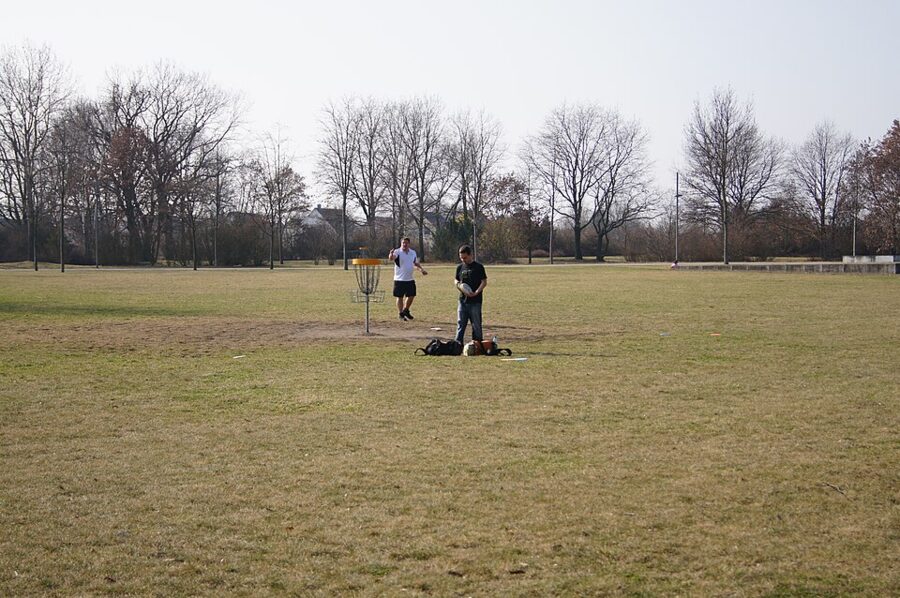
The disc golf course has 15 holes through the north of the park, laid out on the initiative of the local club, the Hyzernauts. You can play without booking during opening hours, signs at the start explain the rules, and you can rent discs at the information pavilion by the main gate. There is also a kickabout pitch with two goals at the north end of the Remisenpark.


The water playground and the other play areas
The summer magnet is the water playground: a 900 square meter pool with wooden rafts, a fine sand “beach,” fish that spit water, a lighthouse, a fisherman’s hut and a lawn for the parents. It is drained for the frost season and refilled in spring, so do not plan on it between late autumn and the end of the frosts. The café “das haus im park” sits right beside it.
For the youngest children the playground in the Nedlitzer Holz has a big sand area; table tennis tables stand there, in the sports rampart and near the water playground, with a teqball table as well. The minigolf and pit-pat course (a mix of minigolf and billiards) opened in 2011, and the season runs from late March to the end of October. The rebuilt skate park in the sports rampart opened in spring 2026 and welcomes “every vehicle,” as the operator puts it: skateboard, BMX, inline skates, scooter or wheelchair.

The art from 2001
Four of the garden show’s art projects are still in the park, and they are worth hunting down because they are the only things here that talk about the past. Igor Sacharow-Ross’s “Der Zaun” (The Fence) encloses a garden on a spot where Soviet soldiers trained for hand-to-hand combat, handing the ground back to nature behind a fence. Fritz Balthaus put a large letter K, the map symbol for art, on a plinth in the landscape, so the sign and the thing it marks are the same object.
The art group Inges Idee built a basketball court that rises and falls with the ground; it is fully playable, which is rather the point. Annette Wehrmann gutted an old watchtower and lined it with mirrors, so a building made for looking out now shows you only yourself. You can borrow the key at weekends in the summer season from the information pavilion at the main gate, against a deposit. Of the four, the tower is the one I would make the effort for.
The Biosphäre on the edge of the park
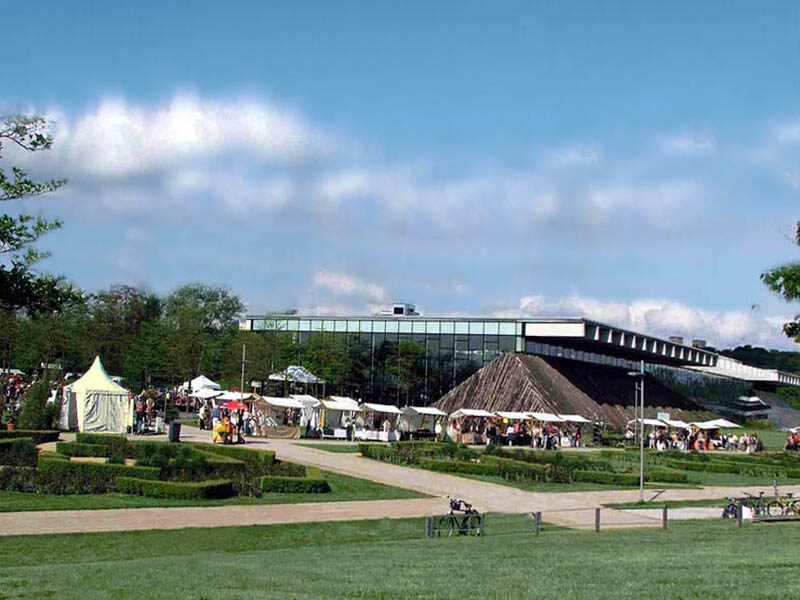
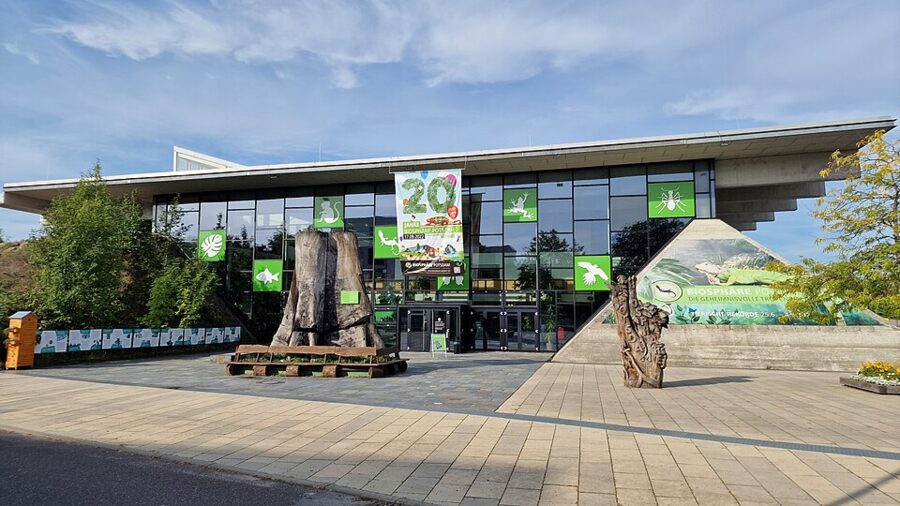
The long glass hall by the main gate is the Biosphäre, the garden show’s flower hall turned into an indoor rainforest of about 20,000 tropical plants with a butterfly house and an aquarium wing. It is run as a separate attraction with its own ticket and its own opening hours, and it is the best wet-weather fallback in this part of town. If you want both on the same day, the combined day ticket for park and hall costs €21 and is sold only at the park’s information pavilion and at the Biosphäre itself.

Admission, hours and the rules
The gates of the fenced park are open every day of the year from 05:00 to 23:00, with changes for events and closures in storms, ice or heavy snow. The night quiet starts at 22:00. Adults pay; a great many people do not. Entry is free for everyone under 18, for school pupils over 18 and students, for people doing a voluntary social or ecological service, for people receiving benefits under the German social code, and for people with a disability rating of 50 percent or more; carry proof.
According to the operator’s admission page, a day ticket costs €1.50 in the summer tariff (March 1 to November 30) and €0.50 in the winter tariff (December 1 to the end of February). There is also a voluntary “Lieblingspark” (favorite park) day ticket at €3 for anyone who wants to pay more. Annual cards cost €19 (€13 reduced), a Lieblingspark annual card at €30 adds free entry to the kite festival and the autumn festival, and a combined annual card for park and Biosphäre costs €79.
Tickets come from machines at most entrances; the ones at the main gate, by the café, at the southern entrance on the Kiepenheuerallee and at the Remisenpark entrance on the Georg-Hermann-Allee take coins, and the machines at the main gate and by the café also take cards. You can buy a day ticket in the MoBiLET app too. If you only want to cross the park, the machines issue a free short-term transit ticket, valid for the shortest route within the time printed on it.

The information pavilion, rentals and toilets
The information pavilion at the main gate is the park’s front desk, lost-property office and rental shop. It opens at weekends from 13:00 to 17:00 in March; from April to September on weekdays 14:00–18:00 and at weekends and on holidays 12:00–18:00; in October on weekdays 13:00–16:00 and at weekends 12:00–16:00. From early November to the end of February it is closed.
Rentals are priced for up to three hours or longer: a handcart €3 or €5, a set of disc golf discs €3 or €5, a ball €1.50 or €3, table tennis bats €2 or €4, a boules set or a skateboard €3 or €5. A pedal go-kart costs €3 for one hour only and cannot be reserved. The pavilion also sells ice cream, cold drinks and snacks.
There are seven toilet blocks. Two stay open all year, in the Veranstaltungswall and at the Stadtplatz in the Remisenpark, and both are accessible, as is the new block at the main gate. The other five are shut from about mid-November to early March because they are not frost-proof. The park describes itself as largely barrier-free, and the paved loop makes most of it workable with a wheelchair or a stroller.
Dogs, bikes and barbecues
The park’s FAQ settles the common questions. Dogs are welcome on a leash, though usually not at events. Bikes, inline skates, skateboards and e-scooters may use the paved paths and squares at your own risk, except the paths on and along the ramparts. In the royal parks cycling is mostly banned, so this is the big park in Potsdam to ride through rather than around.
Barbecues are not allowed anywhere in the park, and open fires carry a €25 fee on the spot. The park rules also ban glass bottles outside the cafés, drones, camping and sleeping in the park; music is fine as long as nobody else has to listen. Children under six must be with an adult.
Eating in the park
The café “das haus im park” by the water playground is the main place to eat, with homemade cake, fresh waffles, coffee from a Potsdam roaster, soft ice cream, fries, burgers and pizza. It opens daily in the main season and only at weekends in November, January and February, and it closes for December; the operator’s two pages give slightly different hours, so check the day before. The Dorf Potsdam beer garden just inside the main gate now opens all year, from Thursday to Sunday at least, from 16:00 on Thursdays and Fridays and from 12:00 on Sundays, and the Wok King stall in the Wallkreuz serves Asian food from February to November, closed on Mondays.
The minigolf kiosk sells coffee, ice cream and drinks between Easter and the autumn school holidays. For a proper meal before or after, the restaurants of central Potsdam are about ten minutes south by tram.
Events through the year
The park runs close to 60 events a season, and the operator publishes them in a program booklet each year in mid-March and in its online calendar. The 2027 dates had not been published by late November 2026, so the dates below are the 2026 ones; the pattern has been steady for years, and most events cost only the normal park admission.
The year starts in February with the charity “Eisgolfen,” ice golf, on the disc golf course; in 2026 it was the 19th edition, and players could buy a second try at a bad throw for €1, the money going to a youth project. On Easter Saturday the Easter bonfire on the Großer Wiesenpark is lit at about 17:30 with the volunteer fire brigade of Bornstedt, and children bake bread on sticks over the embers. The season opens on May 1 with the Potsdam fanfare band.
At Pentecost the Ritterfest, the knights’ festival, takes over the big meadow for three days with jousting, a medieval market, tightrope walkers and a fire show; the 20th edition in 2026 ran from May 23 to 25, at €9 for adults and €4 for children aged 7–16. The children’s flea market fills 120 stalls from the main gate to the Wallkreuz on three Saturdays, in 2026 on May 9, July 4 and August 29. In June runners do laps of the 2.5 km circuit in the Preußische Meile, and in July the family book picnic takes over the meadow.
September is the busiest month. The Potsdam environment festival, with about 100 exhibitors on climate, food and transport, was on September 13 in 2026, and the 37th international kite festival filled the sky on September 26 and 27 with stunt kites flying to music, at €7 for adults, €3.50 for children aged 5–17 and €15 for a family. On the first weekend of October the apple festival brings fruit experts and old apple varieties to taste, with a medieval market next door; in mid-October you can dig up dahlia tubers from the park’s own beds; and the autumn festival in 2026 was on October 18, at €6 for adults and €14 for a family.
The last big evening is St. Martin’s Day, November 11, when St. Martin rides in on horseback at 17:00 and leads a lantern parade through the dark park, ending at a campfire. In the jubilee year of 2026 there were small monthly surprises on the 25th; a “Party im Park” planned for June 27 was called off because of the heat, and another went ahead on August 29.
Getting to the Volkspark
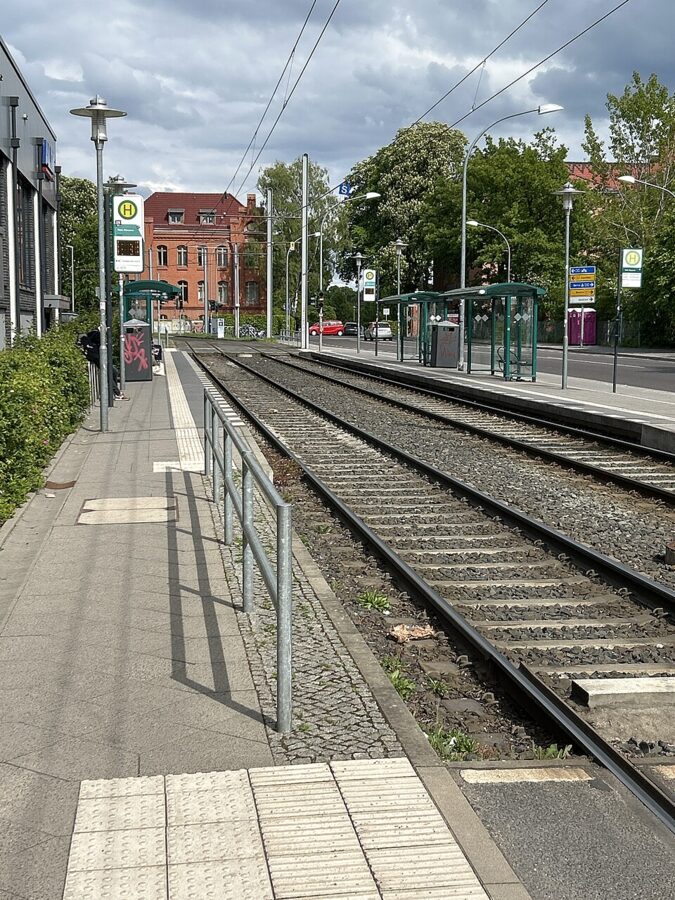
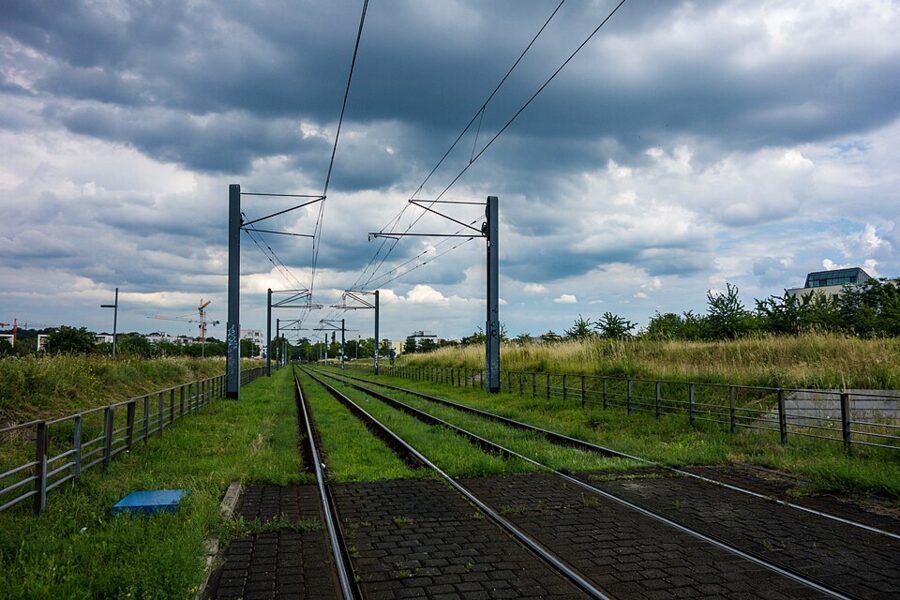
The park is a tram ride from the station and needs no planning beyond that. From Potsdam Hauptbahnhof, the main station, take tram 96 toward Campus Jungfernsee to the stop Volkspark, opposite the main gate and the Biosphäre; the ride takes about 15 minutes. The 96 also stops at Erich-Arendt-Straße for the orchard and the disc golf course and at Rote Kaserne for the eastern side. The operator’s timetable note has it running every ten minutes on weekdays from about 05:30 to 20:30.
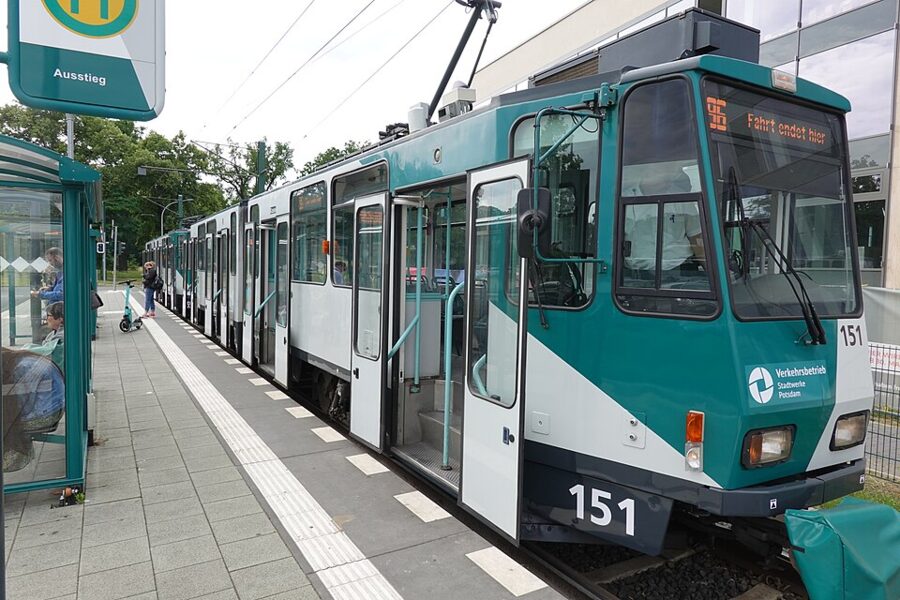

Tram 92 toward Kirschallee runs along the south and west of the park, with stops at Campus Fachhochschule, Wiesenpark and Hannes-Meyer-Straße, and it is the line to take for Bornstedt. Buses 604 and 697 stop at Am Pfingstberg and Rote Kaserne/Nedlitzer Straße on the eastern side, and the night bus N17 stops at Volkspark.
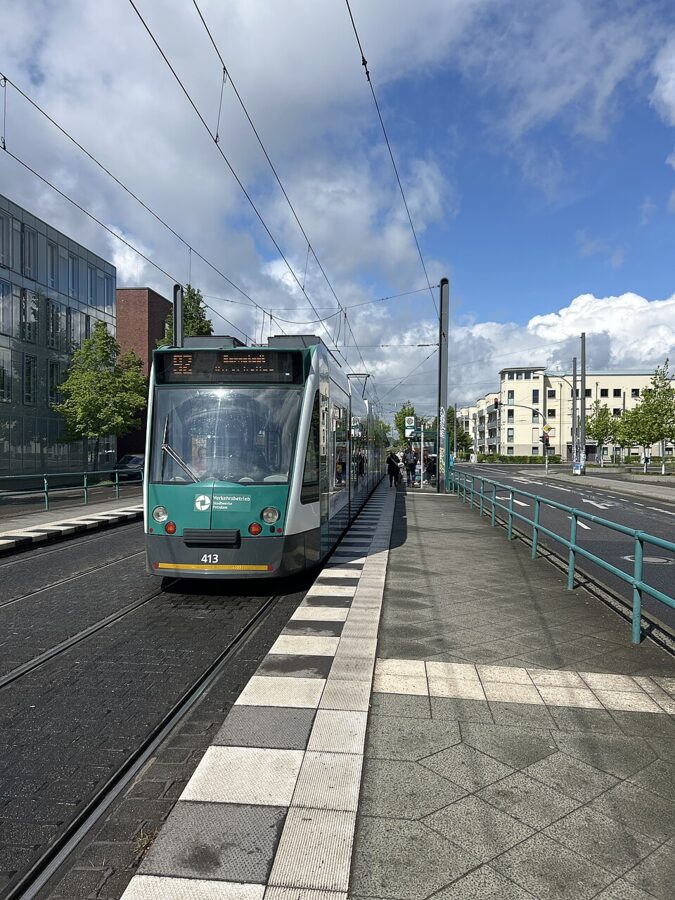

Inside the city a single ticket Potsdam AB covers the ride and costs €3.00 in 2026 and €3.10 from January 1, 2027. If you come from Berlin, the single ticket Berlin ABC covers the whole trip at €5.00, rising to €5.20 from January 1, 2027, and the 24-hour ticket Berlin ABC costs €12.90, then €13.20; the Deutschlandticket is valid too. The trains from Berlin are in the guide to a Potsdam day trip from Berlin.
By bike, follow the signposted routes marked “BUGA-Park” from the city center. By car, follow the same signs to the car park at Georg-Hermann-Allee 101, with almost 160 spaces at €3 for the first two hours, €1.50 for each hour after that and €8 for the day. On festival days the car park fills fast and the operator itself asks people to come by tram or bike.
Bornstedt, the Krongut and Sanssouci next door
The Volkspark is the least historic garden in Potsdam and it is surrounded by some of the most historic ones, which is what makes it useful. Three short walks start at its edges, and any of them turns a park afternoon into a full day.
South over the Ruinenberg to Sanssouci
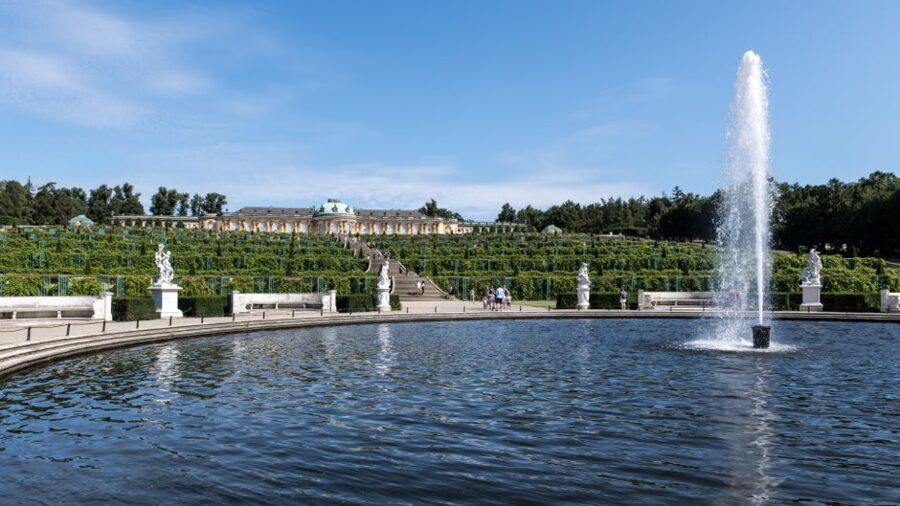
Leave by the southern entrances and cross the Pappelallee, Frederick William IV’s dividing line, and you are at the foot of the Ruinenberg, about half a kilometer from the park’s southwest corner. Climb to the reservoir with its fake columns, round temple and theater wall, then walk down the avenue on the far side. Sanssouci Palace (Schloss Sanssouci) is a little over a kilometer from the park edge, and you reach it from the north, through the forecourt behind its colonnades.
On the way you pass close to the Historic Mill next to the palace. If you are doing the palaces properly, start at Sanssouci in the morning and come up to the Volkspark after lunch; the terraces are best before the crowds, and the park is at its liveliest in the afternoon.
Southwest to Bornstedt and the Krongut
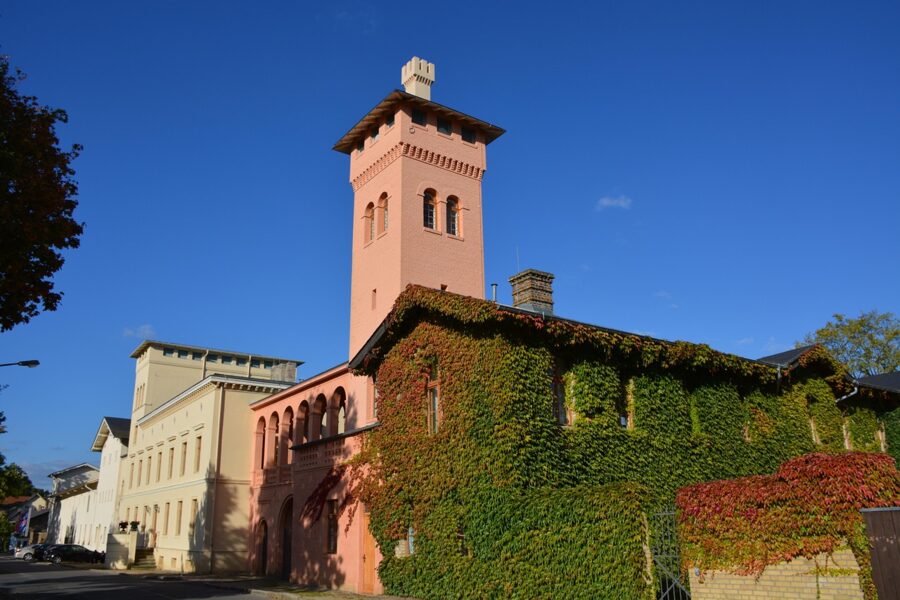
The old village of Bornstedt sits on its lake southwest of the park, under a kilometer from the park as the crow flies, or two stops on tram 92 to the Kirschallee terminus. Frederick William IV gave it an Italian look, and the Krongut Bornstedt, the old crown estate with its tower and Italianate buildings, is the heart of it.
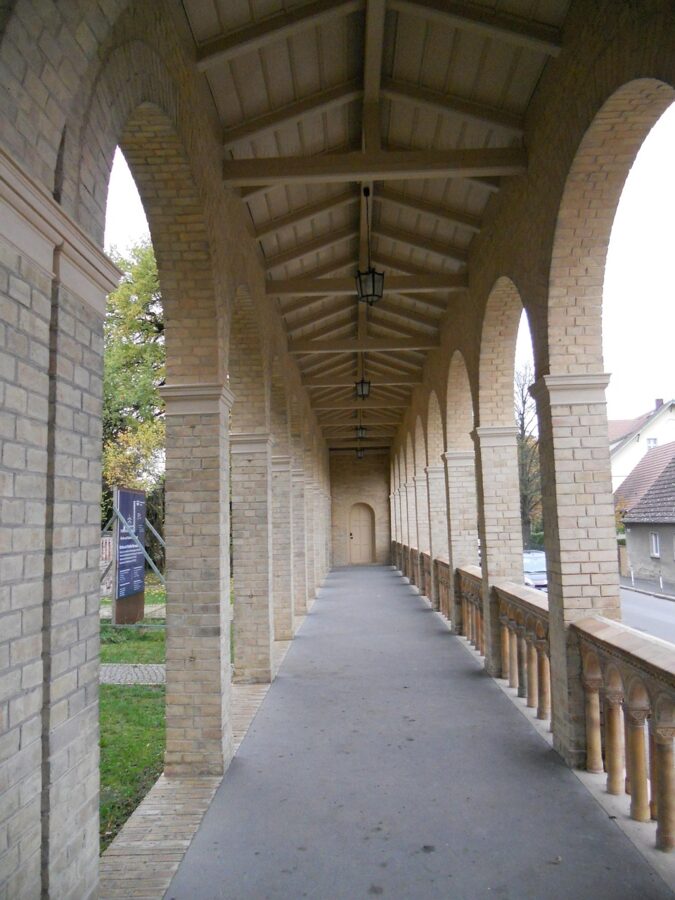
A short walk along the Ribbeckstraße is the Bornstedt church with its arcade and campanile, and behind it the Bornstedter Friedhof, the village cemetery where Lenné is buried along with generations of royal gardeners and architects. It is the right place to end a walk that began on ground he once tried to make beautiful.
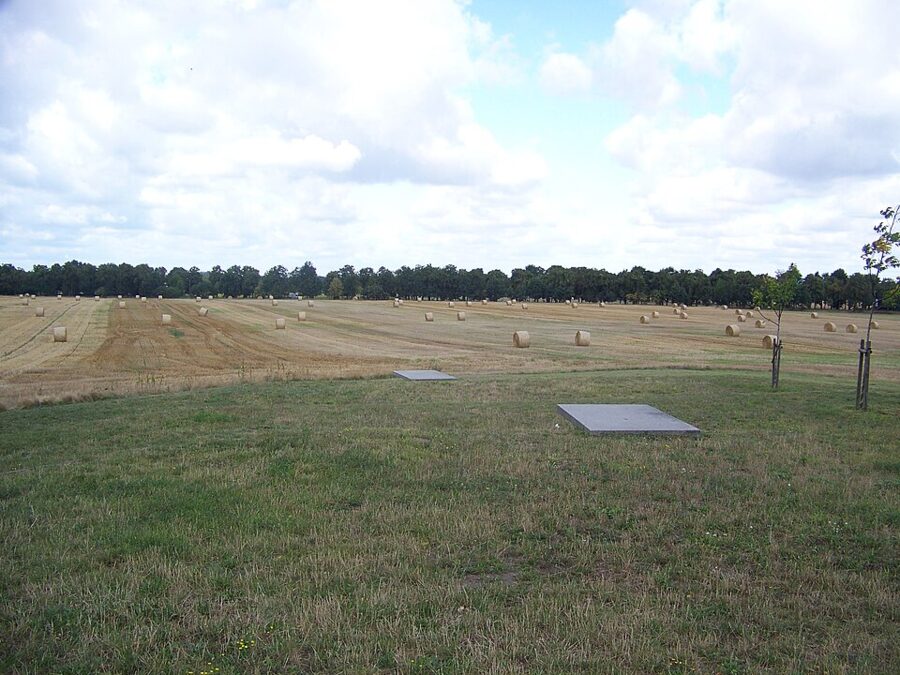
West of Bornstedt and the park the Bornstedter Feldflur, the farmland Lenné hedged in the 1840s, is still open country, and the park plans of the 1990s were drawn to connect the royal gardens to it. It is a good last stretch on a summer evening, when the hay is in.

East to the Pfingstberg and Alexandrowka
On the eastern side the bus stop Am Pfingstberg is about 400 m from the Biosphäre, and the hill rises behind it. The Belvedere on the Pfingstberg gives you the view the old field never had, over the whole city and its lakes. Below it lies Alexandrowka, the Russian colony of wooden houses, on the way back toward the old town.
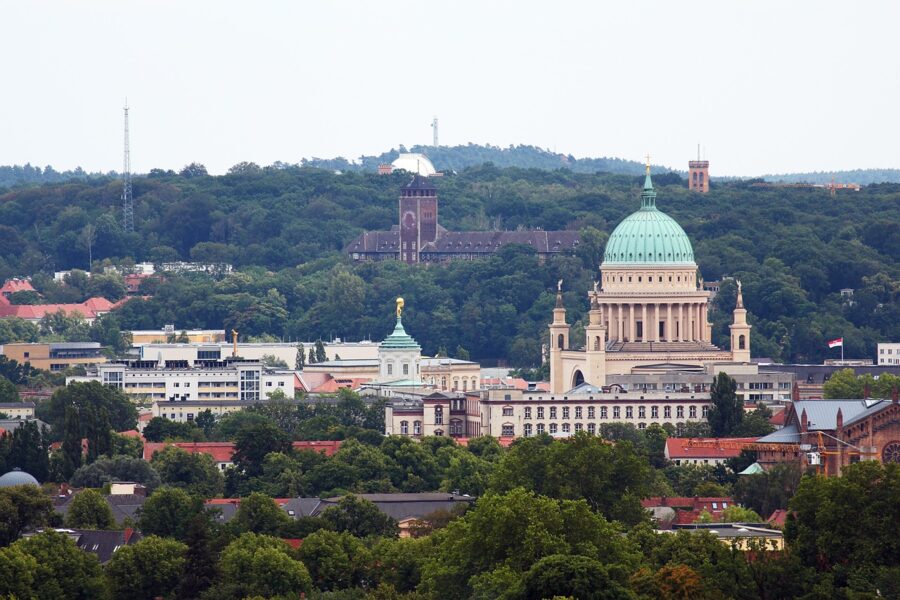
For everything else in town, the full list of things to do in Potsdam picks up where this walk ends, and if you are traveling with children, the guide to Potsdam with kids puts the Volkspark together with the other easy wins. For when to come, the guide on the best time to visit Potsdam has the seasons; for this park I would pick May, when the rhododendrons flower.
Go back to the Waldpark on your way out. The hollows the tanks hid in are full of rhododendrons, the old firing ramparts are covered in sage and lavender, and the copse Frederick planted for his game is the oldest wood in the park. Tram 96 leaves from the main gate every ten minutes on weekdays, and the gates stay open until 23:00.