

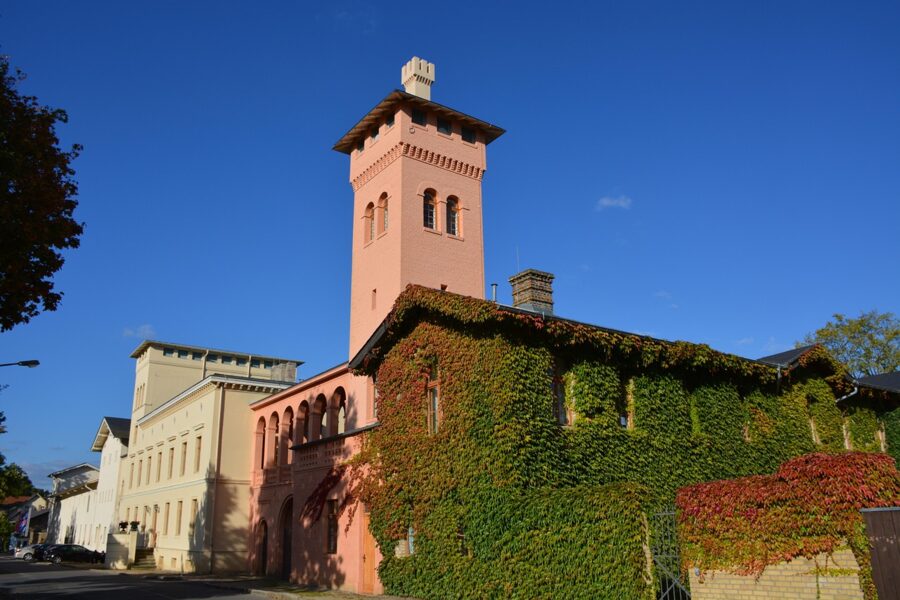
Walk 400 meters north from the top terrace of Sanssouci Palace, past the windmill and up a lane called An der Orangerie, and a brick bell tower 34 meters tall rises over a village street. Behind its arcade lies a country churchyard where the men who planted and built the royal park are buried in their own walled garden. Across the road, behind a pink arched gateway, stands the farm that fed the palace.
That is Bornstedt in one view. The village is older than Potsdam’s palaces by five centuries, and the kings who built Sanssouci on its fields kept coming back to it: Frederick William IV (Friedrich Wilhelm IV) dressed it as an Italian village after a fire in 1846, his nephew the crown prince and his English wife turned the estate into a model farm, and the court’s gardeners and architects chose its cemetery for their graves. Theodor Fontane, who walked through in 1869, summed it up: “What dies in Sanssouci is buried in Bornstedt.”
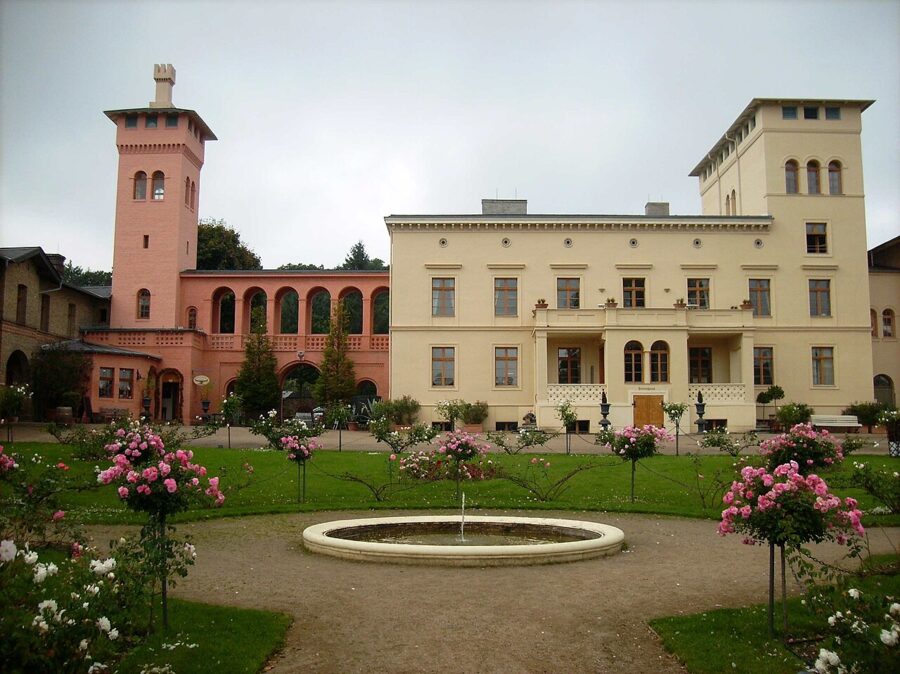

The Krongut Bornstedt, the crown estate, is the part most people come for, and it is the part with the shortest opening hours: a café-brasserie runs on weekends, the brewery restaurant is closed for now, and the courtyard fills up mainly for markets and weddings. The church and the cemetery are the better reason to make the walk. I’d come on a weekend afternoon, when volunteers open the church from 14:00 to 17:00, and give the whole village an hour and a half on the way out of Park Sanssouci.

Contents8 parts
A village older than the palaces
Bornstedt was probably founded in the late twelfth century, between about 1160 and 1200, and it appears in the records in 1304. Charles IV’s land register of 1375 lists “Bornstede” among the villages on the island of Potsdam, with farms held by two old Brandenburg noble families, the von der Groebens and the von Ribbecks. Nobody agrees on the name: a Slavic forest spirit, a sandy landscape of birch and pine, or a family from the county of Mansfeld are all proposed.
What matters as you walk around is how much land the village once owned. Its fields ran south to the ditch at the foot of the moraine ridge where Sanssouci Palace, the Orangery Palace and the Belvedere stand, so most of the park you have just walked through was cut out of Bornstedt farmland. The Great Elector (Friedrich Wilhelm, the Elector of Brandenburg) bought the manor in 1664, and Frederick William I gave it to the Great Military Orphanage in Potsdam as a source of income.
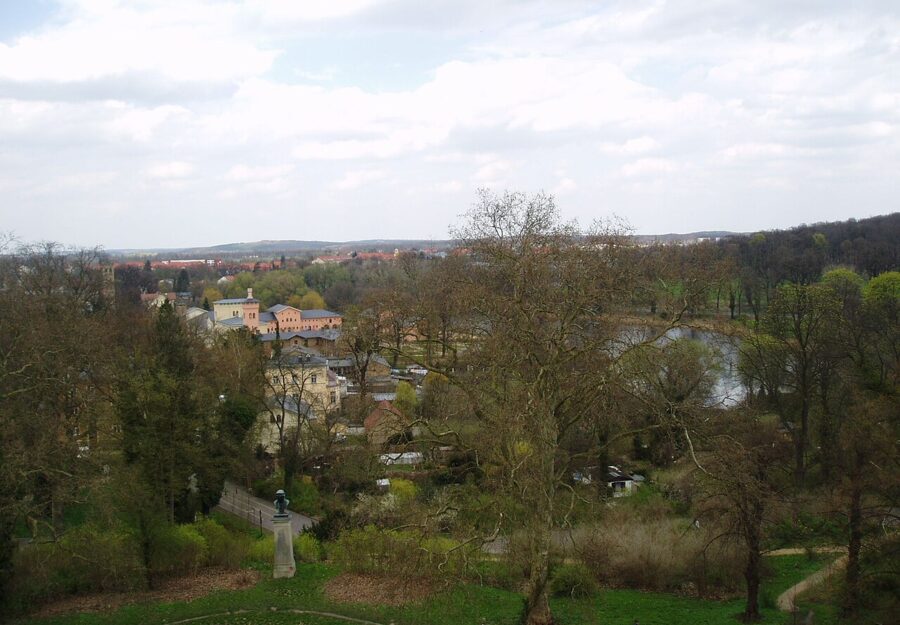

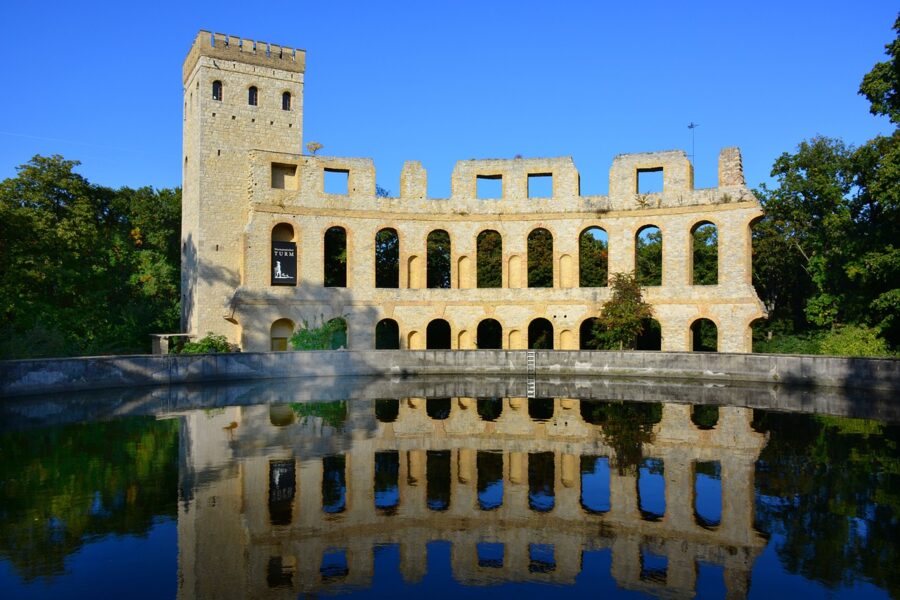
The orphanage had to be bought off when Frederick the Great (Friedrich II) wanted the slope for his vineyard terraces in 1744, and it negotiated good compensation. The king then put deer and partridges into the woods on the hill behind the palace, and from 1748 he had the hill carry a reservoir for his fountains. The reservoir never worked as planned, so he dressed it with fake classical ruins, and the hill has been the Ruinenberg ever since.
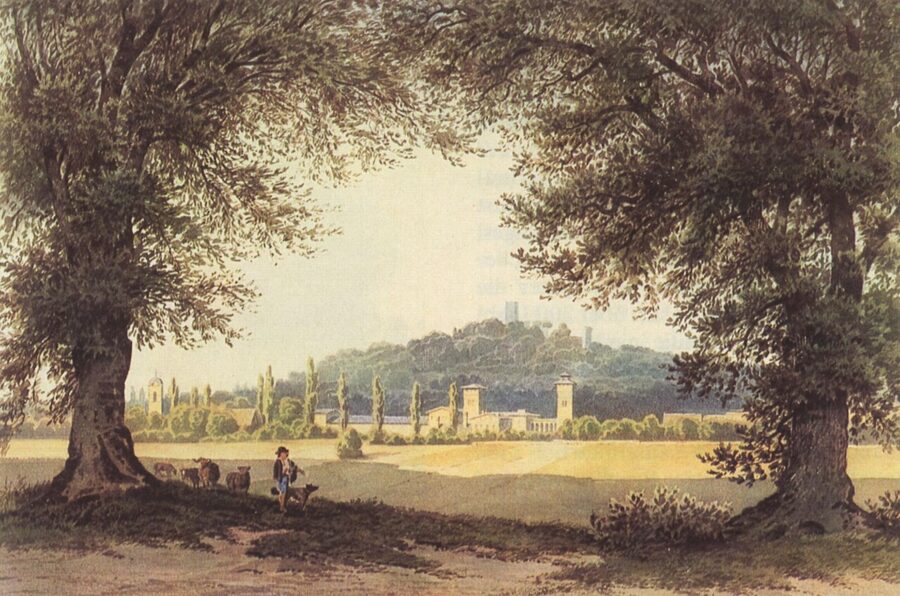
The rest of the eighteenth century was less romantic. From about 1750 the open land north of the park, the Bornstedter Feld, was the army’s drill ground, and the village’s fallow fields had to take the cavalry exercises in turn. Until the middle of the nineteenth century Bornstedt itself was a village of poor half-timbered houses with thatched roofs.
Lenné’s road along the lake
The change came with Frederick William IV, who became king in 1840 and loved to redesign the countryside around his summer palace. In the early 1840s he brought the Bornstedt estate back under the crown, as part of the royal family’s entailed property, and bought the Ruinenberg from the forestry office. He now owned almost everything between the Bornstedter See, the small lake beside the village, and the Russian colony of Alexandrowka.
It was probably Peter Joseph Lenné, the royal garden director, who persuaded him to move the new main road to Hamburg off the slope of the Ruinenberg and swing it along the lakeshore instead, “with regard to beauty.” It was built in 1842 and is today’s B 273, the Potsdamer Straße. The fields between the hill and the lake were edged with hedges the king had seen on his travels, the road to Nedlitz was planted with limes, and a contemporary guide called the result “a new park.”
The Ruinenberg was landscaped last. In 1845 Ferdinand von Arnim built the Norman Tower (Normannischer Turm) on its summit to designs by Ludwig Persius, a lookout with views as far as the royal farm at Bornim. The tower was also the end point of the planted road from Bornim and of the axis of the Bornstedt church’s nave, which tells you how carefully this landscape was aimed.
The fire of 1846 and the Italian village
Frederick William IV wanted Bornstedt to look Italian. In 1843 he paid the master carpenter Heinrich Rietz a subsidy of 600 thalers to build his house at today’s Ribbeckstraße 22 to an Italianate design by Persius, with a tower and a vine-covered pergola joining it to the workshop. Rietz had to sign that he would change nothing on the outside without the king’s approval, and the clause went into the land register so it bound every later owner.
That was the first Italianate building in the village. In 1844 the king talked through a rebuilding of every farmhouse in Bornstedt with Persius, then dropped the plan when he heard the cost. He settled for having every new building in the village inspected by his court architects, first Ludwig Ferdinand Hesse and later Arnim.
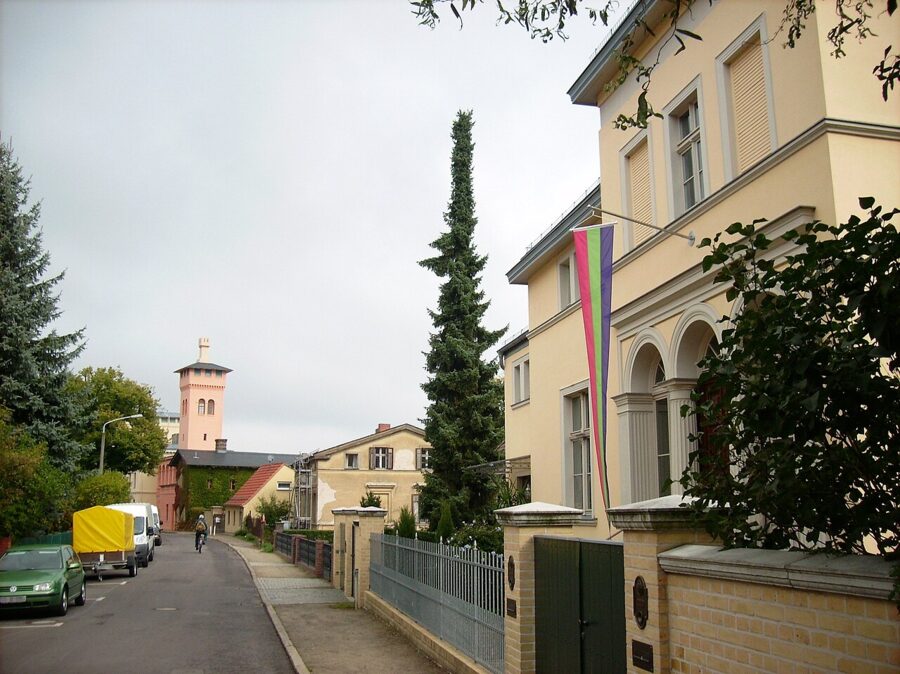

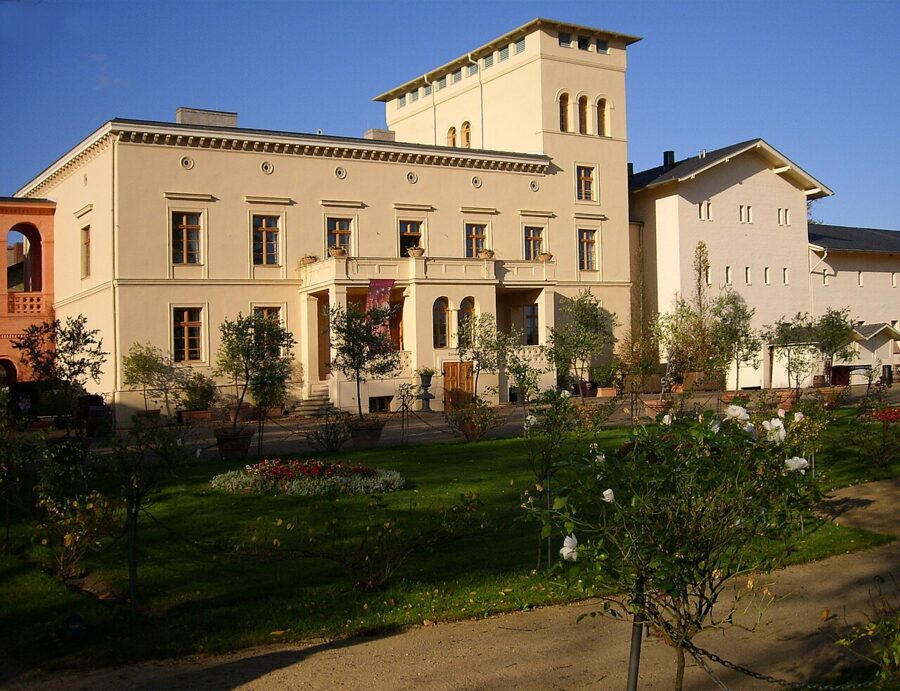
Then the estate burned. In 1846 a fire destroyed the Krongut down to part of the manor house, and the king turned the disaster into the project he had wanted. Johann Heinrich Haeberlin, newly appointed to the court building office, designed a complete Italian country estate to the king’s instructions the same year, and it was finished in 1848. Persius, who is often credited with Bornstedt’s Italian look, had died in July 1845: his share is the Rietz house, the first plans for the church and the Norman Tower, not the estate itself.
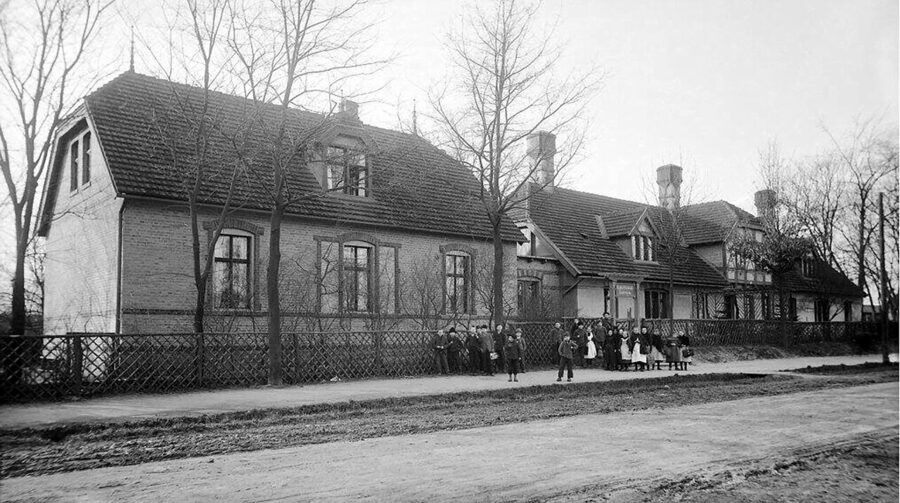
The rest of the village followed over the next decade. The Orangery Palace was begun in 1851 on the ridge above, and it is mirrored in the Bornstedter See. In the mid-1850s the church was rebuilt, and in 1855 the king had the run-down sexton’s and school house that stood directly opposite it pulled down and rebuilt a little further south, so that it no longer blocked the view. Hesse gave the new school an Italian dress and a small tower, and the future Wilhelm II went to lessons there.
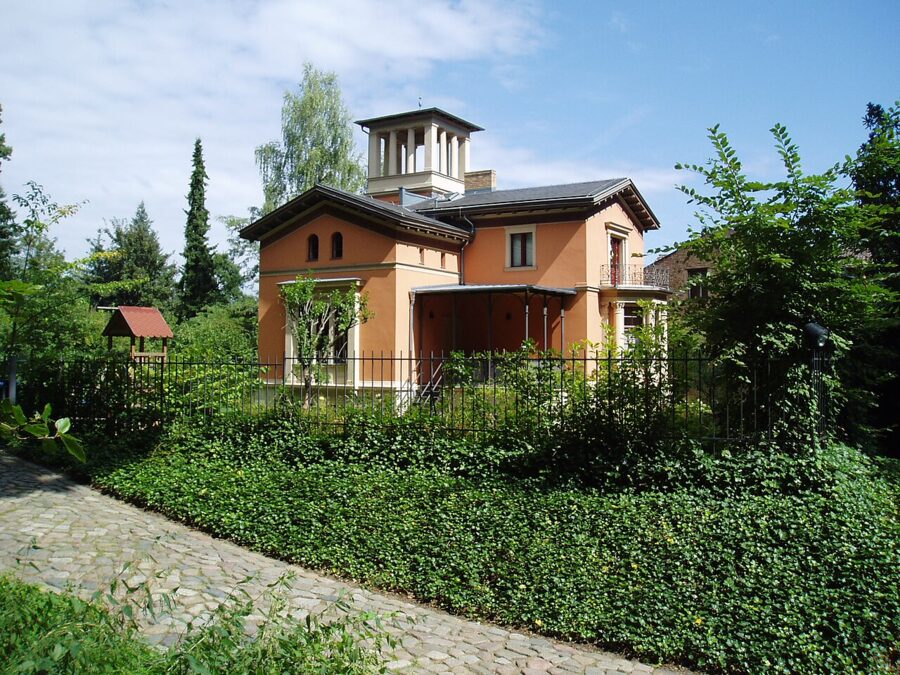

After Frederick William IV died in 1861 the Italian style went out of fashion, though it hung on in Potsdam for unusually long. Kopp’s villa of 1872 still followed the royal model. The merchant Heydemann’s villa at Ribbeckstraße 2, from 1873, only half did, and its tower-like south side pushes itself into the view between the Orangery and the Krongut. Later private houses on the village street ignored the rules altogether, which is why Bornstedt today reads as an Italian set piece around the church and the estate, with an ordinary Brandenburg suburb behind it.
The Krongut: the belly of Sanssouci
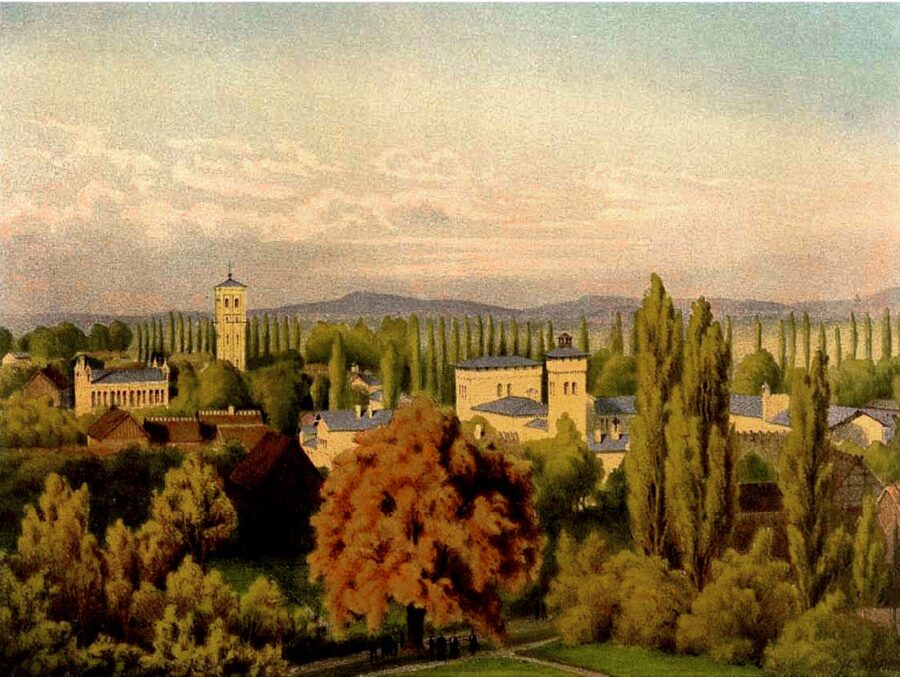
The estate’s own name for its old role is the “belly of Sanssouci.” Beer had been brewed here since 1689, by the time of the soldier-king Frederick William I the estate had its own brewery and distillery, and a hop garden planted from 1727 lasted a century, until Lenné’s landscaping plan replaced it. Poultry, vegetables and bread for the court tables came from these buildings, and the surviving ones still say what they were: the brew and distillery house, the poultry house, the wash, bake and slaughter house, the wine barns by the lake.
Frederick and Victoria’s model farm
Frederick William IV rebuilt the Krongut but rarely used it, although rooms on the upper floor of the estate house were kept for him. Life arrived in 1867, when King Wilhelm I handed the estate to his son, Crown Prince Frederick William, later the Emperor Frederick III, and his wife Victoria. She was the eldest daughter of Queen Victoria, she was interested in farming, and she had long wanted a model farm near her home like the ones her father, Prince Albert, had set up in England.
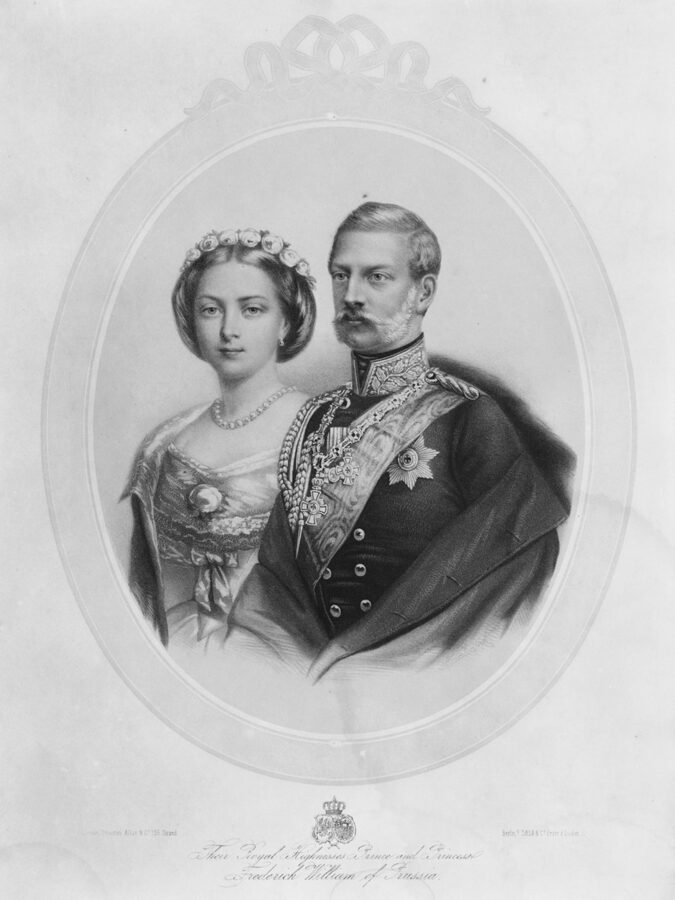
Victoria, in her late twenties and already a mother several times over, took on the dairy cattle, the poultry, the pigs and the sheep, and planted a fruit and herb garden for the household. With the court gardener Emil Sello, a friend of the couple, she turned Lenné’s lawn between the manor house and the lake into an English farm garden between 1873 and 1875. The result was a rose garden with a stage by the water. She had the climbing roses for the festoons shipped from England, and the lawnmowers too.
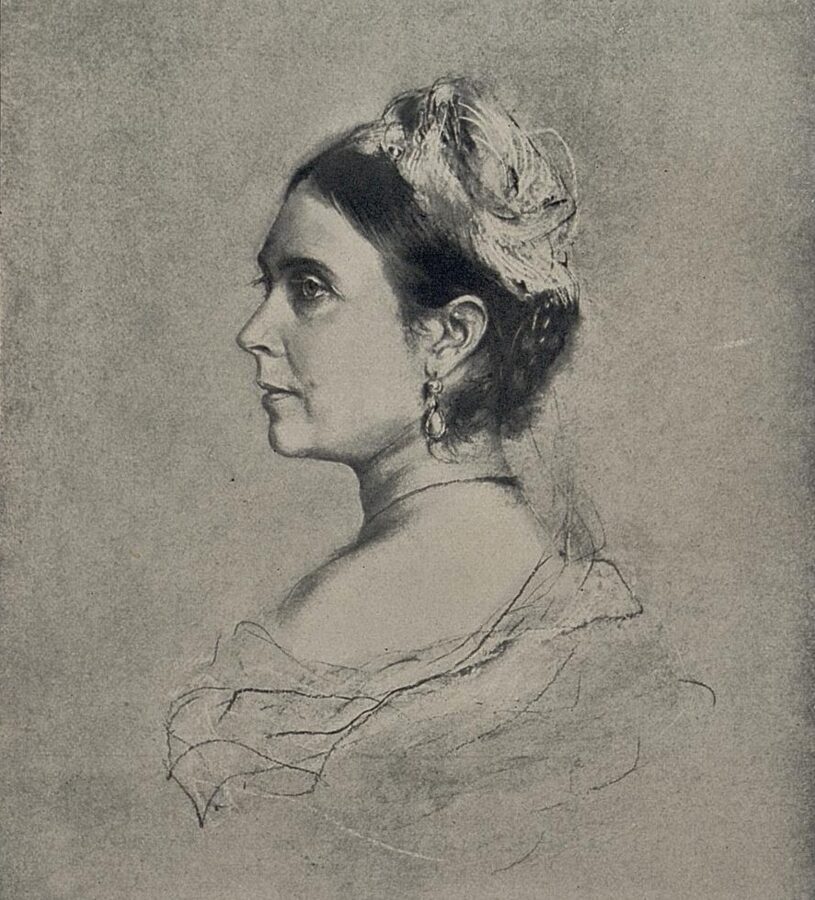
The couple’s influence spread through the whole village, which is why Bornstedt is sometimes called the most English corner of Potsdam. In 1877 Victoria had a new school built in the English style in the woods north of the village when the old one became too small. An orphanage and two houses for estate workers went up on the Potsdamer Straße, and in 1883 the estate opened a children’s home so that the mothers who worked the farm had somewhere to leave their children.
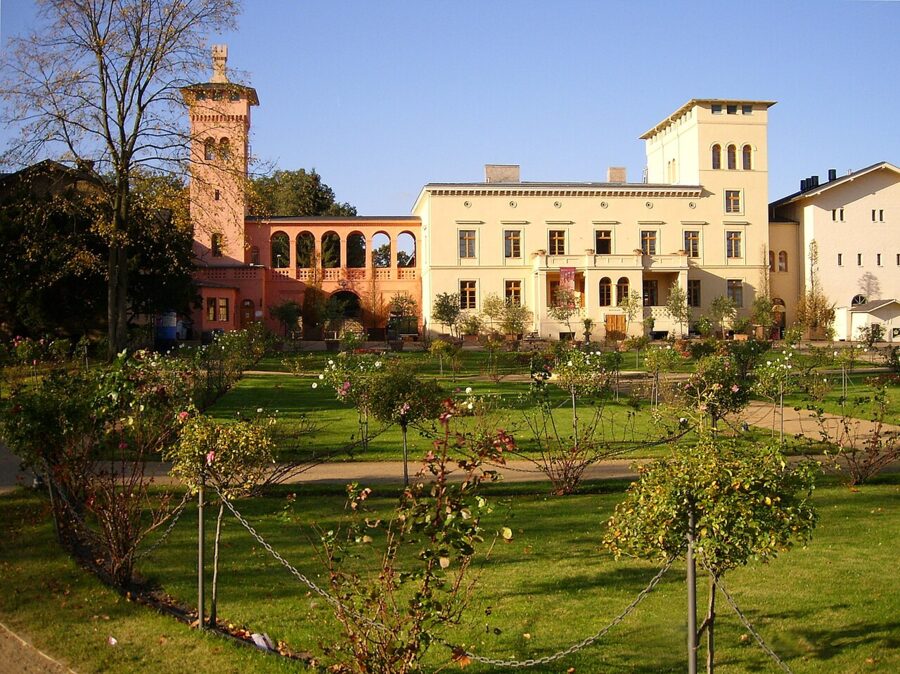

In 1878 the estate was merged with the crown estate at Gallin and run as Krongut Bornstedt-Gallin, an arrangement undone in 1928. The crown prince’s years ended with his death in 1888, after only 99 days as emperor. Bornstedt remembered him in its street names, the Friedrich-Wilhelm-Straße and the Victoriastraße, which are today’s Potsdamer Straße and Ribbeckstraße.
Princess Feodora’s artists’ court
The next resident was a painter. Princess Feodora of Schleswig-Holstein-Sonderburg-Augustenburg, the youngest sister of the Empress Auguste Victoria, was given the estate for life in the early 1900s (the sources give 1901 and 1903). She made it a meeting place for writers and painters, painted impressionist landscapes of the fields around the estate, and published stories under the pen names Feodora Holstein and F. Hugin.
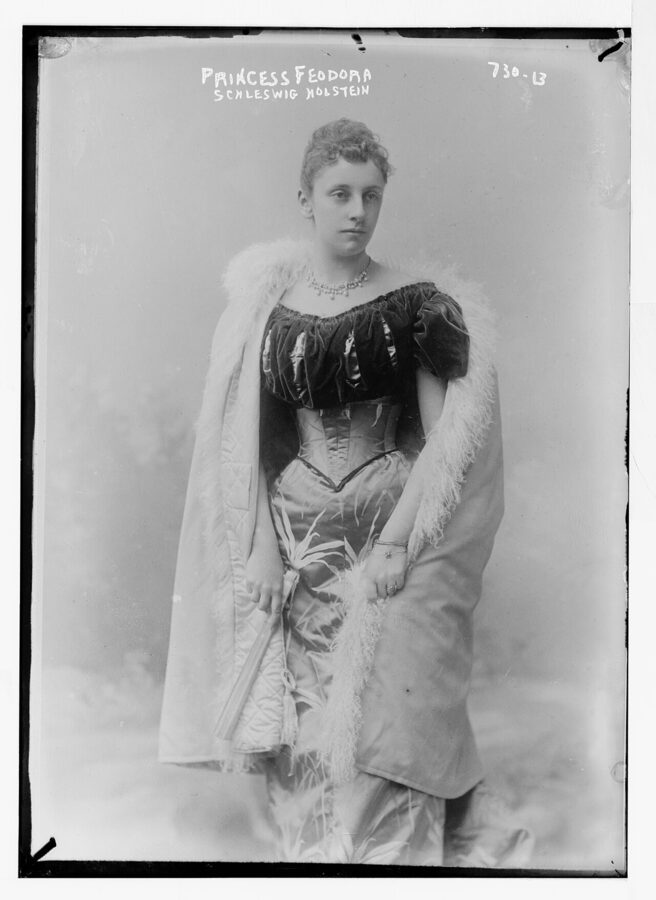
A brand of chocolate took her name. The local legend says she tasted a bar from a Tangermünde chocolate maker at a charity event in Bornstedt and was so delighted that the firm was allowed to sell under her name. The likelier version is that the name was granted after her death, at the maker’s request to the empress’s household.
From 1925 to 1939 the writer Eugen Diesel, son of the engine’s inventor Rudolf Diesel, lived on the estate. In 1928 the old estate districts were dissolved and the Krongut came under Potsdam, and on June 27, 1935, Hermann Göring signed the law incorporating the village of Bornstedt into the city.
From the GDR to the reopening of 2002
After the Second World War the Soviet army took over the barracks and the whole Bornstedter Feld north of the village, fenced it off, and kept it until the troops withdrew in 1994. In the same decades the Krongut, no longer royal property, was overbuilt with modern structures, a process that ran into the 1980s. From 1999 those additions were torn down and the 1840s buildings reconstructed, and the estate reopened on June 1, 2002, as a venue with a brewery restaurant, a bakery, craft workshops and shops.
Queen Elizabeth II, a great-great-granddaughter of Victoria’s mother, visited in November 2004. The opening boom did not last: in the 2010s footfall dropped, tenants left and complained about the management, and in 2015 the whole ensemble was offered for sale. The Berlin restaurateur Josef Laggner, whose group has run the estate since 2008, still operates it through the Laggner Krongut Bornstedt company.
One family’s story runs through the whole period. The fashion designer Wolfgang Joop grew up on his grandparents’ farm next to the Krongut before the family moved west in 1954. An aunt kept the property through the GDR years, his parents moved back after reunification, and since 2018 it has been his main home again. On the estate plan, the former wash, bake and slaughter house is marked as Joop’s studios, and it is private.
The buildings, one by one
The estate covers about 18,000 square meters, and you can walk into the courtyard from Ribbeckstraße 6–7 without a ticket. Start at the manor house (Herrenhaus), the only building that partly survived the fire: its ground floor holds a wedding room of Potsdam’s civil registry office, so expect wedding parties. The brew and distillery house keeps its historic malting floor in the roof, now a hall for events.

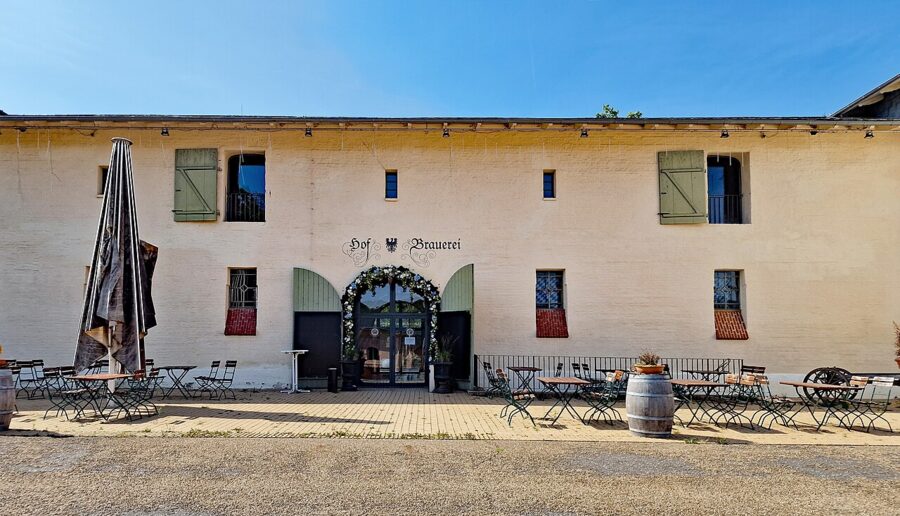

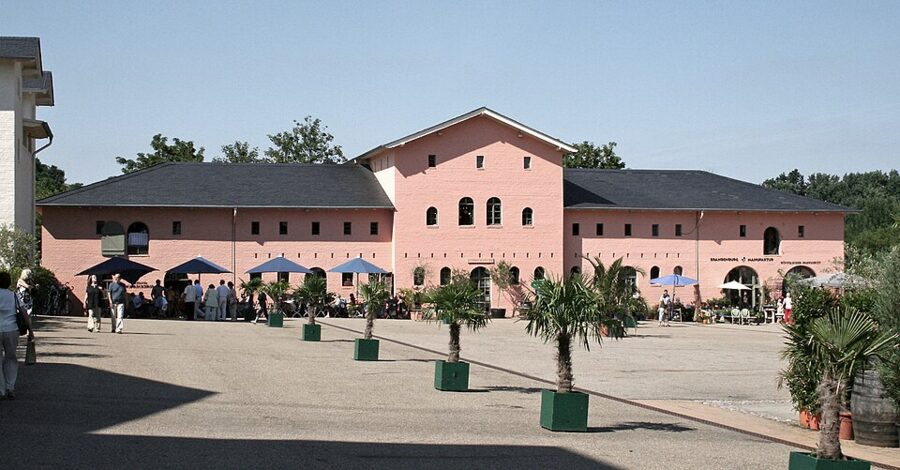

The estate plan puts the café-brasserie and its terrace in the Remise, the old coach house. On the lake side, the wine barns, the wine shop and the lake terrace are booked for parties, and the lake stage with its small atrium is used for outdoor weddings and concerts. The poultry house on the market square was rebuilt from scratch, and the old school house on the street is private.
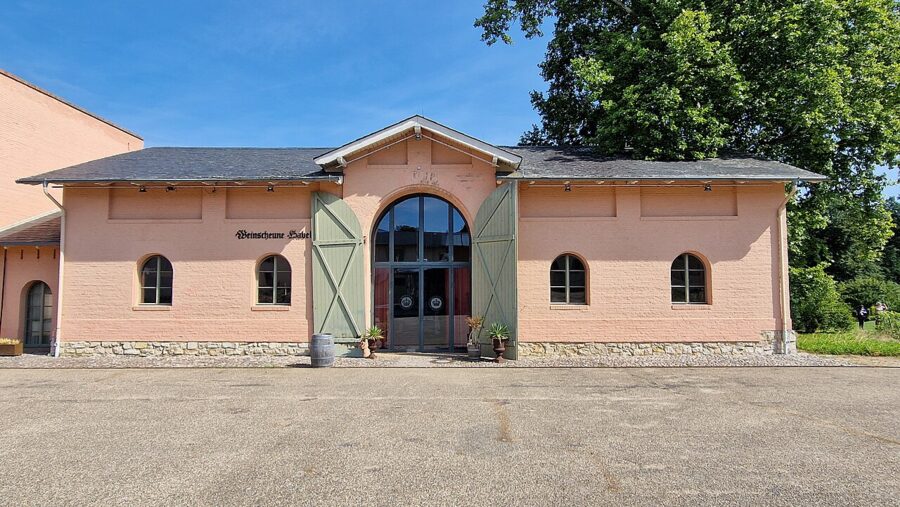

What is open at the Krongut now
Go with modest expectations and the Krongut is a pleasant twenty minutes. The courtyard, the rose garden and the view of the lake are free, and there is a playground with a herb garden for children. What has changed in recent years is the food: as of late 2026 the operator says the brewery restaurant is not open, and it points diners to its other restaurant by the Park Sanssouci station instead.
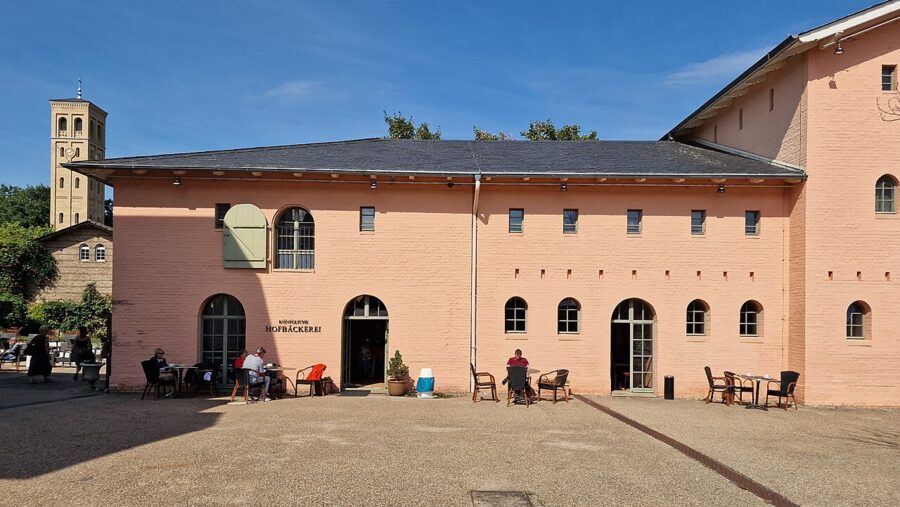

The café is the HofBrasserie, open in autumn 2026 on Fridays, Saturdays and Sundays from 10:00 to 17:00 and closed Monday to Thursday. It serves sheet cakes, tortes, coffee from the house’s own Berlin roastery and a soup of the day. During the conversion of the former court bakery, the café works from a temporary space on the grounds, signposted on the courtyard, so check the page before you plan lunch around it.
The Krongut is busiest in December. Its Advent village runs on the second and third weekends of Advent, in 2026 on December 5–6 and 12–13, from 12:00 to 20:30 each day, in the courtyard and the barns by the lake. It is small and free, with regional craft stalls (a beekeeper, a game butcher, a furniture maker), mulled wine and waffles, and dogs are welcome. If you are collecting markets, it fits into a day with the others in the Potsdam Christmas market season.
On New Year’s Eve the estate holds a ball in the wine barn on a 1920s theme, with a buffet, drinks, dancing and fireworks over the lake, at €159 per person, booked in advance only. The rest of the year the events are mostly private: weddings, company parties and the occasional market.
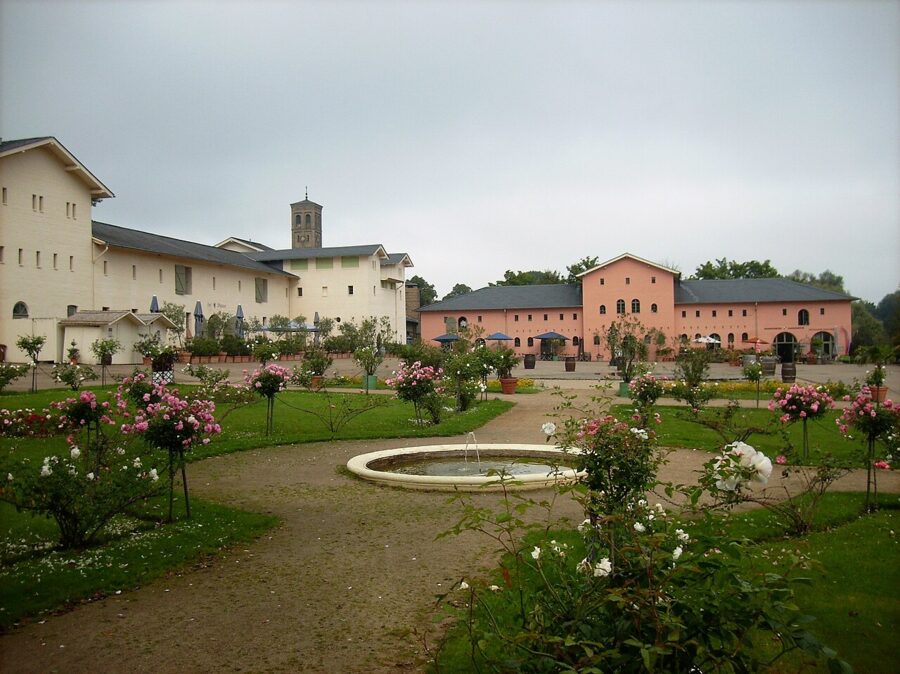

The Bornstedt church
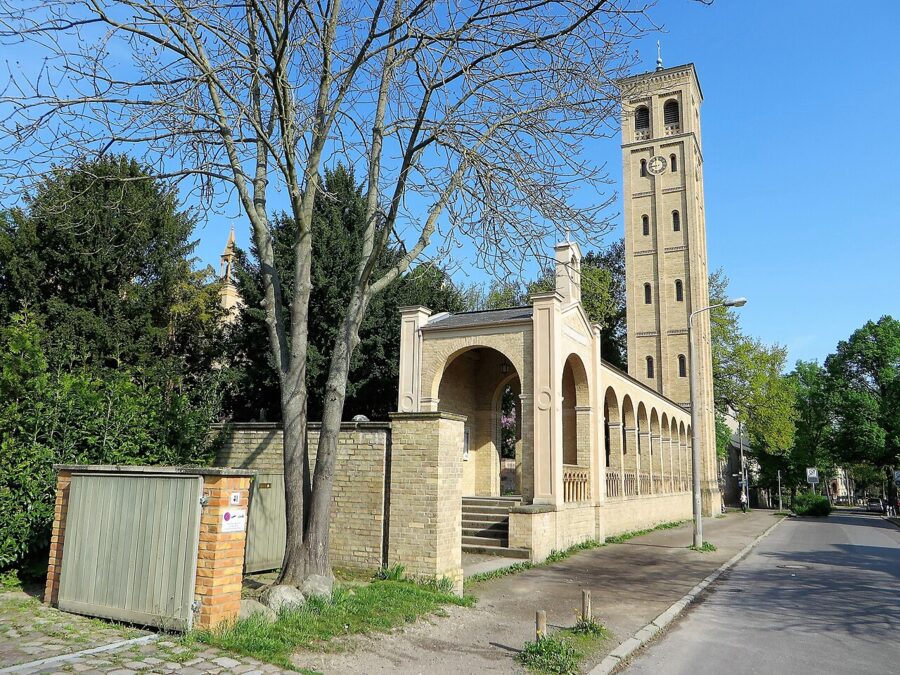
The church stands on the cemetery hill across Ribbeckstraße, and the street front you see is a piece of stage scenery. The first church here was built in the sixteenth century, renewed in 1689 and 1769, and replaced in 1805 by a new building by Carl Friedrich Quednow. By the 1840s it was already in poor repair, and Frederick William IV wanted something that suited his landscape.
Persius drew a first design in 1842 and 1843, but nothing was built before his death. Stüler took over and designed the arcade on the street and the free-standing campanile in 1849, and the church itself was rebuilt on the old foundations under Haeberlin’s site management in the mid-1850s; the sources give 1854–1855 or 1855–1856. The Brandenburg monument register’s entry for the church names Stüler, Haeberlin and Reinhold Persius, who comes into the story later.
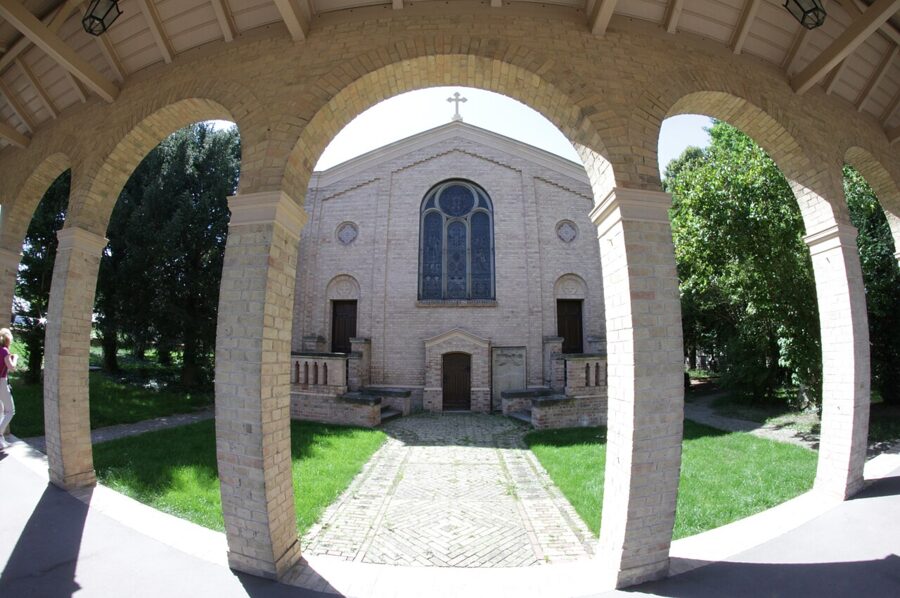

Above the portal, the inscription quotes John 10:9 in its old German spelling: I am the door, whoever enters through me will be saved and will find pasture. It is a neat text for a church that you enter through an arcade, a gatehouse and a churchyard.
The arcade and the campanile
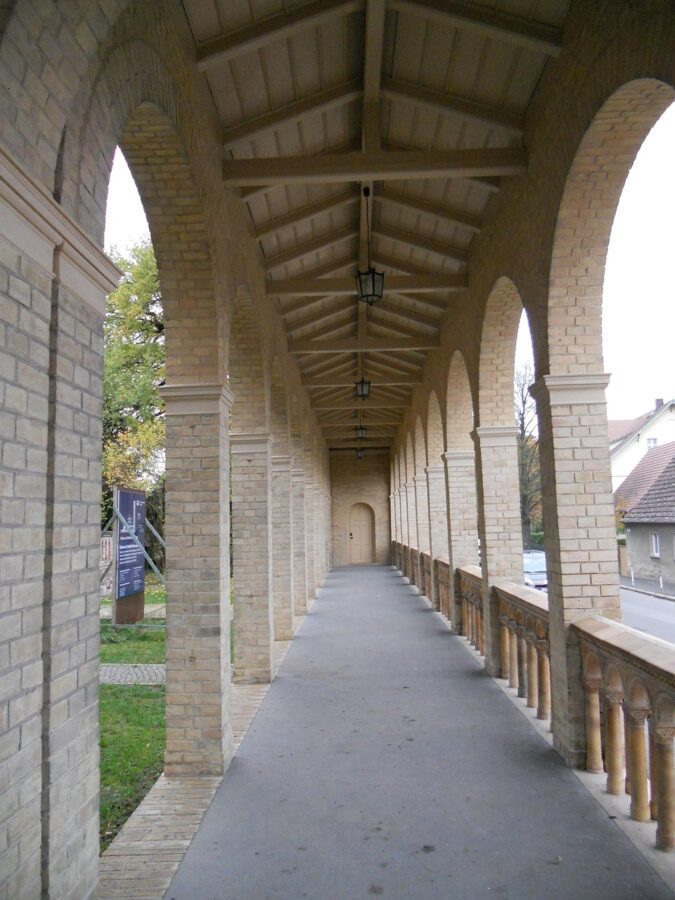
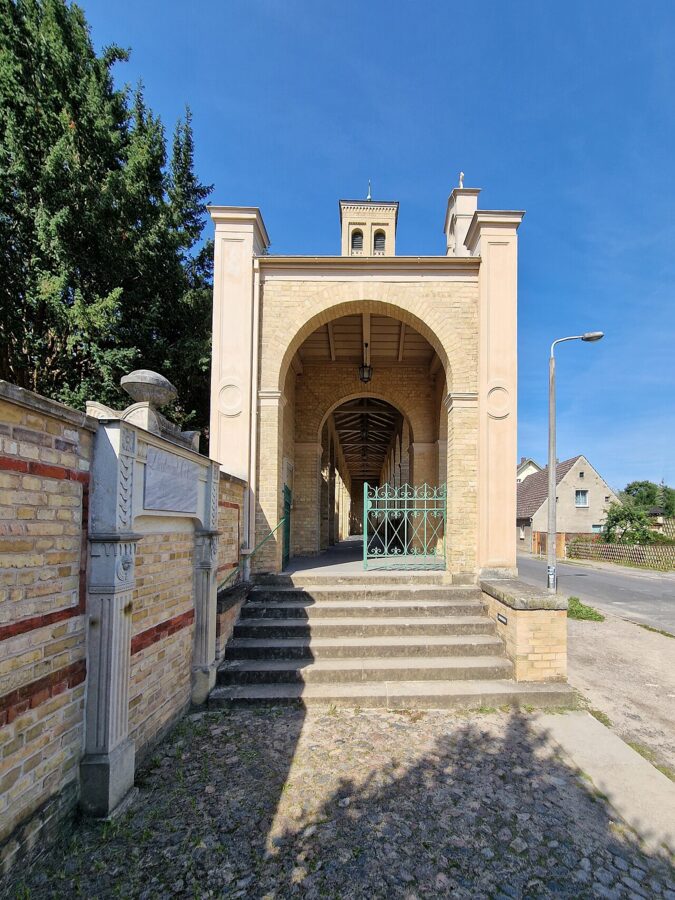
The arcade has nine arches on square piers and an open timber roof, with a parapet of small arches on terracotta columns. It separates the church and the cemetery from the lower street, and you enter through a chapel-like gatehouse at its south end, up a flight of steps, under the words “Enter his gates with thanksgiving.” The campanile at the north end climbs in five matching stories to the bell chamber, where two medieval bells hang.
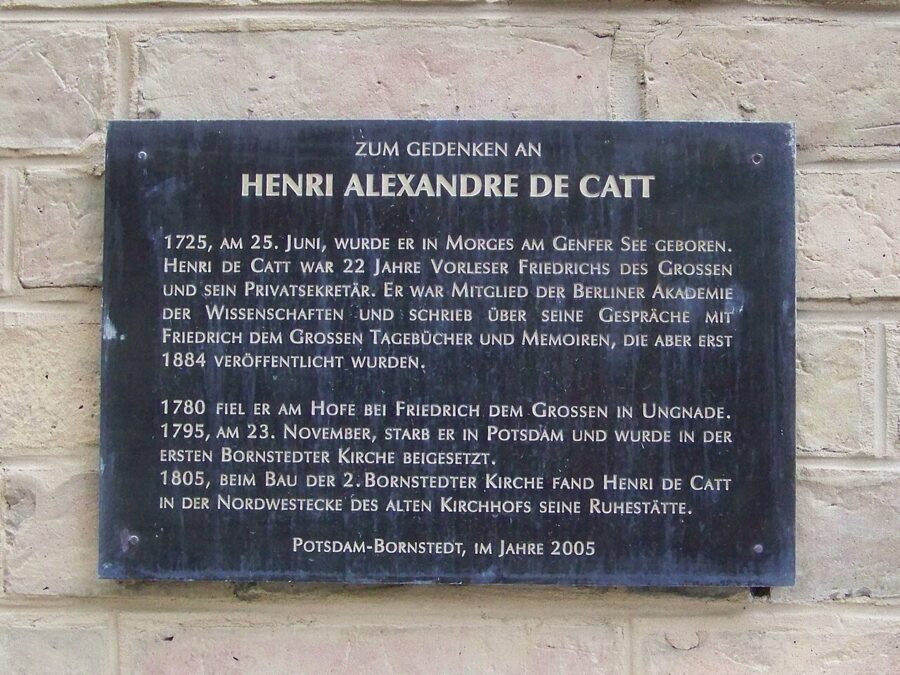
A plaque at the foot of the tower, put up in 2005, remembers Henri de Catt, Frederick the Great’s private secretary and reader. He was buried in the first church here, his grave was moved to the cemetery when the church was rebuilt in 1805, and it has since been lost.


Inside: Victoria’s English church
The interior is a bright hall with dark wooden galleries on three sides and the organ on the west gallery. In 1881 and 1882 Victoria had the church extended to the east by Reinhold Persius, the son of Ludwig, who replaced the old apse with a three-aisled choir. The side aisles became private boxes, one for the church council and one for the crown prince’s family, and the altar space got a ceiling painted as a starry sky on a blue ground.
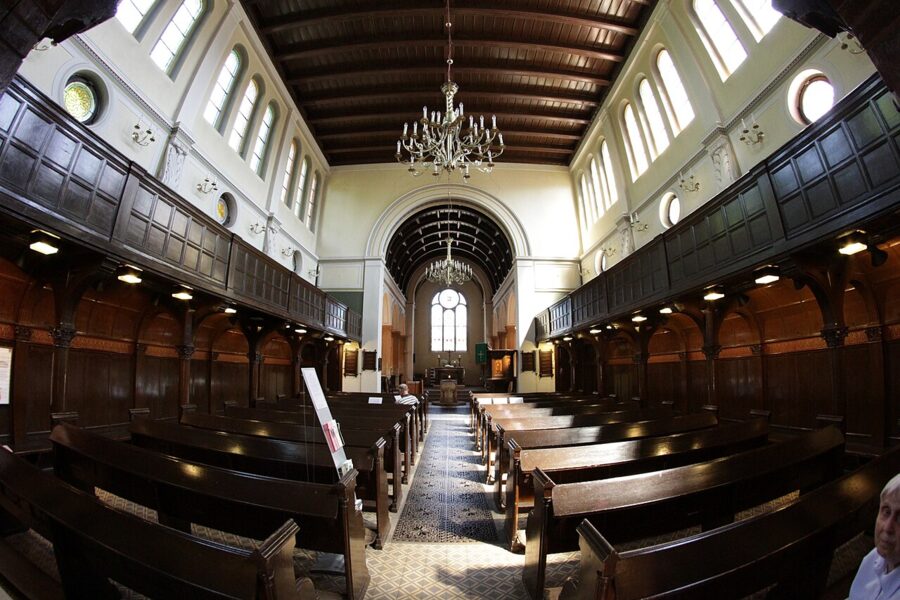

Look for the English details. The sandstone font copies the Romanesque font of the church at Belaugh in Norfolk, at Victoria’s wish, and the painting of the organ pipes added in 1882 follows English models. The gilded copper baptismal bowl is an 1875 copy of the bowl of the Garrison Church in town.
The crown prince gave the church a set of cast-iron works from the Kronprinzenpalais in Berlin in 1869, among them a relief of the Last Supper after Leonardo da Vinci by Leonhard Posch. The organ inside the 1856 case by Carl Ludwig Gesell is a Schuke instrument of 1978. The church was restored in 1981 and again in the 2010s.
Gundling in his wine cask
Under the west gallery are three Baroque memorial stones from the church of Frederick William I’s day, saved through the rebuildings by the local historian Karoline Schulze, the daughter of a garden director buried outside. One remembers Heinrich Christian von Holwede, head of the court kitchens in Berlin and Potsdam, another the Potsdam mayor Martin Plümicke.
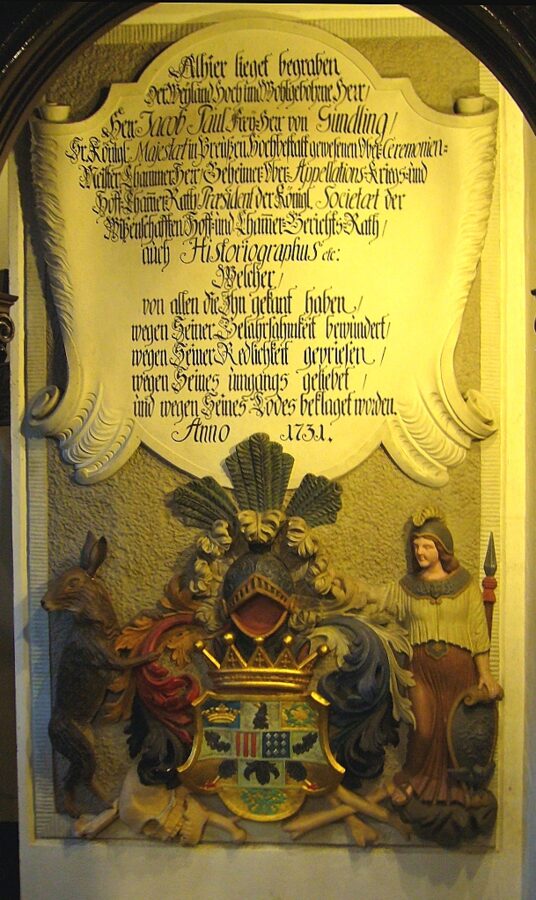

The third, north of the entrance, belongs to Jacob Paul von Gundling, the scholar whom Frederick William I kept as court historian and unwilling court jester. For years the king made him sleep next to a wine cask fitted out as his coffin, and when Gundling died in 1731 he was displayed in it in costume. The Potsdam clergy refused to take part, so his rival David Faßmann preached the funeral sermon.
The cask went to the edge of town carried by eight tailors, or, in other accounts, pulled by pigs, and on to Bornstedt in a cattle cart. Gundling was buried in a vault under the village church, and the vault disappeared with the rebuildings. The stone is what is left.
Outside, on the east wall of the choir, is the oldest surviving grave marker on the site, for the electoral clerk Christoph Schmaill, who died in 1678, and his wife Margarethe. The church belongs to the Protestant parish of Potsdam-Bornstedt, which has had its own pastor since 1860; before that, the clergy of St. Nicholas’ and later of the Friedenskirche in the park served the village.
When the church is open
The Friends of the Bornstedt Cemetery (Freunde des Bornstedter Friedhofs) and other volunteers have kept the church open since 1992. They open it at weekends from 14:00 to 17:00, and on weekday afternoons when they can, with a book table on the cemetery and the people buried in it. Entry is free and a donation to the upkeep is asked for.
The Bornstedter Friedhof
The cemetery was laid out in 1599 and has grown in stages ever since. From the second half of the eighteenth century it became the preferred burial place of the court’s gardeners, officials and dignitaries, partly because Potsdam had no room for grand family vaults. Those vaults and chapels, and the burials inside the church, were lost in the rebuildings of 1805 and the 1850s.
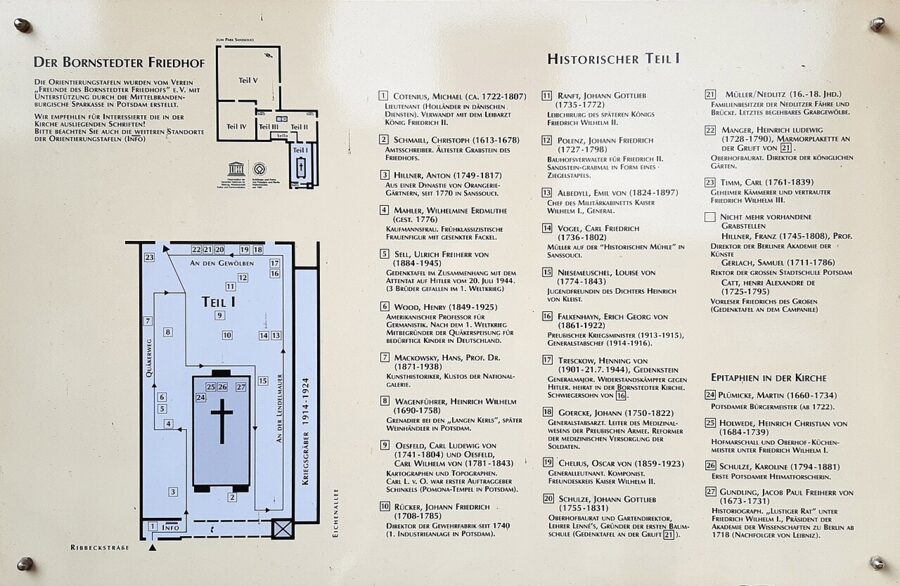

When Fontane came in 1869, the sexton still harvested fruit and hay among the graves, and Fontane wrote that the old churchyard had the friendly character of an orchard. The cemetery you walk through today dates mainly from its reuse from 1897 and a redesign in 1911 and 1912. It is divided into five parts plus the Sello family cemetery, and the Friends count more than 500 notable people among the dead and nearly 1,000 historic graves under monument protection, all of them inside the UNESCO World Heritage site of the Potsdam palaces and parks.
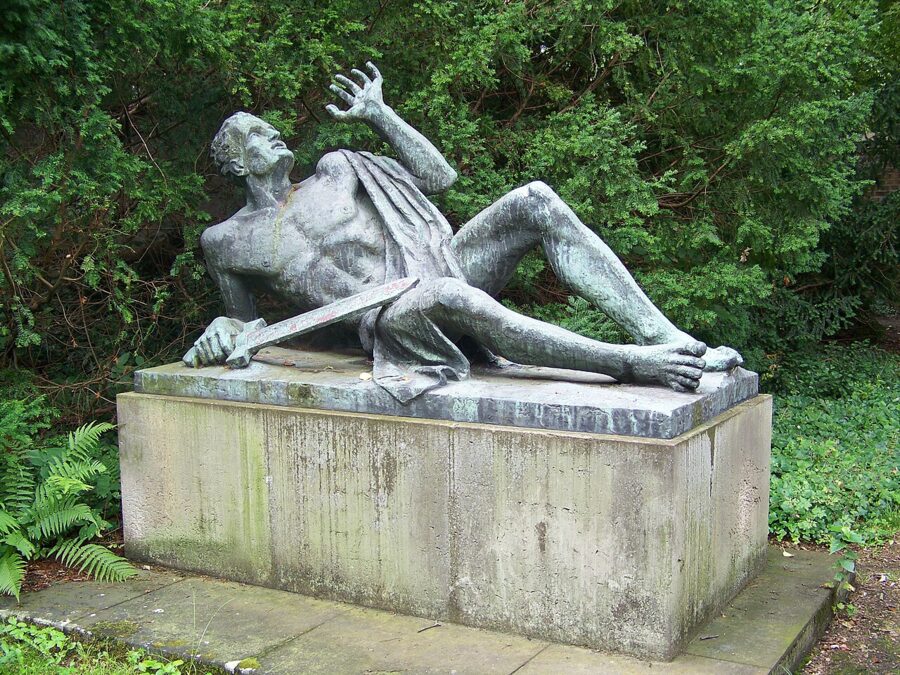
Two later additions are worth knowing about. The funeral hall in part II was built around 1900 to plans by Reinhold Persius and restored in 2010 with money from a UNESCO fund. On the Eichenallee, the cemetery’s northern edge, a small memorial grove for the dead of the First World War was laid out by Hans Kölle in 1935 and 1936 for the Nazi-era mayor Hans Friedrichs, with a bronze figure by Walter E. Lemcke of 1937 by the entrance.

The Sello cemetery: gardeners in battalions
The cemetery’s center of gravity is a private plot. The Sellos were Potsdam’s great dynasty of court gardeners, and when Christian Ludwig Samuel Sello, gardener of the Sanssouci terraces, died in 1837, the family could only buy a cramped grave against the back wall. In 1844 Hermann Sello, the court gardener who had laid out the grounds of Charlottenhof under Lenné, bought the land behind it as a family burial ground.
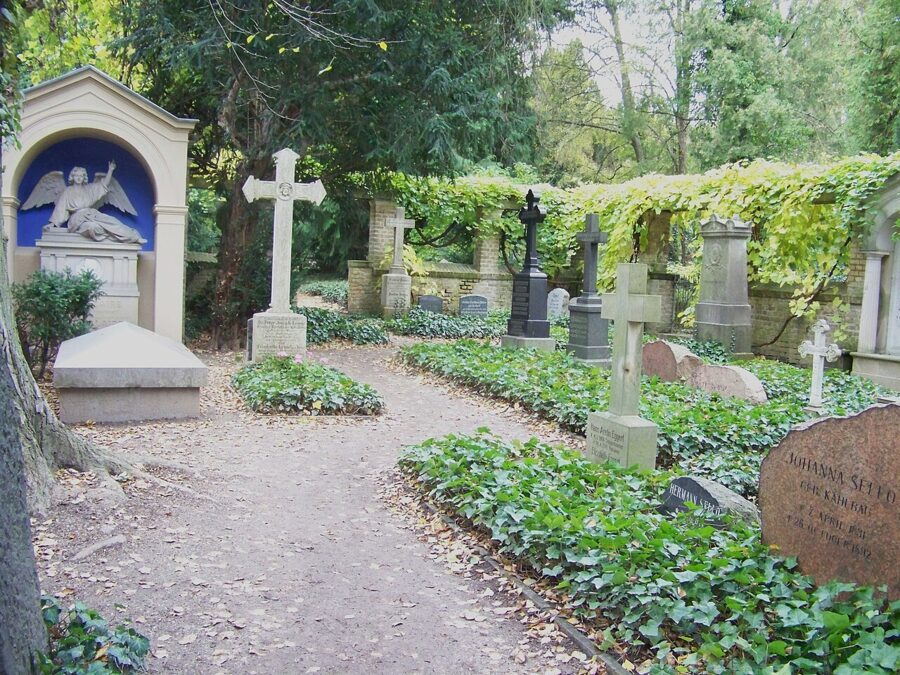

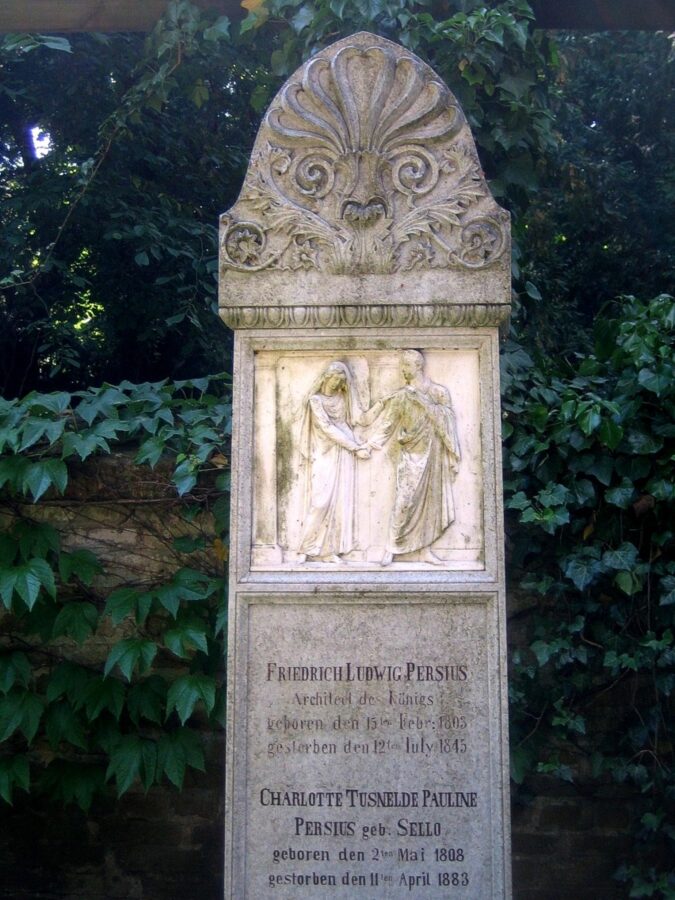
It filled sooner than anyone expected. In 1845 Hermann’s sister Louise Schnee died, and in July his brother-in-law Ludwig Persius, married to his sister Pauline. The plot was walled with yellow Glindow brick and a pergola, Persius received a carved monument, and the Sellos kept to their own custom of rough granite boulders as gravestones.

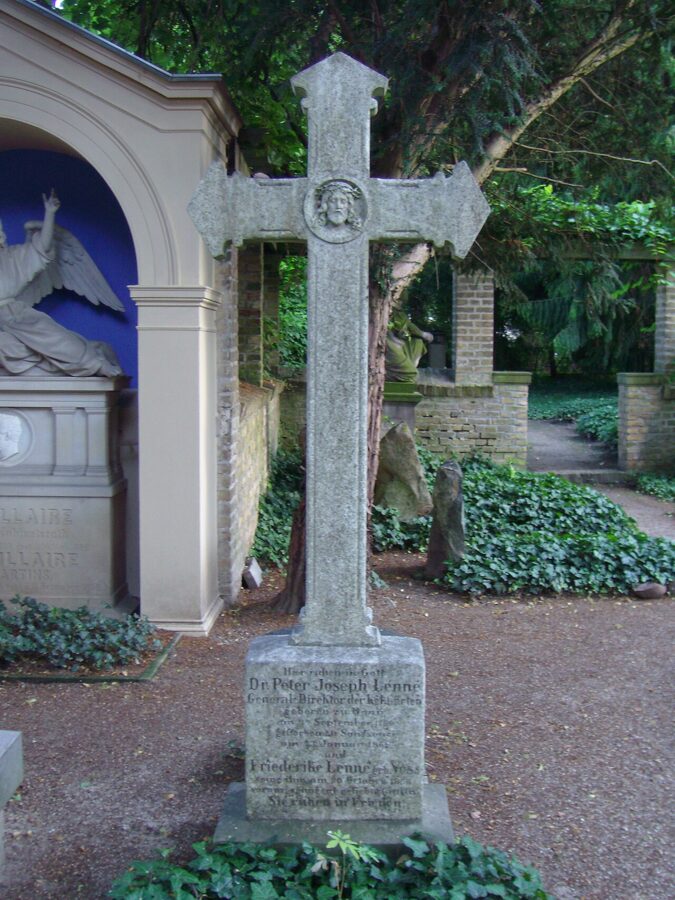
Then, in January 1866, Hermann Sello’s wife Aline died, and a few days after her, on January 23, Peter Joseph Lenné. Lenné had designed most of the gardens in this town over half a century, but he was a Catholic and could not get a grave in Protestant Potsdam, so Sello took him into his private cemetery. A silver laurel wreath, gilded and with fifty leaves each engraved with one of Lenné’s gardens, had been made for his fiftieth year in royal service; he died weeks short of the jubilee, and it was carried before his coffin instead.
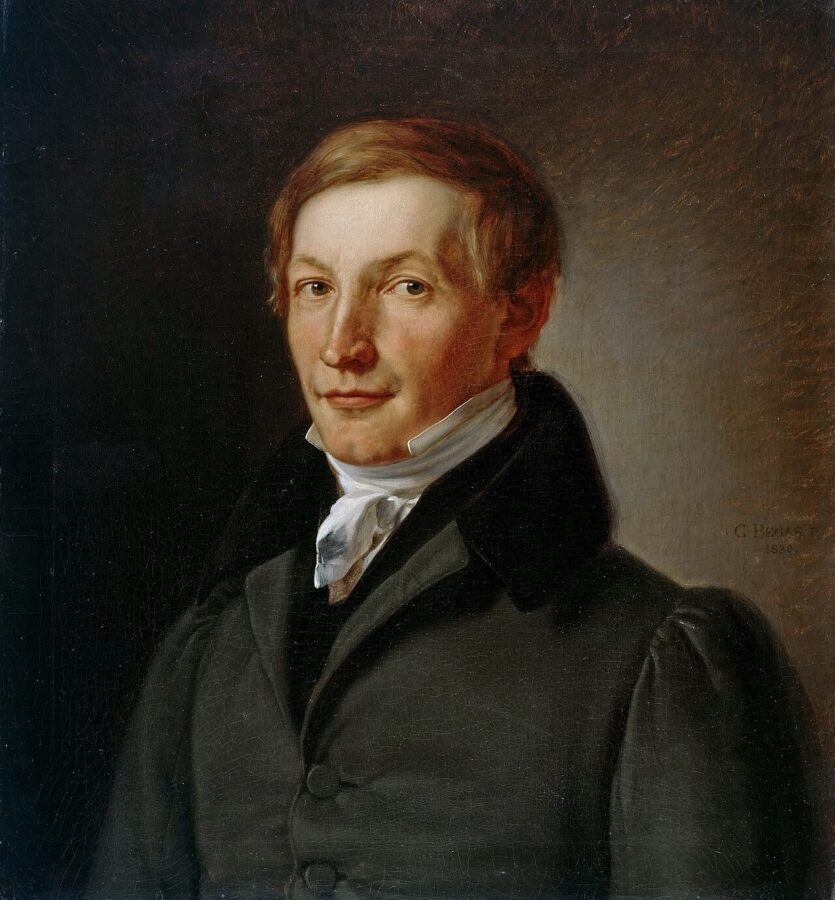

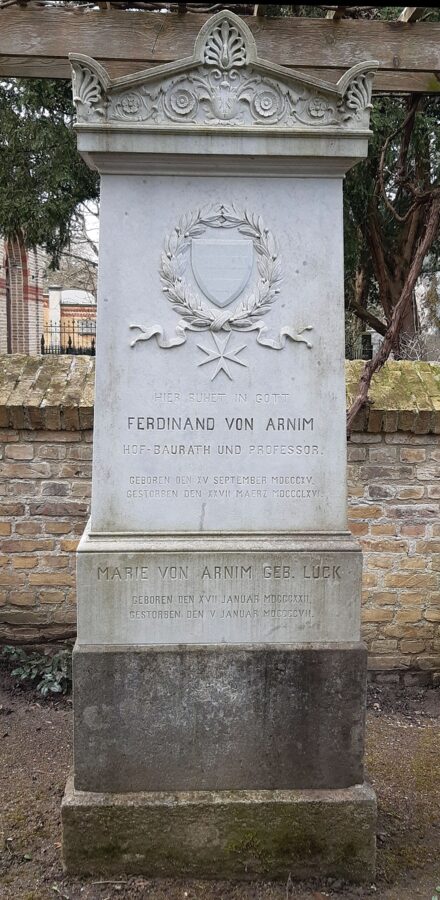
Two more of the king’s men joined him that spring: the court architect Ferdinand von Arnim in March and Ernst Emil Illaire, head of the king’s civil cabinet, in May. Sello gave both a grave and bought another strip of land from a smallholder named Rietz to make room. When Fontane came through a few years later he found “court gardeners in battalions,” Sellos and Nietners, and wrote in his notebook that the old gardeners had wanted to rest in a garden.

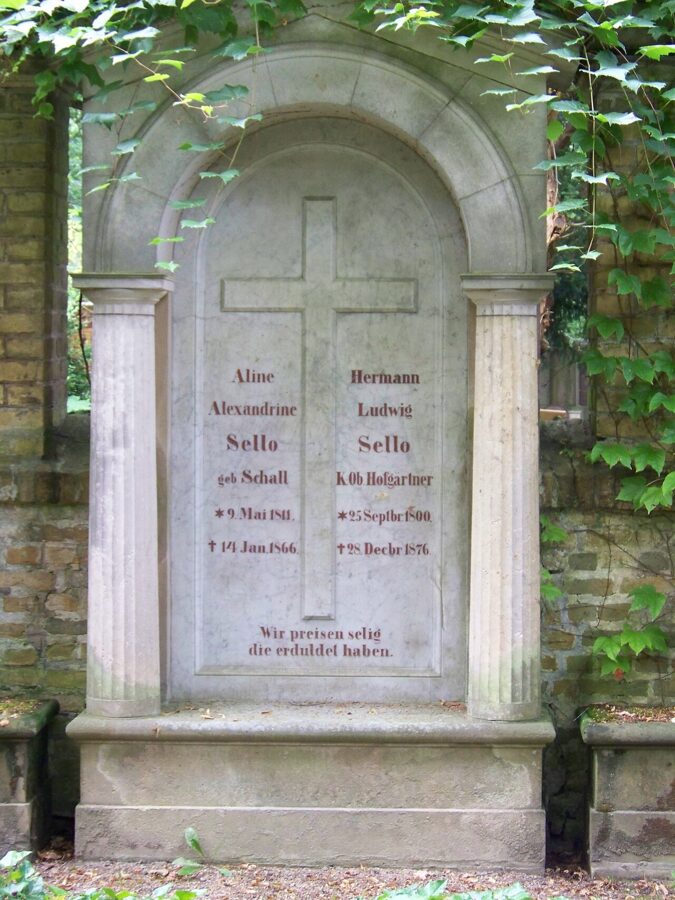

Hermann Sello’s generosity paid off later. After 1945, with no court gardeners left, Lenné’s grave protected the whole plot. During the GDR years relatives in East and West found ways to get money across for basic upkeep, the new part was fenced in 1976 with the help of the pastor, and after reunification the cemetery came back to the family. Family burials resumed in the 1990s, and the Sello family foundation’s history of the plot tells the whole saga.
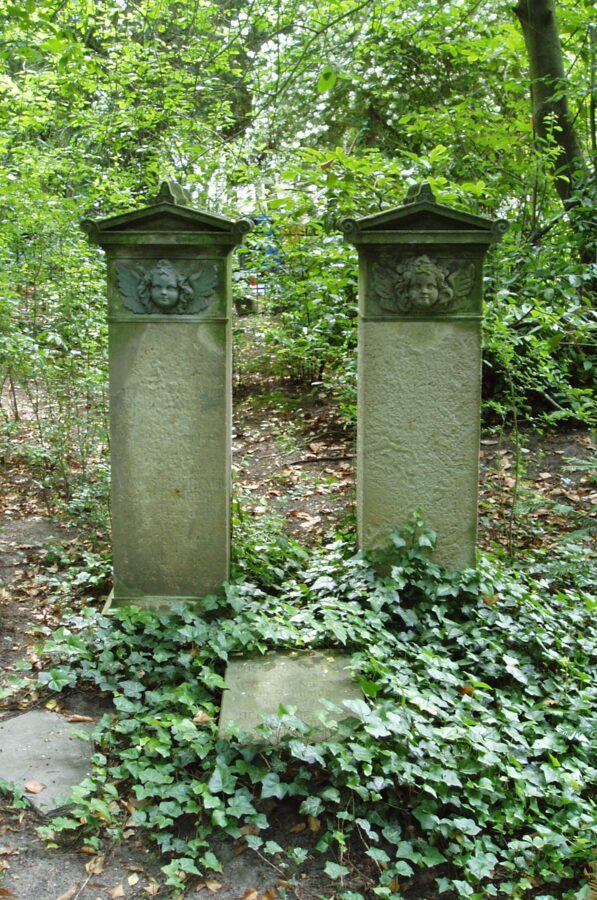

Who else lies here
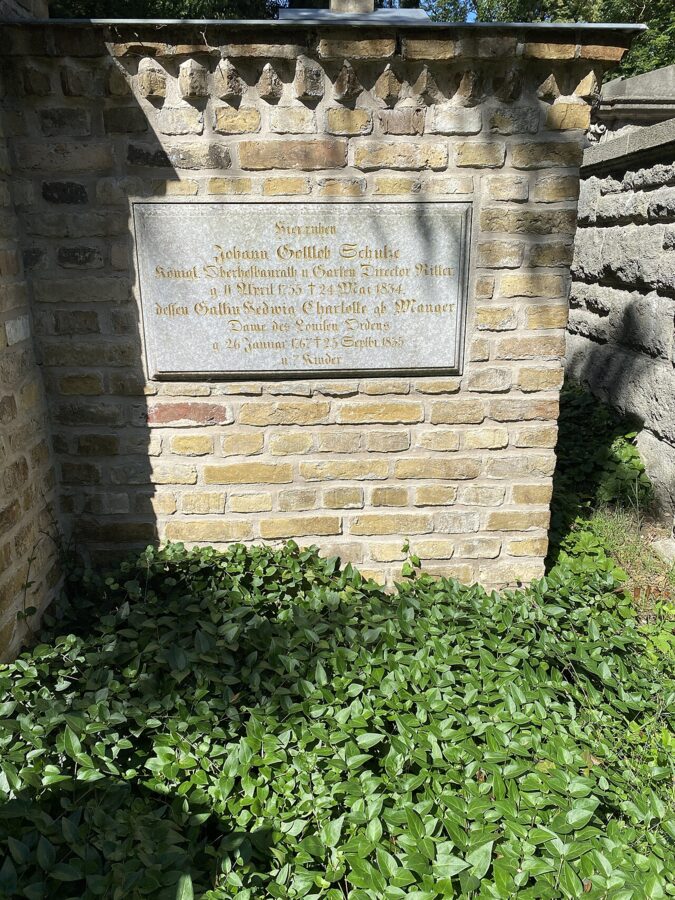
Across the road from the estate he rebuilt lies Johann Heinrich Haeberlin, who died in 1866, the same year as Lenné. The garden director Johann Gottlob Schulze is here too, the father of Karoline, who saved the church’s memorial stones. Lenné did not marry Schulze’s daughter, as the older man seems to have expected, but the daughter of the royal kitchen gardener Voß, and the two men quarreled over their duties for years.
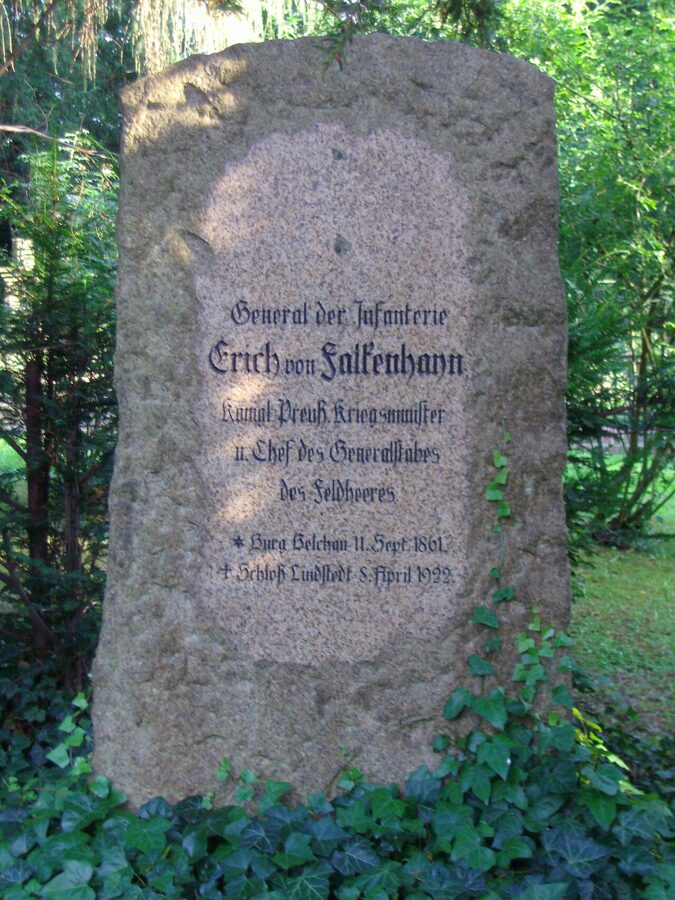
The soldiers are a who’s who of the Prussian army’s last century. Erich von Falkenhayn, Prussian minister of war and chief of the general staff in the First World War, died at Lindstedt Palace nearby in 1922 and lies under a granite boulder. Admiral Ludwig von Reuter, who ordered the German fleet interned at Scapa Flow to scuttle itself in June 1919, is buried here, and so is Heinrich Wilhelm Wagenführer, a grenadier of Frederick William I’s regiment of “Tall Fellows” (Lange Kerls) who became a wine merchant.

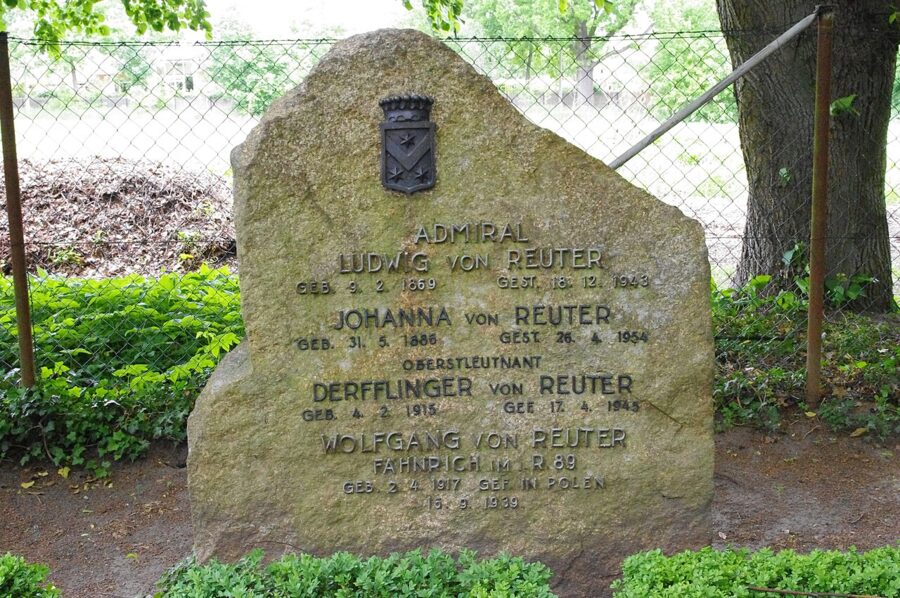

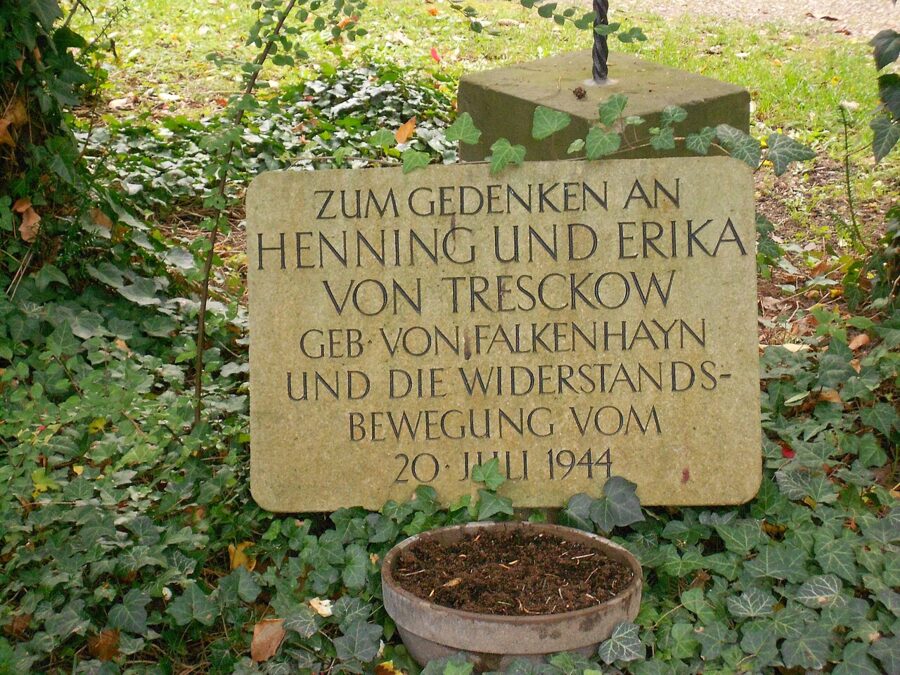
The resistance of July 20, 1944, has its own corner. Kurt von Plettenberg, who managed the former royal house’s property and belonged to the plotters’ inner circle, is buried here, as is Ulrich von Sell, confidant and executor of Wilhelm II. A memorial stone remembers Henning von Tresckow and his wife Erika; Tresckow killed himself on the eastern front the day after the failed assassination, and he has no grave.
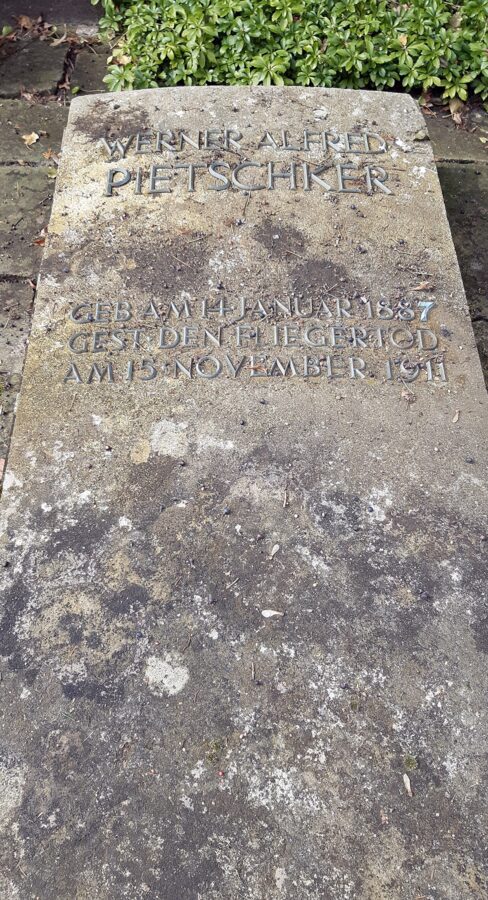
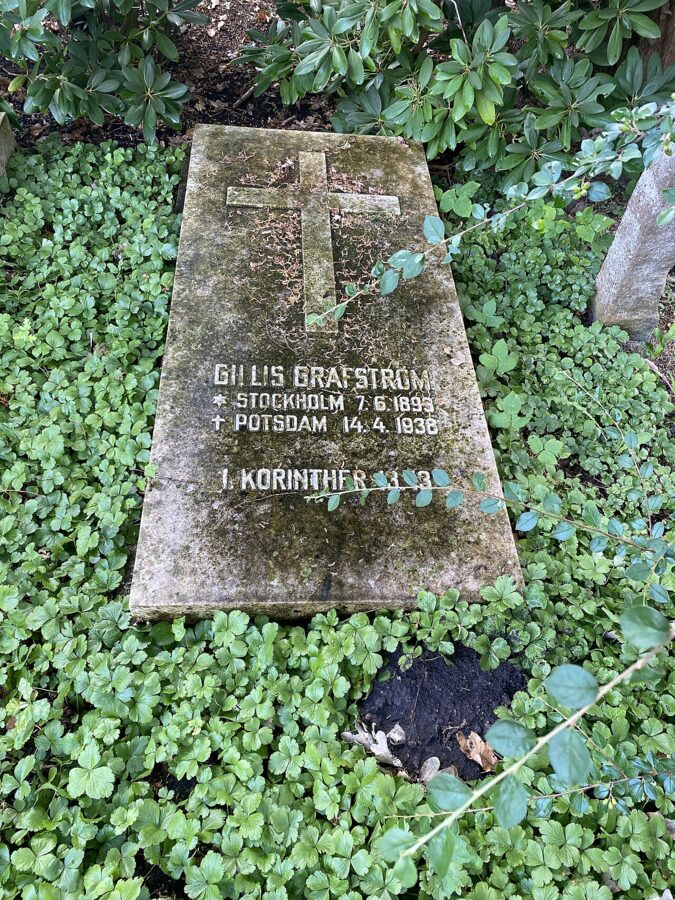
The less martial graves are often the more moving. Gillis Grafström, the Swedish figure skater who won Olympic gold in 1920, 1924 and 1928, lived in Potsdam and died here in 1938. Werner Alfred Pietschker, a grandson of Werner von Siemens and one of Germany’s first aviators, was born in Bornstedt and killed in a crash at Johannisthal in 1911. Samuel Rösel, who taught drawing to Frederick William IV and to Felix Mendelssohn Bartholdy, is here, and so is Ludwig Justi, who ran the National Gallery in Berlin from 1909 to 1933.

The list runs into the present. Prince Wilhelm Karl of Prussia, the last surviving grandson of Wilhelm II, was buried here in 2007. Hans-Joachim Giersberg, a former director general of the palaces foundation, lies in the same ground as the court gardeners whose work he looked after, and Manfred Stolpe, the first premier of the state of Brandenburg, is here too. Wolfgang Joop designed the sculpture on his parents’ grave himself.
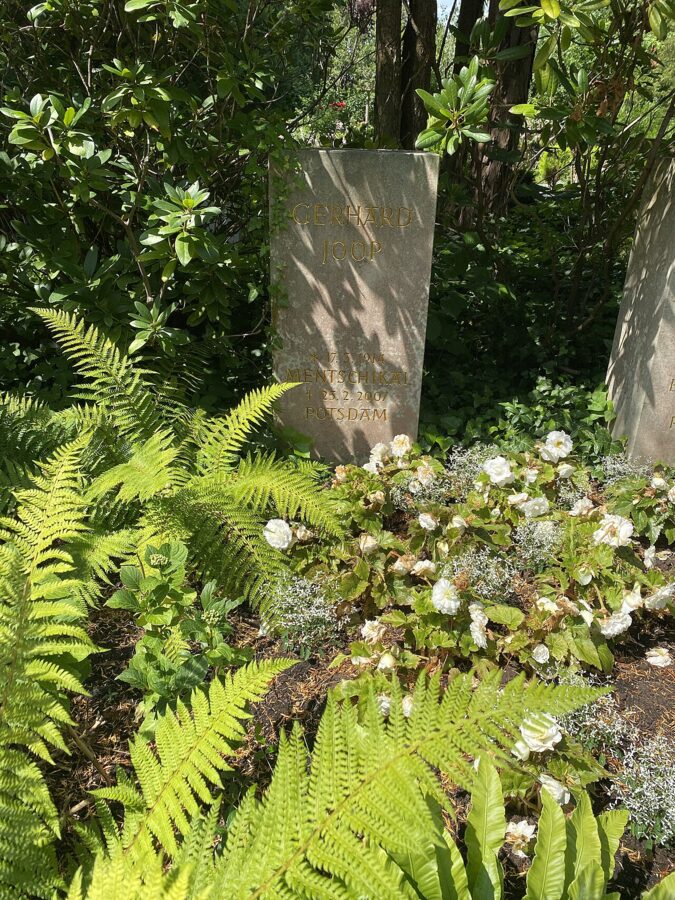
Finding the graves
Enter through the gatehouse at the south end of the church arcade. Overview boards with plans stand at the entrances and at the gates into each part, and signposts point the way to the Sello cemetery and the best-known graves. The Friends keep a list of notable graves with short biographies, and it is worth reading on your phone as you walk.
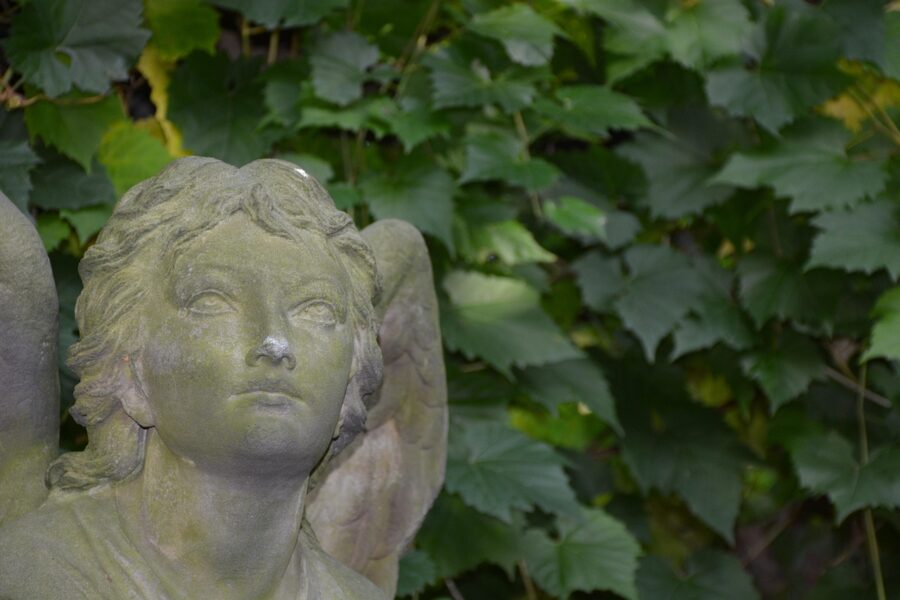
For the stories behind the stones, join a tour. The Friends run public cemetery tours on the first Saturday of each month between April and October, meeting at 14:30 in the church, and group tours by arrangement. This is a working cemetery with new burials, so keep to the paths and keep your voice down.
The walk from Sanssouci
From the top terrace of Sanssouci Palace, walk to the Historic Mill just west of it, on the road along the top of the park. Go past the mill into the small street called An der Orangerie and follow it to Ribbeckstraße. Turn right, and the Krongut gateway and the church arcade face each other a short way along. From the palace it is about 400 meters, an easy ten minutes.
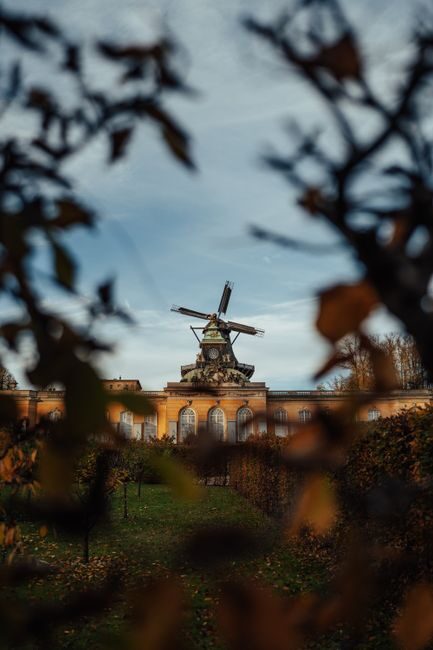
If you are coming from the bus, the Schloss Sanssouci stop on bus 695 is by the mill, so the walk is the same. You can also make Bornstedt the turning point of a longer loop. Climb the Ruinenberg on the way back for the view down onto the palace roof, then drop back into the park.
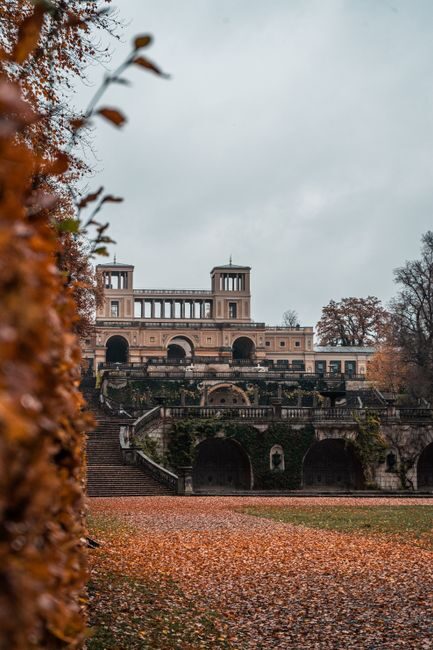
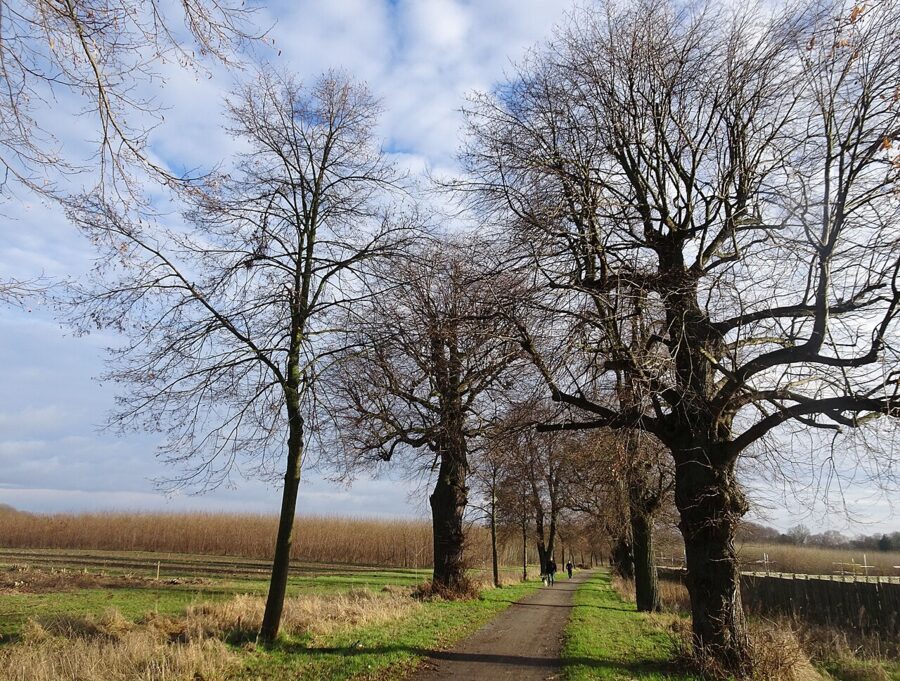
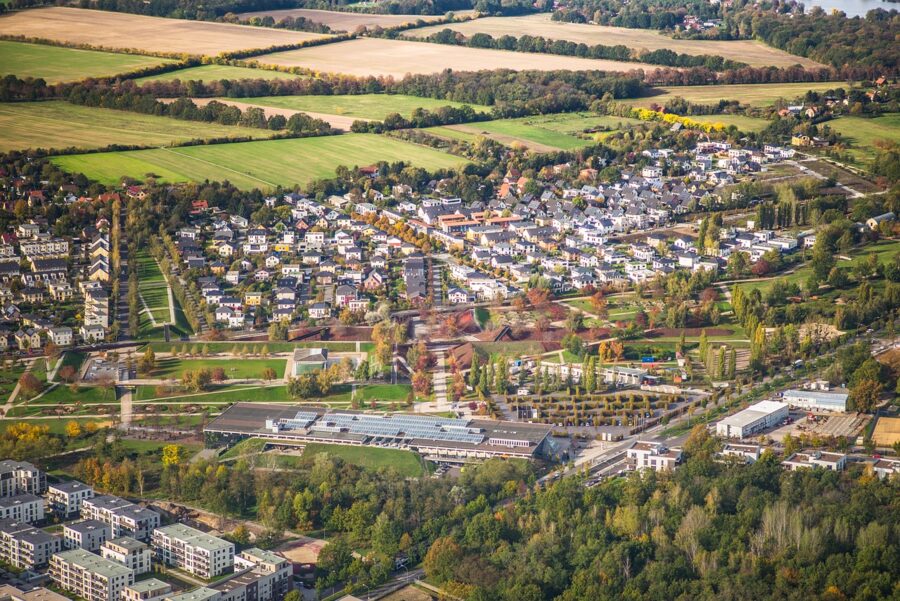
North and east of the village, the old drill ground of the Bornstedter Feld is now the Volkspark Potsdam, built for the federal garden show of 2001. From the Krongut it is a walk of about 2 km north and east across Bornstedt to the park and the rainforest hall of the Biosphäre, a good move with children; the Potsdam with kids guide has more. Westward, Hermann Sello’s restored lime avenue leads out across the open fields toward Bornim, a quieter walk with bicycles welcome.

Getting there, eating and timing
From Berlin, take the S7 or the RE1 to Potsdam Hauptbahnhof, the main station; the day trip from Berlin guide covers the trains. A single ticket Berlin ABC costs €5.00 in 2026 and the 24-hour ticket €12.90, rising to €5.20 and €13.20 on January 1, 2027. Both cover the trams and buses in Potsdam, and the Deutschlandticket is valid too.
- Tram 92 from the main station toward Bornstedt, Kirschallee: ride to the end of the line, then walk about seven minutes to the Krongut.
- Bus 695 from the main station to the stop Schloss Sanssouci, then the walk past the mill described above, about five minutes.
- Buses 614 and 650 from the main station to the stop Ribbeckstraße, about four minutes on foot from the estate.
- By car, follow the brown KRONGUT signs off the B 273 to the visitor car park, three to five minutes from the gate, or use the car park at the Historic Mill.
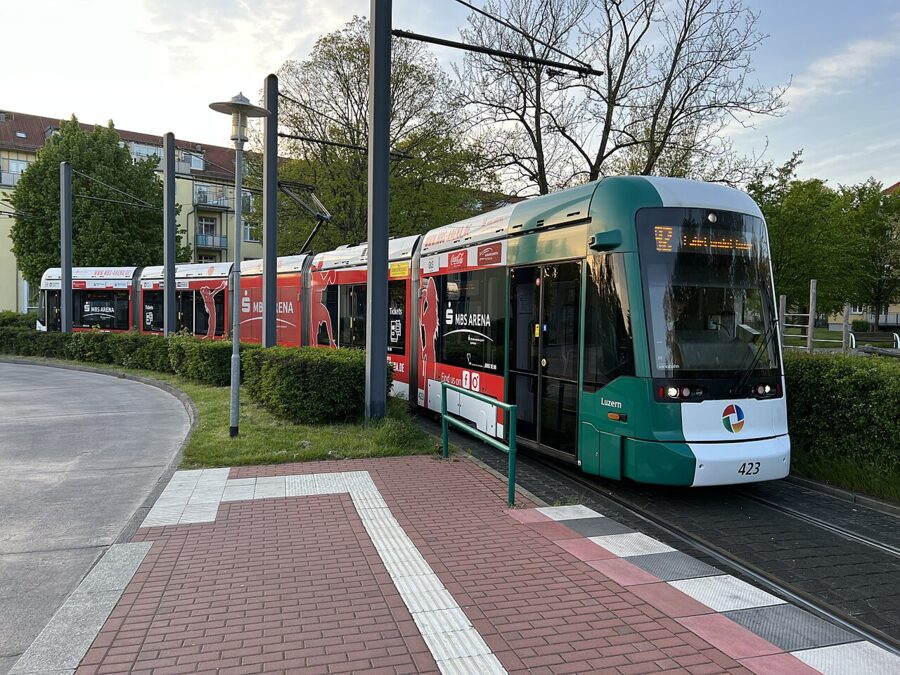

The operator’s directions page for the Krongut repeats these routes, and by bicycle it suggests leaving the R1 long-distance route at the Templiner See and following the signs toward Marquardt, about 5 km. The city’s own page on the Krongut puts the estate at 400 steps from the palace, which is generous, but not by much.
For food, the HofBrasserie is the only café on the estate, and its hours are short. For a proper meal, eat in town before or after: the Potsdam restaurants guide covers the old town and the streets around the Brandenburg Gate, about half an hour’s walk away.
Timing is simple. Come on a weekend afternoon, when both the café and the church are open, or on the first Saturday of the month between April and October for the cemetery tour. Early summer is best for the roses and the fields, and December for the Advent village; the best time to visit Potsdam guide sets out the palace seasons. If you have only one day, put Bornstedt after Sanssouci Palace and before the train: the things to do in Potsdam list will tell you what else to fit in, and the history of Potsdam fills in the kings.
Then stand under the arcade again on your way out. The Norman Tower on the Ruinenberg sits where the king meant it to sit, at the end of the church’s line, and somewhere behind the yews Lenné has his laurel. The palace he worked for is ten minutes back down the lane, and Bornstedt is where it kept the people who made it.