

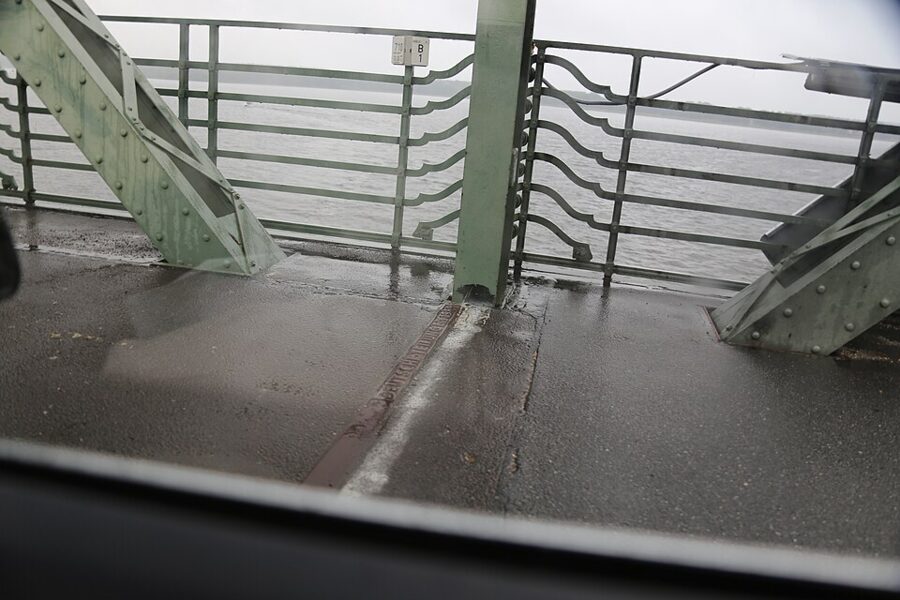
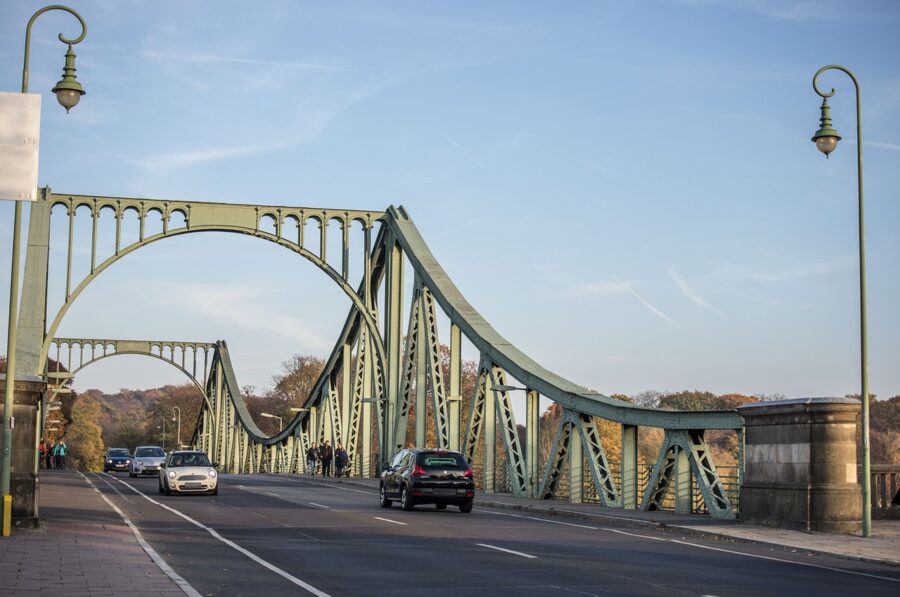
Stand at the exact middle of the Glienicke Bridge (Glienicker Brücke) and look up at the steel. The half toward Potsdam is painted a lighter green than the half toward Berlin, and the change happens right over your head, above a thin metal strip in the sidewalk. When West Berlin paid for the bridge’s repair in 1985, the paint came from a single West Berlin works, and still two different greens went on, one for each half. Nobody has matched them since, and the seam sits exactly on the old border.
That line is why people come. Three times, in 1962, 1985 and 1986, the United States and the Soviet bloc walked prisoners across it, and the press gave the bridge the nickname Hollywood later borrowed: the Bridge of Spies. The story is better than the nickname, and the setting is better than its fame suggests, with a palace at each end and a church across the lake that spent the Cold War trapped inside the Wall.
Give it an afternoon. The bridge and its two banks take about two hours on foot; make it half a day if you go inside Glienicke Palace and walk on to Babelsberg. Everything on the banks makes more sense once you know what happened in the middle, so the history comes first.
Contents10 parts
- Where the Havel narrows
- 1945 and the Bridge of Unity
- The border bridge
- The three exchanges
- Bridge of Spies, the film
- November 10, 1989, and after
- The Potsdam bank: Berliner Vorstadt and Villa Schöningen
- The Berlin bank: Glienicke Palace and Klein Glienicke
- Across the water: the church at Sacrow
- Getting there and walking it
Where the Havel narrows
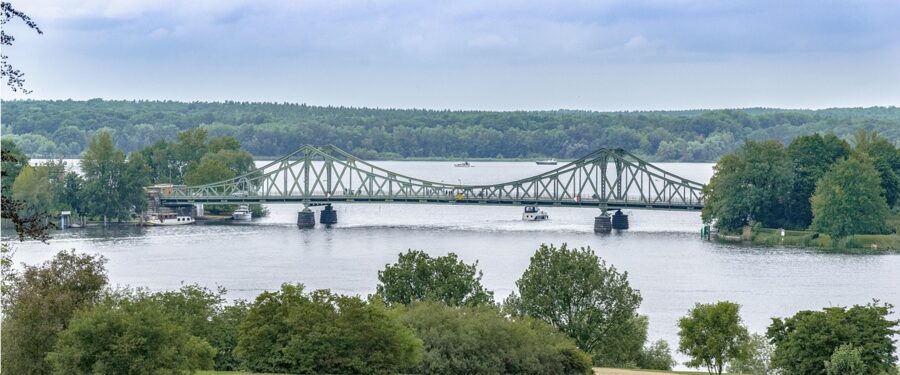
Look north from the bridge and the Havel opens into the Jungfernsee; look south and it fills the Glienicker Lake, where the Teltow Canal begins. A crossing has stood on this throat between the two for more than three centuries. The bridge’s long axis runs exactly east to west, so at the equinoxes the sun rises over the Berlin end and sets straight down the road into Potsdam.
The name comes from the old estate of Klein Glienicke on the Berlin bank, where Glienicke Palace stands today. Big barges never pass underneath: freight on the Havel cuts across the loop through the Sacrow-Paretz Canal to the north. The traffic under the Glienicke Bridge is excursion boats, sailing dinghies and the odd rowing eight.
Wood, then Schinkel’s brick
The first bridge was a narrow wooden one, built so the court could ride from the Potsdam palaces to the hunting grounds on the far bank, and for decades only the nobility used it. German sources date it to the end of the seventeenth century; English ones round it to about 1660. In 1754, under Frederick the Great (Friedrich II), a regular post route between Berlin and Potsdam was opened over it, and ordinary coaches followed.
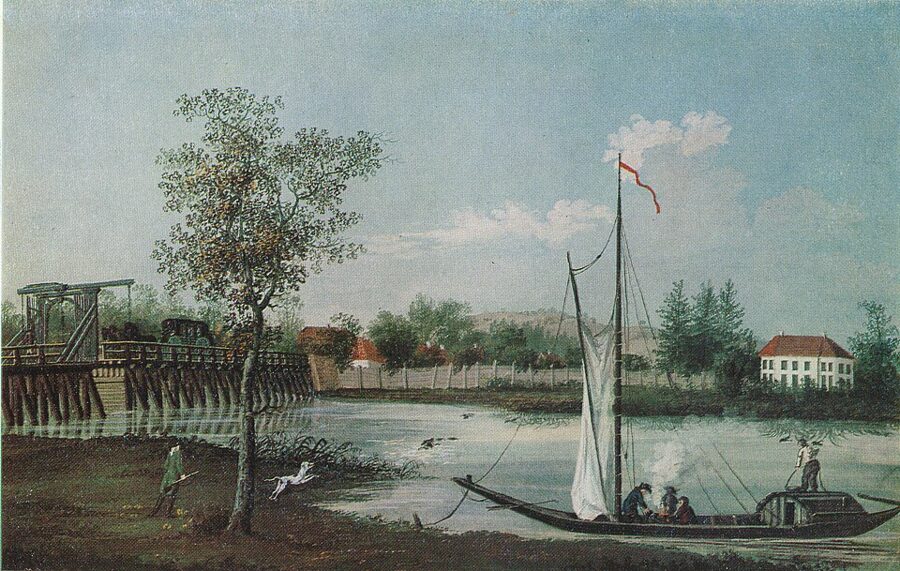
Traffic grew so fast that a new wooden drawbridge with a guardhouse at each end replaced the first one in 1777. It got the crossing’s first barrier pole, because coachmen kept driving straight through the checks. When the road was rebuilt as a model Prussian highway in 1792–1795, a tollhouse went up, and officials collected a fee from everyone except the nobility. The checkpoint, in other words, is older than the border.
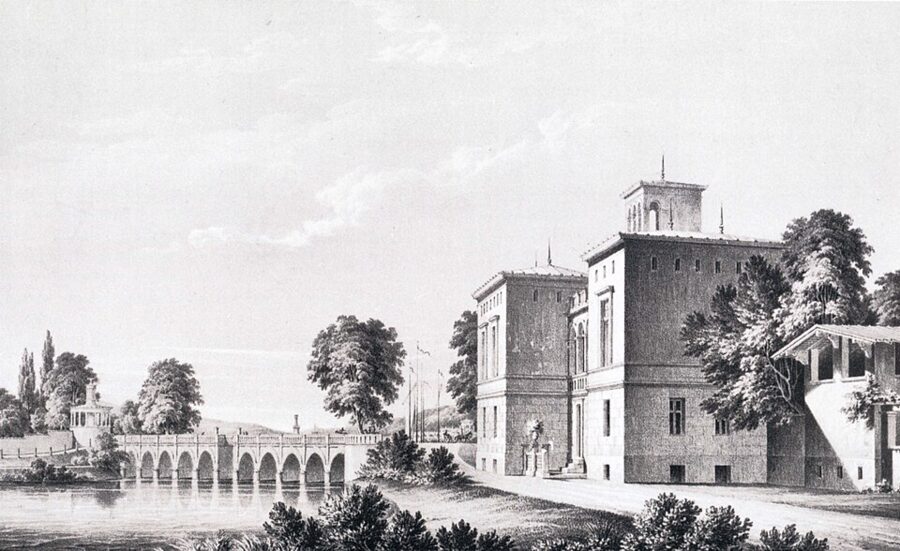
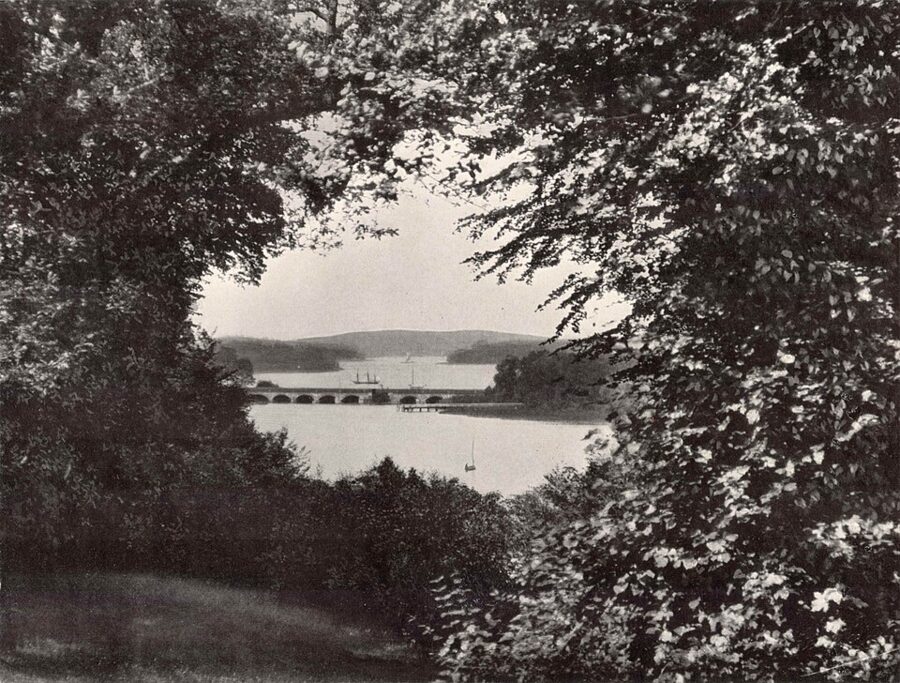
The third bridge was Karl Friedrich Schinkel’s: a brick bridge of about 177 m with a drawbridge in the middle, begun in 1831 and opened on September 30, 1834, its roadway only about 6.5 m wide. That same year the steamer Henriette passed under it carrying a lion, two anteaters and two monkeys from Hamburg to the royal menagerie on Peacock Island (Pfaueninsel), with two Prussian princes along for the ride.
The steel bridge of 1907
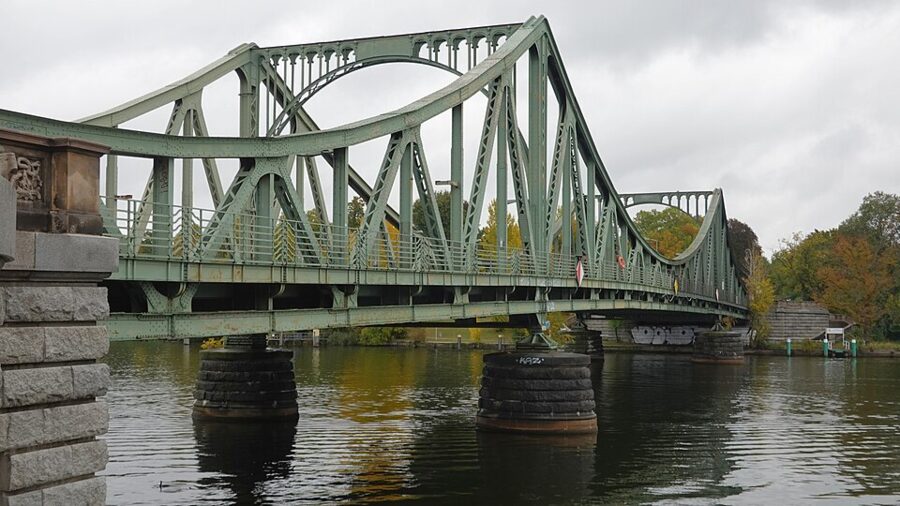
When the Teltow Canal opened in 1906 it ended right at Schinkel’s drawbridge, and road traffic had reached about 11,400 carts and motor vehicles a month. Over the protests of preservationists, the brick bridge came down and the present steel truss bridge, by the Duisburg firm of Johann Caspar Harkort, opened on November 16, 1907. Its official name was Kaiser-Wilhelm-Brücke. Nobody used it.
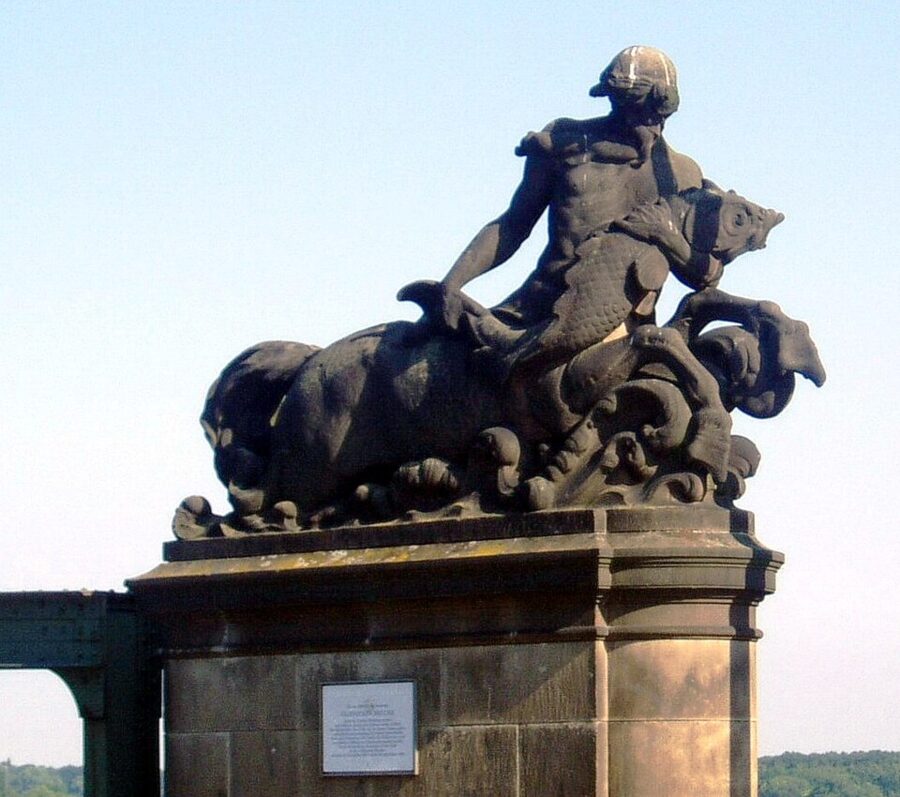
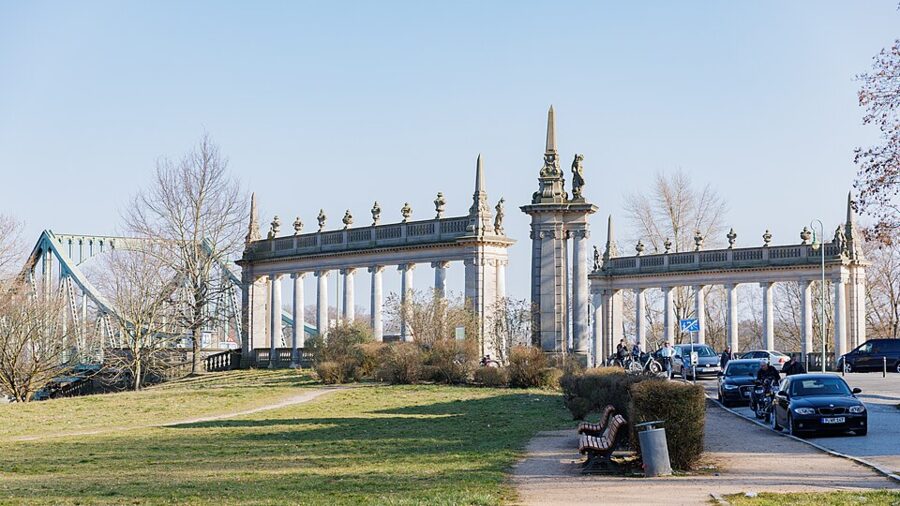
Critics did not love it either; one called it a clumsy iron construction. The builders dressed it up anyway. On high pedestals at the ends of the two trusses stand four stone centaurs by the sculptor Stephan Walter, and at the Potsdam end two curved colonnades by the architect Eduard Fürstenau frame the road like a city gate.
The bridge was also laid with tram rails for an extension of the Potsdam tramway to Wannsee. The plan died after the First World War, the rails came out in 1934, and tram 93 still ends its run at the Potsdam end of the bridge. From 1937 the road was widened to four lanes, and in 1938 Schinkel’s pavilion at the Berlin end, the Große Neugierde, was moved 4.5 m north to make room.
1945 and the Bridge of Unity
In the last days of April 1945, as the Red Army fought its way into Potsdam’s Berliner Vorstadt, the bridge was partly wrecked. German engineers had fixed demolition charges to every pier, but the man meant to fire them was waiting for an attack from the Berlin side, and the Soviets came from behind him instead. The detailed German account says Soviet tanks fired on the bridge and hit two of the charges, which brought down part of it; other accounts blame a single shell. Either way, nobody blew it up on purpose.
That summer the victors met at Cecilienhof for the Potsdam Conference, and Soviet engineers laid a pontoon bridge beside the ruin for delegates coming out from Berlin. Rebuilding began on November 3, 1947, under the engineer Hans Dehnert, who had the fallen steel lifted back into place in its original form. The repair weakened the structure, so the sidewalks moved inward and the roadway shrank from 13 m to 11 m.
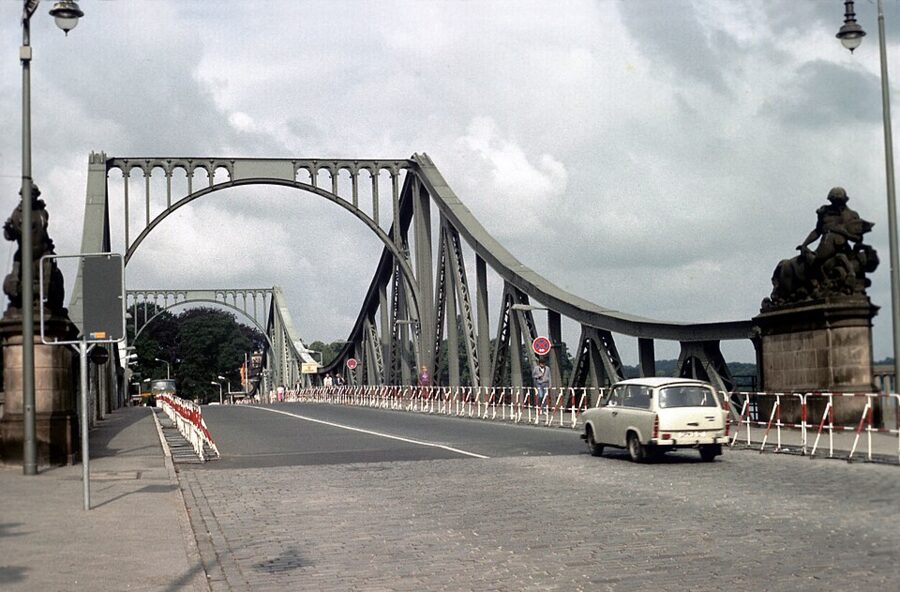
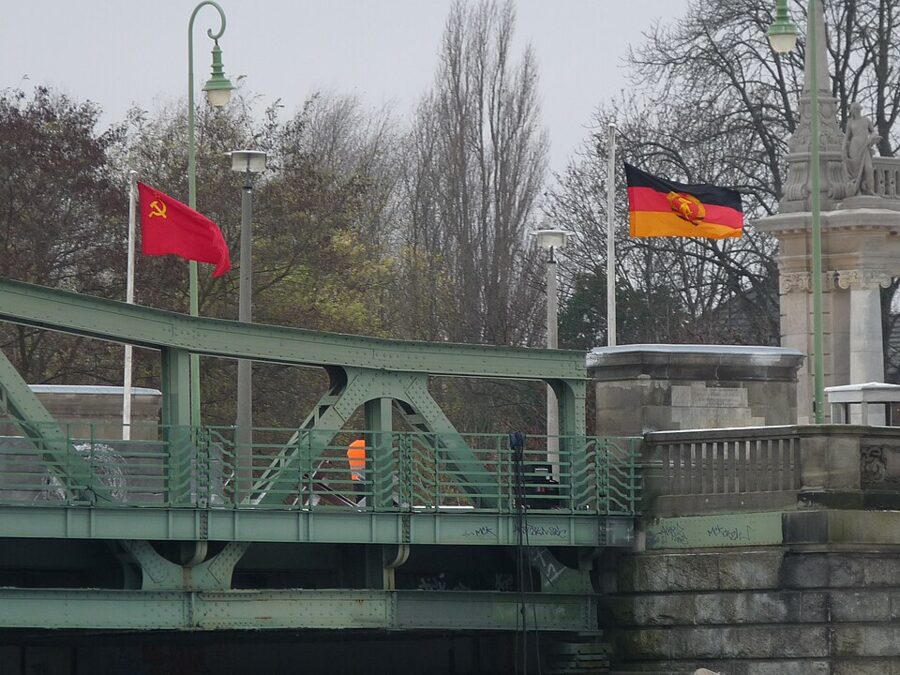
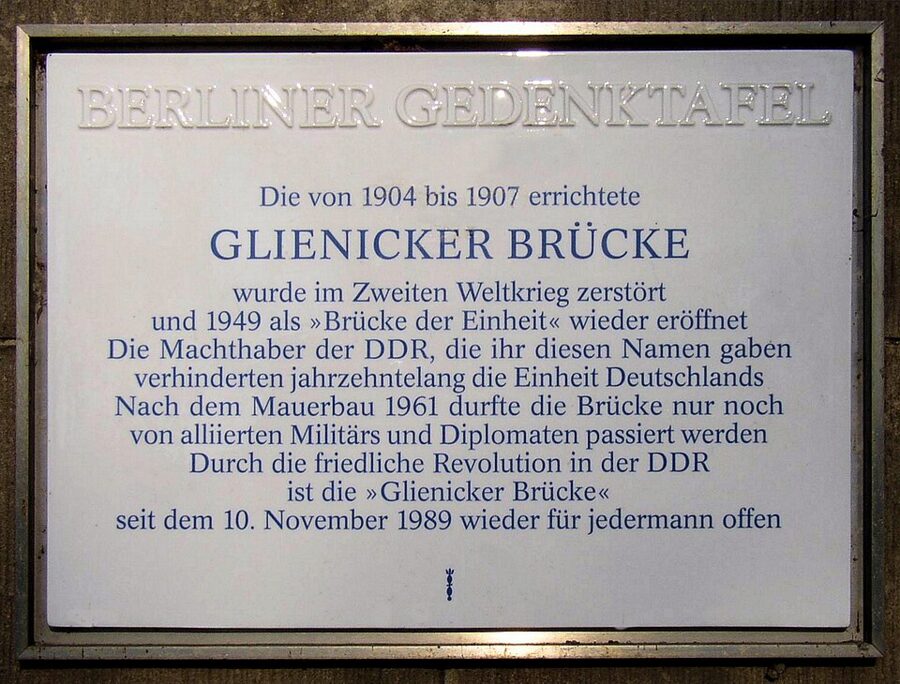
The bridge reopened on December 19, 1949, two months after the founding of the German Democratic Republic. The Brandenburg government renamed it the Brücke der Einheit, the Bridge of Unity, a name that aged badly. A white line was painted across the middle to mark the boundary between the GDR and West Berlin.
The border bridge
On May 27, 1952, East Germany closed the bridge to West Berliners and West Germans, who from then on needed a special permit. East Germans could still cross, under checks, until August 1961. After the Wall went up, only Allied military personnel and diplomats could use it.
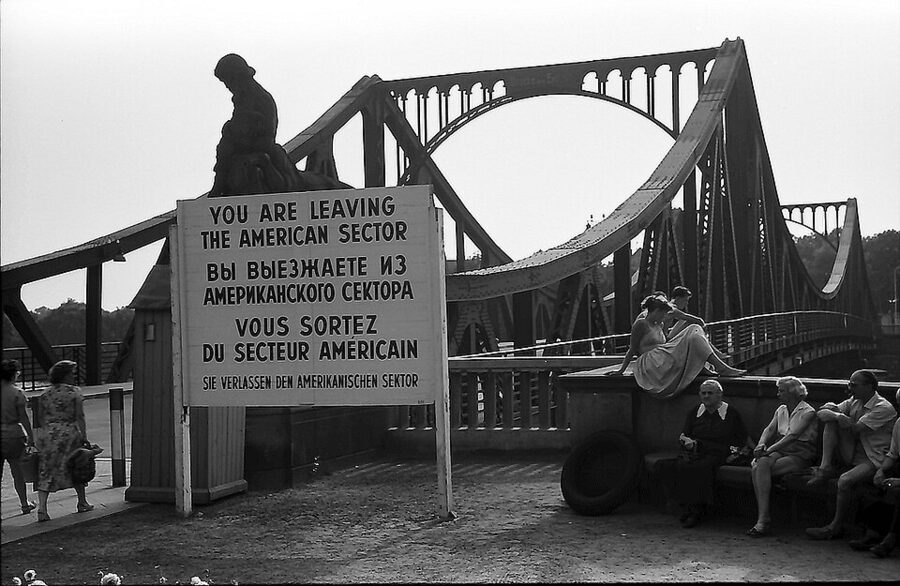
The people who did cross were mostly soldiers in olive-drab cars. Under postwar agreements the United States, Britain and France each kept a small military liaison mission in Potsdam, matched by Soviet missions in West Germany. Their teams lived in West Berlin and drove out over the bridge to their mission houses, the British and French near the Seestraße, the Americans in Neu Fahrland, and set off from there on tours of East Germany that were partly diplomacy and mostly watching.
What set this crossing apart from every other way out of West Berlin was who stood guard. Elsewhere East German border troops ran the checkpoints; here the post on the eastern side was Soviet. That, and the ease with which both superpowers could reach it and seal it off, made it the place to trade people.
By the 1970s the steel needed serious work, and the two sides could not agree on who should pay. On November 15, 1984, East Germany closed the bridge for safety reasons. On December 20, 1984, West Berlin announced it would cover the repair, estimated at two million marks, and the bridge came through the repair still in its two greens.
In March 1985 the body of Major Arthur D. Nicholson, an American liaison officer shot by a Soviet sentry, was handed back to the American army here. Between 1978 and 1987 the British returned three aircraft over the bridge, two light planes and a glider in which East Germans had fled to the British airfield at Gatow. And at about 02:00 on March 10, 1988, three people from Potsdam smashed through the barriers into West Berlin in a stolen W50 truck.
The three exchanges
“Bridge of Spies” covers three days spread over 24 years and about forty people. The sources do not quite agree on the totals, the dates or the order of events, and where they differ, I say so.
February 10, 1962: Abel for Powers
On May 1, 1960, a Soviet missile brought down a CIA U-2 spy plane over the Soviet Union, and its pilot, Francis Gary Powers, was tried in Moscow and sentenced to ten years. In an Atlanta penitentiary sat the man the Americans had to offer: a KGB colonel arrested in New York in 1957, who called himself Rudolf Abel and was serving 30 years for espionage. His real name was William Fisher, born in 1903 in Newcastle upon Tyne to Russian parents, which came out only after his death in 1971.
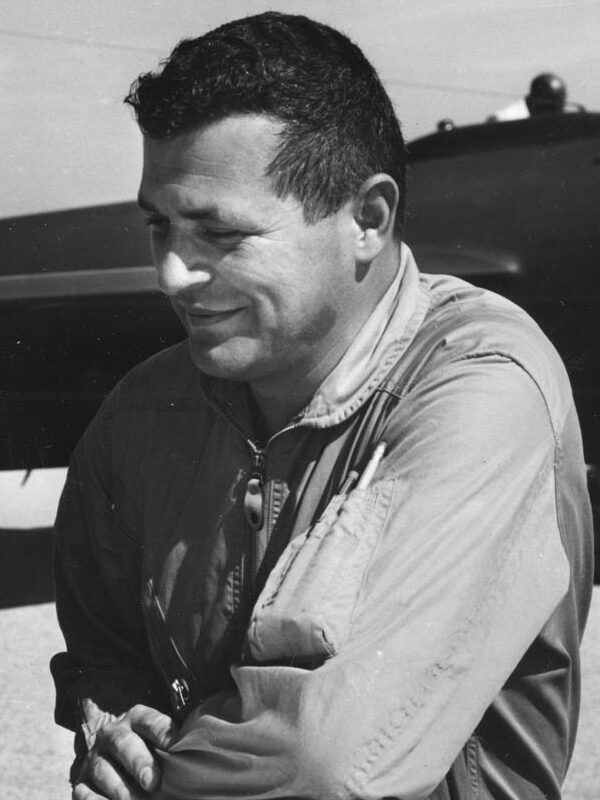
The deal came together through lawyers. James B. Donovan, the New York attorney who had defended Abel, corresponded with a “Mrs. Abel” in East Germany, whose lawyer was Wolfgang Vogel, an East Berlin attorney with close ties to the East German state.
President John F. Kennedy approved the swap. The East Germans added a condition: Frederic Pryor, a 28-year-old American economics student arrested by the Stasi in August 1961.
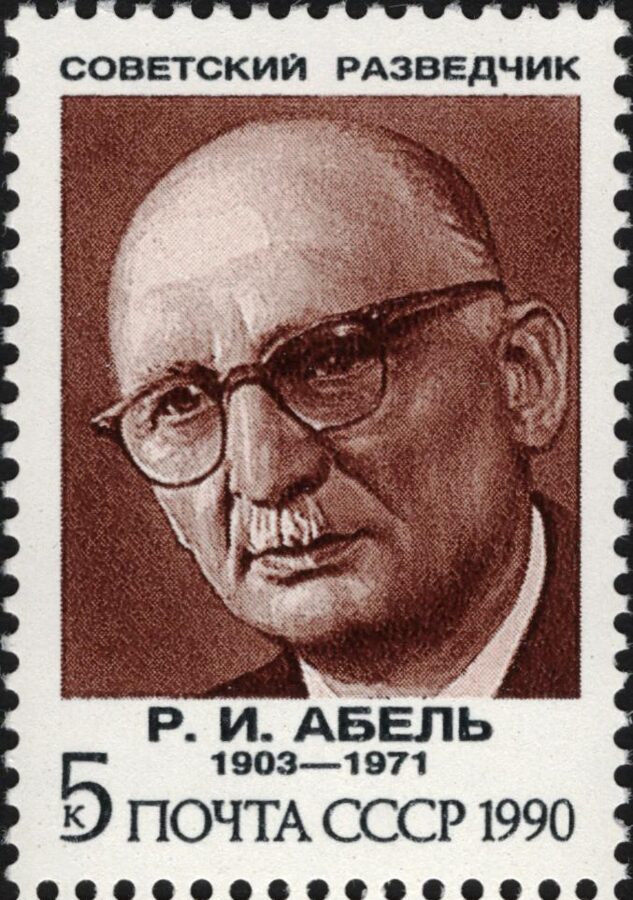
On the morning of Saturday, February 10, 1962, the two prisoners were brought to opposite ends of the bridge, identified and exchanged at the white line. Pryor was never on the bridge. He was released at Checkpoint Charlie in the city center, and here the accounts diverge: some say he was freed first and the bridge swap waited until that was confirmed, others that both happened at the same moment.
The State Department’s record of the exchange settles the outcome, Abel for Powers and Pryor, not the choreography. For that, the best source is still Donovan’s own book, Strangers on a Bridge.
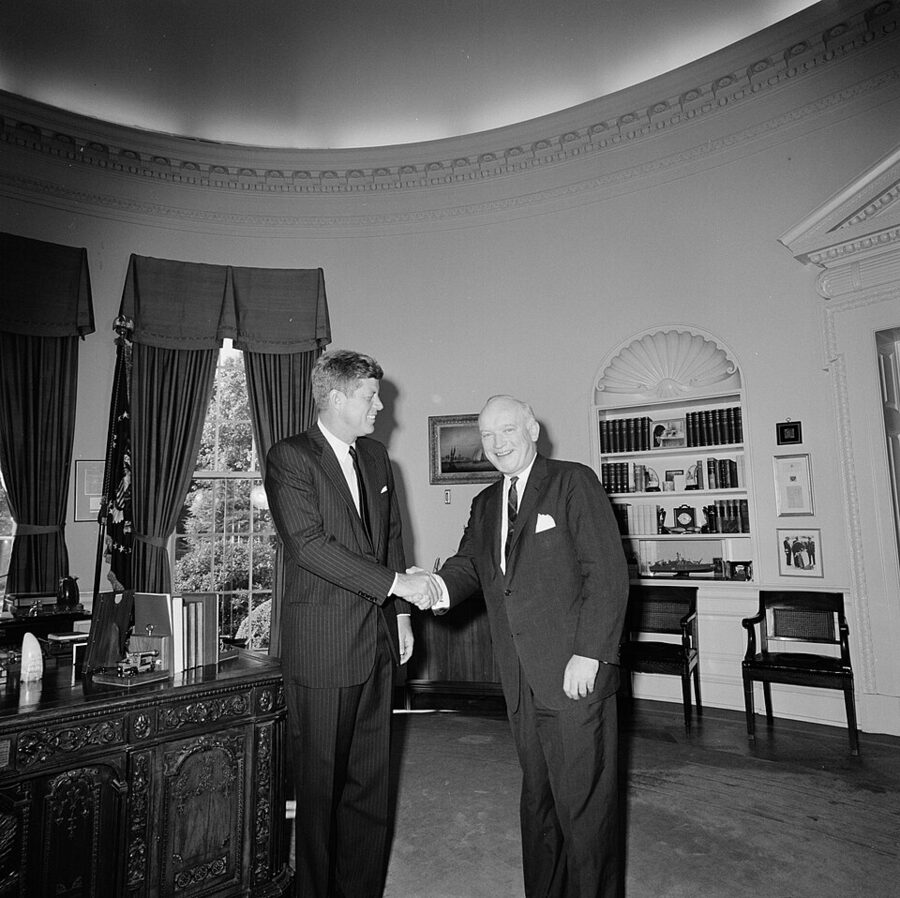
The secrecy did not last; the swap made headlines everywhere, and the nickname stuck. For Vogel it was the start of a career. Until the Wall fell he took part in the release of some 150 agents from 23 countries, and he became East Germany’s negotiator in the sale of political prisoners to West Germany, which bought the freedom of more than 33,000 people.
June 1985: twenty-three for four
More than twenty years passed before the next exchange, and it was the largest. After three years of negotiation, with Vogel again in the middle, 23 people held in East Germany and Poland, most of them convicted as Western agents, walked west in return for four Eastern Bloc agents arrested in the West. Among the four were Marian Zacharski, a Polish intelligence officer who had bought secrets on Hawk and Patriot missiles from an employee of Hughes Aircraft, Alfred Zehe and Alice Michelson.
Vogel had agreed to 25 names; 23 came across. Even the date depends on whom you read: the German record gives June 11, 1985, English accounts usually June 12.
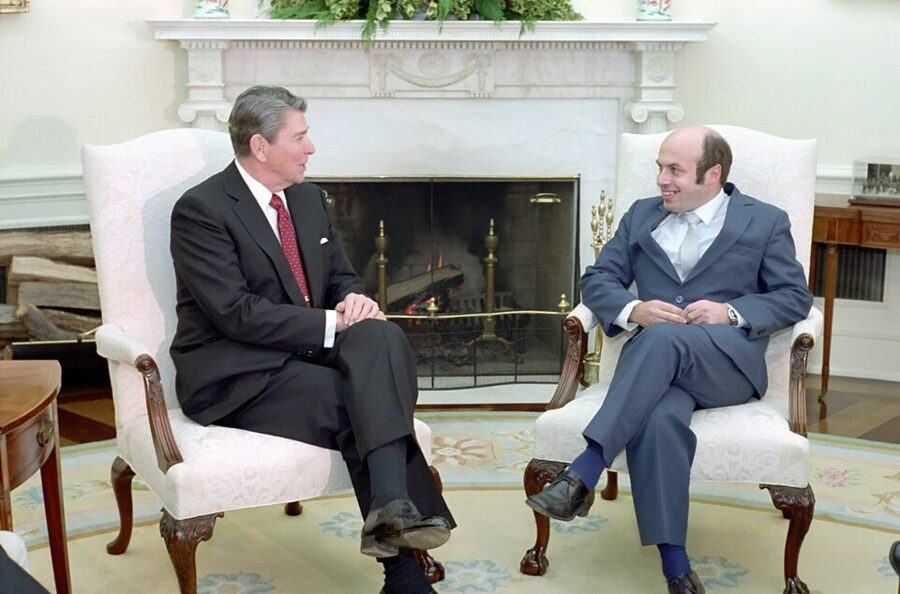
February 11, 1986: Shcharansky walks first
The last exchange was the most public. Anatoly Shcharansky, a Soviet Jewish dissident convicted of treason and anti-Soviet agitation, had become the best-known political prisoner in the Soviet Union through a campaign led by his wife, Avital, and he was the first one Mikhail Gorbachev let go. He and three Western agents, Jaroslav Javorský of Czechoslovakia and the West Germans Wolf-Georg Frohn and Dietrich Nistroy, were traded for five Eastern agents held in the West. Among them were Karl and Hana Koecher; Karl had spied on the CIA from inside it.
The two sides had argued for months over what Shcharansky was. Moscow called him a spy; Washington refused to have him counted as one, and won the point. He was driven to the line first and alone, and crossed ahead of the swap proper, accompanied by the American ambassador to West Germany, Richard Burt.
German accounts add that his guards sent him over in trousers too big for him and no belt, so that he crossed holding them up in front of the cameras. Western media covered the day at length; in East Germany the party paper, Neues Deutschland, gave it a few lines.
Fiction got here first. The 1966 Harry Palmer film Funeral in Berlin, from Len Deighton’s novel, stages a trade on the bridge, and in 1986 the British band T’Pau called their first album Bridge of Spies. Filmmakers who cannot close the real thing often use Berlin’s Swinemünder Brücke instead; the giveaway is the cross-bracing over the roadway, which the Glienicke Bridge does not have.
Bridge of Spies, the film
Steven Spielberg’s Bridge of Spies (2015) is how most people under fifty know this bridge. Tom Hanks plays Donovan, Mark Rylance won an Oscar as Abel, and Sebastian Koch plays Vogel. The production was based at Studio Babelsberg, and for the exchange scene the real bridge was closed over the weekend of November 28 to December 1, 2014, and dressed back to its 1962 state. Chancellor Angela Merkel came to watch.
The film is right in outline and loose in detail. Pryor said his part was told wrongly: he was on vacation in Denmark when the Wall went up and was arrested later, visiting the apartment of a friend’s sister. Donovan was threatened at home but never shot at, his coat was never stolen, and he did not see anyone shot at the Wall; the killing of Peter Fechter came the summer after the exchange.
Pryor also felt Vogel came off unfairly; he remembered a quiet, well-spoken man and became his friend. Watch it anyway, ideally the night before you come. The bridge you walk across is the bridge on the screen.
November 10, 1989, and after
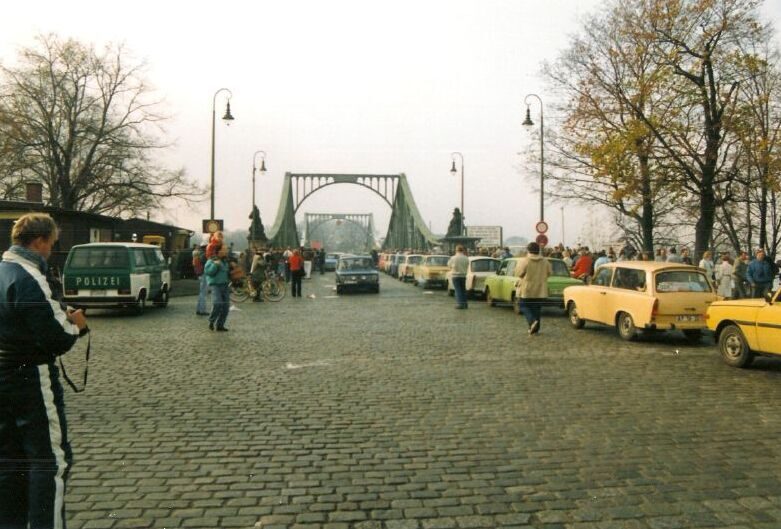
The Wall opened in central Berlin on the night of November 9, 1989. The Glienicke Bridge followed the next evening, November 10, when it opened to people on foot. The unification treaty of 1990 ended all controls, and the bridge became an ordinary stretch of the Bundesstraße 1 again.
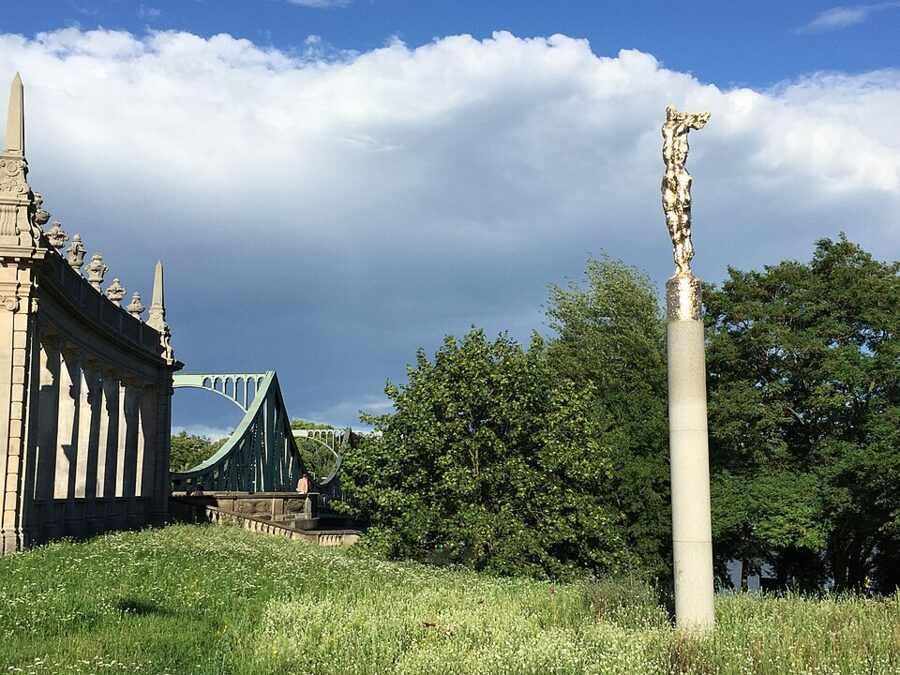
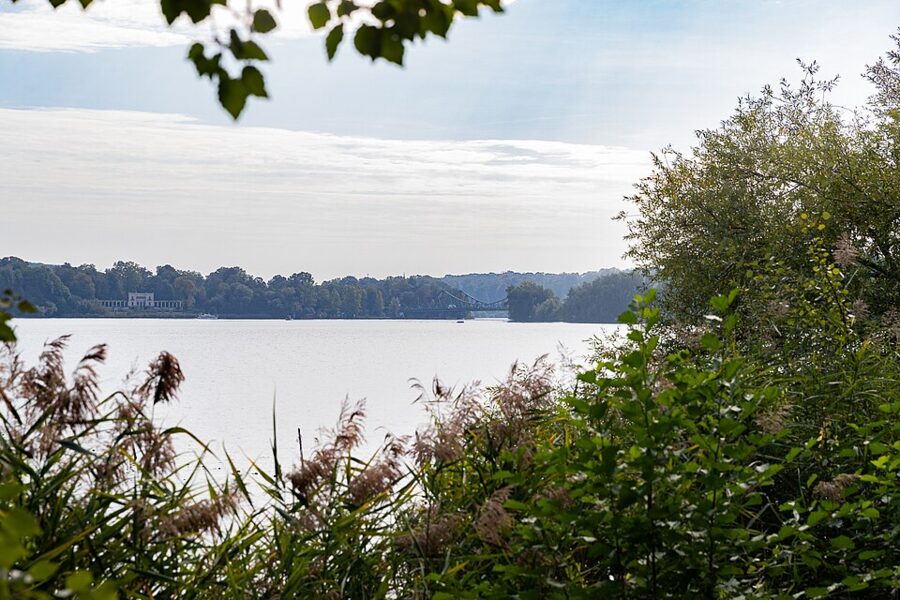
The memorials are low-key, which suits the place. A brown plaque at the Potsdam end records the reopening and a plaque at the Berlin end tells the bridge’s history. By the Potsdam bank stands Wieland Förster’s bronze Nike 89, unveiled on November 10, 1999, in memory of the fall of the Wall. The bridge and its landscape belong to the UNESCO World Heritage Site of the palaces and parks of Potsdam and Berlin.
The Potsdam bank: Berliner Vorstadt and Villa Schöningen
The Potsdam end of the bridge belongs to the Berliner Vorstadt, a quarter of nineteenth-century villas between the Havel and the Heiliger See. The first house you reach, on the corner of Berliner Straße and Schwanenallee, is Villa Schöningen, the one building on either bank that lived through the whole Cold War at arm’s length from the bridge.
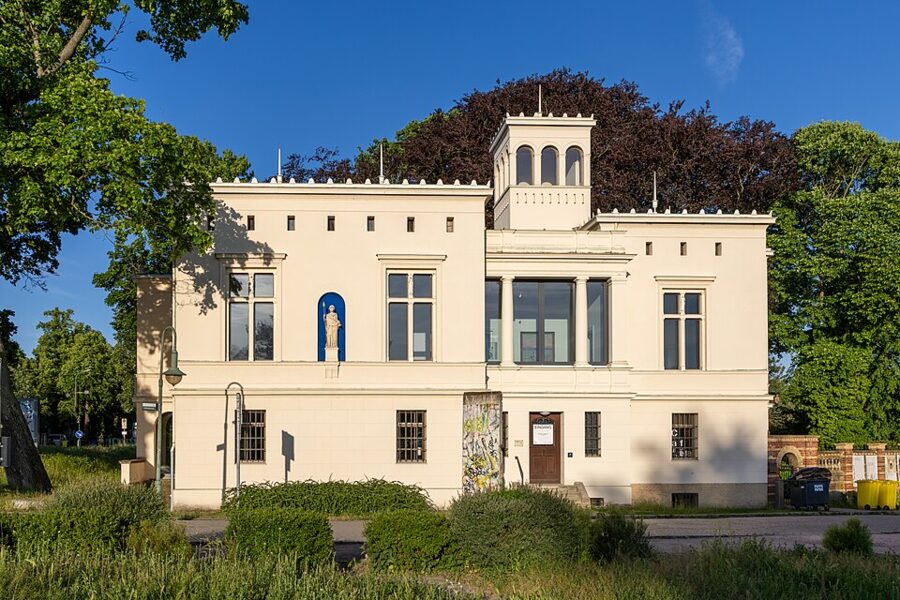
Ludwig Persius designed it in 1843 for Kurd Wolfgang von Schöning, court marshal to Prince Carl of Prussia, on the instructions of King Frederick William IV (Friedrich Wilhelm IV). A plain shipbuilder’s house on the lot spoiled the view from Prince Carl’s new palace at Glienicke, and the king wanted something here that would answer it. Persius kept the cellar and ground floor and built an Italian villa on top, with a figure of Minerva in a blue niche facing the Schwanenallee, a compliment to the military historian inside.
Later the family of the banker Hermann Wallich, one of the first directors of Deutsche Bank, used it as a summer house, and his son Paul made it his home. After the pogrom of November 1938, Paul Wallich took his own life. In 1945 the Red Army made the villa a field hospital, and from 1952 it was a weekly children’s home, where children stayed Monday through Friday.
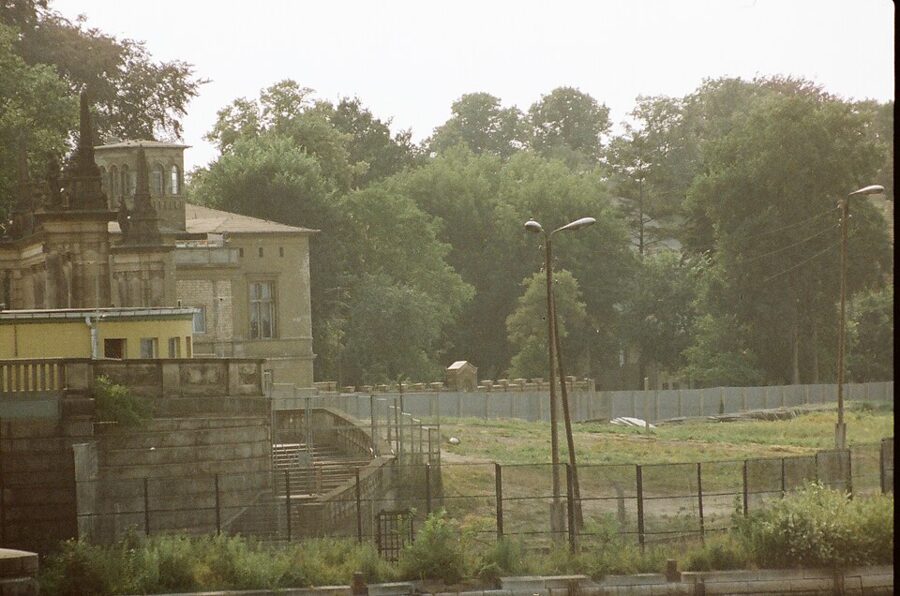
After August 1961 the border fence, later the Wall, ran about 15 m from the front door. The villa’s own history calls it the only such children’s home in the GDR inside the border strip.
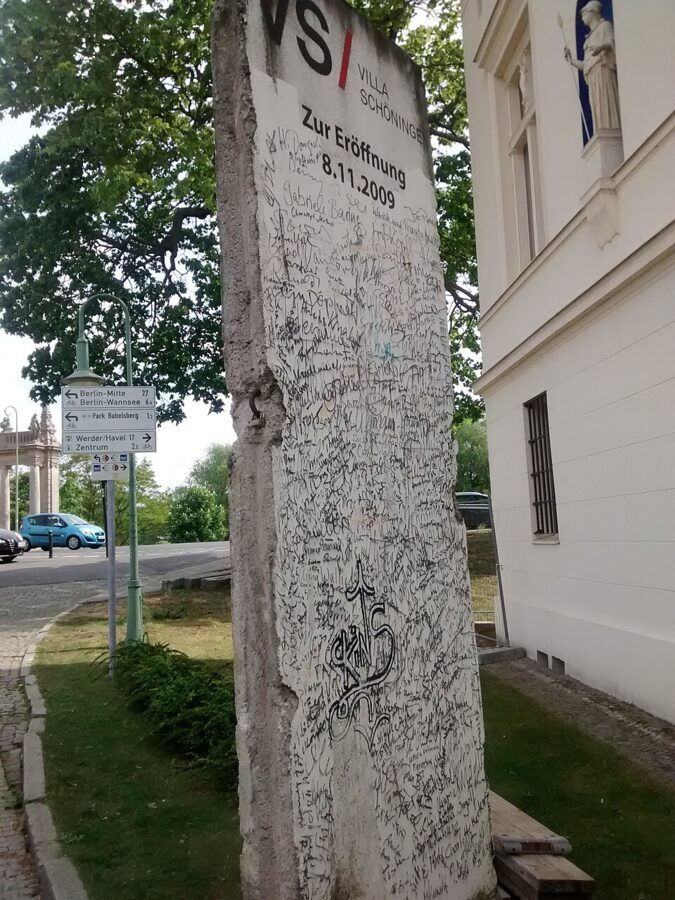
After reunification the house decayed, and a developer who wanted to demolish it was refused. In 2007 the publisher Mathias Döpfner and the banker Leonhard Fischer bought and restored it, and it opened on November 8, 2009, the eve of the Wall’s twentieth anniversary, with Angela Merkel, Mikhail Gorbachev and Henry Kissinger among the guests.
Know this before you go: Villa Schöningen is not a museum about the bridge. It shows changing exhibitions of contemporary art with older works from the Döpfner Collection; until March 31, 2027, the show is Zwischen Bäumen, about the forest in art. The bridge’s story is told on the villa’s monthly historical tours, which cover its place in the spy exchanges; the next is on November 29, 2026, at 14:00.
The villa’s opening hours in winter are Friday to Sunday, 11:00–17:00 (12:00–18:00 in summer), and admission is €8 (€5 reduced, free under 18). The ground-floor café, run by Pedales, keeps the same winter days and opens Tuesday to Sunday in summer, with soups, salads, homemade organic cakes and a view over the garden.
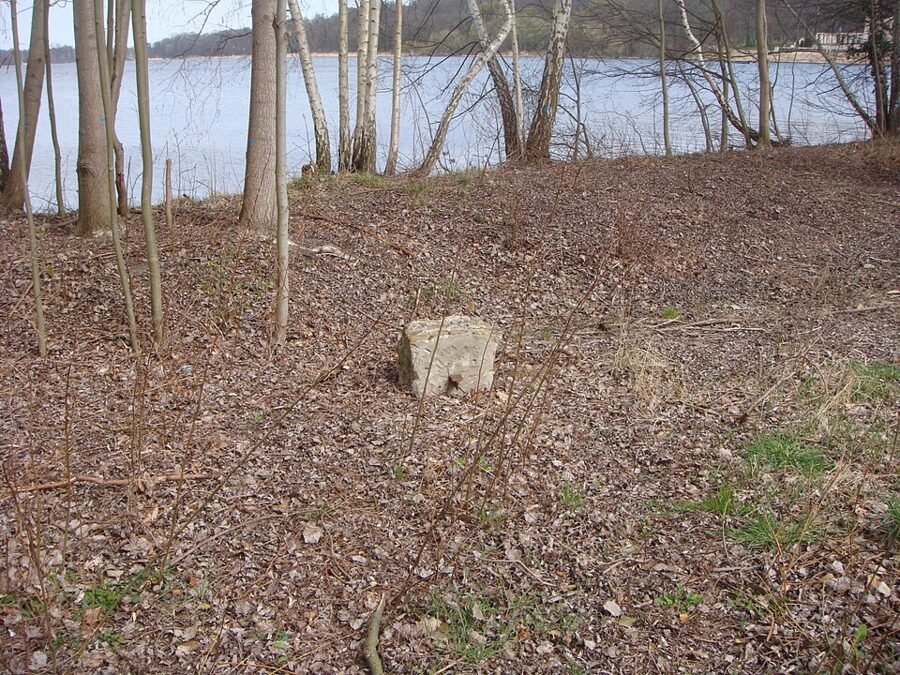
From the villa the Schwanenallee runs north along the shore of the Jungfernsee. The GDR’s fortifications followed the lake here too, and memorial plaques along the road explain the border installations and life in the zone. A little way along you pass the buildings of the Kongsnæs sailors’ station, built for the Kaiser’s boat crews in Norwegian style.
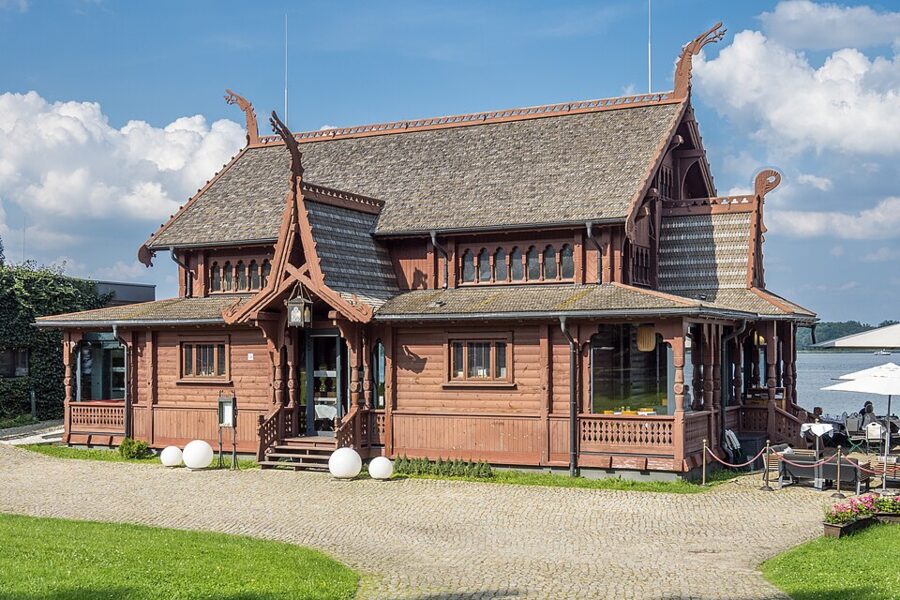
The Berlin bank: Glienicke Palace and Klein Glienicke
Cross to the Berlin end and the first thing you meet is Schinkel’s round pavilion, the Große Neugierde, the “great curiosity,” built in the 1830s as a lookout over the road and the water. Climb its steps for the best view of the bridge from the east bank.
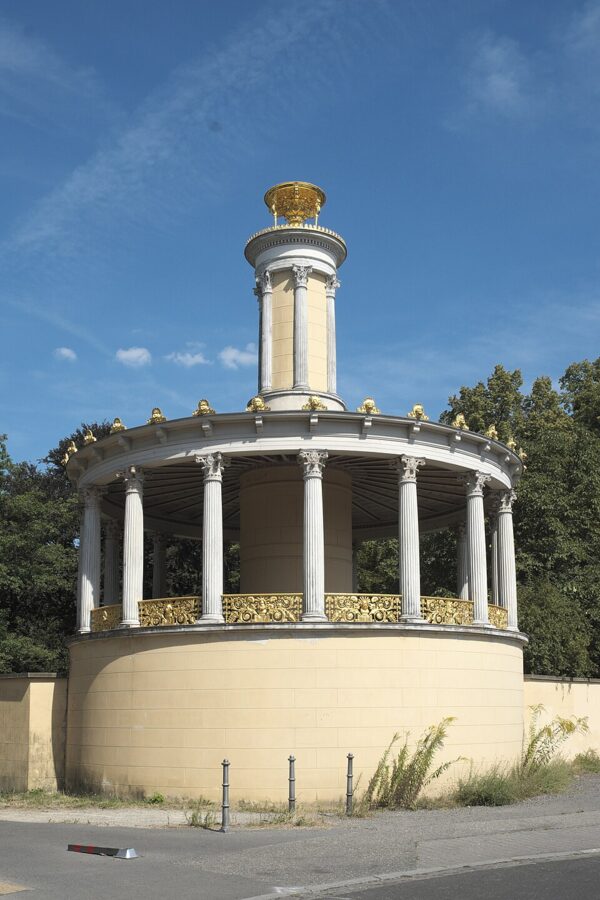
Behind it lies the park of Glienicke, the summer home of Prince Carl of Prussia, who came back from Italy in 1823 wanting a villa in a southern landscape. Peter Joseph Lenné had already laid out the grounds for the previous owner, Chancellor Hardenberg; Schinkel turned the manor house into a small classical palace and built the Casino on the shore. Carl set fragments of Roman sculpture into their walls, and on a summer evening the effect is genuinely Italian.
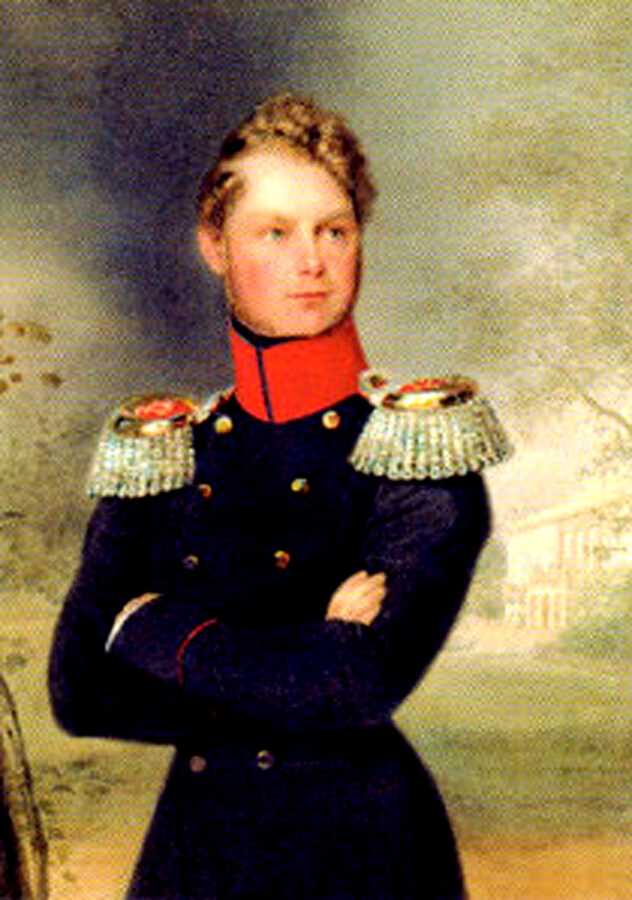
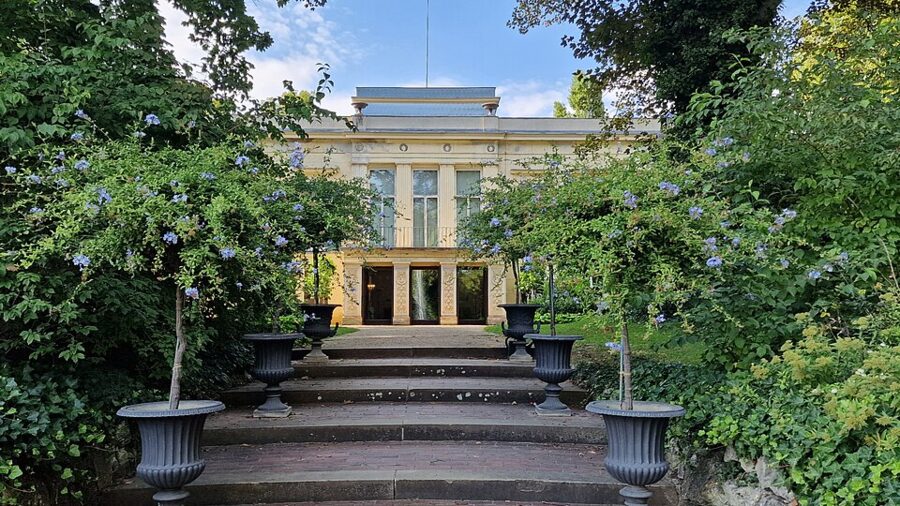
The palace is the one interior on either bank I would pay for. Inside are Schinkel’s rooms in strong colors, the red hall, green salon, turquoise bedroom and deep blue library, and in the west wing the Hofgärtnermuseum, devoted to the court gardeners who made these landscapes. Visits are by guided tour only, in German.
In November and December the Prussian Palaces and Gardens Foundation (SPSG) opens Glienicke Palace on Saturdays and Sundays, 10:00–16:00, with tours at 10:20, 11:40, 12:50, 14:00 and 15:20. Admission is €8 (€6 reduced); it is closed on December 24, 25 and 31. Check the foundation’s page for the longer spring and summer season.
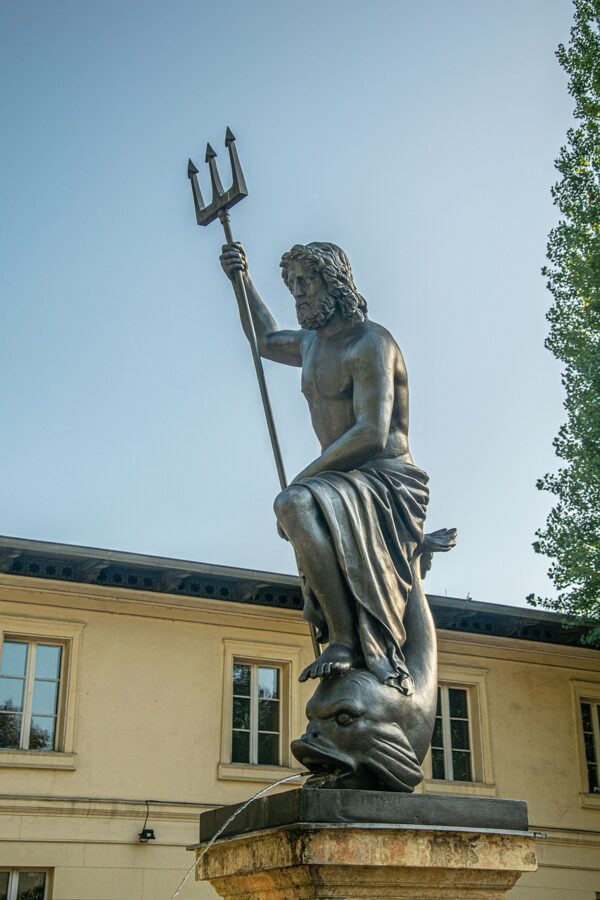
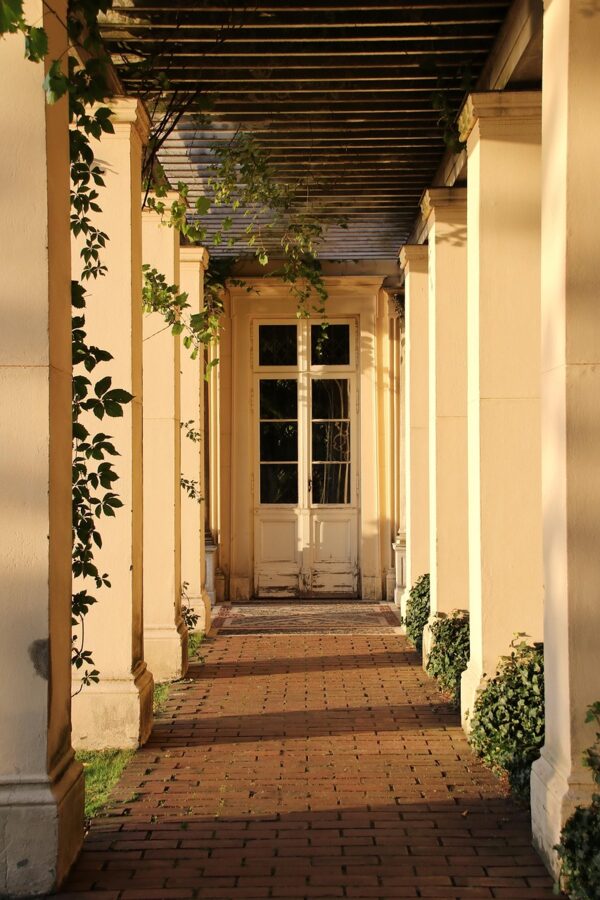
The park is free and open daily from 08:00 until dusk. Walk down to the Casino, whose long pergolas reach out along the shore; the Casino opens inside only for special events, but the pergolas and the view to Potsdam are there whenever the park is open.
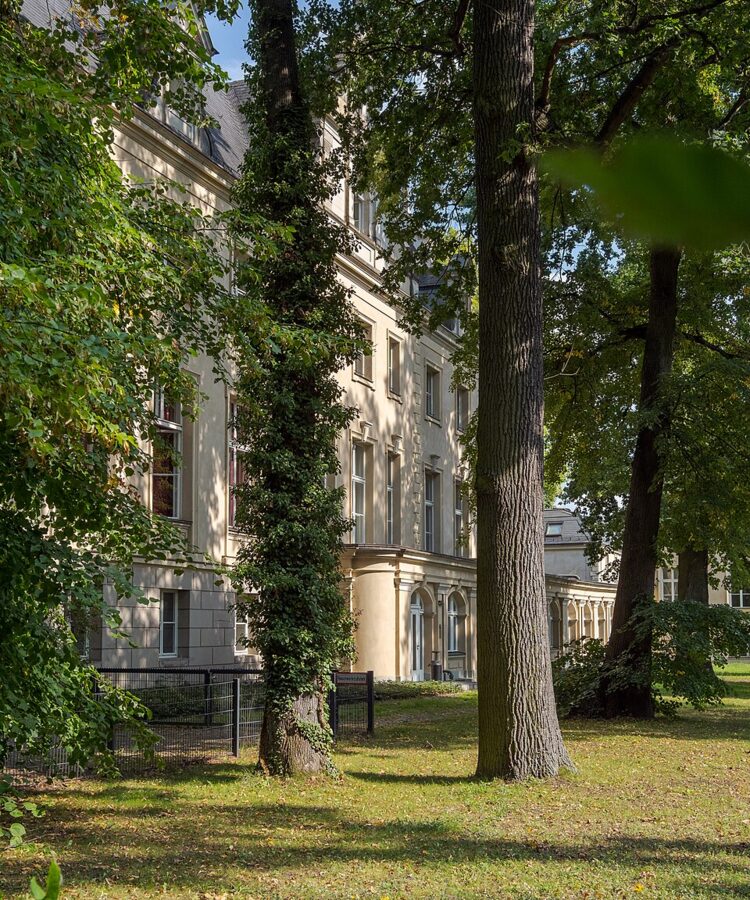
Across Königstraße stands the Glienicke Hunting Lodge (Jagdschloss Glienicke), which goes back to a seventeenth-century hunting house of the Great Elector and was rebuilt by Ferdinand von Arnim for Prince Carl in the 1860s. It now houses a training institute, so you see it from outside.
South of the lodge, between the Glienicker Lake and the Griebnitzsee, lies Klein Glienicke. It belongs to Potsdam though it sits on the Berlin side of the water, and in the Cold War that made it a scrap of East Germany walled in by West Berlin, only 15 m wide at its narrowest. People called it the appendix of the GDR, and only residents and pass holders could enter.
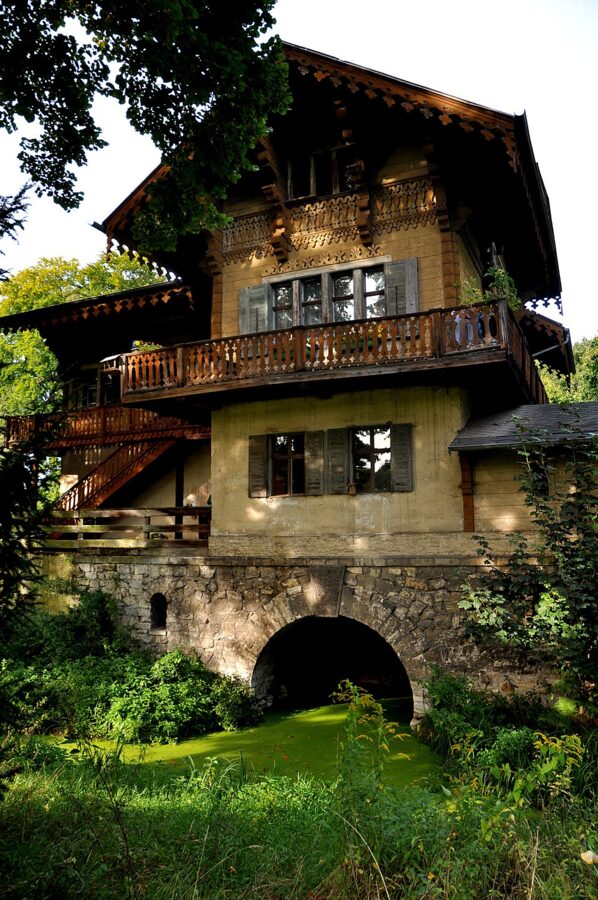
Ladders had to be kept locked, because so many people had gone over the Wall on them, and in 1973 the last successful escape tunnel out of East Germany ran 19 m under the Wall here. Prince Carl had dressed the village with Swiss-style chalets, and the survivors, with their wooden galleries, still stand on the edge of the former death strip.
Across the water: the church at Sacrow
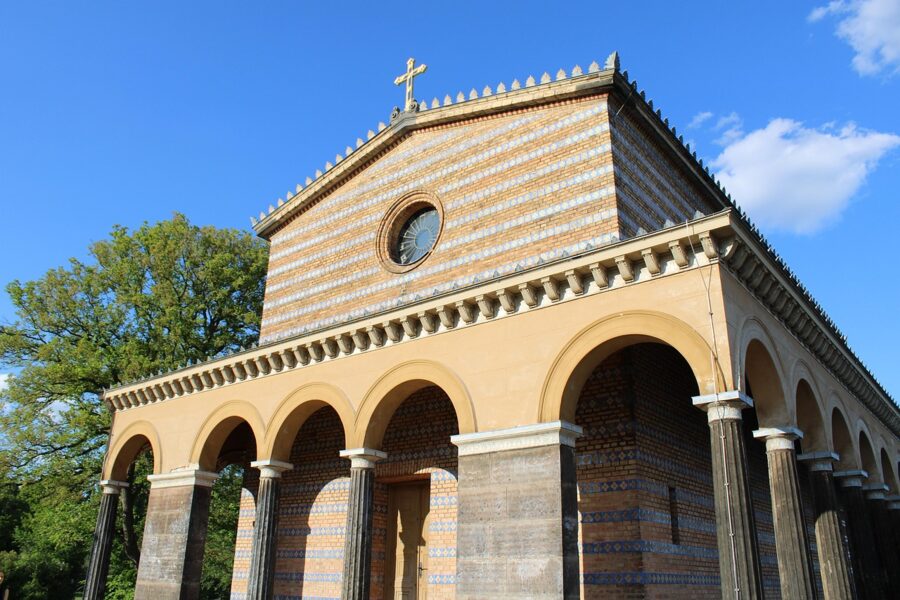
From the north side of the bridge, look across the Jungfernsee. On a low terrace at the water’s edge, a little over a kilometer away, stands a small Italian church with a freestanding bell tower: the Heilandskirche, the Church of the Redeemer at the Port of Sacrow. Frederick William IV sketched it himself, Persius built it in 1844, and it stands out in the reeds on a grid of piles that cost a third of the building budget, so it lies along the shore like a ship at a pier.
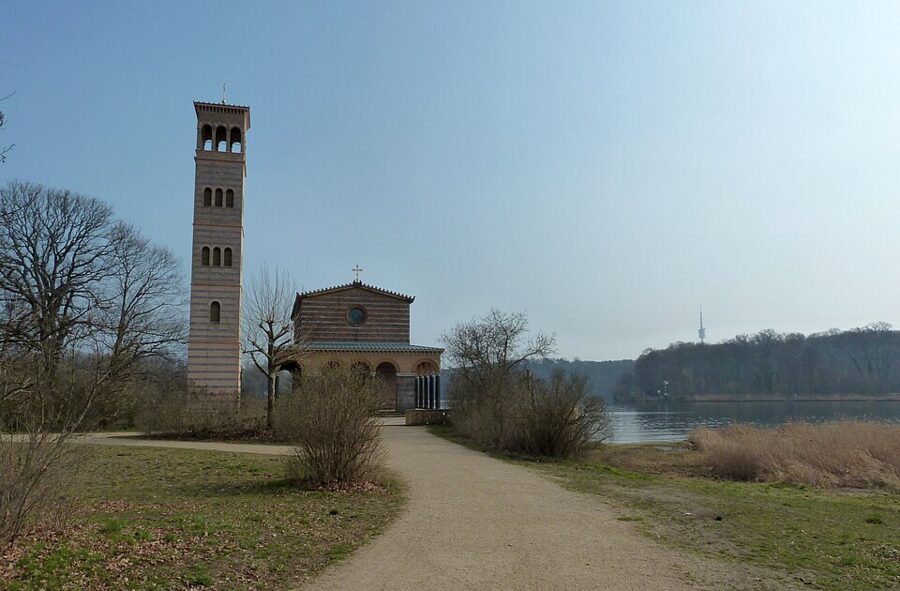
In August 1961 the border fortifications ran straight across the churchyard, and the bell tower became part of the wall. Services went on until Christmas Eve 1961; a few days later the interior was smashed and the church sealed off. For two decades West Berliners watched it rot from the opposite shore, until Richard von Weizsäcker, then mayor of West Berlin, pushed for a rescue and the exterior was restored in 1984–1985.
The first service in almost thirty years was held on Christmas Eve 1989, and the interior, with twelve carved apostles and a ceiling of yellow stars on blue, was restored in 1993–1995.
The church’s visiting hours from November to February are Saturday and Sunday, 11:00–15:30. In March, April, September and October it opens Friday to Sunday, 11:00–16:00, and from May to August Thursday 11:00–16:00 and Friday to Sunday 11:00–17:00. From Potsdam Hauptbahnhof (the main station) take bus 639 to Neu Fahrland, Heinrich-Heine-Weg, change to bus 697 for Schloss Sacrow, and walk through the park.
Getting there and walking it
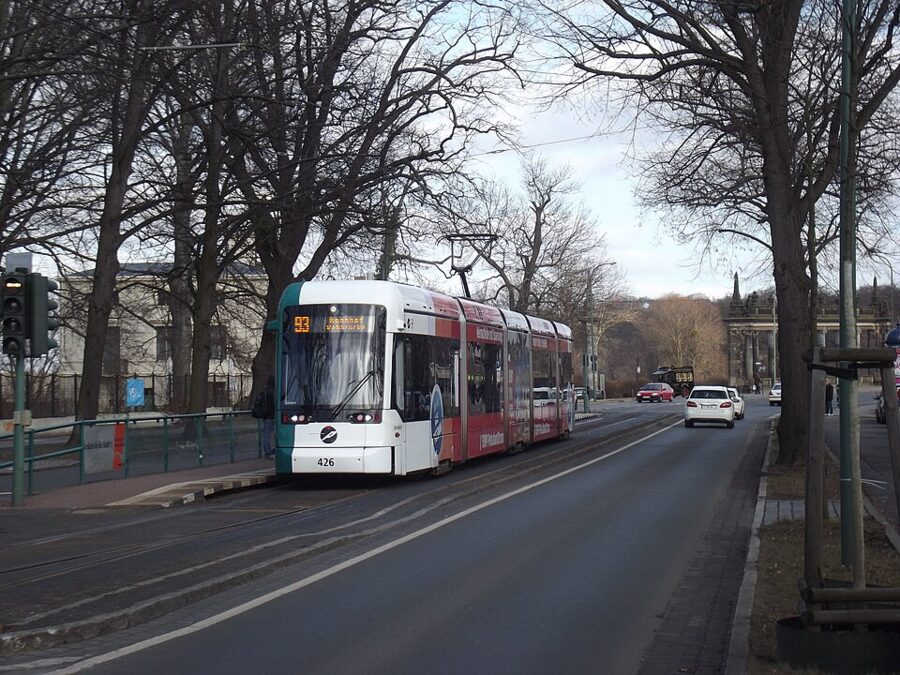
The easiest way is tram 93 from the forecourt of Potsdam Hauptbahnhof to its last stop, Glienicker Brücke. From Berlin, take the S7 or a regional train to Wannsee and then bus 316, which ends at the same stop, so you can arrive from one side and leave from the other. From Berlin you need a Berlin ABC ticket: VBB’s single tickets cost €5.00 for ABC in 2026 (€5.20 from January 1, 2027), and a Potsdam AB single for the tram alone is €3.00.
For more than one trip in a day, the 24-hour ticket for Berlin ABC at €12.90 (€13.20 from 2027) pays for itself. The Deutschlandticket covers all of it.
A walk from the Neuer Garten
The best way to arrive is on foot from the north. After a morning at Cecilienhof, leave the Neuer Garten at its eastern edge and follow the Schwanenallee south along the Jungfernsee. It is under 2 km, about half an hour, past the Kongsnæs sailors’ station and the border plaques, with the Casino and the Große Neugierde across the water the whole way.
On to Babelsberg
From the bridge, cross to the Berlin end, turn right past the hunting lodge and walk through Klein Glienicke. The single-lane Parkbrücke over the Teltow Canal drops you into Park Babelsberg, and the paths climb from there to Babelsberg Palace, about 2 km in all. The palace sits on the hill you can see from the bridge, so you always know where you are heading.
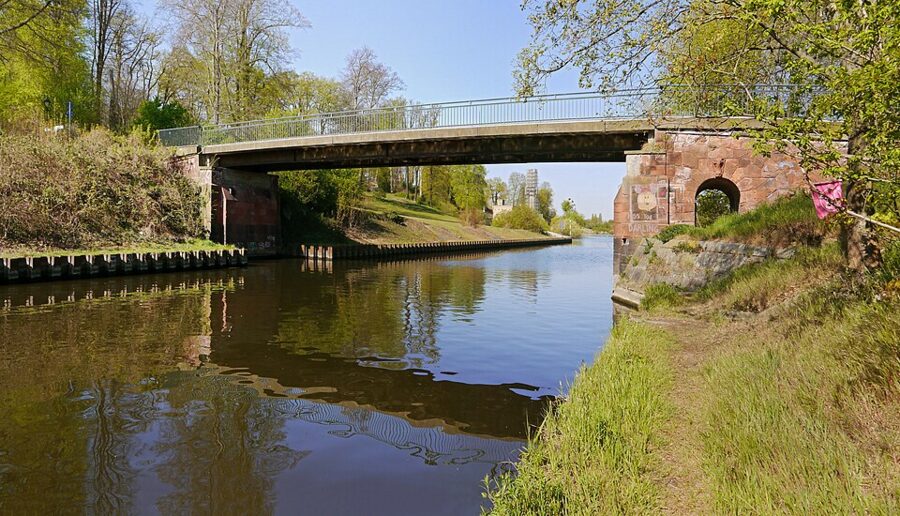
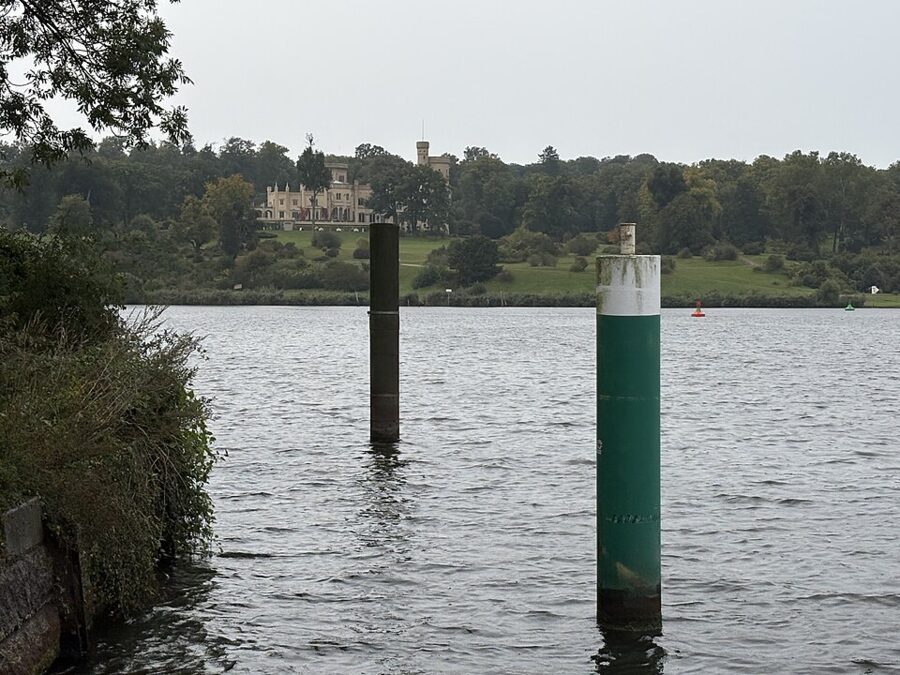
From the water
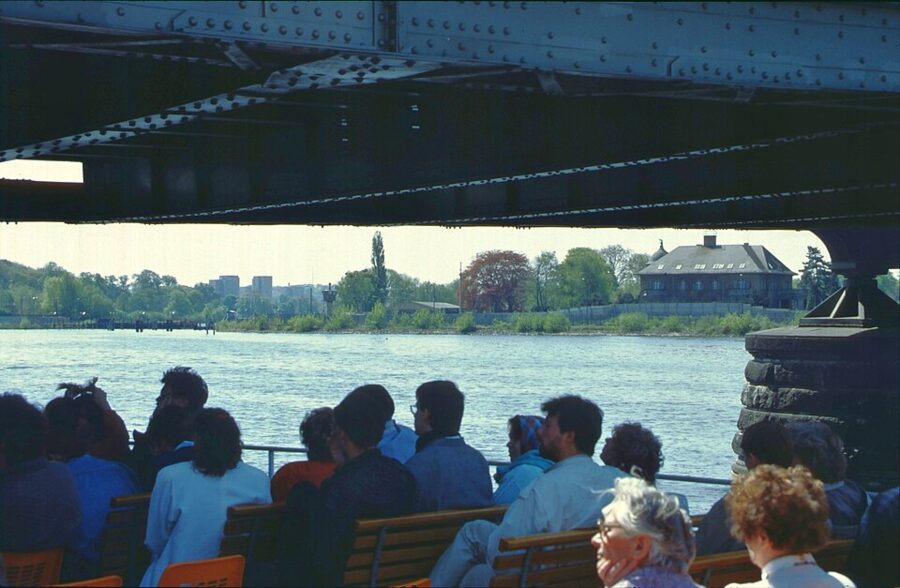
The bridge is at its best from a boat. Stern und Kreis runs the Seven Lakes Tour (7-Seen-Tour) from Wannsee station through the Kleiner Wannsee, Pohlesee, Stölpchensee and Griebnitzsee, across the Glienicker Lake, under the bridge and into the Jungfernsee, then back to the Großer Wannsee. Boats stop at the Glienicker Brücke landing, fares start at €20.50, and the round trip takes a little under two hours. The 2026 season is over; sailings for 2027 are listed from March 20, with departures from Wannsee including 10:30, 12:30 and 14:30.
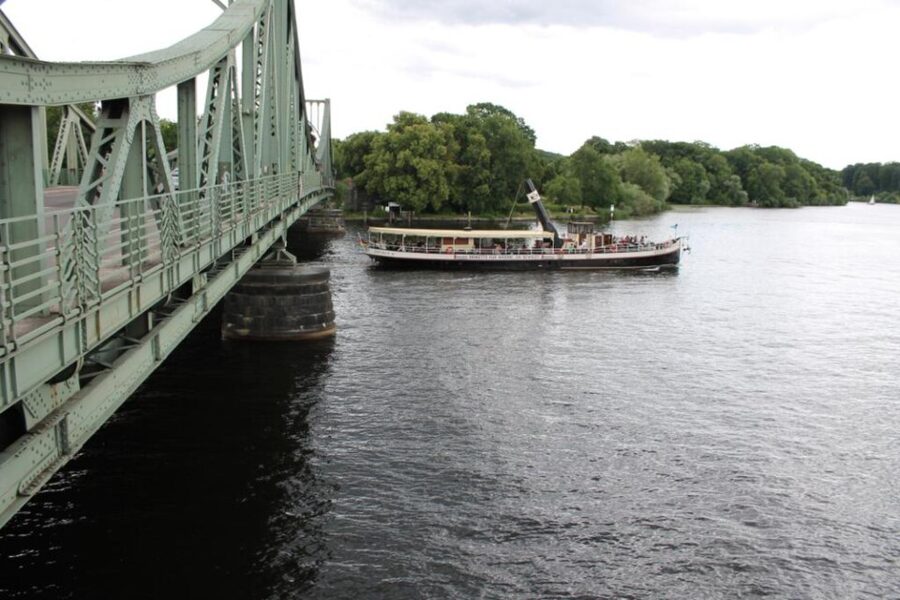
In winter, when the boats stop, the bridge is quieter and arguably better. Go late on a weekend afternoon, cross from the Wannsee side after the palace tour, and stand at the midpoint as the light goes. In December the sun sets well south of the road’s line, but on a clear evening the Havel catches the last of it on both sides.
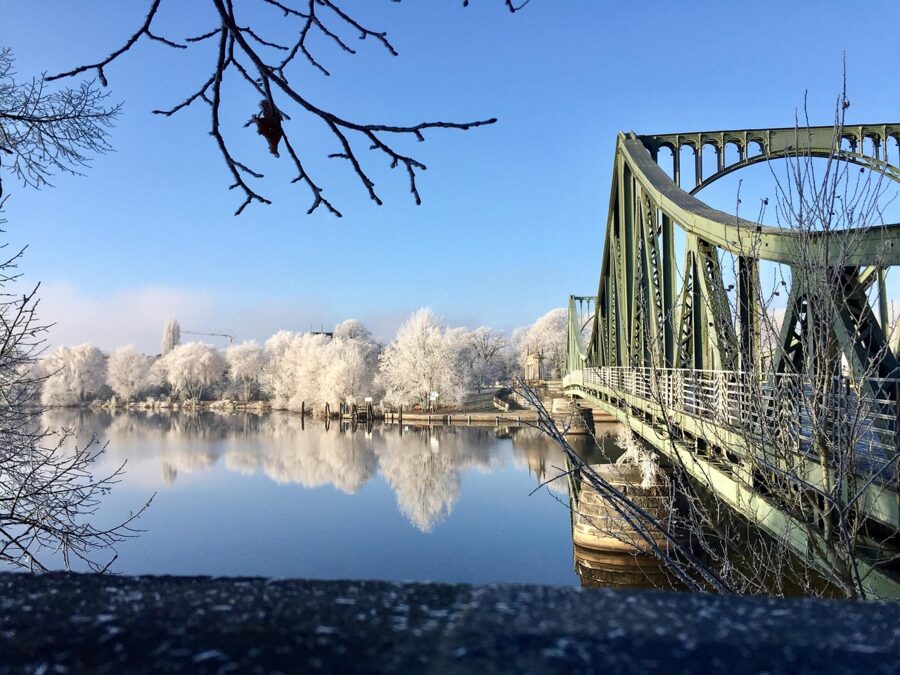
Come back to the middle before you leave. The metal strip is under your feet, the lighter green is behind you if you face Berlin, and now you know why the paint does not match: a West Berlin repair in 1985, one paint works, two greens, and a seam nobody ever painted over. Then walk back between Fürstenau’s colonnades, past the villa that spent 28 years looking at a wall, and take tram 93 into town.