

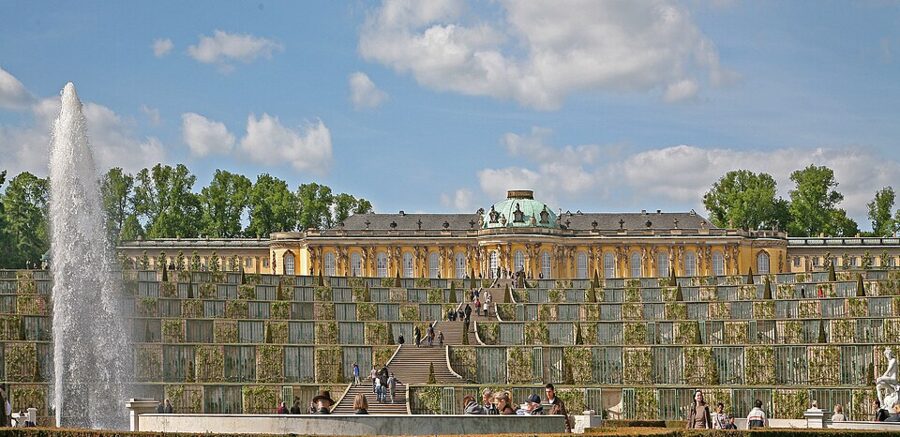
Stand at the rim of the Great Fountain (Große Fontäne) and count. Six terraces climb the hill in front of you, their retaining walls curved inward like cupped hands to hold the sun, and 132 steps run up the middle. At the top sits a yellow house only one storey high, so low that from down here the vines nearly swallow it. That is Sanssouci Palace (Schloss Sanssouci), the summer house of Frederick the Great (Friedrich II), and the whole park around it grows out of this one slope.

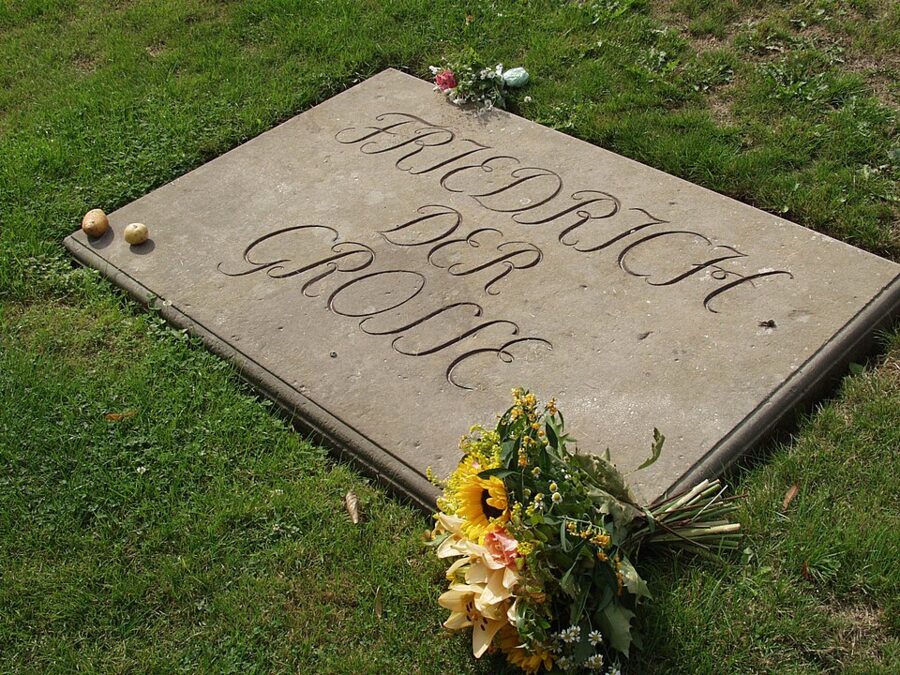
At the top of the steps, beside the palace, a plain stone slab lies in the grass with his name cut into it, and most days someone has left potatoes on it. Frederick asked to be buried here, next to his dogs, “without splendor, without pomp and at night”. He died in 1786. He got his wish in 1991.

Between those two dates sits the story of a 300-hectare park more than 2 km long, with a second palace built to impress, a Chinese tea pavilion, a Dutch windmill, an Italian villa, fake Roman ruins and, down by the river, a pump house dressed as a mosque. You can see the essentials in half a day. To understand why each one stands where it does, give it a full day.

Contents8 parts
A vineyard first, a palace second
The terraces came before the palace. On August 10, 1744, Frederick ordered the bare south slope of the Bornstedt ridge, locally the “Wüster Berg” or barren hill, to be cut into vineyard terraces (Weinbergterrassen). The architect Friedrich Wilhelm Diterichs laid out six broad steps with walls that bow toward the center to catch the most sun. Espaliered vines and fruit grew against the walls, and 168 glazed niches held the tender foreign varieties.
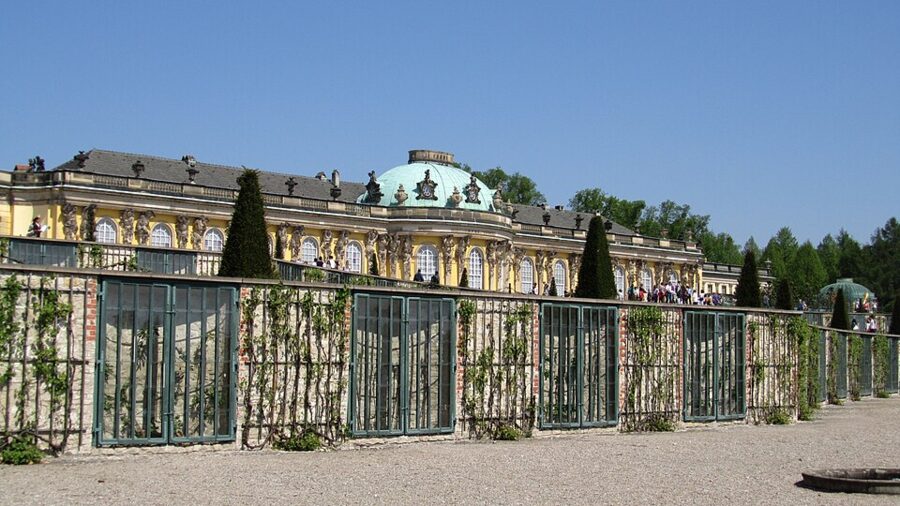

Only then, in a cabinet order of January 13, 1745, did the king ask for a Lust-Haus, a pleasure house. He drew the first sketches himself and handed them to Georg Wenzeslaus von Knobelsdorff, his architect and a friend since his years as crown prince. Knobelsdorff wanted a raised basement and the house pushed forward to the edge of the top terrace, so that it would look grand from below. Frederick refused both: he wanted no stairs between his rooms and his garden, only a single storey whose plinth was the hill itself.
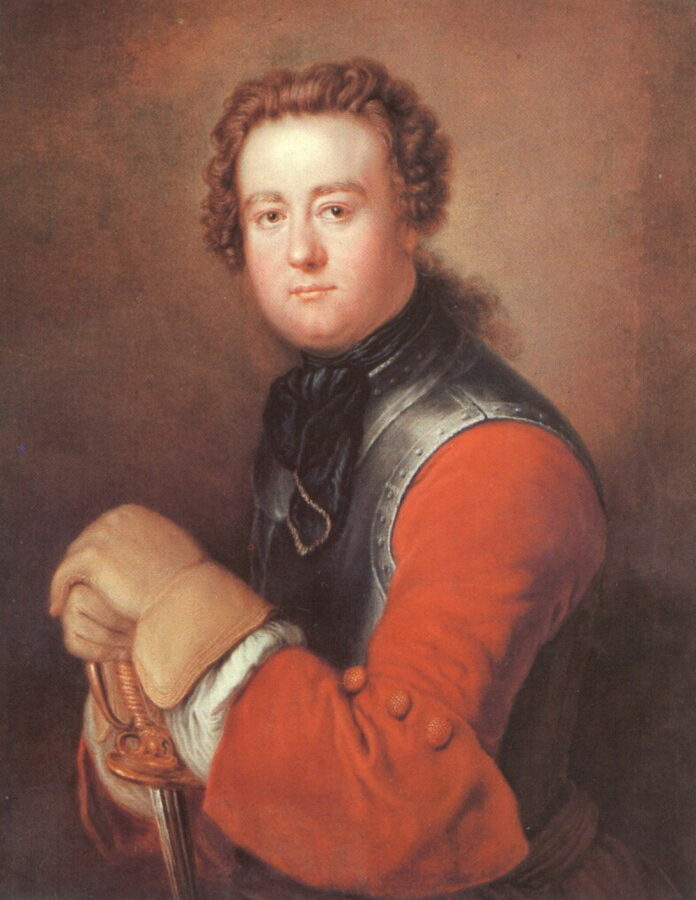
The king won the argument and lost the comfort. Without a cellar, damp rose into the parquet and the rooms stayed cold underfoot for the rest of his life. The two men fell out, and by most accounts Knobelsdorff was off the project by 1746. The foundation stone was laid on April 14, 1745, and the house was inaugurated on May 1, 1747, before all its rooms were finished.
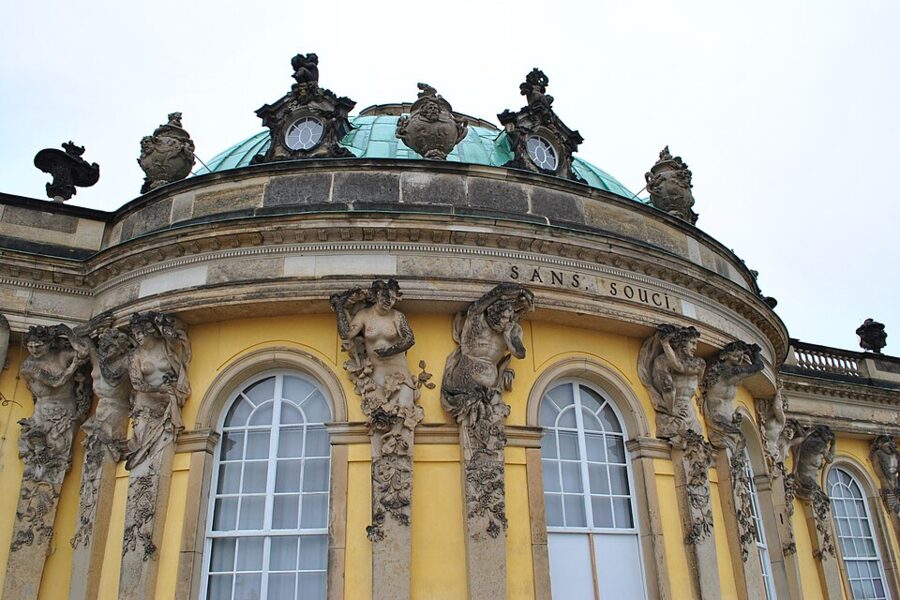
What you see from the parterre is Frederick’s version. The house sits back from the edge, which is exactly why it seems to sink into the vines when you look up from the fountain. Up close, the garden front is anything but modest: 36 sandstone followers of Bacchus, carved on site by Friedrich Christian Glume in 1746, hold up the cornice in pairs between tall arched windows, and over the central window runs the name of the house in gilded bronze letters.
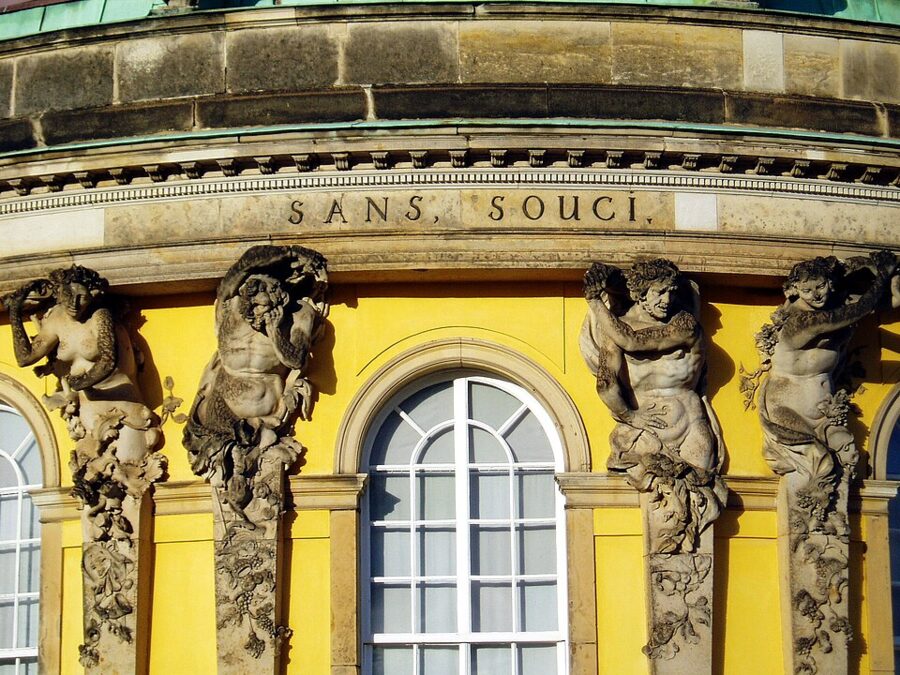

Look carefully at that name. It reads SANS, SOUCI. with a comma in the middle and a full stop at the end, and nobody has settled why. The historian Heinz Dieter Kittsteiner wrote a whole research report on it without closing the case.
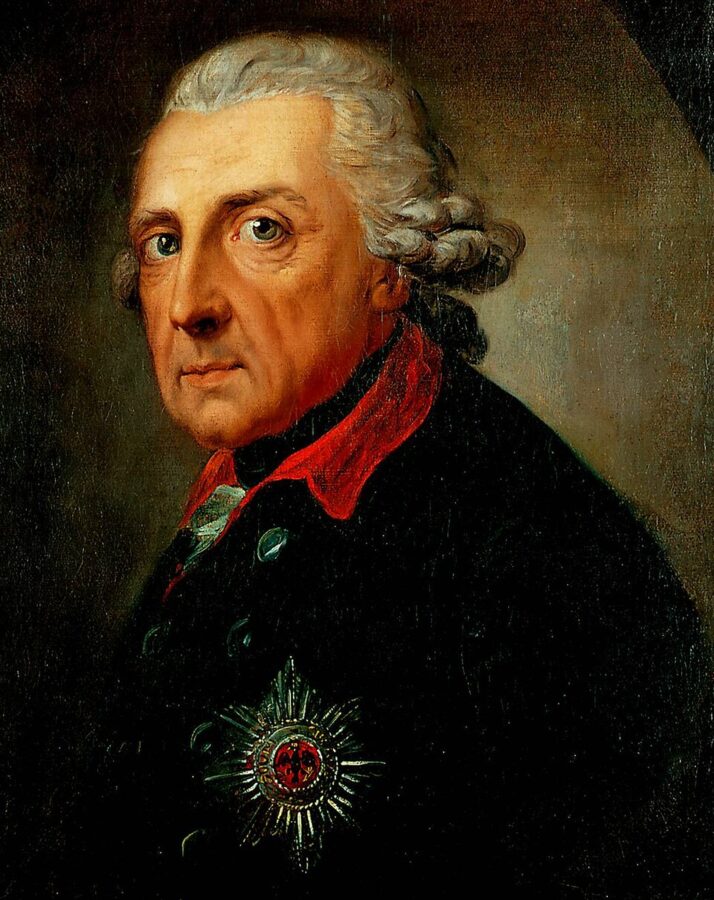
The name is French, like everything Frederick cared about, and means “without worry”. The house was built for him and the guests he chose. His wife, Elisabeth Christine, was given Schönhausen near Berlin as her summer residence and had no right to enter Sanssouci; she saw it once, in October 1757, while fleeing Berlin during the Seven Years’ War. Frederick lived here from late April to early October every year he was not at war.
The grave on the top terrace
The crypt beside the palace is older than the palace: Frederick had it built in 1744, while the terraces were still being dug. His nephew and successor, Frederick William II (Friedrich Wilhelm II), ignored the will and buried him in Potsdam’s Garrison Church beside his father, the Soldier King. Visitors were shown the empty terrace grave with the remark that the old king “would rather have lain beside his dogs than among his ancestors”.
The coffin’s twentieth century was a long detour. In 1943 it was moved to a bunker outside the city, in March 1945 to a salt mine at Bernterode, then by American soldiers to Marburg, and in 1952 to Hohenzollern Castle in the far southwest. The Garrison Church burned out in the air raid on Potsdam in April 1945.
After reunification the head of the house of Hohenzollern, Louis Ferdinand Prince of Prussia, set the will in motion. On August 17, 1991, the 205th anniversary of Frederick’s death, his sarcophagus lay in state in the palace forecourt and was buried at midnight on the terrace, with Chancellor Helmut Kohl present and the ceremony on television. His dogs lie under small slabs beside him. The potatoes are thanks for his “potato order”, the campaign to get Prussian farmers to plant the crop.
According to the publisher Friedrich Nicolai, Frederick once told the Marquis d’Argens on the building site: “Quand je serai là, je serai sans souci.” When I am there, I will be without worry. Nobody can prove he said it.
Inside Sanssouci Palace
The palace has twelve rooms and Frederick lived in five of them, so this is a short visit, on a fixed entry time with a free audio guide in the SANSSOUCI app of the Prussian Palaces and Gardens Foundation (SPSG). Tickets for Sanssouci Palace cost €14 (reduced €10) in 2026. Daily numbers are capped, so I book the Sanssouci+ ticket online, the only ticket that fixes a slot in advance; same-day tickets go on sale at the visitor center by the Historic Mill 30 minutes before opening, while they last.
Bring your own headphones for the app. Strollers cannot go into the rooms, and there is nowhere to leave luggage.
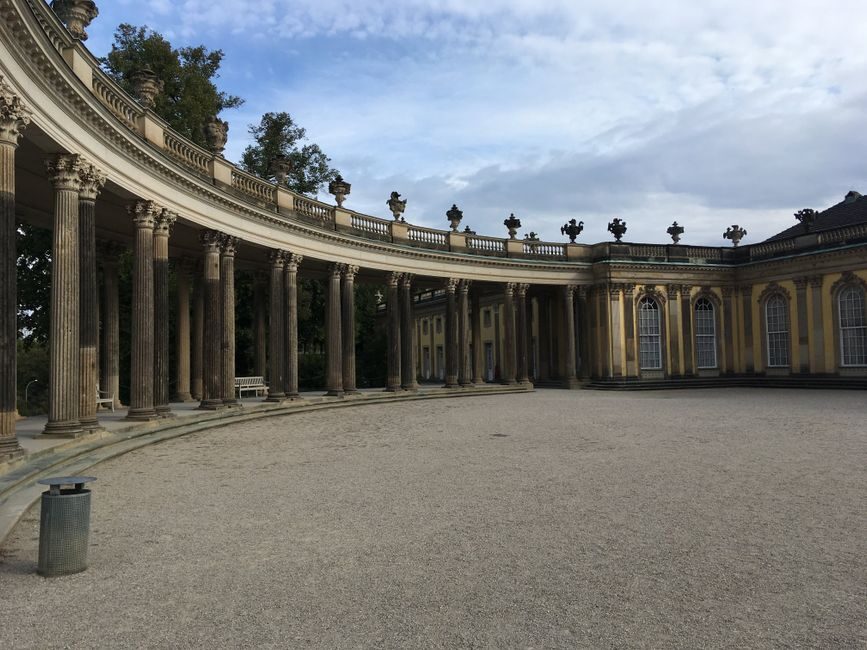
You enter from the north, through the curved double colonnade of the forecourt, into a vestibule of paired white stucco-marble columns under a ceiling of Flora scattering flowers, painted by Johann Harper in 1746. Straight ahead is the Marble Hall (Marmorsaal), the oval room under the dome. Knobelsdorff took the Pantheon in Rome as his model, with an opening at the top of the dome and paired Corinthian columns of Carrara and Silesian marble.
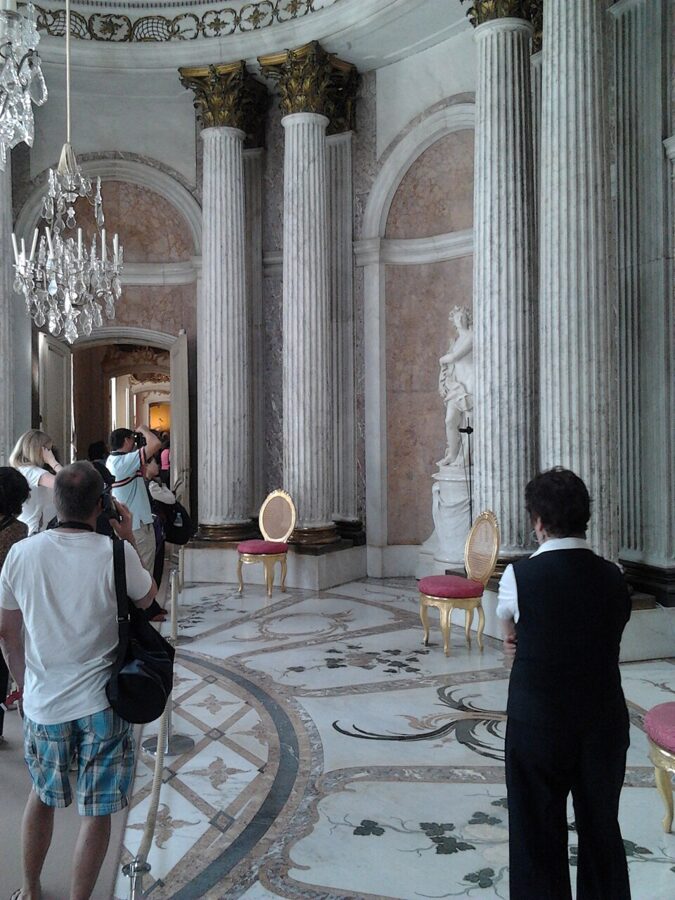
The open book in the hand of Apollo, by the door, is read as Lucretius’s On the Nature of Things, the Epicurean poem about a universe that runs without the gods, and gilded letters in the hall quote its opening lines to Venus. A strange text for a king’s banqueting hall, and exactly Frederick’s kind of joke.
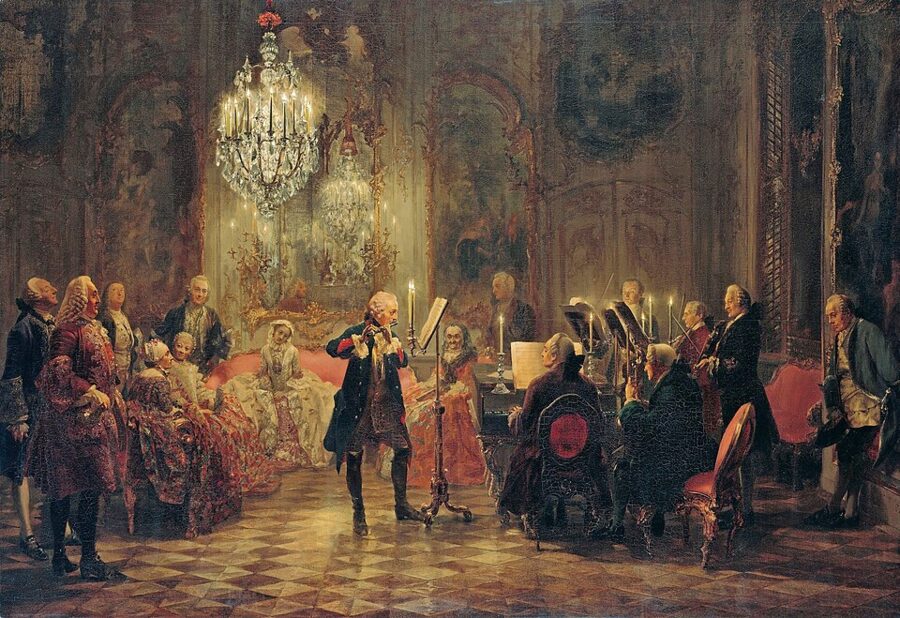
East of the hall are the king’s own rooms. The audience room doubled as his dining room, and his famous round-table dinners most likely happened here; Adolph Menzel put them in the Marble Hall a century later because it made a better picture. Then comes the concert room, the most extravagant space in the house: white and gold, every surface curling into rocaille, with wall paintings by Antoine Pesne set into the paneling.
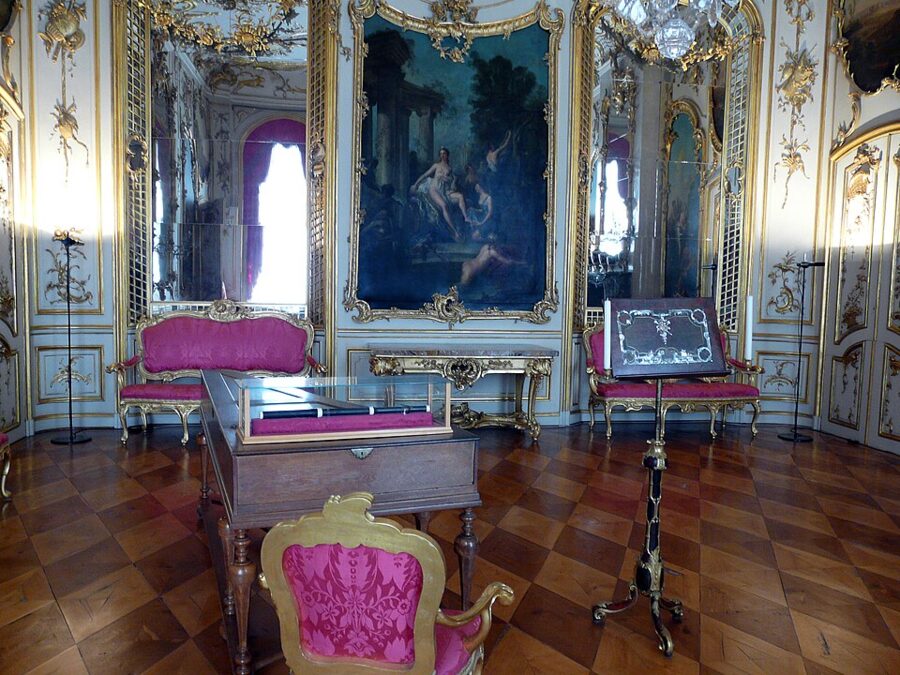

In the corner stands a fortepiano made by Gottfried Silbermann in 1746, and beside it Frederick’s music stand, carved by Johann Melchior Kambly in 1767. The king played the flute, composed for it and held evening concerts in this room. Menzel painted one of them in 1850 to 1852, and the picture now hangs in Berlin’s Alte Nationalgalerie; look it up before you come and you will recognize the room.
The study and bedroom next door is where Frederick died, in an armchair, on August 17, 1786. His successor had it redone in the new classical style within months, so only the fireplace is original; the chair came back in 1843. Beyond it, off the line of doors down a narrow passage, is the library: a small round room paneled in cedar, holding about 2,100 volumes in brown and red goatskin. They are Greek and Roman authors in French translation and French literature, with Voltaire at the center, and German books barely figure.
West of the Marble Hall are five guest rooms. The fourth, the Voltaire Room, is a riot of carved and painted flowers, fruit, shrubs and animals on yellow-lacquered oak, made by Johann Christian Hoppenhaupt in 1752 and 1753. The name came later. Voltaire lived in Potsdam from 1750 to 1753 and was constantly at the king’s table, but he had rooms in the City Palace, and nobody knows whether he ever slept here; an inventory of 1782 calls it the flower room.
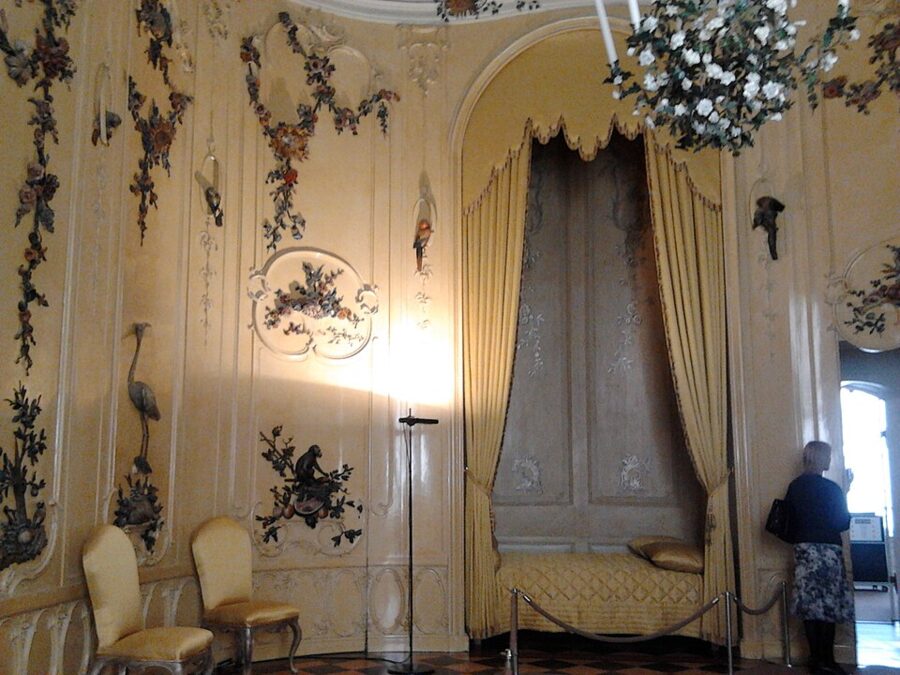
What the rooms say about their owner is plain once you have walked them. Frederick went about in a stained and threadbare uniform and cared nothing for etiquette, yet he designed his private interiors down to the ornament. He also refused almost every repair, because the house was meant to “last only my lifetime”. The palace came through 1945 undamaged, though many paintings and furnishings sent away for safekeeping were taken to the Soviet Union and only some came back; Frederick’s books returned from West Berlin in 1992.
The two side wings are later. Frederick William IV (Friedrich Wilhelm IV), the great-grandnephew who revered him, made Sanssouci his summer home after 1840 and rebuilt the wings in 1841 and 1842 rather than touch Frederick’s rooms. The east wing holds the palace kitchen (Schlossküche), used only from 1842 to 1873 and so still fitted with its cast-iron “cooking machine” and copper pans; it opens in summer, Wednesday to Sunday. The west wing, the Ladies’ Wing (Damenflügel), opens only for special events.
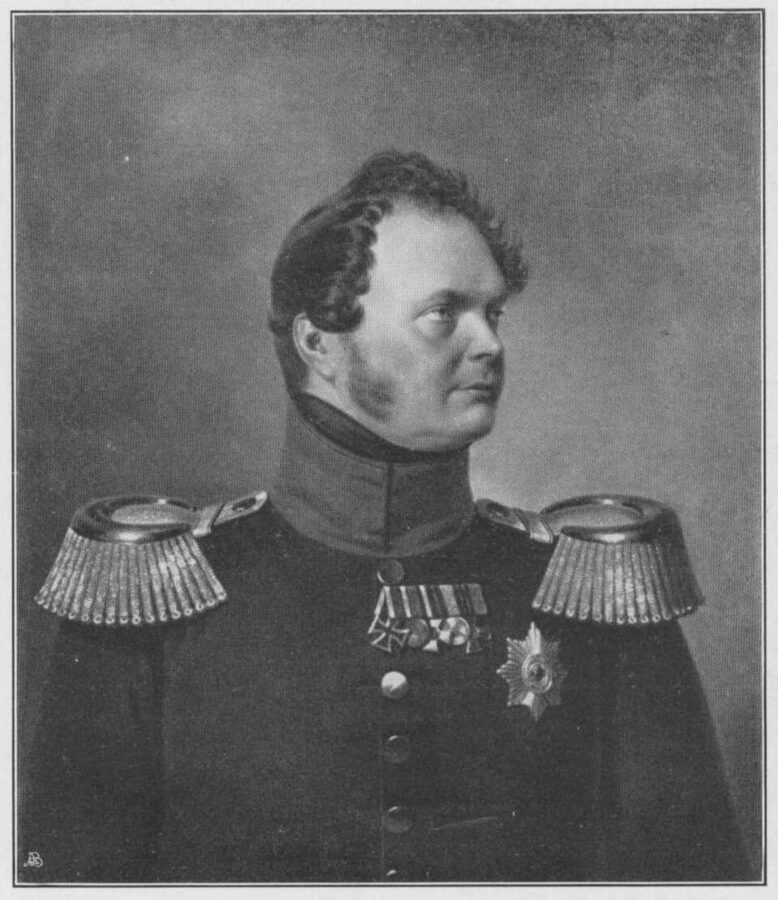
The Picture Gallery and the New Chambers
The two long, low buildings on either side of the palace look like a matched pair of orangeries, and one of them was. To the east, the Picture Gallery (Bildergalerie), built by Johann Gottfried Büring from 1755 to 1764 on the site of a hothouse for tropical fruit, is the oldest surviving purpose-built gallery in Germany. Frederick hung it close with nearly 180 Flemish, Dutch and Italian paintings among antique and French sculpture.
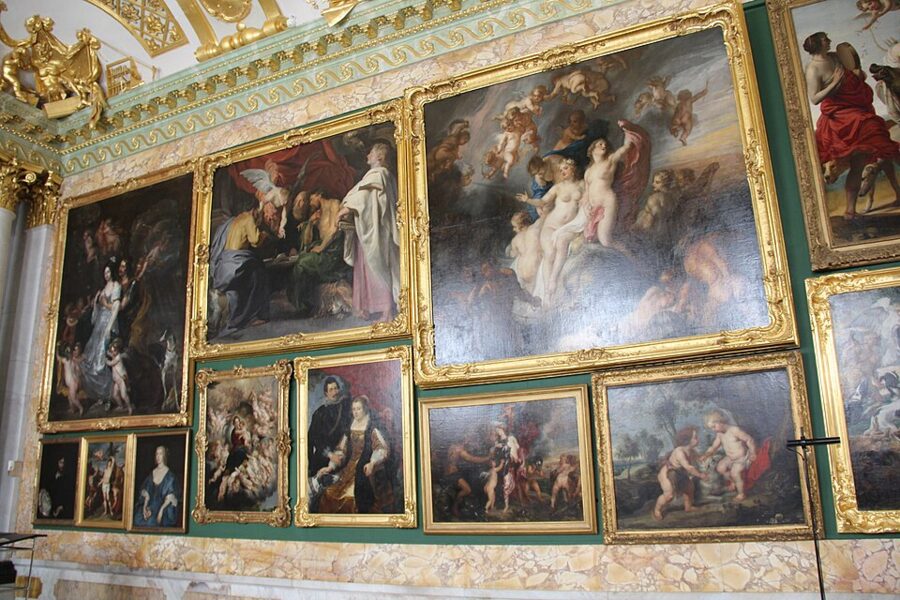
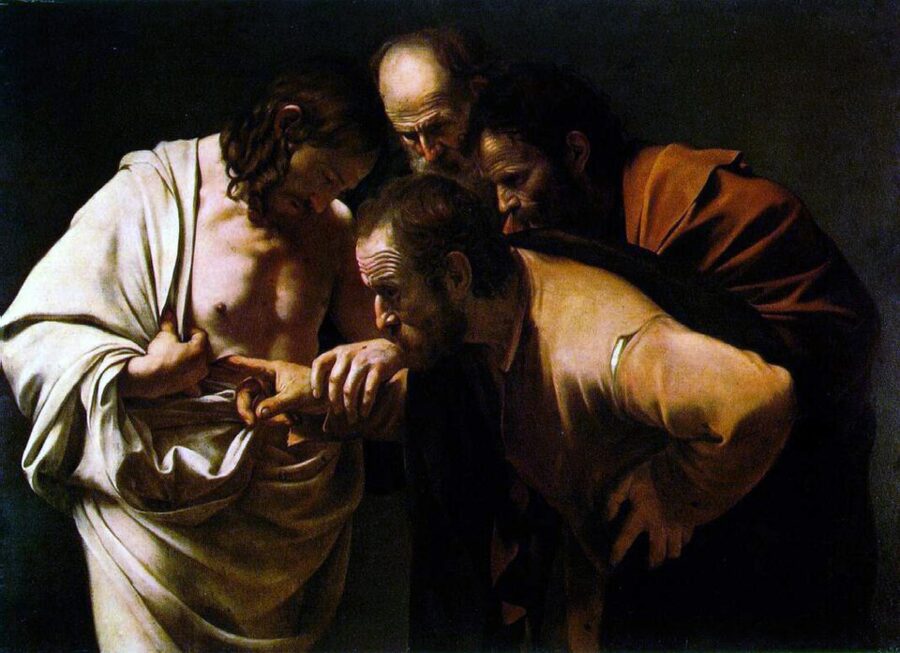
More than 140 paintings hang there today, including Caravaggio’s Doubting Thomas, seven works by Rubens and five by van Dyck, under a gilded vault on a floor of yellow and white marble. War losses still show: in 2003 the gallery counted 99 works missing. It is the one interior in the park I would put level with the palace itself.
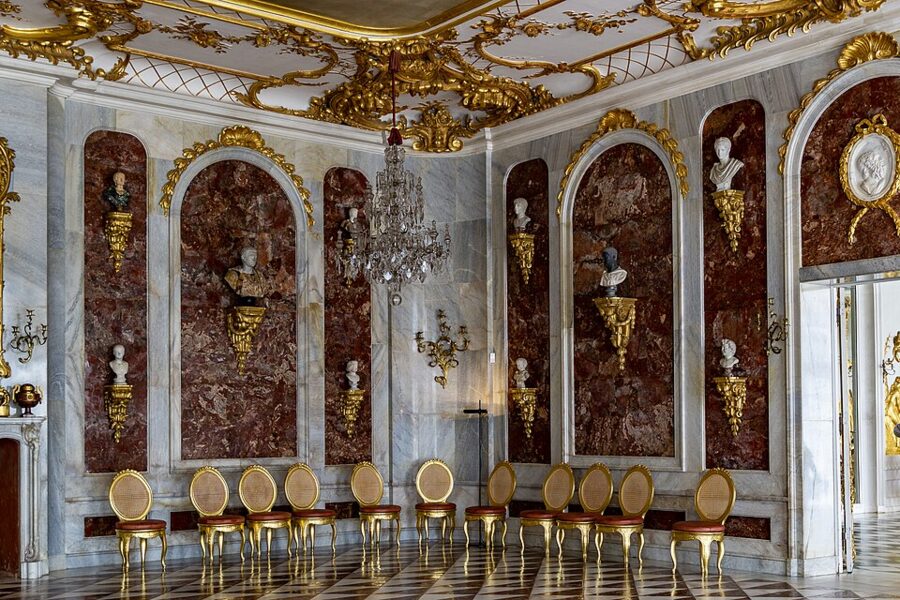
To the west, the New Chambers (Neue Kammern) began as Knobelsdorff’s orangery of 1747, where the orange trees from the terraces spent the winter; the ramps for their tubs are still outside. In 1768 Frederick decided to turn it into a guesthouse, and Georg Christian Unger rebuilt it between 1771 and 1775. The Jasper Hall is lined with red jasper and antique busts under a ceiling of Venus, and the Ovid Gallery next to it shows scenes from the Metamorphoses in gilded relief.

Both open only in the summer season, Wednesday to Sunday from 10:00 to 17:30, and both are covered by the Flanierkarte, a €10 (reduced €8) day ticket that also takes in the palace kitchen, the Chinese House and Charlottenhof.
The park as a stage set
From the bottom of the terraces the park runs in both directions along one straight avenue, the Hauptallee, roughly 2 km long. It begins in the east at the Obelisk Portal (Obeliskportal), with an obelisk of 1748 on the square outside and the goddesses Flora and Pomona on the gate, flowers and fruit, the two halves of Frederick’s idea of a garden. It ends in the west at the New Palace, and almost everything Frederick built stands on this line or a short walk off it.
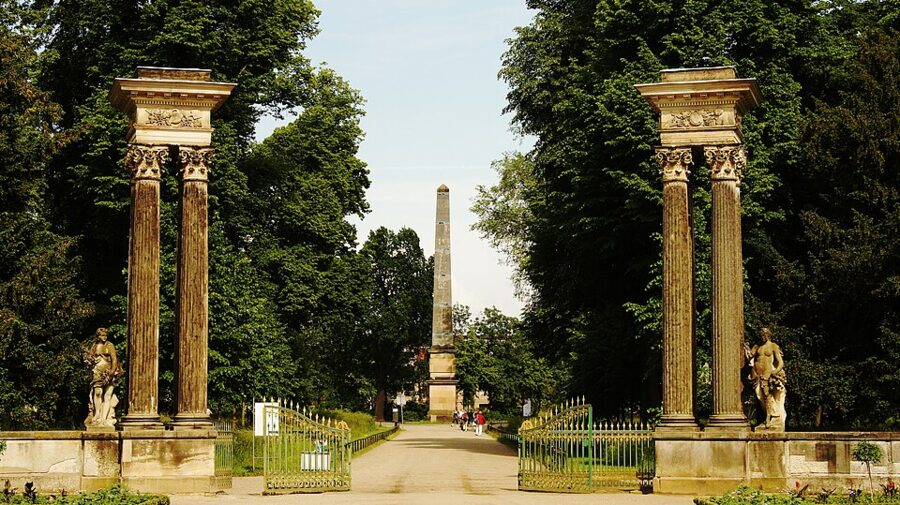

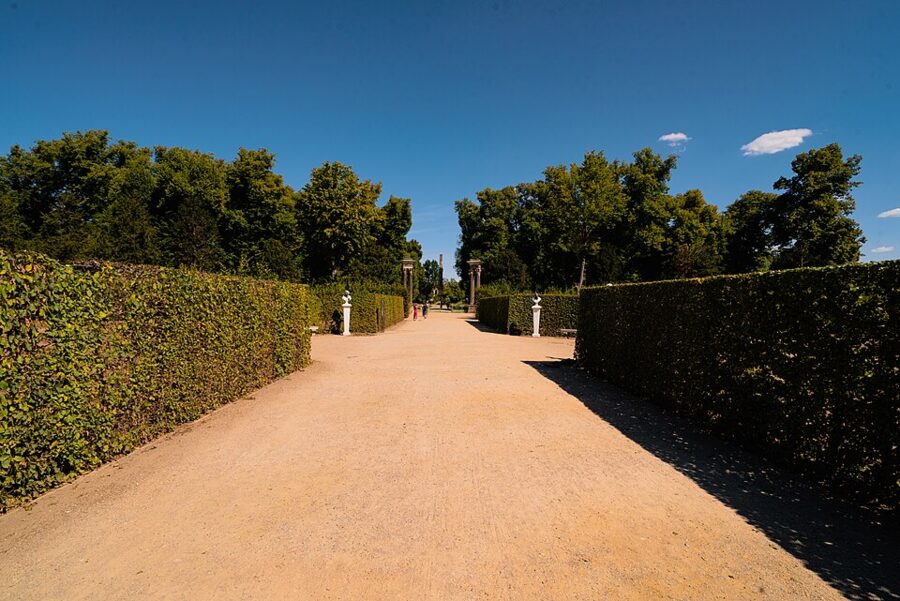
Along the way the avenue opens into round clearings with fountain basins, and paths run off like spokes between tall hedges into smaller gardens. Frederick’s park was a working one: 3,000 fruit trees in the hedged quarters, and oranges, melons, peaches and bananas from the greenhouses. Nearly 60 gardeners still tend it and replant the parterre below the palace twice a year with more than 230,000 plants. Since 1990 the park has been part of the Palaces and Parks of Potsdam and Berlin World Heritage Site.

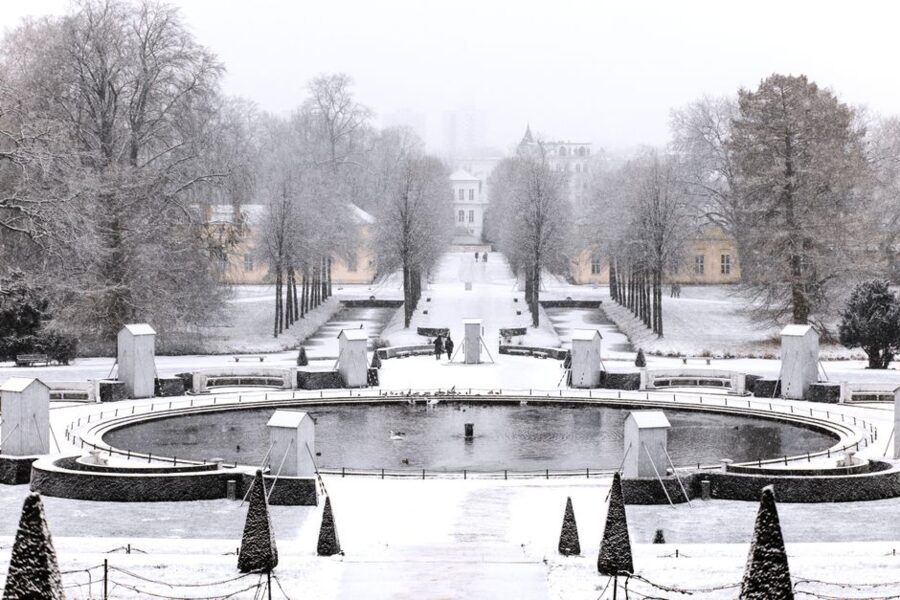
The Great Fountain is the park’s best reveal, because for a hundred years it did not work. Frederick laid out the basin in 1748 and had the mathematician Leonhard Euler do the calculations. Windmills were to pump water from the Havel up to a reservoir on the hill north of the palace, and gravity would do the rest. The mills could not run evenly, the pipes of bored-out tree trunks failed, and the king kept cutting the budget.
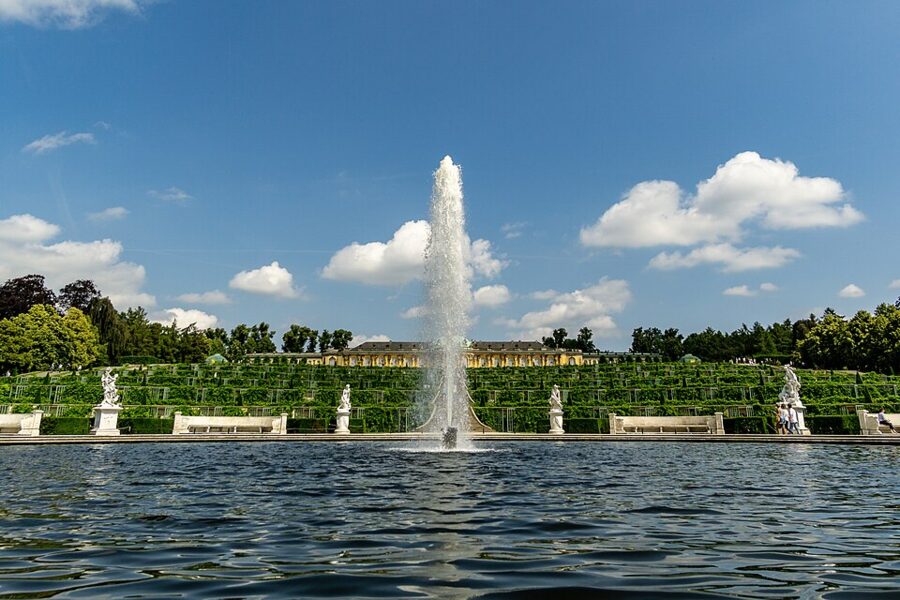

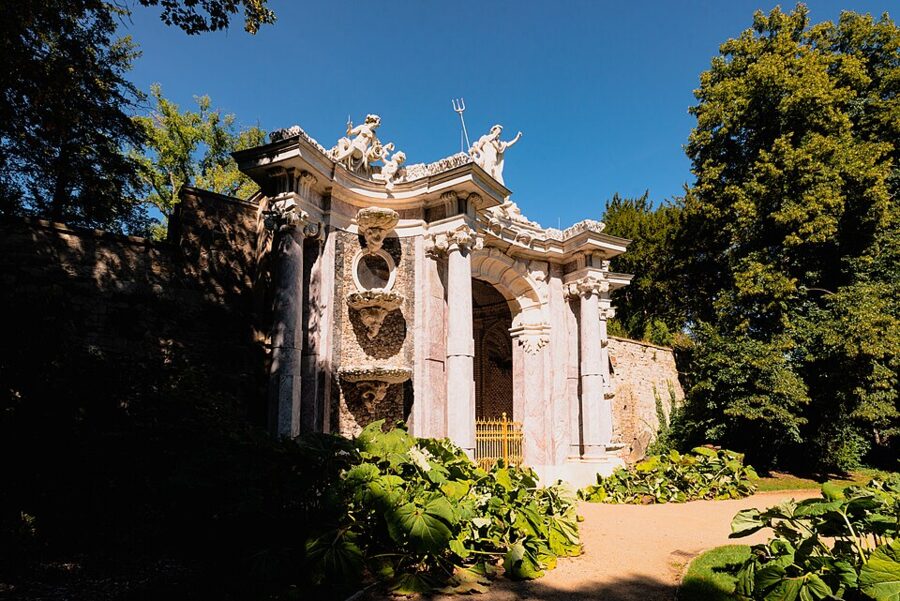
Frederick saw a fountain jump in his own park exactly once, below the Picture Gallery on Good Friday 1754, after a wet winter had filled the reservoir. He gave up in 1780, having spent 168,490 thalers. The Neptune Grotto (Neptungrotte), finished in 1757 at the eastern end of the park in white and pink Silesian marble, was built for cascades of river water that never came. The twelve marble figures you see around the fountain today are Carrara copies made between 2000 and 2010.

The Ruinenberg
Look north from the forecourt colonnade and you face a hill crowned with broken columns, a round temple, a little pyramid and the arched wall of what seems to be a Roman theater. They were never anything but ruins. In 1748 Frederick had a round reservoir dug on the summit of the Ruinenberg and had Knobelsdorff and the Berlin opera’s scene painter Innocente Bellavite surround it with antique stage scenery, one of the earliest English-style garden follies on the Continent.
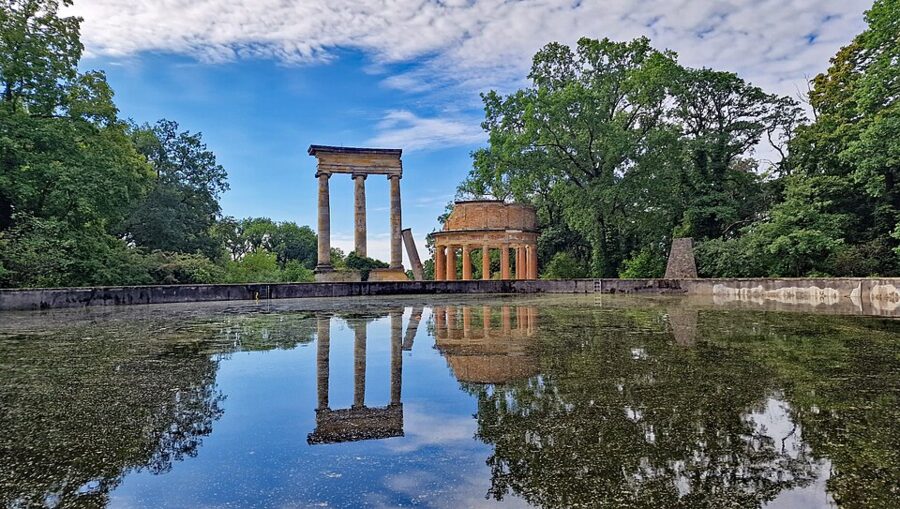

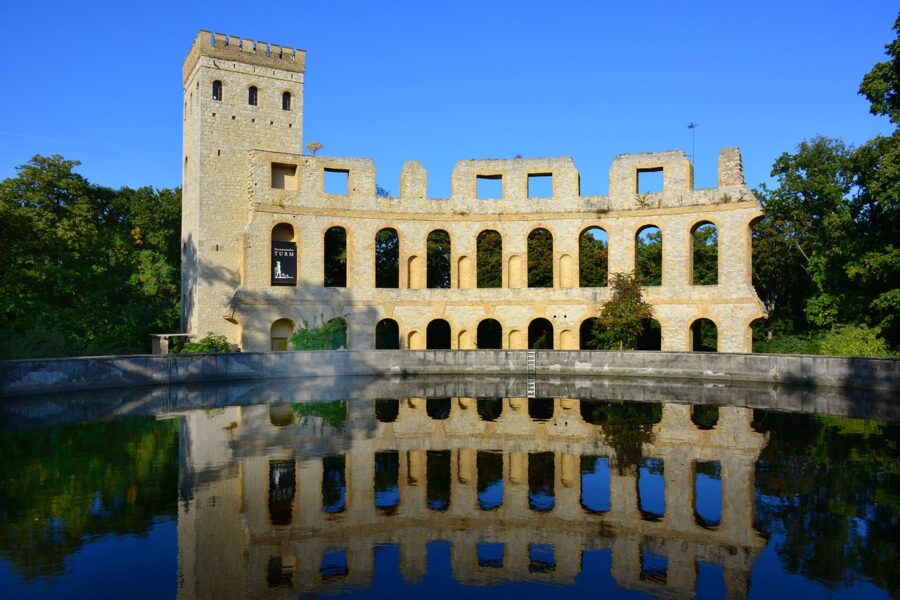
Frederick William IV had the garden designer Peter Joseph Lenné plant the hill with 50,000 trees and shrubs from 1841 and added the Norman Tower (Normannischer Turm) in 1846, a 23-meter watchtower with a tea room on the top floor. The basin still feeds the fountains. Allow about 15 minutes for the walk up from the palace; the Norman Tower itself opens only on selected days in summer.
The pump house by the Havel
What finally made the water rise was steam. Frederick William IV ordered an 81.4-horsepower engine from the young Berlin industrialist August Borsig, the most powerful in Prussia, and put it in a pump house on the Neustädter Havelbucht, a bay of the Havel south of the center. On October 23, 1842, it pushed river water through a 1.8 km main up to the Ruinenberg, and the Great Fountain threw its jet 38 meters high, above the palace roof.
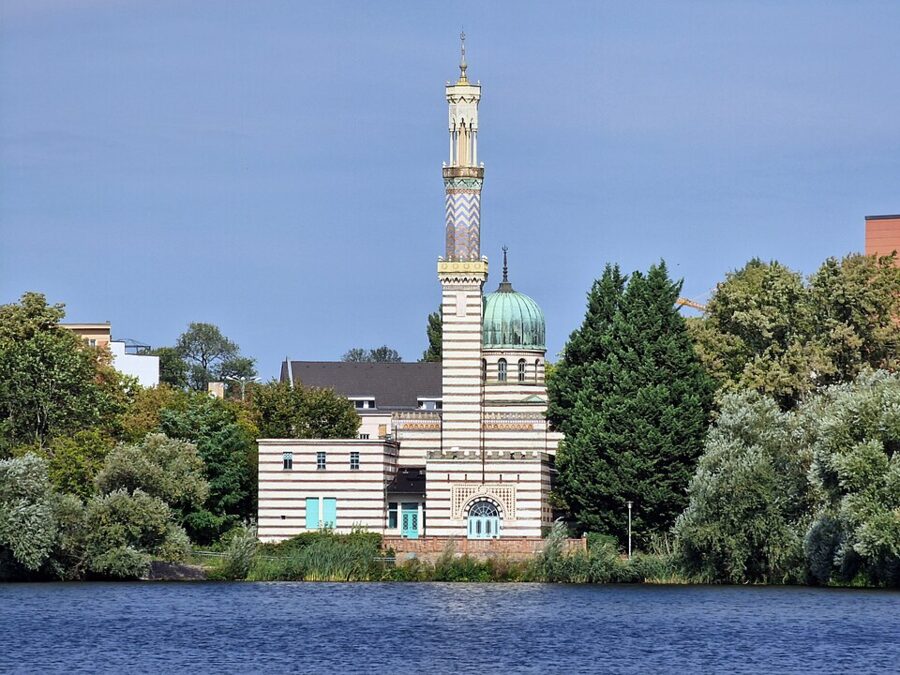

The king asked his architect Ludwig Persius for a building “in the manner of the Turkish mosques, with a minaret as chimney”, and got one, with a dome, Moorish detail and a chimney disguised as a minaret that could then be seen from the palace terrace. Electric pumps took over in 1937. The steam engine house (Dampfmaschinenhaus) on Breite Straße opens only on selected summer days, when you can watch the old engine turn, now moved by an electric motor; tickets are €5, sold on site only. Even shut, it is worth the walk from Luisenplatz for the outside.
The buildings worth walking to
Off the avenue stand a dozen smaller buildings. From spring to October most of them open Wednesday to Sunday; from November to March almost all are shut and you see them from outside. Two are closed for years by the foundation’s renovation program.
The Chinese House
About 660 meters southwest of the palace, in a meadow off the path to Charlottenhof, stands a gilded pavilion ringed by life-size Chinese figures drinking tea and playing instruments. Büring built the Chinese House (Chinesisches Haus) from 1755 to 1764 after the king’s sketches, on a clover-leaf plan borrowed from a garden pavilion at Lunéville in France. The Seven Years’ War stretched the job to nine years.
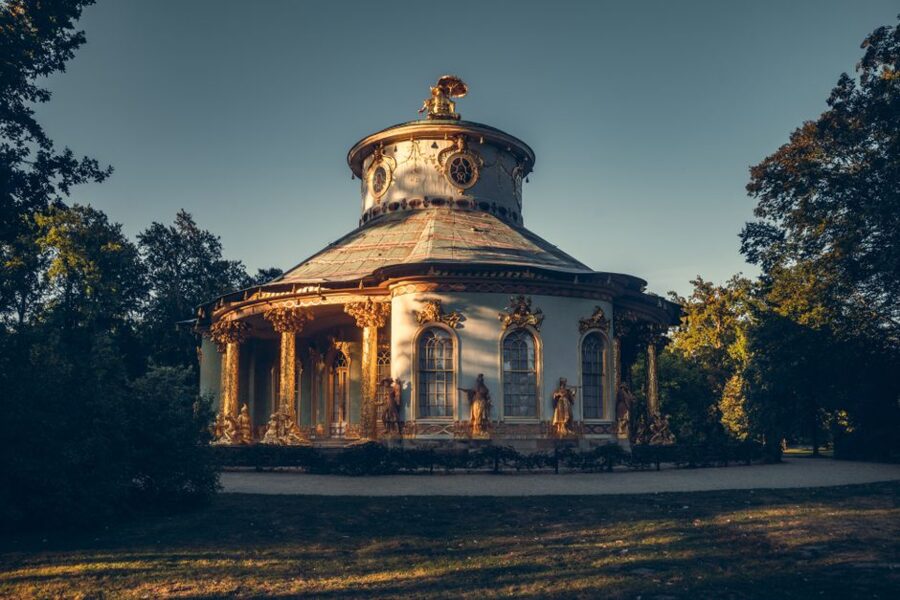
Look at the faces. The sculptors Johann Gottlieb Heymüller and Johann Peter Benkert used local people as models, so the Chinese figures have Brandenburg features. Samuel Wittwer, the foundation’s director of palaces and collections, reads the building as Frederick mocking the fashion for China: gilded monkeys hold instruments over the doors, and in the painted ceiling a large parrot perches in the pose of the Prussian eagle. Frederick called it his monkey house.
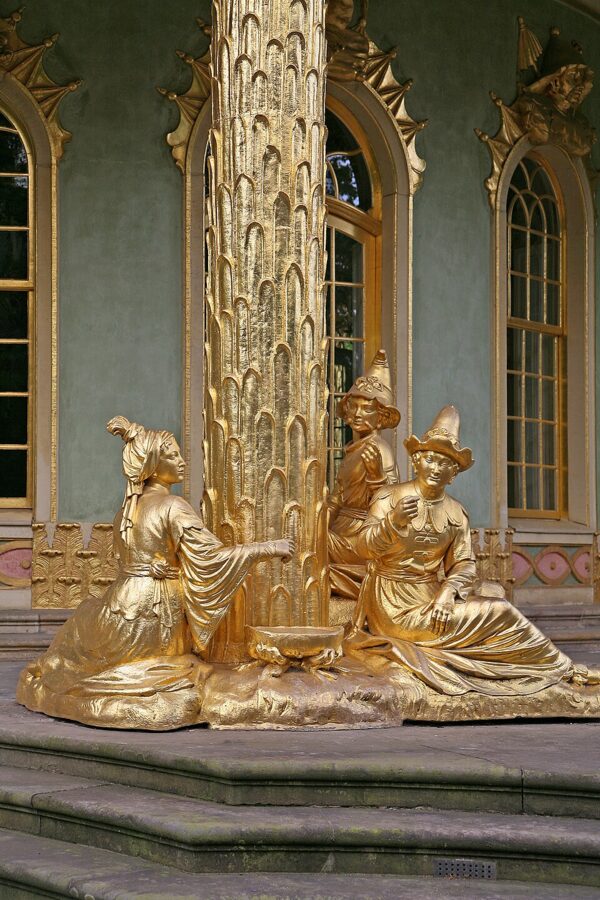

Inside, eighteenth-century porcelain stands on gilded brackets against green stucco-marble walls. The interior opens from spring to October, Wednesday to Sunday; the outside, which is most of the point, is there every day of the year.
The Orangery Palace
On the ridge above the park, the longest building in Sanssouci looks like a Renaissance villa from Rome, with twin towers, arcades and a terrace of fountains and potted palms. The Orangery Palace (Orangerieschloss), built from 1851 to 1864 by Persius, August Stüler and Ludwig Ferdinand Hesse from the king’s sketches, is more than 300 meters long, and its side halls still shelter the park’s potted plants every winter.
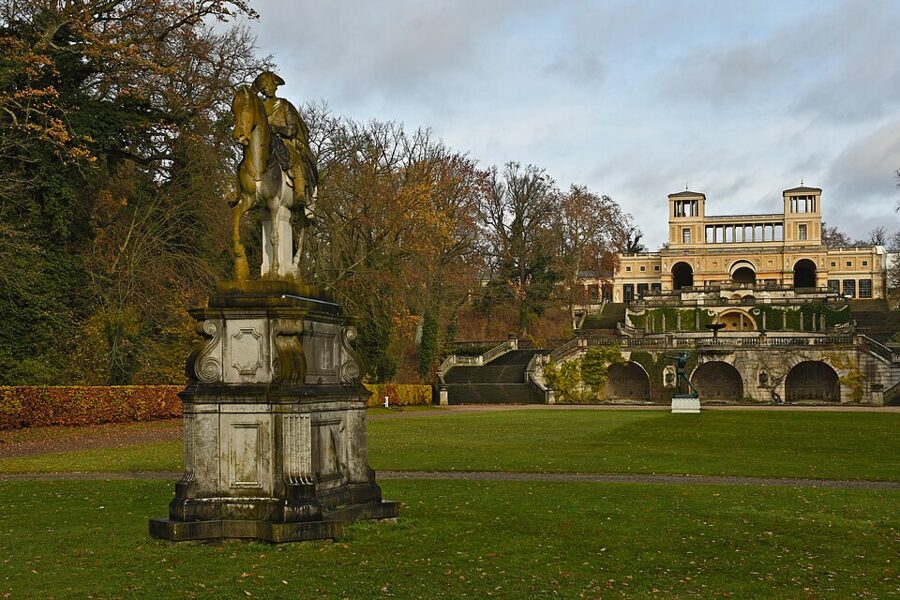
It was the crowning piece of a scheme Frederick William IV never finished, a two-kilometer “triumphal road” along the ridge in honor of Frederick the Great; the revolution of 1848, money and the king’s illness in 1858 stopped it. The central hall holds more than 50 nineteenth-century copies of Raphael on red silk, but the building is closed for renovation, with work on facades, roofs and plant halls scheduled to run to 2029. Walk up anyway for the terrace view and the Sicilian Garden below it.

The Friedenskirche
At the eastern foot of the terraces, by the Grünes Gitter gate, a campanile rises over a pond like a scene from northern Italy. Frederick William IV laid the foundation stone of the Friedenskirche, the Church of Peace, on April 14, 1845, exactly 100 years after Sanssouci’s own. Persius and Stüler built it on the king’s sketches after San Clemente in Rome, with a 42-meter bell tower modeled on Santa Maria in Cosmedin.
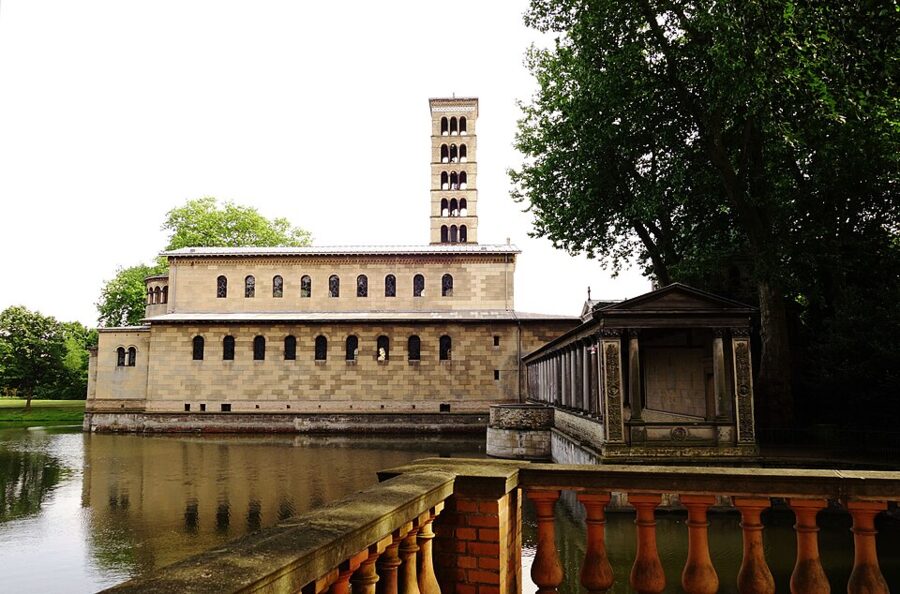

The apse holds a genuine thirteenth-century mosaic of Christ enthroned, bought in 1834 from the church of San Cipriano on Murano when it was about to be demolished. Frederick William IV and Queen Elisabeth lie beneath the nave, and the mausoleum on the atrium holds Emperor Frederick III (Friedrich III) and the Soldier King, Frederick William I (Friedrich Wilhelm I), moved here because East Germany demolished the ruined Garrison Church in 1968. The church was consecrated in September 1848, months after revolution in Berlin, and to the revolutionaries the name read as a provocation.
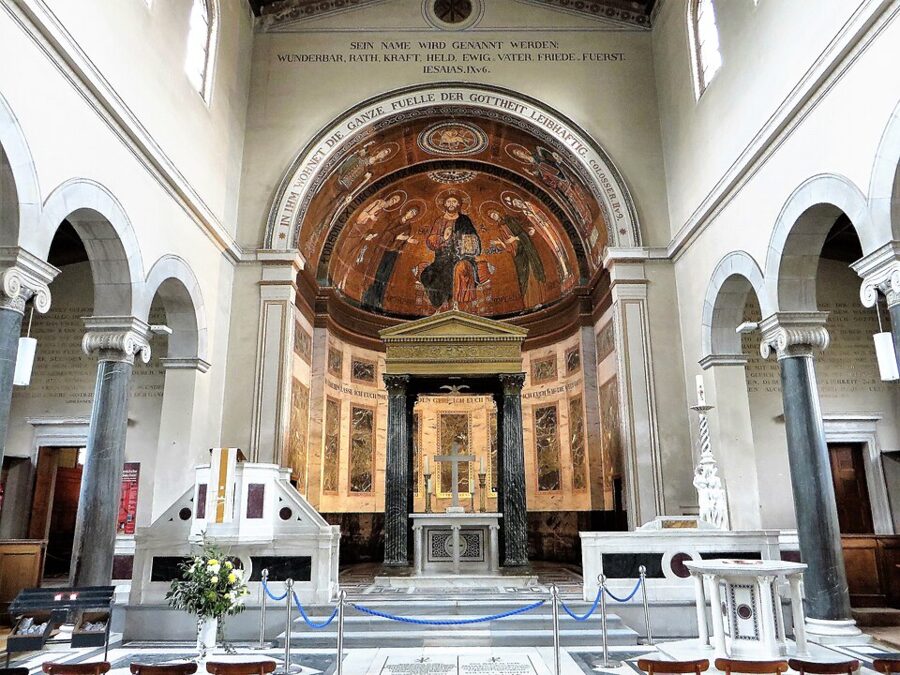

Entry is by donation and the doors are opened by volunteers: from mid-October to mid-March only on Saturday from 11:30 and Sunday from 12:00, both until 16:00, and never during services. The bell tower was saved from collapse between 2022 and 2024, largely with private money.
The Historic Mill
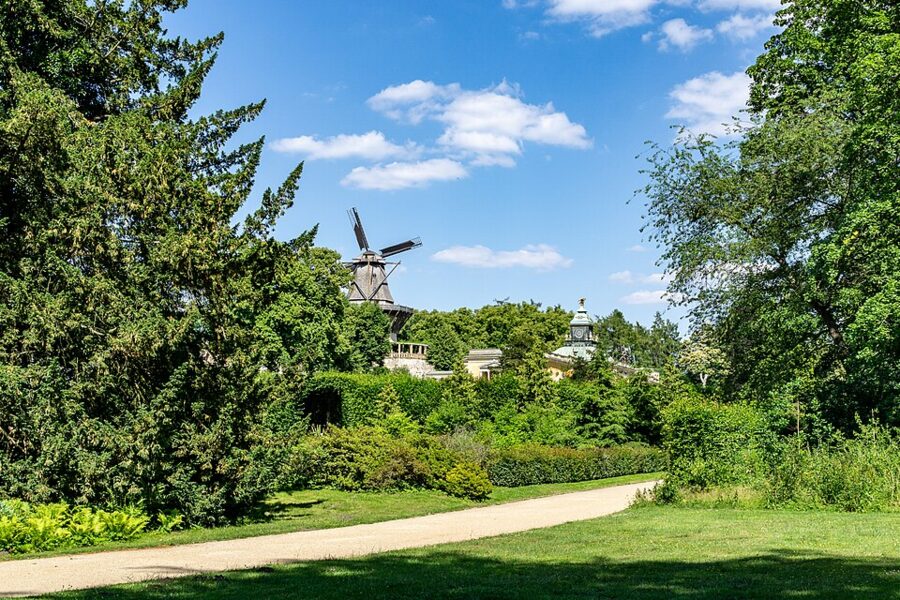
Just west of the palace a Dutch windmill turns above the terrace wall, and it comes with the park’s most famous story. In the legend the king, bothered by the clatter of the sails, ordered the miller to sell or pull it down. The miller answered that there were still judges in Berlin, and the king, shamed, let the mill stand.
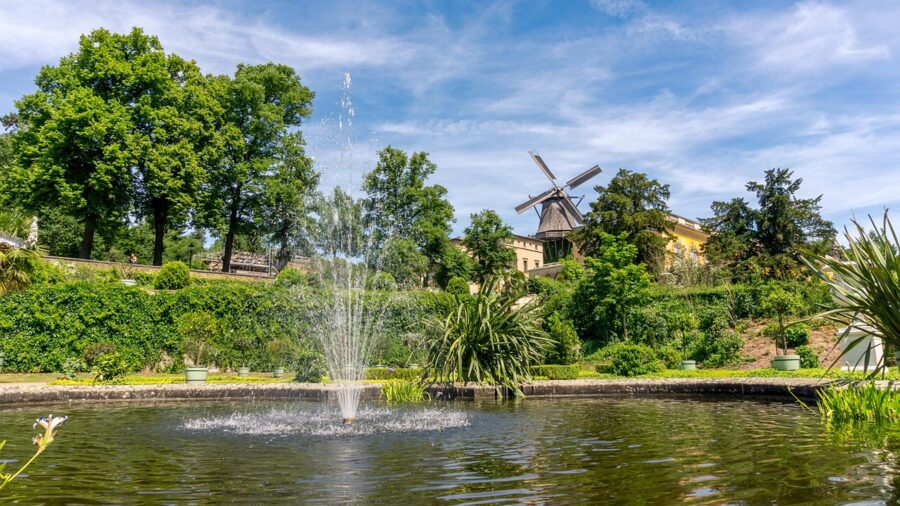
The real history flatters nobody. The miller Johann Wilhelm Grävenitz did build a post mill here from 1737 to 1739, and he did complain, but about the opposite problem: the palace, its walls and its trees were stealing his wind. He was compensated, given money for a new mill elsewhere and sold this one in 1753. Frederick, far from wanting it gone, refused in 1746 to let it be moved, because he thought it an ornament to the palace.
The defiant miller comes from another case, the lawsuit of the miller Arnold in the Neumark, in which Frederick intervened in 1779, overturned the courts and jailed the judges. After his death the two stories were braided together, and a French verse tale of 1797 gave the world the line “Il y a des juges à Berlin”. The mill you see is a rebuild: Frederick William II’s Dutch mill of 1787 to 1791 burned in the fighting of April 1945, and this one went up between 1991 and 1993.
The Historic Mill (Historische Mühle) is run as a working museum by the Berlin-Brandenburg mill society, with an exhibition on three floors and grain still ground at the top. It costs €5 (reduced €3) or comes with Sanssouci+, and the gallery almost 11 meters up looks across the palace roof. It opens 10:00 to 18:00 daily from April to October, 10:00 to 16:00 at weekends in November and from January to March, and closes in December.
The Dragon House
Walk west along the ridge from the Orangery and you reach a green four-storey pagoda with sixteen gilded dragons on the tips of its curved roofs. Carl von Gontard built the Dragon House (Drachenhaus) from 1770 to 1772 after William Chambers’s designs for the pagoda at Kew, as a home for the vintner of a new royal vineyard on the Klausberg. The vintner never moved in, and the vines failed.
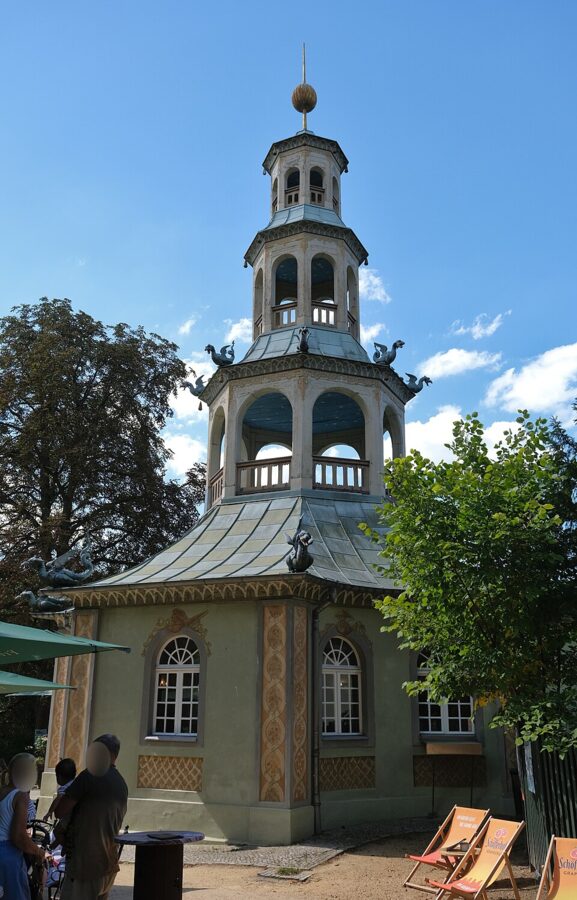
It has been a restaurant since 1934 and it is the one place inside the park I would plan lunch around, with two historic rooms and three sun terraces. The Drachenhaus opens daily from 11:00 to 19:00 from April to October; in November, December and March Thursday to Sunday, 12:00 to 18:00; and in January and February at weekends only.
The Belvedere on the Klausberg
A few steps west of the Dragon House stands the last thing Frederick built for Sanssouci. Unger designed the round, domed Belvedere (Belvedere auf dem Klausberg) from 1770 to 1772 after an archaeologist’s reconstruction of a building of Nero’s in Rome: two tiers of twenty columns each, with statues of gods along the balustrade. It was Potsdam’s first masonry viewpoint and started the town’s habit of building for the view.
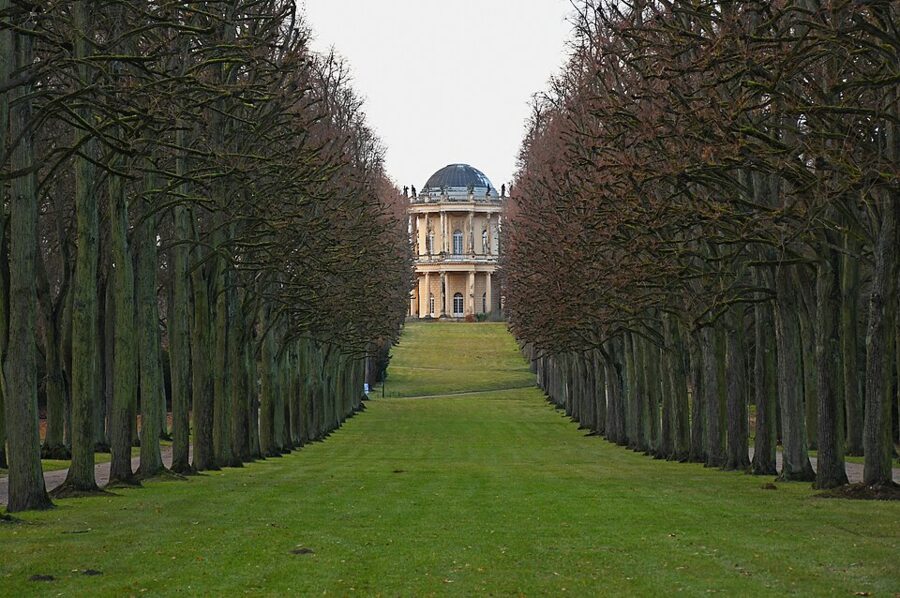
Artillery fire burned it out in April 1945, and it stood as a shell until the Messerschmitt Stiftung, a Munich foundation, paid for its restoration as a gesture to reunification; it was handed back in 2002. The Belvedere opens on selected summer days only, but the view from its steps over the park toward the city is free whenever you come.
The two temples by the New Palace
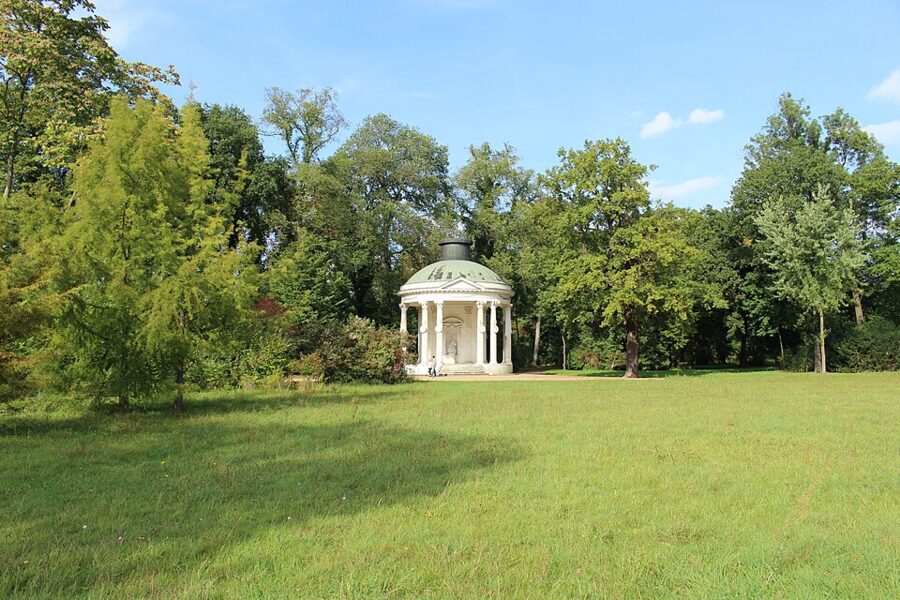
At the western end of the avenue two small round temples face each other across the path. South of it, Gontard’s Temple of Friendship (Freundschaftstempel) of 1768 to 1770 shelters a seated marble statue of Wilhelmine of Bayreuth, the sister Frederick loved most, who died in 1758. North of it, the Antique Temple (Antikentempel) was built for his ancient sculpture, coins and engraved stones; since 1921 it has been a Hohenzollern mausoleum and is closed.

The New Palace: Frederick’s fanfaronade
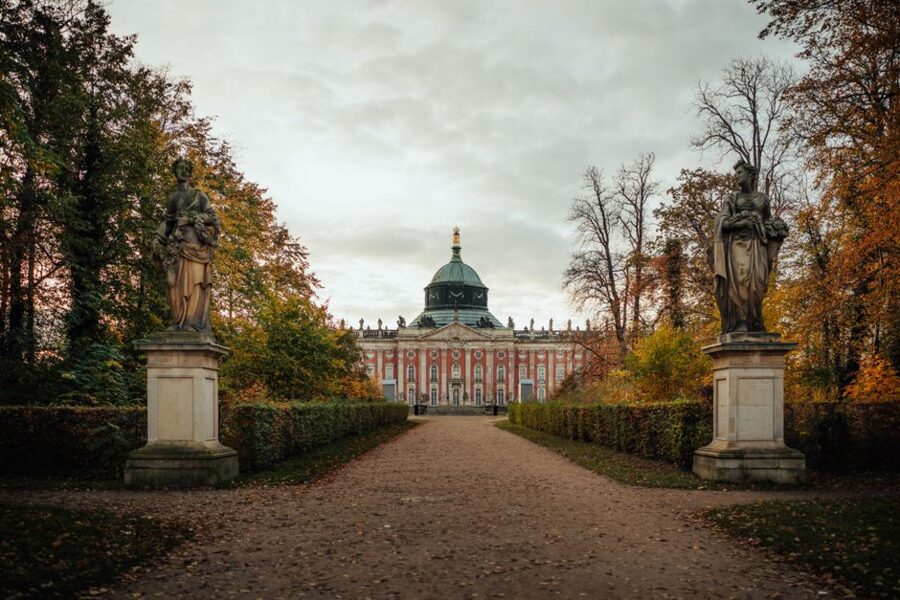
Walk the length of the avenue and the New Palace (Neues Palais) fills its end: 220 meters of front, a 55-meter dome topped by three Graces holding up a crown, and 267 larger-than-life statues along the roofline. Frederick began it in 1763, the year the Seven Years’ War ended, and finished it in 1769. He called it a fanfaronnade, a piece of bragging, and meant it: proof that Prussia, nearly ruined by war, could still build a palace this size.
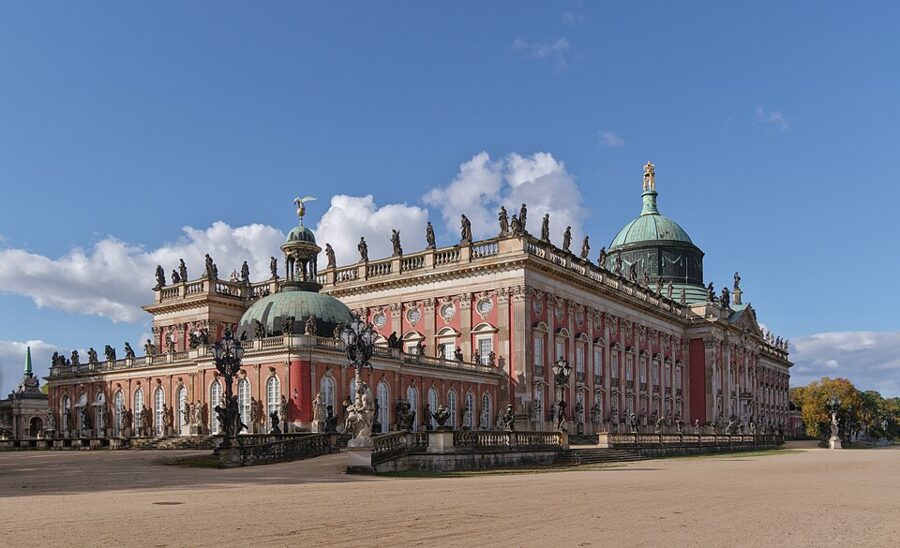

Much of it is theater. The great dome covers no domed hall; it is there for the silhouette. Most of the red brick is paint, because bricks ran short and proper pointing took too long, and only the south wing, where the king had his rooms, is real brick. On the cartouches of the central block runs the motto Nec soli cedit, “he yields not even to the sun”.
It was a guest palace for summer festivities. Between April and October the king’s brothers and sisters and their families, foreign princes and a hand-picked part of the court came for weeks of parties, with 200 rooms, four festival halls and a theater in the south wing. The queen was never present. Later Emperor Frederick III and then Wilhelm II, the last emperor, made it their main residence, and in November 1918 Empress Auguste Viktoria left from the station nearby to follow her husband into exile.
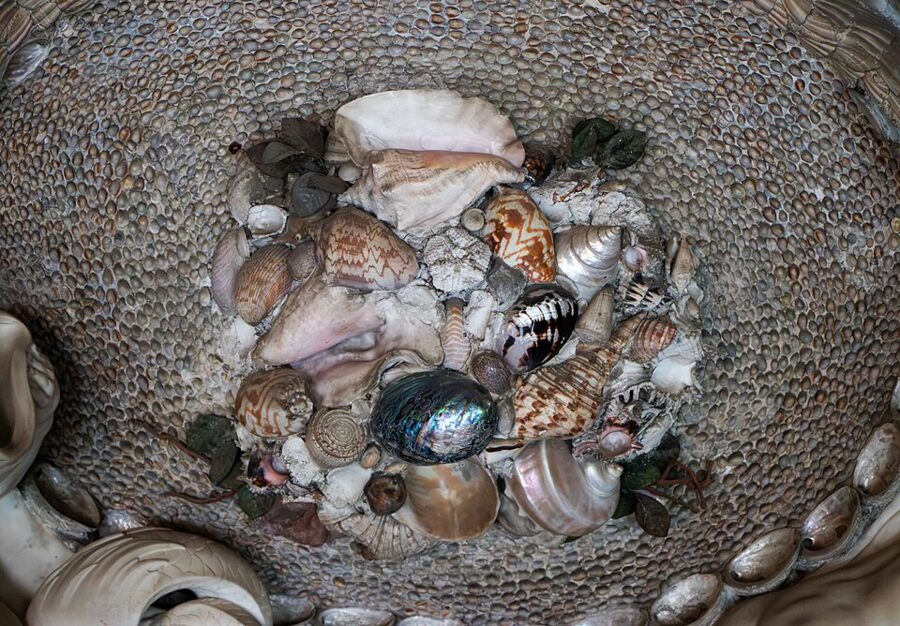
The visit, called the Grand Tour, covers the four festival halls and the guest apartments. The Grotto Hall on the ground floor, its walls encrusted with shells, glass, minerals and fossils, is back on the route after a long restoration, and so is the Lower Princes’ Quarter with its concert room and oval cabinet. Above the grotto, the two-storey Marble Hall carries Charles Amédée Philippe van Loo’s gods at their banquet, about 240 square meters and the largest canvas ceiling painting north of the Alps.

The New Palace charges €14 (reduced €10) for the Grand Tour in 2026, rising to €16 (reduced €12) in 2027, on a timed ticket from the visitor centers or as part of Sanssouci+. From April to October you can walk round on your own; from November to March the visit is a guided tour in German with information in other languages. The king’s own eleven-room apartment, the most luxurious he ever had, is closed for renovation.
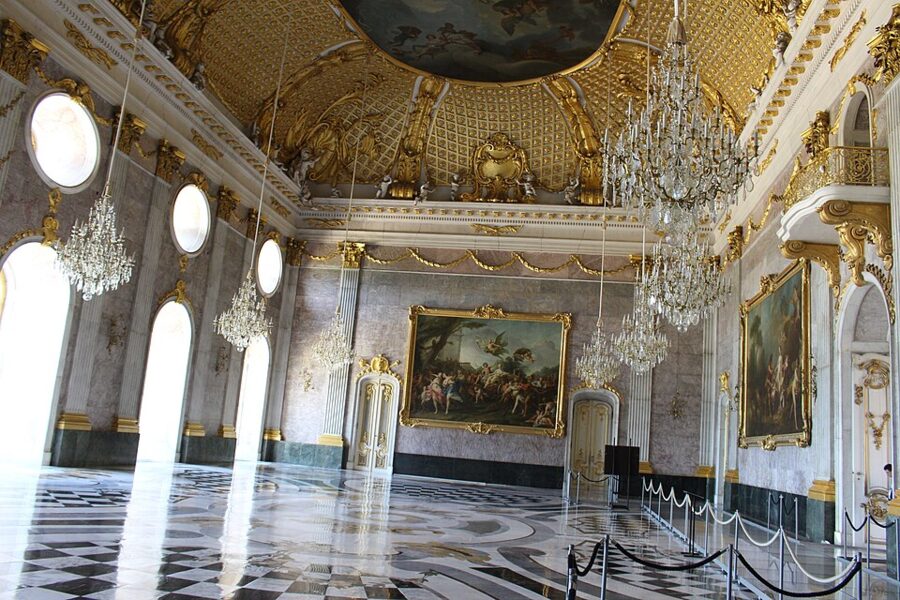

The apartment of Prince Henry, the king’s brother, with its silk walls and two state beds, is shown on German-language tours at 13:00 and 15:00 from April to October, for €8 (reduced €6), or €16 combined with the Grand Tour. Watch the closing days here: from January to October the New Palace closes on Mondays like Sanssouci, but in November and December it closes on Tuesdays and opens on Mondays instead. Its visitor center is shut every Tuesday.
If you have time for one interior beyond Sanssouci, make it this one: it shows the other Frederick, the king who wanted to be seen, not the philosopher who wanted to be left alone.
Turn round before you leave. Behind the palace, across a brick-paved square called the Mopke, stand the Communs, two domed buildings joined by colonnades and a triumphal gate. They look like more palaces but held kitchens, service rooms and lodgings for courtiers, dressed up so well that nothing gives the kitchens away. Today they belong to the University of Potsdam, and the gate and its colonnades were restored from 2008 to 2014.
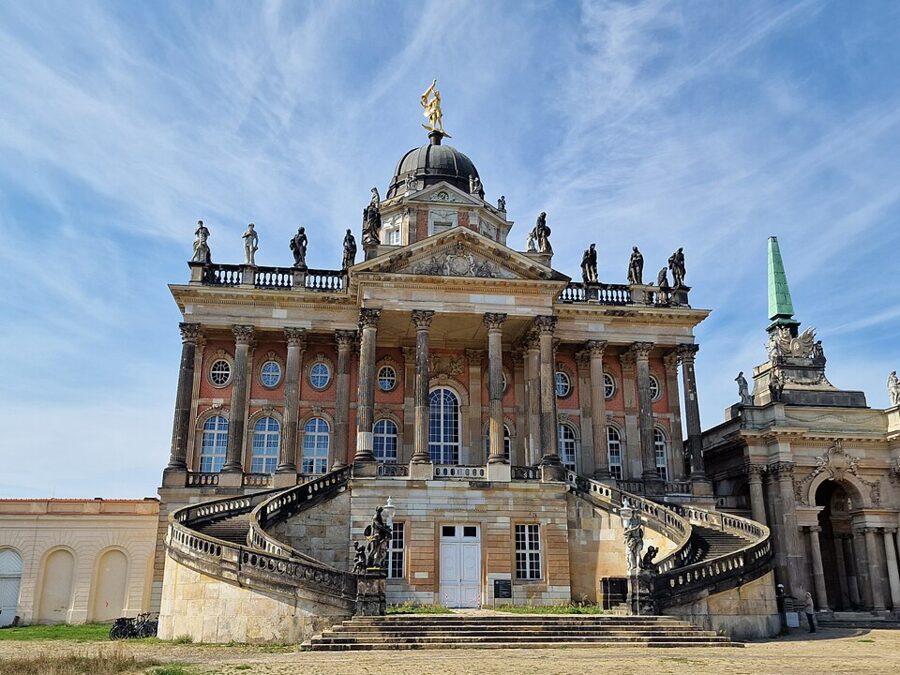

Charlottenhof and the Roman Baths
The southern park belongs to a different king and a different dream. At Christmas 1825 Frederick William III (Friedrich Wilhelm III) gave his son, the crown prince, an estate south of Sanssouci with a plain manor house. The crown prince, a gifted draftsman who never stopped sketching Italy, had Karl Friedrich Schinkel and his pupil Persius turn it into a small classical villa from 1826 to 1829, while Lenné turned the flat, partly marshy land into an open landscape park with long sightlines across meadows to the New Palace and the Roman Baths.
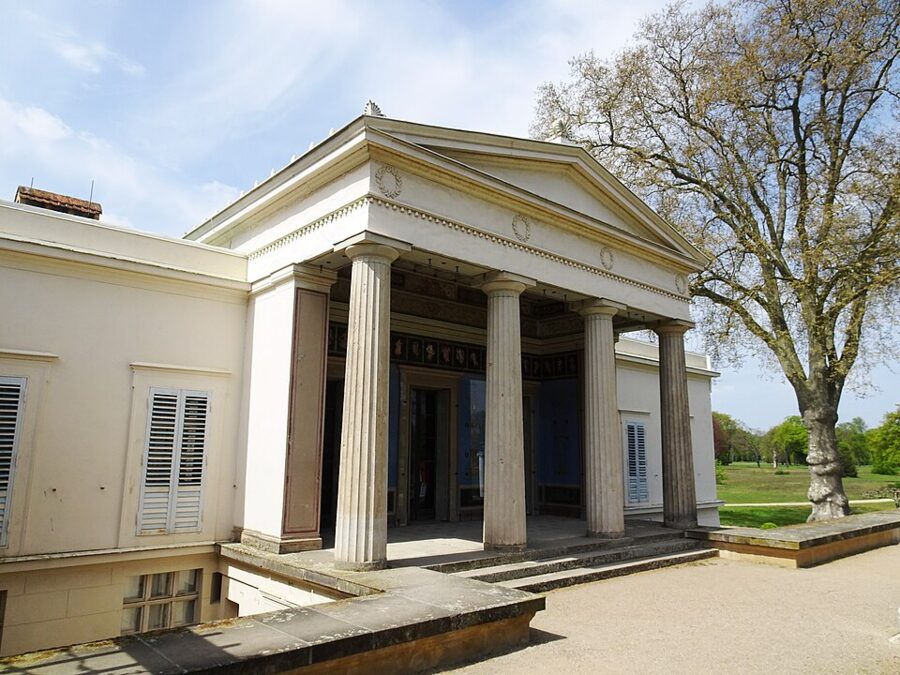

Schinkel had walked Pompeii in 1817, and Charlottenhof Palace (Schloss Charlottenhof) shows it: painted walls in the Pompeian manner, furniture he mostly designed himself, a portico onto a terrace and pergola, and a fountain whose stream runs through the house. The best room is the corner tent room, striped blue and white like the inside of a marquee. The crown prince called the house “Siam”, to him the land of the free, and signed himself the “Siam-house-architect”.
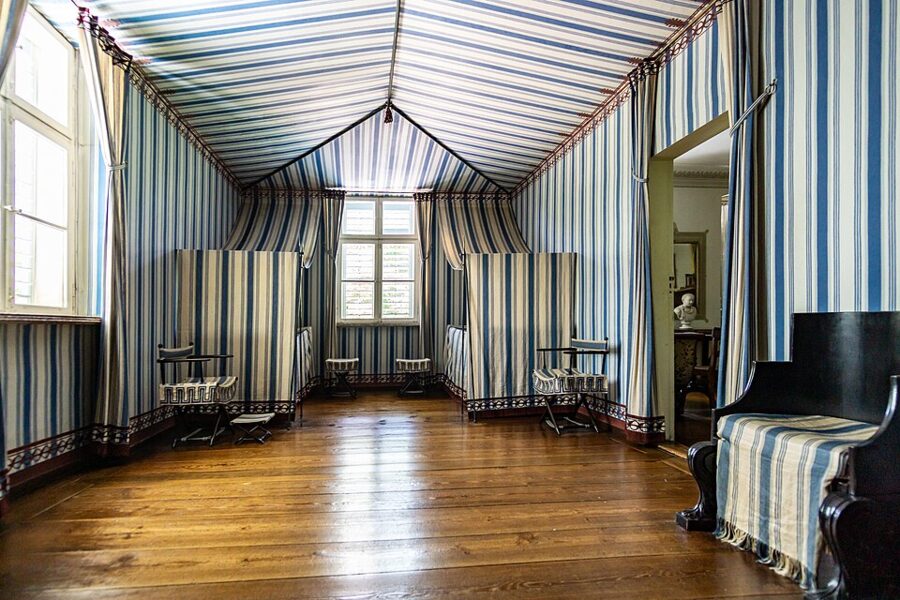

The rooms are shown on a guided tour in German from spring to October, Wednesday to Sunday, and there can be a wait. It is small and slightly odd, and I would choose it over the Chinese House interior: it is the clearest picture anywhere in Potsdam of what Frederick William IV wanted from life.
A short walk northeast, beside an artificial lake, the Roman Baths (Römische Bäder) are the same wish built as a village. Schinkel and Persius put them up from 1829 to 1840 from the crown prince’s sketches: a gardener’s house like an Italian farmhouse, a tea pavilion like a Roman temple, arcades, a pergola hung with vines and finally a bath house that nobody ever bathed in. Alexander von Humboldt stayed here on his visits to Potsdam.
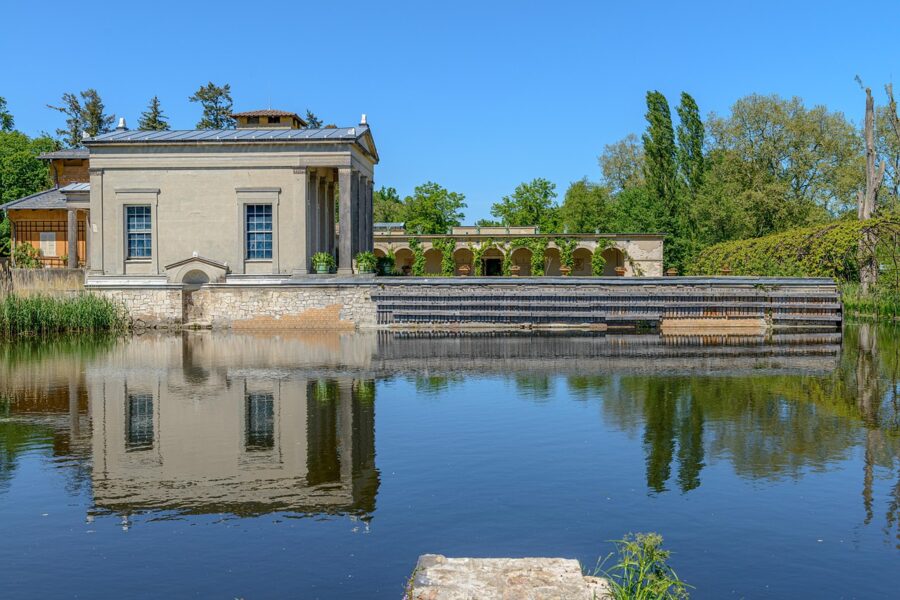
The Roman Baths are closed for a full renovation scheduled to run to 2028, so for now this is a walk past. The outside is the better half anyway, with its tower and uneven roofs over the water, and the meadows of the southern park are where you lose the crowds.
Tickets, hours and when to go
The park itself is free and opens daily from 08:00 until dusk. If you want Sanssouci Palace and more than one other interior on the same day, buy the Sanssouci+ ticket: €22 (reduced €17) in 2026 and €24 (reduced €20) in 2027, or €49 for up to two adults and four children. It covers one visit to every open foundation palace in Potsdam for a day, with a timed slot at Sanssouci and, if you choose, at the New Palace.
That includes the Marble Palace in the Neuer Garten and the Flatow Tower in Park Babelsberg, though not Sacrow Palace, Jagdschloss Stern or special exhibitions. The palaces outside this park, from Cecilienhof in the Neuer Garten to Sacrow, are covered in Potsdam’s palaces.
| Building | Season | Open | Ticket (2026) |
|---|---|---|---|
| Sanssouci Palace | All year | Tue–Sun 10:00–17:30, Nov–Mar to 16:30 | €14, timed |
| New Palace | All year | Tue–Sun Jan–Oct, Wed–Mon Nov–Dec; 10:00–17:30, Nov–Mar to 16:30 | €14 Grand Tour |
| Picture Gallery, New Chambers, Chinese House, palace kitchen, Charlottenhof | Spring to October | Wed–Sun 10:00–17:30 | €10 Flanierkarte for all five |
| Historic Mill | All year except December | Daily 10:00–18:00 Apr–Oct; weekends 10:00–16:00 in winter | €5 |
| Orangery Palace, Roman Baths | Closed for renovation | ||
| Norman Tower, Belvedere, pump house, Ladies’ Wing | Selected days or special events in summer | ||
Last entry everywhere is 30 minutes before closing. Holidays follow weekend hours unless the foundation says otherwise; every palace is closed on December 24 and 25, and on New Year’s Eve Sanssouci and the New Palace close at 14:30. The foundation’s holiday opening list has the rest.
Mondays are the trap. Sanssouci Palace and the visitor center at the mill close every Monday, and the small summer buildings close on Mondays and Tuesdays, which leaves Monday for the park and the outsides. Midweek outside school holidays is quietest.
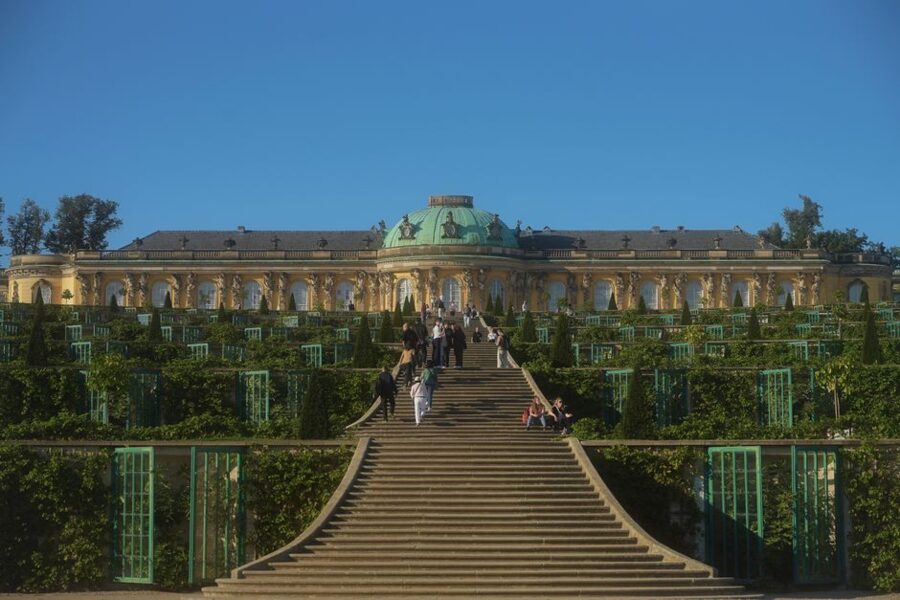
The first hour of the day is the quiet one, before the day-tour coaches from Berlin arrive. Book the 10:00 palace slot but be in the park by 09:00: the terraces in morning light, with the gardeners at work and nobody on the steps, are the best thing in Sanssouci and cost nothing. Afterwards walk west while the crowds walk up, and come back to the terraces in the late afternoon, when the low sun turns the facade gold.
In late spring and summer the parterre is planted and the fountains run; from November to March the small buildings shut, the water is off and the park belongs to dog walkers. In dry summers the foundation warns against lingering under old trees, which drop branches, and asks you to stay out of the park in storm warnings.
Getting there and getting around
From central Berlin, the S-Bahn S7 or a regional RE1 train runs to Potsdam Hauptbahnhof, the main station; the day trip from Berlin has the trains in detail. You need fare zone C, so buy a single ticket Berlin ABC at €5.00 in 2026 or a 24-hour ticket Berlin ABC at €12.90; from January 1, 2027, they rise to €5.20 and €13.20. The Deutschlandticket covers everything here.
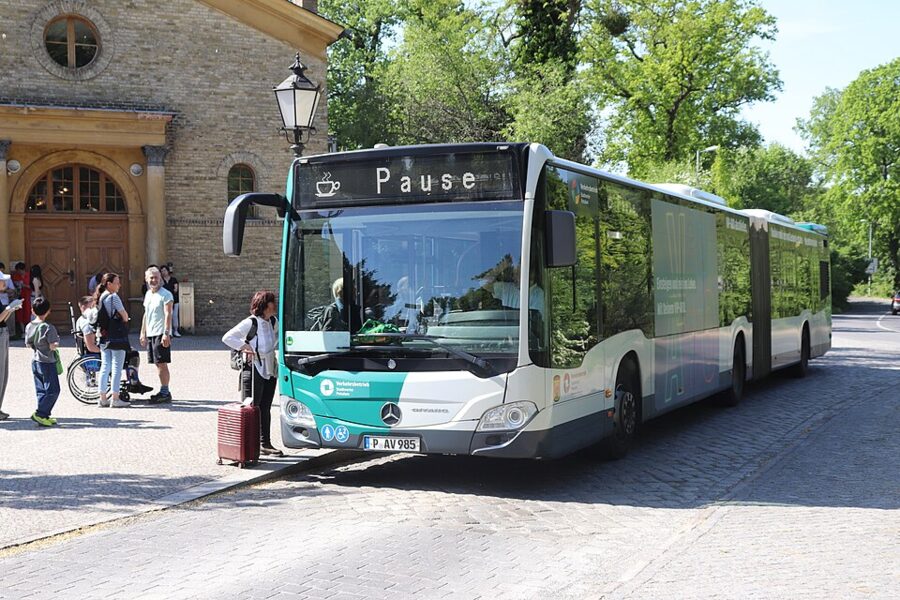

From the main station, bus 695 runs via Luisenplatz to the stop “Schloss Sanssouci” in about 15 minutes, along the road on the north side of the park, then on to the Orangery and the Dragon House. In the summer season the X15 adds a direct service to the same stops and on to the New Palace. For the western end, bus 605 runs from the main station to “Schloss Charlottenhof”, “Bhf Park Sanssouci” and “Neues Palais”. Inside Potsdam a single ticket Potsdam AB costs €3.00 and a 24-hour ticket €6.30 in 2026.
Potsdam Park Sanssouci station, served by the RE1 and several RB lines, lies just south of the New Palace and is the easiest way to start or finish at the western end; the Kaiserbahnhof beside it was the emperors’ private station. Trams 91 and 94 stop at Charlottenhof station, a short walk from the southern park. Or walk: from Luisenplatz, at the end of Brandenburger Straße, the Obelisk Portal is a few minutes away and the foot of the terraces about 15.

Distances are bigger than they look: the avenue from the obelisk to the New Palace is a good 30 minutes, and many paths are sand and gravel. If you come by bike, lock it at the stands marked on the foundation’s park plan.
A half-day route
Walk in from Luisenplatz through the Obelisk Portal by 09:00, follow the avenue to the Great Fountain, climb the steps to the grave and go into the palace at 10:00. Then the Picture Gallery or the New Chambers in season, and the mill’s gallery. Leave past the Friedenskirche through the Grünes Gitter gate, ten minutes from the old town; allow four hours.
A full-day route
Do the half-day route as far as the mill, then walk up to the Orangery terrace and west along the ridge to the Dragon House for lunch, with the Belvedere a few steps on. Walk down to the New Palace, about 15 minutes, for an afternoon Grand Tour, and look at the Communs and the two temples on your way out.
From the temples head southeast through Lenné’s park to Charlottenhof and the Roman Baths, then north past the Chinese House back to the foot of the terraces. Finish with the climb to the Ruinenberg for the view down onto the palace roof, or take bus 695 back to the station from “Schloss Sanssouci”. Allow eight hours and about 8 km on foot.
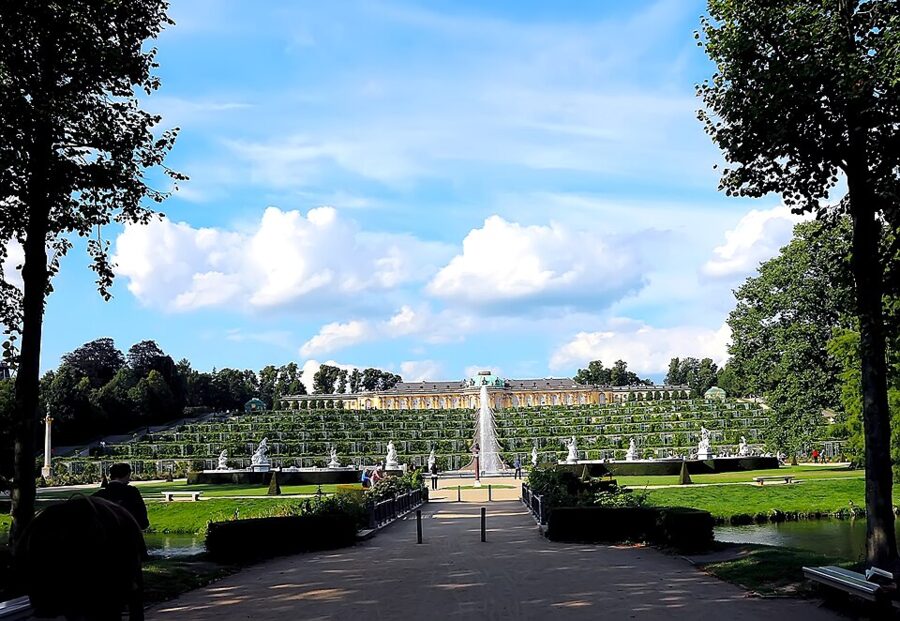

Whichever you choose, end where you started. From the fountain at closing time the terraces look the way Frederick meant them to: a vineyard with a house on top, the house so low it is half lost in the vines, because the man who built it wanted to step straight from his study into the garden. The water jumping in front of you came a century too late for him. The potatoes on his grave will be there again in the morning.