

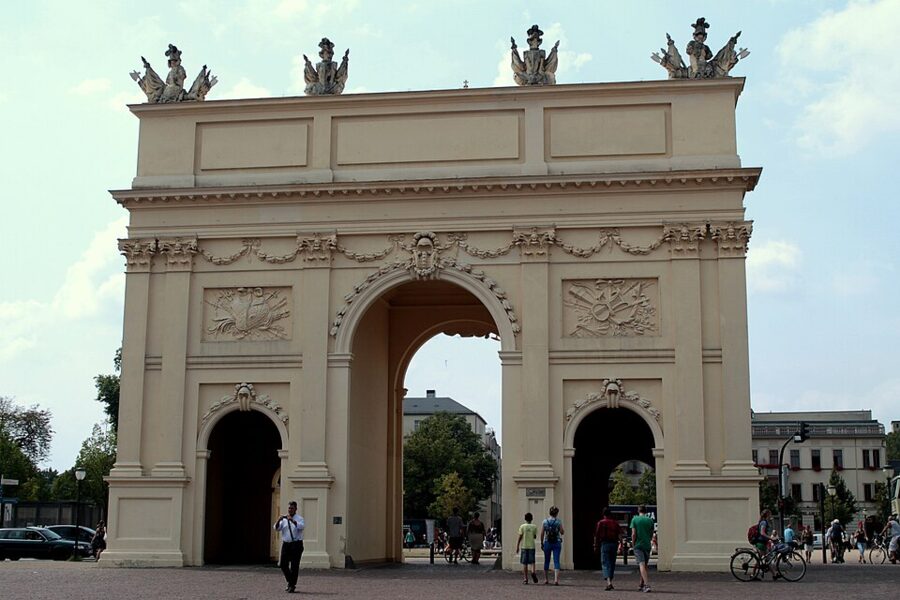
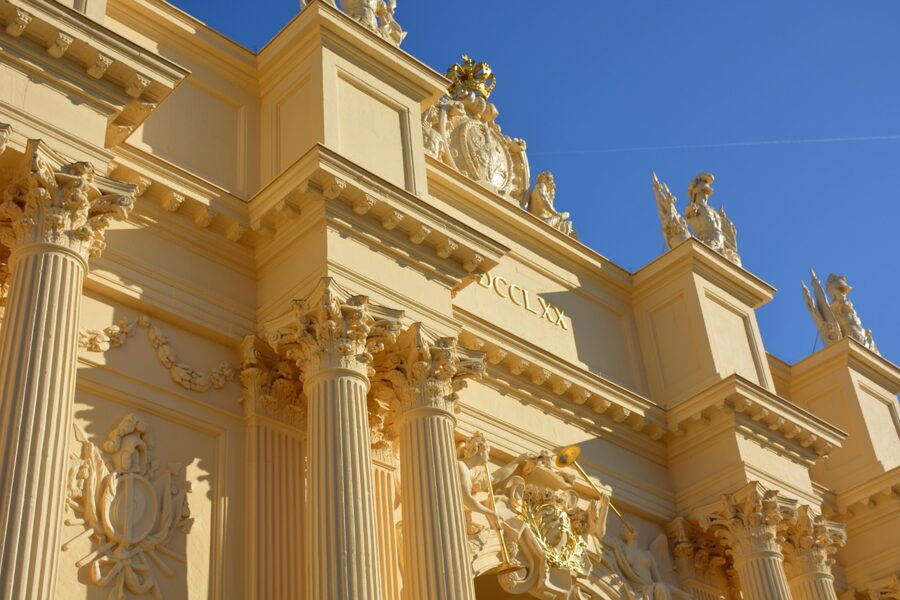
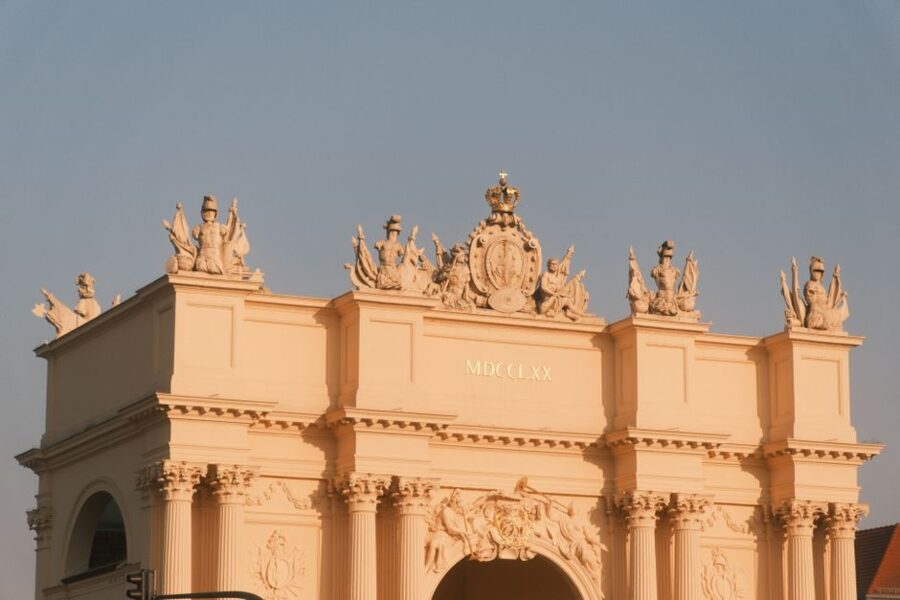
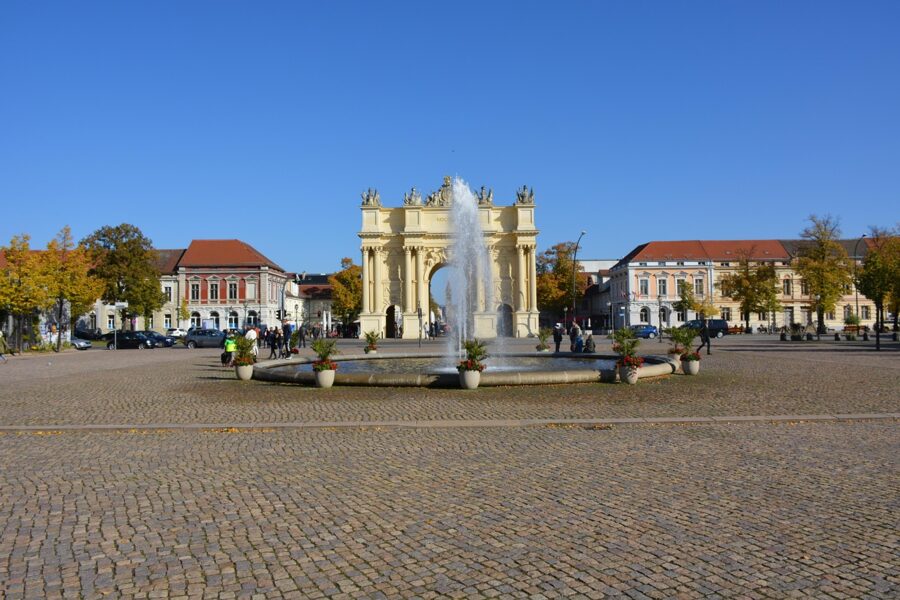
Walk through Potsdam’s Brandenburg Gate (Brandenburger Tor) from Luisenplatz, then turn around. The side you just passed is a Roman triumphal arch, all paired columns, gilded trumpets and a skyline of trophies. The side now facing you is a flat, polite wall with pilasters, the kind of front a town house might wear.
Two architects did that. In 1770 Frederick the Great had Carl von Gontard design the town side and gave the country side to Gontard’s pupil Georg Christian Unger, and neither seems to have tried very hard to match the other. The result went up in 1770–71, some eighteen years before the far more famous gate of the same name in Berlin, and it still stands at the west end of Brandenburger Straße, the long baroque street that runs dead straight to the church of St. Peter and Paul.
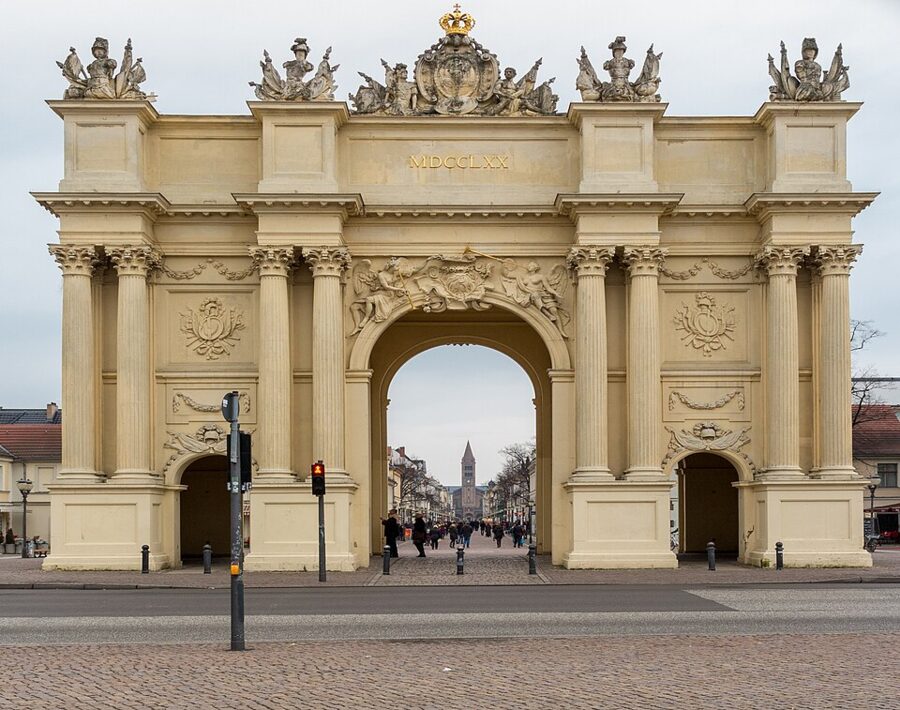

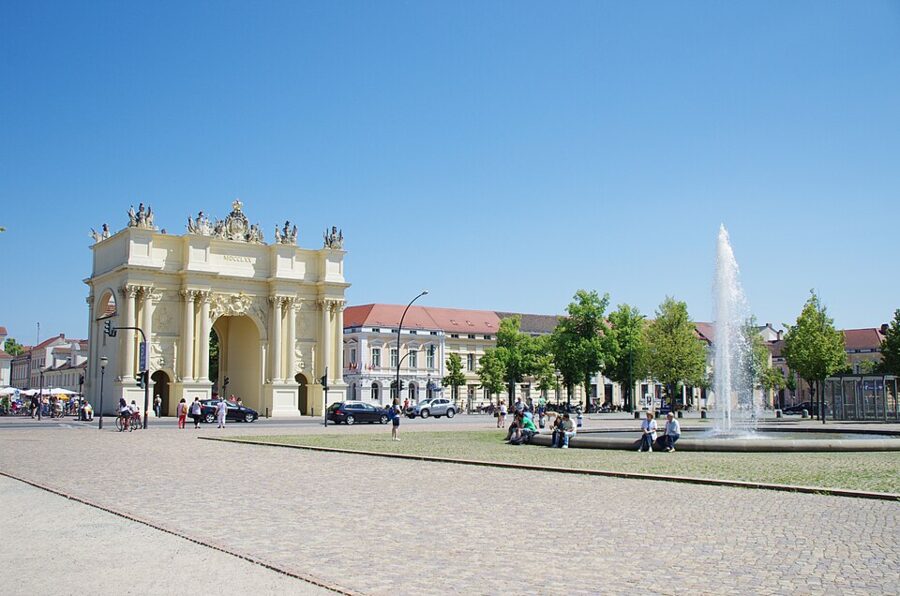
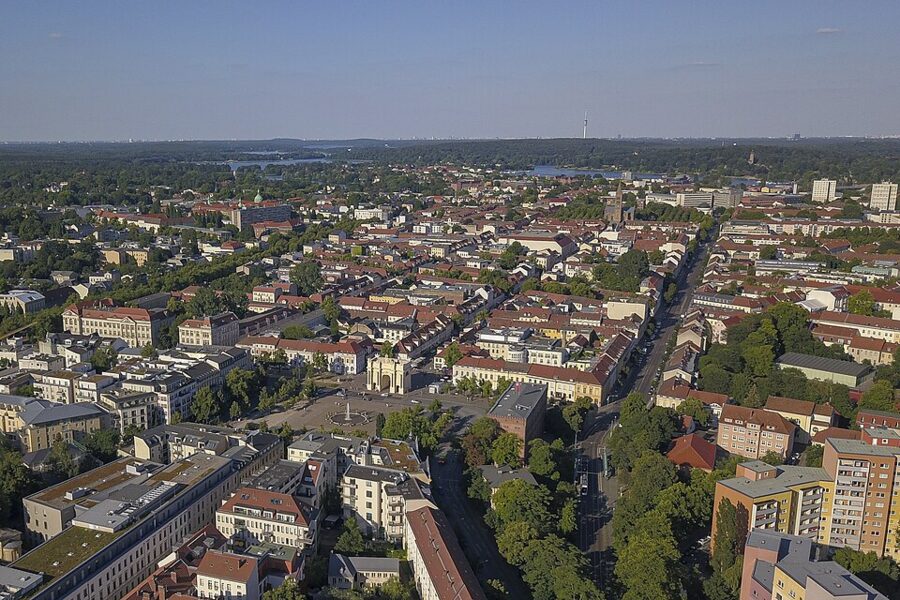
The gate is the hinge of the old town. On one side lies Luisenplatz and the road to the park of Sanssouci; on the other, the grid of soldiers’ houses the gate once locked in, with a customs wall around it whose two other surviving gates are a short walk away.


Contents7 parts
A victory arch with two faces
Potsdam had a gate on this spot before Frederick touched it. When his father, Frederick William I (Friedrich Wilhelm I), pushed the town west in 1733, the new customs wall needed an exit toward the town of Brandenburg, and a plain gate went up here. A guidebook of 1900, quoted by the city, calls it the old wooden gate.
The Seven Years’ War changed its fate. Prussia ended that war in 1763 still standing and still holding Silesia, and Frederick spent the following decade building as if he had won outright: the New Palace (Neues Palais) at the far end of Sanssouci, and at the edge of his garrison town a proper triumphal arch. The city’s own page on the gate puts it plainly: the new gate was meant to show Prussia’s rise into the ranks of the European great powers.

Gontard’s side and Unger’s side
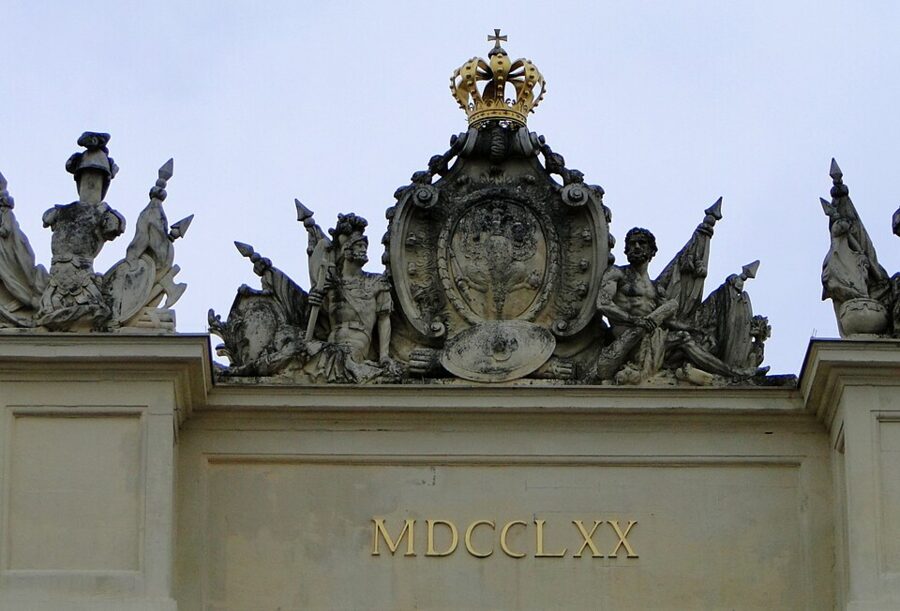
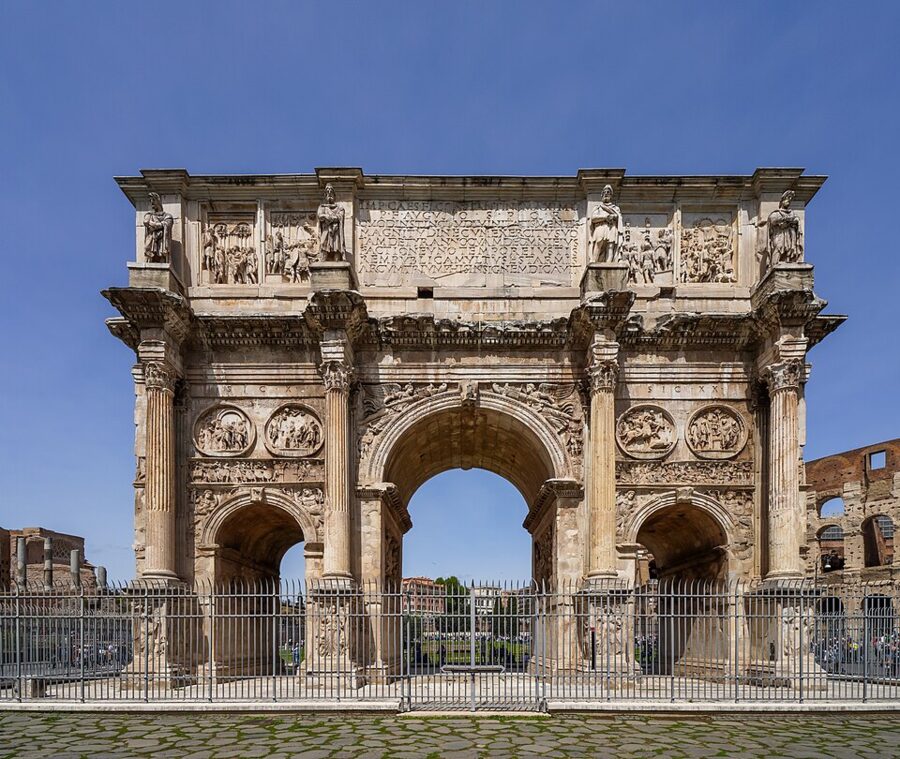
The model for the country side, or field side (Feldseite, the side facing the fields), was the Arch of Constantine in Rome. You can see it in the doubled Corinthian columns standing free of the wall, in the cornice that juts out over each pair, and in the tall attic crowded with trophies. Unger made this the side to be seen from far off, at the point where several roads converged on the gate from the west.
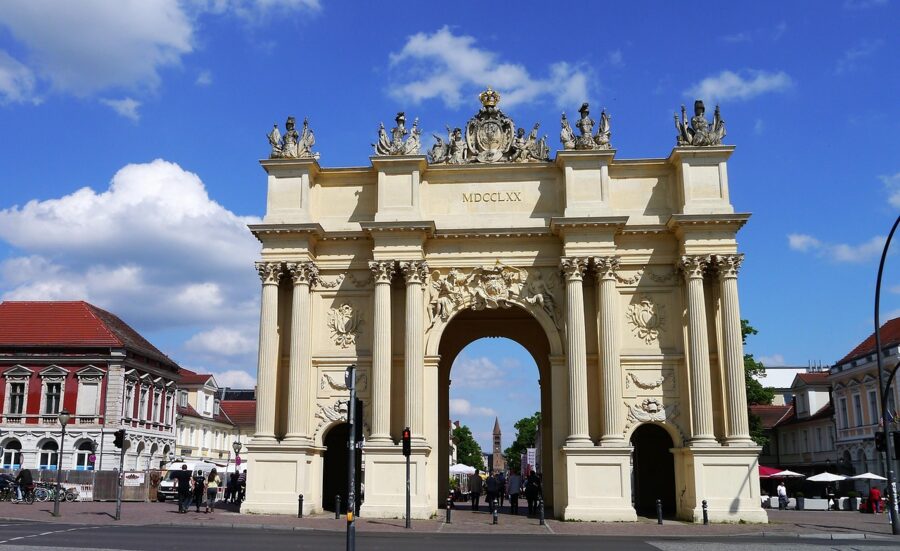
Gontard’s town side (Stadtseite) is a stucco front with Corinthian-style pilasters and trophies laid flat against the wall. It is handsome, and it is a different building. The usual reading is the city’s: the field side was a showpiece for arrivals, while the town side faced a working forecourt where guards checked who and what was leaving.
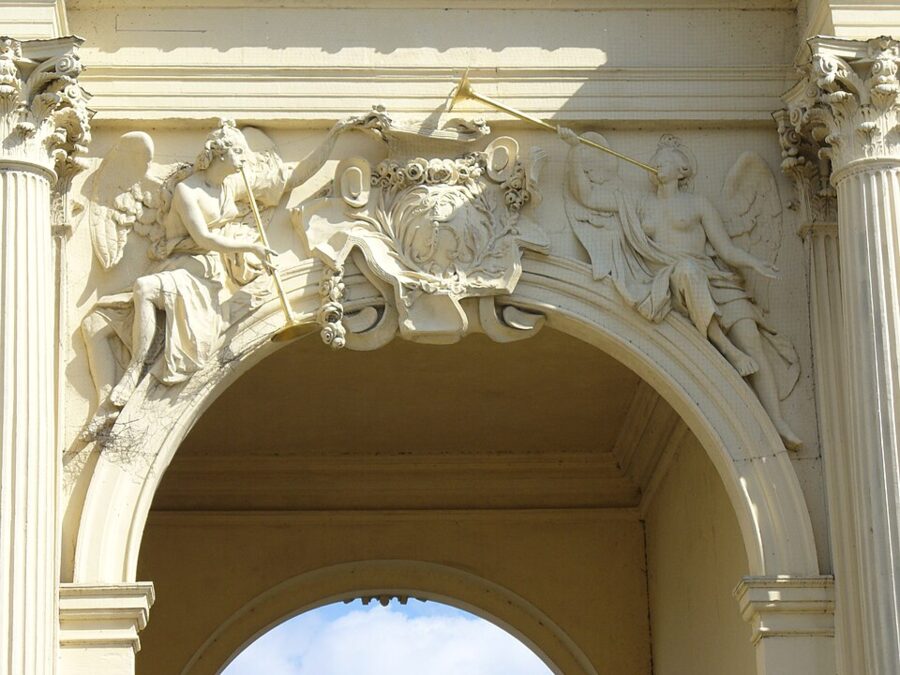

The authorship is not as tidy as the two names suggest. The same 1900 guidebook says Unger built the outer side “after the king’s own design”, and Frederick did sketch buildings for his architects, so it is fair to read the field side as the king’s idea in Unger’s hands. The state’s monument register simply lists both men, Gontard and Unger, as designers in 1770.
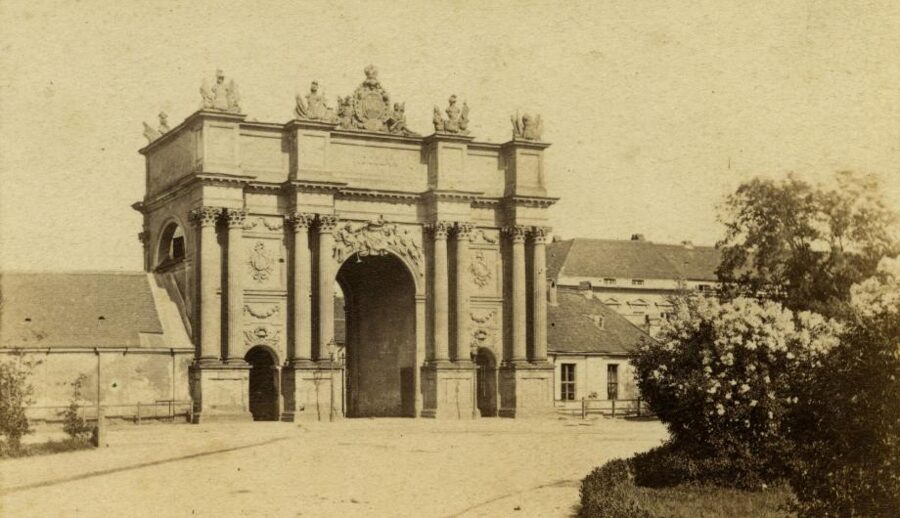

Those side passages are the easiest thing to misread. They look like part of the Roman scheme, but until the nineteenth century they held the guardroom and the rooms of the royal customs. Frederick William IV (Friedrich Wilhelm IV) had them opened in 1843 to cope with the traffic, and that is why the gate you walk through today has three ways in.
Older than Berlin’s
Berlin’s Brandenburg Gate came later and looks nothing like this. Carl Gotthard Langhans built it in 1788–91 for Frederick William II, as a Greek colonnade modeled on the gateway to the Acropolis, with the Quadriga added on top. Potsdam’s is a Roman arch, smaller, older by eighteen years and, I think, more fun to look at, because you can stand in one spot and see exactly where two designers stopped talking to each other.
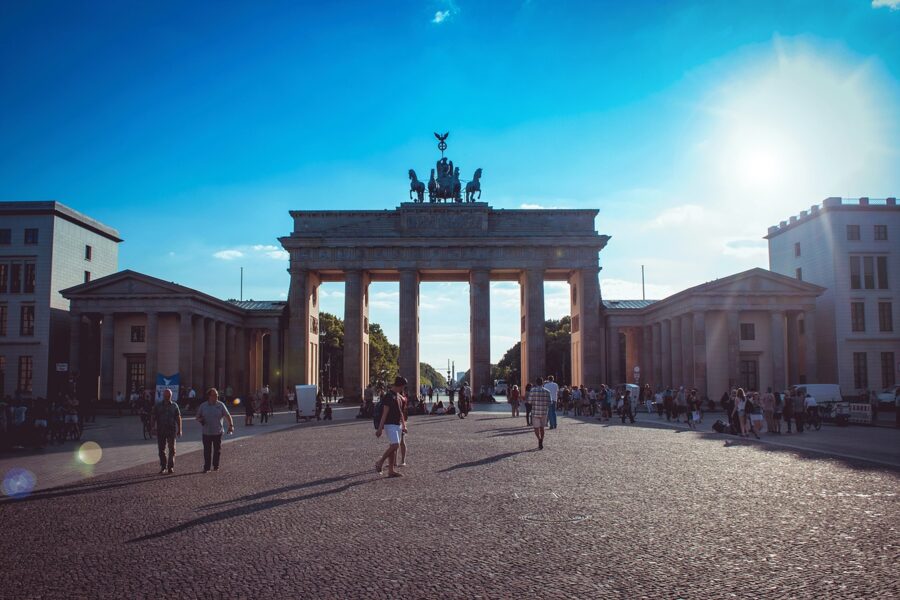
Both gates are named for the same thing: the road to the town of Brandenburg an der Havel, the old seat of the margraves. In Potsdam you left town through this gate to take it, and the road still begins on Luisenplatz as Zeppelinstraße.
From city gate to monument
The gate lost its job slowly. The wall it sat in was cut away in stages, and the sources disagree on when this stretch went: the regional encyclopedia says the gate has stood alone since the wall came down around 1900, while the account of the Jägertor dates the demolition there to 1869. Either way, by the start of the twentieth century the Brandenburg Gate was a freestanding arch on a square.
From 1880 a single-track horse tram ran through the arch onto Luisenplatz, and it left a mark you can still find. On the right pier of the town side, the word Schritt (walk, as in “at walking pace”) is still lettered on the stone, an order to the tram drivers to slow down for people on foot. The tram moved to Charlottenstraße when it was electrified in 1907.
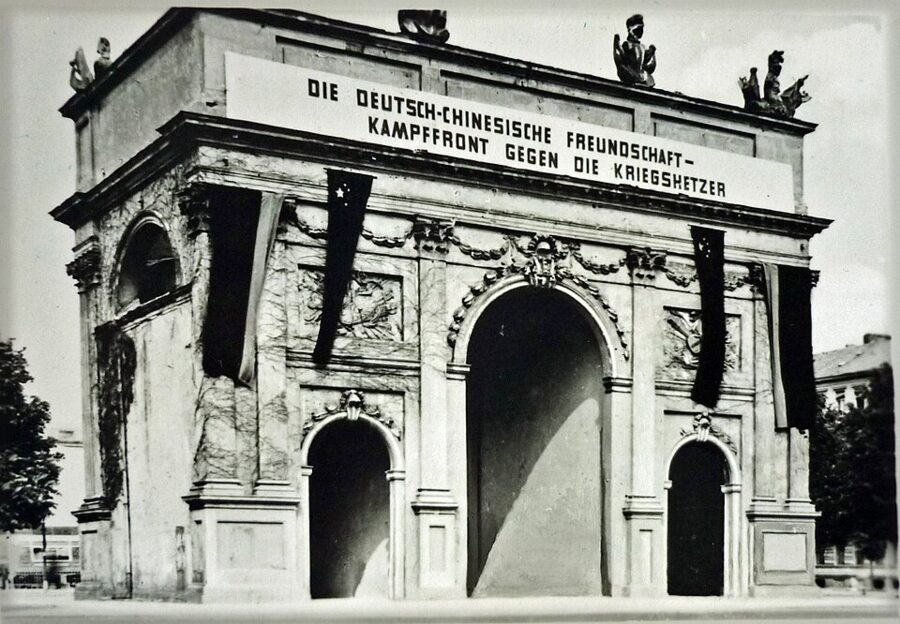
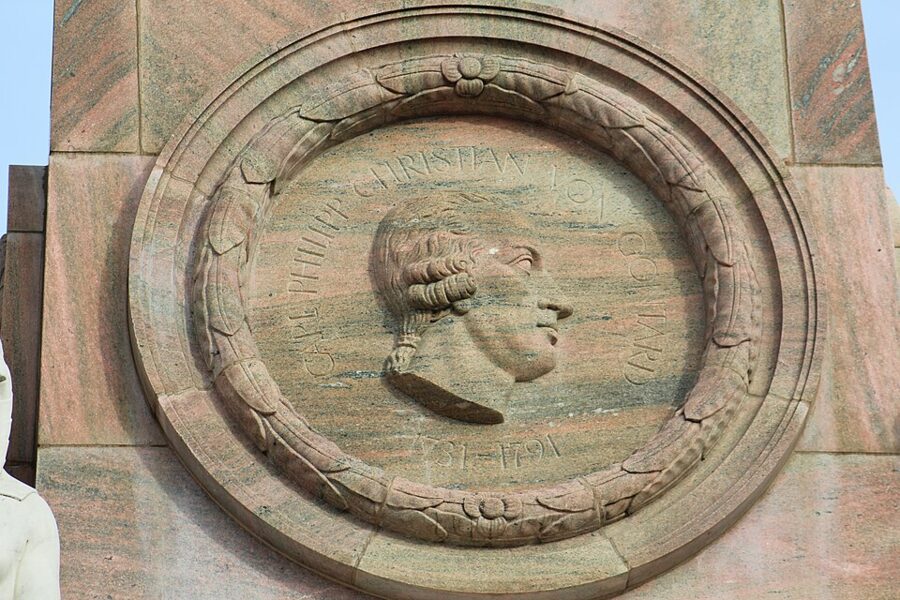
Like every gate in town it was damaged in the war, and it came through the GDR years, when the street behind it was named for the Czechoslovak communist leader Klement Gottwald. It is a listed monument in the Brandenburg state register, and today it is where Potsdam gathers: demonstrations start in front of it, and in Advent the city puts its biggest Christmas tree beside it.
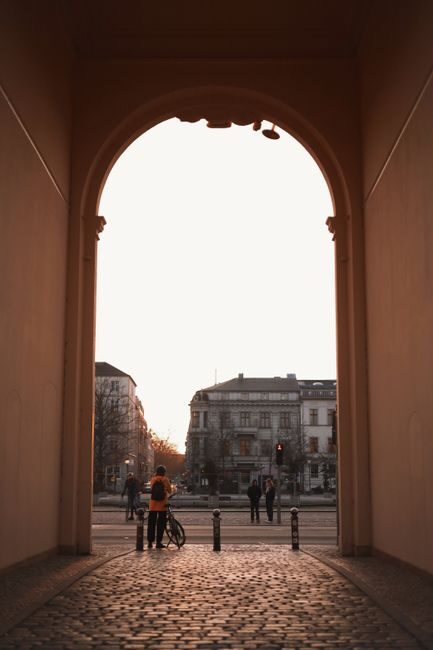
Luisenplatz, from timber yard to fountain
The square in front of the field side began as working ground. It was laid out with the wall in about 1733 as a timber yard, according to the city’s history of the area and the regional encyclopedia; the city’s page on the gate gives 1744, under Frederick, instead. Three roads fan out from it to the west: Zeppelinstraße toward Brandenburg an der Havel, Zimmerstraße into the western suburb, and the Allee nach Sanssouci to the park.
The name comes from one afternoon. On December 21, 1793, the town received a 17-year-old princess here, Luise of Mecklenburg-Strelitz, on her way to marry the Prussian crown prince. As Queen Luise she became the most celebrated queen in Prussian memory, and the square carries her name.
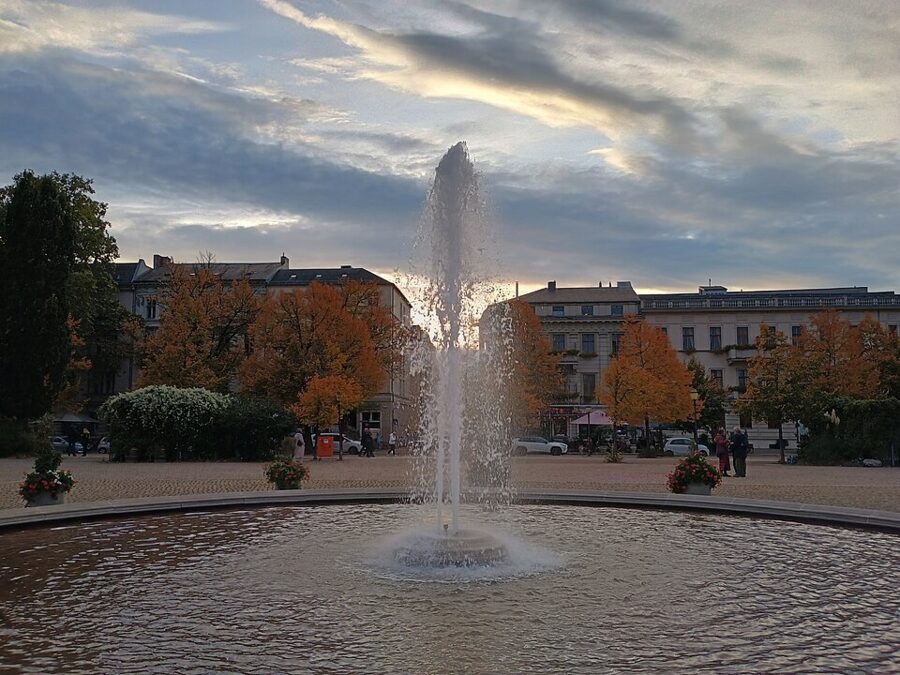

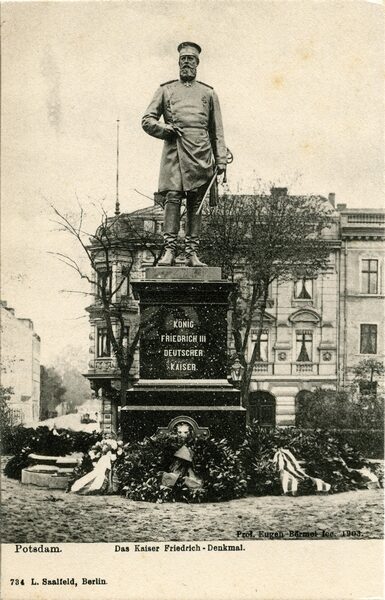
Peter Joseph Lenné, the royal garden director, turned the yard into a garden in 1854 for Frederick William IV, with lawns, hedges, ornamental trees and a fountain rich with sculpture in the middle. In 1903 the fountain gave way to a statue of Frederick III, the emperor who reigned for 99 days in 1888.
Then the cars came. The city’s history says the garden was paved over for parking in 1939; the regional encyclopedia puts the paving in 1931, when the square was rebuilt with a tram stop and two traffic islands. The renaming followed the politics: Brandenburger Platz in 1945, Platz der Nationen in 1951, Luisenplatz again in 1991. Through the GDR years it held fairs and Christmas markets as well as parked cars.
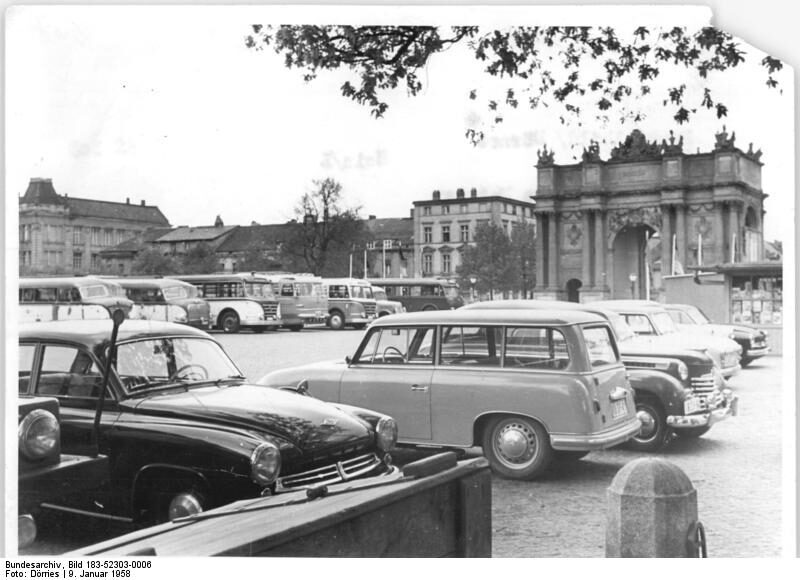

The present square dates from 1999–2000, when Potsdam prepared for the Federal Garden Show (Bundesgartenschau) of 2001. An underground garage went in to replace the surface parking, double and triple rows of lime trees were planted, of a special non-dripping variety, and the fountain returned as a free reading of Lenné’s 1854 design. The tram line was straightened in 1999 and now runs along the south edge.
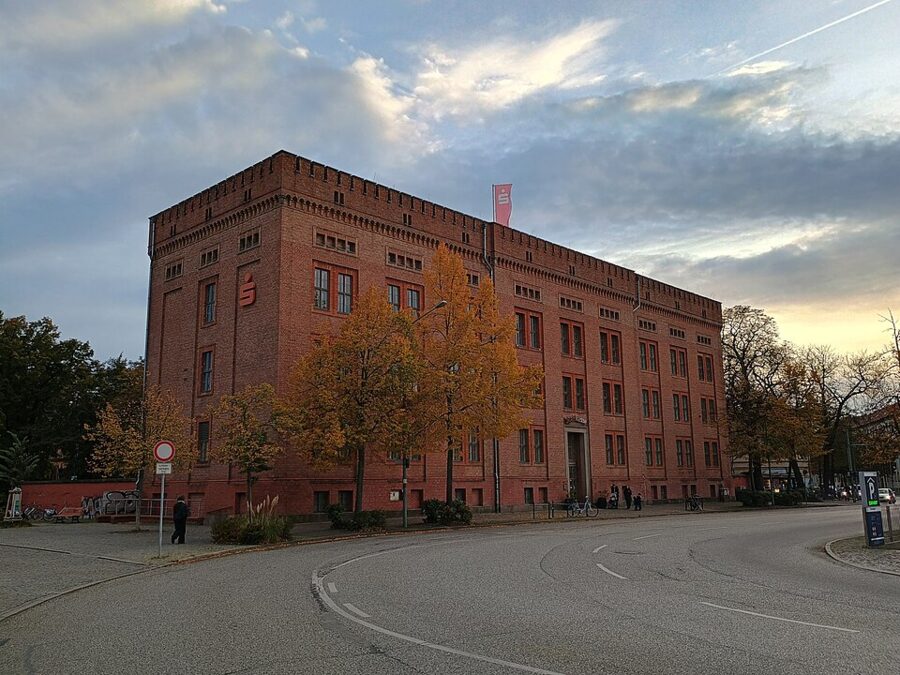
Look around the edges before you move on. The dark red block at Luisenplatz 9, now a savings bank, was built in 1833–36 as barracks for the 1st Guard Uhlan Regiment. On the south side, a listed house that was long the tavern of the gate guards and the soldiers from the barracks has one wall formed by the city wall of 1733, with its arches still visible.

Since November 2020 the square has also carried a memorial to the largest demonstration of the peaceful revolution in Potsdam, on November 4, 1989. The Potsdam artist Mikos Meininger set cast-iron plates into the ground in the shape of the date, “4.11.1989”, with 106 footprints of people who marched that day and slogans from their banners.

The soldier king’s wall
The wall the gate was built into was never meant to keep an army out. Frederick William I, the soldier king, made Potsdam the permanent base of his guard from 1713, and his wall had two jobs: to stop soldiers from deserting, and to make sure every cartload of goods paid the excise (Akzise), the consumption tax that Prussian towns had collected on the Dutch model since 1680.
Potsdam was a town of soldiers lodged in private houses, and the wall was the only thing between a homesick recruit and the open country. In the files it was the Accise- und Desertations-Communikation, and the word stuck to the streets along it: a printing house on today’s Hegelallee still had the address Jäger-Kommunikation 9 when it was founded in 1887.
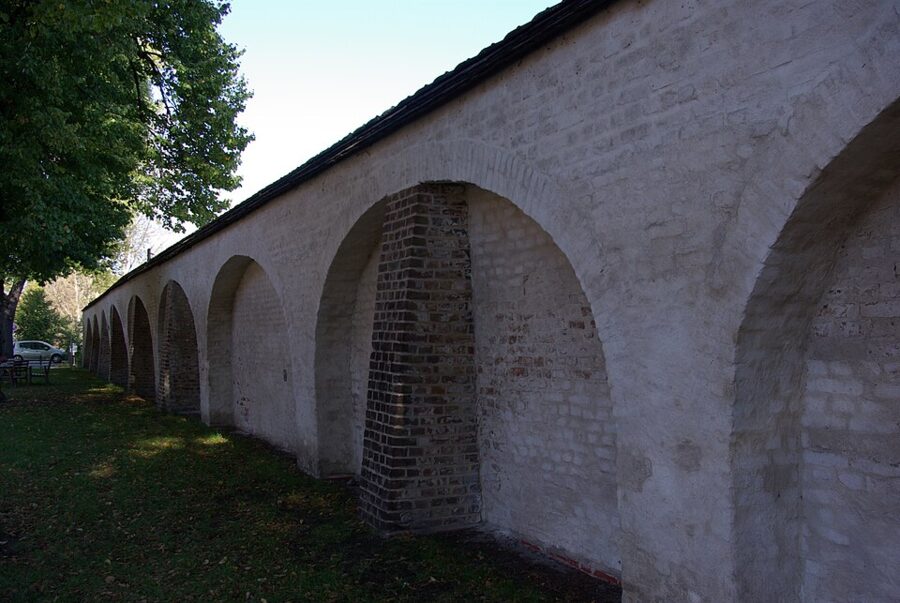

The wall moved twice. The first expansion from 1722 doubled the town beyond the canal and enclosed it along what are now Charlottenstraße and Lindenstraße; sources give dates between 1713 and 1722 for the first barrier, which began as a palisade. Only eleven years later the garrison had outgrown it again, and the second expansion of 1733–42 pushed the wall out to its final line, with the Nauener Tor, the Jägertor and the Brandenburger Tor on the north and west. Between 1715 and 1740 the town grew from 199 houses and 1,500 people to 1,154 houses and 11,708 people.
There were ten gates in all, and the excise collectors outlived the soldiers. After the reforms of Stein and Hardenberg ended the old excise in the early nineteenth century, the gates went on collecting a tax on milled grain and slaughtered meat until 1909. Three gates survive whole: the Brandenburger Tor, the Jägertor and the Nauener Tor. Where the wall ran between them, a promenade now links all three.
The Jägertor
The Jägertor of 1733 is the oldest gate left in Potsdam, and the only one from the second expansion that survives much as it was built. It stands at the north end of Lindenstraße, set at an angle because the street crossed the wall on a slant, and it takes its name from the elector’s hunting lodge, the Jägerhof, that stood outside the town.
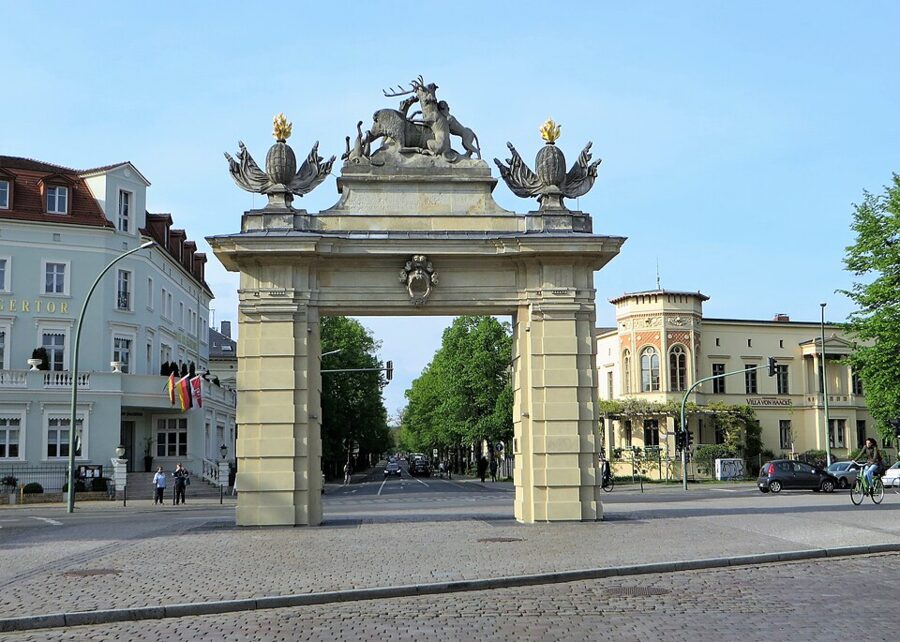

It is a frank piece of design. Two rusticated piers of rendered brick carry a straight sandstone beam, and on top a stag stands at bay among hunting dogs, flanked by flaming grenades. Hunting lodge and garrison, both in one crown.
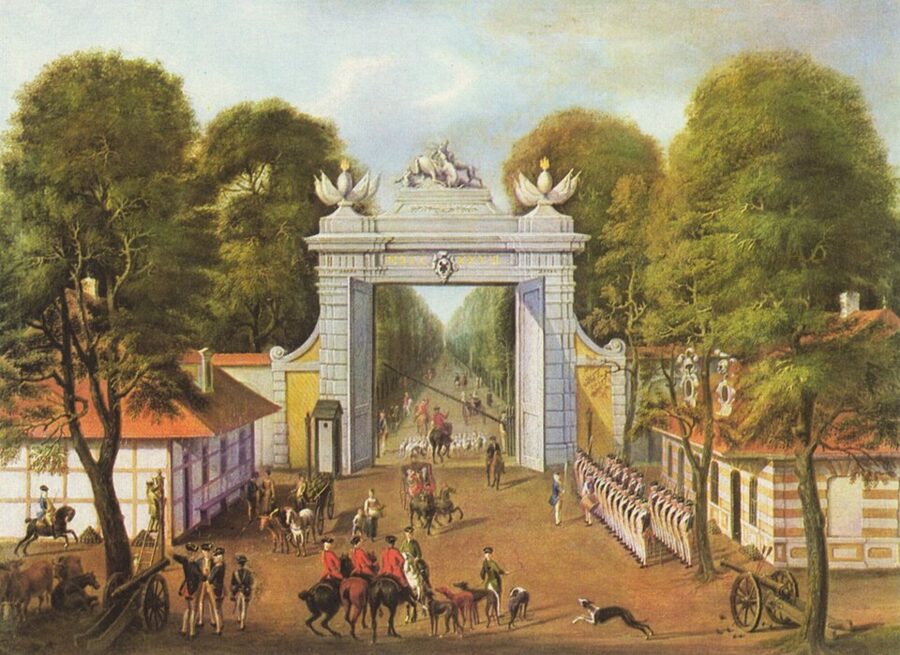
The soldier king’s court painter, Dismar Degen, painted the gate soon after it was built, with the guardhouse on one side, the excise house on the other, and a company of guards turned out in front. He made the gate far bigger and grander than it is, which tells you what the king wanted to see. The painting belongs to the Prussian Palaces and Gardens Foundation (SPSG).
The Nauener Tor
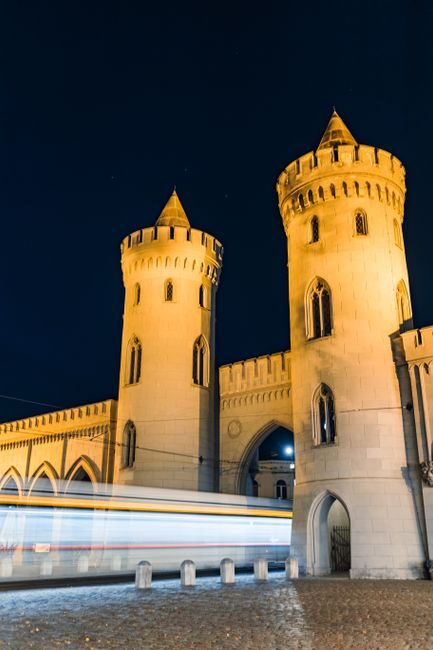
The Nauener Tor is a surprise for the eighteenth century: round towers, battlements, pointed arches. Frederick sketched it himself, and Johann Gottfried Büring built it in 1754–55 at the head of the road to Nauen. The city describes it as the oldest piece of neo-Gothic architecture on the European mainland, built in a style England was only beginning to play with, and on purpose: the king wanted a gate that looked older than it was.
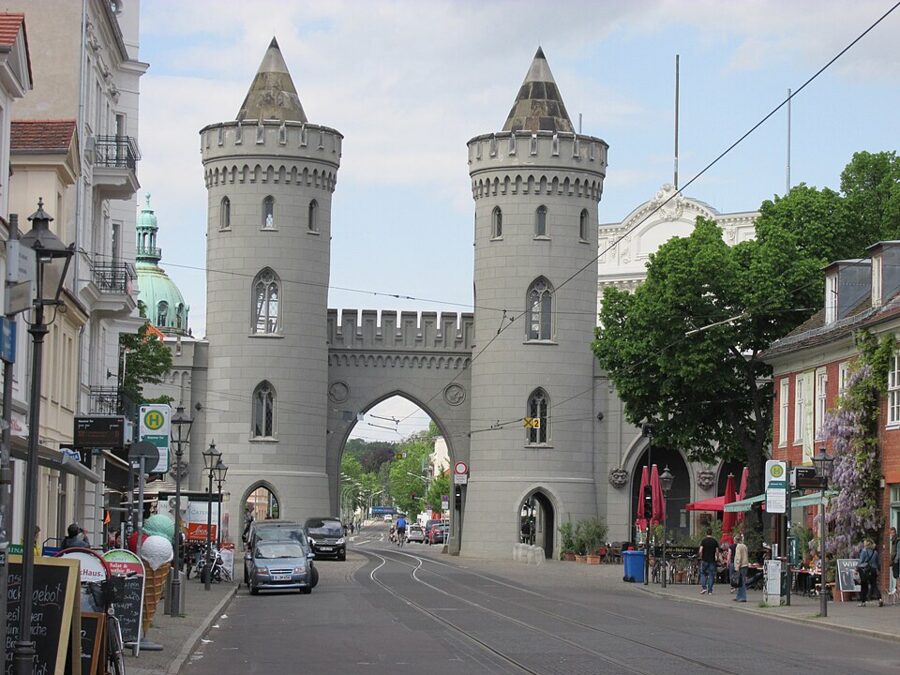

What you see is partly Victorian. The baroque gate of 1733 stayed standing between Frederick’s towers until 1867, when it was pulled down along with the wall and replaced by the present, wider pointed arch. That 1733 gate had carried the inscription “Long live the king and all brave soldiers”. The gate and its forecourt were restored in 1996–97 and repainted in their historic colors.
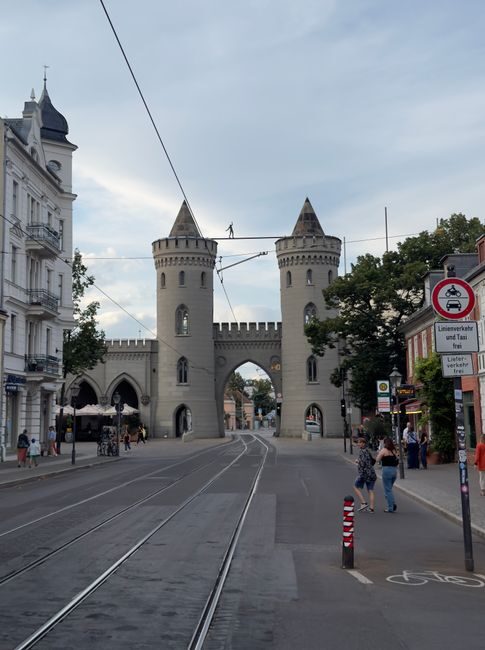
Trams still run through the arch, and the two side wings now hold restaurants. The Nauener Tor is also the front door of the Dutch Quarter (Holländisches Viertel), the four blocks of red-brick gabled houses the soldier king built for Dutch craftsmen between 1733 and 1742.
The gates that are gone
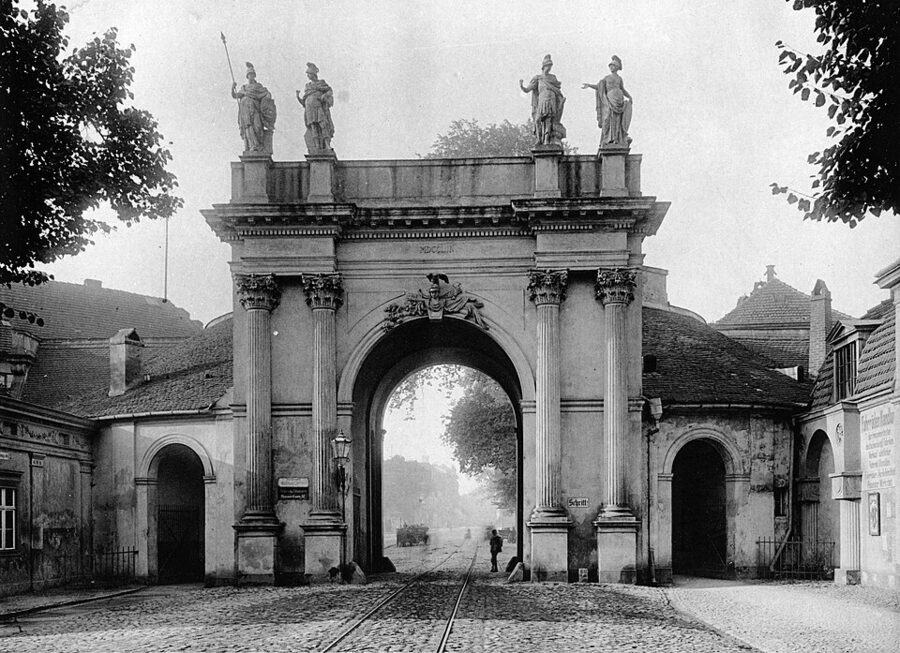
The lost gates are the better story, because the war started their destruction and town planning finished it. The Berliner Tor on the road to Berlin was built in 1752 by Jan Bouman, the Dutch master builder of the Dutch Quarter, on the model of a Roman arch at Pula on the Adriatic, with four statues on its attic. It was moved a few meters in 1901 to make room for traffic, damaged in the war, and in 1951 the town council demolished the intact arch as an obstacle to traffic.

The Neustädter Tor at the end of Breite Straße was the oddest of them. Georg Wenzeslaus von Knobelsdorff, the architect of Sanssouci Palace, built it in 1752 or 1753 (the city and the regional encyclopedia differ) as a pair of obelisks carrying stone eagles, covered in hieroglyphs chosen for looks, since nobody could read Egyptian yet. The eagles were too heavy and the obelisks leaned; they were repaired in 1772 and rebuilt in 1776, when the stone eagles were swapped for sheet-metal ones that turned in the wind.
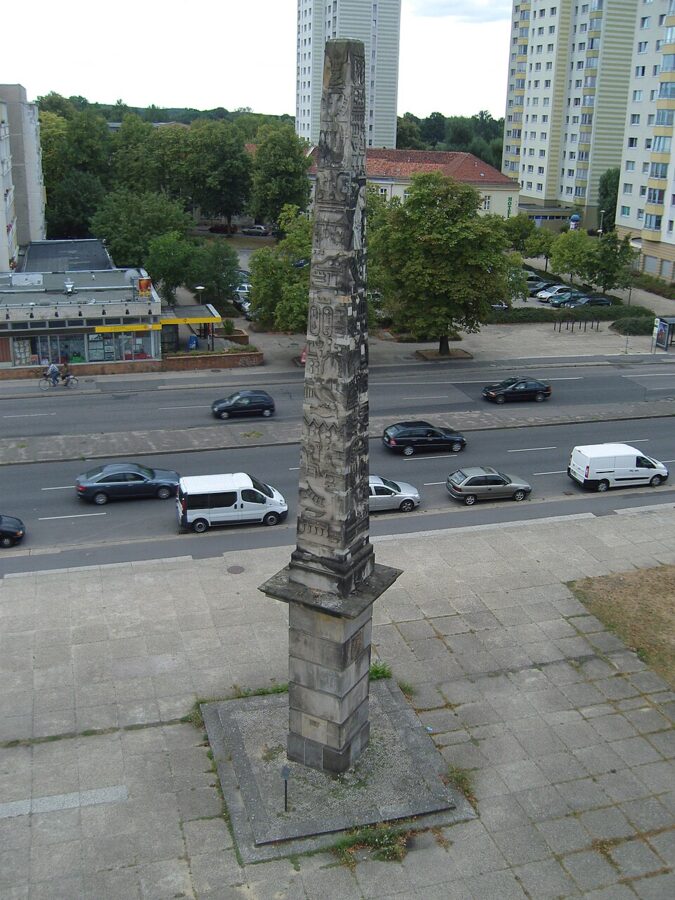

The air raid of April 14, 1945 knocked one obelisk down. The ruins were cleared in 1969 to make way for the extension of Breite Straße, and the surviving obelisk was set up again in 1981 a short way from where it stood. A battered copper eagle from the gate is in the permanent exhibition of the Potsdam Museum on the Alter Markt, one of the museums in Potsdam worth an hour if you like the town’s own story.
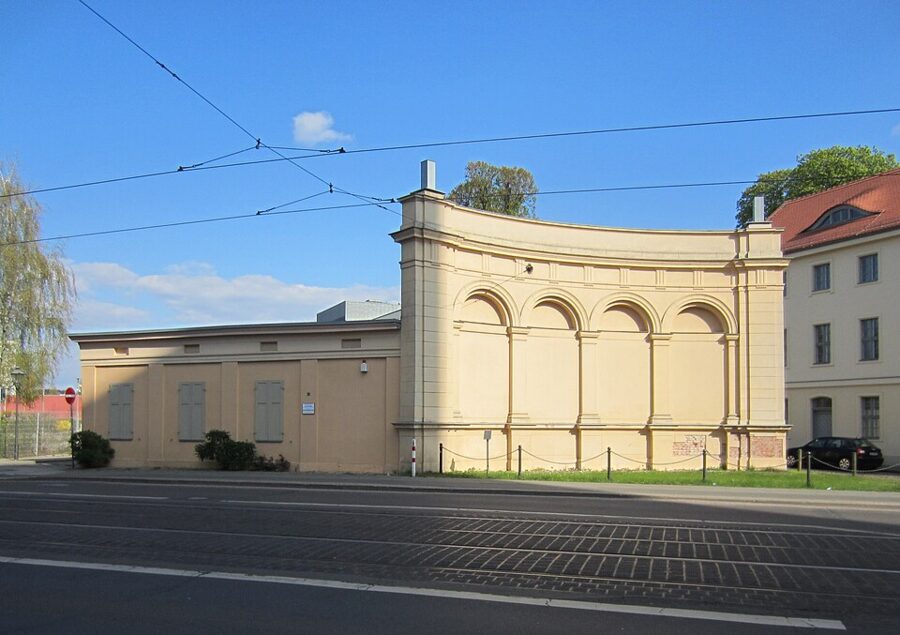
Down by the Havel, the Kellertor guarded the point where the city canal left the river, and its guard and customs house, probably by the same Unger who drew the field side of the Brandenburg Gate, collected the excise on goods that came in by water. Soviet artillery hit it in 1945 and the town demolished it around 1960. A private owner rebuilt the house to its old measurements in 2015–17 as a home, beside a small riverside park.
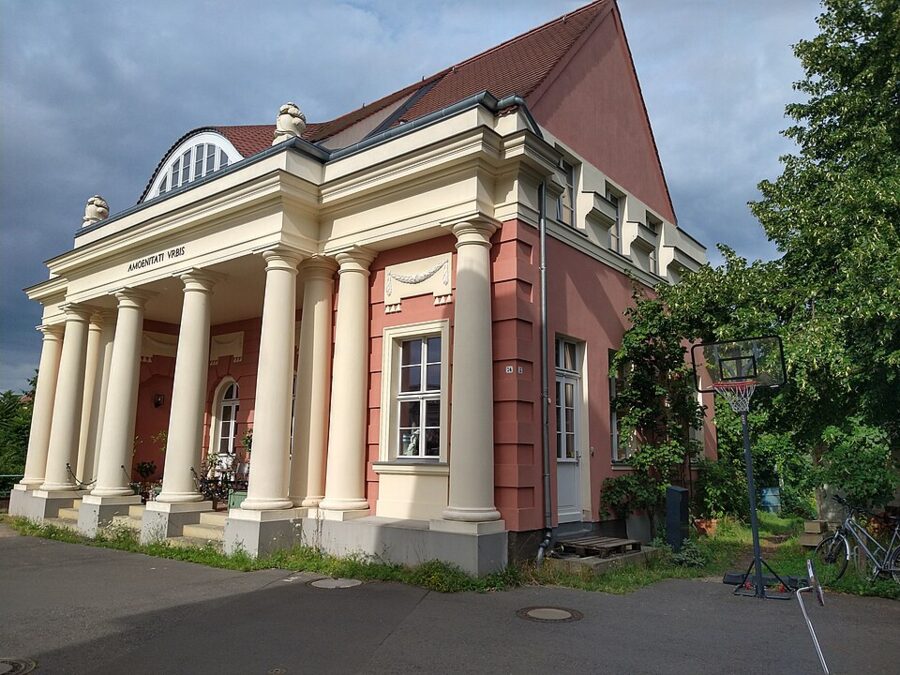

Of the Teltower Tor at the Lange Brücke only listed fragments remain beside the bridge, and the Alt-Wassertor, Neu-Wassertor and Wasserpforte disappeared in the imperial years. If you want to trace the wall, start with the three survivors and the promenade between them.
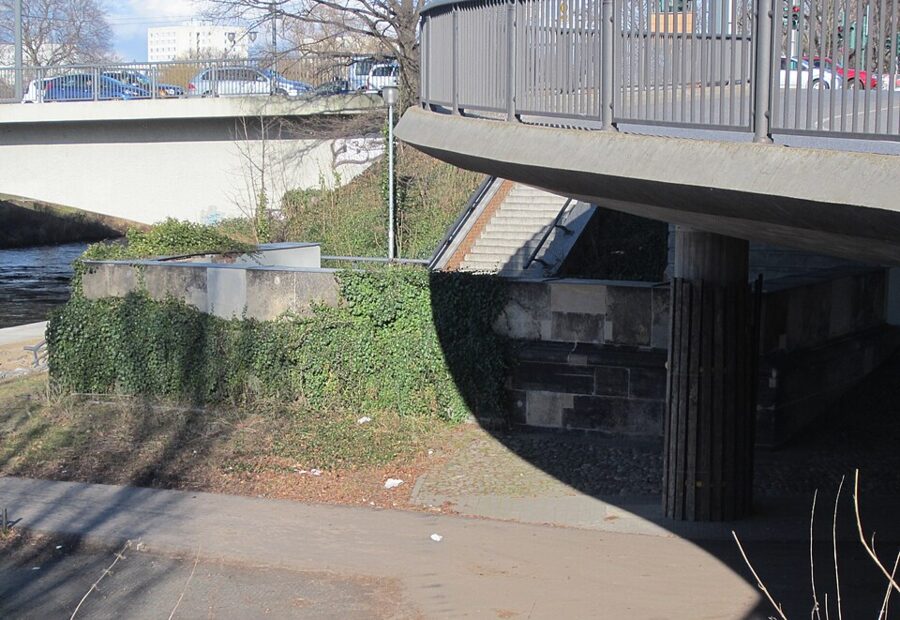

Walking the line of the wall
From the Brandenburger Tor, head north up Schopenhauerstraße along the inside of the old wall line, then turn east along Hegelallee to the Jägertor and on to the Nauener Tor: about 1 km, a quarter of an hour without stops. The corner at the top of Schopenhauerstraße was the wall’s westernmost point. Opposite it stands the Villa Tieck at Schopenhauerstraße 24, where the poet Ludwig Tieck spent his summers from 1841 to 1849, looking out over the park.
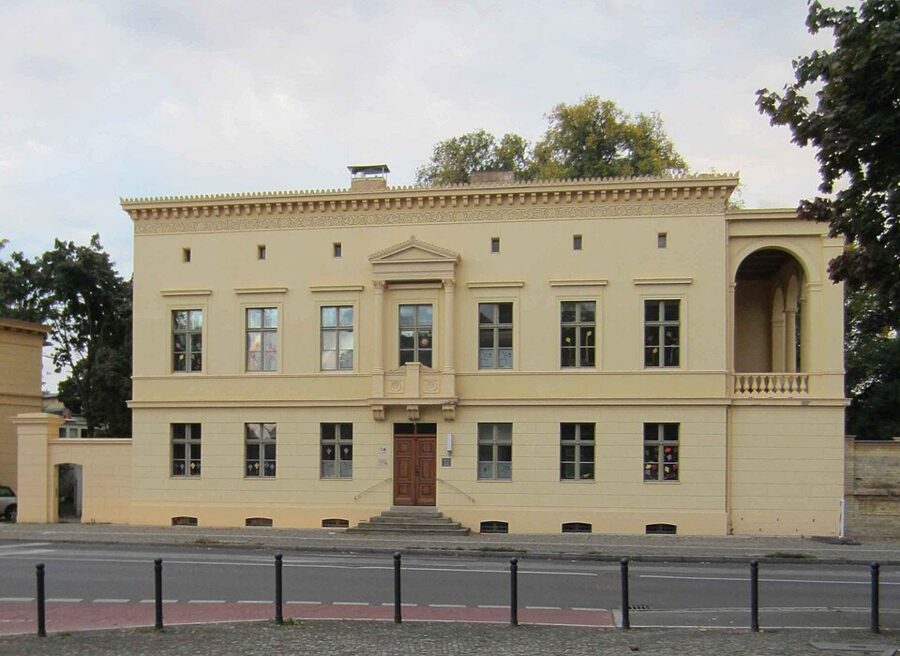

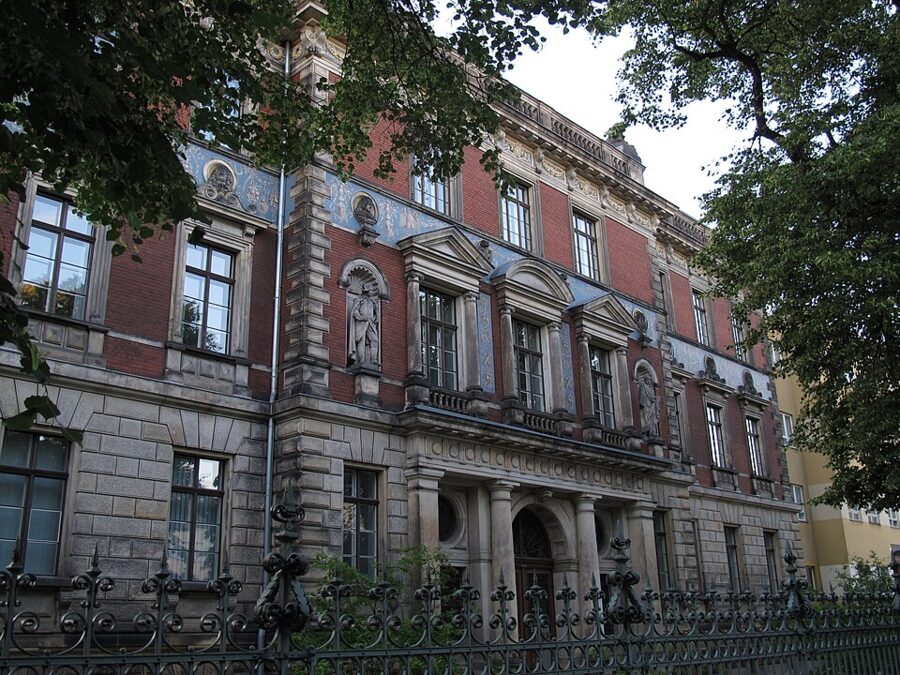
On Hegelallee you pass the Einstein school building of 1909, where Helmuth James von Moltke, later the founder of the anti-Nazi Kreisau Circle, took his final exams in 1925, and the old royal court building at Hegelallee 8, now the local court, whose statues of Frederick II and Wilhelm I were taken down in 1966 and put back after 1993.

At number 53, the printing house of Edmund Stein printed Die Weltbühne, the magazine of Carl von Ossietzky and Kurt Tucholsky, until the Nazis destroyed the last issue in March 1933.
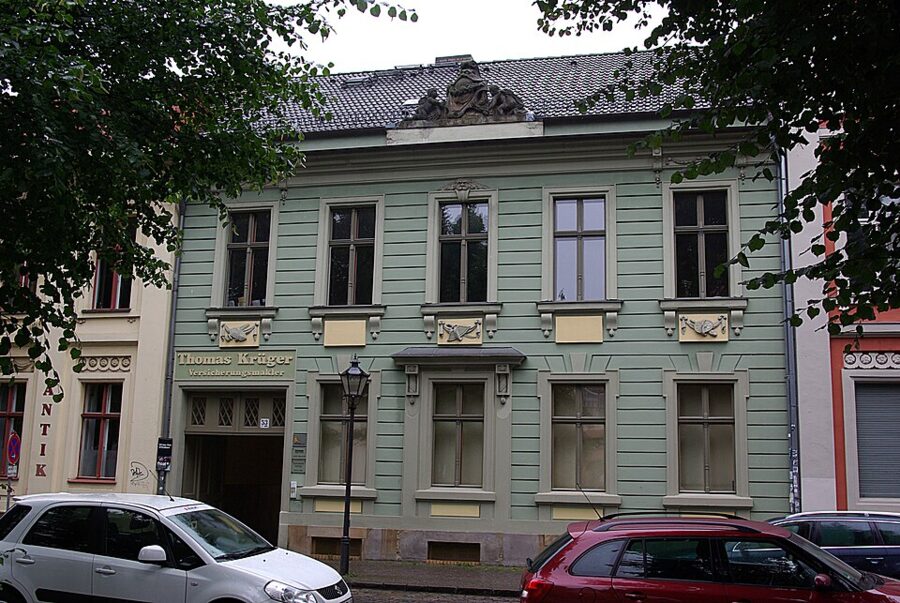

Brandenburger Straße, the spine of the second town
Brandenburger Straße is the backbone of the second expansion, laid out from 1733 and about 750 m long between the gate and St. Peter and Paul. Most of its houses are the standard type houses (Typenhäuser) the soldier king ordered built fast and cheap, two stories high and five windows wide, with masonry fronts to the street and timber frames behind.
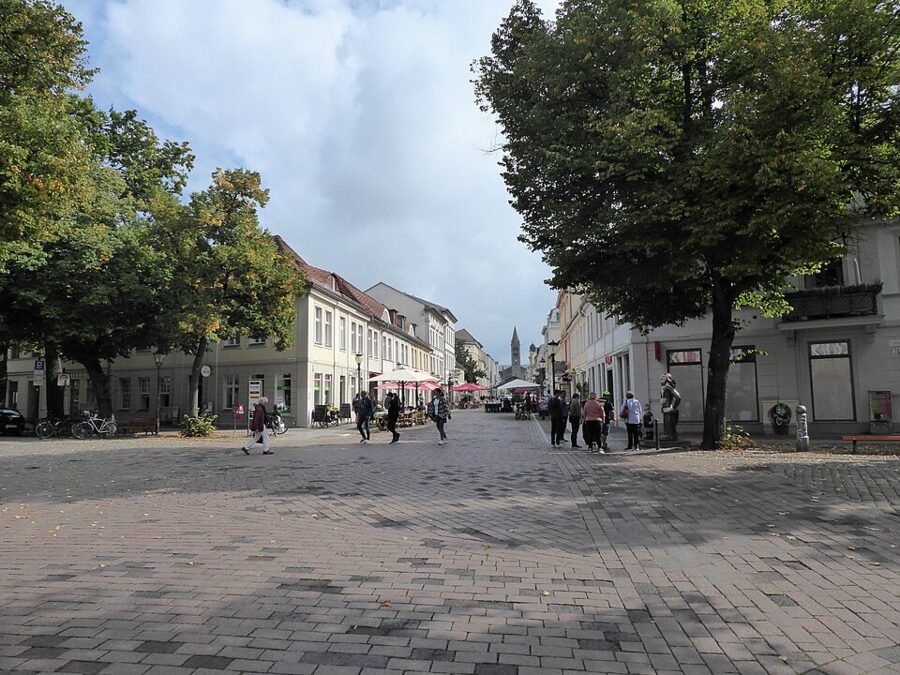

The people who first lived here were bakers, brewers and glovemakers, plumbers, masons and wigmakers, and every one of them had soldiers in the house. Depending on its size, a house on this street had to lodge four to six men of the king’s army.
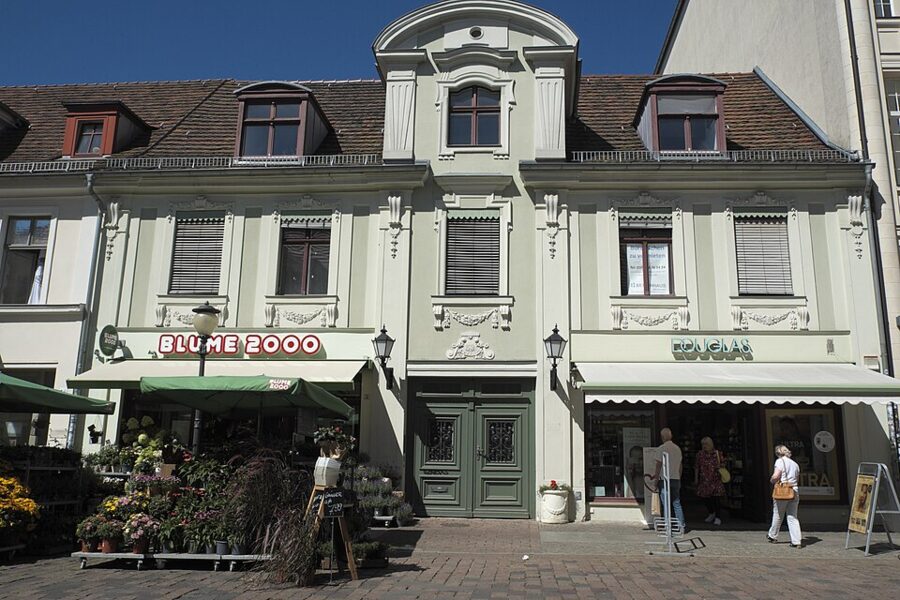

Frederick added a few showpieces: the two two-story stucco houses beside the gate and the corner houses at Hermann-Elflein-Straße. The nineteenth and twentieth centuries dressed many fronts in neo-baroque or Gründerzeit style or replaced them outright, and in the second half of the nineteenth century the street turned from homes into shops.
Department stores and the GDR rebuild
Two department stores arrived early in the twentieth century. The larger, at Brandenburger Straße 49/52, was built in 1910 for the firm F. Schwarz, according to the city’s description of the building, though another page of the same city history gives 1905. Karstadt took it over in 1929, it was expropriated in 1946 and handed to the consumer cooperative, and after reunification it burned out and stood empty for years before reopening in 2005 as the Stadtpalais.
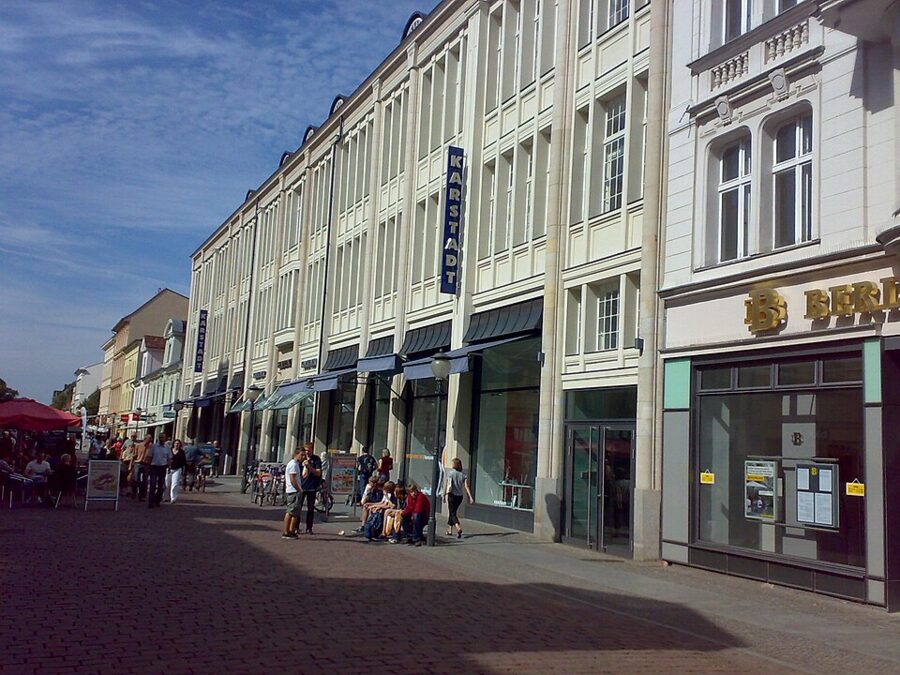
Go in for the light court even if you have nothing to buy. Its Art Nouveau atrium is one of the last surviving light courts of a historic department store in the Berlin and Brandenburg region, with a structured-glass ceiling two floors up. The store trades today as GALERIA Potsdam Stadtpalais.
Across the street, nearer Friedrich-Ebert-Straße, the Kaufhaus Hirsch at number 30 was built in 1910 for a firm founded in 1880. In 1938 it was “Aryanized”, taken from its Jewish owners and sold to a Nazi party member; after 1945 it served as a shop for Soviet officers and then as a state furniture store.
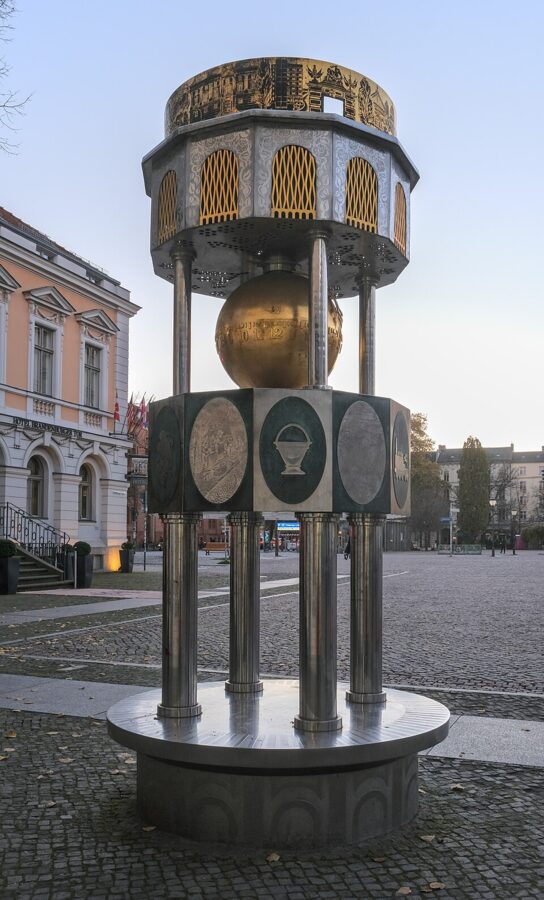
The street as you see it is largely the GDR’s work. From 1950 to 1990 it was Klement-Gottwald-Straße, and in 1975–78 it was restored house by house and closed to traffic as a pedestrian zone. At its west end, on the south side near the gate, the designer Gottfried Höfer added a musical clock in 1979, built in the tower-clock workshop at Meißen.
Höfer’s clock became something its makers never planned: a meeting point. In 1983 young people gathered at it for a “silence for the environment”, from the mid-1980s people who had applied to leave the GDR met there silently, and on October 7, 1989 a civil rights demonstration began at the clock. Its porcelain bells broke over the years, the clock fell silent in the early 1990s, and after a restoration in Meißen paid for by the city it started playing again on May 2, 2010.
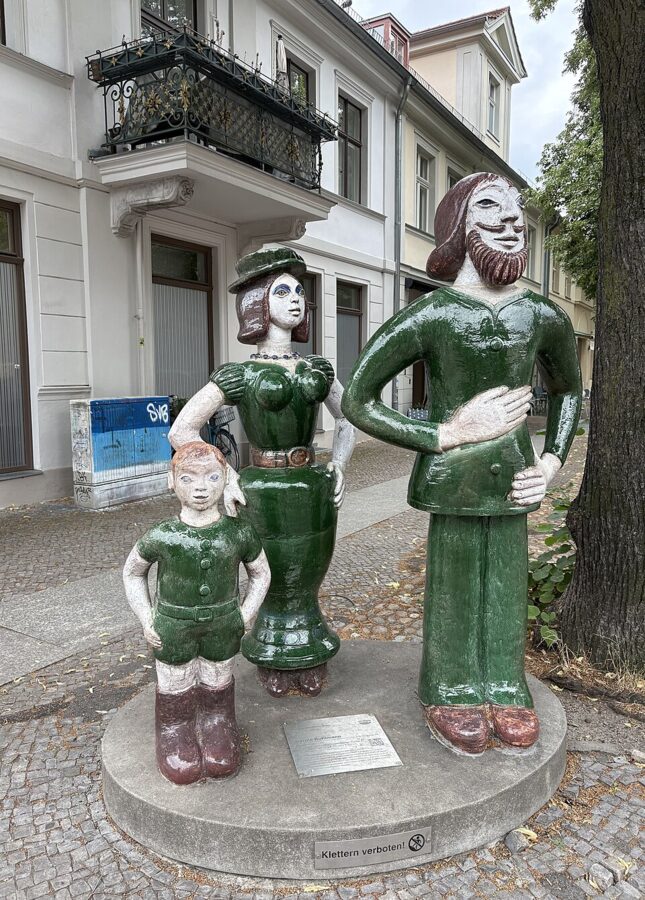
Locals call the street the “Broadway” or the “Boulevard”, only half joking. It is the town’s main shopping street and it feels like one, with shop windows in every baroque ground floor, but the scale is still the soldier king’s, and nothing on it rises above the two-story line of 1733 except the church at the end.
The Boulevard des Films, and a street still being rebuilt
For several years now the street has been dug up in sections for new gas, water, sewer and district-heating pipes and new granite paving, because the old red granite had worked so loose that the city’s crews were repairing it several times a week. The first section, from Friedrich-Ebert-Straße to Jägerstraße, was finished in July 2024, and in March 2026 the pedestrian zone was extended east to Am Bassin, so that it now runs the whole way from the church to the gate.
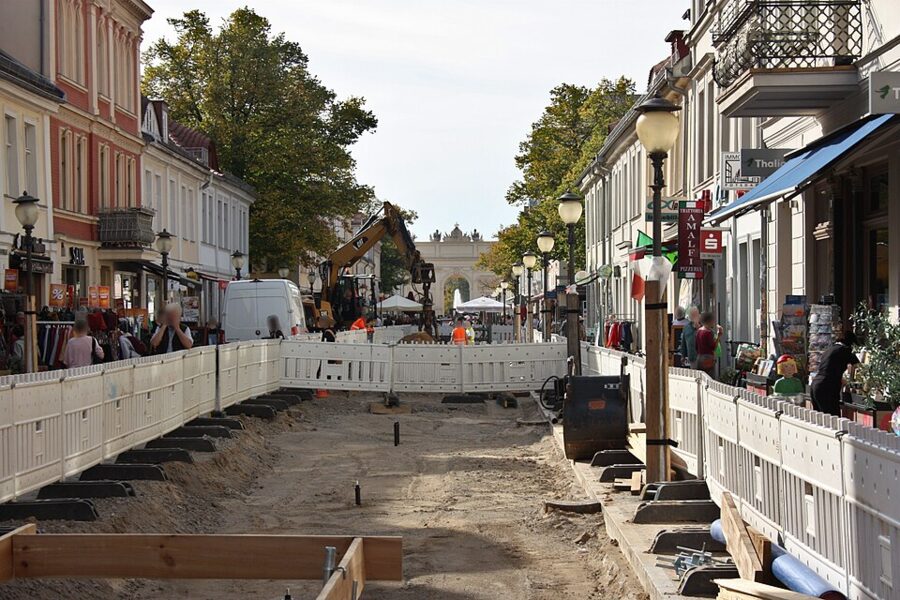

The work is not over. The city announced on November 9, 2026 that the first part of the third section had been finished two weeks early, that the barriers were down for Advent, and that digging would resume in the second week of 2027 on the south side of the street. Expect fences and narrowed paths along part of the street in 2027.
The rebuilding came with a gift for film fans. Potsdam has been a UNESCO City of Film since 2019, and the Boulevard des Films sets 55 granite plates into the new paving, one for each of 55 films made in Potsdam and the region, chosen by a jury for their social weight, craft, popularity or cult status. Unlike Hollywood’s Walk of Fame, the plates honor whole films rather than stars.
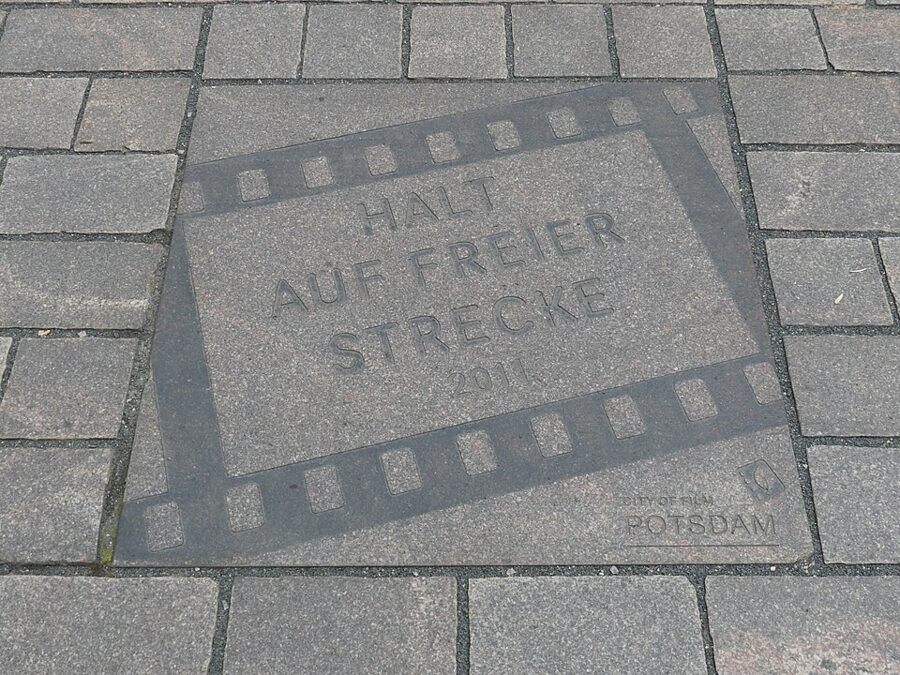

Andreas Dresen unveiled the first plate on July 4, 2024; the public vote went to Konrad Wolf’s Ich war neunzehn. Plates go down as each section is finished, and in March 2026 six more joined, among them Three Wishes for Cinderella (Drei Haselnüsse für Aschenbrödel), Babylon Berlin and Inglourious Basterds. When the street is done, the boulevard will run the full length from the gate to the church. For the story behind the studios, the Filmmuseum Potsdam tells it in the old royal stables near the Alter Markt.
St. Peter and Paul at the end of the axis
Stand in the gate and the street ends in a tower. That is the Catholic church of St. Peter and Paul, finished in 1870, which closes the axis, and its tower, 64 m high, is modeled on the campanile of San Zeno in Verona.
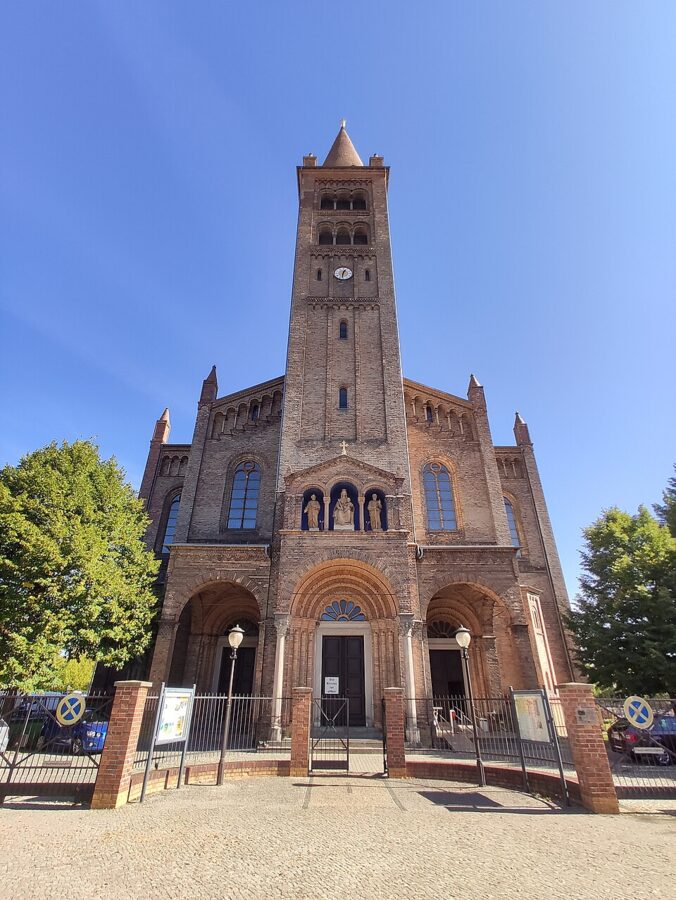

The parish is older than the building, and its origin is pure soldier king. In 1722 Frederick William I recruited gunsmiths from the Catholic city of Liège for his new rifle factory, and they agreed to come to Protestant Prussia only if they could practice their faith. They got a priest, the right to keep a few cows, and no permission to brew their own beer. Their first timber church of 1738 was among the first Catholic churches built in Prussia since the Reformation.
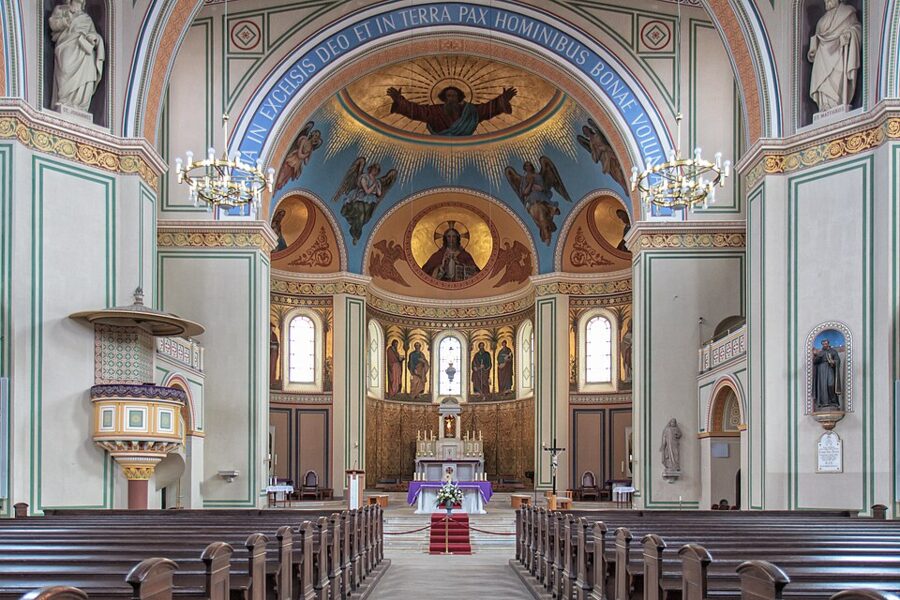
August Stüler drew plans for the new church in 1856, and after his death Wilhelm Salzenberg reworked them, replacing Stüler’s twin towers with the single campanile and giving the east end three apses on the model of Hagia Sophia. The foundation stone was laid on June 4, 1867 and the church was finished on August 7, 1870. Inside are three paintings by the court painter Antoine Pesne, saved from the old church, including the former high altarpiece of Christ in the Garden of Gethsemane.

Side streets worth the detour
The cross streets of Brandenburger Straße are quieter and, to my eye, more interesting. Lindenstraße is the one I’d give time to. At Lindenstraße 54/55 stands the “Great Dutch House”, built in red brick in 1734–37 for the commander of the king’s regiment of giant grenadiers, with ceilings 5 m high to suit the tenant.
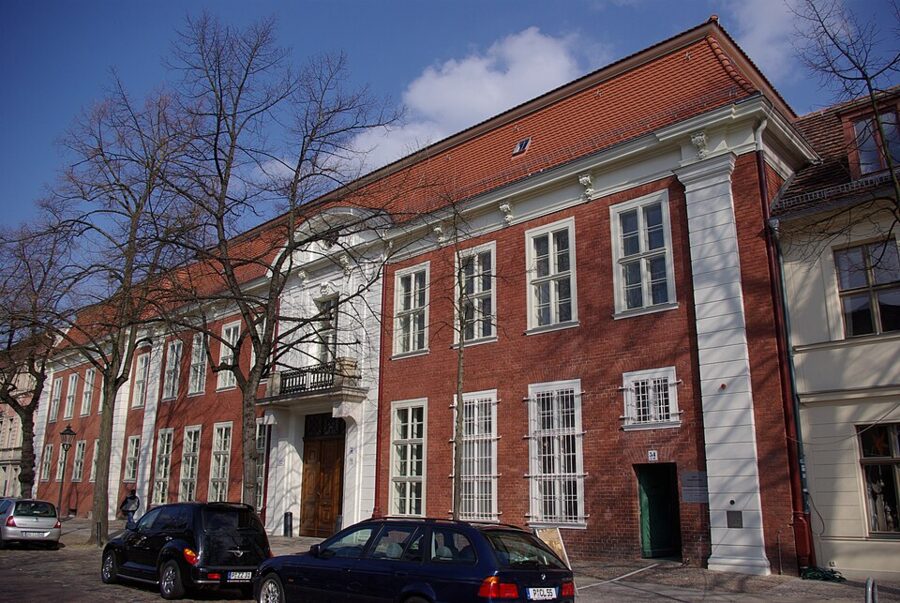

The house has had a long and mostly grim life. Potsdam’s first elected town council met here on March 20, 1809, and the poet Theodor Storm worked here as a court assessor in 1853–56. From the spring of 1933 the prison behind it held opponents of the Nazis, many arrested around the “Day of Potsdam” at the Garrison Church; after 1945 the Soviet secret police took it over, and from the 1950s the Stasi, and people called it the “Lindenhotel”.
Today it is the Lindenstraße memorial (Gedenkstätte Lindenstraße), with the cells, the yard and permanent exhibitions on both dictatorships. It opens Tuesday to Sunday 10:00–18:00, last entry 17:30, and admission is pay-what-you-can from €0 to €10, with a public tour every Saturday at 14:00. Give it an hour; it is the most serious hour you can spend on this walk.
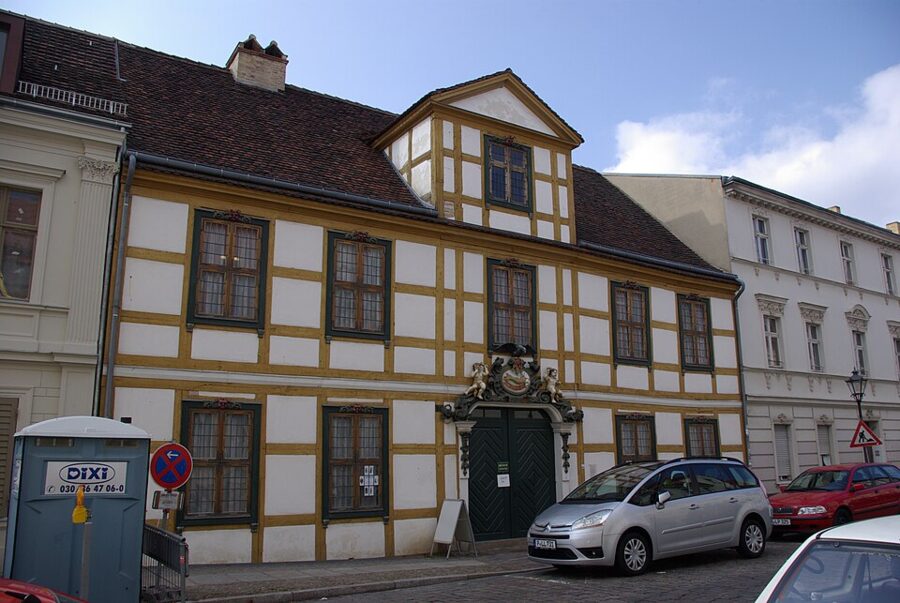
One block over, Hermann-Elflein-Straße keeps one of the few type houses with a half-timbered front, “Im Güldenen Arm” at number 3, built in 1737 on land the king gave to a woodcarver and brewer from southern Germany. The carved sign over the door shows cherubs with carving and coopering tools, and the inside, with its original room plan and black tiled stoves, opens when it hosts exhibitions.

Head east instead and Brandenburger Straße opens onto the Bassinplatz, with St. Peter and Paul on one side and the Dutch Quarter just to the north. For the whole baroque town around this street, from the Alter Markt to the canal, the guide to Potsdam’s old town takes it block by block.
From the gate to Sanssouci
The gate stands where it does because this was the way to the king. At its outer forecourt, the city notes, the road to Brandenburg began and the direct routes to the royal palaces and gardens met. From Luisenplatz you have two ways into the park, and both take a few minutes.
The straight way is the Allee nach Sanssouci, one of the three roads fanning west from the square. It ends at the Grünes Gitter, the green iron gate Ludwig Ferdinand Hesse designed in 1854 while the Friedenskirche was being built, its rails tipped with gold leaf and carrying the initials of Frederick William IV.
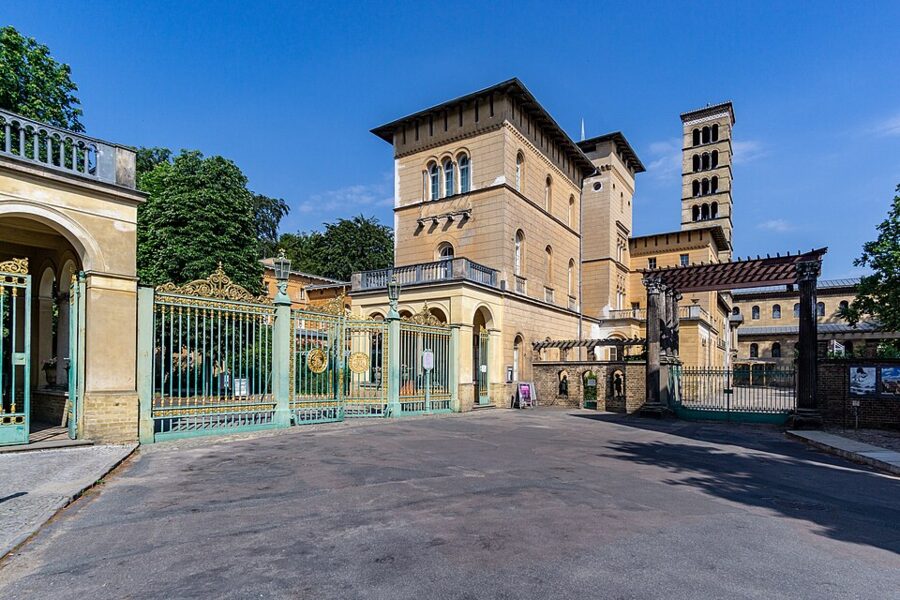

The older way is the one Frederick himself laid out. Walk north up Schopenhauerstraße and turn left at the obelisk Knobelsdorff designed in 1748, which marked the edge of the royal grounds; its hieroglyphs, like those of the Neustädter Tor, say nothing at all. Behind it is the Obelisk Portal (Obeliskportal) of 1747, two groups of four fluted Corinthian columns with Flora and Pomona, goddesses of flowers and fruit, on the curving walls.
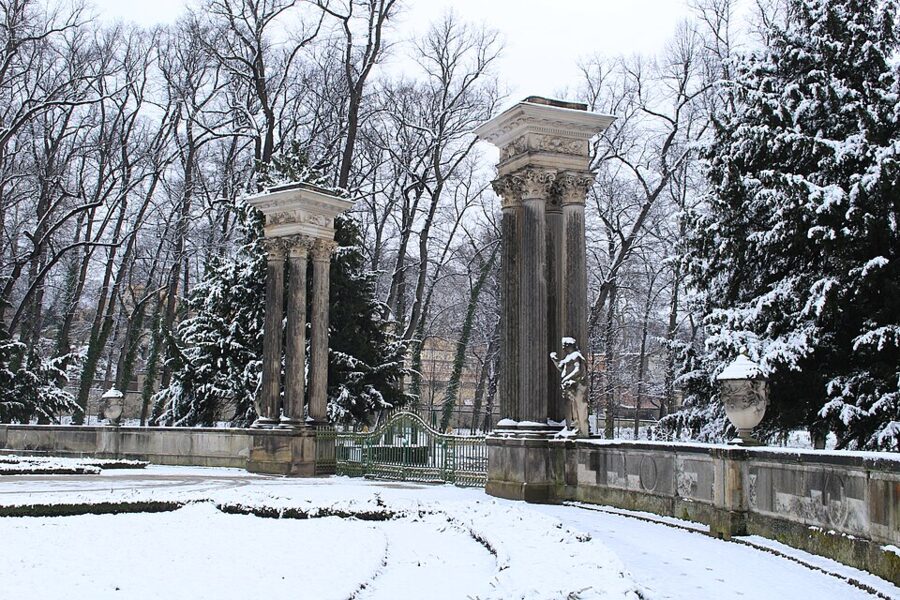

From the portal, the main avenue runs about 2 km in a straight line west to the New Palace, with the terraces of Sanssouci Palace on your right partway along. The park is free and, as the foundation’s park page says, open daily from 08:00 until dusk. The palace interiors are another matter; the Sanssouci tickets guide sorts out which ones to book.
Seen from here, the gate makes sense. Coming in from Sanssouci, Frederick the Great would have met the field side first, and that is the side he had dressed as a Roman triumph.
Trams, coffee and the Christmas market
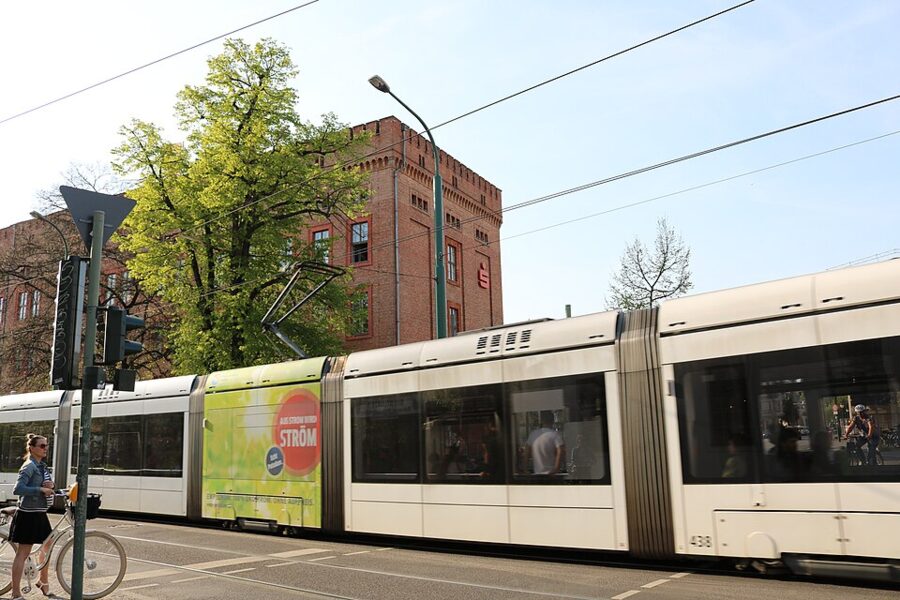
From Potsdam Hauptbahnhof, the main station, trams 91 and 94 take about seven minutes to the stop Luisenplatz-Süd/Park Sanssouci, right by the gate, and buses 605, 631, 692 and 695 stop there too. Luisenplatz-Nord/Park Sanssouci on the other side of the square serves buses 614, 650, 692 and 695. For the middle of the street, trams 92 and 96 stop at Brandenburger Straße on Friedrich-Ebert-Straße, and at Nauener Tor; for Lindenstraße, use Dortustraße (trams 91, 94 and 98).

Potsdam is in fare zone C, so from central Berlin you need a ticket for Berlin ABC: a single ticket costs €5.00 in 2026 and €5.20 from January 1, 2027, and a 24-hour ticket €12.90, then €13.20. The Deutschlandticket covers all of it. For trains from Berlin and how to spend the rest of the day, see the Potsdam day trip from Berlin guide.
For lunch on the square itself, Assaggi at Luisenplatz 3 cooks Italian in an open kitchen daily from 12:00 to midnight, closed on Wednesdays, and closes over the holidays from December 23 to 26, 2026 and from December 30, 2026 to January 1, 2027. At the other end of the wall walk, Café Heider at the Nauener Tor opens daily 09:00–21:00, with hot food from 12:00 to 20:00, and takes cards only.
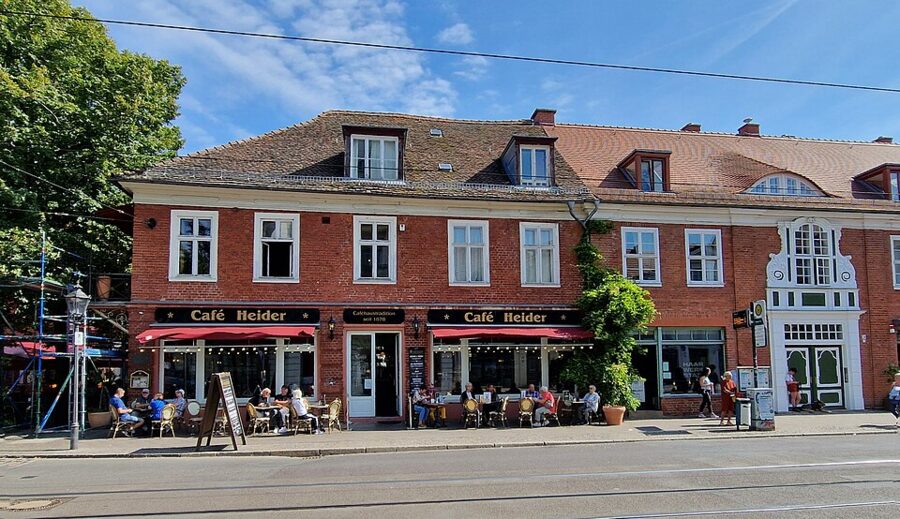

Café Heider is also history: in the same building, then the Café Rabin, Carl von Ossietzky wrote leading articles for Die Weltbühne and edited its pages with Tucholsky. For more tables near the street and across town, see the Potsdam restaurants guide, and for a bed within sight of the gate, where to stay in Potsdam.
In Advent the whole street becomes a fair. The Potsdamer Weihnachtszauber fills it with about 250 stalls from Luisenplatz to the Bassinplatz: a white pagoda village with a jazz and swing stage on Luisenplatz, a children’s carousel and the city’s biggest Christmas tree at the gate, and an ice rink and a Ferris wheel at the Bassinplatz end. The city counted about a million visitors a year in 2023, when the market still went by its old name, Blauer Lichterglanz.
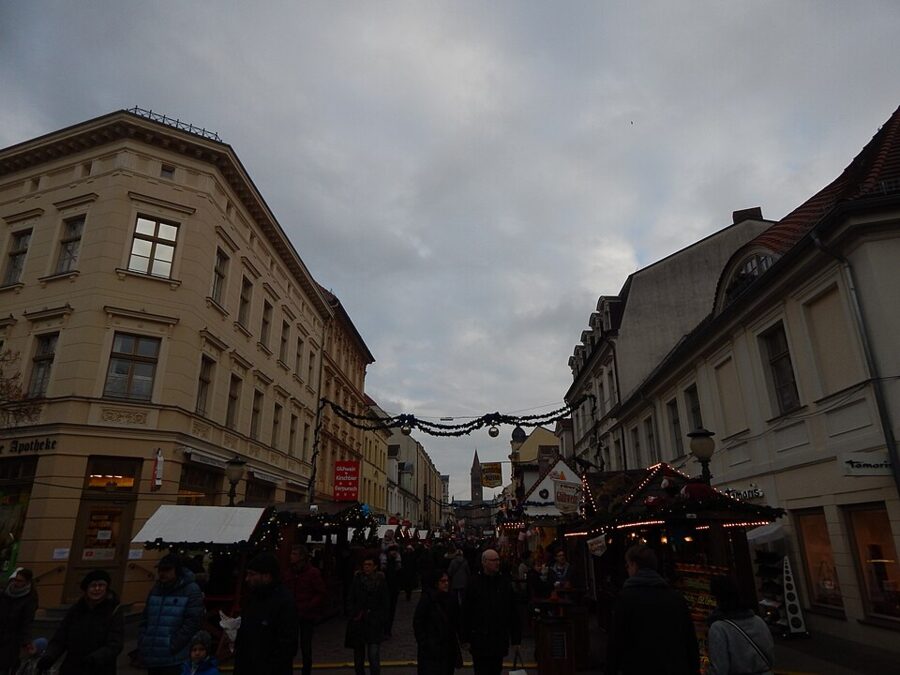

Dates, opening hours and the other Advent markets in town are in the Potsdam Christmas market guide. For everything else within reach of the gate, the list of things to do in Potsdam is the place to start.
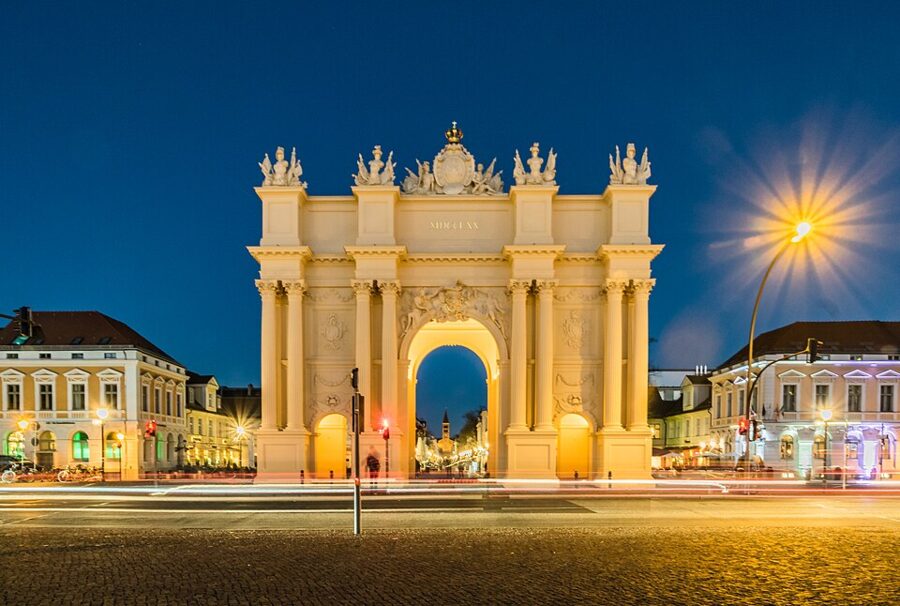

End where you began, but the other way round. Walk west down Brandenburger Straße at dusk with the plain town side ahead of you, Gontard’s polite wall, pass under the arch and turn: Unger’s columns are lit up against the dark over Luisenplatz, the face Frederick kept for arrivals. Then cross to Luisenplatz-Süd and take the 91 back to the station.