

Walk out to the obelisk in the middle of the Alter Markt and look for the kings. There are none. The four portrait medallions on the shaft show architects, Knobelsdorff, Gontard, Schinkel and Persius, the men who designed most of what stands around you. Until 1945 the same four frames held the Great Elector and the first three kings in Prussia; when the East German authorities rebuilt the bomb-damaged obelisk in 1978 and 1979, they kept the shape, replaced the marble and swapped the monarchs for their builders.
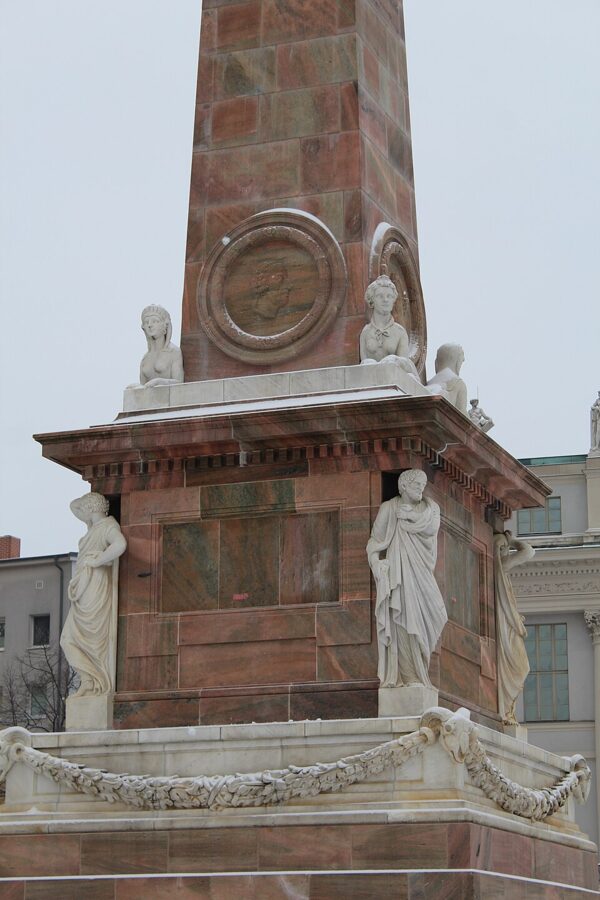
That swap is the quickest lesson in how to read Potsdam’s old center. Very little here is simply old. Frederick the Great remade the square in the 1750s as a Roman piazza, one night of bombing on April 14, 1945 gutted it, the GDR blew up what it disliked and rebuilt what it could use, and since 1990 the city has been putting the eighteenth century back, facade by facade, while arguing about every one of them.
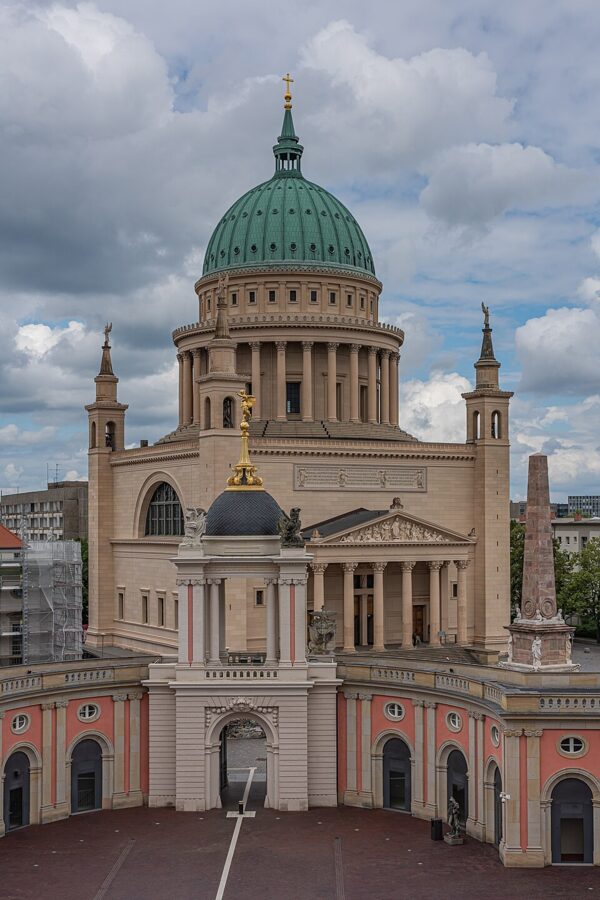
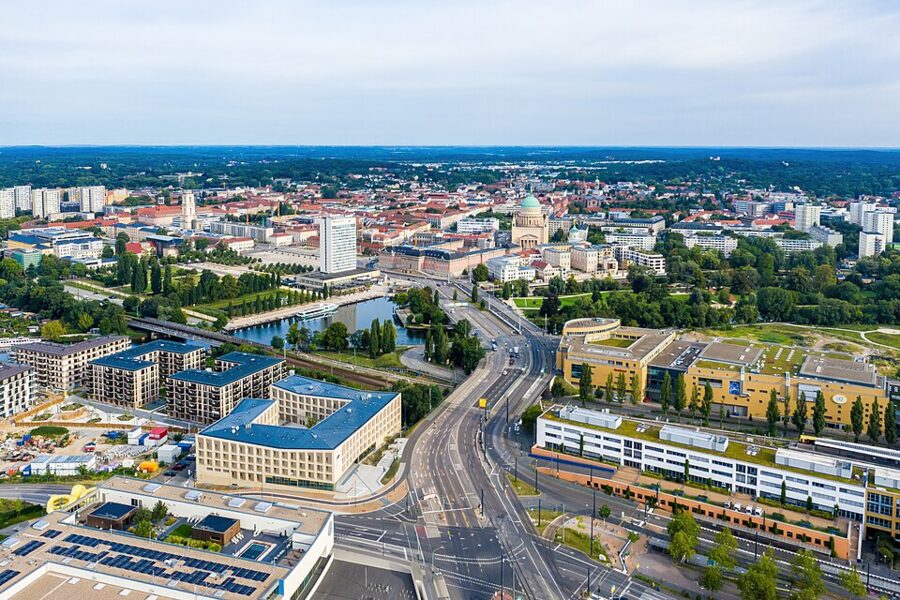
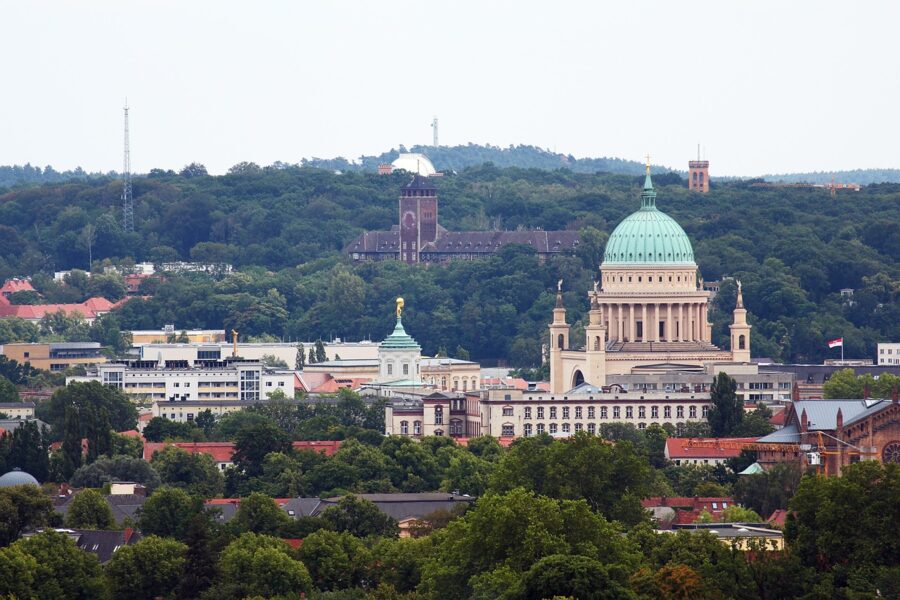
The center is small enough to walk in a morning. The Alter Markt with the Landtag, the Nikolaikirche and the Old Town Hall sits by the river; the quieter Neuer Markt is a block behind it; the Lustgarten and the Marstall run along the water to the west; and the baroque streets climb north toward the Dutch Quarter. All of it starts ten minutes on foot from Potsdam Hauptbahnhof (main station), most of it costs nothing, and the one ticket I would not skip is the €7 climb up the Nikolaikirche dome.
Contents10 parts
- An island in the Havel, and the town stacked on it
- The Alter Markt
- The Neuer Markt
- The Lustgarten, the Marstall and the river
- April 14, 1945
- What the GDR took down, and what it put up
- Rebuilding since 1990, and the quarrel that comes with it
- The streets of the baroque town
- A walk through the old town, with times
- Getting there, eating and sleeping
An island in the Havel, and the town stacked on it
Potsdam began at a river crossing. The Havel runs past the south side of the old town in two arms, the Alte Fahrt and the Neue Fahrt, with the long Freundschaftsinsel between them, and the shallow water there made it the easiest place to cross from the Havelland to the Teltow. A castle guarded the ford by the time the settlement of Poztupimi was first written down in 993, and the palace that later stood on the same spot inherited the job of watching the bridge.
For most of its history the town was small. The Great Elector, Frederick William of Brandenburg, made Potsdam his second residence in 1660, and in the following years the town still counted only about 200 houses. He built a Dutch-style palace by the river, laid out the Lustgarten beside it, and drained the marsh to the west for a planned street of new houses, the Kurfürstliche Freiheit (the Elector’s new quarter) along what is now Breite Straße.
The kings who followed stacked their own towns on top. Frederick William I, the soldier king, needed houses for a garrison and pushed the town north in two baroque extensions from 1722 and 1733, draining the ground with a canal dug on the Dutch model and closing the new grid behind a customs wall whose gates were meant to stop smuggling and desertion. The Dutch Quarter, 134 brick houses in four blocks, went up inside that wall between 1733 and 1742, and it marks the northern edge of the old center, fifteen minutes on foot from the river.
Frederick the Great (Friedrich II) did not build more town so much as dress the one he had. From the 1750s he paid for new facades on plain burghers’ houses, copied from palaces in Italy, France and the Netherlands, and Potsdamers called them Vorhemdchen, little shirt-fronts, because there was often an ordinary house behind the show. His taste for Roman show also produced the Brandenburg Gate on Luisenplatz, a triumphal arch of 1770–1771 at the far end of Brandenburger Straße.
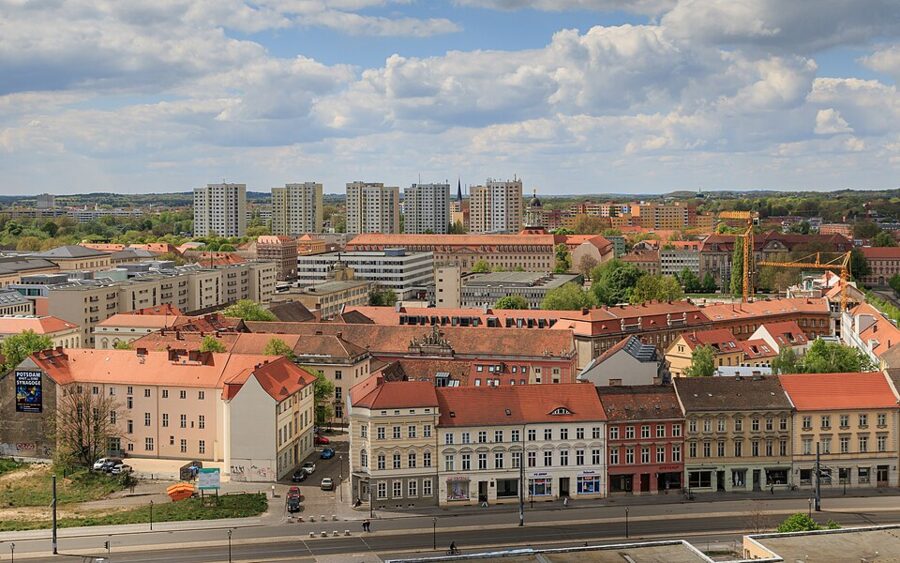
Read on a map today, the layout is simple. The Alter Markt and the Landtag sit at the river end; Breite Straße runs west from the Landtag past the Marstall, the Garrison Church tower and the Military Orphanage; the Neuer Markt hides in the block between them; and north of Yorckstraße, the line of the old canal, the grid of the soldier king’s town takes over, with Brandenburger Straße as its spine. You can cross the whole of it on foot in under half an hour.
The Alter Markt
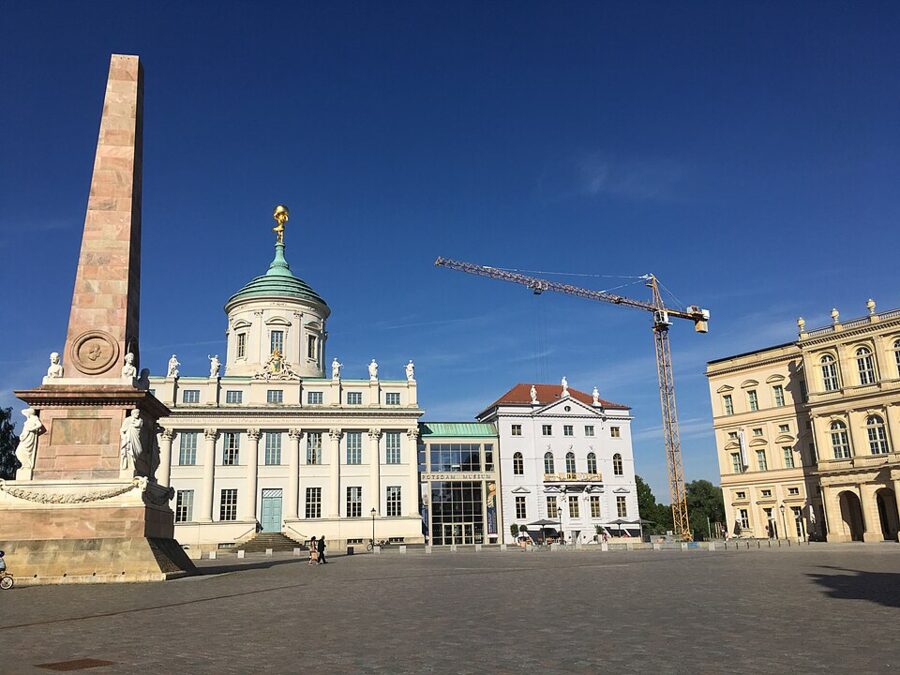
The Alter Markt is the square where Potsdam’s palace, town hall, parish church and weekly market all met, which is why every regime since has wanted to put its stamp on it. In Frederick’s time the market ran here on Tuesdays and Saturdays. He had his architects turn the square into an Italian piazza in the 1750s: a copy of the facade of Santa Maria Maggiore in Rome for the old baroque church, a design by Palladio for the town hall, the obelisk in the middle, and in 1771–1772 a copy of Rome’s Palazzo Barberini for the south-east corner.
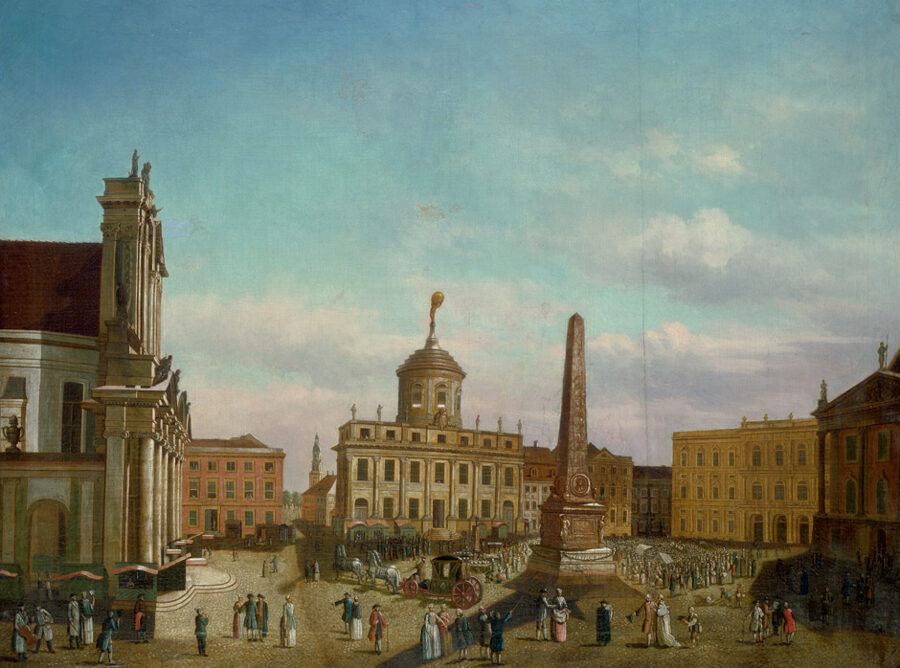
Today the Landtag in the rebuilt City Palace fills the south-west side, the Museum Barberini the south-east, the Old Town Hall and the Potsdam Museum the east, and the Nikolaikirche rises on the north. The west side is still being finished: new blocks with reconstructed facades have been going up since the East German teacher-training college there came down in 2017 and 2018. The tourist information on the Alter Markt sells palace tickets and the Berlin WelcomeCard if you need either.
The Landtag in the City Palace
The pink palace with the green copper roof is Brandenburg’s state parliament, and its outside is a copy. The original City Palace (Stadtschloss) was begun for the Great Elector in the 1660s, lived in by the soldier king, and remodeled for Frederick the Great by Georg Wenzeslaus von Knobelsdorff between 1747 and 1750 into one of the main works of the style the Germans call Frederician rococo. It burned out in 1945, was blown up by the GDR in 1959 and 1960, and was rebuilt between 2010 and 2013 to plans by the Dresden architect Peter Kulka, opening as the parliament on January 21, 2014.
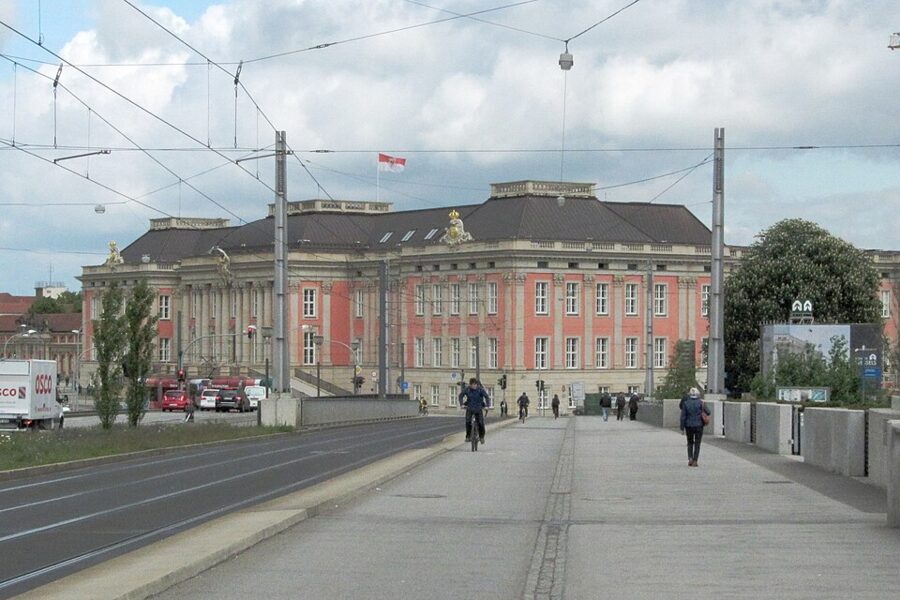
The facades are a faithful reconstruction and the rooms behind them are not. Hasso Plattner, the co-founder of SAP, gave €20 million so that the outside would look like Knobelsdorff’s palace rather than the modern front first proposed, and later paid for a copper roof instead of zinc. About 600 original fragments that survived the demolition were built back into the walls, and you can pick them out by their weathered, darker stone. Inside, the side wings were made deeper than the old ones to fit offices for the members, which is why the courtyard is smaller than it was.
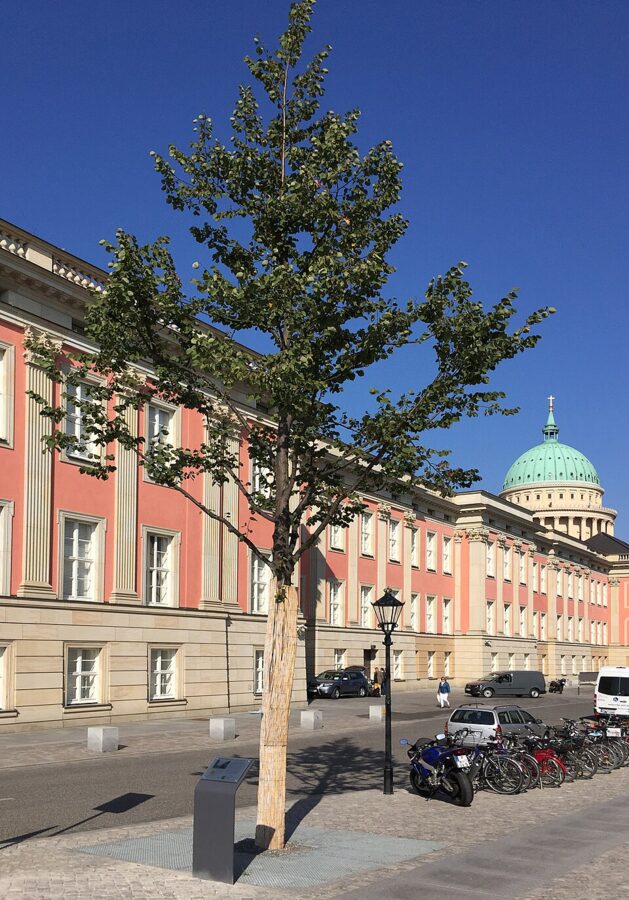
Walk round to the palace’s south-east corner, on Humboldtstraße, and two smaller things stand by the wall. One is the Bittschriftenlinde (petition lime), the tree under which Frederick is said to have collected petitions from his subjects; the other is a bronze memorial to Otto Braun, the last democratic prime minister of the Free State of Prussia. The street is named after Alexander von Humboldt, who had a flat in the palace’s east wing and wrote much of his Kosmos there.
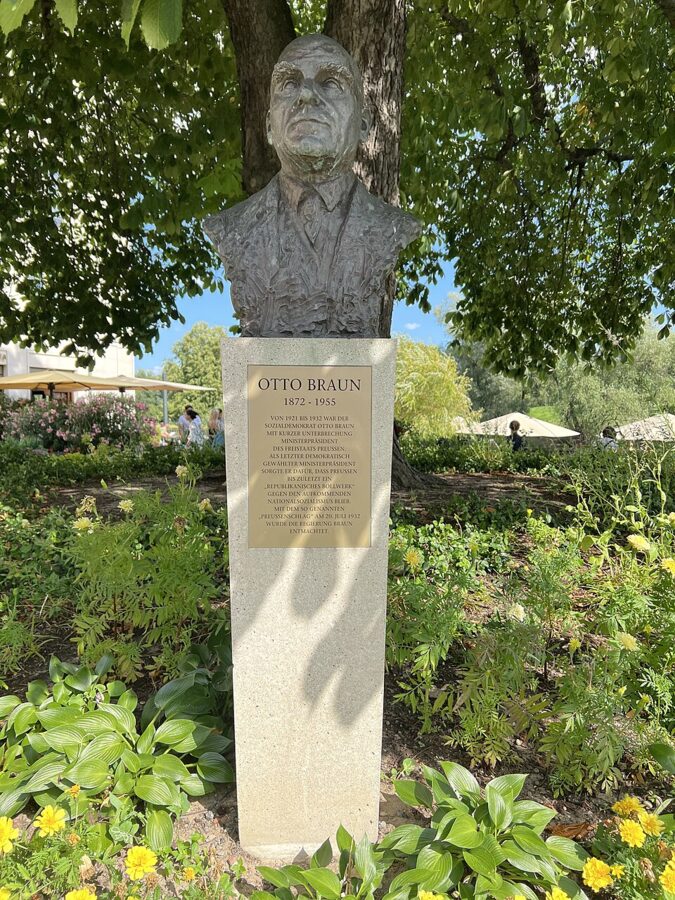
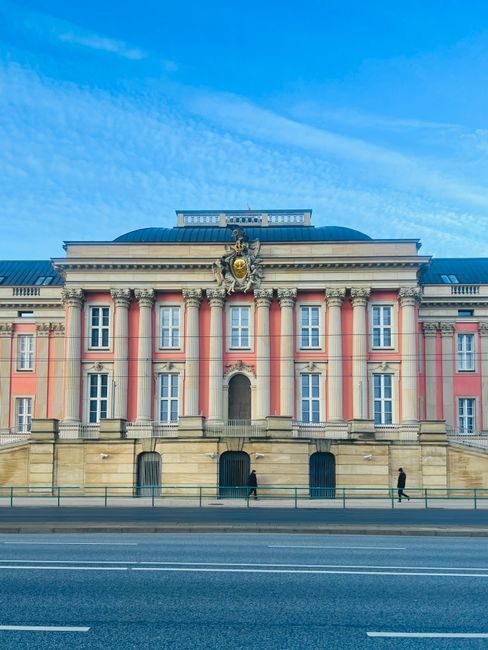
Look at the west end, facing the Marstall, and you will find a dry joke about all this: the words Ceci n’est pas un château, “This is not a castle,” lettered on the facade after René Magritte’s painted pipe. Of the 76 statues that stood on the attic, 56 may come back, but only with private donations, the condition the Landtag set in 2005. Since 2003 a citizens’ society has raised over €2 million for 15 figures, five trophy groups and the restored Fahnentreppe (flag staircase), and it needs about €5 million more.
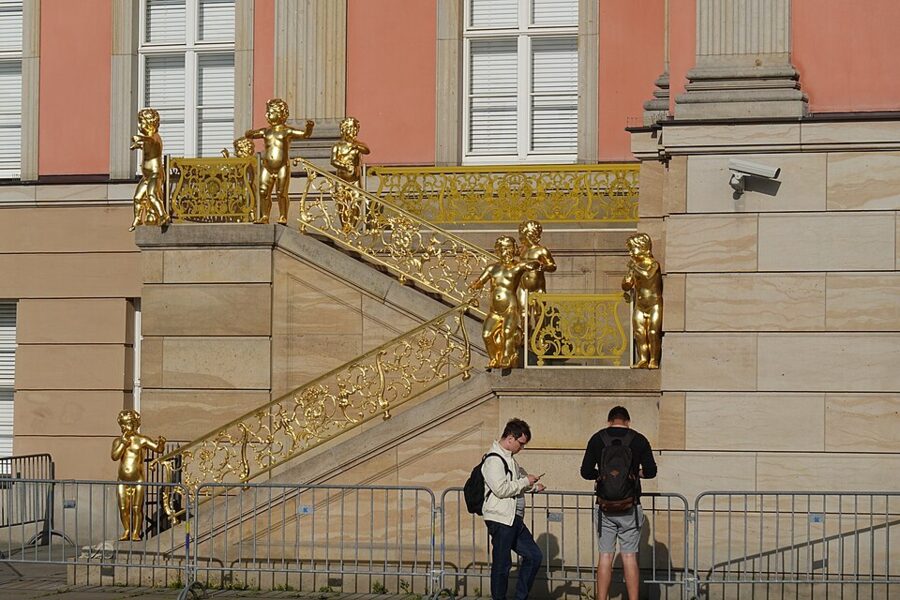
You can walk in. The courtyard behind the Fortuna Portal is open daily 08:00–20:00, and on weekdays 08:00–18:00 you can go through to the rebuilt Knobelsdorff staircase, the exhibitions and a model of the building in the foyer, all listed on the Landtag’s opening hours. The building closes on public holidays, and on days when the full parliament sits you leave an official photo ID at the door in exchange for a visitor’s pass. An audio guide of 16 stations plays on your phone.
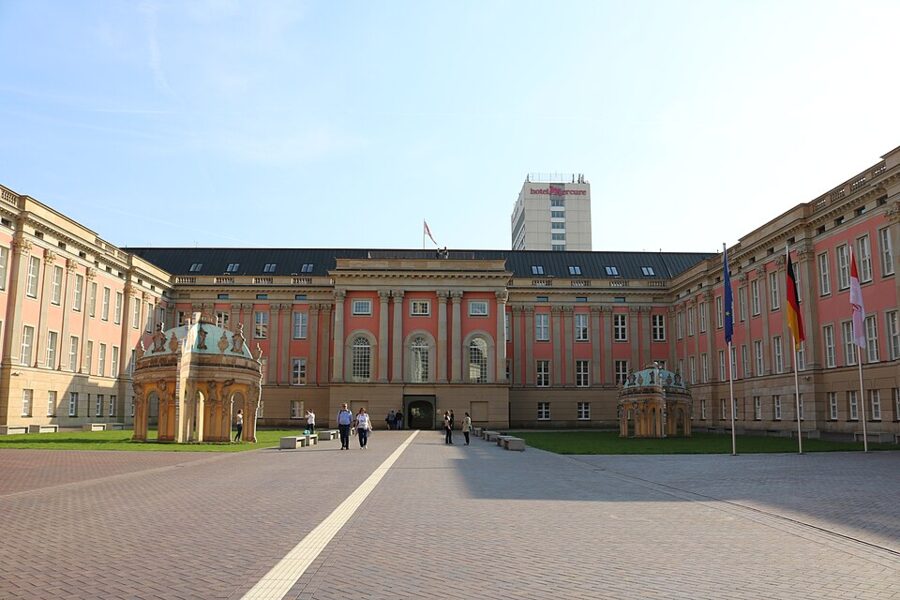
The best thing in the building is on the roof. The members’ canteen on the fourth floor opens to everyone Monday to Friday, 11:30–14:00 (13:00–14:00 on plenary days), and the roof terrace beside it is open on weekdays 08:00–18:00, according to the canteen’s page. From up there the Fortuna Portal, the obelisk and the Nikolaikirche line up in one axis, which is exactly what Frederick’s architects intended and what nobody on the square can see.
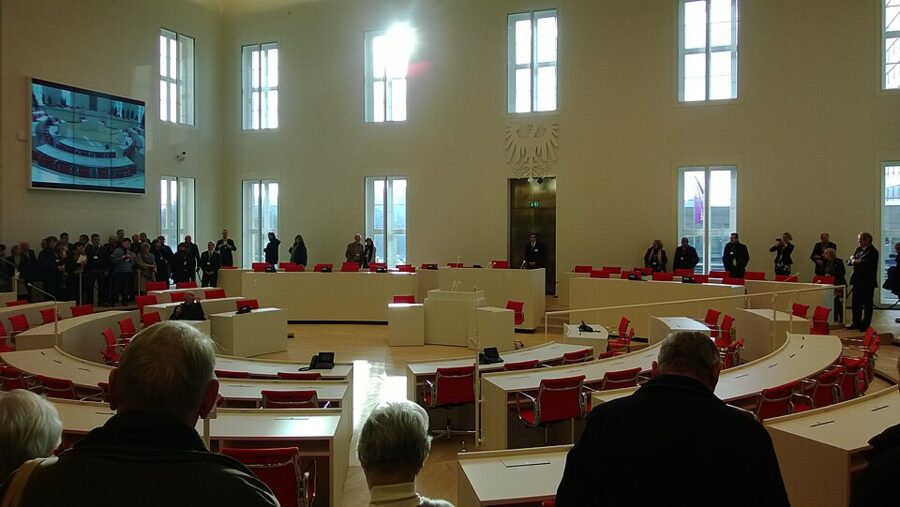
For the inside proper, the Landtag runs free one-hour tours for individual visitors, usually twice a month on a Friday, 15:00–16:00, booked online up to three months ahead and cancelled if fewer than five people sign up. I’d only plan around one if you care about parliaments; the staircase, the courtyard and the terrace give you the building without it.
The Fortuna Portal
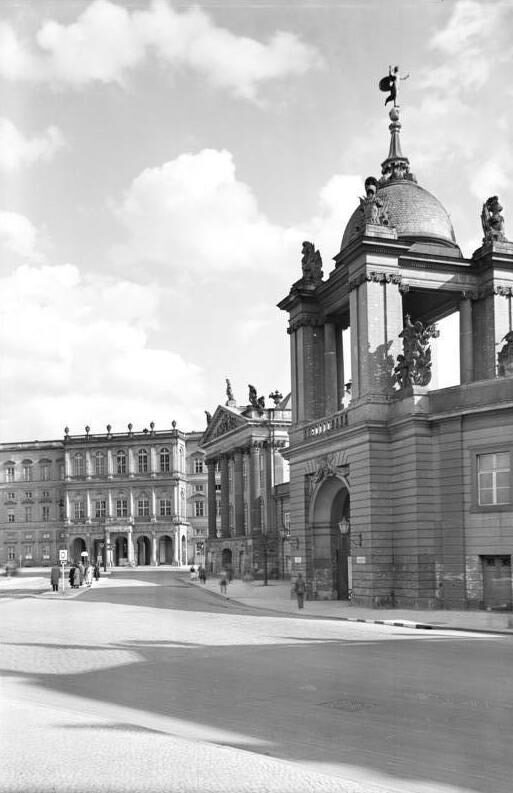
The gate with the gilded goddess was the first piece of the palace to come back, and the one that made the rest possible. Jean de Bodt designed the Fortuna Portal (Fortunaportal) in 1701 to mark the Elector Frederick III crowning himself King Frederick I in Prussia, and it is usually counted as the start of Potsdam’s classical architecture. It was blown up with the palace in 1960; the sculptors’ work was ordered destroyed as militarist, and only a few pieces were saved, including the head of Minerva, found later in the rubble.
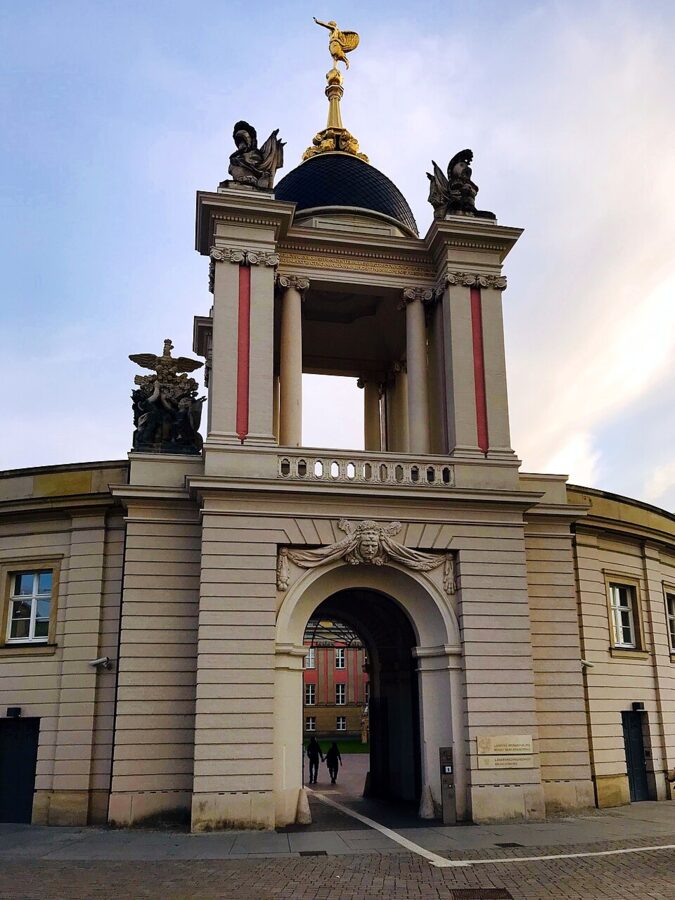
Rebuilding began on September 8, 2000, paid for by a citizens’ society, the German concrete industry and the television host Günther Jauch, who lives in Potsdam and gave up much of his fees for an advertising campaign to fund it. The 27-meter gate is in Saxon sandstone like the original, and the gilded Fortuna went up on October 12, 2002, with documents sealed inside her as a time capsule. The eight large sculpture groups that crowned the gate are coming back one by one on donations: two in 2007, a trophy in 2014, the first eagle group in 2018.
The Nikolaikirche
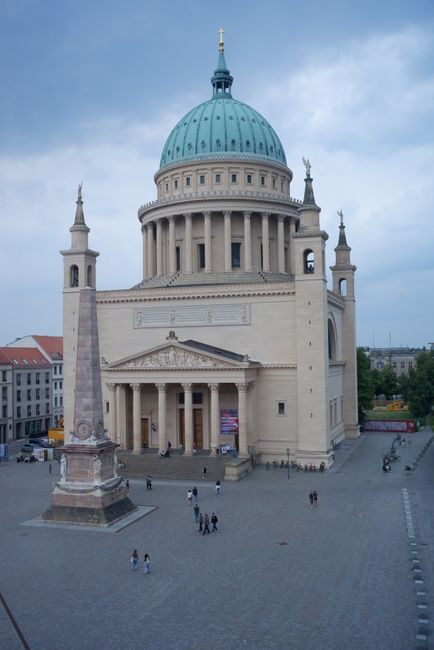
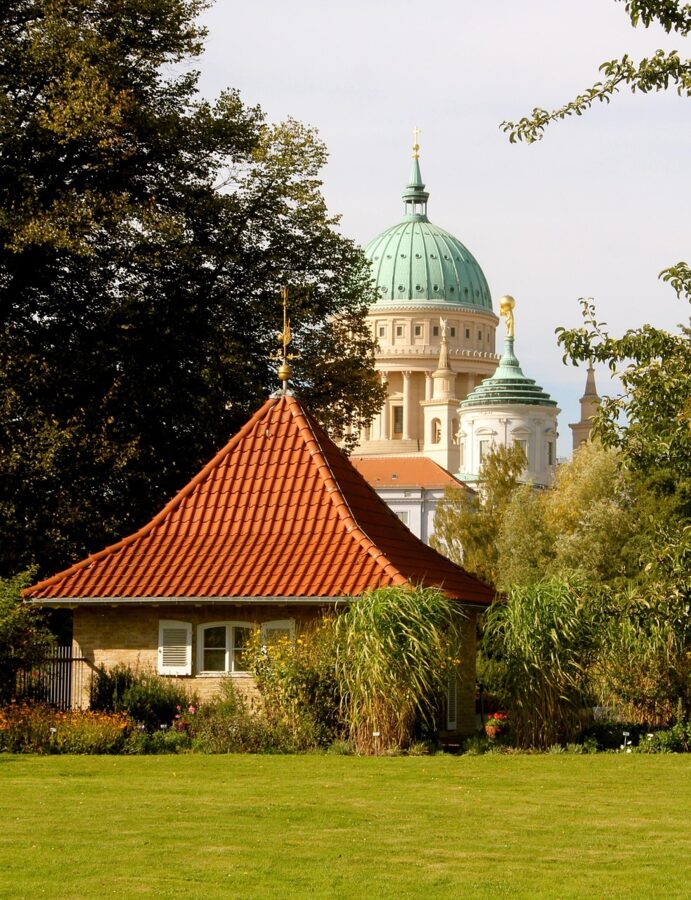
The dome that marks Potsdam from every direction belongs to St. Nicholas’ Church (Nikolaikirche), and it was nearly never built. A baroque church stood here from 1724, with Knobelsdorff’s Roman facade added in the 1750s; it burned to the ground on September 3, 1795, when a roofer’s soldering fire got away during repairs to the tower. The site lay empty through the Napoleonic wars, and only in 1826 did Frederick William III ask Karl Friedrich Schinkel for a new church.
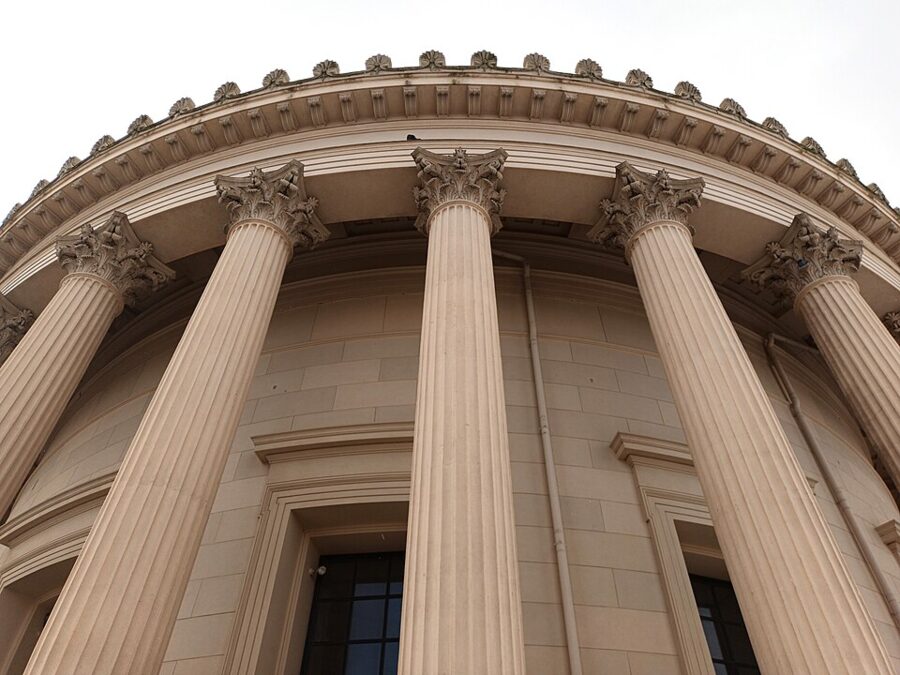
Schinkel wanted a dome on a Greek cross, after Wren’s St Paul’s in London and the Panthéon in Paris. The king’s money ran only to the base, so the church consecrated on September 17, 1837 was a flat-roofed box with a portico, and Schinkel was not invited to the ceremony. The crown prince had sketched domes of his own, and once he became Frederick William IV (Friedrich Wilhelm IV) he ordered Schinkel’s plan built in a cabinet order of May 1, 1843. Schinkel had died in 1841; Ludwig Persius took over and died in 1845; Friedrich August Stüler finished the dome for a second consecration on March 24, 1850.
The whole thing stands 77 meters to the cross. Persius stiffened the corners with four towers to carry the dome’s weight, and three of them now hold bells while the fourth, at the north-east corner, carries the stair to the viewing gallery. The relief of the Sermon on the Mount in the pediment over the portico was smashed in 1945 and carved again between 2015 and 2018 by the Potsdam sculptor Rudolf Böhm from old survey photographs.
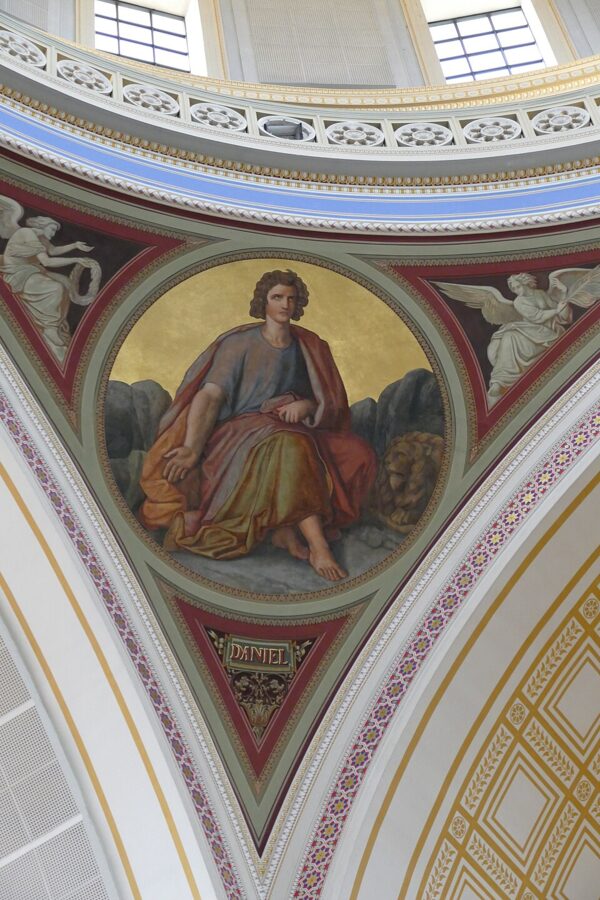
The church came through the bombing on April 14, 1945 with light damage. It was the Soviet artillery in the last days of April that wrecked it: the dome fell in, the portico broke, and the organ gallery collapsed with the organ on it. The congregation decided to rebuild in 1948, put up a 47-tonne steel frame for the outer dome from 1955, closed the lantern in 1962, and rebuilt the portico and facades between 1968 and 1977, partly with 3.77 million marks that the West German Protestant church put into a building program for churches in the East. The church was consecrated again on May 2, 1981, 36 years after its destruction.
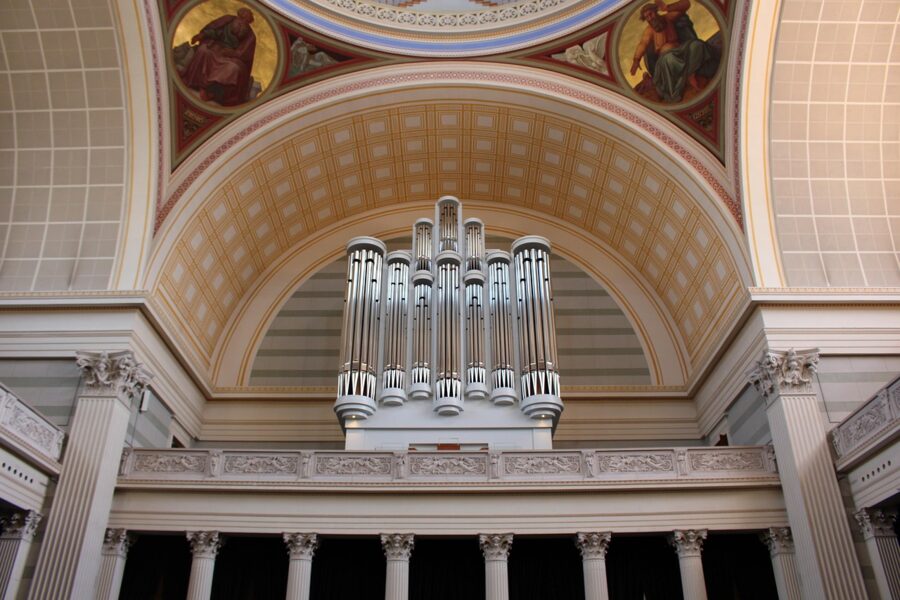
Climb it: the church is open daily, and the tower runs 09:30–17:30, from 12:00 on Sundays, with the last climb half an hour before closing, as the parish’s opening hours put it. Adults pay €7 and children from 6 to 14 pay €3, cash or card. The gallery around the drum is 42 meters up, by 223 steps, and it closes in ice, storm and thunder, so on a bad winter day check before you count on it. On many mornings there is a short organ recital at 11:15.
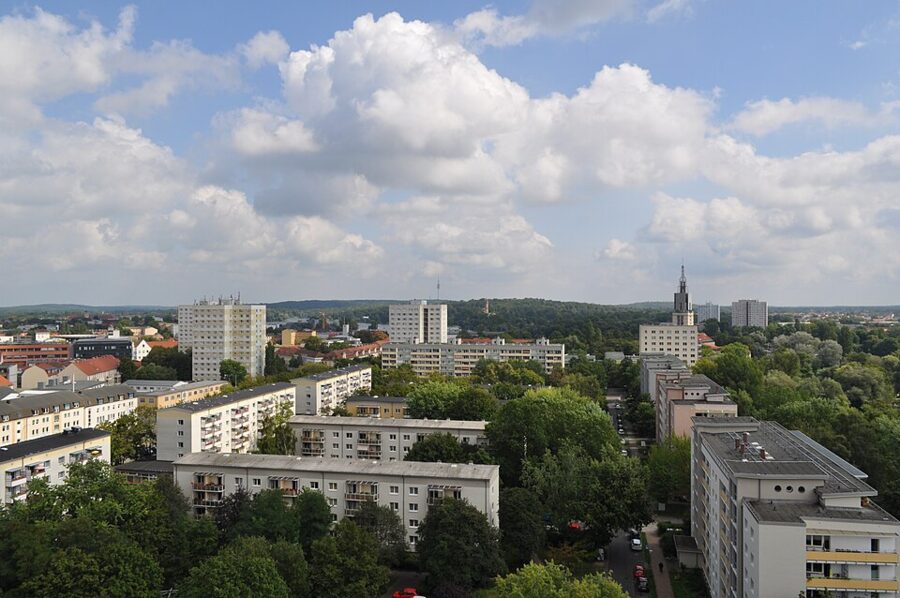
The Old Town Hall and the Potsdam Museum
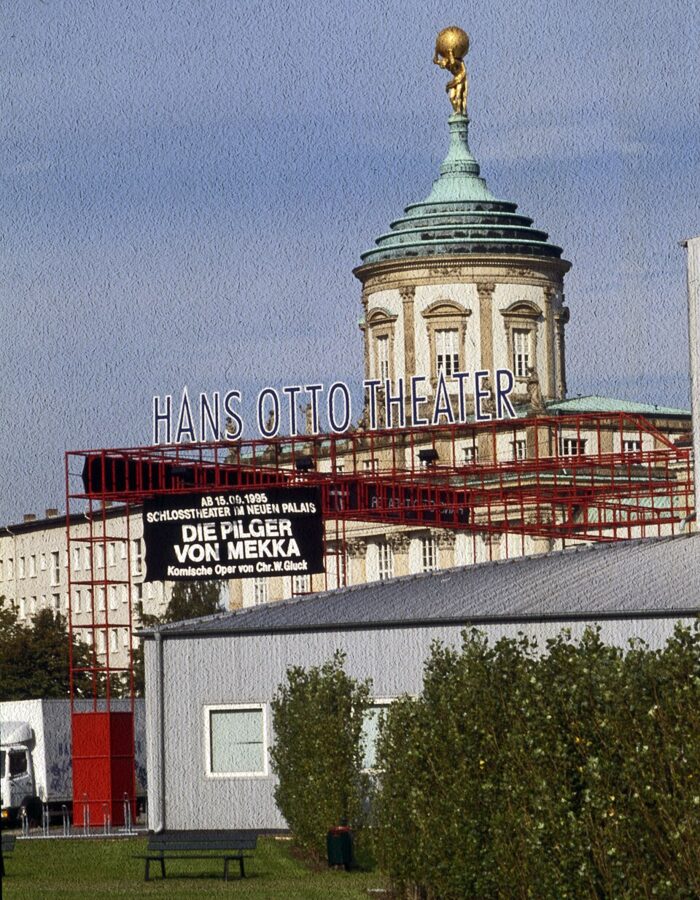
The building with the gilded man on top is the Old Town Hall (Altes Rathaus), built in 1753–1755 for Frederick the Great by Johann Boumann, the Dutch-born builder who also worked on the Dutch Quarter. Its model was a palace that Andrea Palladio designed for Vicenza and never built, the Palazzo Angarano. Palladio’s drawing has nine bays and Potsdam’s town hall has seven, and the usual explanation is a baker named Windelband next door who refused to sell his plot or swap it for another.
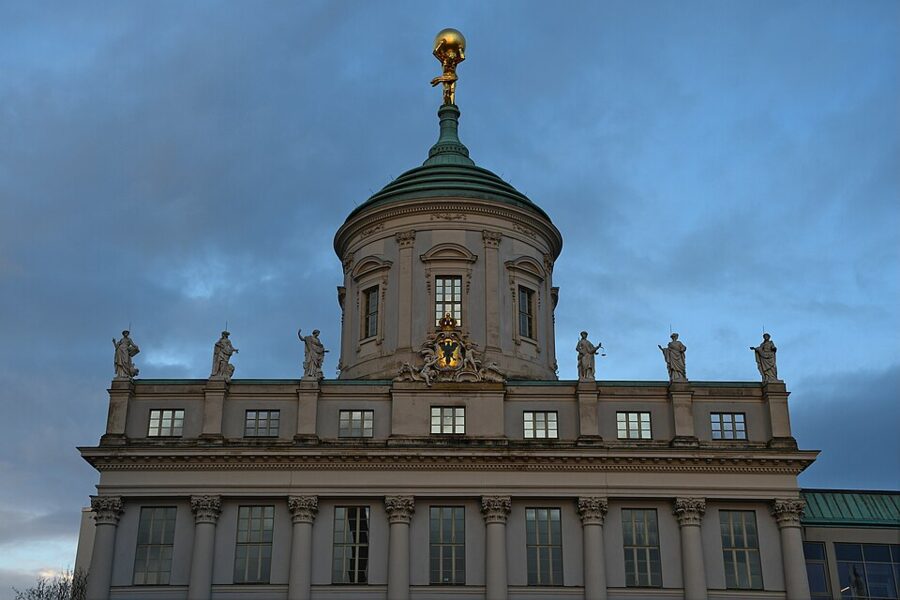
The figure on the dome is Atlas carrying the globe. The first Atlas, cast in lead by Benjamin Giese in 1754, weighed about six tonnes and fell into the street in 1776; its replacement in gilded copper weighs a tenth as much. The town jail was in the building until 1875, and Potsdamers who had done time were said to have “sat under the doll,” as they called the Atlas.
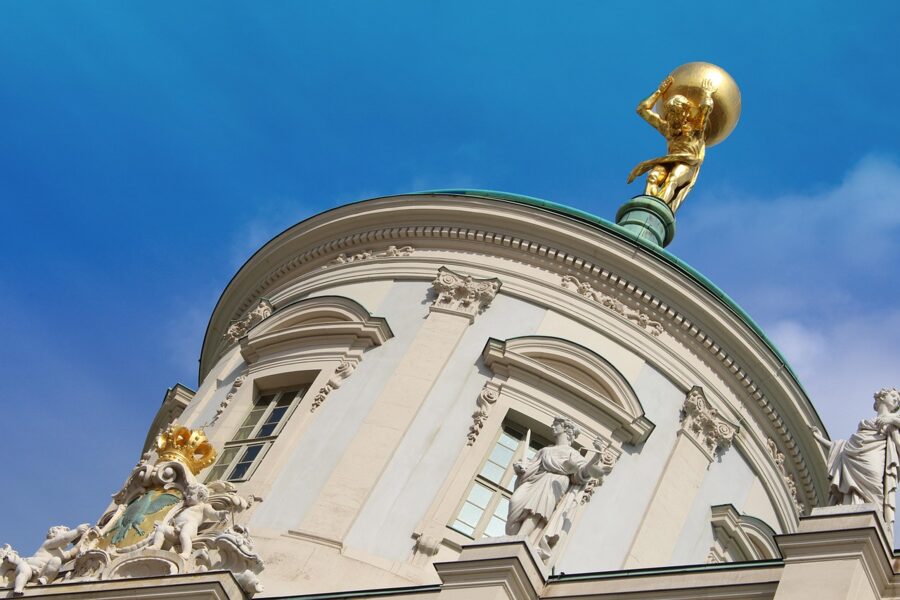
The town hall survived 1945 badly damaged and was rebuilt between 1961 and 1966 as a cultural center, joined to the neighboring Knobelsdorff House by a plain modern link on the site of the baker’s house. Since 2012 the whole complex has been the Potsdam Museum, the city’s own museum, founded by its citizens in 1909 and now holding more than 250,000 objects. It opens Tuesday to Sunday and on holidays, 10:00–18:00, closed December 24 and 31.
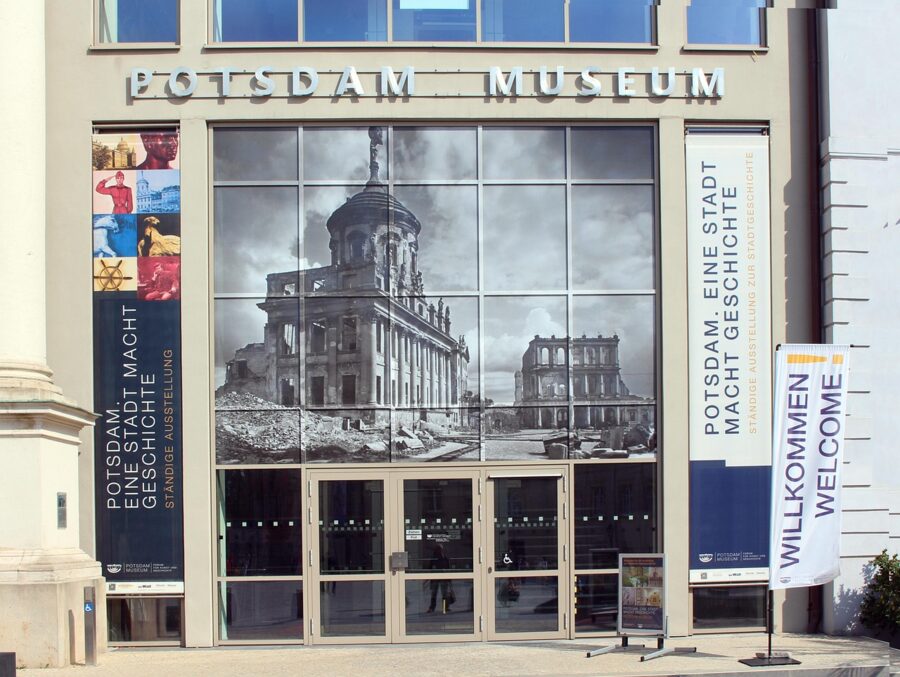
The permanent exhibition on the city’s history, “Potsdam. Eine Stadt macht Geschichte” (a city makes history), is free, and it is the best hour you can spend indoors on this square before you go out and look at the real thing. Until January 3, 2027 two paid exhibitions are about the square itself: “Platz für Neues?”, on the plans made for the Alter Markt between 1945 and 2025, and paintings of the square by Christopher Lehmpfuhl. Each costs €6 (reduced €3), both together €9 (reduced €5), and visitors up to 18 go free.
The town hall tower is normally closed, but the museum takes groups of up to 15 up to the Atlas’s level a few times a year; the next tower climb is on December 5, 2026, 14:00–15:00, and has to be booked. It is not step-free beyond the upper floor.
The obelisk
The obelisk stands exactly where the center lines of the Nikolaikirche, the Old Town Hall and the Palast Barberini cross, which tells you how carefully this square was set out. Knobelsdorff designed it and it went up in 1753–1755, almost 25 meters tall, with red Silesian and white Italian marble, sphinxes by Johann Peter Benkert on the corners and figures of ancient orators by Gottlieb Heymüller below them.
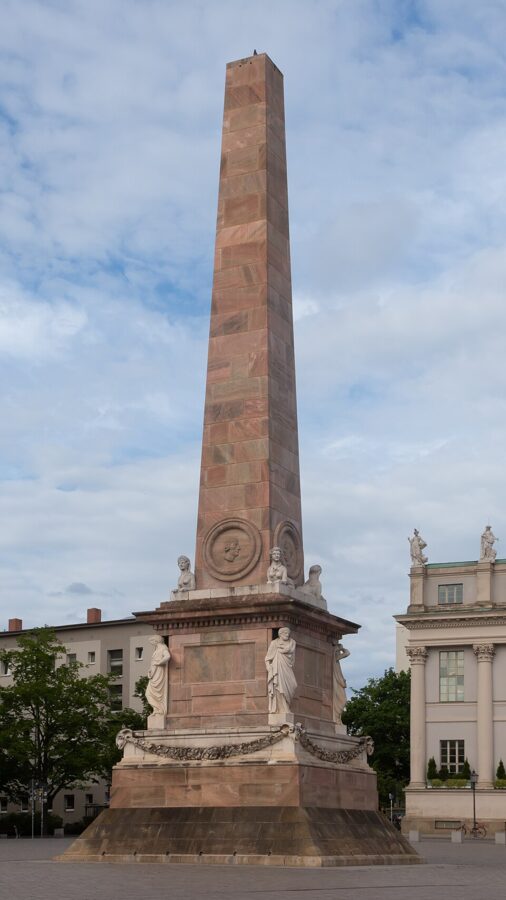
After the bombing it was taken down to the plinth in 1969 and put back in 1978–1979 with new marble, and the new medallions by the sculptors Rudolf Böhm and Walter Rentzsch turned a monument to princes into a monument to architects, something no other city in Germany has. Knobelsdorff and Gontard built much of Frederick’s Potsdam; Schinkel and Persius built the church behind it. Persius, as it happens, was born on this square.
Museum Barberini
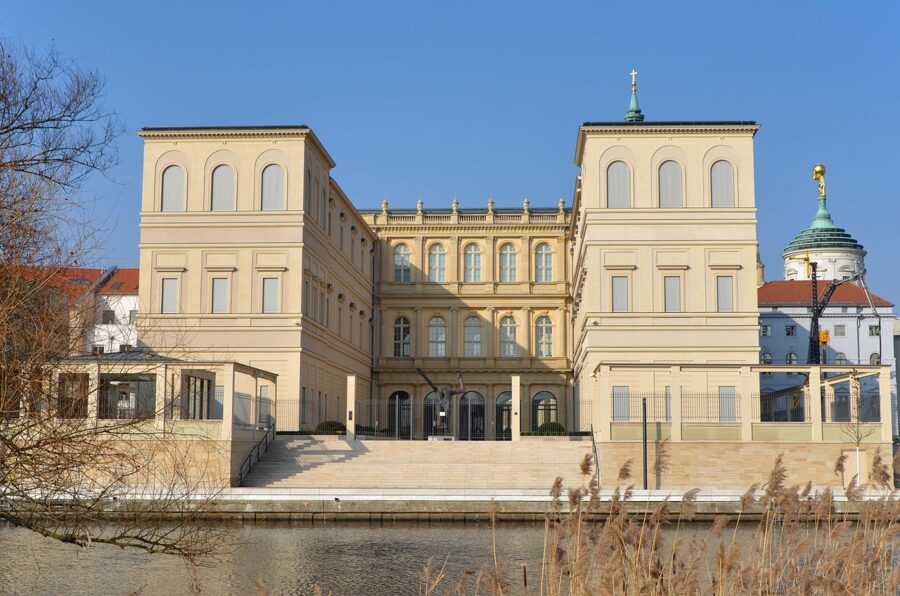
The pale palace on the south-east side is the Museum Barberini: Gontard’s 1771–1772 copy of the Palazzo Barberini in Rome, burned in 1945, cleared in 1948, and rebuilt between 2013 and 2016 by Hasso Plattner to show his collection of Impressionist paintings, with three loan exhibitions a year. It needs half a day and a timed ticket of its own, and its river courtyard is the best place on the square to sit with the Freundschaftsinsel across the water.
The new blocks on the north-west side
Where the teacher-training college stood, the city is rebuilding the eighteenth-century street blocks: five houses copied faithfully from the old facades, five in simplified form, and about 40 new buildings in between, with a third of the flats subsidized and the rest let below the local average rent. Block III, at the corner of the Alter Markt and Schlossstraße, was finished in early 2025 with the Klingnersches Haus and the Plögerscher Gasthof, an inn first built in 1754.
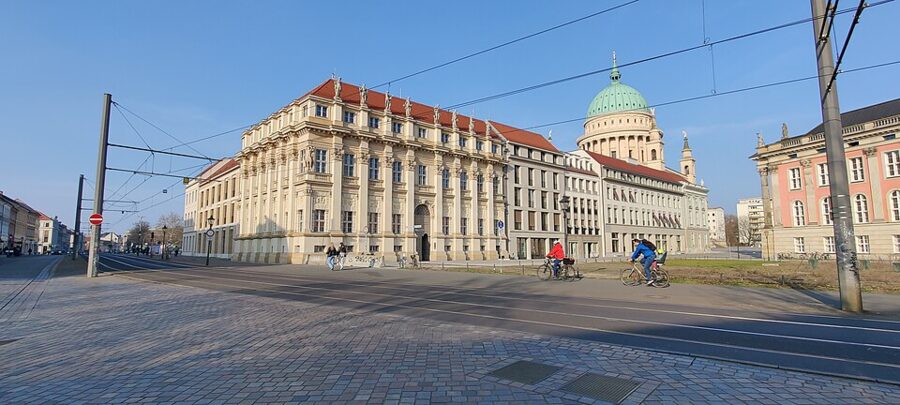
Blocks IV and V, in the shadow of the church, are under construction or planned, including the Palmirosches Haus where Persius was born. When they are done the square will be closed on all four sides for the first time since 1945. Until then, the cleared ground north of the church is a building site, and the city publishes the plan behind it on its page on the historic center.
The Neuer Markt
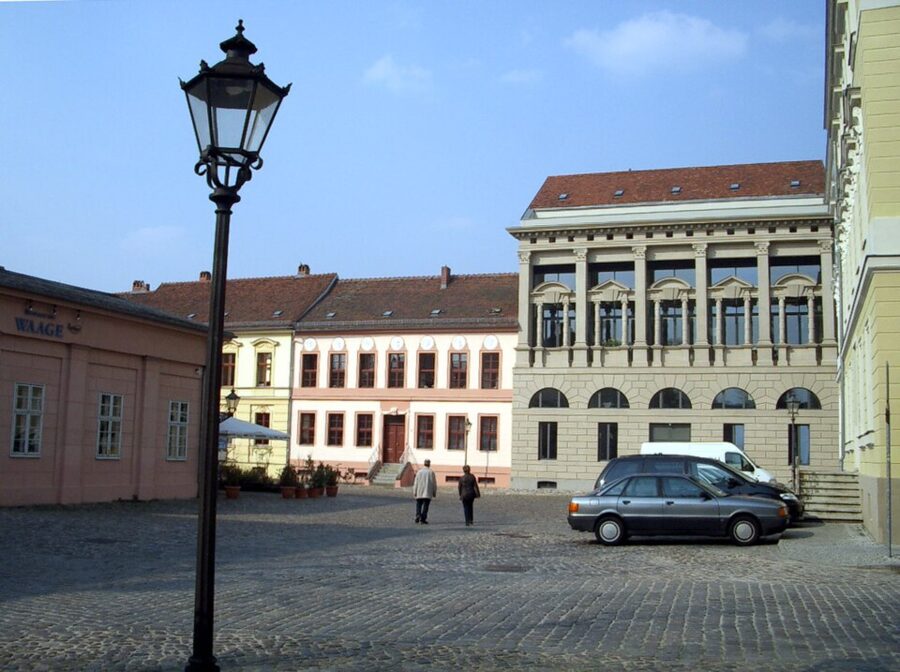
Walk two minutes west from the Alter Markt along Schlossstraße and you come out on the square I would show anyone who thinks Potsdam’s center is all reconstruction. The Neuer Markt, about 50 by 40 meters, came through the war with only two buildings lost on its north corner and is counted among the best-preserved baroque squares in Europe. It began as the yard where the court’s carriage horses were harnessed and unharnessed, and it shrank to its present size as houses were built around it from 1725.
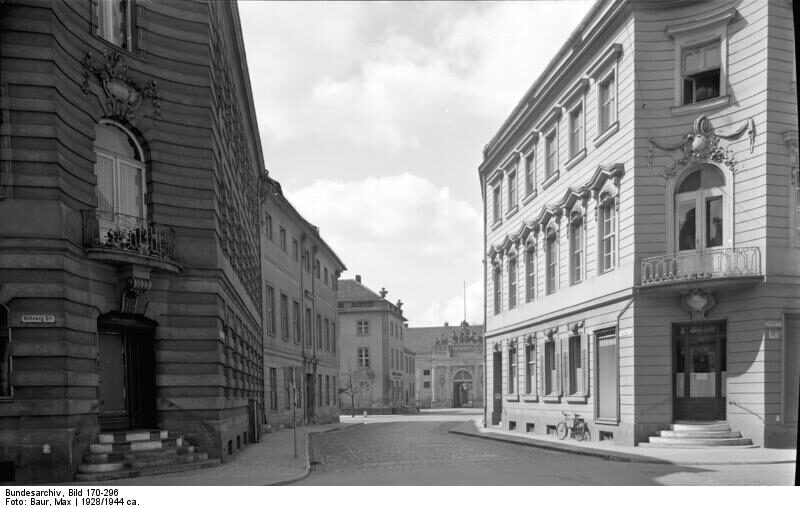
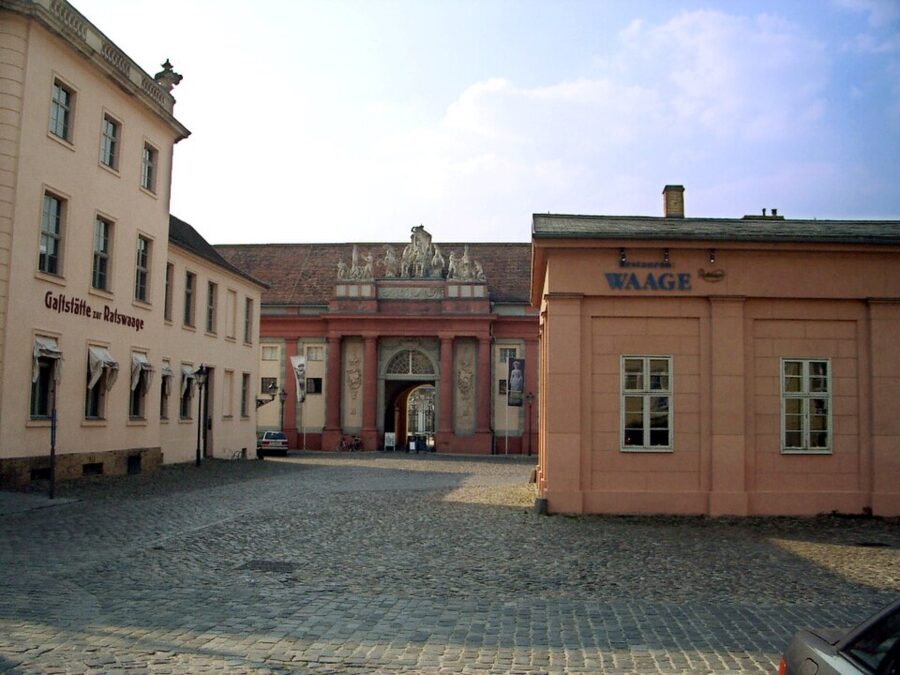
It is quiet in a way the Alter Markt is not, because no main road crosses it and nothing on it sells much. Most of the houses now belong to scholars: the Leibniz Centre for Contemporary History, the Moses Mendelssohn Centre for European-Jewish Studies and the Einstein Forum all have their addresses here.
The weigh house
The little building in the middle is the old royal malt and grain scale. A weighing station was set up here in a half-timbered house in 1735, and its takings went to the Military Orphanage; the present building dates from 1836 and was probably designed by Christian Heinrich Ziller, one of Schinkel’s pupils. The town’s own scales moved here in 1875, and the weigh house was still in use for the trucks of the state fruit-juice works until the end of the 1970s.
The Kutschstall and the Brandenburg Museum
The long stable on the west side, with a gate like a Roman triumphal arch, is the royal carriage-horse stable (Kutschpferdestall, or Kutschstall for short), built in 1787–1789 by Andreas Ludwig Krüger for 100 of the king’s horses. On the gate a four-horse chariot carries the figure of Johann Georg Pfund, Frederick the Great’s own coachman, a rare monument to a man who drove a king rather than one who was a king.
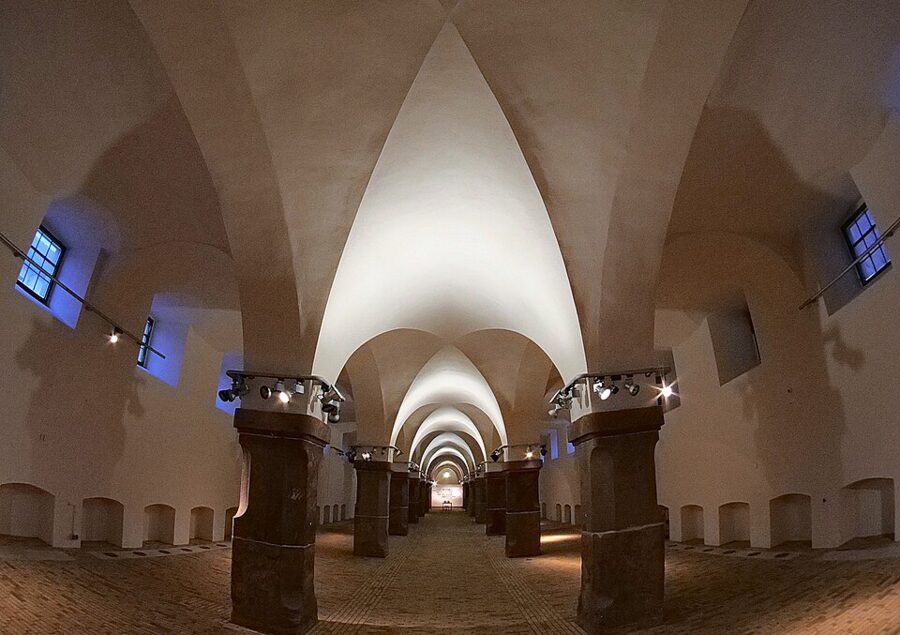
After the monarchy the stable housed mounted police, a tennis hall, a furniture store and a fruit and vegetable market, and in the GDR a car-repair shop and a vegetable wholesaler. Since 2003 it has been a museum of Brandenburg and Prussian history, renamed the Brandenburg Museum in 2024. Its overview exhibition is pay-what-you-wish, with €0–10 suggested, and it opens Tuesday, Wednesday and Friday to Sunday 11:00–18:00 and Thursday until 20:00, closed on Mondays, as set out on the museum’s visitor page.
Until March 14, 2027 the upper floor has a photography show, “Ach, Brandenburg … Fotografie im Dialog 1996 | 2026,” for €8 (reduced €5). If you plan more than one museum in the center, the MUSEUM Kombikarte costs €14 since June 2026 and gets one adult and two children into the Brandenburg Museum, the Potsdam Museum, the Filmmuseum and the natural history museum once each within a year. How these compare with the rest of the town’s collections is covered in museums in Potsdam.
The Kabinetthaus and the north side
The corner house on the east side, Am Neuen Markt 1, is the Kabinetthaus. It was built in 1753 as an ordinary house for a country preacher named Krumbholz; Frederick the Great then rented it, joined it to the corner house behind, and from 1764 to 1786 lodged his nephew and heir there, the future Frederick William II. Two notable children were born in it: the future King Frederick William III in 1770 and, very probably, Wilhelm von Humboldt in 1767, whose father served the prince’s first wife.
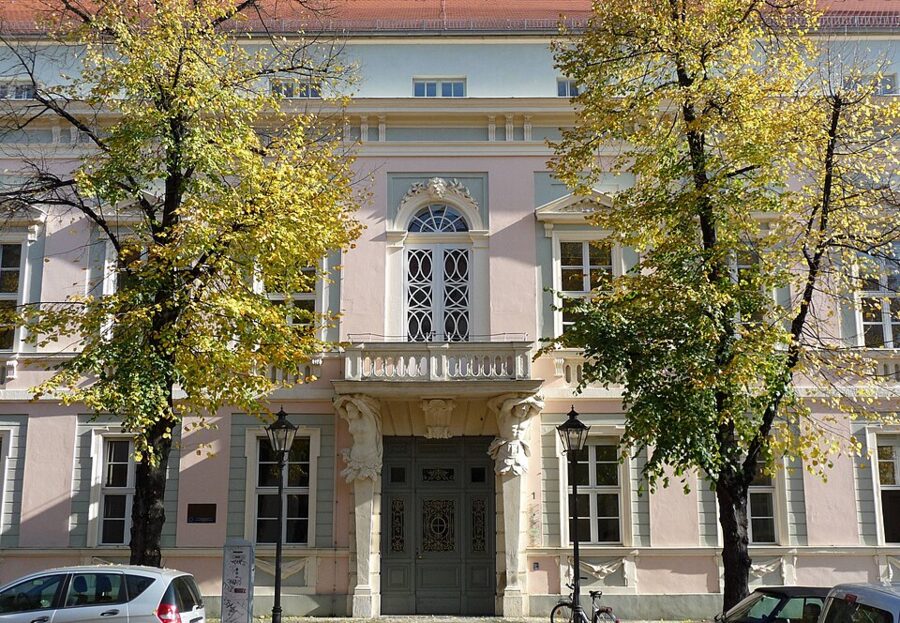
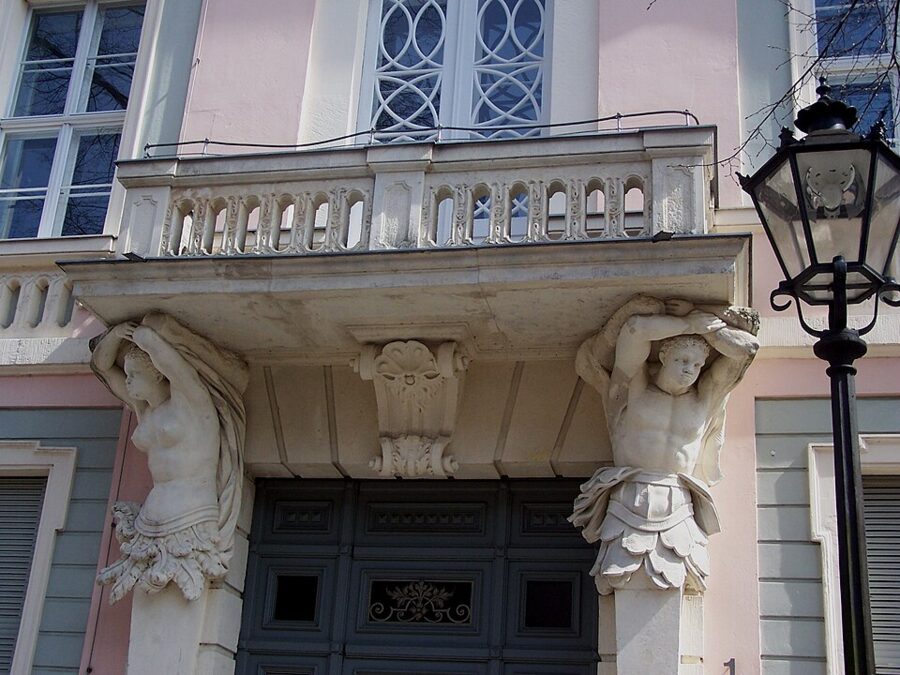
The house later held the army’s engineering academy from 1788 to 1806 and, from 1833, the king’s cabinet office, which gave it its name. A contemporary complained that for all the silk on the walls it stayed “a former burgher’s house, far too cramped and uncomfortable for a great prince,” and you can see why: it is a handsome town house, not a palace. On the north side, Neuer Markt 5 was built in 1755 with a facade after Palladio’s Palazzo Thiene, destroyed in 1945 and rebuilt around 2000 in a form that quotes the original without copying it; the two-story houses beside it at numbers 6 to 8 are by Georg Christian Unger, 1773.
The Lustgarten, the Marstall and the river
South and west of the Landtag the old center opens out toward the Havel, and this is the part that lost most and has been least repaired. The Lustgarten (pleasure garden) was first recorded in 1589, laid out properly for the Great Elector from 1660 with Versailles in mind, and turned half into a parade ground by the soldier king in 1714. Frederick the Great spent more than 90,000 thalers on the rest between 1746 and 1751, with a gilded Neptune group in the harbor basin and balustrades with putti along the river.
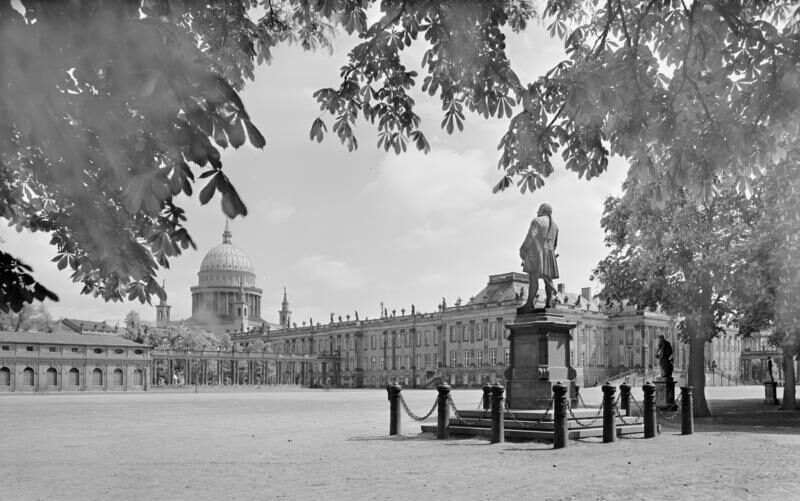
The railway to Magdeburg came along the south edge in 1846, and when its embankment was raised in 1903 it cut the garden off from the river for good. After 1945 the East Germans built a sports stadium over the parade ground, filled in the Neptune basin with the statues still in it, and in 1969 put up the Interhotel, today’s Hotel Mercure, on the old flowerbeds. For the federal garden show of 2001 the stadium was removed, the basin dug out and the space relaid as the Neuer Lustgarten, mostly paved so that fairs and circuses can set up on it.
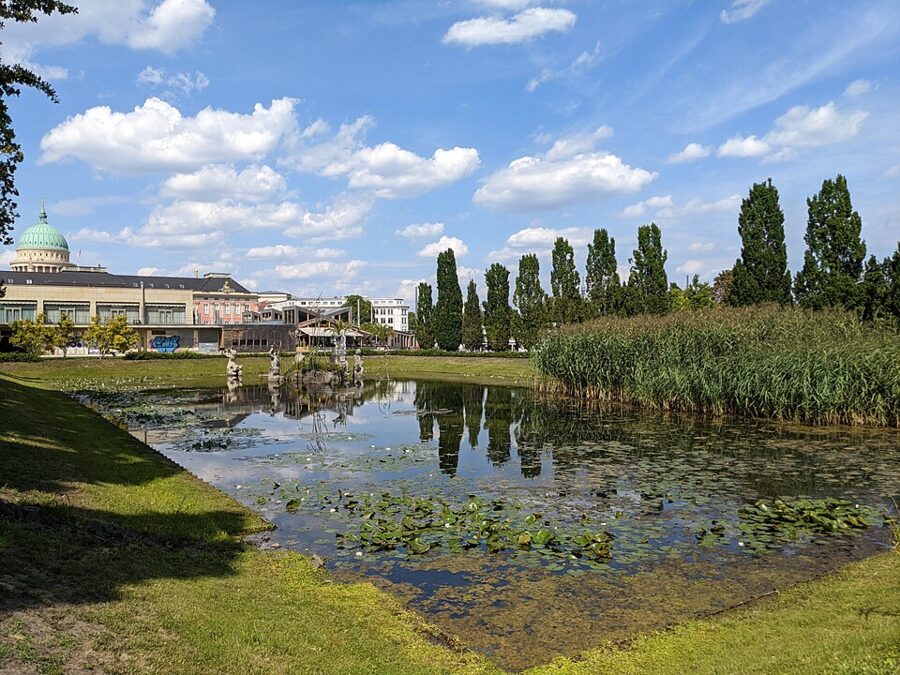
I won’t pretend it is a lovely garden. The paving is wide and hot in summer and the hotel tower presses on it. But the Neptune basin and the colonnade beside it are worth the detour, and the view east from here, across to the Landtag’s river front, is the one the palace was built to give.
The Marstall
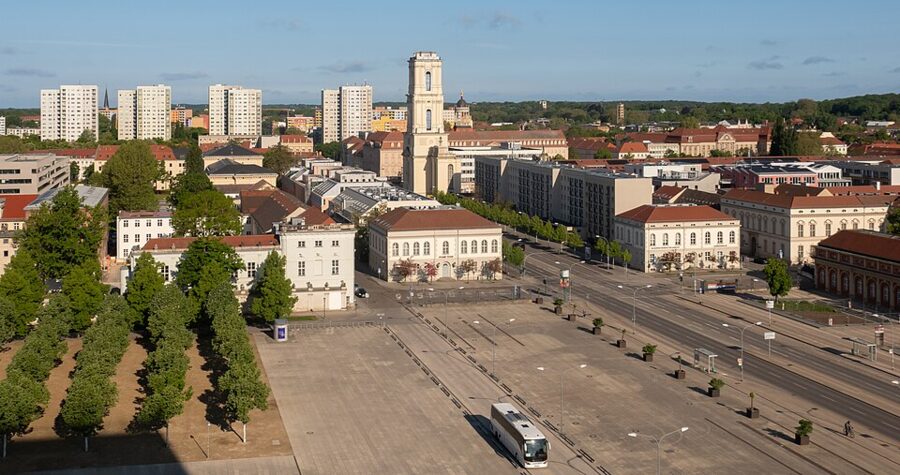
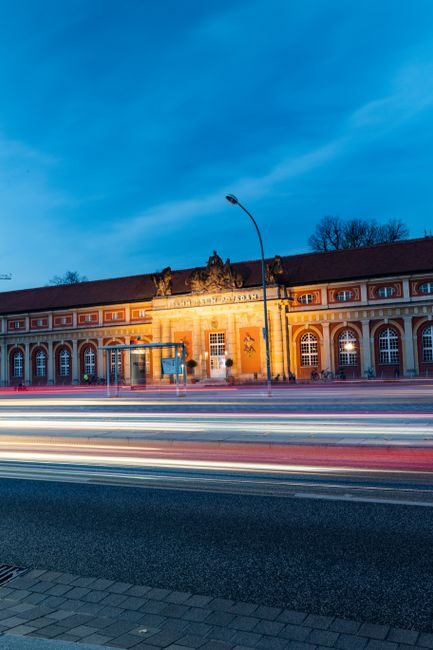
The long, low building along the north side of the Lustgarten is the oldest in central Potsdam, and the only big building of the palace ensemble to come through the war and the GDR. Johann Arnold Nering built it in 1685 as an orangery for the Great Elector; the soldier king turned it into a stable for his riding horses in 1714, and Knobelsdorff and Andreas Krüger lengthened it to 33 bays in 1746 and set Friedrich Christian Glume’s horse-tamers on the roof.
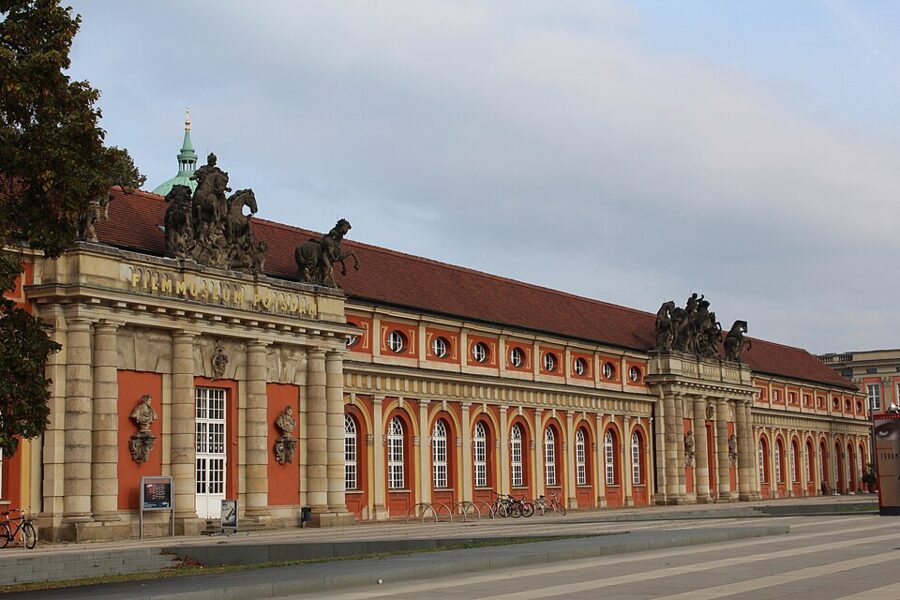
After 1918 it became a garrison museum, and from 1939 the Luftwaffe’s cipher office worked inside it. It was due to be pulled down after the war and was saved because someone wanted it for a film museum, which opened in 1981. The Filmmuseum Potsdam tells the story of the Babelsberg studios and runs a cinema in the old stable.
The Ringerkolonnade and the Steubenplatz
Between the Marstall and the Landtag’s west end, a row of paired columns marks where Knobelsdorff closed the Lustgarten off from the town in 1745–1746. The Ringerkolonnade took its name from the sculpture between the columns, six groups of wrestlers, five fencers and a slinger. Half of it was destroyed in 1945; what survived was moved down to the harbor by the hotel in 1970.
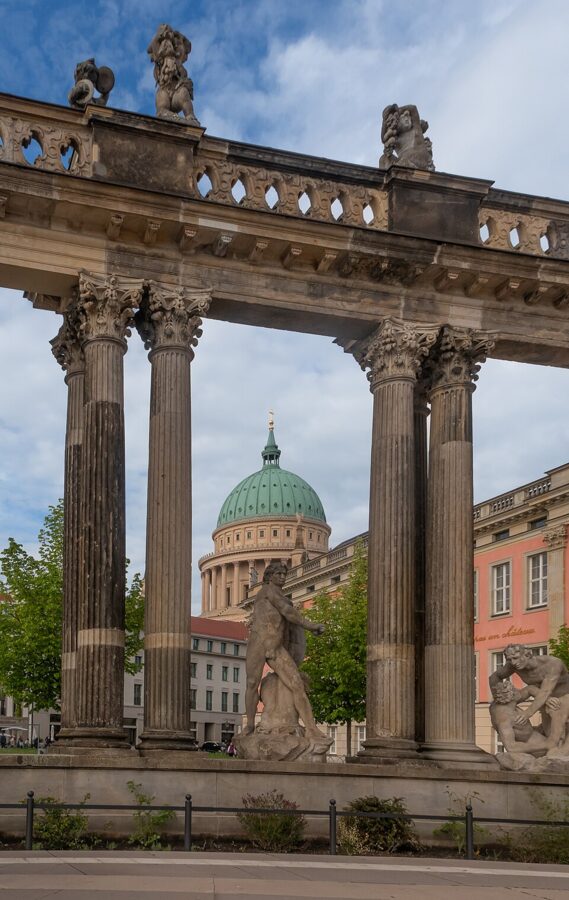
Since 2016 the restored column pairs have stood again on the Steubenplatz, the small square between palace and stable, though the figures are still mostly in storage. Two putti and a vase went back up in 2019.
The Lange Brücke and the Freundschaftsinsel
The bridge you cross from the station is the sixth on this spot. A bridge is recorded here in 1317 and again in 1416; the Great Elector’s wooden one of 1662–1664 was about 220 meters long on 48 arches, and Frederick the Great marched his army over it into the Seven Years’ War on August 8, 1756. The German army blew up the span over the Neue Fahrt on April 24, 1945, and the present bridge went up in 1958–1961 on a new line aimed straight at the garden entrance of the palace, which the GDR was by then preparing to demolish.
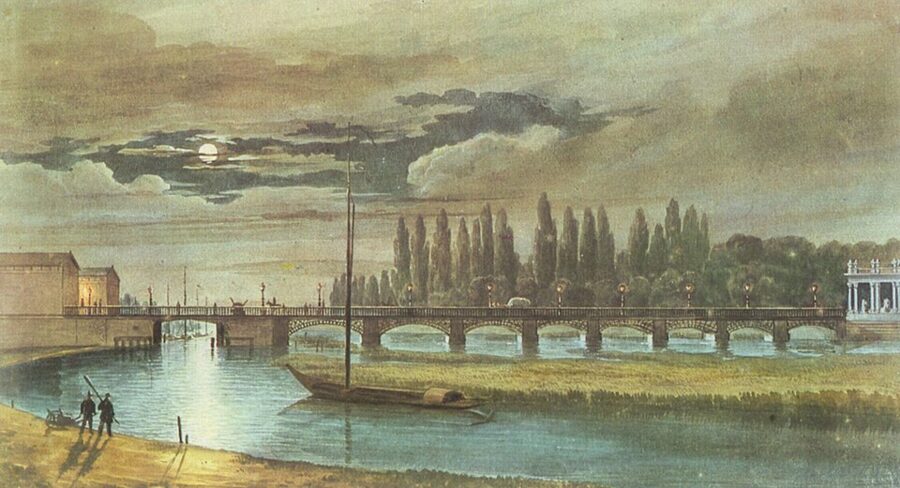
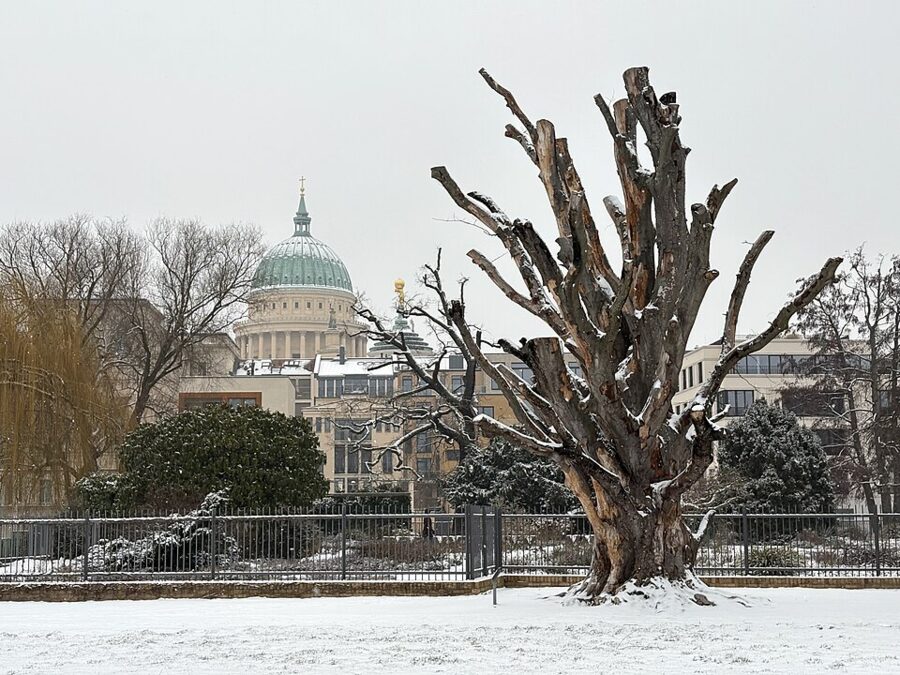
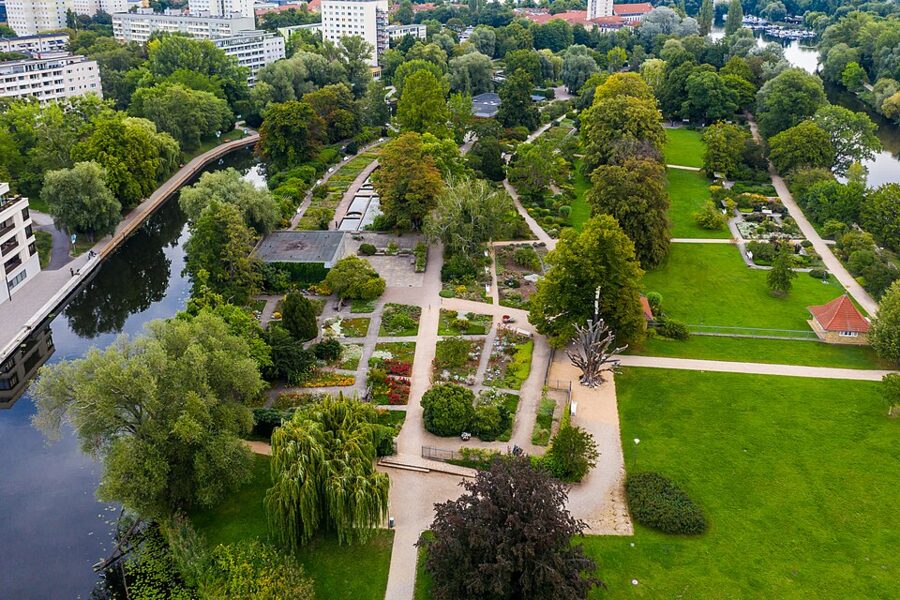
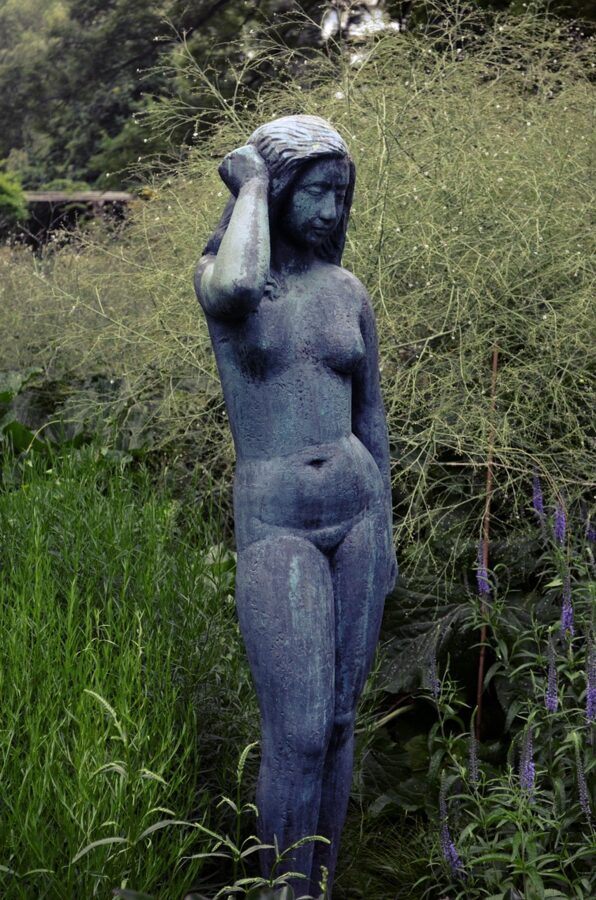
The bridge clips the western end of the Freundschaftsinsel (Friendship Island), 6.5 hectares of park between the two arms of the river, named after a nineteenth-century excursion restaurant called the Insel der Freundschaft; a footbridge also crosses to it from the old-town bank at Burgstraße. Its gardens were restored for 2001 with more than 200 of Foerster’s own perennial varieties, there is an open-air stage and an art pavilion, and the inner garden is locked at sunset. The excursion boats leave from the harbor at the island’s western tip, beside the hotel; routes and prices are in Potsdam boat tours.
April 14, 1945
The night that made all this rebuilding necessary began at 22:16. About 490 Lancaster bombers of the Royal Air Force dropped some 1,700 tonnes of high explosive, mines and incendiaries on Potsdam; 1,593 people died in the raid or the fire that followed, almost 1,000 buildings in the center were destroyed, and about 60,000 people were left homeless. The Allies named the town station as the target, but the marker flares came down on the old town, and RAF records handed over after 1990 show that the old town was the aiming point.
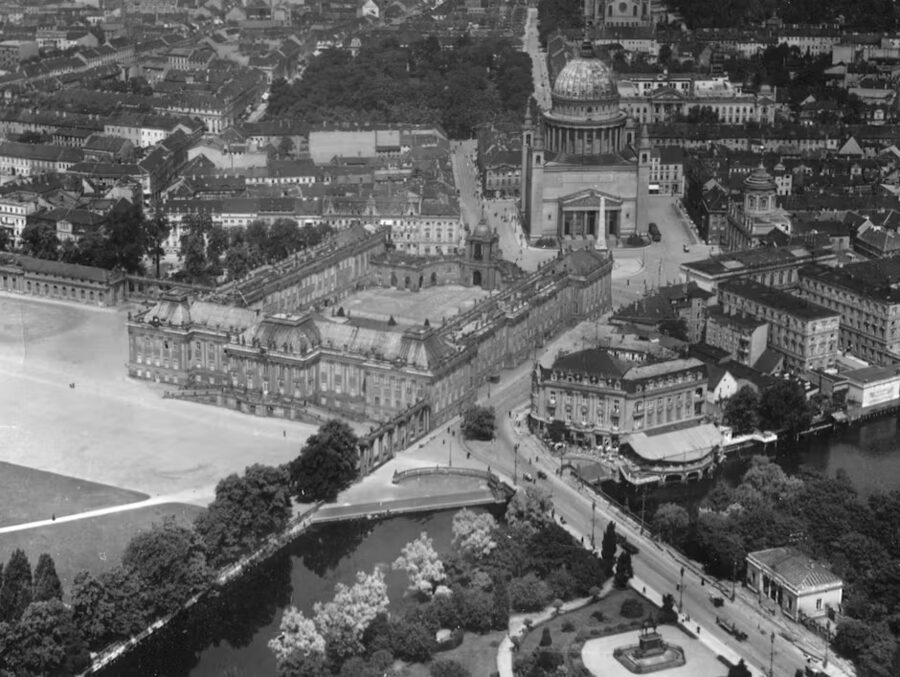
The City Palace and the Garrison Church burned out, and in the center and the Berliner Vorstadt up to 97 percent of buildings were destroyed or damaged. Some survived the night only to be lost later in April, when the town was declared a fortress and Soviet artillery shelled every high point that might hold an observer. That is how the Nikolaikirche lost its dome in the last days of the month and the Military Orphanage its temple on April 26; the Red Army took Potsdam on April 30. The parks and their palaces were largely spared.
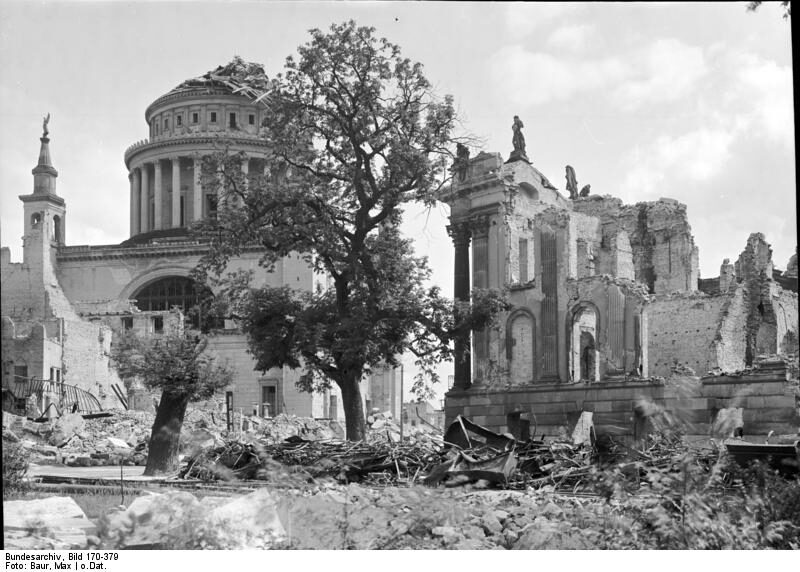
The palace was a shell but not a ruin in the sense of a heap. A survey by the city’s monuments office found 83 percent of its remaining walls still sound, and much of the sculpture was still in place. The Old Town Hall, the Nikolaikirche, the Holy Ghost Church and the playhouse in the eastern old town were all standing in some form.
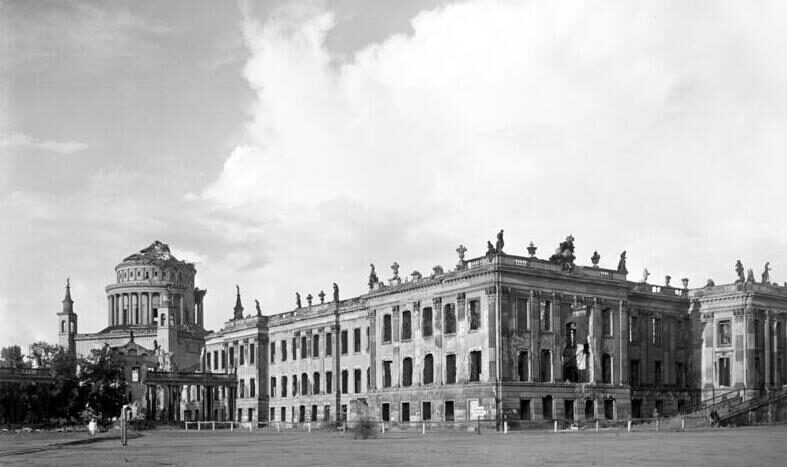
The graves of 1,641 of Potsdam’s dead lie in two fields of graves for the bombing victims at the Neuer Friedhof, with a memorial of 1979 that reads, in German, “in memory of the victims of the bombing of Potsdam on April 14, 1945.” In 2013 the Nikolaikirche’s cantor, Björn O. Wiede, wrote a Potsdam Requiem for the anniversary, first sung in the church that the same weeks of 1945 had wrecked.
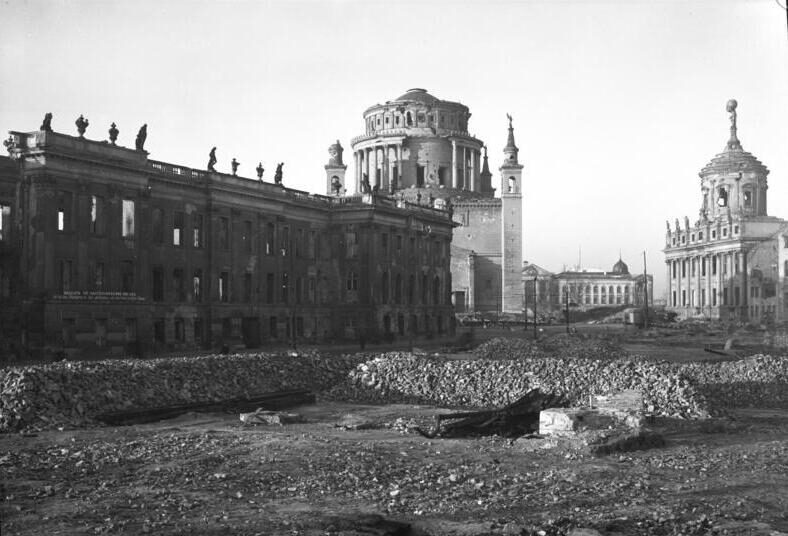
What the GDR took down, and what it put up
For fourteen years the palace stood as a burned shell while the argument went on between conservationists, architects and city planners on one side and the regional leadership of the ruling party, the SED, on the other. In May 1959 the Politburo decided to clear it for a “Karl Liebknecht Forum,” named after the socialist who had won Potsdam’s seat in the Reichstag in 1912. Between December 1959 and April 1960 the palace was blown up in a series of explosions that began at the Fortuna Portal, and much of the rubble went to build up the stands of the stadium in the Lustgarten.
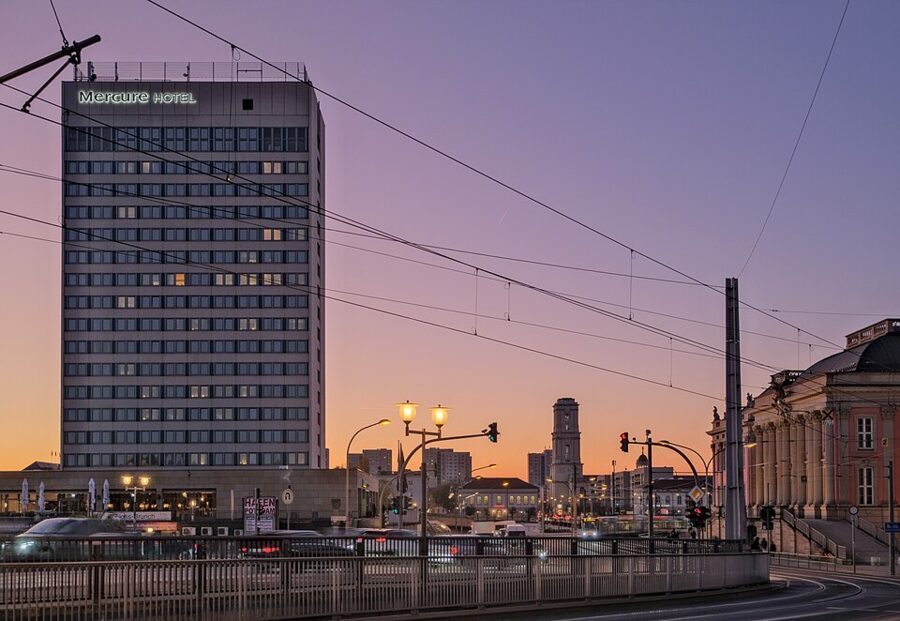
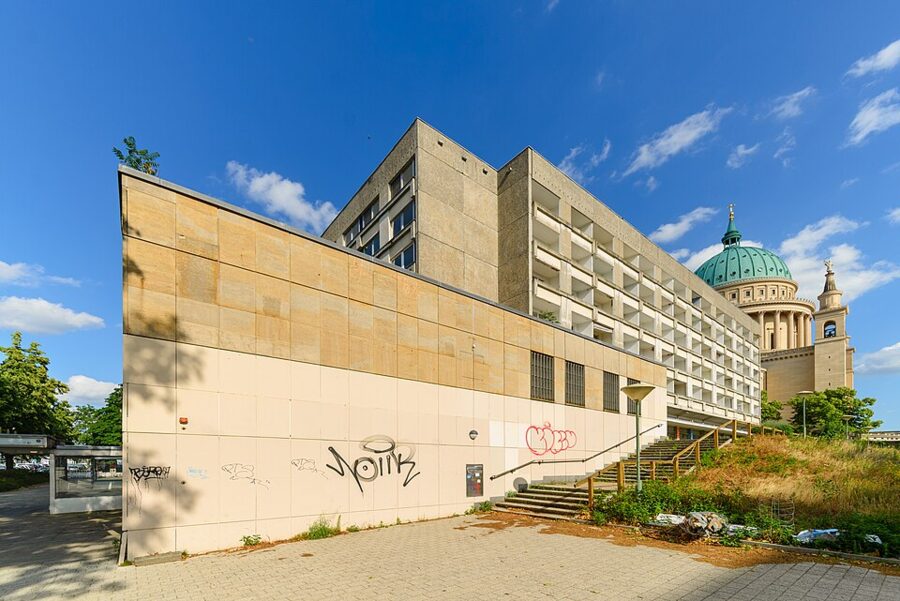
The forum was never built where it was meant to go. Instead the cleared ground became a road junction, the new Lange Brücke fed traffic straight across it, and the GDR built its own center around the edges: the Interhotel on the Lustgarten in 1969, the Institute for Teacher Training on the west side of the Alter Markt in the 1970s, and the Staudenhof apartment block behind the Nikolaikirche in 1971–1972. The Stadtkanal was filled in between 1962 and 1965.
The Garrison Church went in 1968, in the face of protests from churchmen, conservationists and architects in East and West; the city council’s vote, unusually for the GDR, had four votes against. The nave was blown up from May 14, the first attempt on the tower on June 19 left half of it standing, and the second, on June 23, brought it down. On part of the site rose the Rechenzentrum, a computing center for the district, built in 1969–1971 by the same team under Sepp Weber that designed the hotel.
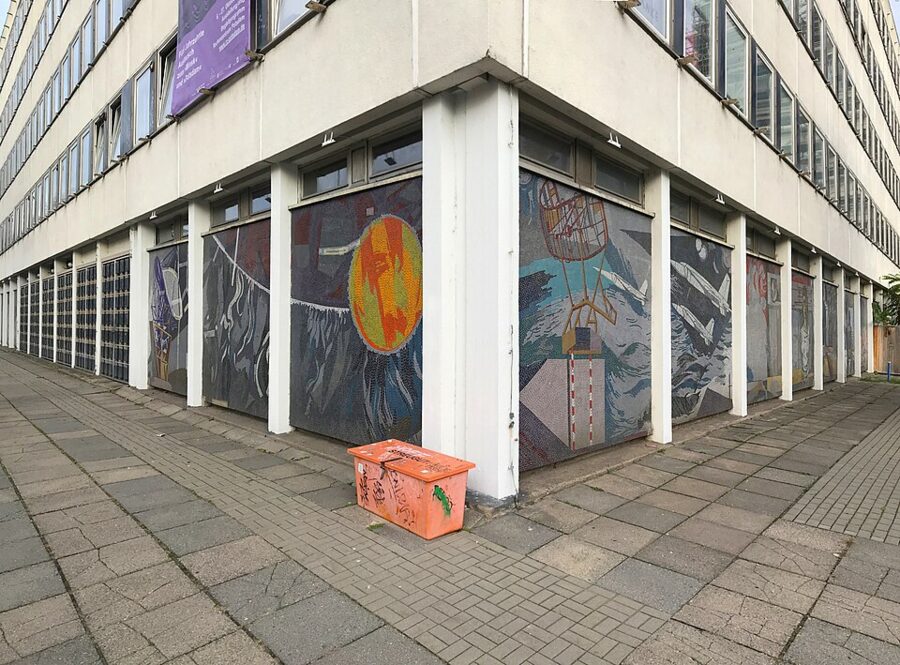
It would be wrong to say the GDR years only brought demolition. The Nikolaikirche’s congregation rebuilt their church over 26 years, the city rebuilt the Old Town Hall as a cultural center, a blown-up wing of the Military Orphanage was reconstructed between 1971 and 1981, and in 1989 the state laid the foundation stone for a new city theater on the palace site. The obelisk, with its architects in place of kings, is as much a GDR monument as the hotel is.
Rebuilding since 1990, and the quarrel that comes with it
On October 24, 1990, three weeks after reunification, Potsdam’s first freely elected council voted for a “return to the historic townscape.” The theater shell on the palace site came down in 1991, a temporary theater known as the tin can stood on the Alter Markt until the company moved to a new house by the Tiefer See in 2006, and for years the palace site was a lawn with a road junction beside it. The Fortuna Portal of 2002 was the first sign that the larger plan might happen.
What turned the plan into a building was the parliament’s need for a home. On May 20, 2005 the Landtag decided to build within the outline of the palace; in a citizens’ poll in November 2006, 42.8 percent chose the palace site against 28.5 percent for a new building in the Speicherstadt on the river; and Plattner’s money settled the facades. From 2006 there were Monday demonstrations at the Fortuna Portal for the historic center, and the citizens’ initiative Mitteschön campaigned for a historic front; they won.
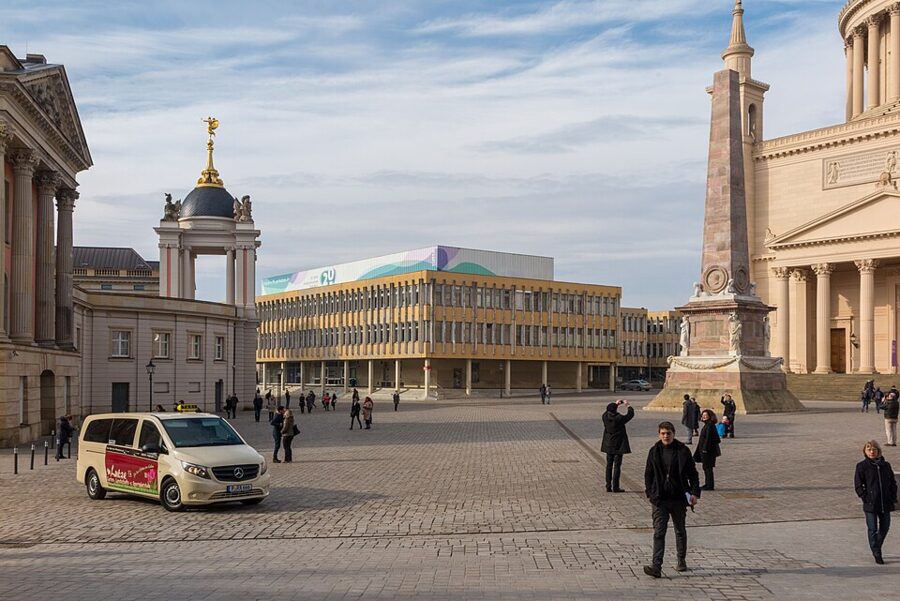
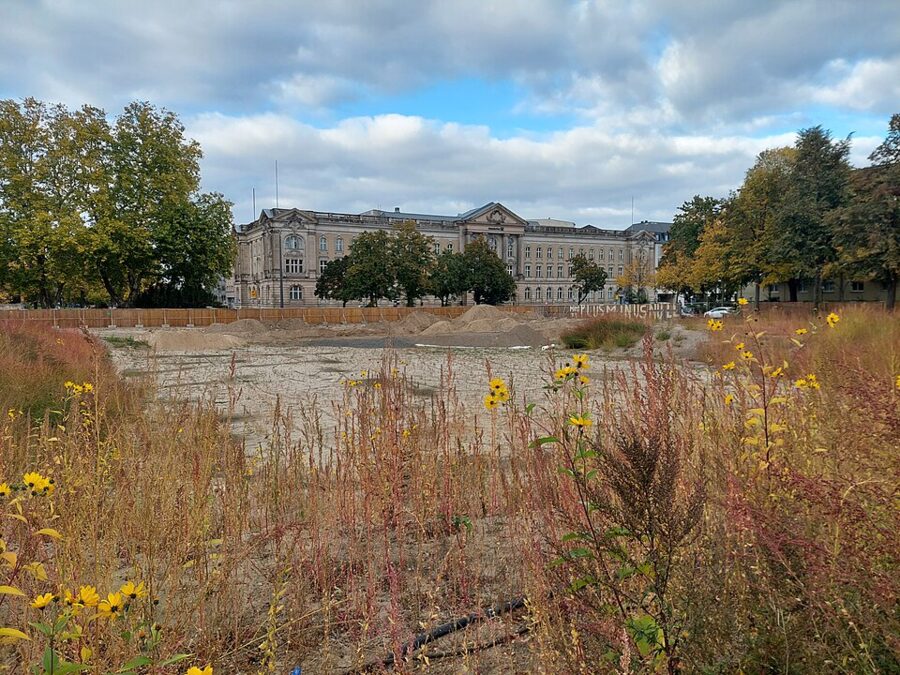
The college building on the west side of the square came down in 2017 and 2018. The Staudenhof fight was harder. Its tenants organized, architects including the Pritzker Prize winner Jean-Philippe Vassal argued for keeping it, and the case for the energy already built into its concrete was made loudly; the council confirmed demolition in November 2023, the last tenant moved out on December 5, 2023, and the block came down in 2024 and 2025 at higher cost than planned because of pollutants in the walls. As of mid-2025 it was an open question whether the state would still fund the subsidized flats meant to replace it.
Two GDR buildings are still standing at the time of writing. The Hotel Mercure was on the demolition list in the 2010s, when the city considered buying it to give the Lustgarten back, but in a vote on the 2015/16 citizens’ budget “no purchase and demolition of the Mercure” came second, and since 2021 the monument authorities have been examining whether to list it. The Rechenzentrum, used since 2015 as a house for artists and studios, was due to lose its permission at the end of July 2026; in June 2026 the city, the Garrison Church foundation and the operator agreed on a compromise that lets it run until July 31, 2033, after which the plan is still to clear it for a square.
The arguments on both sides are serious. Supporters of the rebuilding say the center was a coherent work of art, that the GDR’s demolitions were a political act that a free city may undo, and that the Alter Markt only makes sense closed. Critics answer that a reconstructed eighteenth century erases forty years of other people’s lives, that the subsidized housing was the price of the facades, and that the Garrison Church, outside which Hitler bowed to Hindenburg on the Day of Potsdam, March 21, 1933, was never just a building. Standing on the square, I find the closed Alter Markt works as a space in a way the open lawn never could; what I would miss, if the Mercure and the Rechenzentrum go, is any visible sign that the decades between 1945 and 1990 happened here at all.
The Garrison Church tower is the sharpest case. It was rebuilt from 2017, opened with an exhibition and a viewing platform 57 meters up in August 2024, and is due to get its cap, almost 32 meters of it, in summer 2027, when it will be the tallest building in Potsdam again.
The streets of the baroque town
The squares are only half the old center. The other half is the grid of streets that the Great Elector and the soldier king laid out, where Frederick’s show-fronts still line the pavements and where the two worst chapters of the twentieth century left a prison you can walk through.
Breite Straße
Breite Straße, the broad street, began as an avenue of oaks planted around 1668 from the palace’s south-west front toward the hills, with the Elector’s planned houses along it. In the 1760s Frederick decided to make it a showpiece and paid for new facades house by house; the grandest are the Hiller-Brandtsche Häuser at numbers 8 to 12, finished in 1769 by Georg Christian Unger for a merchant and a master tailor, with a barracks behind the palace front. They cost about 70,000 thalers, far more than any ordinary house, and Henning von Tresckow, who later plotted against Hitler, lived there in the 1920s.
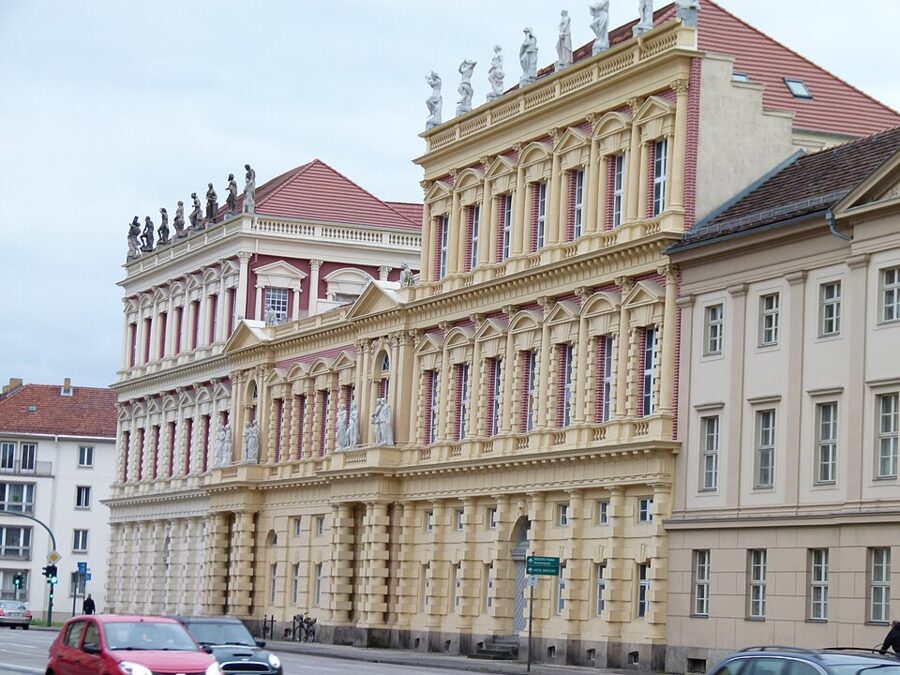
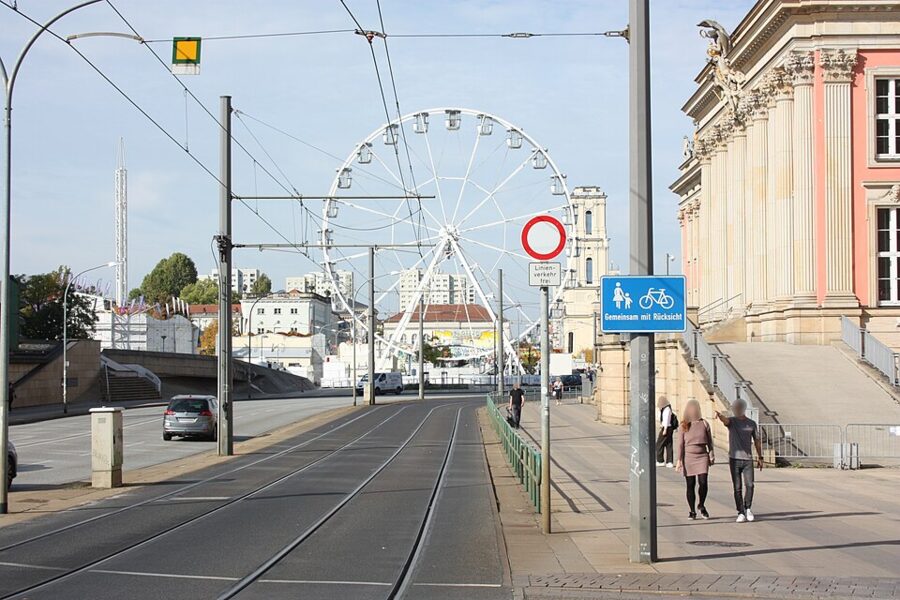
Walking west from the Landtag you pass the Marstall, then the Hiller-Brandt houses, then the Garrison Church tower at the corner of Dortustraße, the Rechenzentrum beside it with Eisel’s mosaic at pavement level, and opposite them the Breite Straße wing of the Military Orphanage. It is a busy road, not a strolling street, and I’d walk it for the buildings and then turn off.
The Plantage and the Langer Stall
Behind the Garrison Church tower lies the Plantage, one of the oldest squares in Potsdam, named after the mulberry trees planted here for silkworms early in the eighteenth century. It became a parade ground and then, in 1850, a green square by Peter Joseph Lenné, with a statue of Frederick the Great in the middle that the SED had destroyed in 1950. The Rechenzentrum now covers part of it.
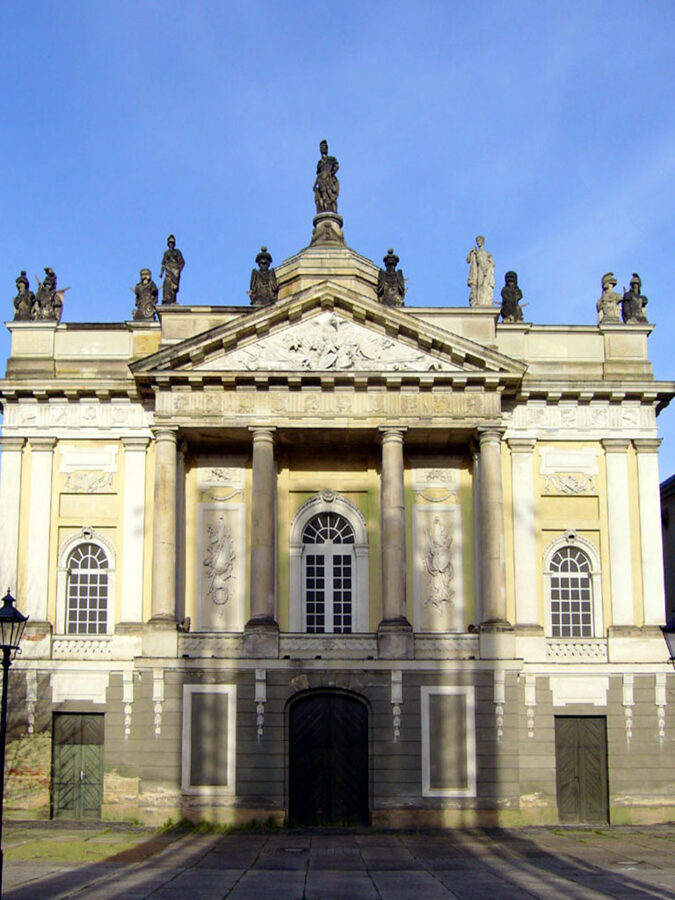
On the east side of the Plantage stands a stage-set: a pillared portal with nothing behind it. The Langer Stall (long stable) was an exercise hall 166.5 meters long, built in 1734 so the soldier king’s regiments could drill in bad weather; the hall was lost in the war and only Unger’s 1781 front survived. Its north end once held a Russian Orthodox chapel, until 1740, for the Russian soldiers whom the tsar sent to serve in the king’s regiment of giants. A creative quarter of about 25,000 square meters went up on the ground next to the portal and was finished in October 2025.
Lindenstraße and the Great Military Orphanage
Turn north up Lindenstraße and the gilded figure over the rooftops is Caritas, on the temple tower of the Great Military Orphanage (Großes Militärwaisenhaus), the largest baroque ensemble in Potsdam. Frederick William I founded it on November 1, 1724 for the children of soldiers, after the model of the Francke Foundations in Halle; it took girls from 1725 and housed 600 children at first, and by 1740 more than 1,500.
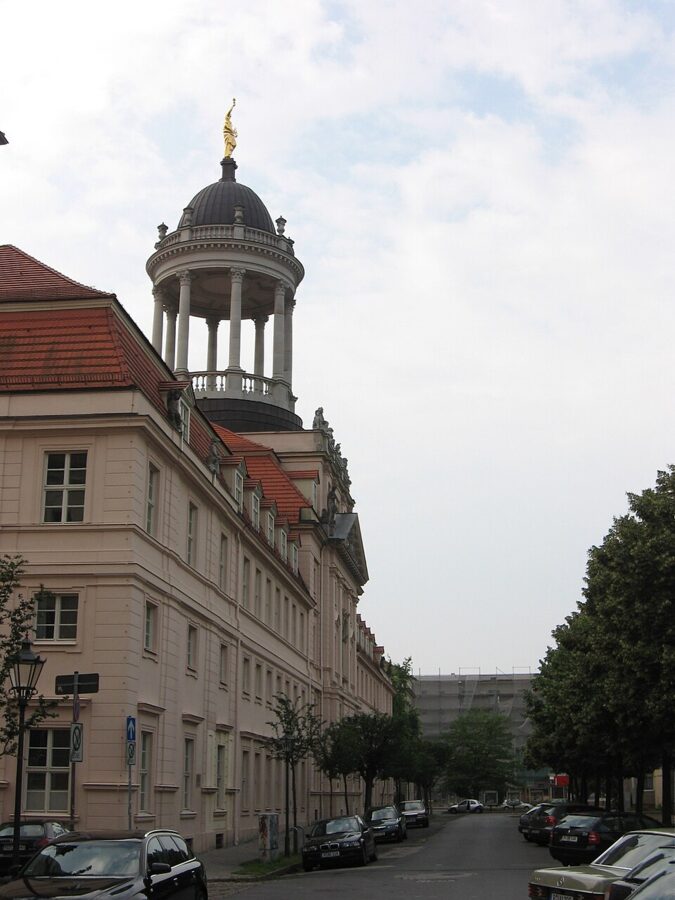
It was a charity run like a regiment. The children learned to read, write and count, the boys then a trade, but they were also hired out to cloth mills and gun factories for up to ten hours a day, and about 200 of them died each year from the work. After 1933 the house became a Nazi elite school; in the GDR it was a children’s home and then offices. The foundation itself was dissolved in 1952, revived in 1992, and still supports youth projects from the building.
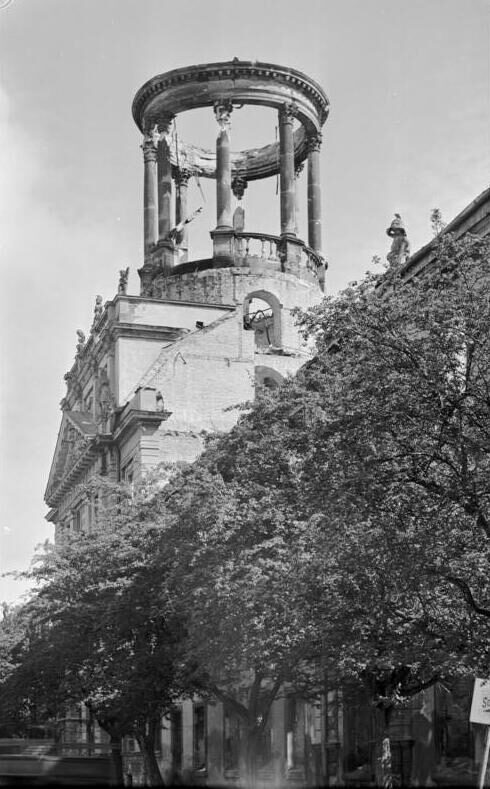
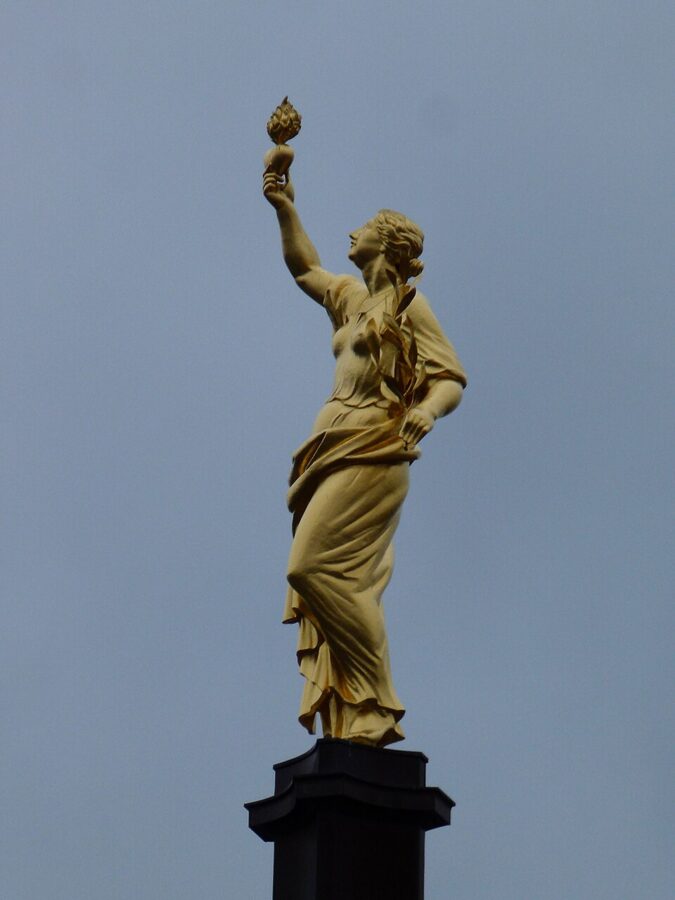
The temple and its figure came back in 2004. Every column, capital, vase and putto had to be made new, some of the 1950s concrete replacements had been decorated with wine glasses that did not belong on an orphanage, and the sculptor Andreas Hoferick had to model the 3.75-meter Caritas from photographs in which she was mostly a blur. She stands with an olive branch and a burning heart at the top of a 46-meter tower.
A few doors north, the red-brick baroque house at Lindenstraße 54/55 has the darkest history in the old town. Built in 1734–1737 as the Great Dutch House and given to the town, it was where Potsdam’s first elected council met on March 20, 1809, and from 1820 it was a court and a prison; Theodor Storm worked here as a junior judge in the 1850s. Under the Nazis its “hereditary health court” ordered at least 3,300 forced sterilizations, and from 1943 it held defendants of the People’s Court, among them the wrestler Werner Seelenbinder. The Soviet secret police took it over in 1945 and the Stasi after them; Potsdamers called it the Lindenhotel.
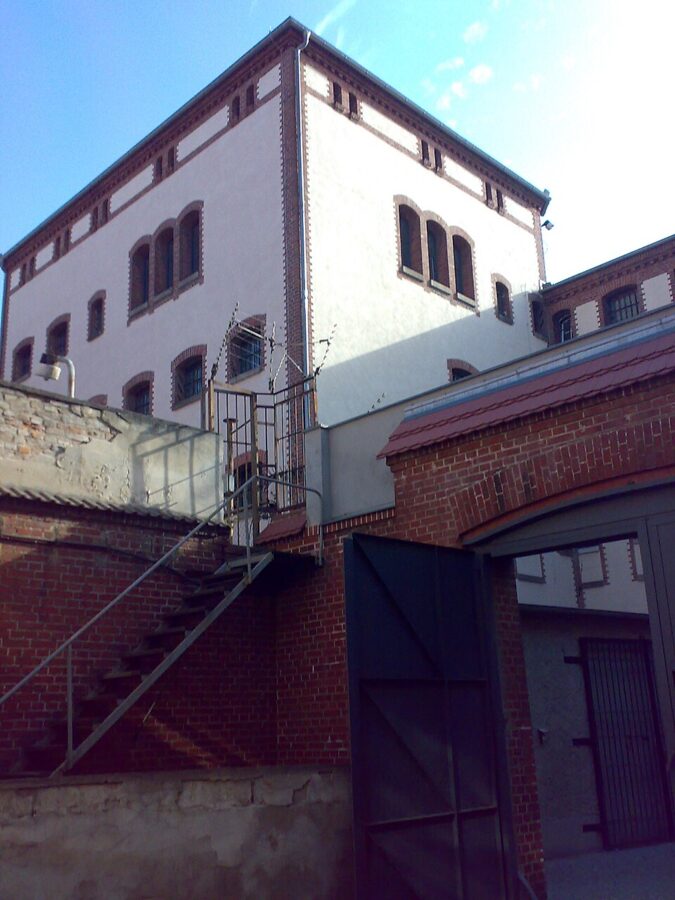
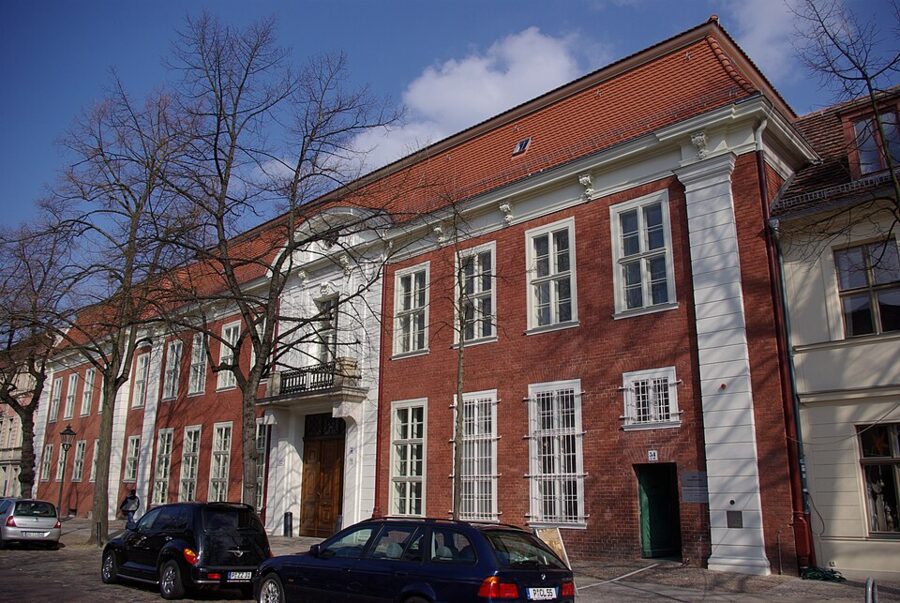
It is now a memorial to political persecution under both dictatorships, open Tuesday to Sunday 10:00–18:00 with last entry at 17:30, per the memorial’s opening hours; it is closed from December 21, 2026 to January 1, 2027. Entry is pay-what-you-can, €0–10, and an audio guide in English costs €4. Give it at least an hour; it is not a place to rush.
Yorckstraße and the canal
Yorckstraße follows the line of the Stadtkanal, which began as a drainage ditch in 1673 and was rebuilt from 1722 by the soldier king on the model of an Amsterdam canal. Frederick the Great gave it sandstone walls, iron railings and nine stone bridges, and for two centuries it ran 1,840 meters round the north and west of the old town. Residents were already complaining of the smell in 1809, and the GDR filled it in between 1962 and 1965.
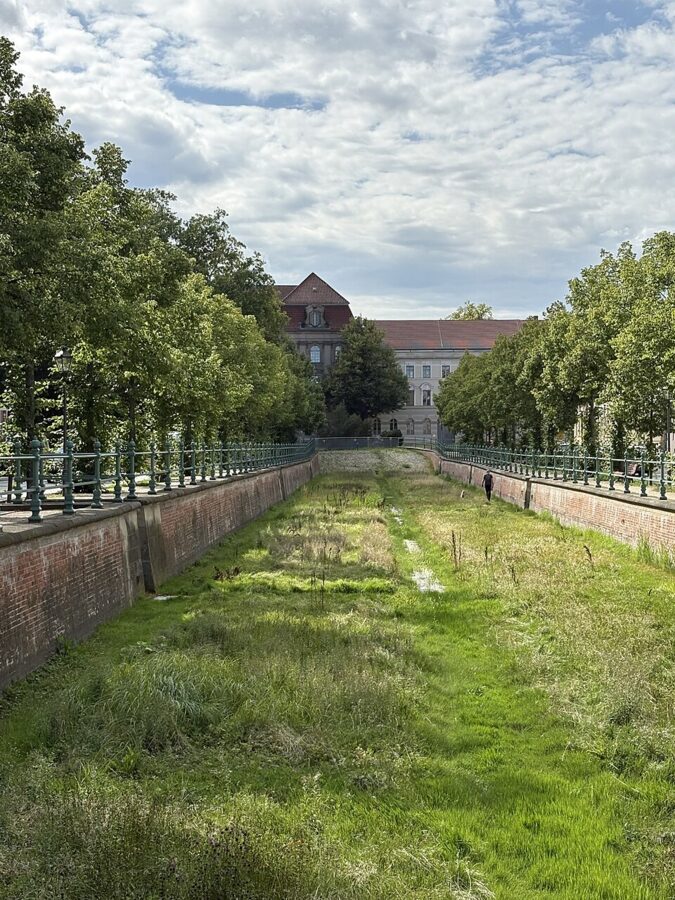
A first stretch on Yorckstraße was dug out again from 1999 and is usually dry, except for the annual canoe sprint, when it is flooded and paddlers race down it. A second section at the Kellertor was reconnected to the Havel in July 2011 and holds water all year. Follow Yorckstraße east to Friedrich-Ebert-Straße and turn north, and the Dutch Quarter is ten minutes up the road.
A walk through the old town, with times
This route covers about 3.5 km and takes half a day with two interiors, a full day if you add the Barberini. It works in either direction, but I’d start at the river so that the Alter Markt comes first, while you’re fresh, and the streets after.
Potsdam Hauptbahnhof to the Alter Markt, 15 minutes. Walk north across the Lange Brücke; the Landtag gives the distance to its door as about 700 meters. Stop on the bridge for the view along the Alte Fahrt to the Barberini, and if you have twenty minutes to spare, detour onto the Freundschaftsinsel first.
The Landtag, 20 minutes. Through the Fortuna Portal into the courtyard, then on a weekday up to the roof terrace. Come out the way you went in and you are facing the obelisk.
The Nikolaikirche, 45 minutes. The church and the climb to the gallery. Before noon on a weekday is best; on Sundays the tower opens only at 12:00.
The Old Town Hall, 45–60 minutes. The free history exhibition in the Potsdam Museum, plus a paid exhibition if one is on. Then walk down to the river behind the Barberini and along the bank for the view back to the square.
The Neuer Markt, 20 minutes. West along Schlossstraße past the new blocks, two minutes on foot. Walk round the square, look at the coachman on the Kutschstall gate and the balcony of the Kabinetthaus, and go into the Brandenburg Museum if you have the time (it is closed on Mondays).
Breite Straße to the Plantage, 20 minutes. South out of the square to Breite Straße and west past the Marstall, the Hiller-Brandt houses and the Garrison Church tower to the Rechenzentrum mosaic, then behind the tower to the Langer Stall portal.
Lindenstraße, 15 minutes or 75 with the memorial. North past the Military Orphanage and its Caritas to Lindenstraße 54/55. The memorial is closed on Mondays.
Yorckstraße and on, 15 minutes. East along the canal to Friedrich-Ebert-Straße, then north. In about five minutes you cross Brandenburger Straße, the pedestrian street that runs west to the Brandenburg Gate and on toward Sanssouci, and a few minutes more bring you to the Dutch Quarter. For everything else to do in town, see things to do in Potsdam.
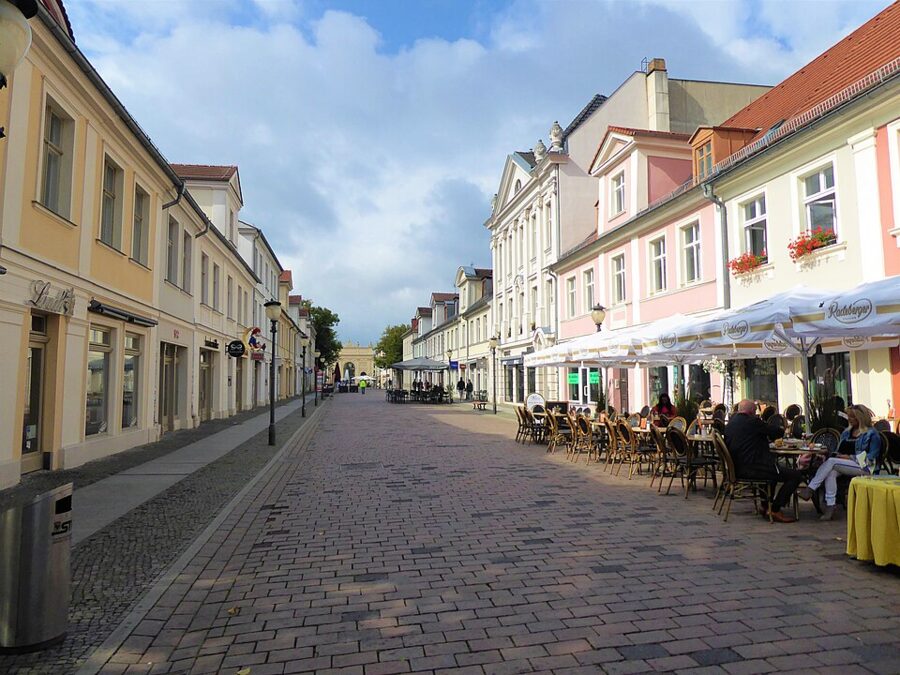
On a Monday the Potsdam Museum, the Brandenburg Museum and the Lindenstraße memorial are all closed, but the Landtag courtyard and terrace, the Nikolaikirche and its dome, and every street and square on this route are open, so the walk still works with the interiors cut down to two.
Getting there, eating and sleeping
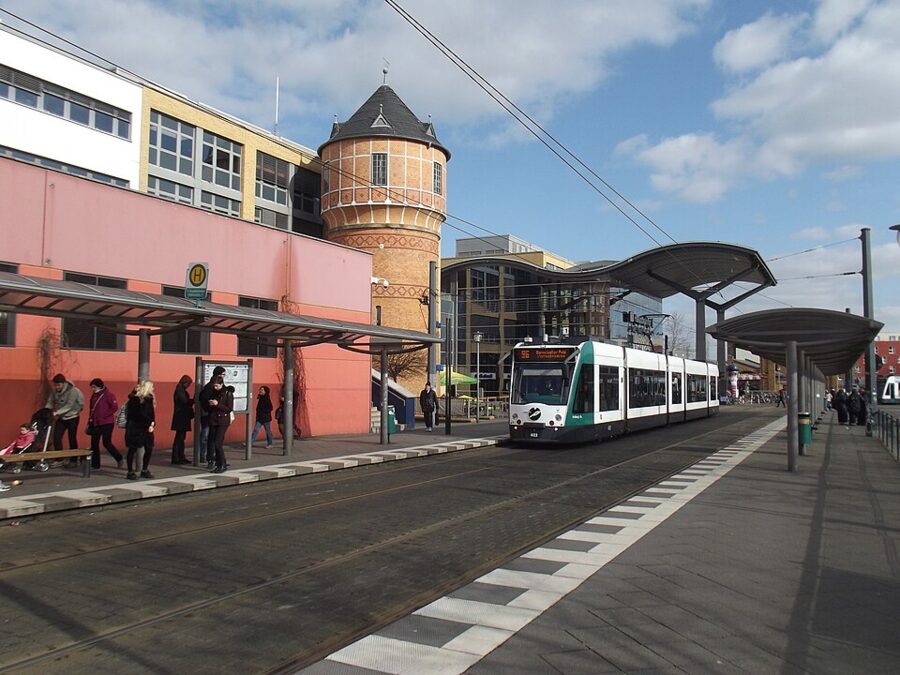
From Berlin, take the S7 or the RE1 to Potsdam Hauptbahnhof. Potsdam is in fare zone C, so you need a Berlin ABC ticket: €5.00 for a single and €12.90 for 24 hours in 2026, rising to €5.20 and €13.20 on January 1, 2027, and the Deutschlandticket covers the trip. Trams 91, 92, 93, 96 and 99 stop at Alter Markt/Landtag if you’d rather ride than walk across the bridge. The train options, the tickets and the return are set out in the Potsdam day trip from Berlin.
For a cheap lunch inside the sights, the Landtag canteen serves a daily menu to anyone on weekdays, and the Potsdam Museum has a café, the Café Central, with coffee, cake and small dishes. Up on Breite Straße, the café in the Rechenzentrum, LAIKA, opens Wednesday to Friday, 13:00–17:00, with coffee, cake and art on the walls, as listed on the Rechenzentrum’s site. For proper restaurants around Brandenburger Straße, the Alter Markt and the Dutch Quarter, see Potsdam restaurants.
The old town is also the best place to stay if you want the palaces of Sanssouci before the coaches arrive: you are a tram ride from the park and a short walk from the station. The hotels by the Military Orphanage, in the Dutch Quarter and near the Brandenburg Gate are compared in where to stay in Potsdam.
Winter changes less here than in the parks, since none of the old-town sights depends on fountains or garden seasons. In Advent the Christmas market fills Brandenburger Straße, a few minutes north of the squares; the days are short, so climb the dome early, and expect it to be shut if there is ice or wind. The gallery is open to the weather, and at 0 °C (32 °F) with a wind off the Havel it feels a good deal colder than the square below.
Come back to the Alter Markt at the end of the day, when the light goes gold on the Landtag’s pink walls and the Fortuna on the portal has swung round to face whichever way the wind is blowing. The four architects on the obelisk are still looking out over the square: Knobelsdorff’s palace front, Gontard’s Barberini, Schinkel’s church with the dome Persius began, and a few steps away the house where Persius was born, coming back from the ground. The station is ten minutes away across the Lange Brücke.