

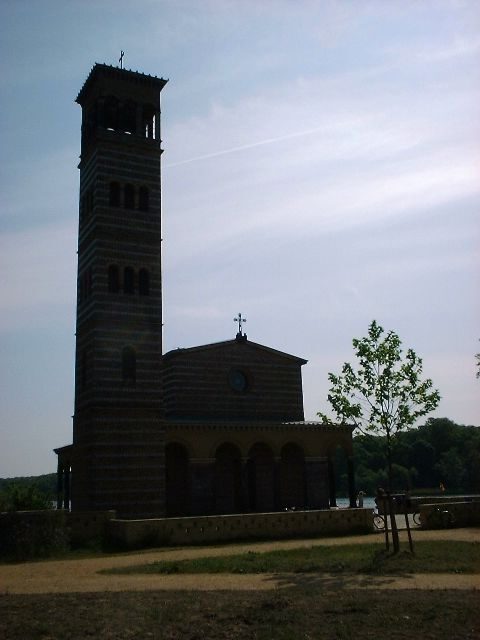
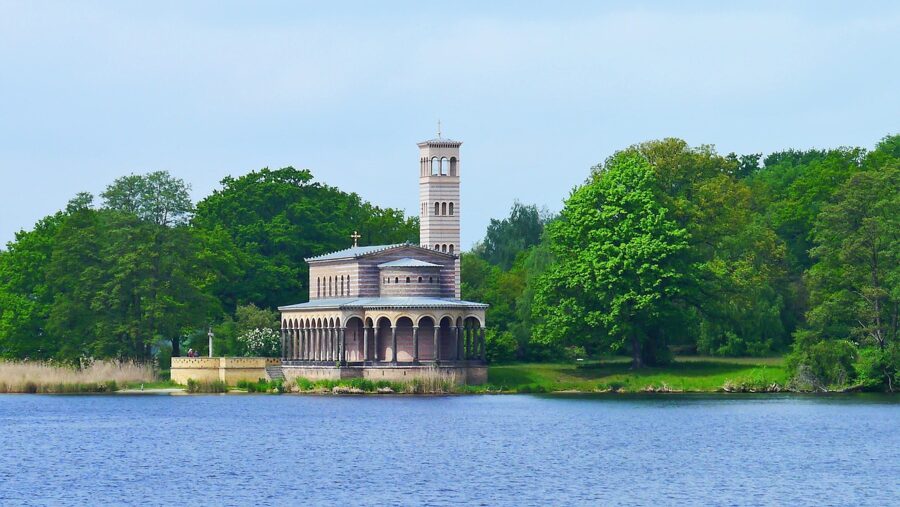
For 28 years the bell tower of the Church of the Redeemer (Heilandskirche) was a piece of the Berlin Wall. When East Germany sealed the shore at Sacrow in 1961, its builders ran the concrete slabs straight up to the campanile and used the tower itself as a section of the barrier, so that the nave, out on its terrace in the Havel, ended up between the Wall and the border line in midstream. From the West Berlin bank, 200 m away, people watched the roof rot.
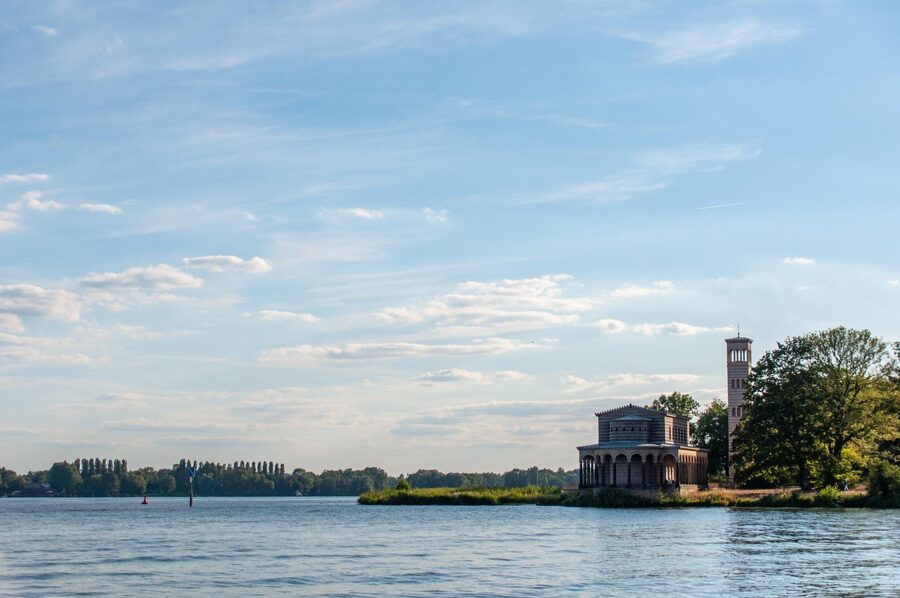
Stand today at the north end of the Glienicke Bridge (Glienicker Brücke) and the church is the thing your eye goes to: a small Italian basilica with a freestanding tower, sitting on the water at the far side of the Jungfernsee. It is 1.2 km away as the gull flies. By road it is more than 10 km, because there is no bridge on this side, and that gap between the view and the journey is the whole story of Sacrow.
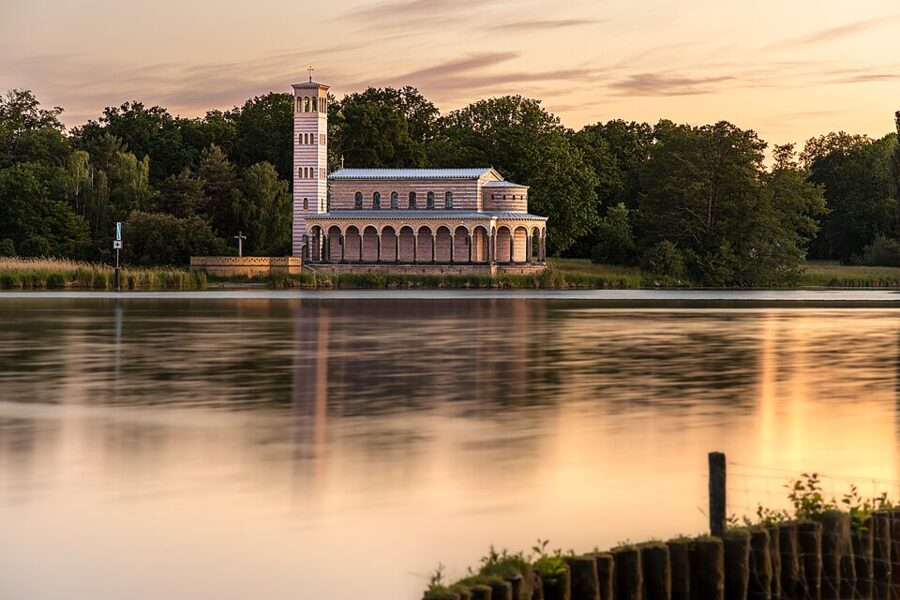

Sacrow itself is the smallest district of Potsdam, a village of 127 people (at the end of 2025) on a strip of wooded land between the Havel and the Sacrower See. It has a little palace that is open only for exhibitions, a park by Peter Joseph Lenné, the church, a deep lake in a nature reserve, and almost nothing to buy. I’d come for half a day, by water if the season allows, and leave the car behind.

Contents9 parts
A village behind the bushes
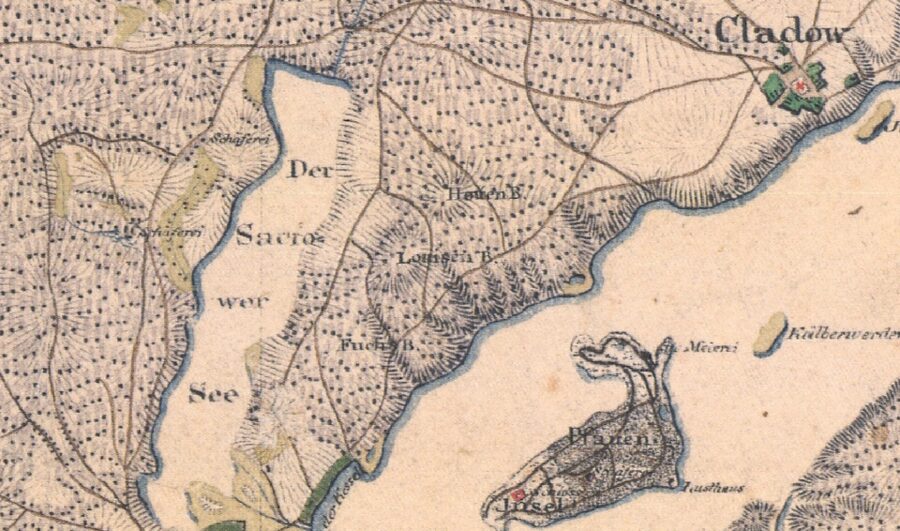
The name is older than anything you can see. Sacrow comes from the Slavic za krowje, “behind the bushes”, and the village first appears in writing in the land register of Emperor Charles IV in 1375, a small farming place that by the sixteenth century also kept a ferry over the Havel. Through the fifteenth and sixteenth centuries it passed between Spandau burgher families, the Helmbrechts and then the von Wartenbergs, who slowly bought out the farmers until almost every field belonged to the manor.
After the Thirty Years’ War the estate became a piece of property that changed hands every generation. It went back to the crown when the last Wartenberg died childless, was granted to a court official, sold to the Potsdam orphanage, sold on again, and fought over in court by a widow who spent two decades suing the Potsdam fishermen over the lake before she had to sell up in 1757.
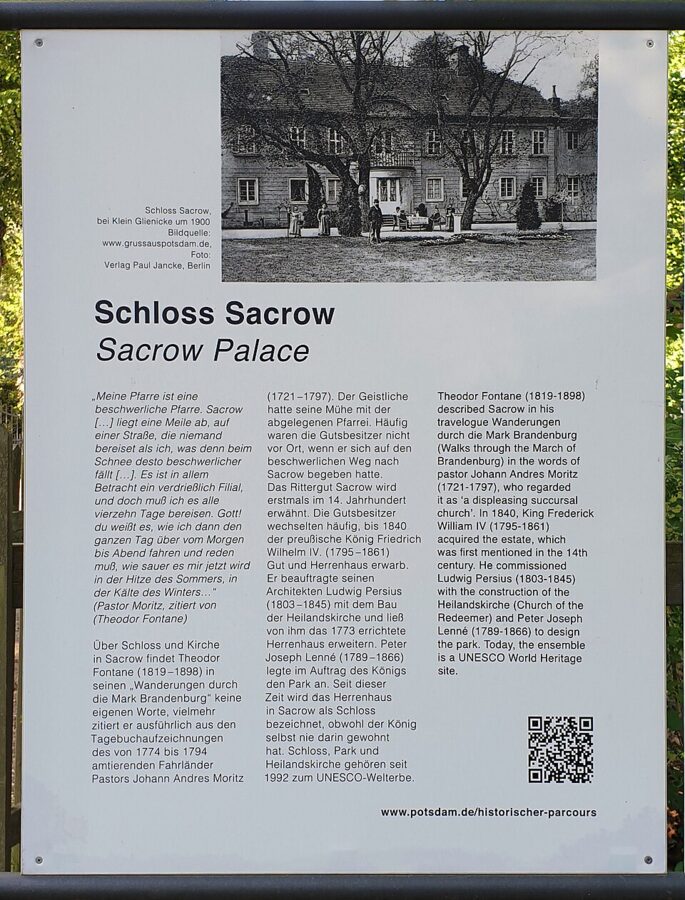
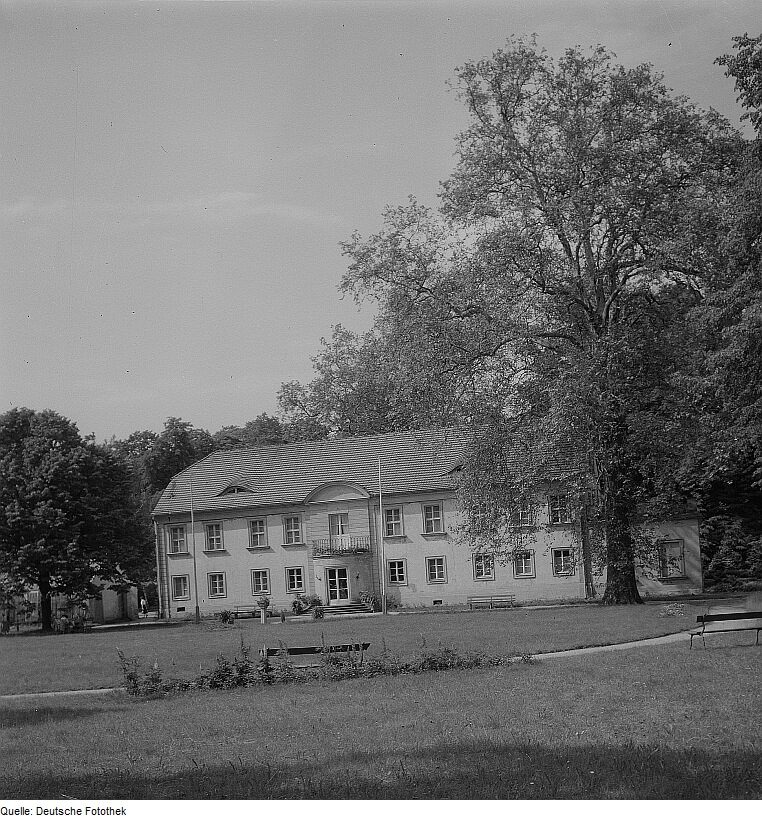
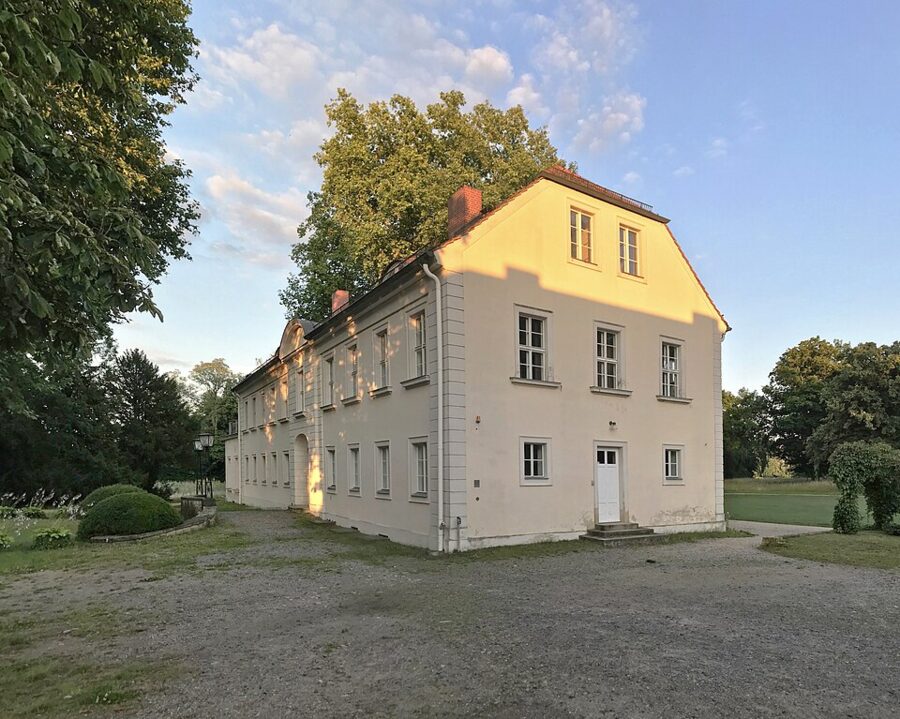
The house that stands today was built by a Swede. Count Johann Ludwig von Hordt, a Swedish-born lieutenant general who later governed the citadel at Spandau, bought Sacrow in 1764 and in 1773 put up a plain two-story baroque manor, strictly symmetrical with four window bays on each side of the center and a big greenhouse against its south gable. He also built a summerhouse with a balcony on the Havel and planted a chestnut avenue up to the house. Hordt is buried at Sacrow, though he died far away in Lower Lusatia in 1798.
The village had no pastor of its own. Sacrow was a branch of the parish of Fahrland, a league away, and the pastor there from 1774 to 1794, Johann Andres Moritz, kept a diary of the village and its changing masters that Theodor Fontane later copied almost word for word into his Wanderungen durch die Mark Brandenburg (Rambles through the March of Brandenburg).
Moritz did not love the place. “My parish is a troublesome parish,” he wrote in 1790, and he had to make the trip every fortnight. His church was a half-timbered building of 1694 on the village street; it was unusable by 1813 and pulled down in 1822, and for the next twenty years the congregation met in a room in a house near the manor.

In 1779 the estate went to Heinrich Carl de la Motte Fouqué, son of one of the generals of Frederick the Great (Friedrich II), and his boy Friedrich spent several childhood years here. That boy grew up to write Undine (1811), the tale of a water spirit who marries a knight, and the local tradition is that the Sacrower See gave him the idea. Nobody can prove it, but stand on the lake shore at dusk and you can see why the story sticks.

Then came the businessmen. A Berlin merchant who had made his money trading with Russia bought Sacrow in 1811, and in 1816 the banker Magnus took it as a summer place for his family.
The Magnus family ran a works on the estate making lead sugar and lead white, and their distant relatives in the Mendelssohn family came to stay, and Felix Mendelssohn Bartholdy probably wrote parts of his String Quartet in A minor, Op. 13, at Sacrow. The lead works ran for about twenty years and poisoned the ground under the farmyard so thoroughly that the palace and part of the park had to be closed for two years and the soil dug out in 2012.
Frederick William III (Friedrich Wilhelm III) tried to buy the estate in 1828. The brothers asked at least 100,000 thalers and the king walked away. His son was more patient, and more determined.
The king’s harbor
Frederick William IV (Friedrich Wilhelm IV) came to the throne in June 1840 and bought Sacrow that October, from the five Magnus brothers, for 60,000 thalers. He had wanted it for years. As crown prince in the 1830s he had already drawn a church here, with a cloister, a parsonage and a school, and the Prussian Palaces and Gardens Foundation (SPSG), which runs the park today, puts the reason simply: Sacrow closed the ring of royal gardens around the Jungfernsee.
The ring had a plan behind it. In 1833 Lenné had drawn up his “Beautification Plan for the Surroundings of Potsdam”, a scheme to turn the lakes and their shores into one connected landscape of sightlines, and the far bank opposite Glienicke and the Neuer Garten was the missing piece. In 1842 Lenné and the king followed it with a plan for Sacrow alone, and its central idea was the new church as a point to look at from across the water.
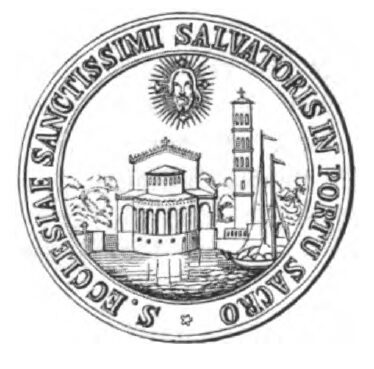
The king chose the site himself, a small bay where the Havel fishermen sheltered their boats in storms. He moved the ferry landing 300 m to the northeast to clear it, and he named the church after the bay: Ecclesia sanctissimi Salvatoris in portu sacro, the Church of the Most Holy Savior in the Holy Harbor. Sacrow, which had meant “behind the bushes” for nearly five hundred years, became “sacro”, holy, in a single Latin ablative. The German name, Heilandskirche am Port von Sacrow, is a loose translation of that seal.
Ludwig Persius, the court architect and Karl Friedrich Schinkel’s pupil, turned the sketches into drawings, and the king approved them, after some changes, on May 7, 1841. Persius’s own building diary shows how closely the king watched: he came to site meetings, visited the works often and fixed many details of the facades and the furnishings himself. Ferdinand von Arnim and Johann Heinrich Haeberlin ran the site day to day.
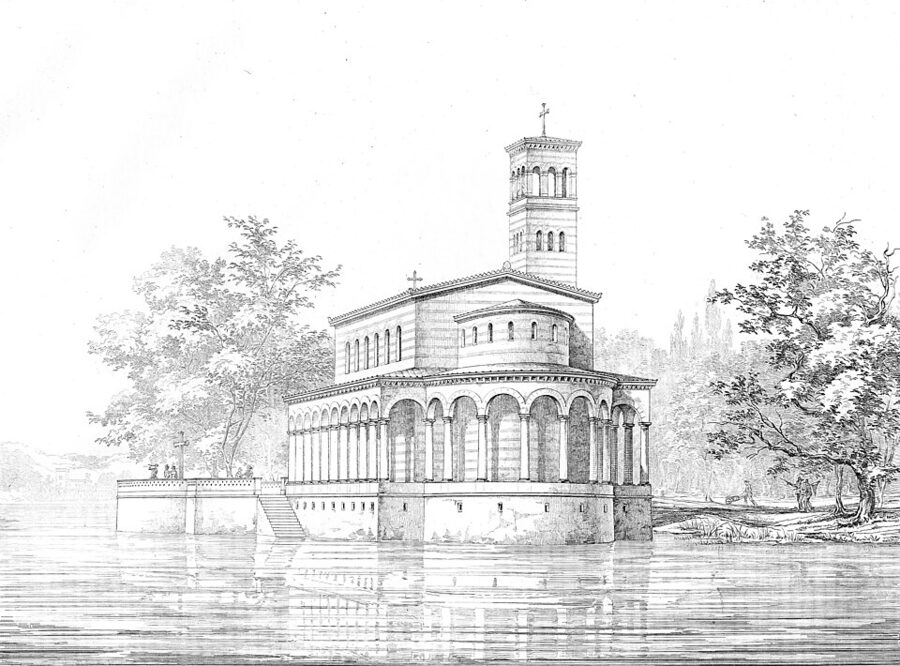
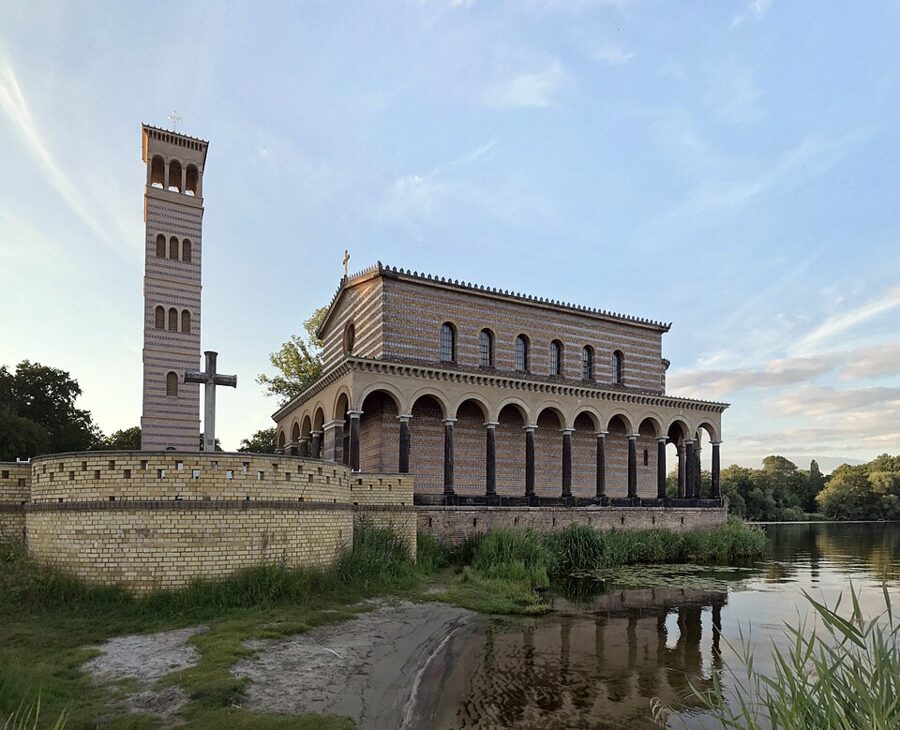
Building in the reeds was the expensive part. The nave stands on a grid of oak piles driven into the lake bed, and that foundation swallowed a third of the total cost of 45,234 thalers and 27 silver groschen. Persius wanted to call the building “The Ship”. The name did not stick, but the idea did: seen from the water, the arcaded nave on its half-round terrace looks like a vessel tied up at a pier, and the tower beside it like a mooring post or a funnel.
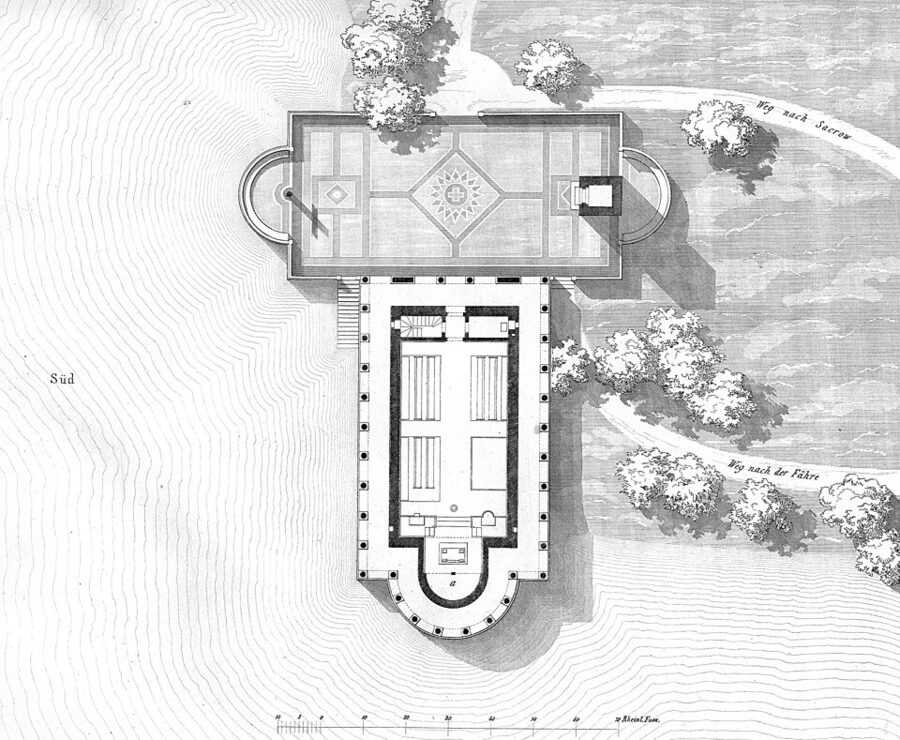
The church was consecrated on July 21, 1844, in the presence of the king, Queen Elisabeth and a large suite, and the court preacher Adolf Sydow led the service. The same day Albrecht Wilhelm Heym took office as royal chaplain and village pastor, with an apartment in the manor house. That is when the manor began to be called a palace, though the king never lived there.
A church built like a ship
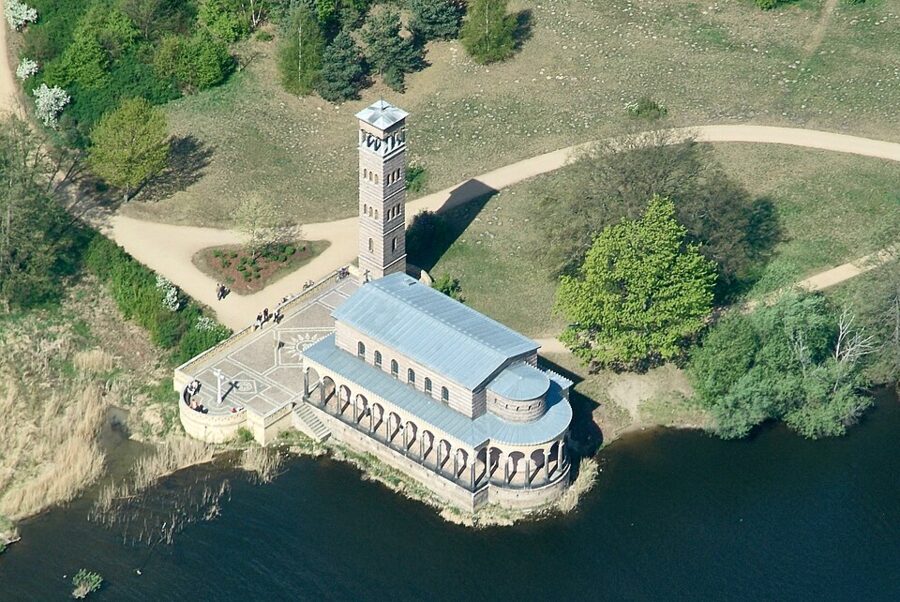
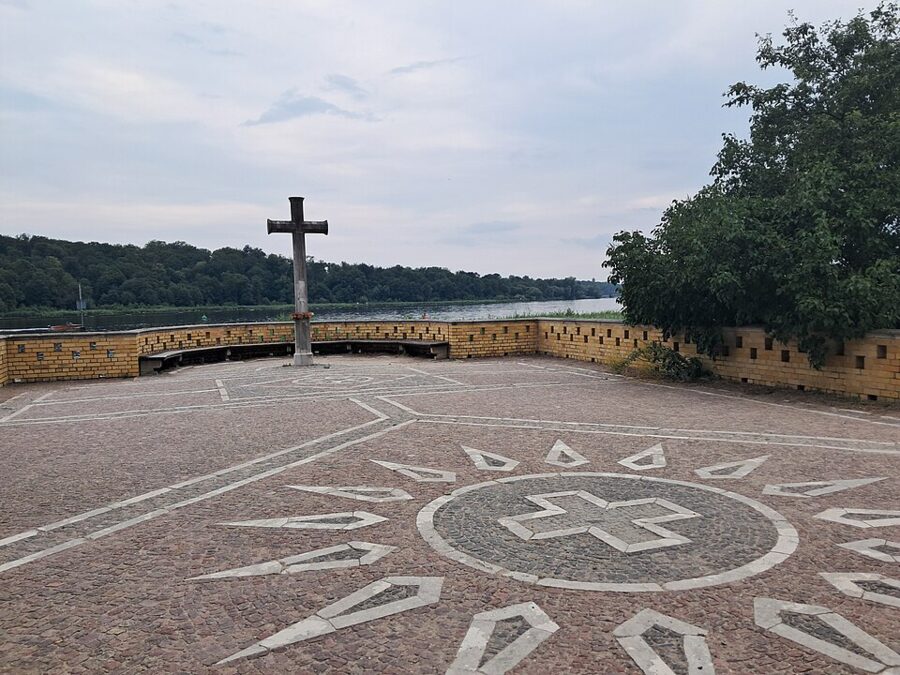
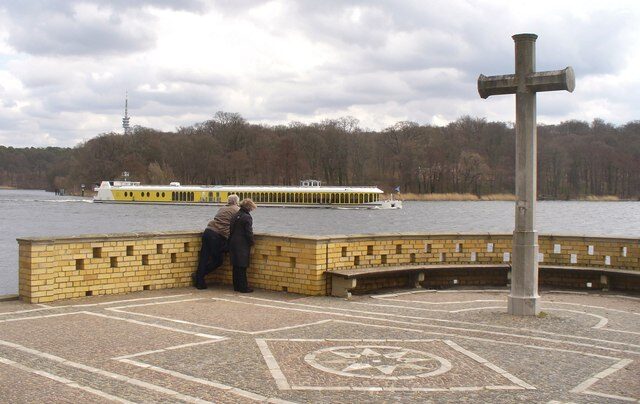
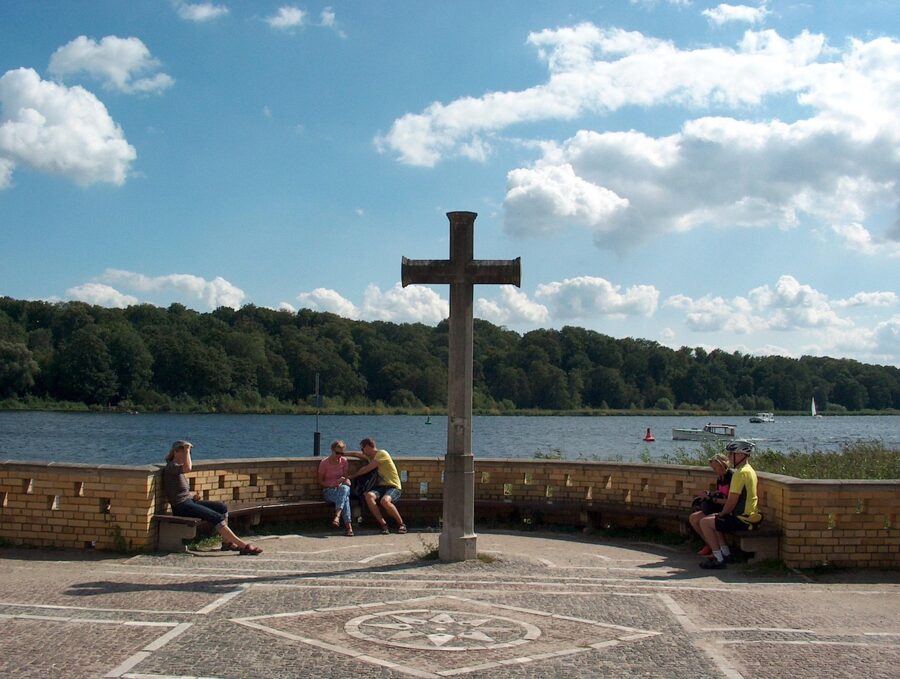
Walk down through the park and the church arrives side-on, behind a parapet. The forecourt, with its semicircular stone bench and a marble cross, was designed as an open-air gathering place, and a flight of steps runs from it down into the Havel, where the parish still holds the occasional full-immersion baptism. Go round the arcade first, and look at the building before you go in.


The model was early Christian. Frederick William IV had seen the old basilicas of Rome on his Italian journeys of 1828 and 1835, he owned the engraved survey of them published by the architects Gutensohn and Knapp, and he exchanged ideas on Protestant worship with the diplomat and lay theologian Christian Carl Josias von Bunsen. He wanted a new ideal church for Prussian Protestants built on the forms of the first Christians, with a flat timber roof instead of Gothic vaults.
Sacrow was his first try. The Church of Peace (Friedenskirche) in Sanssouci park, begun in 1845, is the grander version of the same idea.
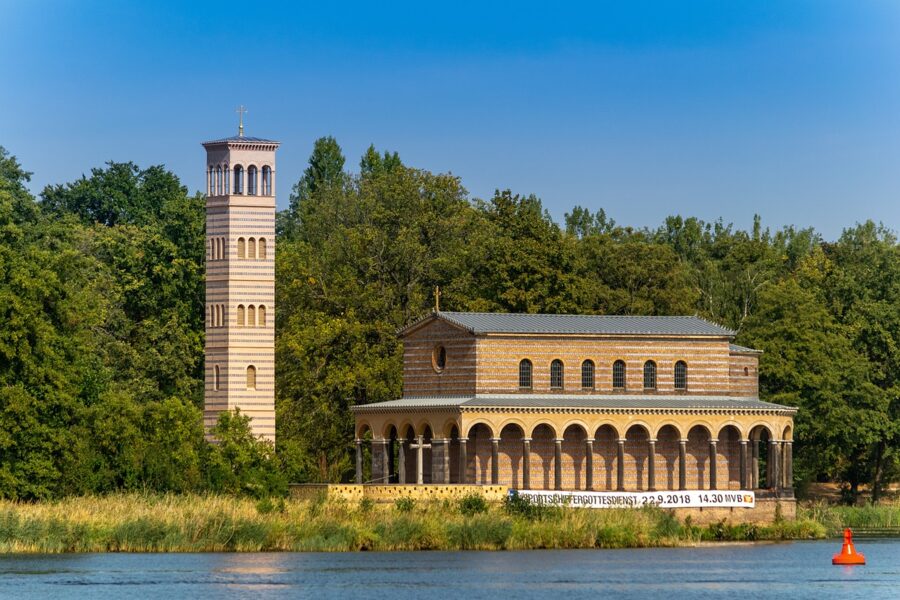
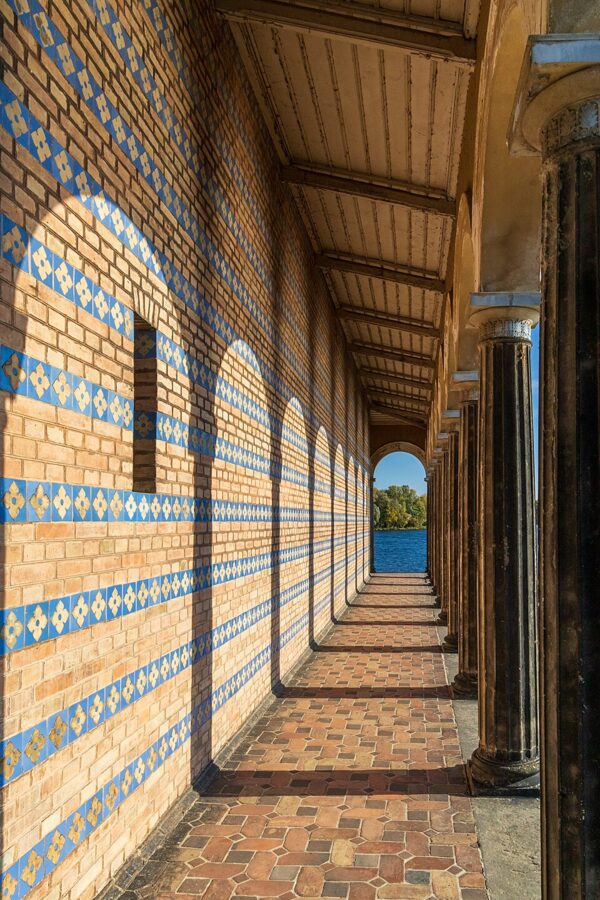
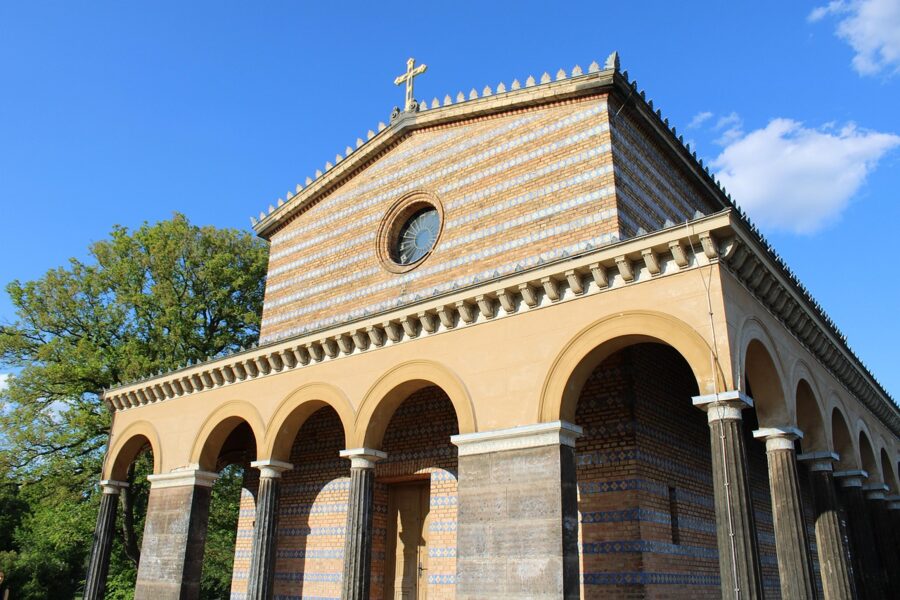
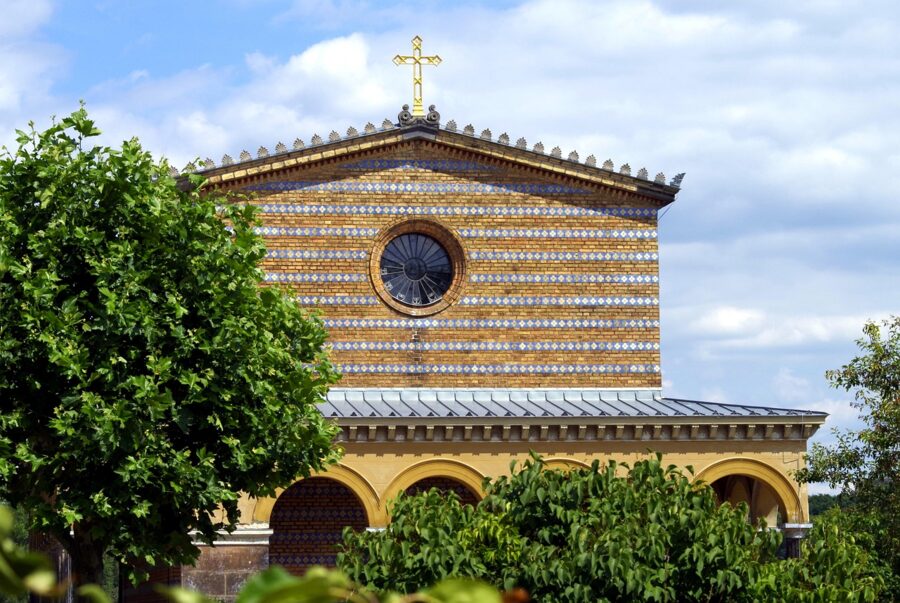
What Persius built is a “false basilica”. The side aisles are gone and the columns moved outside, so a single tall hall, 18 m long, 8 m wide and 9 m high, rises out of a low colonnade. The colonnade was the king’s own addition to Persius’s design. Its fluted sandstone columns have no capitals; each carries instead a ring of palm leaves in cast zinc.

Stripes, tiles and painted zinc
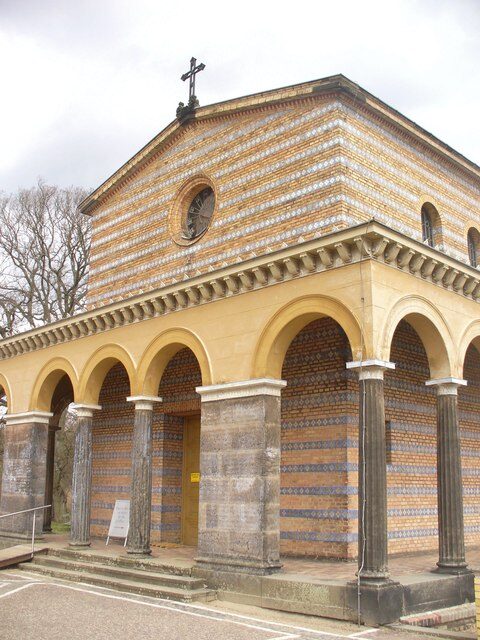
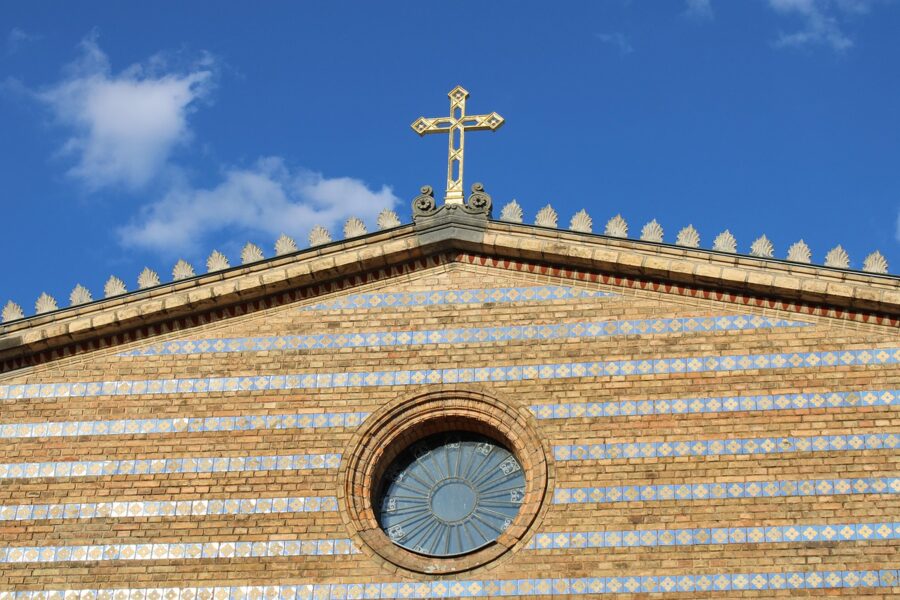
The colors are the surprise. The walls are faced with yellow-pink brick laid in fine horizontal bands with shiny blue glazed tiles, each one stamped with a yellow rosette. Schinkel had brought this kind of facade to Berlin from northern Italy after 1829, and Persius carried it on here. Brick and tiles came from the Royal Prussian brickworks at Joachimsthal on the Werbellinsee, and the king wanted to see them first: “samples of the colored stripes the masonry is to receive are to be submitted”, he ordered on October 21, 1841.
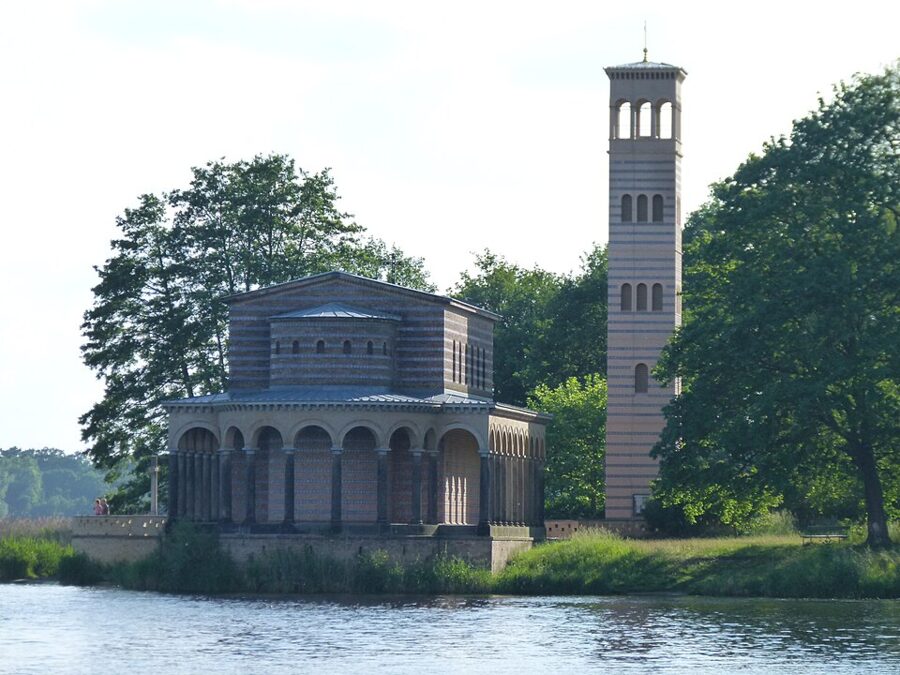
When the tower was restored in 2011–2014, conservators found that the brick bands had been coated with silicate paint when the church was new. As far as anyone knows it is the oldest coat of its kind in the Mark Brandenburg, and it was put back on the tower as found. The palmettes along the roof edge are cast zinc too, made in series by the Berlin foundry of Moritz Geiss; the first ones were terracotta and were swapped for zinc after rain got into the roof as early as 1850.
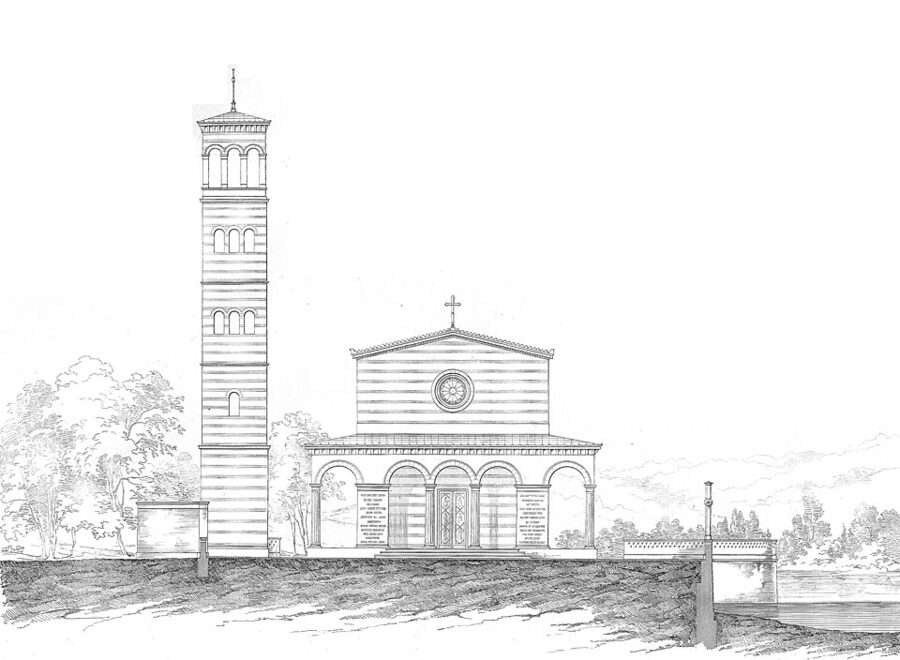
On the west front two broad sandstone piers break the row of columns. They carry carved Bible texts, like votive tablets: on the left the opening of the Gospel of John, “In the beginning was the Word”, on the right Paul’s chapter on love from 1 Corinthians 13. The king picked both passages on New Year’s Eve 1842 with his court preacher Friedrich Strauß.

The campanile
The tower stands apart on the forecourt, 23.80 m high in five stories, with round-arched openings that grow wider as they rise and finish in an open belvedere under a flat pyramid roof with a ball and cross. It carries one bell, which may be more than 600 years old. The traditional casting date is 1406, impossible to prove, and it is first recorded in 1661; it almost certainly came from the old fieldstone church in the village. A second bell was taken for the arms industry in 1917, and its successor went the same way in 1944.
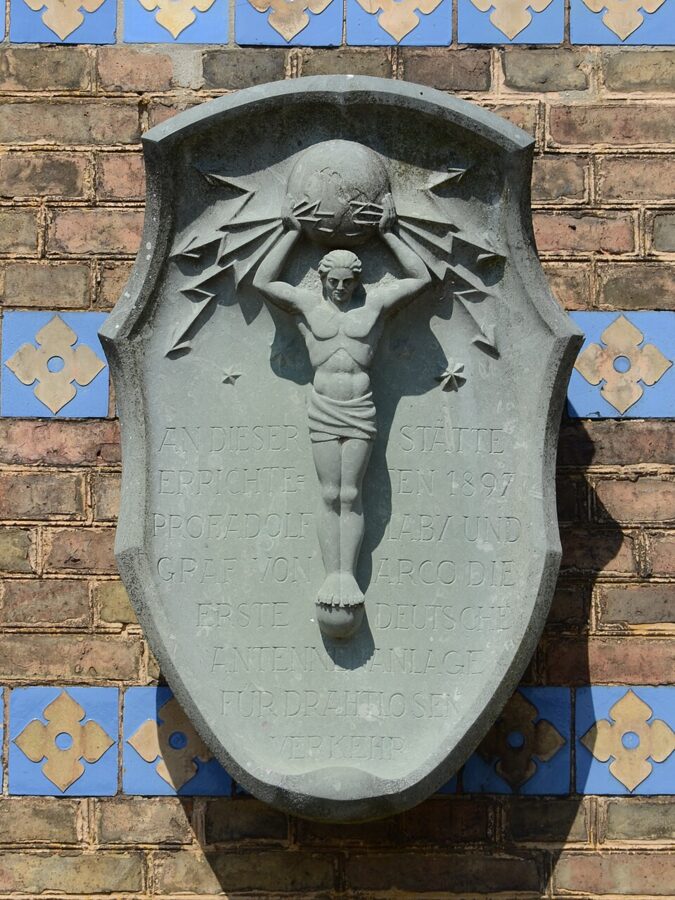
In the summer of 1897 the tower did something its builders never imagined. The physicists Adolf Slaby and Georg Graf von Arco strung an aerial from it to test Marconi’s new wireless telegraphy, and on August 27 they got a signal across the Jungfernsee to the imperial sailors’ station at Kongsnæs on the Potsdam shore, 1.6 km away. It was the first German antenna for wireless communication. A green dolomite plaque by the sculptor Hermann Hosaeus, put up in 1928 over the tower door, shows Atlas carrying the globe in a crackle of lightning bolts.

Inside the Church of the Redeemer
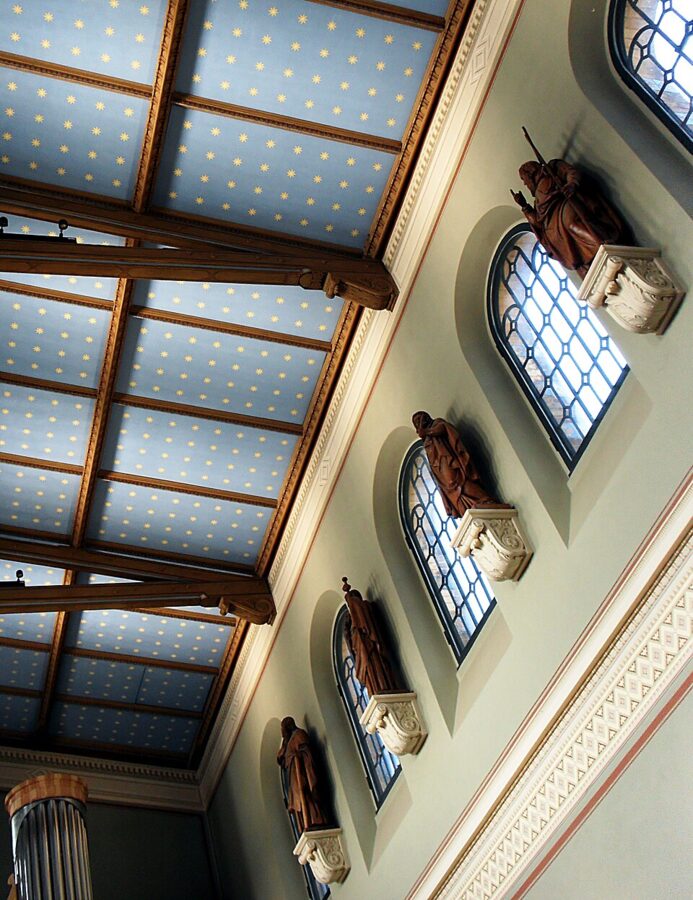
The door is in the west front, under the organ gallery. A tiny sacristy is on your left, the gallery stairs on your right, and then the hall opens: an open timber roof with the spaces between the beams filled with blue cloth painted with stars, twelve tall round-arched windows of clear glass in cast-iron frames, walls in a cool green with a painted band, and a floor of red, green and ochre tiles. The lower walls and the high box pews are painted to imitate oak.
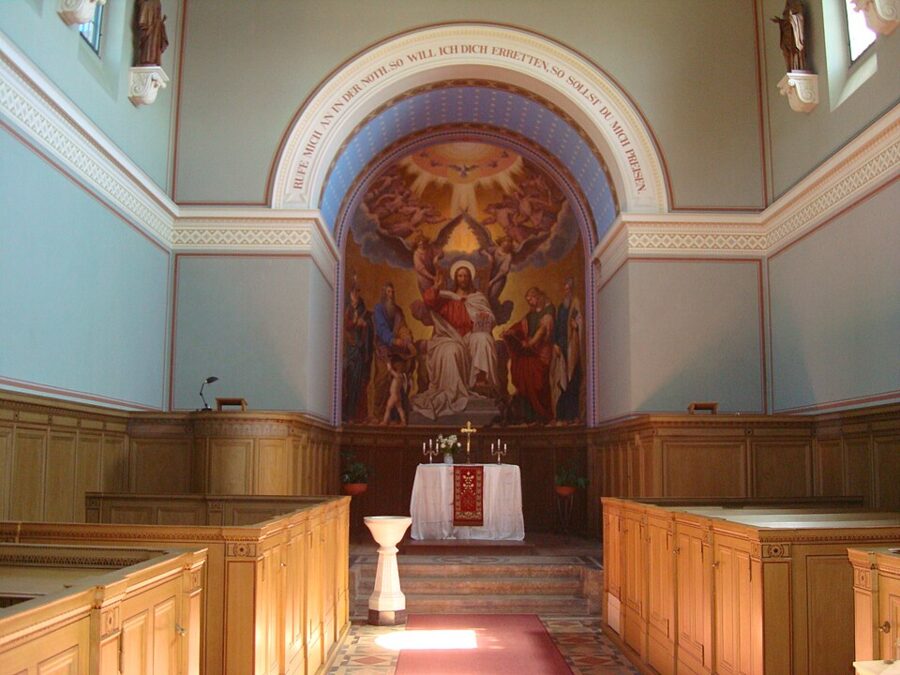

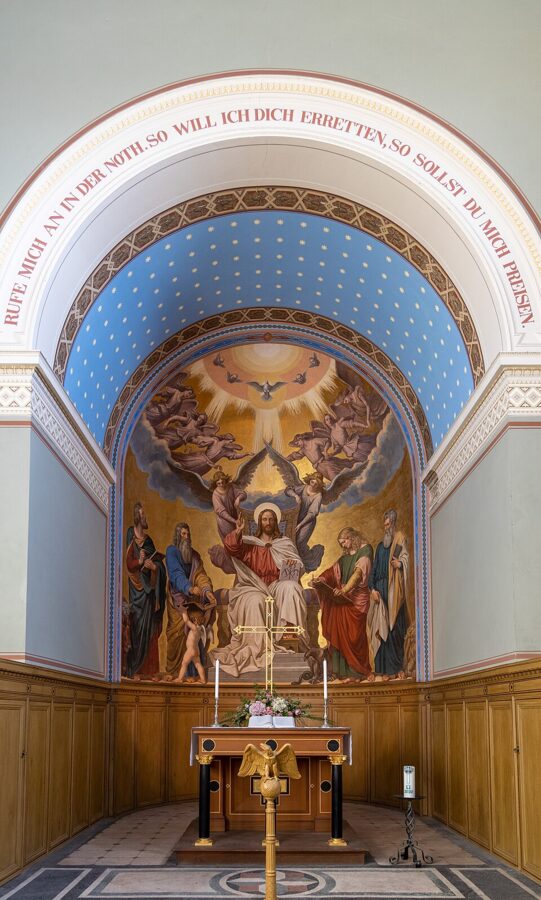

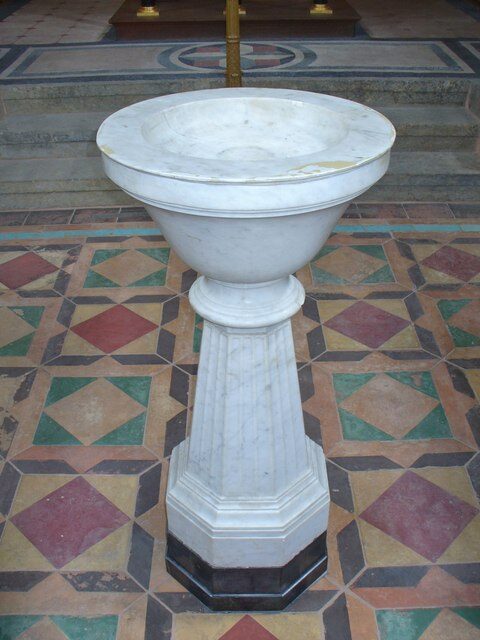
Everything leads the eye down the middle to the apse, and the king arranged the stations along the way as a walk through a Christian life. First comes the white marble font, for entry into the church. Then the eagle lectern, for the preached word; the original is a zinc casting from the Kahle foundry in Potsdam to a design by Persius, now too fragile to use, so it stands among the pews and a lighter aluminum copy does the work. Then the altar of cedar, maple and ebony, then the gilded cross, then the painting promising resurrection.

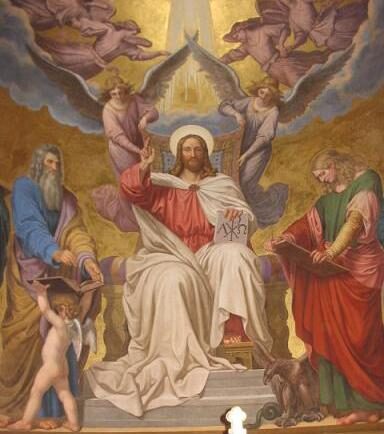

The fresco was designed by Carl Joseph Begas and finished on November 11, 1845, more than a year after the consecration. It fills the whole back wall of the barrel-vaulted chancel on a gold ground, and it was painted in true fresco, wet plaster, the Italian way, which is rare in Berlin and Brandenburg.
Begas did not paint it himself. The work was done to his design and instructions by the painter Eybel, whose first name the sources give as Adolf or Albert. On the arch in front of it runs Psalm 50:15: “Call upon me in the day of trouble; I will deliver thee, and thou shalt glorify me.”
Between the upper windows stand the twelve apostles, limewood statuettes carved in 1840–1844 by Jakob Alberty after the bronze apostles of Peter Vischer’s shrine of Saint Sebald in Nuremberg, by way of models from Christian Daniel Rauch’s workshop for Berlin Cathedral. They went up on January 28, 1844, before the church was even finished. Their later history is the history of the building in miniature: flak damage in 1943, three thrown down from the gallery by looters in 1945, more losses after 1961, and a rescue in 1983 to the parish of Paaren im Glien, where restoration began in 1986.
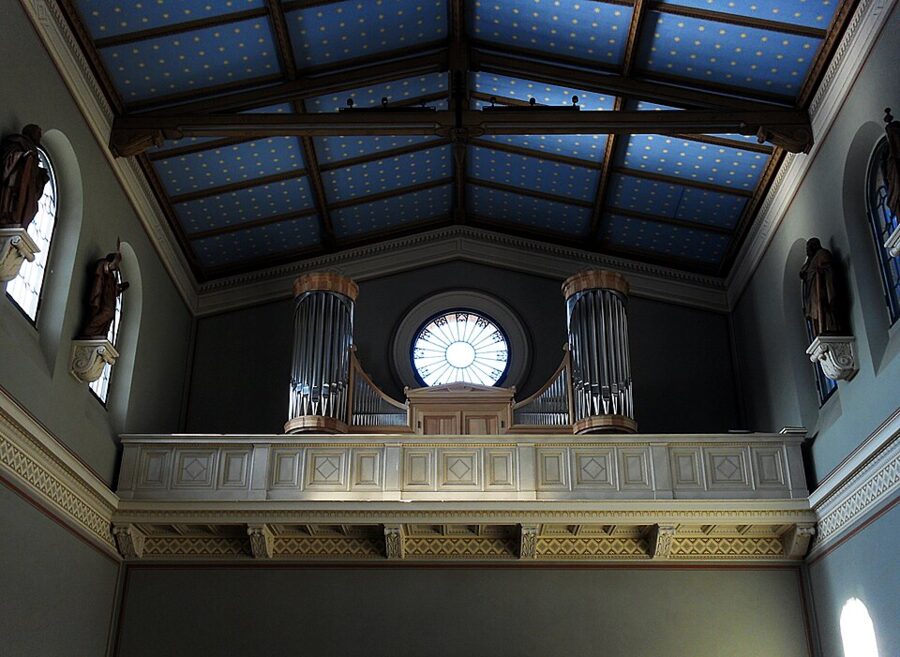
The organ has its own saga. The first, by the Potsdam builder Gottlieb Heise, had one manual and five stops; Alexander Schuke enlarged it in 1907, flak smashed it in 1941, and in December 1961 what was left went down with the rest of the interior. Fragments of its case were later fished out of the Havel. From the 1990s a full-size cardboard model stood in the gallery, and congregational singing went unaccompanied or with an electric piano.
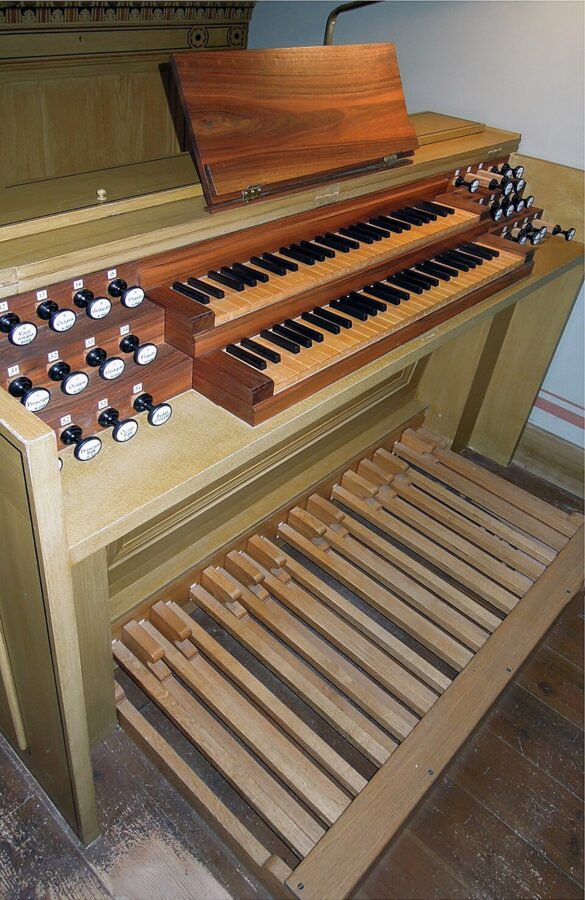
The real organ came in June 2009. Kristian Wegscheider of Dresden built it behind a reconstruction of Heise’s case, and some of its pipes arrived by sailboat.
It has two manuals and 17 stops, and the builder gave it a wink: one keyboard is “Prussian”, with the solid, bass-heavy voices, and the other “Italian”, with bright singing ones, including a Voce umana tuned slightly off to make a natural vibrato. There are no reed stops, because the sun through the rose window behind the organ would put them constantly out of tune. And there is a Rossignol, a nightingale: two tiny pipes dipped in water that bubble and chirp when the organist pulls the knob.

Four royal summers, then a long quiet
For four summers after 1844 the royal family came to Sunday service at Sacrow with their court, by boat, gondola and barge across the Havel from Potsdam. Then, in 1848, the Church of Peace in Sanssouci was consecrated, the king made it his court church, and the chaplain Heym moved into town with him. Sacrow became a branch church, and in 1870 it was bundled into one parish with the village church at Stolpe, the church of Saints Peter and Paul at Nikolskoe and, from 1881, the chapel at Klein-Glienicke.
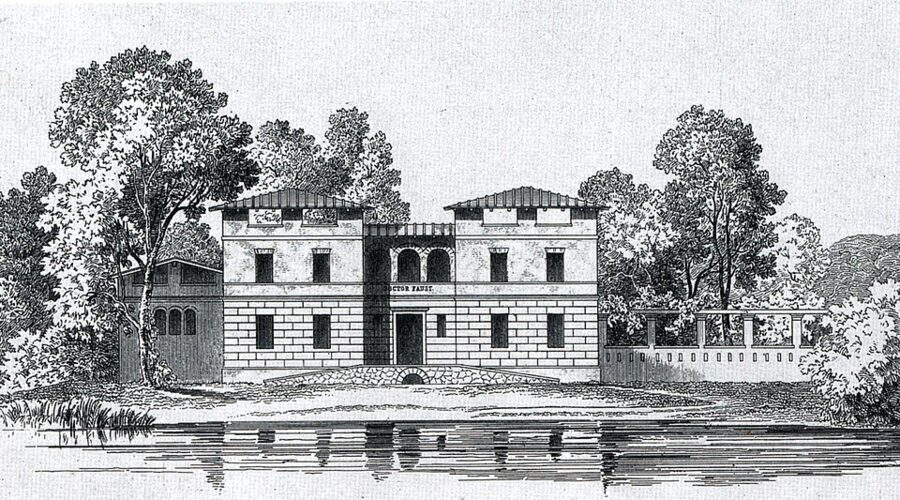
Fame came anyway, from day-trippers. As roads and steamers improved, Berliners began to come out for the church and the view, and by 1913 it was open for visits three days a week, with the organ played on Wednesdays. A steamer landing at the inn Zum Doktor Faust brought people from Wannsee. The parish repaired the tower, roof and embankment in 1927–1933 and renovated the interior for the ninetieth anniversary.
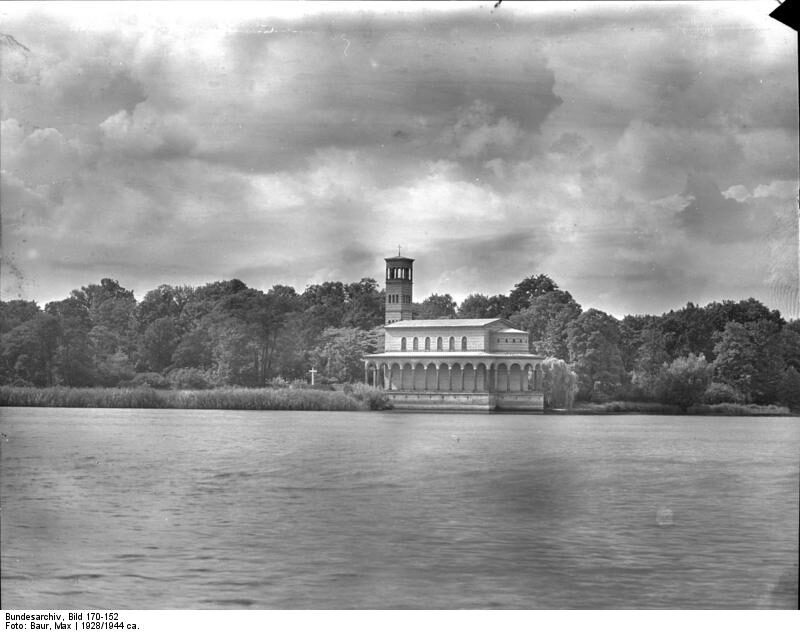

On October 28, 1934, the festival sermon was preached by Reich Bishop Ludwig Müller, the leading figure of the Nazi “German Christians”, and the high point of the day was the blessing of a new “heroes’ memorial and Reich bishop bell”. Five years later Germany invaded Poland.
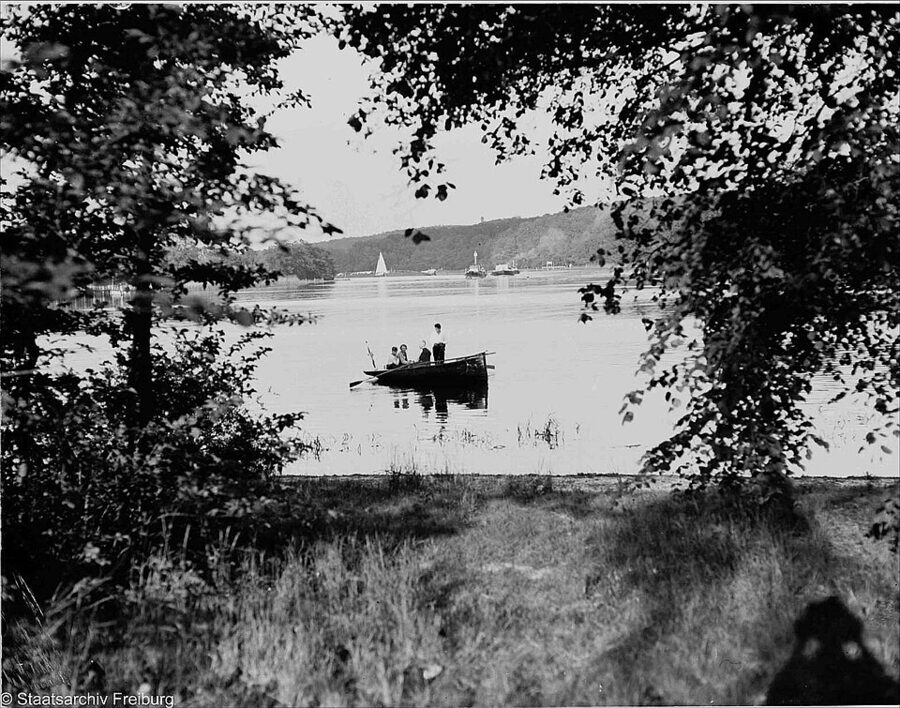

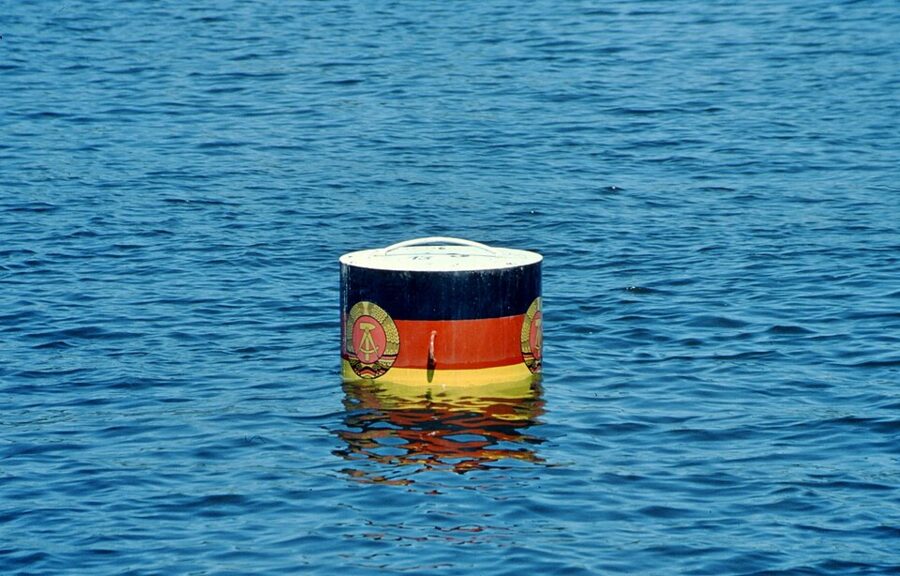
The war left the zinc roof torn and rain coming in, the pulpit and organ damaged. Then, in 1949, two German states were founded and the border between them ran down the middle of the Havel. The church and the Klein-Glienicke parsonage lay in the East, but the shore path to the ferry belonged to West Berlin. In 1952 East Germany set up checkpoints and stopped the cable ferry to Sacrow.
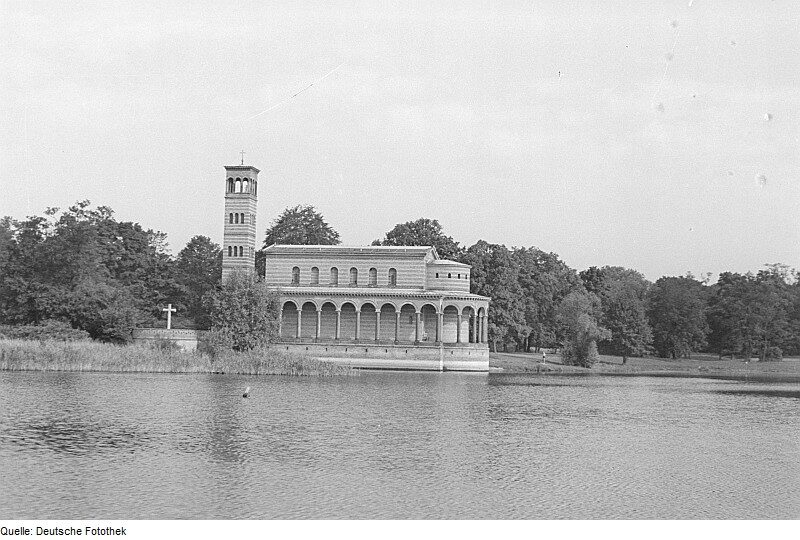

The Wall through the churchyard
On August 13, 1961, the Wall went up, and Sacrow was on the wrong side of it in every sense. The barrier was built along the Sacrow shore, not in the river, and it ran straight across the church grounds, with the campanile used as part of the wall. The nave was left outside, in the strip between the Wall and the border in midstream. The parish still held services until Christmas Eve 1961.
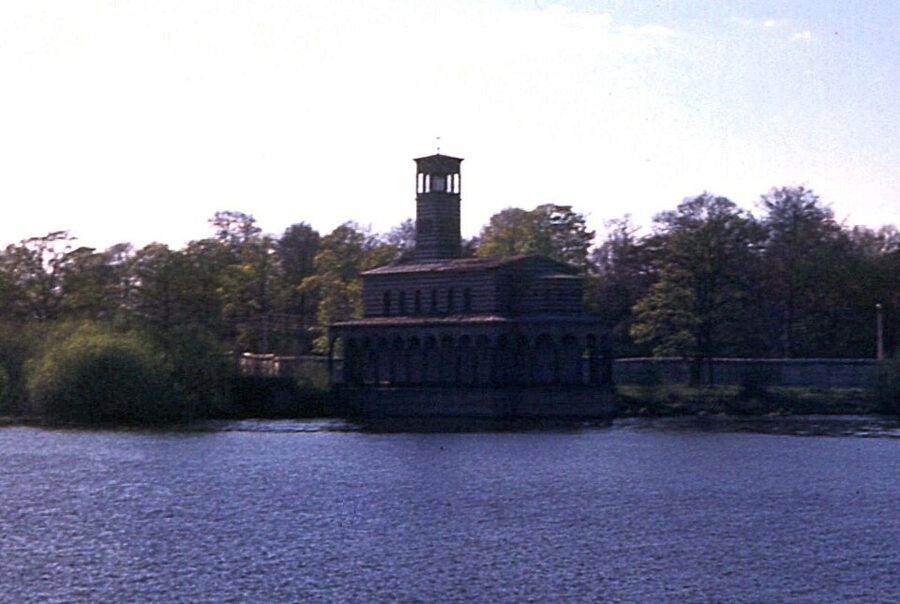

A few days later the interior was wrecked. The fittings were smashed with axes and saws, the cedar altar and the organ among them, almost certainly by the border troops stationed there, and the damage gave the authorities their excuse to seal the church completely so that no one could use it to escape. The congregation moved its services to the chapel in the village cemetery. The church stood empty for 28 years.
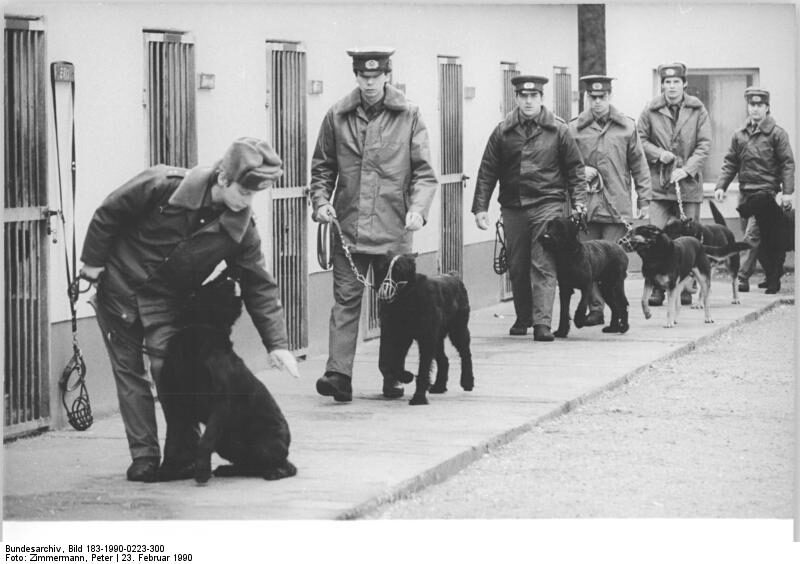
The village became a closed zone. Sacrow could be reached by a single road, watched by the border troops and the Stasi, and you needed a pass or a special stamp to get in. The army moved into the palace; from 1973 the customs service used it to train sniffer dogs, built garages and kennels in the park, tore down the greenhouse and even put up a mock border crossing for practice. About 8 hectares of Lenné’s park were wiped out by the border installations.

Three deaths at Sacrow
The border here killed at least three people. Lothar Lehmann was a 19-year-old conscript posted to the Havel bank at Sacrow, near the Fährstraße, in the first autumn of the Wall. On the evening of November 26, 1961, he put on a life jacket and slipped into the water to swim to West Berlin. The cold water sent him into shock; other guards pulled him out, and he died on the way to the hospital.

Lothar Hennig grew up in Sacrow. On the evening of November 4, 1975, the bus dropped him at the corner of his street. The driver, his cousin, warned him that an escape alert was on, and he ran the 400 m home along the Weinmeisterweg. A border guard saw a running figure, fired from a kneeling position, and hit him in the back.
He died in the early hours of the next morning, aged 21, in the army hospital at Drewitz. Hennig had been an informer for the Stasi since that April, which is why a memorial stele planned for him in Sacrow was put on hold. In 1996 the guard who shot him was given a suspended sentence of 14 months.
Rainer Liebeke was a taxi driver and motorcycle racer from Gotha. In the night of September 2–3, 1986, he and a friend crept through the swamp and reeds to the Sacrower See, under sweeping searchlights, to swim to the border on the far shore.
Liebeke had a broken collarbone from a racing crash and could not make it; his friend waited, then climbed the fence alone and reached West Berlin. Schoolchildren found Liebeke’s body in the lake a week later. He was 34.

A rescue from the West
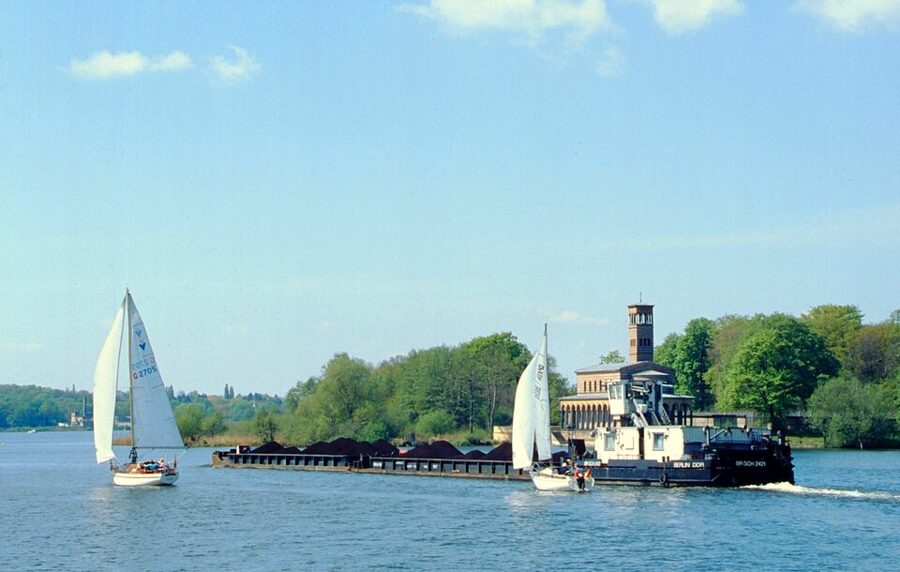
From the late 1970s anyone on a boat or on the West Berlin bank could see the church falling apart: the zinc roof broken up, plants growing on the edges of the nave. The retired pastor Joachim Strauss fought off plans to demolish it, and in West Berlin the Governing Mayor, Richard von Weizsäcker, and the publisher of the daily Der Tagesspiegel took up the cause. After long negotiations with the East German authorities, the Land Berlin and the Tagesspiegel foundation paid one million West German marks, half each.
The work was done in 1984–1985 by the state building firm in Potsdam: a new roof, treatment for dry rot, repairs to the facades of church and tower, and a rebuilt embankment wall. The interior stayed wrecked, and wooden fittings still visible in photographs from 1981 were lost. The church was a ship again from the outside, only nobody was allowed aboard.

Four years after the scaffolding came down, the Wall fell. On Christmas Eve 1989 a vesper service was held in the ruined church, the first in almost three decades. In 1990 the parish decided to restore it, and over the next years state money, church funds and a great many private donations paid the 2.9 million marks it cost.
Using old drawings, black-and-white photographs and fragments found on site, the restorers had rebuilt the star ceiling, the apse painting, pulpit, lectern and pews by 1997. The Wegscheider organ followed in 2009, and in 2011–2014 a federal investment program for German World Heritage sites, with money from the city of Potsdam, paid for the tower, the roof and the missing furnishings. In 1992 the church, the park and the palace had been added to the UNESCO World Heritage site of the Palaces and Parks of Potsdam and Berlin.
What remains of the border here is mostly absence: no wall, no towers, no kennels, only a park that is suspiciously young in places and a church whose fittings are nearly all copies. To see the hardware, go north to Groß Glienicke (below), where a stretch of the Wall still stands.
Schloss Sacrow and Lenné’s park
The palace is the manor house of 1773 with additions. Between 1843 and 1844 Persius added a two-story wing on the north gable with an Italianate entrance, and a large granary behind the greenhouse. Its later owners are a short history of twentieth-century Germany: the Prussian finance minister Albert Südekum lived here after the 1918 revolution, and in 1938 it was converted into the home and office of the Reich’s chief forester, Friedrich Alpers. That conversion stripped out the baroque interior, moved the state rooms downstairs and added the adjutant’s house and a banqueting hall with tall windows under a roof terrace.

The village has its own dark page from those years. Hans von Dohnanyi, the lawyer at the center of the resistance circle in German military intelligence, lived in Sacrow with his wife Christine, sister of the theologian Dietrich Bonhoeffer, and their children, and both were arrested in April 1943. Hans was murdered in 1945. Their sons, the politician Klaus von Dohnanyi and the conductor Christoph von Dohnányi, grew up in Sacrow.
After 1945 the palace became “people’s property” and served as a children’s home and a convalescent home for those persecuted by the Nazi regime, until the border troops and then the customs school took it over. The SPSG took it on in 1993, repaired the roof and installed heating, then stopped: Sacrow is too remote and too awkward to work as a permanent museum. Since 2002 a local association, Ars Sacrow, has opened the house in summer for exhibitions and events. The SPSG’s page for Schloss Sacrow lists it as open only for special events, and notes that the exhibition rooms are not accessible by wheelchair.
In 2026 the association’s summer show was Dystopia, works by Wolfgang Petrick and friends, from July 5 to September 13, alongside readings, concerts and a monthly open-air film night in the courtyard of the old farm buildings, moved into the palace’s mirror hall in the cooler months. The Ars Sacrow program for 2027 was not out yet in late November 2026.

The park is the reason to come even when the house is shut. Lenné’s design covers more than 24 hectares, and its heart is one of his fans of views: from the garden side of the palace, sightlines open across the water to the Jägerhof and the pavilion called the Large Curiosity (Große Neugierde) in the park of Glienicke Palace, to the Flatow Tower (Flatowturm) in Babelsberg, and to the skyline of Potsdam itself. From the house you also look across to the Neuer Garten and its Marble Palace (Marmorpalais). Several of those gardens were given views back to Sacrow in turn, which is the point of the exercise.
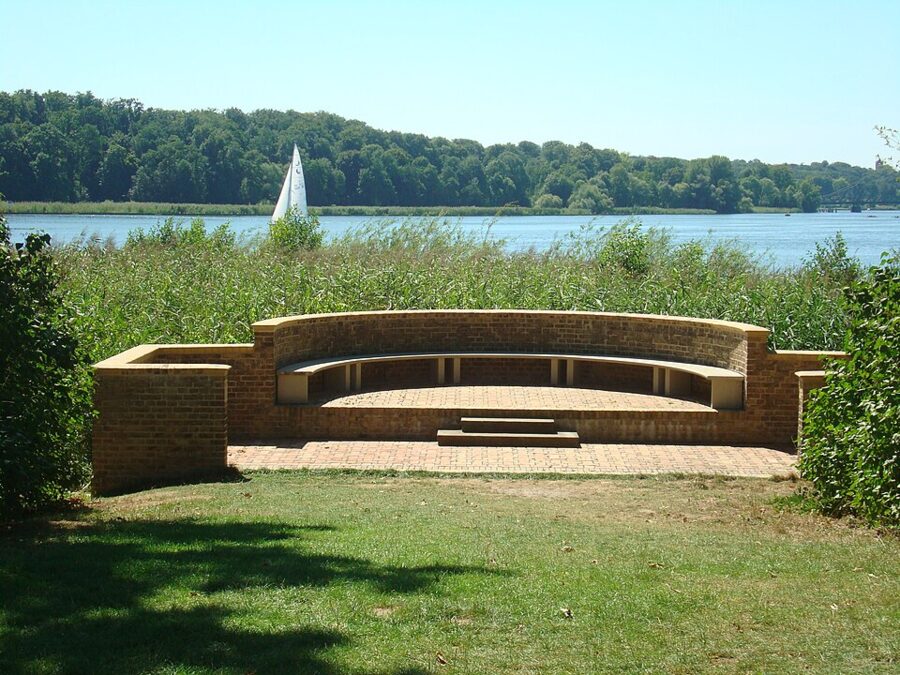
The paths are Lenné’s too, swinging easily through meadows and along the shore. Look for the Roman Bench (Römische Bank), a semicircular stone exedra by Persius looking out over the Jungfernsee. Near the church the park takes on an almost Mediterranean air.

The park’s opening hours are simple: daily from 08:00 until dark, admission free. The park rules allow bikes only on signposted routes, dogs on a short leash, and no fires, barbecues, drones, swimming, fishing or mooring boats on the bank. The foundation also warns that its old trees are dropping branches after years of drought, and asks you not to linger under them, especially in wind.
The village, the Sacrower See and the Königswald
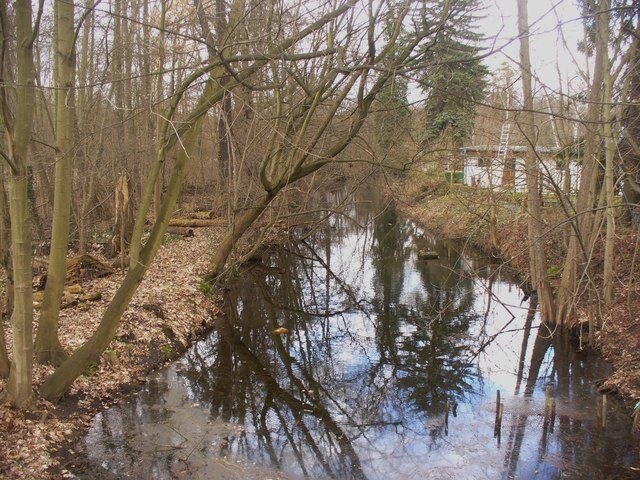
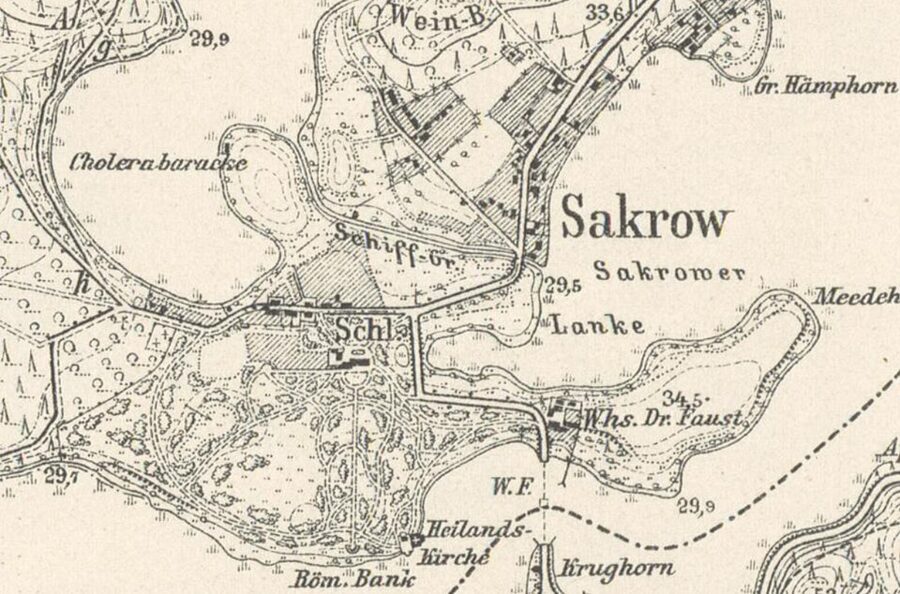
The old village lies northeast of the palace on the Havel bay called the Sacrower Lanke, and you can walk all of it in twenty minutes. It is mostly villas and gardens now: from the early twentieth century Sacrow drew film people, industrialists and airline managers, the actress Jenny Jugo and the director Erik Charell among them, and some houses still belong to well-known Berliners. It became part of Potsdam in 1939.

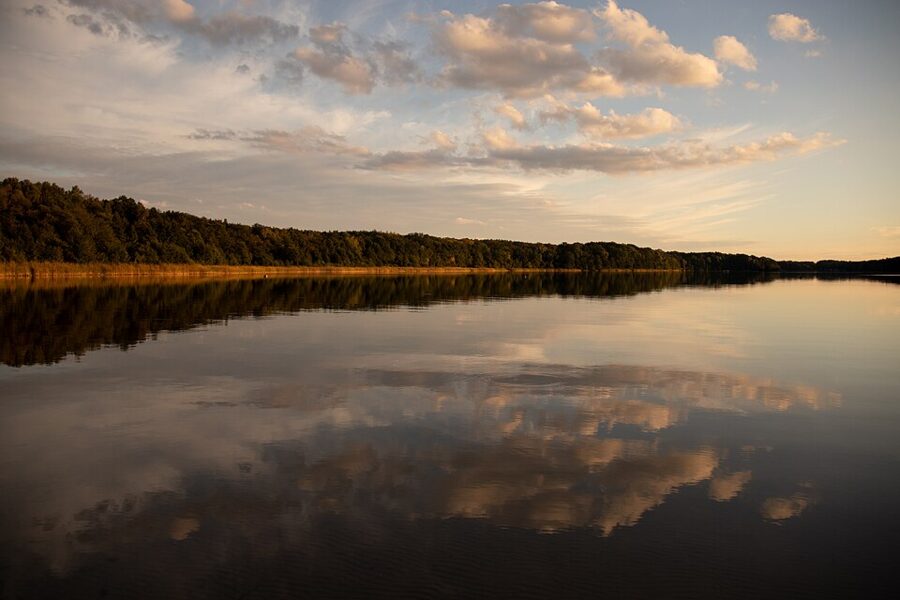
The Sacrower See, behind the village, is the opposite of the busy Havel. It is a long, narrow glacial lake, 3.2 km north to south and never more than 500 m wide, fed by groundwater rather than any stream, and up to 36 m deep in its northern basin, one of the five deepest natural lakes in Brandenburg. My guide to Potsdam’s lakes sets it among the others; here what matters is how protected it is.
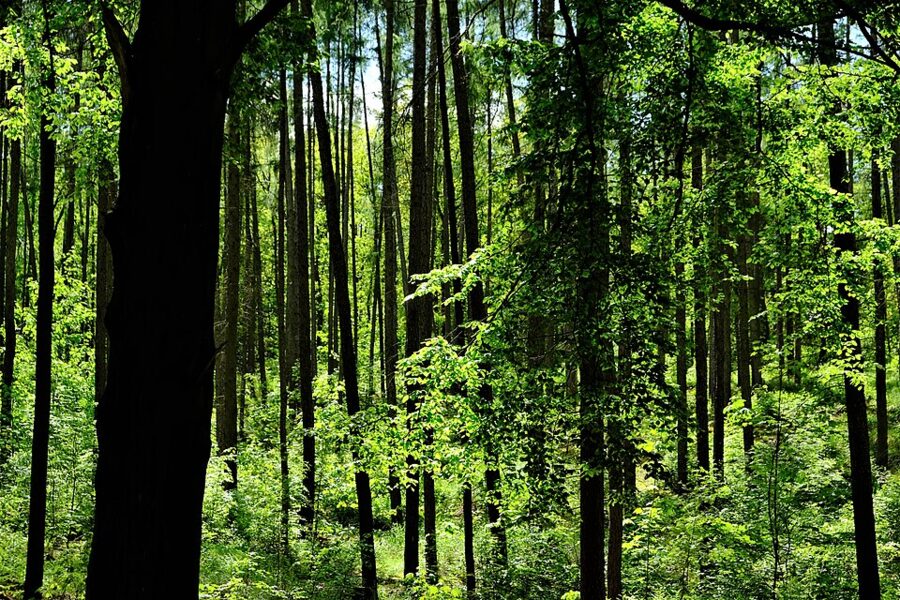
Almost all of Sacrow outside the village is the Sacrower See und Königswald nature reserve, created on March 22, 1941, and the oldest in Potsdam, with 801.5 hectares of old pine and mixed woods, small bogs and the lake. The rules are strict, and the city has said publicly that crowds have already damaged it. Under the city’s rules for the reserve you must stay on the shore path, no craft of any kind may go on the lake, kayaks and paddleboards included, and camping, noise, fires, barbecues and smoking are banned. Swimming is tolerated at just two places, on the north shore near Groß Glienicke and on the east shore near Sacrow.

The Königswald, the King’s Forest, is hilly for these parts. The Luisenberg rises to 78 m, and on a spur above the Lehnitzsee in the west lies the so-called Römerschanze, a ring fort that no Roman ever saw: it was built in the Bronze Age, reoccupied by Slavs, and excavated in 1908–1911, among the first digs in Germany to trace a prehistoric house from the post holes it left. In 2009 the old post road from Priort through Ferbitz to the Sacrow ferry, closed for a century inside military land, reopened as a walking trail.

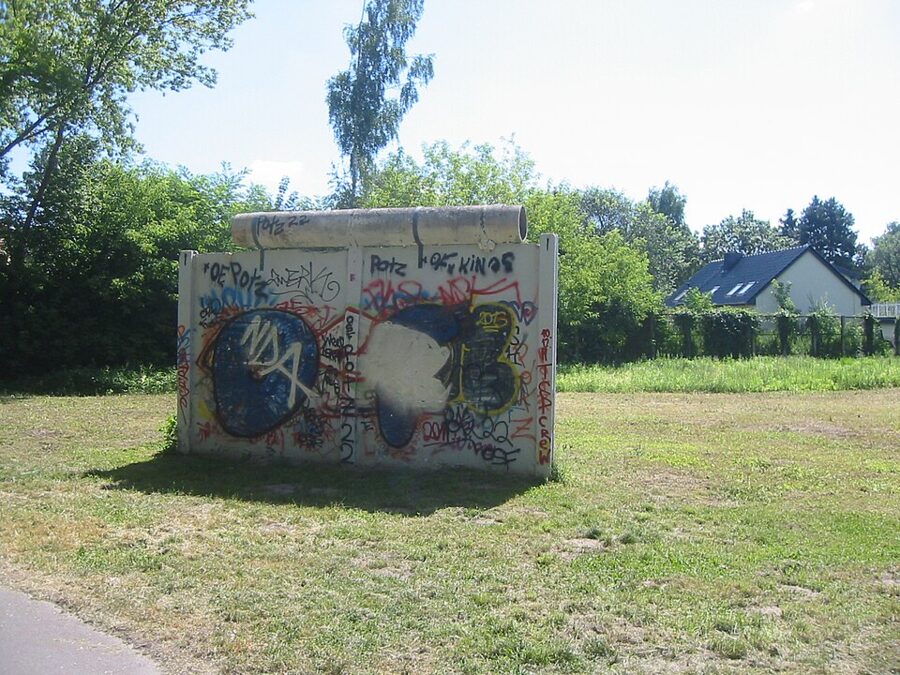
Groß Glienicke, at the north end of the lake, was a village cut in two. The border ran down the middle of the Groß Glienicker See, so that the eastern half went to West Berlin in 1945 and the western half stayed in the East, walled off from its own lake. A piece of the Wall still stands in the old manor park there, and the Berlin Wall Trail follows the lake on the Potsdam side. Thomas Harding’s book The House by the Lake (2015) tells that story through one wooden summer house on the shore.

Getting to Sacrow
Here is the geography to keep in mind. There is no bridge from the Neuer Garten or the Glienicke side, so on land you have to go the long way round: north out of Potsdam on the B2 over the water at Nedlitz and through Neu Fahrland, then off at Krampnitz onto the road into Sacrow. From the west of Berlin you come in from Kladow. The church can be reached only on foot through the park, 300 m south of the palace.
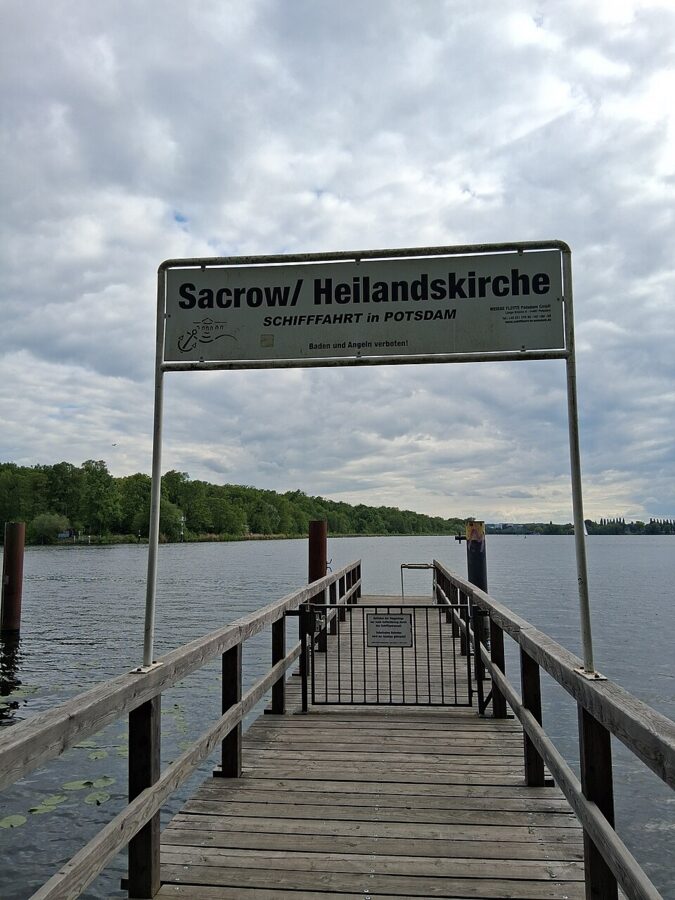
By water taxi. This is the way I’d go. The Weiße Flotte relaunched the Potsdam water taxi on May 14, 2026, on a northern route that calls at a landing called Sacrow Heilandskirche, on Fridays, Saturdays, Sundays and Brandenburg public holidays. The 2026 water taxi timetable had a first boat from Potsdam Hauptbahnhof (the main station) at 10:00, reaching Sacrow at 10:40 by way of the Glienicke Bridge and Park Glienicke at the Krughorn, with shuttles between Peacock Island, the Krughorn and Sacrow through the day and a last call at Sacrow at 17:20 before the boat ran back via the Cecilienhof landing to the station.
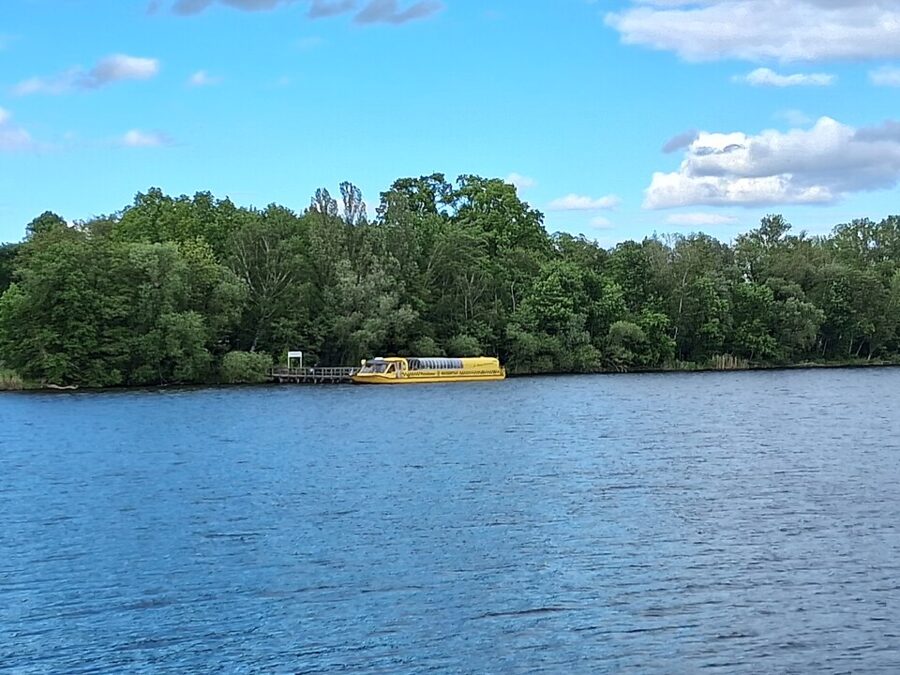

The water taxi fares in 2026 were €5 for a hop between two neighboring landings, such as the Krughorn to Sacrow (€8 with a bike), €9 for a longer ride, €19 for the whole run from the station to Peacock Island and €34 for a day ticket. The 2026 season ended on October 4, and the 2027 timetable has not been published. The bigger excursion boats on the Havel are covered in my guide to Potsdam boat tours.
By bus. From Potsdam Hauptbahnhof take bus 639 toward Spandau as far as Neu Fahrland, Heinrich-Heine-Weg, and change there to bus 697 toward Neukladower Allee, getting off at Schloss Sacrow. From Berlin, bus 697 also comes in from the Kladow side; the parish suggests a regional train to Spandau, bus 134 or 135 to Alt-Kladow and then the 697.
Check the VBB journey planner before you set out, and note the time of the last bus back. A single ticket Berlin ABC covers a trip from Berlin and cost €5.00 in 2026, rising to €5.20 on January 1, 2027; the 24-hour ticket Berlin ABC cost €12.90 and goes up to €13.20.
By car or bike. There is a public car park at the village entrance, about 300 m on foot from the palace. By bike from Potsdam it is the same long loop as the road, through Nedlitz and Krampnitz; the quicker trick in season is to ride to Potsdam Hauptbahnhof or the Glienicke Bridge and take the bike on the water taxi.

Opening times, services and concerts
The church is looked after by volunteers from Ars Sacrow on behalf of the Protestant parish Am Pfingstberg, and the church’s visiting hours follow the seasons. In January and February it opens on Saturdays and Sundays, 11:00–15:30; in March and April on Fridays to Sundays, 11:00–16:00; from May to August on Thursdays 11:00–16:00 and Fridays to Sundays 11:00–17:00; in September and October on Fridays to Sundays, 11:00–16:00; and in November and December on Saturdays and Sundays again, 11:00–15:30. It is open on public holidays, admission is free, and the volunteers ask for donations.
Services take priority over sightseeing, and the volunteers may close the church without notice in bad weather. The park paths down to it are only partly cleared of snow and ice. Main services are held on the second and fourth Sunday of each month at 15:00. In Advent 2026 there is a concert of choral music on November 29 at 15:00 and a service with music on December 20 at 15:00; on Christmas Eve there are vespers at 15:00 and 16:30 and music for the Christmas night at 23:00, and on New Year’s Eve a communion service at 15:00.
The concerts, mostly organ and early music on Sunday afternoons, are free, with a collection. The odd one out is the yachtsmen’s service at the end of the boating season in late September, held in the open air with the congregation sitting in boats anchored in the bay. In 2026 it fell on September 26. That one is worth planning a trip around.
Food and a plan for the day
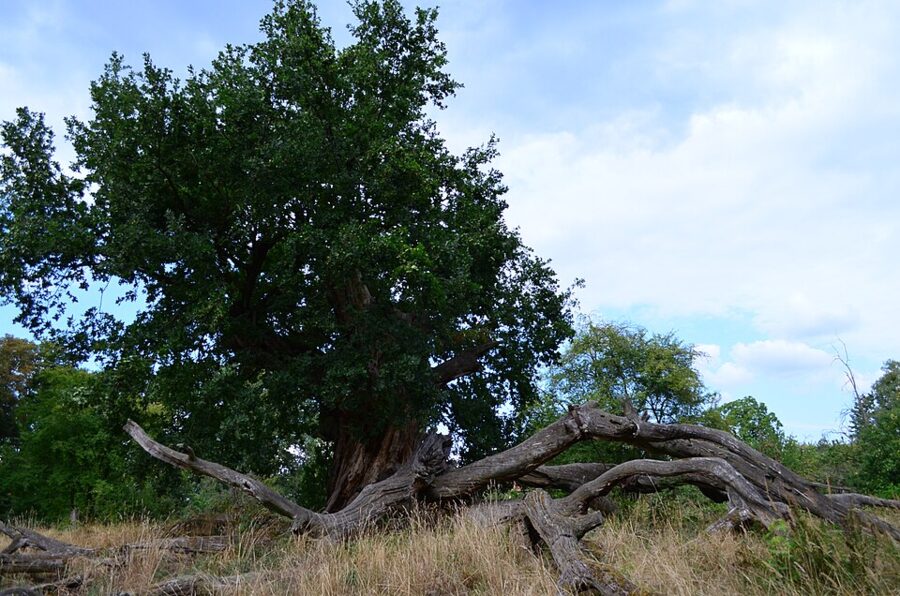
I could not confirm anywhere in Sacrow that is serving food and drink at the moment, so bring a picnic and water and eat it in the orchard by the old oak; the park rules ban fires, not sandwiches. The nearest certain meals are back in Potsdam, and my guide to Potsdam restaurants has them.
For a summer weekend, this is how I’d do it. Take the morning water taxi from Potsdam Hauptbahnhof and get off at Sacrow.
Walk to the church first, while it is quiet, then up through the park to the palace and the oak, out along the village street to the Schiffgraben and onto the lake shore for an hour in the woods. Back at the landing, take a shuttle to the Krughorn for Glienicke, or on to Peacock Island, and ride the last boat home past the Neuer Garten. In winter, come by bus on a Saturday or Sunday and plan around the church’s 15:30 closing. My list of things to do in Potsdam has the rest of the town, and Potsdam’s palaces the other royal houses on the lakes.
Whatever you do, end at the church in the late afternoon and walk round the arcade once more. Stand by the campanile, the tower that served as a piece of the Wall, and look south across the Jungfernsee to the Glienicke Bridge. It is 1.2 km away, and for 28 years it might as well have been the far side of the world. Then go down to the landing and catch the last boat of the afternoon (17:20 in the 2026 timetable) across the water the king built all this to be seen from.