

Stand on the bank of the Nuthe where it slips into the Havel, at the bottom of the Nuthepark, and look north past the wooden footbridge. A pale tower with a spike on top rises over the trees across the river. It belongs to a retirement home, the Heilig-Geist-Residenz, finished in 1997 and shaped to recall the church tower that East Germany blew up on the same spot in 1974. That church had been built in 1726 on top of something older still: the ramparts of the Slavic fort that gave Potsdam its first written name.
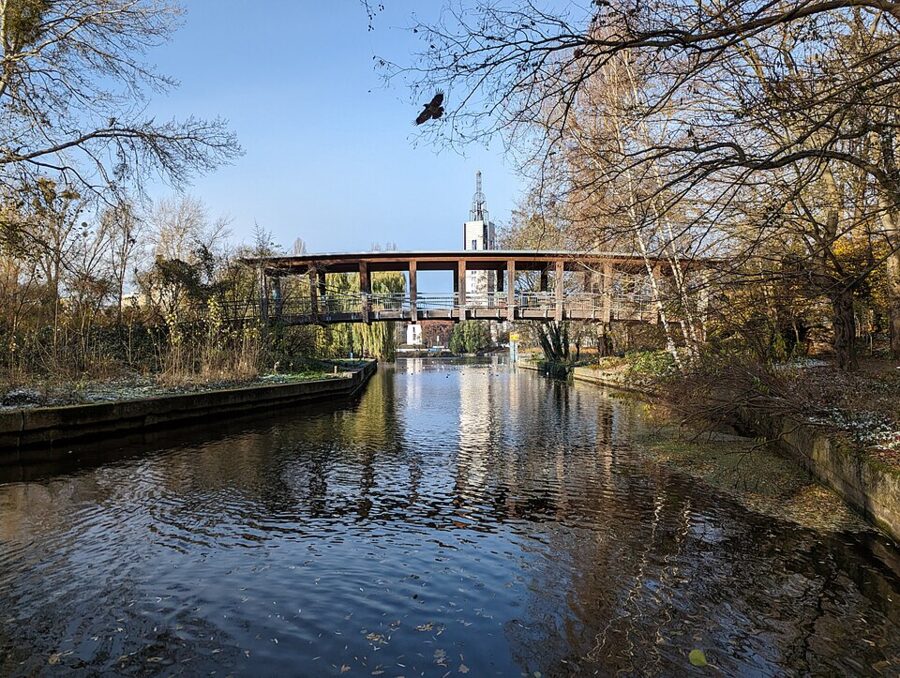

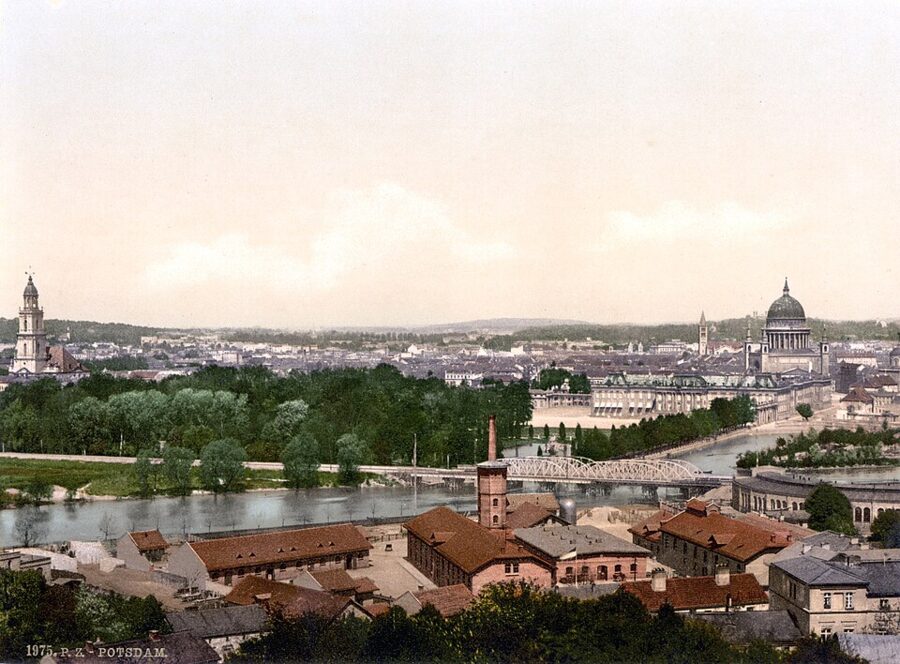
Potsdam has been building on top of itself like that for a thousand years. A fishing town at a ford became an elector’s hunting seat, then a barracks town, then a king’s stage set, then a garrison of the German Empire with a film studio on its edge. One night in April 1945 burned out its center, the Soviets and the East German state took what they wanted and tore down what they disliked, and since 1990 the city has been rebuilding the eighteenth century while arguing about every block of it.
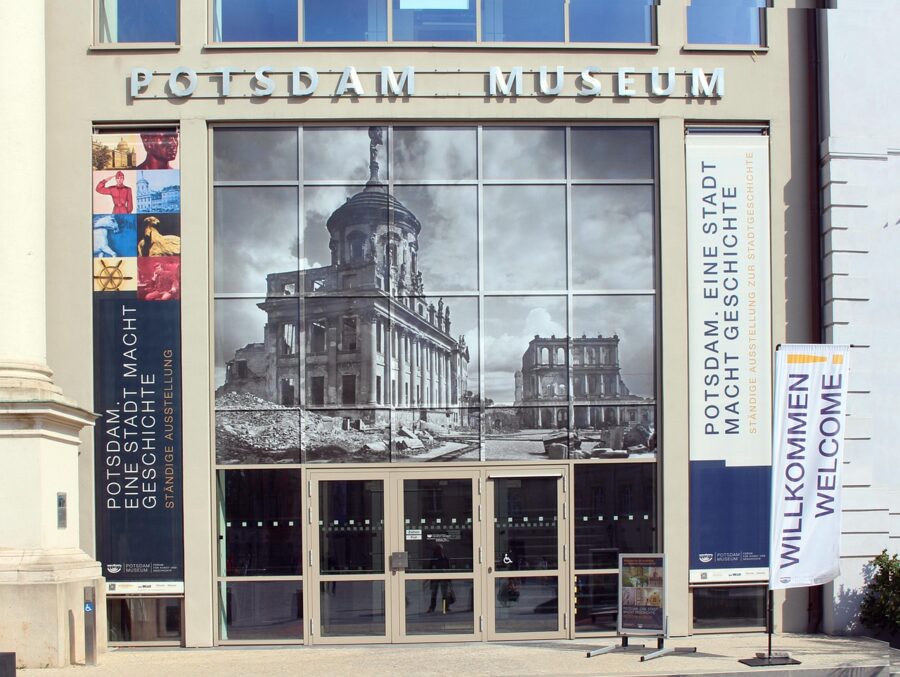
Almost every chapter left something you can still walk to, from a street named after a Slavic castle to a Soviet prison with the inmates’ scratchings on the walls, and the town is small enough to see most of it on foot in a day. Start where the city starts its own story, in the Potsdam Museum on the Alter Markt, a short walk from the station across the Lange Brücke.
Contents16 parts
- Poztupimi, the fort at the ford
- The Great Elector's second residence
- When the soldier king moved in the army
- Frederick the Great dresses the town
- Defeat, reform and the first train in Prussia
- Frederick William IV and Lenné's island
- Guards, villas, telescopes and a film studio
- From 1918 to the Day of Potsdam
- The night of April 14, 1945
- The conference, and the town the Soviets kept
- Socialist Potsdam
- Living beside the Wall
- Autumn 1989
- Capital, World Heritage and the rebuilding argument
- Seeing Potsdam's history in a day
- A short timeline of Potsdam
Poztupimi, the fort at the ford
The Havel here is a chain of lakes, and the narrow, shallow stretch beside today’s old town was the easiest place to cross between the Havelland to the west and the Teltow plateau to the east. After the Germanic Semnones moved away in the great migrations, Slavs settled the empty ground in the sixth and seventh centuries. A tribe the chroniclers call the Hevelli built a fortified settlement on the north bank, opposite the mouth of the Nuthe, to control the crossing.
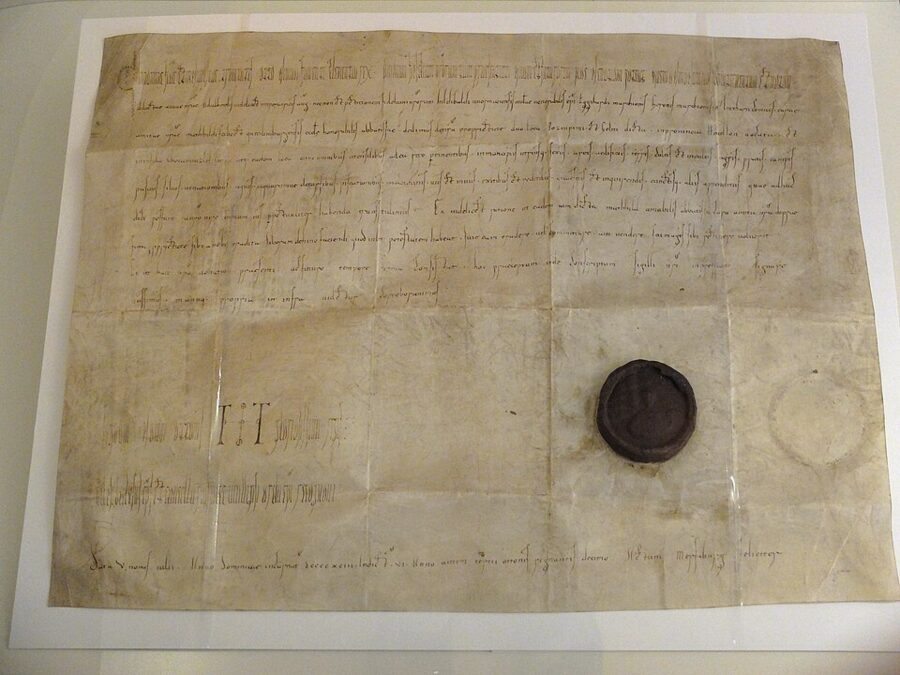
The place enters the written record on July 3, 993, in a charter by which the young emperor Otto III gave two places, “Poztupimi” and “Geliti,” to his aunt Mathilde, abbess of Quedlinburg. Geliti is today’s Geltow, a village a few kilometers west. The gift was probably worth nothing at the time: a great Slavic uprising in 983 had pushed German rule back to the Elbe, and the emperor was handing his aunt land he did not control.

Nobody agrees on what the name means. The old favorite, “under the oaks,” from Slavic pod and dub, is still repeated everywhere, but Germany’s main reference works now call it untenable. The linguist Karlheinz Hengst reads it as Old Polabian for an approach or landing place, which fits a ford very well; others derive it from a man’s name. Sources disagree, and I would not bet on any of them.
A small market town in pawn
German lords returned in the twelfth century, and by the time Albert the Bear founded the Margraviate of Brandenburg in 1157 the crossing was in their hands. They built a stone tower castle about 700 meters from the Slavic fort, and a settlement of servants and fishermen grew between the two. A document of 1304 calls Potsdam a Stedeken, a little town; in 1317 it appears as “Postamp,” with a castle; and in 1345 the margrave confirmed the rights of its councilors.
For the next three hundred years it stayed small. The city’s own history counts fewer than a thousand people in about a hundred houses behind an earth wall and a moat, mostly fishermen, bakers, shoemakers, linen weavers and tailors, with a few big net-fishing operators the town called the yarn lords. A count of 1573 gives 2,000 people in 192 houses. The margraves and electors pawned the town so often to raise money that it changed hands more than almost any other in the Mark, even after the Hohenzollerns took over Brandenburg in 1415.
A great fire in 1536 probably took the medieval town hall, and the Thirty Years’ War did the rest. Plague killed 308 Potsdamers in 1631 alone, and by the end of the war the town had lost about half its people. When the Great Elector chose it as a residence in 1660, 119 of its 198 houses were still empty.
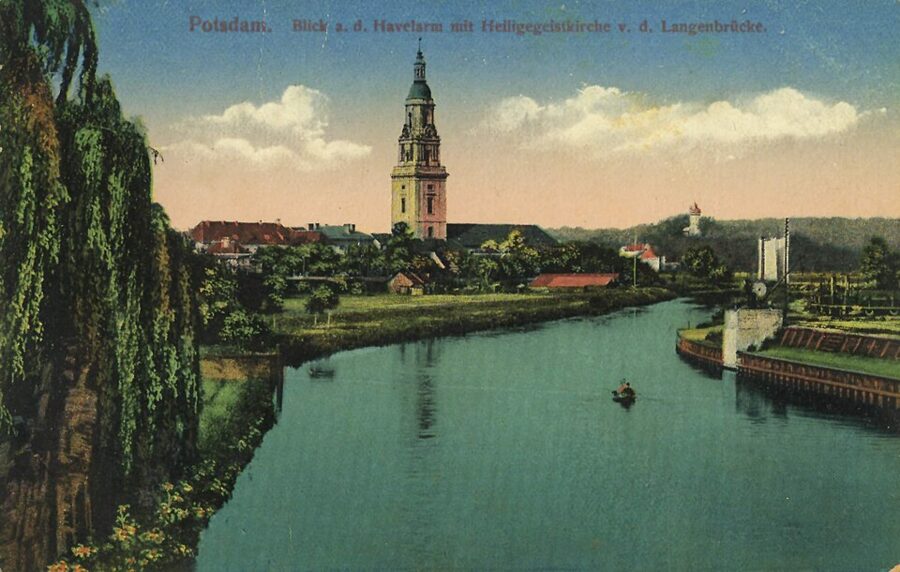
What survives: almost nothing above ground, which is the point. Walk along Burgstraße, the street named after the castle, to the Heilig-Geist-Residenz and the riverside garden around it; the copy of the charter and the finds from the early town are in the Potsdam Museum on the Alter Markt. The Lange Brücke, the bridge you cross from the station, stands where a bridge is first recorded in 1317.
The Great Elector’s second residence
Frederick William of Brandenburg, the Great Elector (Friedrich Wilhelm, der Große Kurfürst), came to the throne in 1640 in the middle of the war and spent decades buying back what his predecessors had pawned. Potsdam appealed to him for the same reasons it had been neglected: forests full of game, water on every side, and almost no burghers to argue with. He had also seen what his governor in Cleves, Johann Moritz of Nassau-Siegen, had made of that town with parks and avenues, and he wanted the same.
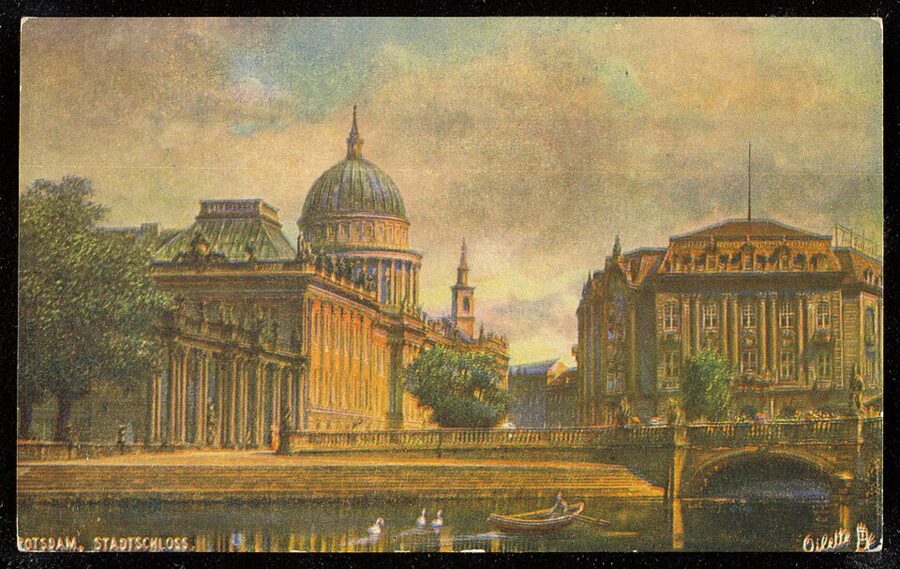
From 1660 he laid out a pleasure garden, the Lustgarten, by the river, and between 1662 and 1674 his architect Johann Gregor Memhardt rebuilt the old castle as a Dutch-style palace. The Elector lived there regularly from 1671 and died there in 1688. A wooden Lange Brücke of 48 arches went across the Havel in the 1660s, and a planted avenue of oaks ran west from the palace along what became Breite Straße, with new houses along it for the people he wanted to attract.
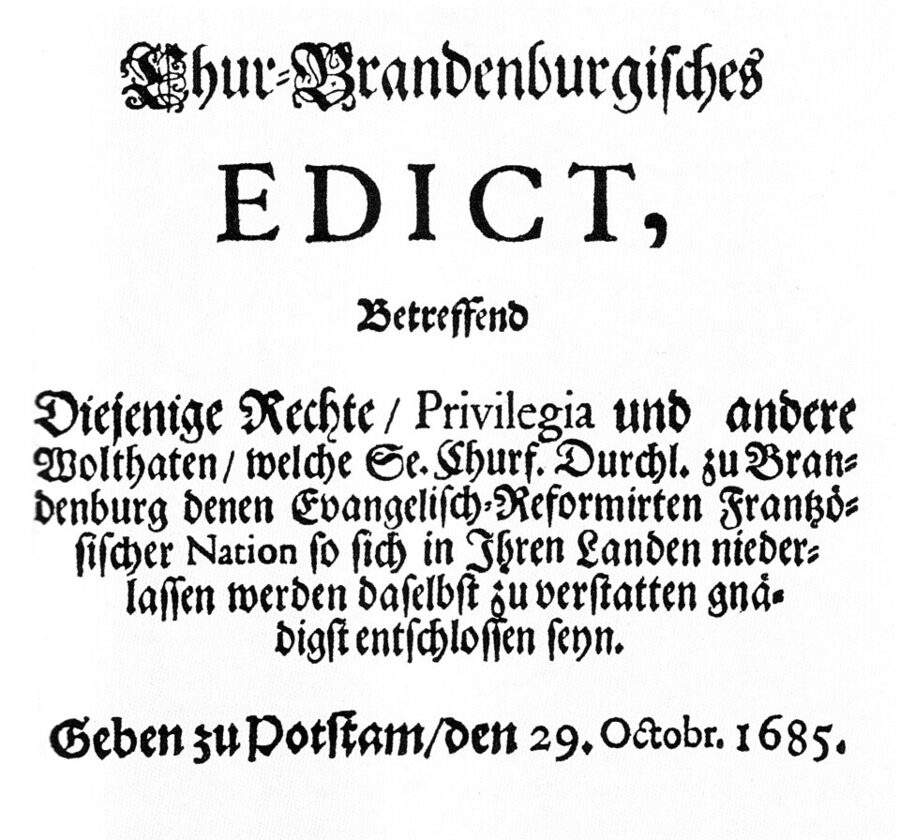
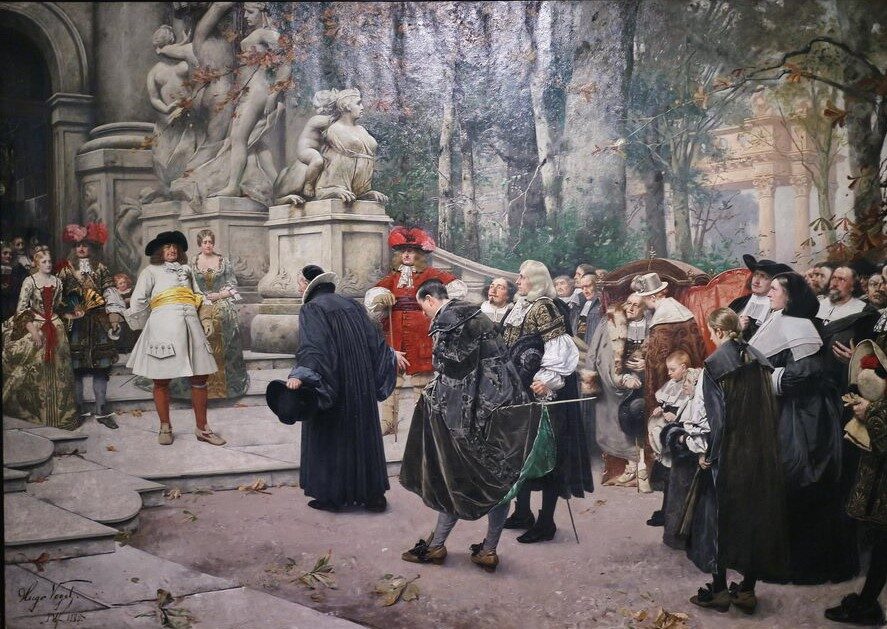
The palace was never just a hunting lodge. Here, on October 29, 1685, by the Julian calendar then used in Brandenburg (November 8 in the modern calendar), the Elector signed the Edict of Potsdam, his answer to Louis XIV’s revocation of the Edict of Nantes three weeks earlier. It offered persecuted French Protestants safe passage, free settlement, tax and customs exemptions, subsidies for their workshops and pastors paid by the state. Somewhere between 15,000 and 20,000 Huguenots came to Brandenburg, enough to raise Berlin’s population by a third, and they brought trades the war-ruined country badly lacked.
Potsdam itself got a smaller share of the newcomers than Berlin, but it got the symbol. A French quarter of about fifty houses grew up later in the soldier king’s new town and was destroyed in 1945. Its church survived: the French Church (Französische Kirche) on the Bassinplatz, a small domed oval that Knobelsdorff built in 1752 and 1753 for the French Reformed congregation, is now the oldest surviving church in the historic center. The story of the edict, who came and what they left is told in full in my article on the Edict of Potsdam.
The Elector’s son made himself King Frederick I in Prussia in 1701, and Jean de Bodt gave the palace a new gate to mark the coronation: the Fortuna Portal (Fortunaportal), with a gilded goddess of luck turning on its dome. Where to see it now: the rebuilt Fortuna Portal and palace facades on the Alter Markt, the Marstall beside them (built in 1685 as the Elector’s orangery, later the royal stables and now the Filmmuseum Potsdam, and the oldest building in the center), and the French Church on the Bassinplatz.
When the soldier king moved in the army
Frederick William I (Friedrich Wilhelm I), king from 1713 to 1740, had no use for his father’s court and every use for an army. He moved his own regiment to Potsdam, and since barracks were not yet the custom, the soldiers lodged with the townspeople: each household had to take two to six men and feed them until the king could build houses with room for soldiers in the attic. That is why Potsdam’s baroque streets are lined with plain two-story houses of almost identical size. He had them built by the hundred, to a pattern, largely at the crown’s expense.
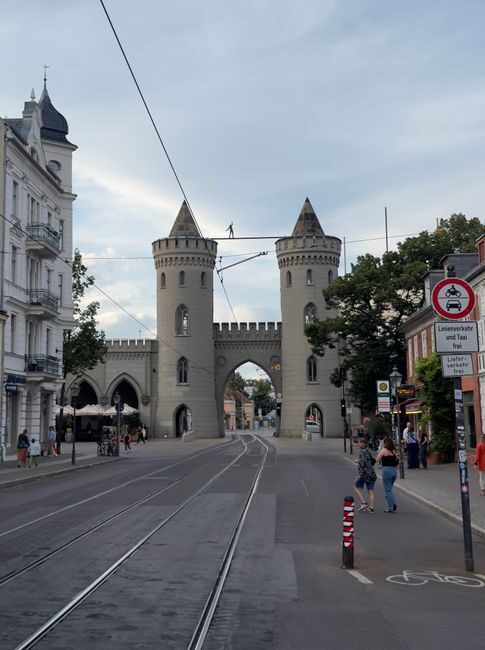
The first town extension went up north of the old center between 1721 and 1725, the second from 1733, both on a grid of straight streets. In 1722 he closed the whole thing behind a customs wall, partly to collect excise duties and partly to stop his soldiers from deserting. The gates in that wall were the town’s front doors, and three of them, the Brandenburg Gate, the Nauener Tor and the Hunters’ Gate (Jägertor), still stand in later forms.
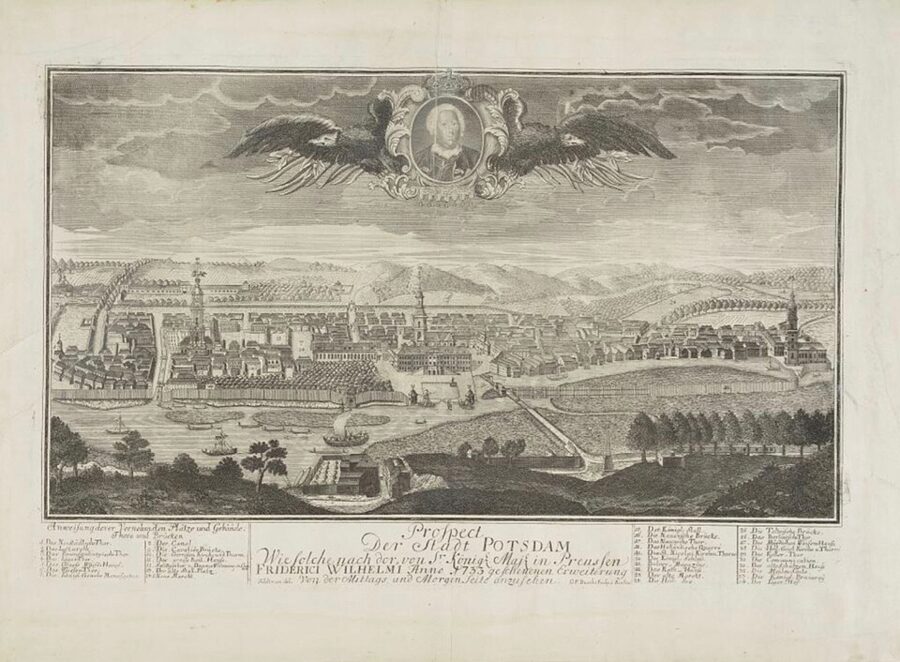
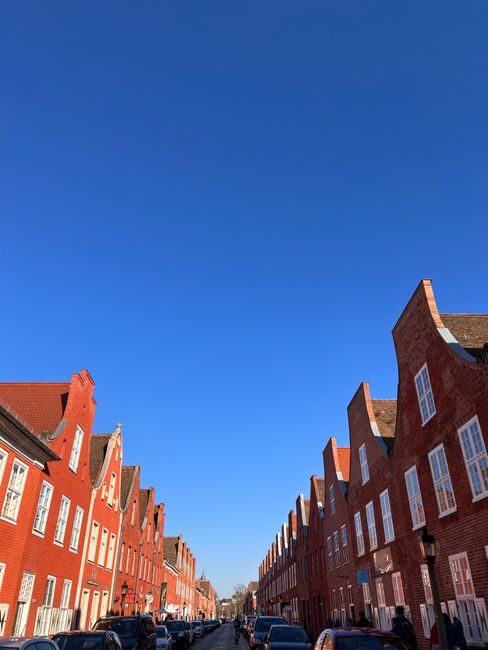
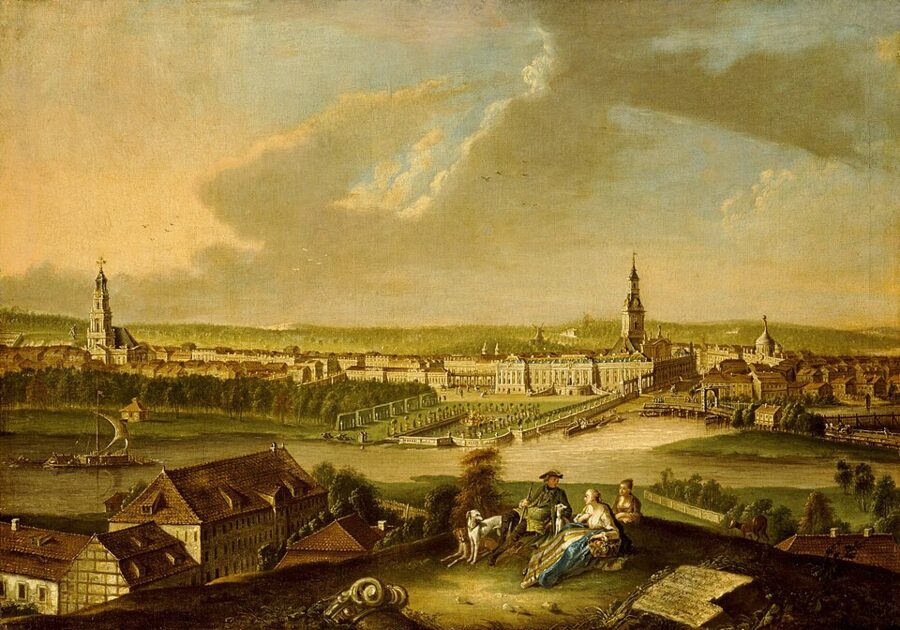
He also gave the town its silhouette. Three new churches, the Holy Ghost Church by the river, the first Nikolaikirche on the market and the Garrison Church on the canal, stood on one line, and painters and postcard makers spent the next two centuries framing the “three-church view.” He founded the Great Military Orphanage in 1724 for soldiers’ children, had the town canal dug on the Amsterdam model, and from 1733 had the Dutch builder Jan Bouman put up 134 brick houses in four blocks for Dutch craftsmen he hoped to lure. Fewer came than he wanted, but the Dutch Quarter is still there, usually called the largest group of Dutch-style buildings outside the Netherlands.
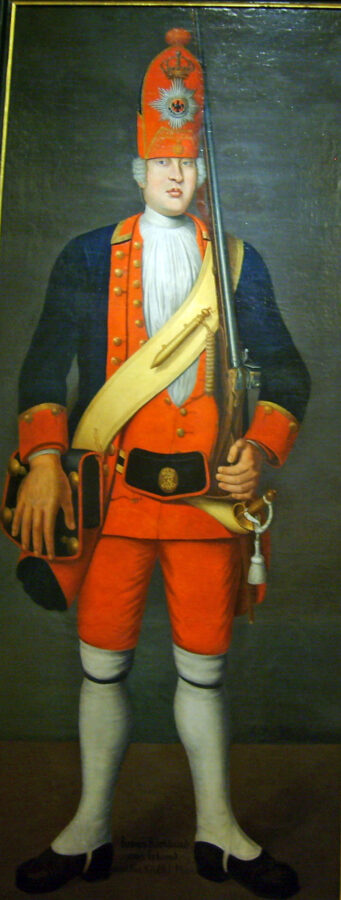
The town’s fame in Europe, though, came from its giants. The king’s own regiment, the Lange Kerls (tall fellows), was meant to be filled with men at least six Rhenish feet tall, about 1.88 meters, and his recruiters roamed the continent paying huge bounties, and sometimes simply kidnapping. The Irishman James Kirkland, 2.17 meters tall, was one of the showpieces, and fellow rulers sent tall men as presents; by 1740 the regiment had about 3,200 men. One historian has argued that many of the giants were too sick to fight and the regiment was a parade troop, and Frederick the Great disbanded all but one battalion when he came to the throne, because it cost too much.
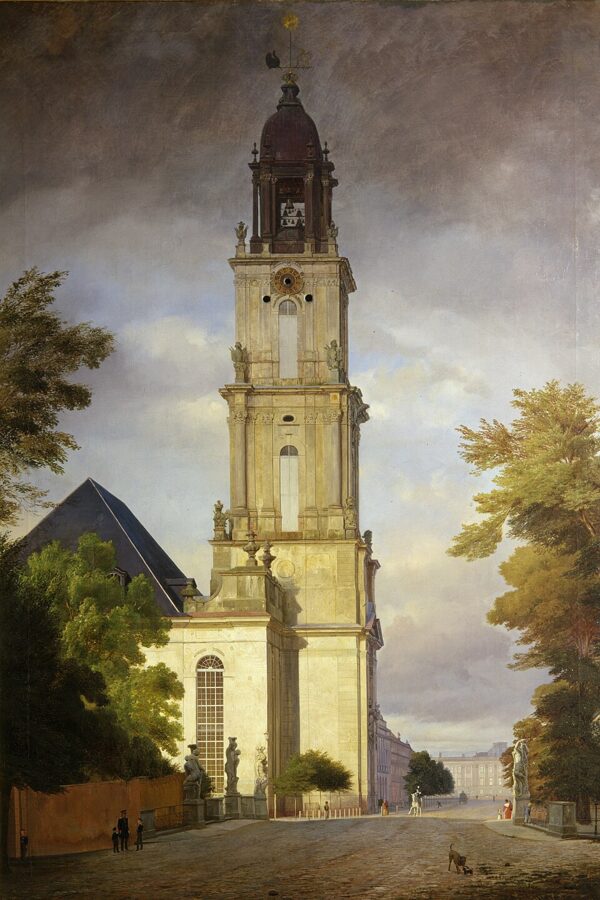
The regiment’s church was the Garrison Church, built from 1730 to 1735 with a tower almost 90 meters high and a carillon that played “Üb’ immer Treu und Redlichkeit” (Always be loyal and upright) every half hour for a century and a half. The king was buried in its crypt in 1740, and his son joined him in 1786. That made it the shrine of Prussian monarchy, and it carried that load all the way to Hitler’s bow in 1933, the fire of 1945, the demolition of 1968 and a rebuilt tower that is still fought over. The whole story is in my guide to the Garrison Church.
When UNESCO listed Potsdam’s palaces and parks in 1990, it noted that the soldier king’s two new towns could not be included, because the bombing of 1945 had destroyed too much of them. What you can still walk through of his Potsdam: the Dutch Quarter, the Nauener Tor at its corner, the gilded Caritas on the orphanage tower on Lindenstraße, the facade of the Langer Stall drill hall on the Plantage, the street grid north of Yorckstraße, and the rebuilt Garrison Church tower on Breite Straße.
Frederick the Great dresses the town
His son spent much of his youth in this barracks town, tried to run away from his father at eighteen, and then made Potsdam the place he loved most. Frederick the Great (Friedrich II) reigned from 1740 to 1786 and spent every summer that was not a war summer at Potsdam. He gave Berlin the government and kept Potsdam for himself. My article on Frederick the Great follows him through the town from his father’s barracks to his grave.
On April 14, 1745, the foundation stone went down for a small summer house on a terraced vineyard west of the town, which he called Sans Souci, without worry. Knobelsdorff built it in two years from the king’s own sketches, a single story painted yellow, with the terraces falling away in front, and Frederick added a picture gallery, guest rooms, fountains that never worked in his lifetime and a vault on the top terrace for his own grave. Voltaire came to stay in 1750 and left in 1753 after a quarrel, and the round table of the king’s suppers became a legend. My guide to Sanssouci covers the palace and the park building by building.
He also rebuilt the town to look like a capital. In the 1740s Knobelsdorff remodeled the City Palace, and in the 1750s the Alter Markt became a Roman square: a new church front copied from Santa Maria Maggiore, a town hall after a design by Palladio, an obelisk in the middle, and in 1771 and 1772 a copy of the Palazzo Barberini on the corner. Along Breite Straße and the side streets the king paid for grand facades on ordinary houses, copied from palaces in Italy, France and the Netherlands; Potsdamers called them Vorhemdchen, shirt-fronts, because there was often a plain house behind the show.
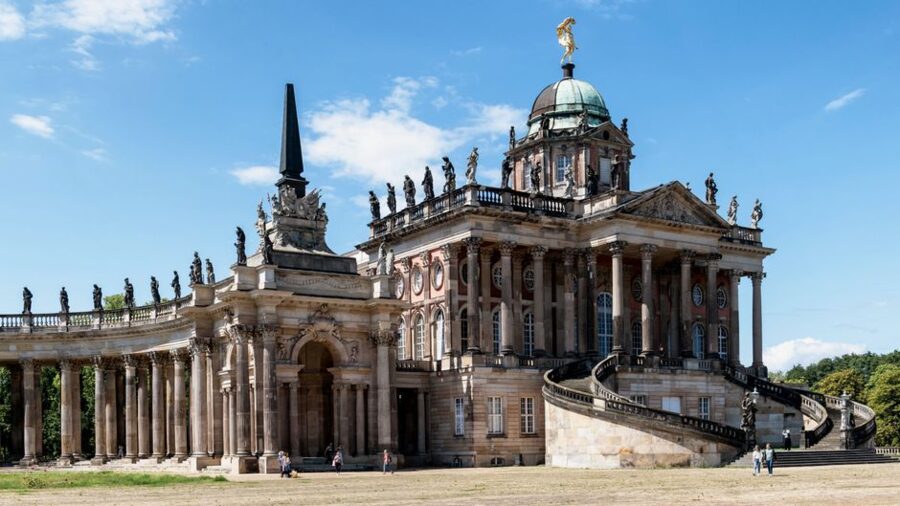
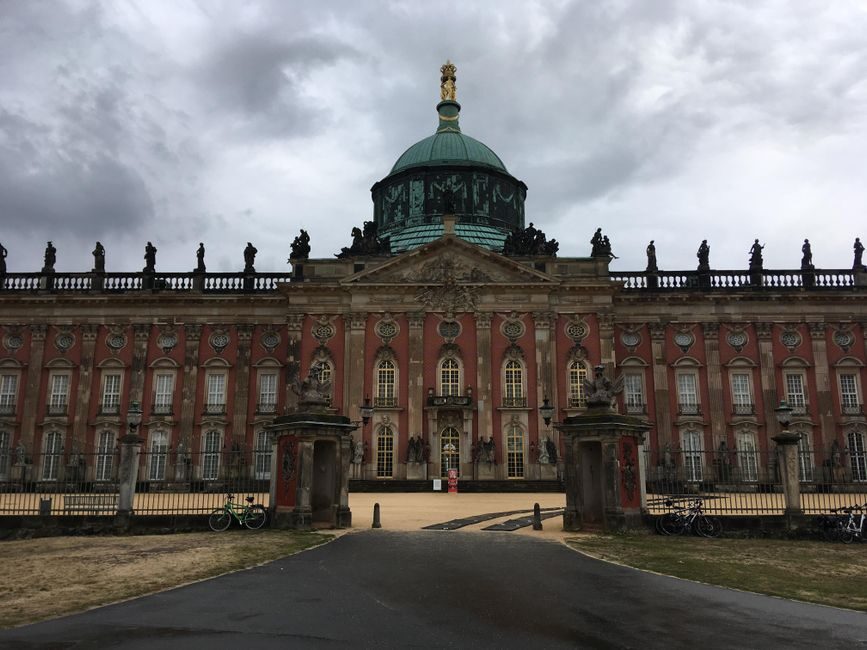
The Seven Years’ War nearly ruined him. He marched out over the Lange Brücke on August 8, 1756, and when it ended in 1763, with Prussia exhausted but intact, he answered with a brag. The New Palace (Neues Palais) at the far end of the park went up from 1763 to 1769, some 220 meters of brick front, most of the brick painted on, under a dome that covers no room; Frederick himself called it a fanfaronade.
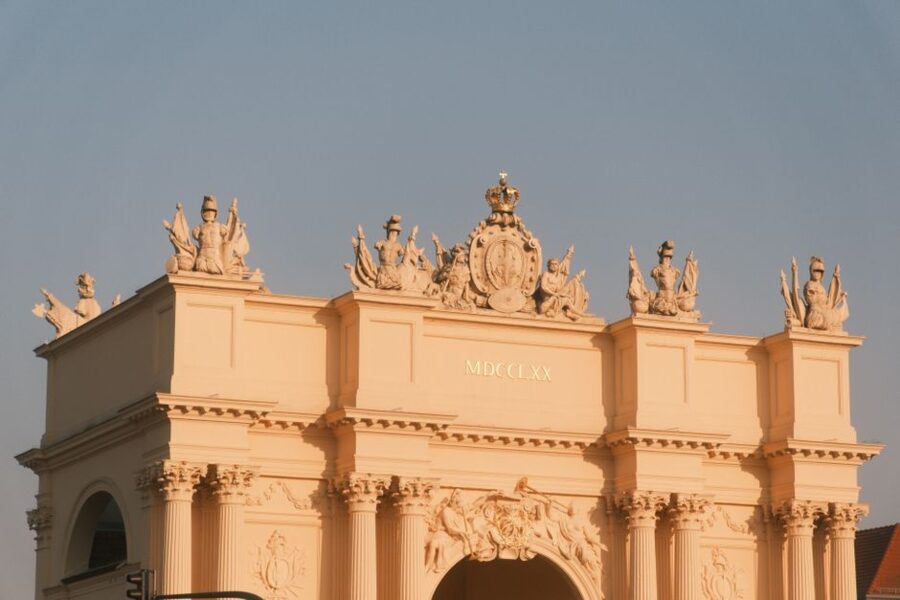
The rest of his building is all over town. He put up the Brandenburg Gate on Luisenplatz in 1770 and 1771 as a triumphal arch for the war, settled Bohemian Protestant weavers in a colony called Nowawes in 1751, the core of today’s Babelsberg, and planted mulberry trees for a silk industry that never quite took. The windmill beside his palace, today the Historic Mill of Sanssouci, belongs to a famous story about a miller who would not sell, though the mill you see was rebuilt in the 1990s. He died in his armchair at Sanssouci on August 17, 1786, and his nephew, ignoring his will, buried him in the Garrison Church.
What you can see: nearly everything. Sanssouci and the New Palace, the Picture Gallery and the New Chambers, the Alter Markt with the Old Town Hall, the obelisk and the Barberini, the Brandenburg Gate and Brandenburger Straße, and the king’s grave on the terrace, where he finally arrived in 1991.
Defeat, reform and the first train in Prussia
Frederick’s nephew, Frederick William II, preferred the lakes to the vineyard. From 1787 he laid out the Neuer Garten on the Heiliger See, an English-style landscape park, and built the Marble Palace (Marmorpalais) on its shore. It was the first sign of the turn from the formal baroque garden to the landscape that would eventually take over the whole region.
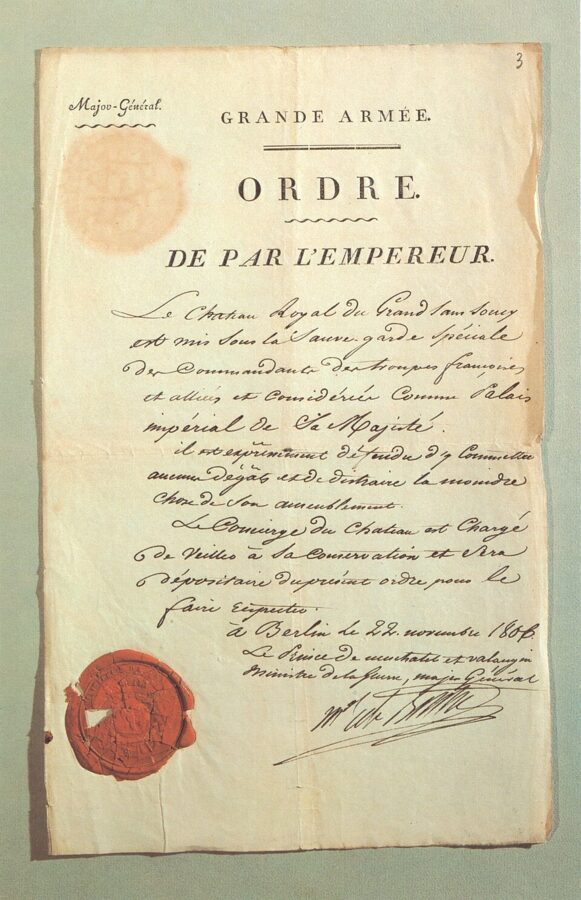
Then Prussia collapsed. After the defeat at Jena and Auerstedt, French troops reached Potsdam on the night of October 21, 1806, and Napoleon came a few days later, stood at Frederick’s coffin in the Garrison Church and had the dead king’s sword carried off to Paris. He also put the palaces under his personal protection, and his letter forbidding looting survives. The two years of occupation and the payments that followed left the town poor for a generation.
Defeat brought reform. Under the new town ordinance of 1808, Potsdam’s first freely elected council met on March 20, 1809, in the Great Dutch House on Lindenstraße. After 1815 the town became an administrative center, the seat of the royal government for a large district around Berlin, full of officials and their families. In 1816 a young gardener from Bonn, Peter Joseph Lenné, arrived to work in the royal gardens, and he would spend fifty years turning the lakes and hills around Potsdam into one designed landscape.
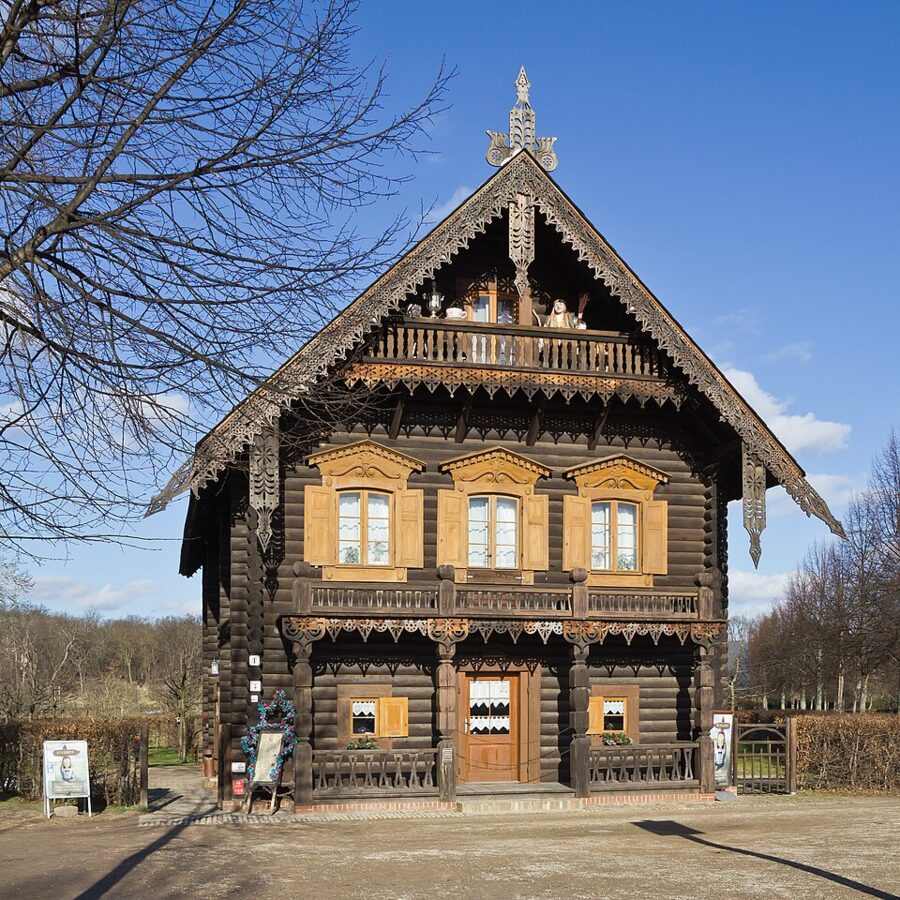
Frederick William III built for his memory and his friendships. In 1826 and 1827 he had a village of wooden houses put up north of the town for the last Russian singers of a soldiers’ choir, in memory of his friend Tsar Alexander I, and called it Alexandrowka. Schinkel built Charlottenhof for the crown prince from 1826, and from 1830 a new Nikolaikirche on the Alter Markt to replace the church that had burned in 1795.

The modern age arrived by rail. On September 22, 1838, the first train in Prussia ran between Potsdam and Zehlendorf, and on October 29 the line opened all the way to Berlin. Potsdam’s station stood south of the Havel, where the main station is today, and the capital was suddenly less than an hour away. Six years earlier a signal mast for the optical telegraph line from Berlin to Koblenz had gone up on the hill south of the station, and the hill has been called the Telegrafenberg ever since.
Frederick William IV and Lenné’s island
The next king was the most passionate builder of them all. Frederick William IV (Friedrich Wilhelm IV), who reigned from 1840 to 1861, drew constantly, dreamed of Italy and wanted to turn the whole stretch of lakes and hills around Potsdam into one picture, an “island of Potsdam” ringed by water, with churches, villas and towers placed for the views between them. Lenné had already drawn the plan in 1833, and the king’s architect Ludwig Persius, a Potsdam merchant’s son born on the Alter Markt in 1803, gave it buildings until he died in 1845, aged 42.
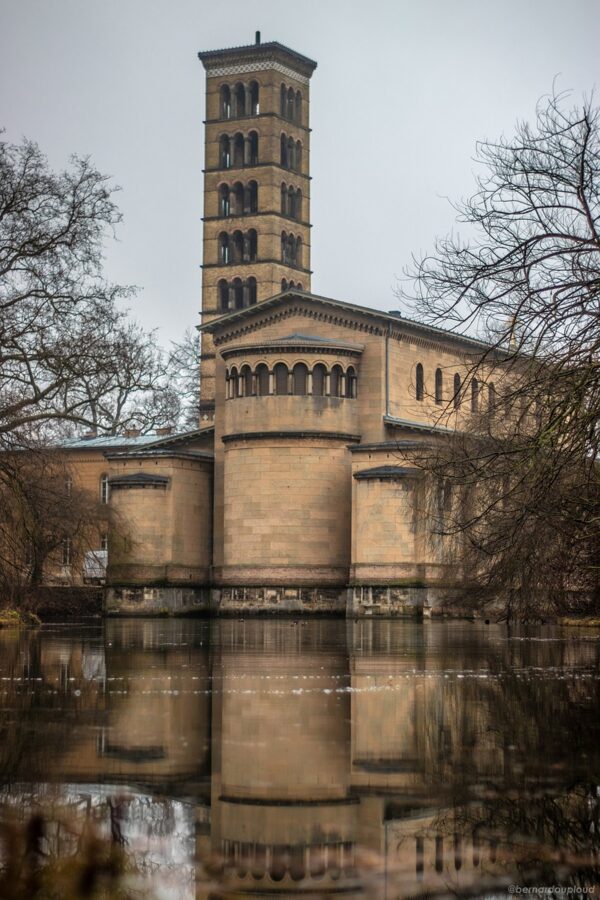
The town’s skyline today is largely theirs. The Nikolaikirche got its great dome between 1843 and 1850, to Schinkel’s design, finished by Persius and then August Stüler. The king’s own church, the Church of Peace (Friedenskirche) at the edge of Park Sanssouci, was begun on April 14, 1845, a hundred years to the day after Sanssouci, as a copy of an early Christian basilica in Rome. He is buried in it.
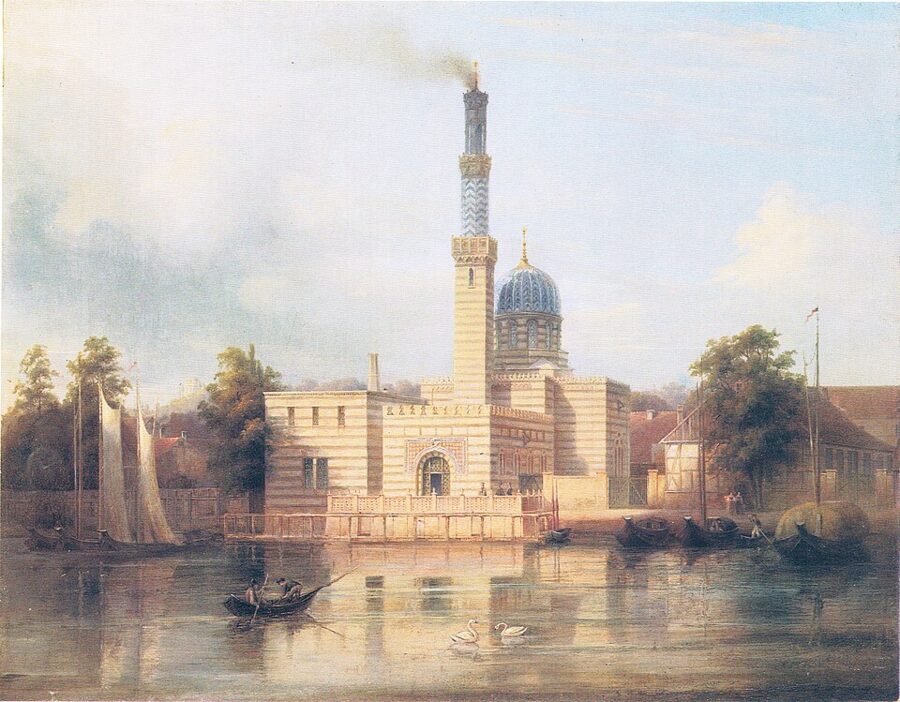
Persius also had a habit of hiding machinery in costume. To finally make Frederick’s fountains work, the king bought a steam engine from August Borsig and housed it on the Havel in a building “in the manner of the Turkish mosques,” with a minaret for a chimney; on October 23, 1842, the Great Fountain in front of Sanssouci threw its jet 38 meters high. Across the Havel at Sacrow, Persius built the Church of the Redeemer (Heilandskirche) as a point to look at from the Neuer Garten, and on the Pfingstberg the king began the Belvedere in 1847 for the view.
The king’s family built too. His brother Wilhelm, later the first German emperor, built Babelsberg Palace on the hill above the Havel from 1834 to 1849 in an English Gothic style, with a park by Lenné and Hermann von Pückler-Muskau. The crown estate at Bornstedt, the Krongut Bornstedt, bought by the king in 1841, was rebuilt in the Italian manner from 1846 after a fire, and from 1867 it was the country home of the crown prince and princess.
Revolution reached Potsdam in a small way. After the street fighting in Berlin in March 1848, the king withdrew to Potsdam on March 29, and on September 12 soldiers gathered in front of the New Palace and tried to free comrades from the guardhouse before loyal troops put them down. Building went on regardless, and in 1851 the king started the Orangery Palace on the ridge above Sanssouci, 300 meters of Italian villa for the park’s potted plants.
Where to find it: the Church of Peace and the Marly garden beside it, the steam engine house on the Neustädter Havelbucht (inside only on selected summer days), the Orangery Palace (closed for restoration) and Charlottenhof, the Belvedere on the Pfingstberg, Babelsberg Park, the church at Sacrow and the Krongut at Bornstedt.
Guards, villas, telescopes and a film studio
Under the German Empire, Potsdam was the guards’ town. The elite Guards regiments filled new barracks on the edges, officers’ villas went up north of the center, and parades marched through the Lustgarten in front of the palace. In 1888, the year of the three emperors, Frederick III reigned for 99 days and died in the New Palace, and his son Wilhelm II made that palace his main home until 1918.
The money came with them. From 1871 a company led by the architects Hermann Ende and Wilhelm Böckmann sold villa plots on the Griebnitzsee as a colony called Neubabelsberg, with its own waterworks and steamboat line by 1876, and the Berliner Vorstadt and Nauener Vorstadt filled with large houses for retired officers and senior officials. The population rose to about 60,000 by 1900. In 1903 the Jewish community consecrated a new synagogue on the Wilhelmplatz, today’s Platz der Einheit, with an organ played by the Nikolaikirche’s organist.
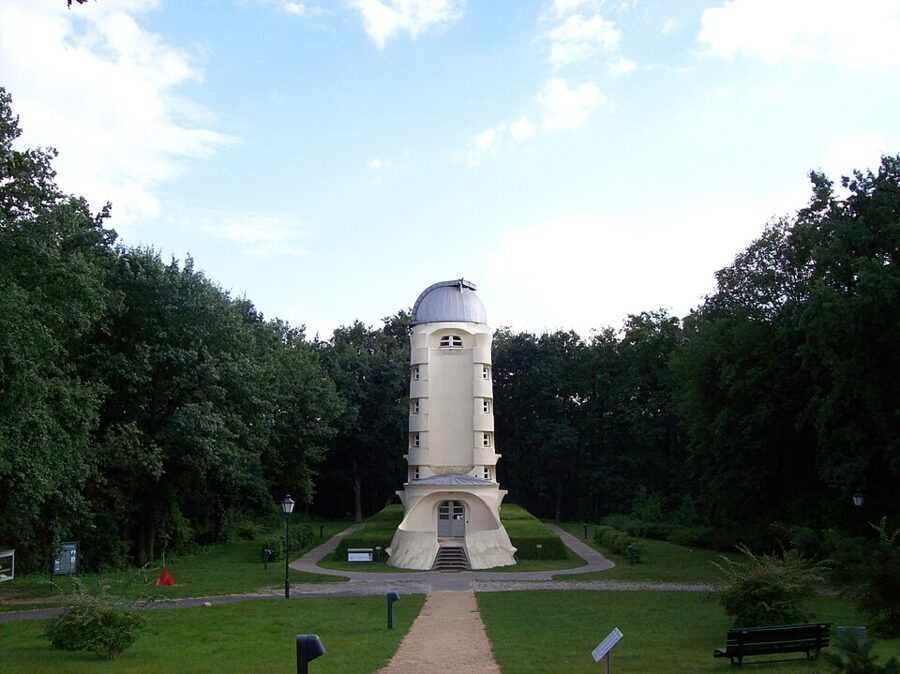
Science moved onto the Telegrafenberg. From the 1870s the Prussian state built observatories in the oak wood on the hill, starting with the Astrophysical Observatory, founded in 1874 as the first institute anywhere set up expressly for astrophysics, and in 1899 the Great Refractor, still the fourth-largest lens telescope in the world. Erich Mendelsohn’s Einstein Tower followed after the war, finished in 1924 to test the general theory of relativity.

Potsdam also kept turning up in the history of technology. In 1897 the first wireless telegraph link in Germany ran 1.6 km across the water between the church at Sacrow and the imperial sailors’ station at the Glienicke Bridge. Electric trams replaced horse trams in 1907, and in 1911 an airship port opened at the Pirschheide, where the largest airship hangar in Germany went up a year later; it was pulled down in 1920.
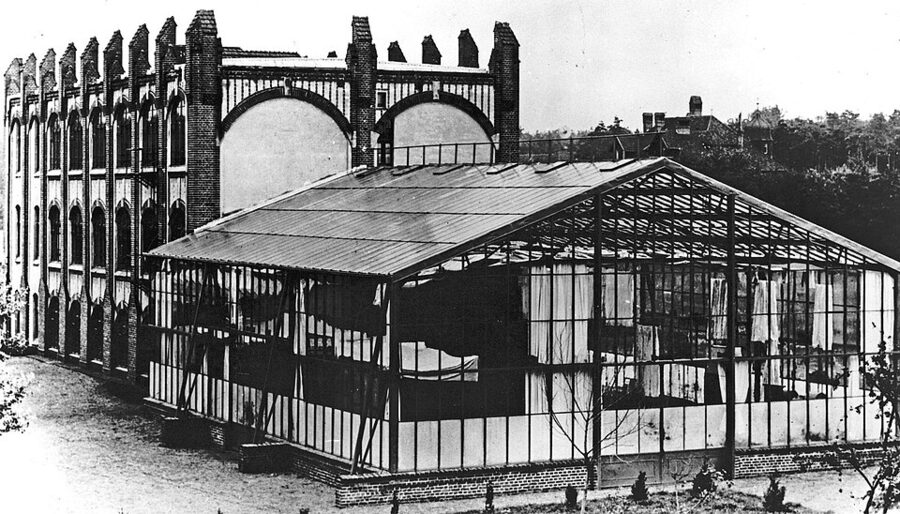
The invention that lasted came from Babelsberg. In November 1911 the cameraman Guido Seeber leased ground on the edge of Nowawes for the Bioscop company, which the Berlin fire brigade wanted out of the city because of its explosive film stock, and built a glass studio there. On February 12, 1912, he shot the first scene of “Der Totentanz” (The Dance of Death) with Asta Nielsen, and the lot has been making films ever since, through Ufa, DEFA and today’s Studio Babelsberg.
Fritz Lang built “Metropolis” here in a hall put up in 1926, and Alfred Hitchcock learned his trade on the lot in the mid-1920s. The studio’s own history is told in the film museum in the old royal stables on Breite Straße.
The last royal building in Potsdam was a country house. Cecilienhof, a rambling half-timbered house in the English Tudor manner in the Neuer Garten, was built from 1913 to 1917 for Crown Prince Wilhelm and Crown Princess Cecilie. When the monarchy fell in November 1918, the emperor fled to the Netherlands and Potsdam stopped being a royal residence after more than 250 years. The New Palace opened as a museum in 1926, the same year a settlement between the Prussian state and the Hohenzollerns gave most of the palaces to the state.
From 1918 to the Day of Potsdam
The republic never won Potsdam over. The town of officers’ widows, retired officials and old regiments became a place of pilgrimage for monarchists and nationalists who hated the new state, and the phrase “the spirit of Potsdam” stood for army, obedience and monarchy, set against “the spirit of Weimar.” The new army’s Infantry Regiment 9, formed in Potsdam in 1920, had so many aristocrats among its officers that it was nicknamed Graf Neun, Count Nine.
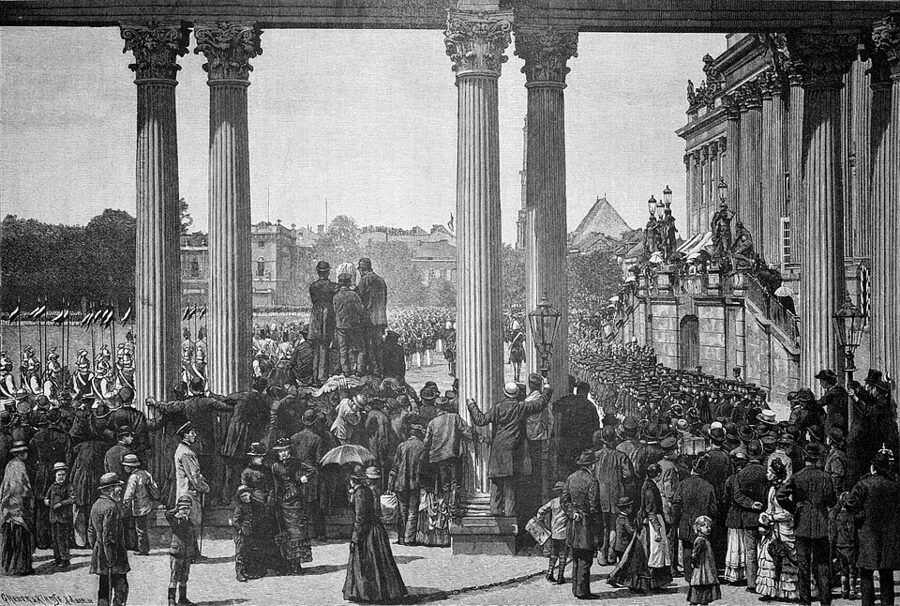
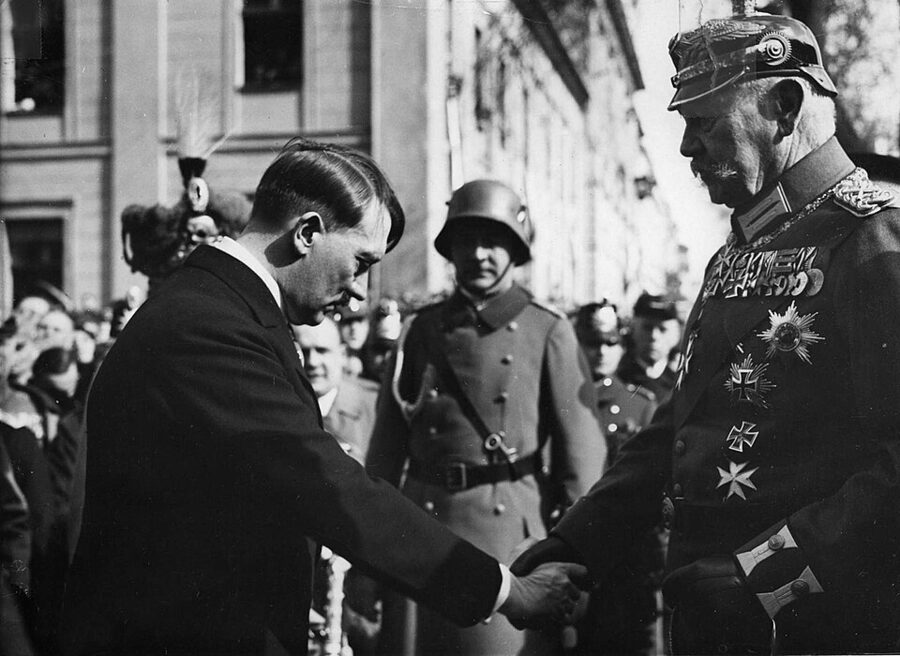
Hitler used all of it. After the Reichstag fire in February 1933, his cabinet opened the new parliament in Potsdam on March 21, the first day of spring and the anniversary of the first Reichstag of 1871, with a ceremony in the Garrison Church. President Hindenburg spoke, Hitler gave a moderate speech, and outside on the street a photographer working for the New York Times caught him bowing over the old field marshal’s hand. Two days later the Reichstag passed the Enabling Act in Berlin, and the “Day of Potsdam” became the picture of the old Prussia blessing the new regime.

Potsdam’s Jewish community, about 600 people at the end of the Weimar years, was pushed out step by step. On the night of November 9, 1938, Nazis wrecked the inside of the synagogue on the Wilhelmplatz; they did not set it on fire only because it stood next to the post office. The last Jews still in the town were forced into a house in Babelsberg and deported, and the last transport left on January 16, 1943, for the ghetto at Riga.
The town grew by decree. In 1938 the weavers’ town of Nowawes was merged with the villa colony of Neubabelsberg and renamed Babelsberg, partly because the regime disliked a Czech name, and on April 1, 1939, Babelsberg and several villages were folded into Potsdam, which passed 100,000 people. The court building on Lindenstraße ordered at least 3,300 forced sterilizations under the Nazi law on hereditary health, and from 1943 it held prisoners of the People’s Court.
The same Potsdam regiments also produced the core of the army plot against Hitler. Of the 29 senior officers and captains serving in Infantry Regiment 9 in 1933, 21 were later in the military resistance, among them Henning von Tresckow, who had lived on Breite Straße, and Fritz-Dietlof von der Schulenburg. Several of them were executed after the failed bomb of July 20, 1944. The Garrison Church’s defenders still cite them, and its critics answer that the plotters met in private houses, not in the church.
The night of April 14, 1945
Potsdam had escaped the bombing for almost the whole war. At 22:16 on April 14, 1945, about 490 Lancaster bombers of the Royal Air Force began dropping some 1,700 tonnes of explosives, mines and incendiaries on the town. The official target was the railway station, but the marker flares came down on the old town, and RAF papers handed over after 1990 confirmed that the old town was the aiming point.
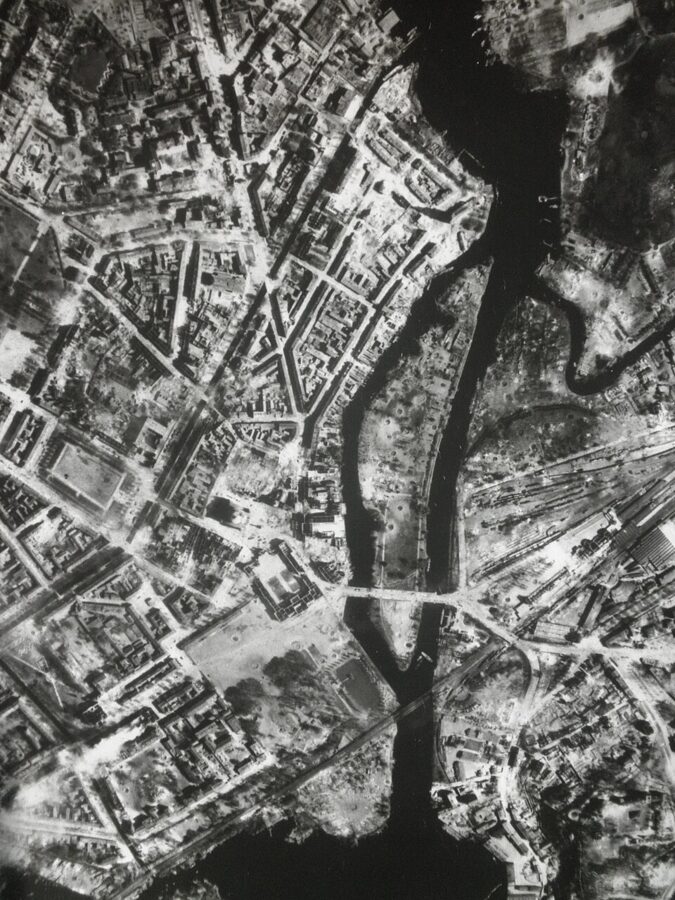
About 1,593 people died in the raid and the fires, almost 1,000 buildings in the center were destroyed, and some 60,000 people lost their homes. The City Palace and the Garrison Church burned out, the church from sparks blown in from the drill hall next door, while the broken water mains left the firemen nothing to fight with. The parks and their palaces came through almost untouched.
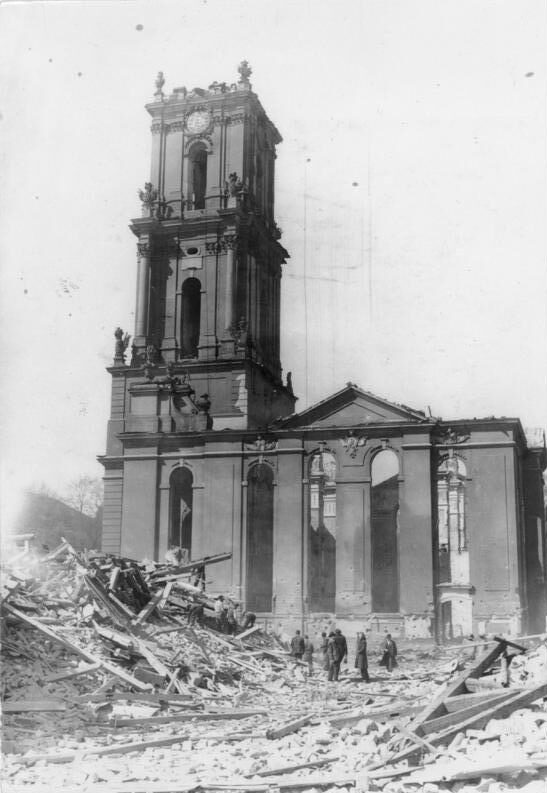

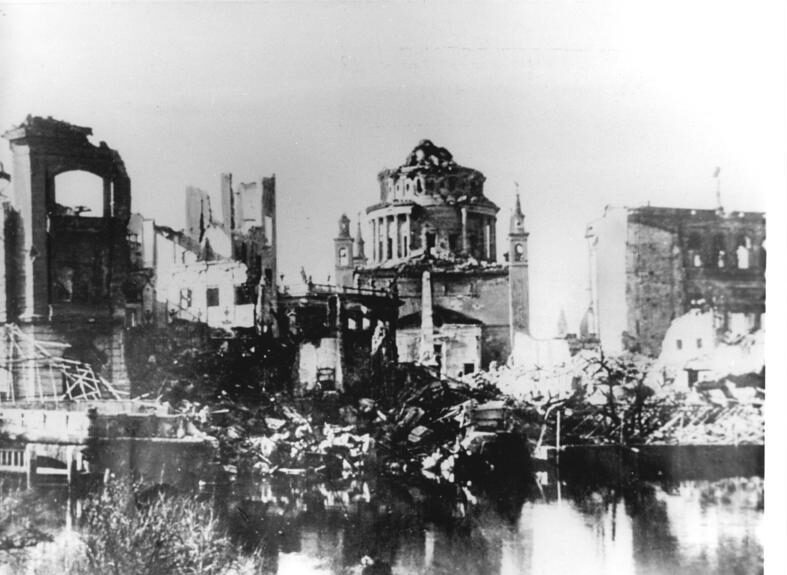
More was lost after the bombers left. The Nazi command declared Potsdam a fortress, blew up bridges over the Havel, the Lange Brücke among them, and put observers on the tallest towers, so Soviet artillery shelled every one of them: the Nikolaikirche lost its dome, the Holy Ghost Church its tower, the Military Orphanage its temple. The Red Army held the town south of the Havel by April 27, and on the night of April 29 the trapped garrison broke out to the south-west. The graves of 1,641 of Potsdam’s dead lie in two fields at the Neuer Friedhof, and unexploded bombs from that night still turn up on building sites, forcing evacuations every year.

The conference, and the town the Soviets kept
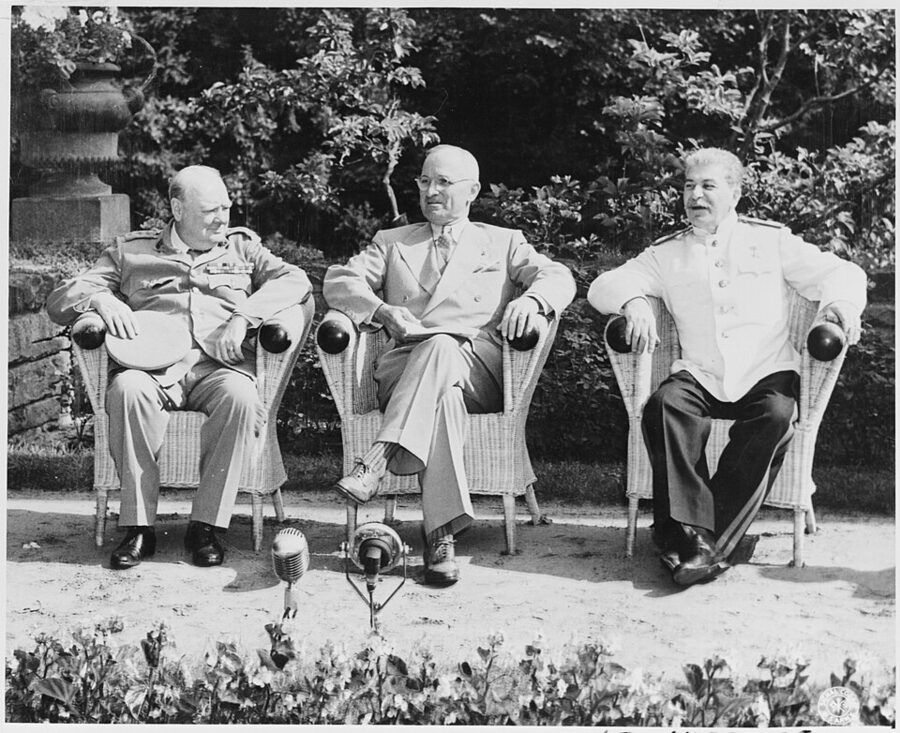
Three months later the victors came to Potsdam because almost everything in Berlin was rubble. From July 17 to August 2, 1945, Truman, Stalin and Churchill, replaced after the British election by Clement Attlee, met around a round table at Cecilienhof, while the delegations slept in requisitioned villas on the Griebnitzsee. They settled the occupation of Germany in four zones, moved Poland’s border west to the Oder and Neisse, issued the ultimatum to Japan, and went home trusting each other less than when they arrived. My article on the Potsdam Conference goes through it session by session.
When the leaders left, the Soviet army stayed, and it took a whole neighborhood. In August 1945 it sealed off about 16 hectares of villas between the Pfingstberg and the Neuer Garten, put out the residents and made the area “Military Town No. 7,” the German headquarters of Soviet military counterintelligence, later part of the KGB. Its streets got Russian names, and for almost fifty years Potsdamers called it the forbidden city.
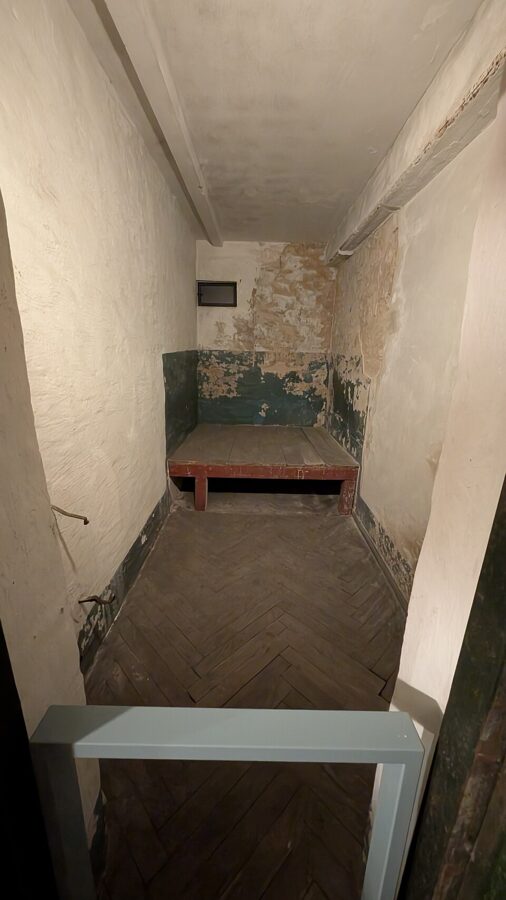
At its center, a former church charity house at Leistikowstraße 1 became the counterintelligence service’s main remand prison. Soviet citizens and Germans were held there for months, often interrogated without any legal help and sentenced by military tribunals to the Gulag or to death; about 80 were shot. The prison ran until 1991, the last Russian units left the area on August 15, 1994, and the house is now a memorial with the prisoners’ scratched inscriptions still on the cell walls.
Socialist Potsdam
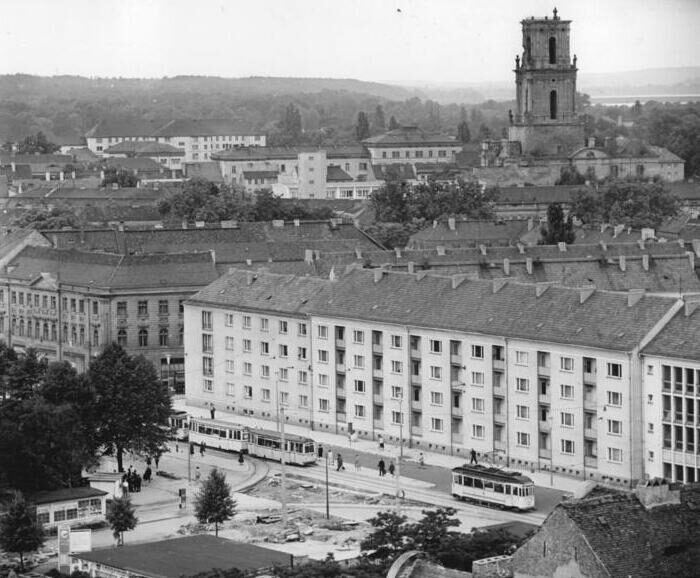
In 1947 Potsdam became capital of the new Land Brandenburg, and when East Germany abolished its states in 1952, it became the seat of a district, the Bezirk Potsdam, with the party’s district leadership, the Stasi’s district headquarters on Hegelallee and the Stasi’s own university in town. A teacher-training college founded in 1951 grew into today’s University of Potsdam. Soviet troops held barracks and compounds all over the city.
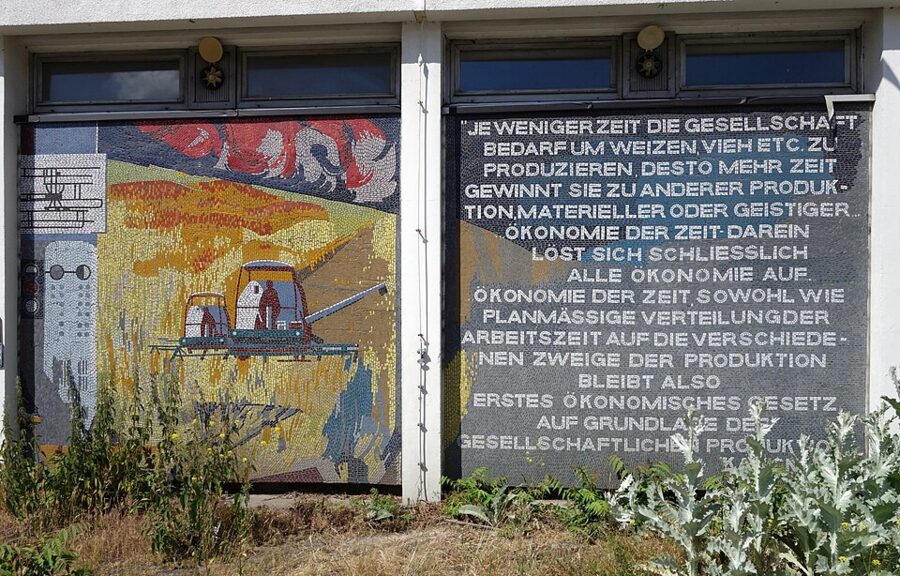
The new state’s attitude to Prussia was split. It put Schinkel and Wilhelm von Humboldt on its first commemorative coins and kept the palaces in the parks open as museums, but it read much of the old town as militarism in stone. The burned-out City Palace was blown up between December 1959 and April 1960 for a socialist forum that was never built, the nave of the Holy Ghost Church came down in 1961 and its tower in 1974, the town canal was filled in between 1962 and 1965, and the Garrison Church went in 1968 despite protests in East and West.
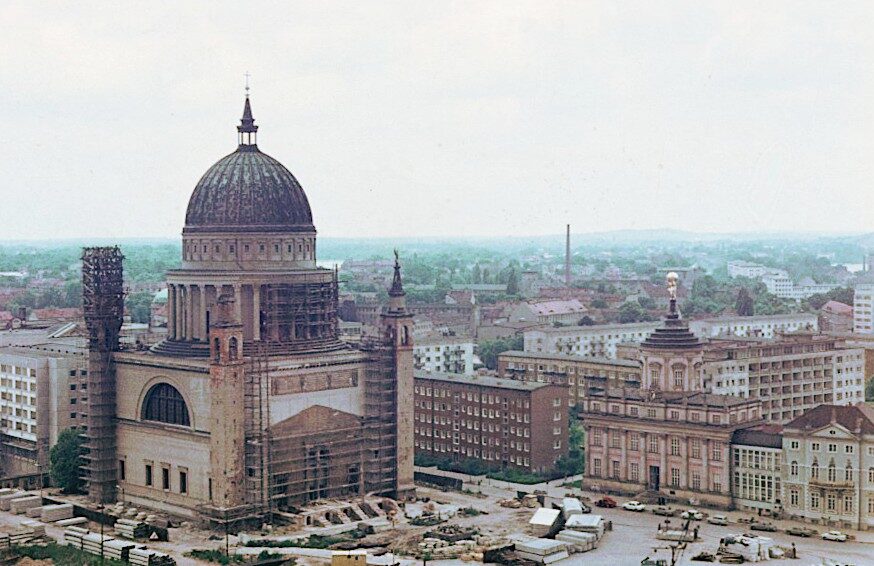

It also rebuilt. The congregation of the Nikolaikirche rebuilt its church over decades and reconsecrated it on May 2, 1981, the Old Town Hall became a cultural center in 1966, and the Marstall became a film museum in 1981. The housing shortage was met with prefabricated concrete districts in the south, Waldstadt, the Schlaatz and Drewitz, and an Interhotel tower went up on the Lustgarten in 1969.
Babelsberg kept making films as DEFA, the state studio, which produced more than 700 feature films and some 160 children’s films. Some were propaganda and some were very good. “Spur der Steine” (Trace of Stones, 1966) was pulled from cinemas within days, and “Jakob der Lügner” (Jacob the Liar) became the only DEFA film ever nominated for an Oscar. Meanwhile the Dutch Quarter, short of money and builders, was slowly falling down.

Living beside the Wall
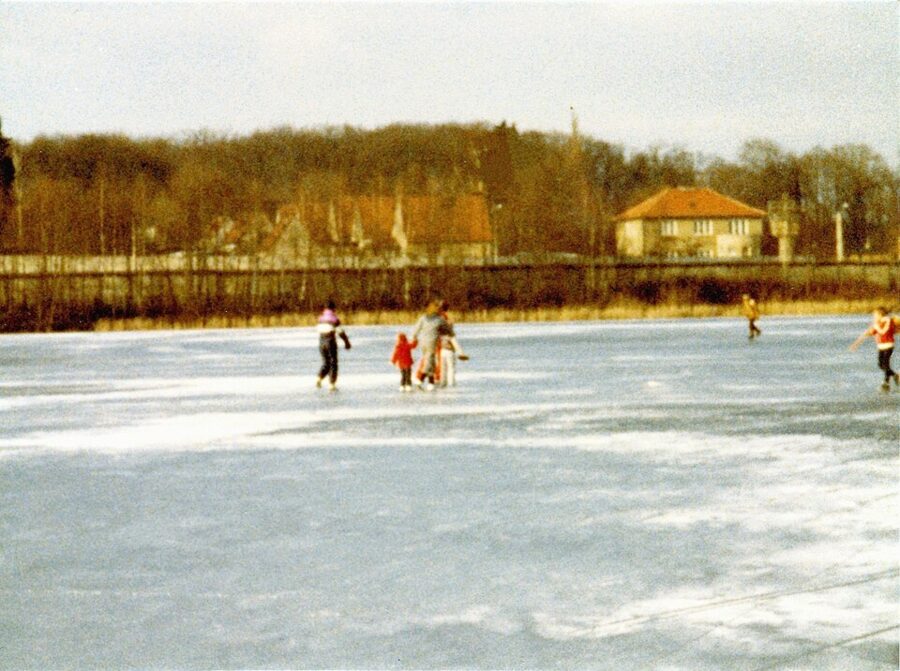
On August 13, 1961, East Germany closed the border to West Berlin, and Potsdam woke up on the wrong side of a wall. For more than a century the town had looked to Berlin across the lakes; now the Griebnitzsee, the Glienicker Lake, the Jungfernsee and the Groß Glienicker See were border water, and the way to East Berlin went round the whole of West Berlin. The Wall ran along the bottom of the villa gardens in Babelsberg and along the shore of the Neuer Garten, whose lakeside dairy stood in the border zone.
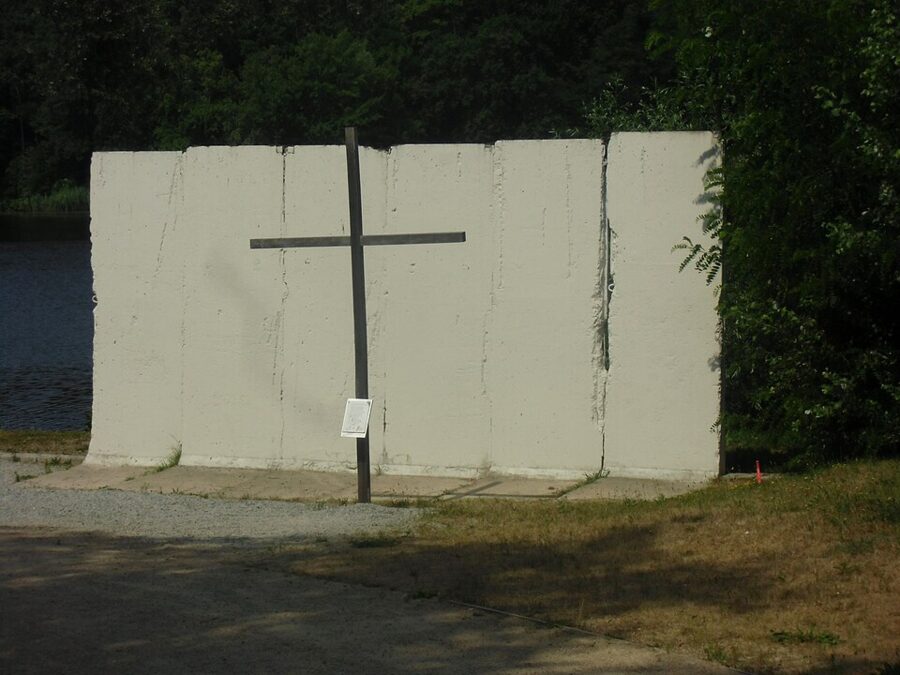

The border cut through the parks themselves. The Church of the Redeemer at Sacrow stood in the death strip for 28 years, with the Wall running up to its bell tower, and the Belvedere on the Pfingstberg was closed and left to decay, partly because it looked straight into West Berlin. In Babelsberg the tiny West Berlin enclave of Steinstücken, home to a few hundred people, sat inside the GDR; East Germany tried to annex it in October 1951 and backed down after American protests, and only a land swap in 1972 gave it a road to the West.

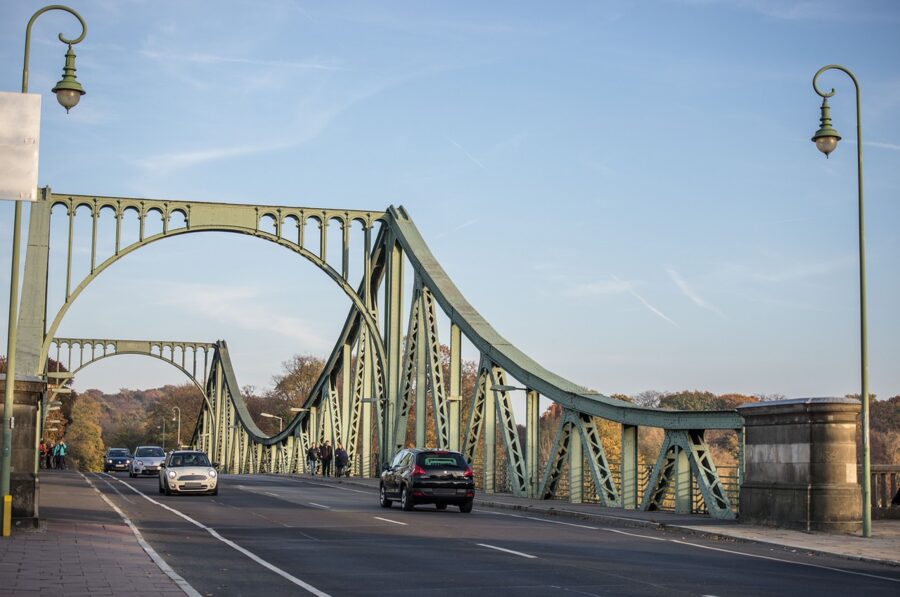
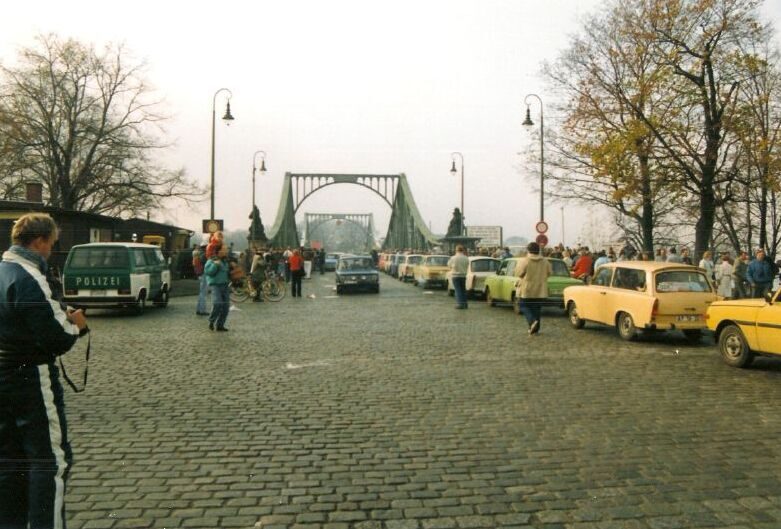
The bridge at the city’s edge became the most famous crossing of the Cold War. Closed to ordinary traffic, the Glienicke Bridge was used three times to exchange prisoners between the United States and the Soviet bloc, in 1962, 1985 and 1986, and the press named it the Bridge of Spies. My article on the Glienicke Bridge tells those three days and shows you where the line ran across the steel.
Autumn 1989
Opposition in Potsdam started small, in flats and church halls in the second half of the 1980s: groups working for human rights, for peace and disarmament in East and West, against pollution, and against the decay of the old town. The environmental group Argus campaigned to save the crumbling Dutch Quarter. In May 1989 a group that met in a church hall in Babelsberg proved that the local election results had been faked.
On October 7, 1989, the fortieth anniversary of the GDR, people gathered at the musical clock by the Brandenburg Gate for the first independent demonstration in the town; it was banned, and there were arrests. Three days earlier the appeal of the new civic movement New Forum had been read out in the Friedrichskirche in Babelsberg. By November 4, about 20,000 people filled the Luisenplatz, then named Platz der Nationen, in the largest demonstration Potsdam saw in those weeks.
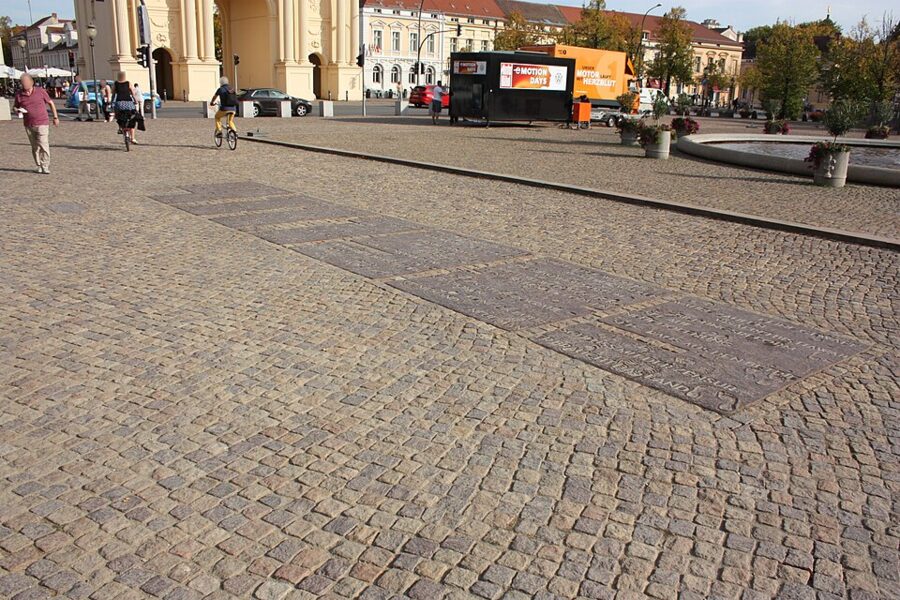

Five days after that, the Wall opened in Berlin, and on November 10 the Glienicke Bridge opened to anyone on foot. On December 5, citizens occupied the Stasi’s district headquarters on Hegelallee to stop the files from being destroyed. The East German state did not last another year.

Capital, World Heritage and the rebuilding argument
Reunification on October 3, 1990, brought the Land Brandenburg back, with Potsdam as its capital. In December 1990 UNESCO listed the palaces and parks of Potsdam and Berlin as World Heritage, 500 hectares of parks and 150 buildings put up between 1730 and 1916, and later extensions added Sacrow, Alexandrowka, the Pfingstberg and the Bornstedt village. The Russian army left in 1994, and the city celebrated its thousandth anniversary, counted from the charter of 993, in 1993.
On October 24, 1990, three weeks into the new Germany, the first freely elected city council voted for a “return to the historic townscape,” and the arguments have not stopped since. The Fortuna Portal came back in 2002, paid for by citizens and a television host who lives in town; the City Palace’s facades went up again from 2010 to 2013 around the Landtag, Brandenburg’s state parliament, which moved in on January 21, 2014; and the Palazzo Barberini reopened as the Museum Barberini in 2017. My guide to Potsdam’s old town walks the rebuilt center street by street and sets out both sides of the quarrel.
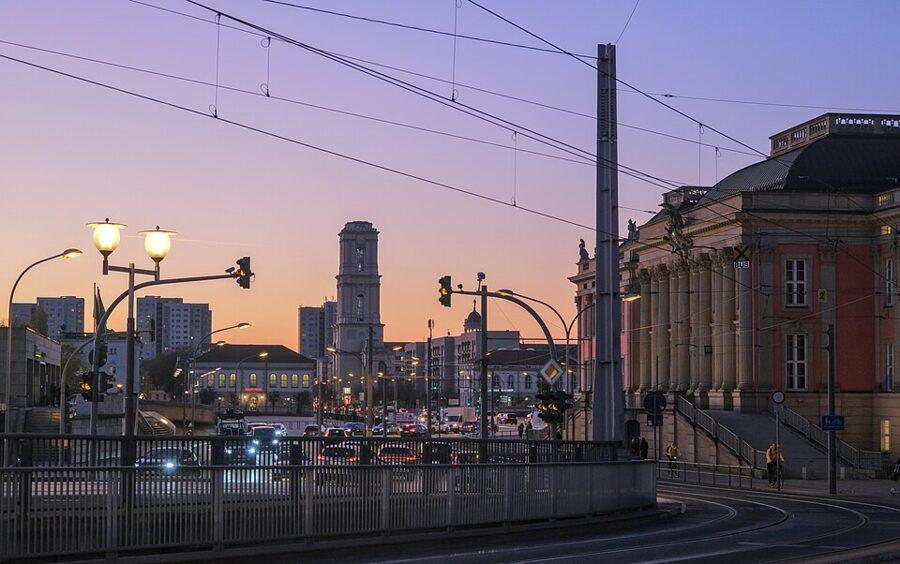

The Garrison Church is the hardest case. Its tower was rebuilt from 2017 and opened in August 2024 with an exhibition that faces the whole record, from the soldier king to 1933, while critics in the artists’ house next door, the GDR’s old computing center, argue that rebuilding it honors the militarism it stood for. The cap is due in summer 2027, and the computing center may stay until 2033. Meanwhile the East German apartment block behind the Nikolaikirche came down in 2024 and 2025, and new houses with old facades are closing the Alter Markt again.
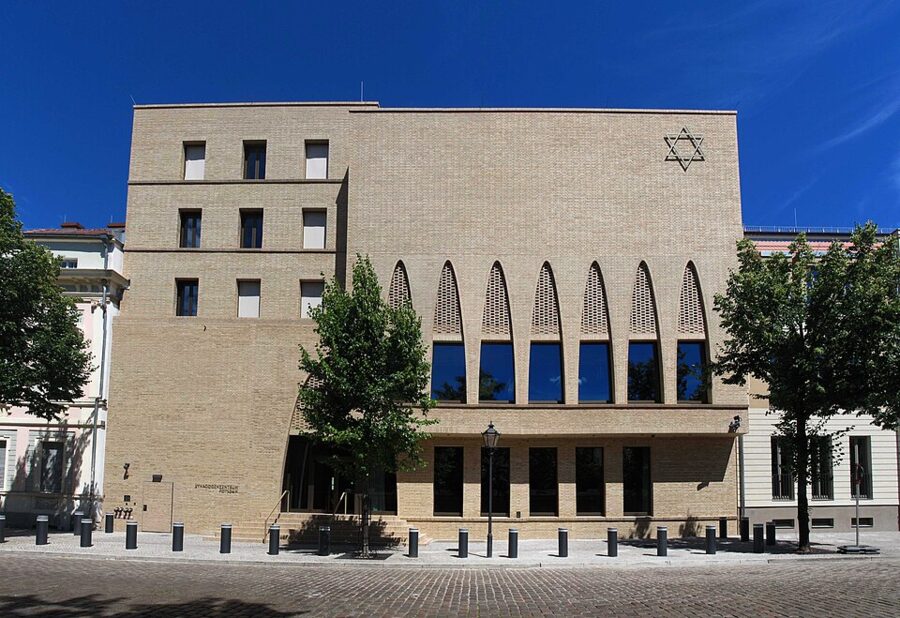
Not all of the new Potsdam is old. The federal garden show of 2001 turned a former army training ground on the Bornstedter Feld into the Volkspark Potsdam, and the stretch of the town canal on Yorckstraße was dug out again for it. On July 4, 2024, a synagogue center opened on Schlossstraße, across the street from the Filmmuseum, the first synagogue built in central Potsdam since the war. UNESCO named Potsdam a Creative City of Film in 2019, the University and more than 30 research institutes have made it a science town, and the population, 128,983 at its post-reunification low in 1999, stood at 185,137 at the end of 2025.

Seeing Potsdam’s history in a day
You can walk the thousand years in a long day, and I would do it in this order. Take the S7 or the RE1 to Potsdam Hauptbahnhof (main station); you need a Berlin ABC ticket, €5.00 single or €12.90 for 24 hours in 2026, rising to €5.20 and €13.20 on January 1, 2027, and the Deutschlandticket covers it too. The trains and fares are laid out in my Potsdam day trip from Berlin.
Cross the Lange Brücke and start at the Potsdam Museum in the Old Town Hall, open Tuesday to Sunday and on holidays 10:00–18:00 (closed December 24 and 31), whose permanent history exhibition is free. Then walk the Alter Markt, Burgstraße and the Neuer Markt, where the Brandenburg Museum in the old carriage stables covers the whole state’s history, and go up Breite Straße to the Garrison Church tower; its exhibition and platform together cost €12 (reduced €9), and from 2027 its weekday hours may change, so check before a weekday visit.
North of Yorckstraße, the Lindenstraße memorial in the old court and prison covers both dictatorships and asks for whatever you can pay, €0–10. The Dutch Quarter and the Nauener Tor are ten minutes on; Alexandrowka is ten minutes beyond that, and the former Soviet prison at Leistikowstraße 1 is a short walk east of the colony, free and open Tuesday to Sunday 13:00–17:00, closed from December 22 to 31, 2026.
Save the afternoon light for Sanssouci. Walk out along Brandenburger Straße and over Luisenplatz, where the 1989 memorial is set in the ground, to the Church of Peace at the park’s edge, then up to Frederick’s grave on the terrace. The Sanssouci+ ticket from the Prussian Palaces and Gardens Foundation (SPSG) costs €22 (reduced €17) in 2026 and €24 (reduced €20) in 2027, and it is the only palace ticket you can book online; it gets you a timed entry to Sanssouci Palace, and single tickets are sold only on the day at the desks.
Two seasonal warnings. The New Palace closes on Mondays from January to October and on Tuesdays in November and December, and from November to March it is seen only on a guided tour. Cecilienhof, the Orangery Palace and the Roman Baths are closed for restoration until further notice, and Babelsberg Palace opens only for events; my notes on the best time to visit Potsdam cover what each season opens and shuts, and the full list of things to do in Potsdam has the rest.
If you are traveling with children, the Filmpark Babelsberg and the Biosphäre are easier sells than a prison memorial, and my guide to Potsdam with kids picks the history that works for them. For the museums I have skipped here, the overview of museums in Potsdam sets them side by side.
A short timeline of Potsdam
- 993: Otto III’s charter names Poztupimi, the Slavic settlement at the Havel crossing.
- 1157: Albert the Bear founds the Margraviate of Brandenburg.
- 1317 and 1345: Potsdam appears as a town, then has its rights confirmed.
- 1618–1648: the Thirty Years’ War halves the population.
- 1660: the Great Elector makes Potsdam his second residence.
- 1685: the Edict of Potsdam invites the Huguenots.
- 1713–1740: Frederick William I builds the garrison town, the Dutch Quarter and the Garrison Church.
- 1745–1747: Sanssouci is built for Frederick the Great.
- 1763–1769: the New Palace goes up after the Seven Years’ War.
- 1806: Napoleon in Potsdam.
- 1838: the first railway in Prussia links Potsdam and Berlin.
- 1840–1861: Frederick William IV, Persius and Lenné shape the landscape around the town.
- 1912: the first film is shot at Babelsberg.
- 1918: the monarchy ends.
- March 21, 1933: the Day of Potsdam in the Garrison Church.
- April 14, 1945: the RAF raid destroys the center.
- July 17 to August 2, 1945: the Potsdam Conference at Cecilienhof.
- 1952–1990: capital of the GDR district of Potsdam.
- 1959–1960 and 1968: the City Palace and the Garrison Church are blown up.
- 1961–1989: the Berlin Wall runs along the city’s lakes.
- November 4, 1989: about 20,000 demonstrate on Luisenplatz.
- 1990: capital of Brandenburg again; the palaces and parks become World Heritage.
- 2014: the Landtag moves into the rebuilt City Palace.
- 2024: the rebuilt Garrison Church tower and the new synagogue open.
Go back to the Nuthe at the end of the day, when the light drops behind the Heilig-Geist-Residenz. The tower that looks like a church is a retirement home, the church it imitates was blown up in 1974, and under both of them lies the fort that a German emperor gave away in 993 without owning it. From there it is about ten minutes along the river to the Lange Brücke and the station, over the oldest crossing in town.