

The gravestone at the east end of the top terrace at Sanssouci carries no dates, no crown and no list of victories. It says Friedrich der Große in three lines of plain capitals, and on most days the slab is half buried under potatoes: small yellow ones, a few sprouting, sometimes a sunflower laid across them. Frederick had the vault under that stone dug in 1744, before a single wall of the palace behind it went up. It then took 205 years, two world wars, one coffin on the road and a reunified Germany before anyone put him in it.
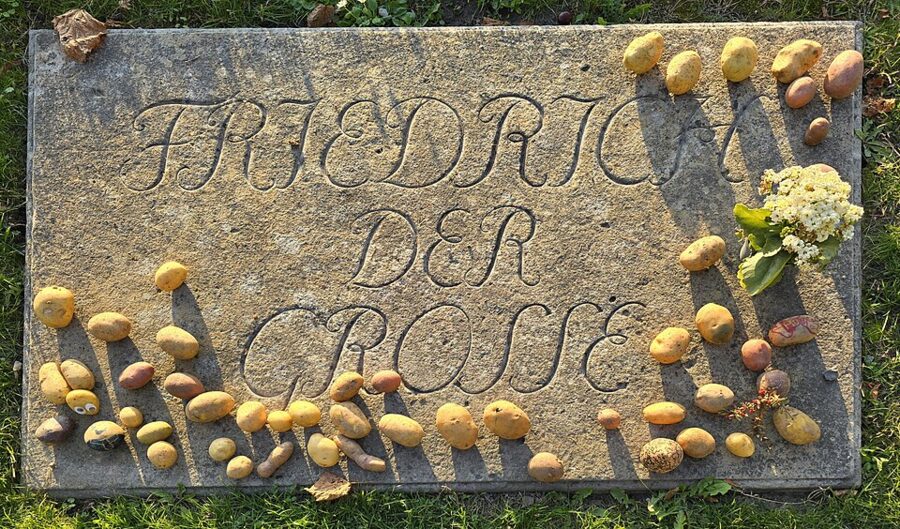

That grave is the best place to start with Frederick the Great (Friedrich II), because it holds the whole argument about him in a few square meters. He wanted to lie next to his greyhounds, at night, without pomp. Instead his coffin went into a church crypt in town, where kings came to bow, Napoleon came to stand, Hindenburg laid wreaths in 1933 and Wehrmacht soldiers carried it off to a bunker ten years later.
Potsdam was his town in a way Berlin never was. He grew up in its barracks, rebuilt its palace and its market square, gave its burghers palace facades they had not asked for, and spent every summer that was not a war summer on a vineyard hill at its western edge. Much of what he built is standing, or standing again, and you can walk his whole life in a day.


Contents7 parts
The soldier king’s garrison town
The Potsdam Frederick knew as a boy belonged to his father, Frederick William I (Friedrich Wilhelm I), the “soldier king.” From the 1720s he turned a small residence on the Havel into a garrison town and billeted his soldiers in the burghers’ own houses, so that at times close to half the people in Potsdam wore a uniform. He pushed the town outward in two baroque extensions, ringed it with an excise wall to stop desertion and smuggling, and gave it three church towers.
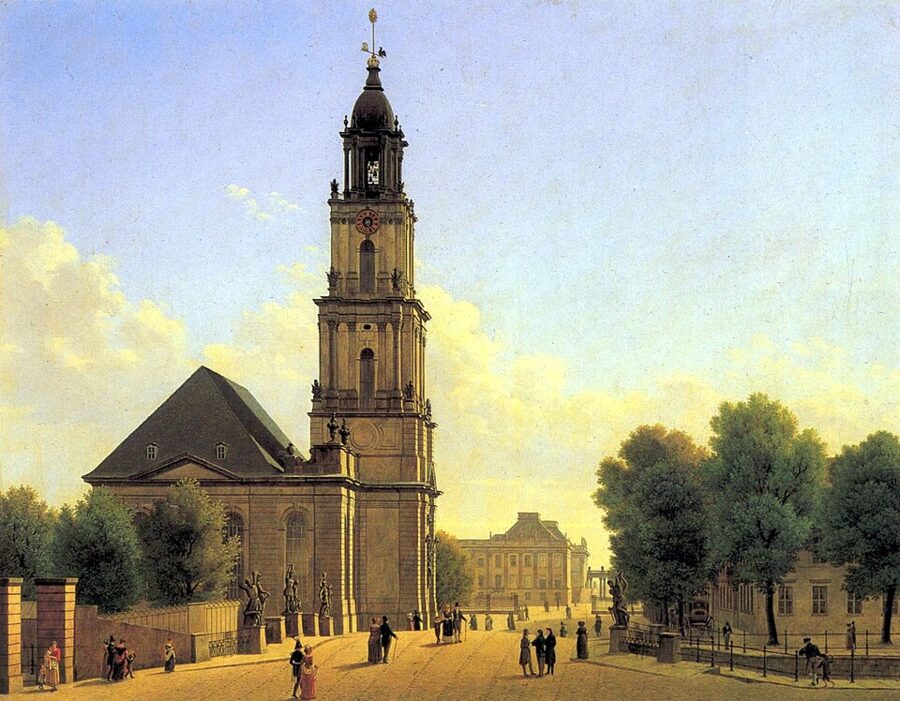
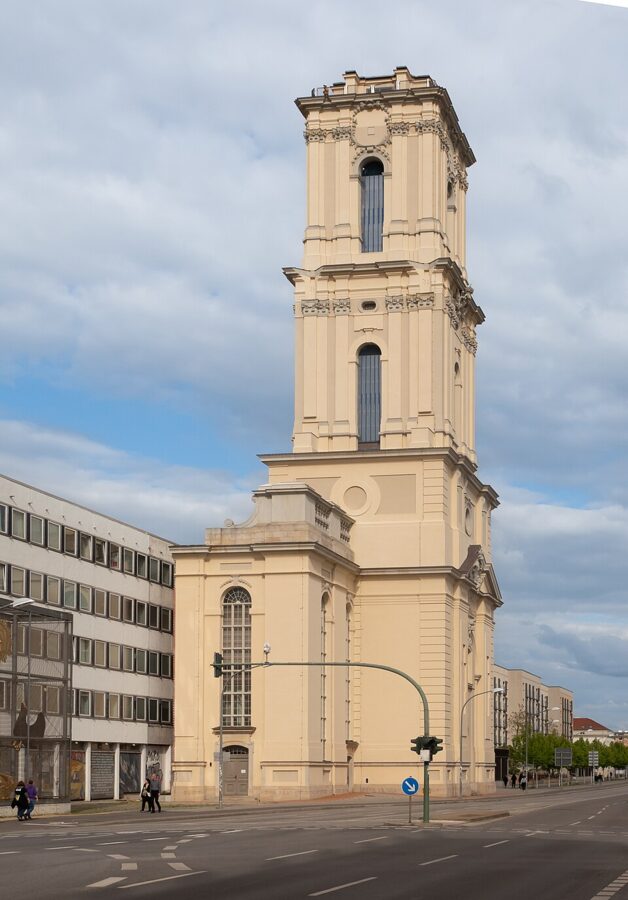
The tallest belonged to the Garrison Church (Garnisonkirche), built to Philipp Gerlach’s design in 1730–35 and almost 90 meters high, with a plain whitewashed vault behind the pulpit that the king had made for himself. To fill the new streets he brought in Dutch craftsmen and had Jan Bouman build them the red-brick Dutch Quarter, 134 houses that his son finished after 1740.
Then there were the giants. The king’s own regiment, the Lange Kerls (“tall fellows”), was meant to take men of at least six Rhenish feet, about 1.88 meters, and his recruiters combed Europe for them with cash and sometimes with force. A home-grown six-footer cost 600 thalers; a 1.92-meter foreigner could cost 3,000. A few were true giants, like the Irishman James Kirkland at 2.17 meters.
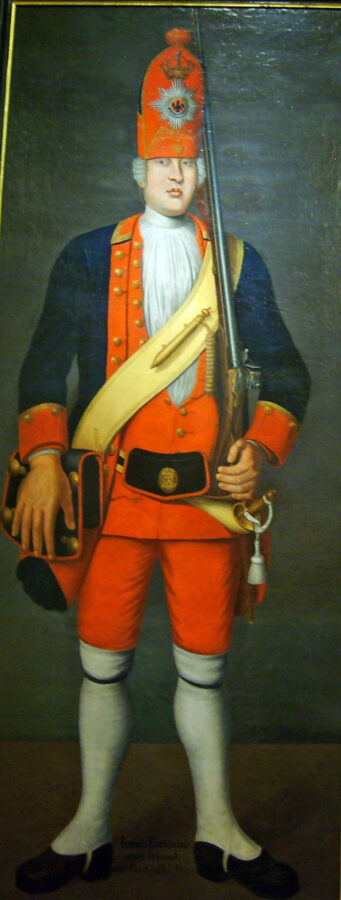
Into this barracks world came a crown prince who liked French verse, curled hair and the flute. His father wrote out his day to the minute, down to “breakfast in seven minutes,” and when he caught him at secret Latin lessons he beat teacher and pupil alike. From 1728 the boy took flute lessons in secret with Johann Joachim Quantz, a court musician from Dresden, who later told how he once spent an hour hiding behind a stove during one of the king’s searches, together with a young officer named Hans Hermann von Katte.
1730: the escape that failed
Katte was eight years older, worldly, a flute player and a poet, and the two were inseparable; a courtier wrote that they behaved like lovers. In the summer of 1730, during a royal journey through southern Germany, Frederick tried to slip away in the night of August 4 from his quarters at Steinsfurt, hoping to reach French Alsace. A valet raised the alarm before he reached his horse, and a letter to Katte with instructions for the flight was intercepted.
Frederick was locked up in the fortress of Küstrin on the Oder. A court-martial at Köpenick gave Katte life imprisonment; the king told the judges to think again, and when they returned the same verdict he changed it himself to death. On November 6, 1730, Katte was beheaded in the fortress courtyard on a scaffold built up to the level of the prince’s window, and Frederick was made to watch. By his sister Wilhelmine’s account he begged Katte’s forgiveness through the window and fainted before the sword fell.
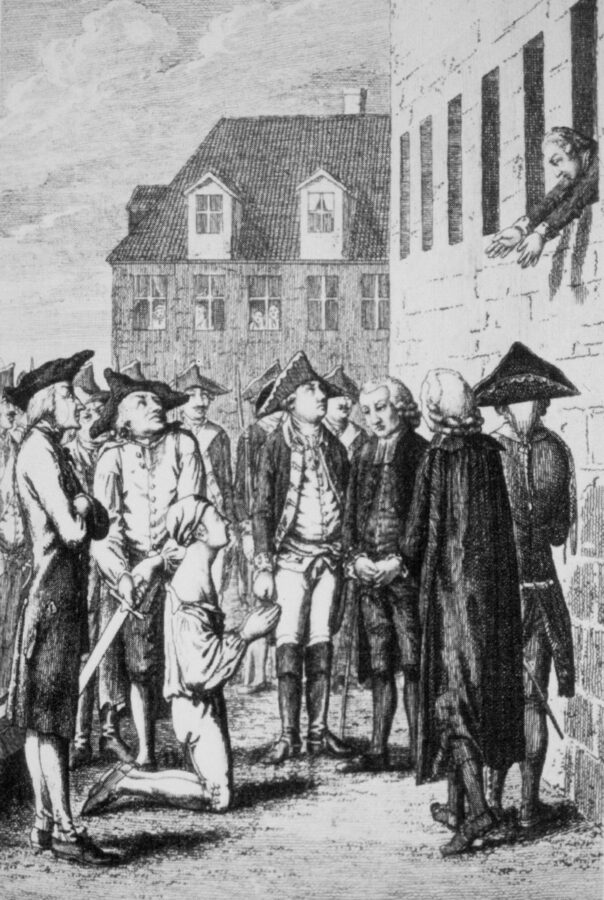
Others paid too. Dorothea Ritter, the sixteen-year-old daughter of a Potsdam school rector who had played music with the prince, was publicly flogged on the king’s orders and shut in the Spandau workhouse until 1733. Frederick was pardoned, put to work in the provincial administration at Küstrin and married off in 1733 to a princess he never loved. He did not try to run again.
You can read the rest of his life in Potsdam as a reply to those years. His father built barracks, churches and streets, not palaces; the son hardly stopped building. His father wanted a soldier, and the son became one, a ruthless one, but he kept his flute, his French books and a small house on a hill where nobody could tell him when to eat breakfast.
The builder
Frederick became king on May 31, 1740, when his father died in the Potsdam City Palace (Stadtschloss). After a few years based mostly at Charlottenburg, around 1744 he settled on Potsdam and set his friend Georg Wenzeslaus von Knobelsdorff to turn the old palace on the Havel into his winter residence, with a staircase faced in Silesian marble, a concert room in green and gold and a theater that opened, unfinished, in March 1748.
In that concert room, at the evening hour of court music on May 7, 1747, a messenger brought word that Johann Sebastian Bach had arrived to visit his son, the court harpsichordist. Frederick broke off the concert (“Gentlemen, old Bach has come!”), sent him round every keyboard in the palace and gave him a theme to improvise on. Bach later worked it up into The Musical Offering.

Sanssouci, from his own sketches
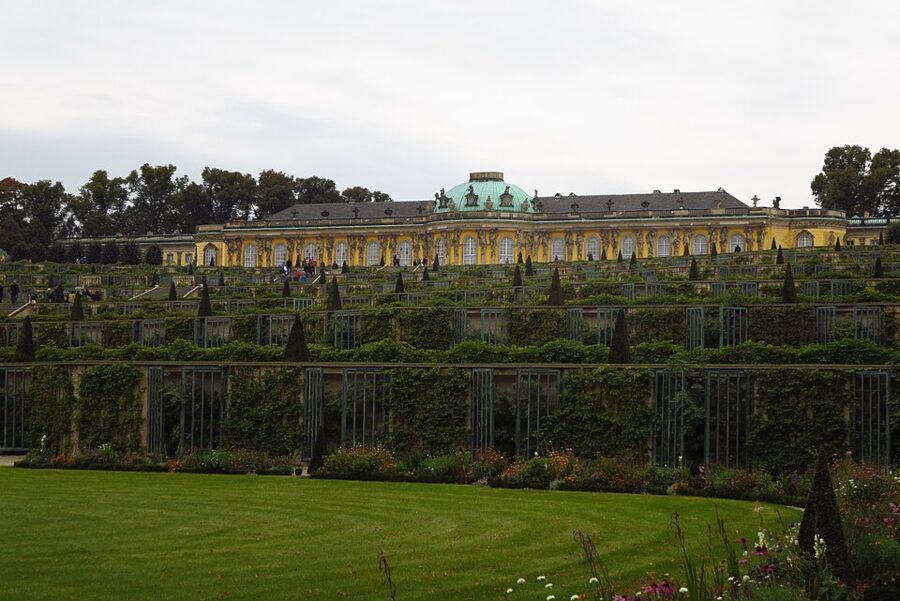
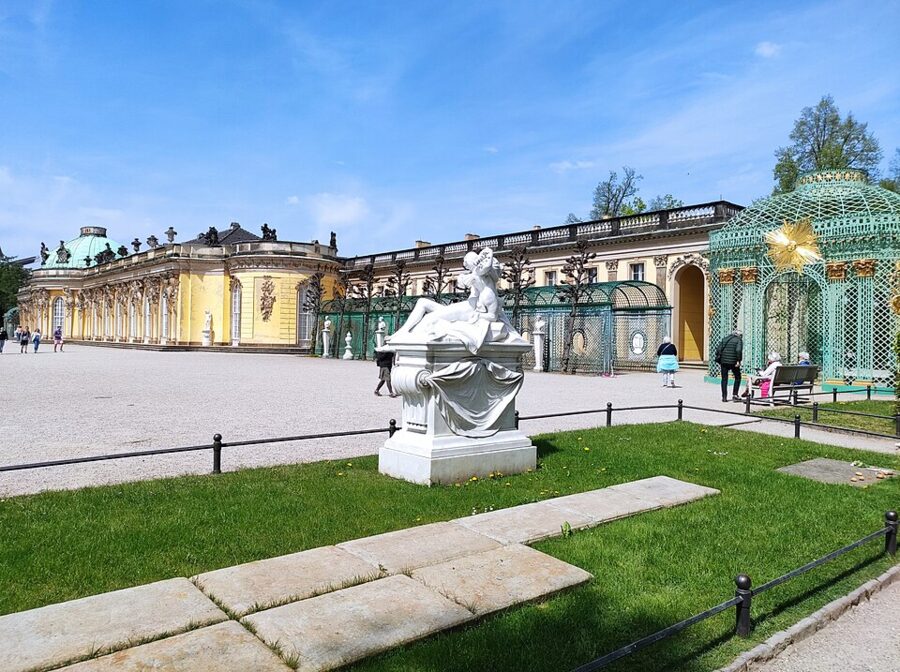
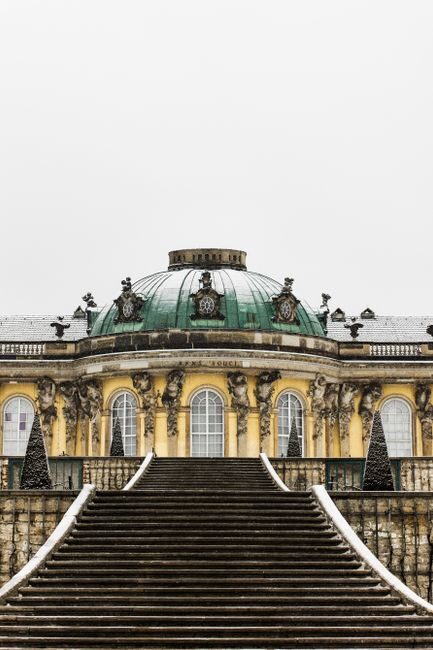
The summer house began as a vineyard. On August 10, 1744, Frederick ordered the bare south slope west of town cut into six terraces, and in January 1745 he ordered a “pleasure house” on top, drawn by Knobelsdorff from the king’s own sketches. Knobelsdorff wanted to raise it on a basement and push it to the edge of the terrace so it would look grander from below; Frederick refused. He wanted one story with the hill as its plinth, so he could step from his rooms straight into the garden, and he got it, along with the rising damp and cold feet that a house without a cellar brings.
Sanssouci opened on May 1, 1747, unfinished, and Frederick lived there from late April to early October in every year without a war. His wife, Elisabeth Christine, was never invited; she saw it once, in October 1757, while fleeing Berlin during the Seven Years’ War. With its cedar-paneled round library, domed Marble Hall and gilded concert room, it is the only palace where his own rooms survive close to the way he left them, and the one interior in Potsdam I would book first.
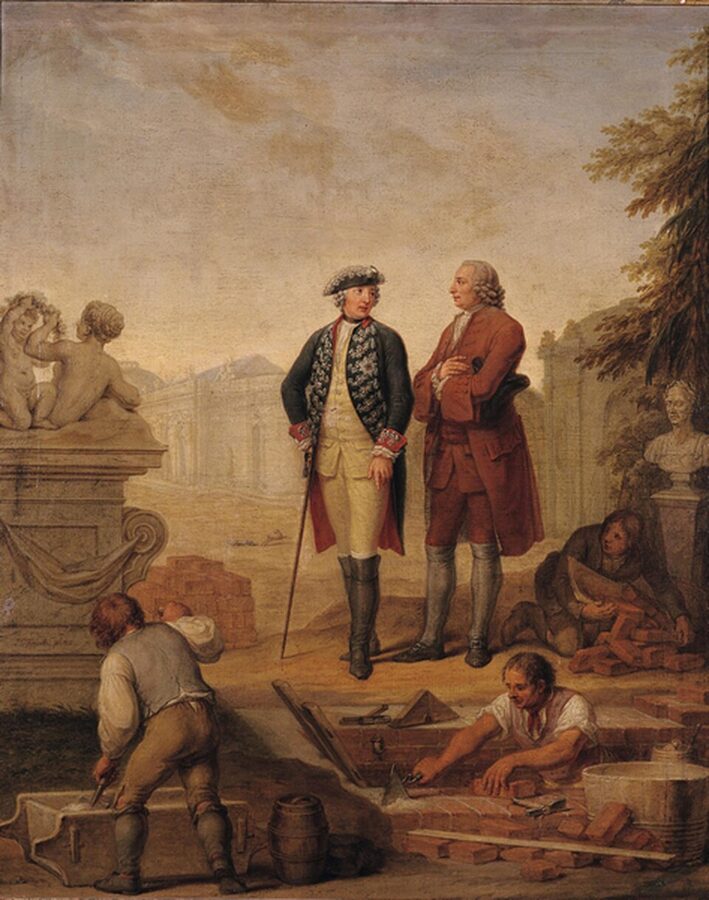
The garden had one problem he never solved. He wanted fountains, and in 1748 had a reservoir dug on the hill north of the palace and dressed up with fake Roman ruins, so that windmill pumps could lift Havel water into it and gravity could send it down to the jets; the mathematician Leonhard Euler was asked for the calculations. The pumps never kept up, the king would not pay for better ones, and the Great Fountain below the terraces stayed dry until a steam engine finally drove it a century later.
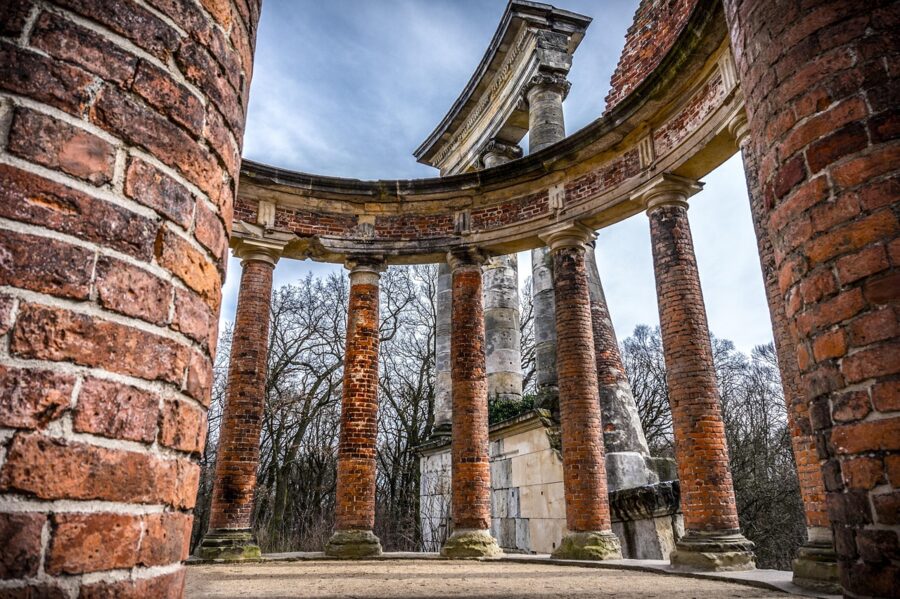
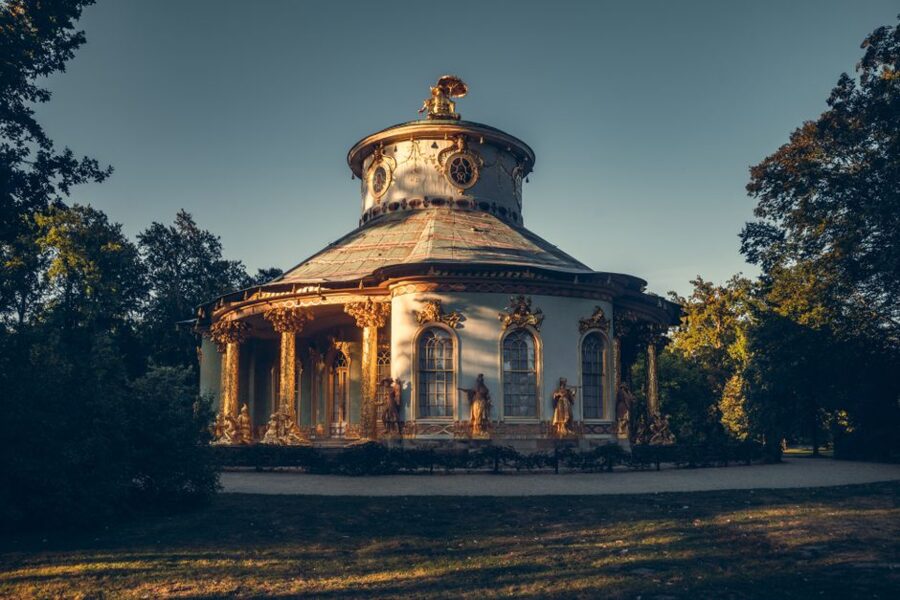
Around the palace he kept adding. To the east came the Picture Gallery (Bildergalerie) of 1755–64, the oldest surviving building in Germany made to show paintings, where Caravaggio’s Doubting Thomas still hangs among works by Rubens and van Dyck. To the west, Knobelsdorff’s orangery was remade in 1771–75 as the New Chambers (Neue Kammern), a guest house with a jasper hall. Down in the park the gilded Chinese House (Chinesisches Haus) went up to his sketches, with life-size golden tea drinkers and musicians around its walls.
After the war: the New Palace and the town
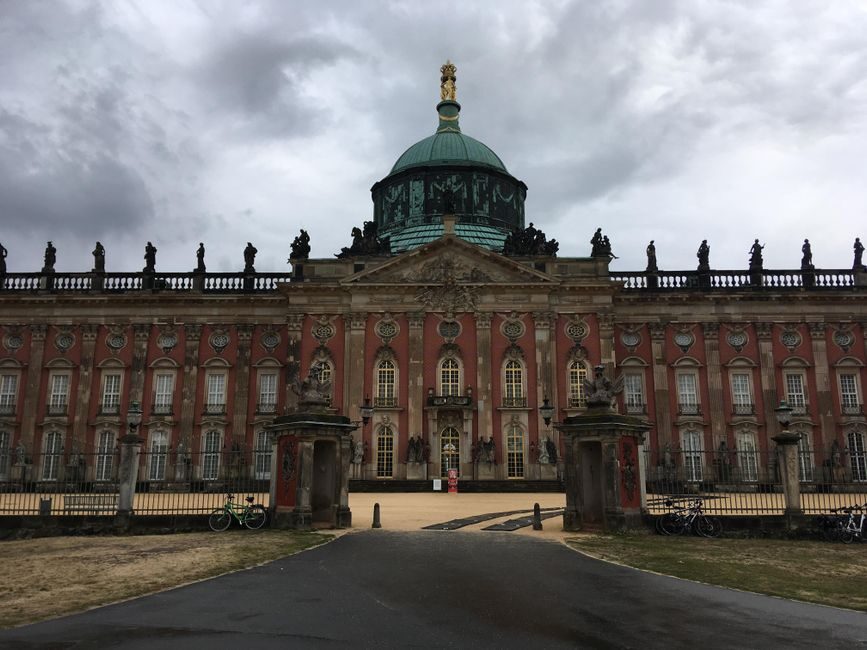
The Seven Years’ War ended in 1763 and Frederick began the New Palace (Neues Palais) the same year at the far western end of the park: more than 200 rooms, four festival halls and a theater, finished by 1769. He called it a fanfaronade, a brag, a message to Europe that Prussia had come through the war with money to spare. He rarely slept there, and at plays in its theater he sat in the third row of the stalls, because there was no royal box.
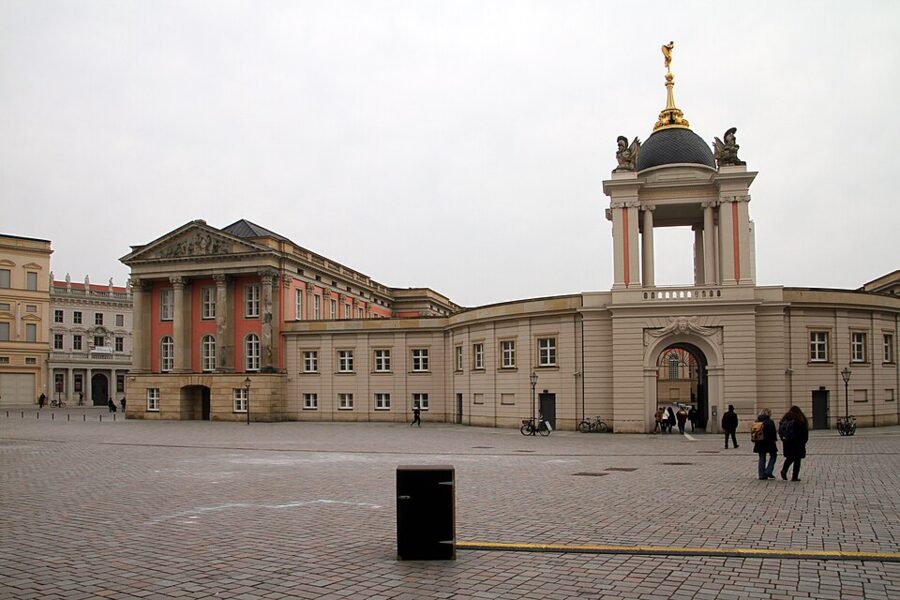
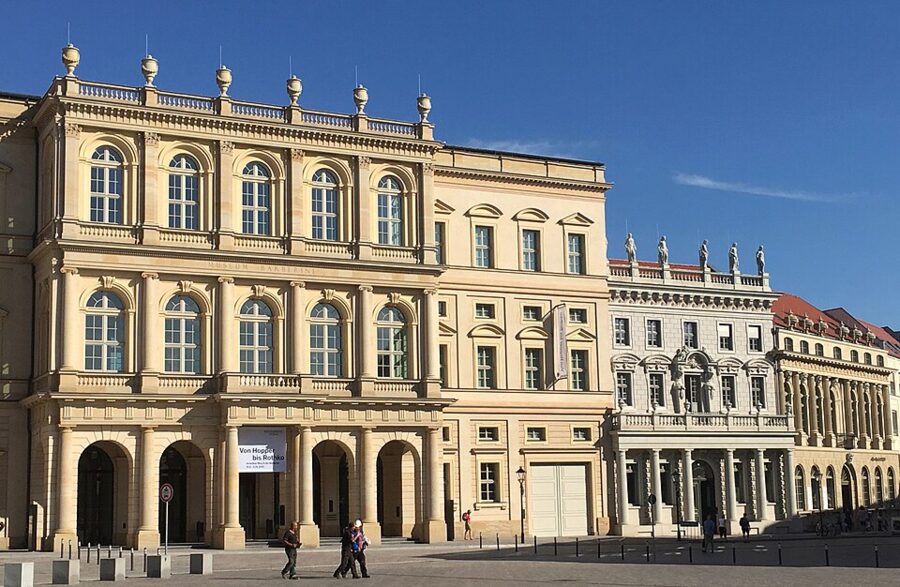
He treated the town like the park. From 1750 the houses around the Alter Markt got new fronts copied from Italian palaces and churches, and in 1753–55 Knobelsdorff set up the obelisk in the middle, with portrait medallions of Frederick and his three predecessors, the only monument to himself he allowed while he lived. In 1771–72 Carl von Gontard closed the south side with the Palais Barberini, copied on the king’s orders from the Palazzo Barberini in Rome.
Behind that palace front lived a carpenter and an innkeeper. That was the system: the king picked a facade from his books, the owners moved out in spring and back in by autumn, and they lived with whatever the copy left them, often low mezzanine rooms squeezed in behind tall windows. Destroyed in 1945, it was rebuilt and reopened in 2017 as the Museum Barberini.

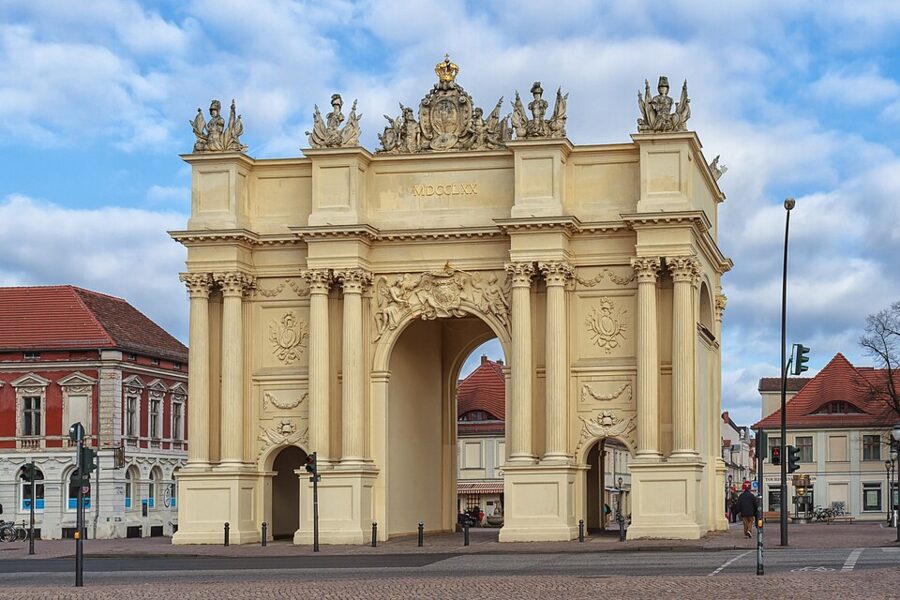
The Brandenburger Tor on Luisenplatz followed in 1770–71 as a victory arch, with two different faces because two architects drew it: Gontard the town side, his pupil Georg Christian Unger the country side, modeled on the Arch of Constantine.

Summers at Sanssouci: the flute, the table, the dogs
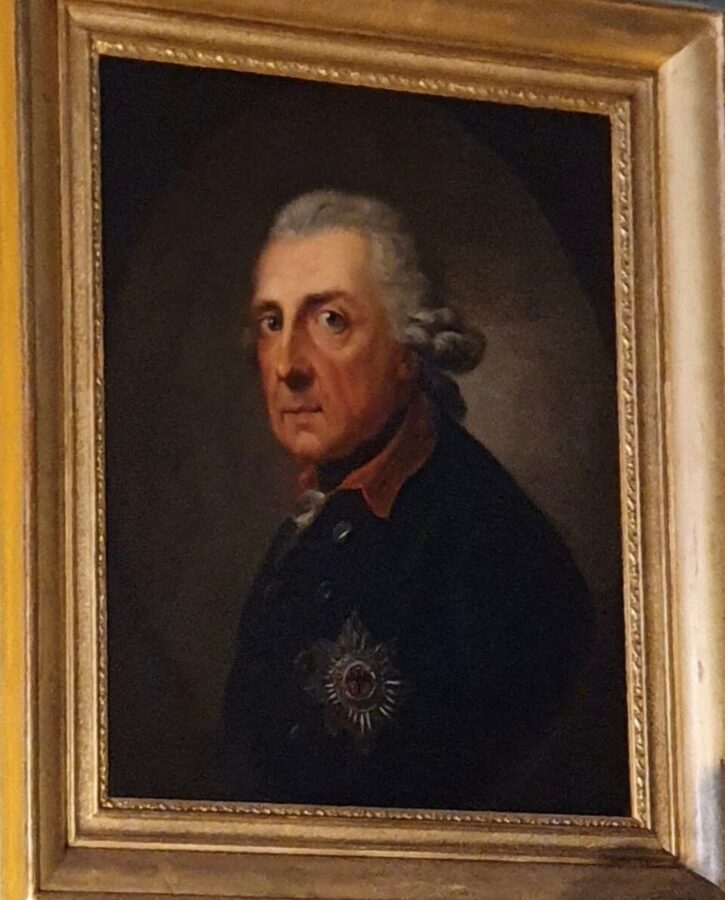
Frederick dressed in the plain blue coat of a colonel of his guard, with the star of the Black Eagle as its only ornament. He felt the cold badly and wore three waistcoats under it in winter, his boots went unpolished, and coat and face were usually dusted with snuff.
The rooms tell you how his days ran. East of the Marble Hall come the audience room, which doubled as his dining room, the concert room, and the study that was also his bedroom; beyond it, off a narrow passage, lies the round library where nobody followed him.
The flute and Quantz
Quantz, the teacher of the secret lessons, joined Frederick’s court after the accession and stayed until his death in Potsdam in 1773. He never played in the court orchestra, only with the king, and wrote some 300 flute concertos and more than 200 sonatas, most of them for his royal pupil. Frederick composed too: about 120 sonatas for flute and keyboard and four concertos survive under his name.
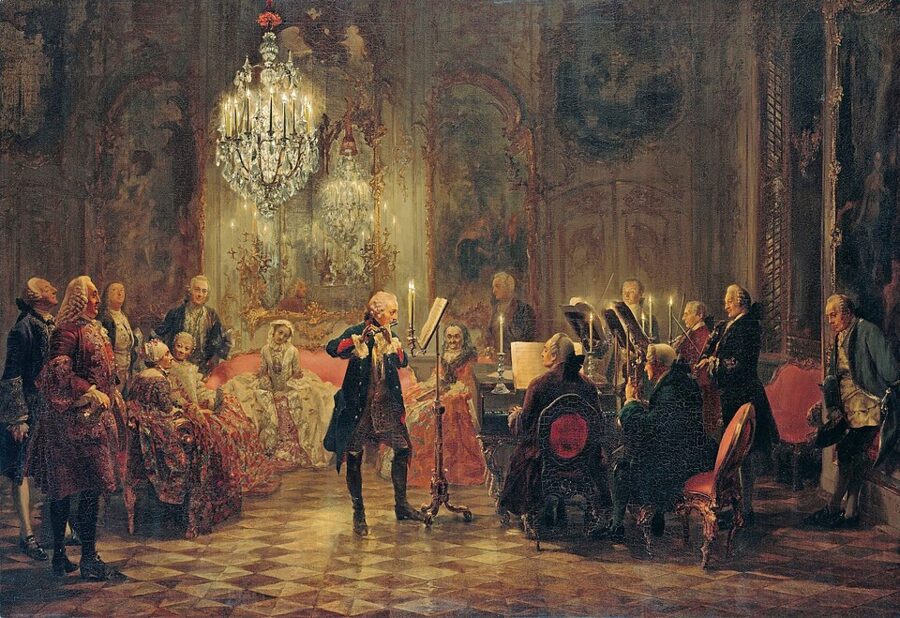
The concerts were small, in the hour before supper, for family, friends and household; in Menzel’s picture every man stands because the king stands, except the harpsichordist and the cellist. Carl Philipp Emanuel Bach served at that keyboard for nearly three decades and, by most accounts, thought little of his employer’s taste, and he left for Hamburg in the late 1760s.
The round table and Voltaire
At table Frederick wanted talk, in French, and he collected people who could supply it: the Marquis d’Argens, Count Algarotti, the materialist doctor La Mettrie, the mathematician Maupertuis, the Scottish Keith brothers and his friend Count Rothenburg. Menzel put his famous Round Table under the dome of the Marble Hall, but the meals probably took place in the smaller audience room next door, which could be heated on cool days.
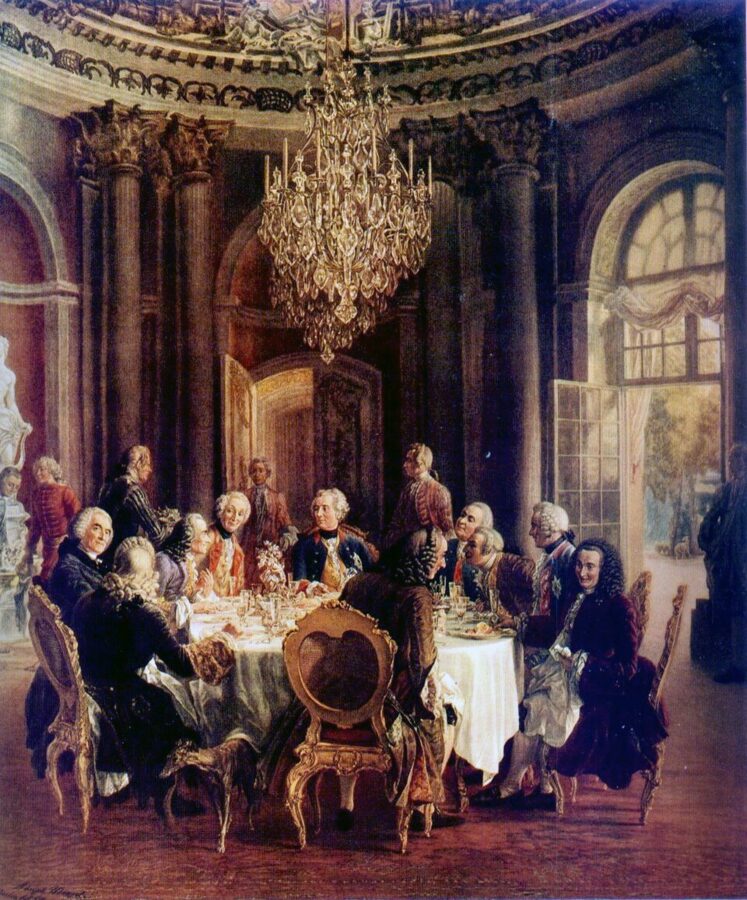
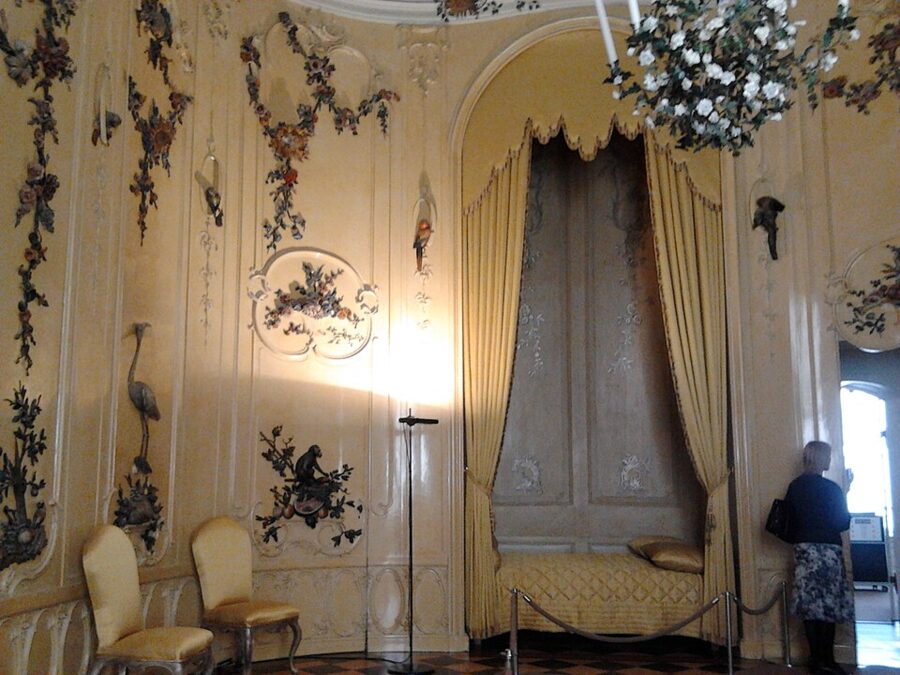
Voltaire was the prize. Frederick had written to him since 1736 and courted him for years before he came in the summer of 1750, as a royal chamberlain on 20,000 livres a year. He lodged mostly at the City Palace rather than at Sanssouci, though a flowered guest room at Sanssouci carries his name, and for two years he polished the king’s French verse and dazzled at dinner.
Then he went after Maupertuis, president of Frederick’s Berlin Academy, in a mocking pamphlet, the Diatribe of Doctor Akakia. Frederick sided with his academy president and made Voltaire promise not to print it again; Voltaire left in March 1753. At Frankfurt, on May 31, Prussian agents held him under house arrest at the Golden Lion inn until he gave back a privately printed volume of the king’s poems. The two did not write again until 1757, after Wilhelmine brokered a truce.
The greyhounds
The people Frederick trusted were few and nearly all men; Michael Gabriel Fredersdorf, a flute-playing army musician he met at Küstrin, rose from valet to privy chamberlain and keeper of the king’s purse. The creatures he trusted without reservation were his Italian greyhounds, the small whippet-like dogs his age called Windspiele.
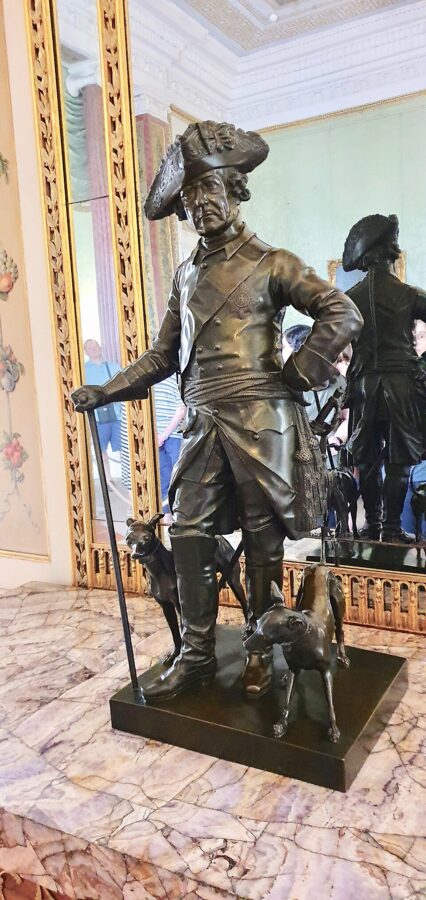

The first was Biche, a white female given to him by Rothenburg in 1744. Austrian Pandurs captured her with his baggage at the battle of Soor in 1745, and Prussia asked for her back in the negotiations; Frederick is said to have wept when she returned. At Sanssouci she slept on the chairs and in his bed, ate from his hand at table, and the footmen had to address her in French with the formal vous. After she died in the concert room in 1752, he wrote to Wilhelmine that he was ashamed a dog’s death could hurt him so much.
Biche was the first of eleven greyhounds buried on the top terrace, each under a sandstone slab with its name, beside the vault he had built for himself. When Alcmène died in 1785, Frederick left the annual troop review in Silesia and hurried home, and by several accounts she was the only one of his dogs laid inside his own crypt. A greyhound named Superbe was in the room when he died.

The wars, the potato and the miller
The man who played the flute in the evenings also started three wars. Months after his accession he marched into Silesia, a rich Austrian province, and fought two Silesian Wars to keep it. In 1756 he invaded Saxony and set off the Seven Years’ War, in which Austria, France and Russia came close to carving up his kingdom; after Kunersdorf in 1759 he wrote that two horses had been shot under him and everything seemed lost. Prussia survived, largely because Russia changed sides in 1762, and kept Silesia.
Potsdam paid in men and money. The guard regiments marched out of the houses where they were billeted, and building in town all but stopped. Peace brought the New Palace and the new facades, and the weavers’ colony Frederick had founded in 1751 for Bohemian Protestants at Nowawes, now part of Babelsberg, kept its tax and religious freedoms and its orders to plant walnut trees for rifle stocks.
Why there are potatoes on the grave
Frederick did not bring the potato to Prussia, but he pushed it harder than anyone. Fifteen of his “potato orders” are known, the first sent out during a famine in Pomerania in 1746; the one for Silesia of March 24, 1756 told officials to make the crop “understood” by every subject. Pastors were enlisted as “tuber preachers,” and officials had to send in tables showing what had been planted.
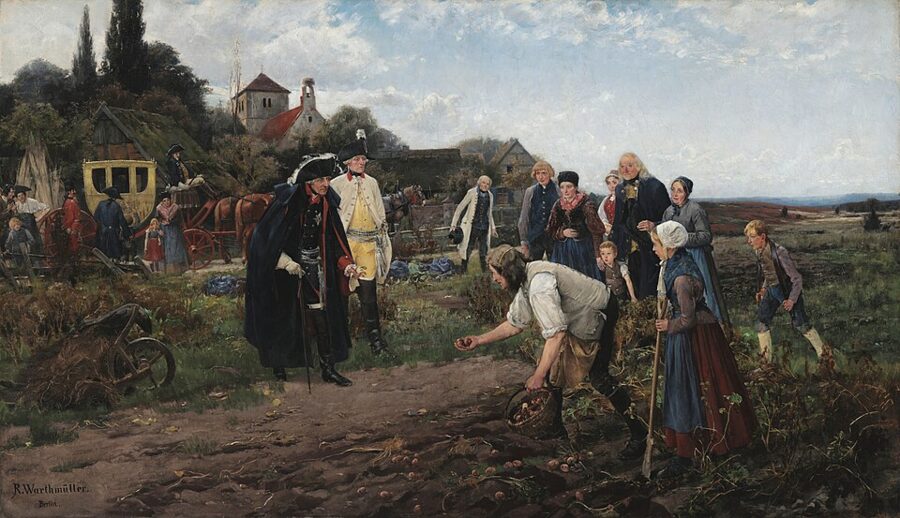
The story everyone tells is a legend: peasants refused the crop until the king had a field planted and guarded by soldiers told to look the other way, so that people stole the “royal” tubers by night and grew them at home. There is no good evidence for it. The orders are real, though, and so is the habit of leaving potatoes on his grave.
The miller of Sanssouci
West of the palace stands the windmill that supposedly proved the king’s justice. In the version German schoolchildren learned, Frederick, annoyed by its clatter, offered to buy it, and when the miller refused he reminded him that a king could simply take it. “Yes, Your Majesty,” the miller answered, “if there were no Supreme Court in Berlin.” The king backed down.
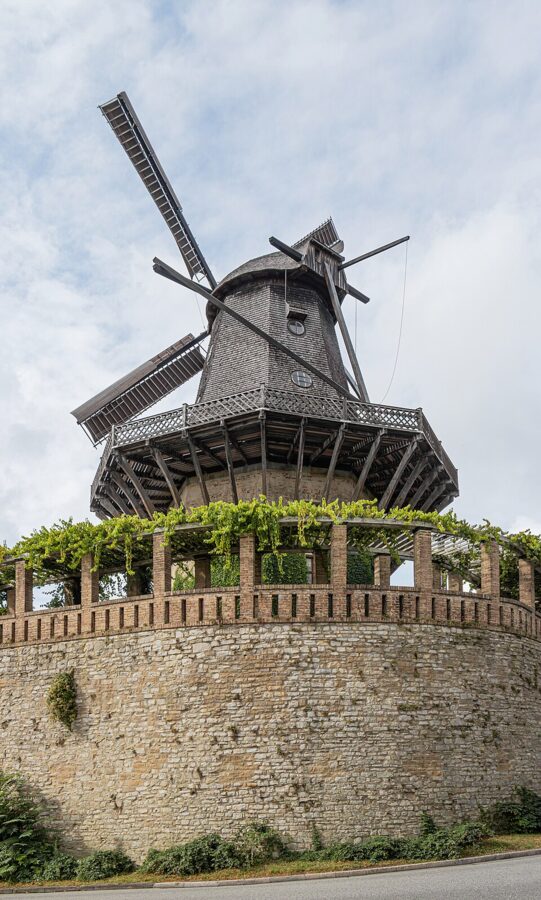

The real history is smaller and odder. The miller Johann Wilhelm Grävenitz had built a post mill on the hill in 1737–39, and in 1745 he complained that the new palace, its walls and its trees were stealing his wind. Frederick had his War and Domains Chamber look into it, and far from wanting the mill gone, in 1746 he forbade moving it because it decorated the view. The anecdote first appeared in print in France in 1787 and seems to fold in the Miller Arnold affair of 1779, when Frederick overruled the courts for an Oder miller and jailed the judges, a ruling his successor declared a mistake.
The townspeople lived beside all this rather than inside it. Potsdam’s windmills rose from 7 to 26 during his reign, soldiers filled the spare rooms, and the gift of a palace facade could mean a darker home behind it.
Death at Sanssouci, and the coffin that traveled
By the 1780s most of the round table was dead, and Frederick lived largely alone with his dogs, his rheumatism and his gout. He died sitting in his armchair in the study at Sanssouci early on August 17, 1786, aged 74. He had written his burial orders again and again, before battles and wars: he wanted to lie at Sanssouci “without splendor, without pomp and at night,” with a lantern and the smallest possible escort, in the vault by his dogs.
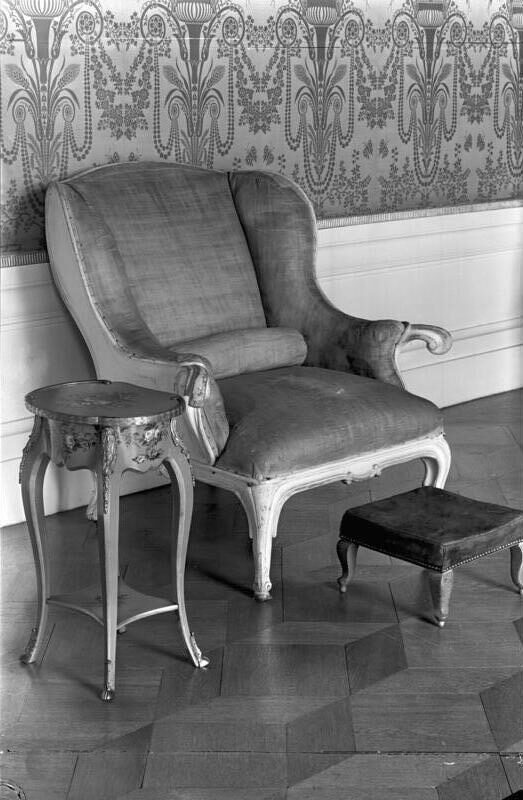

His nephew and heir, Frederick William II (Friedrich Wilhelm II), ignored every word. The body lay in state at the City Palace and went the next evening into the Garrison Church crypt, beside the father Frederick had spent his youth running from. The new king liked to show guests the empty vault on the terrace, where, he said, his predecessor had wanted to lie among his dogs rather than his ancestors. Contemporaries thought a garden grave beneath a king.
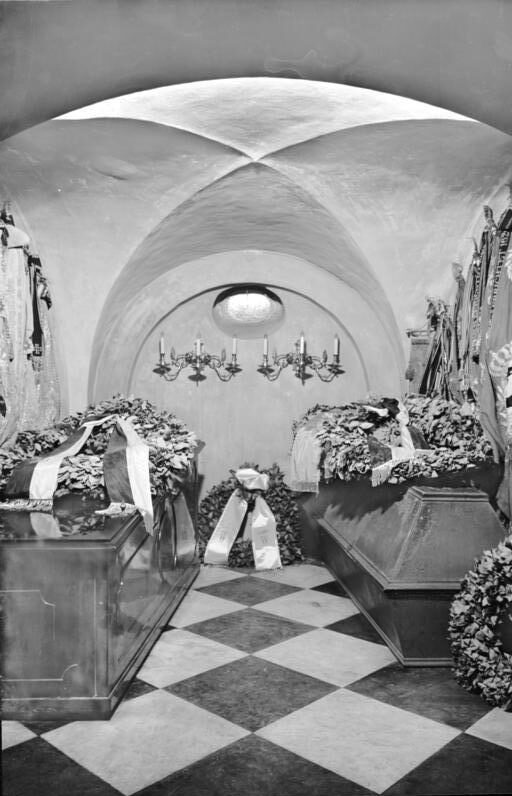

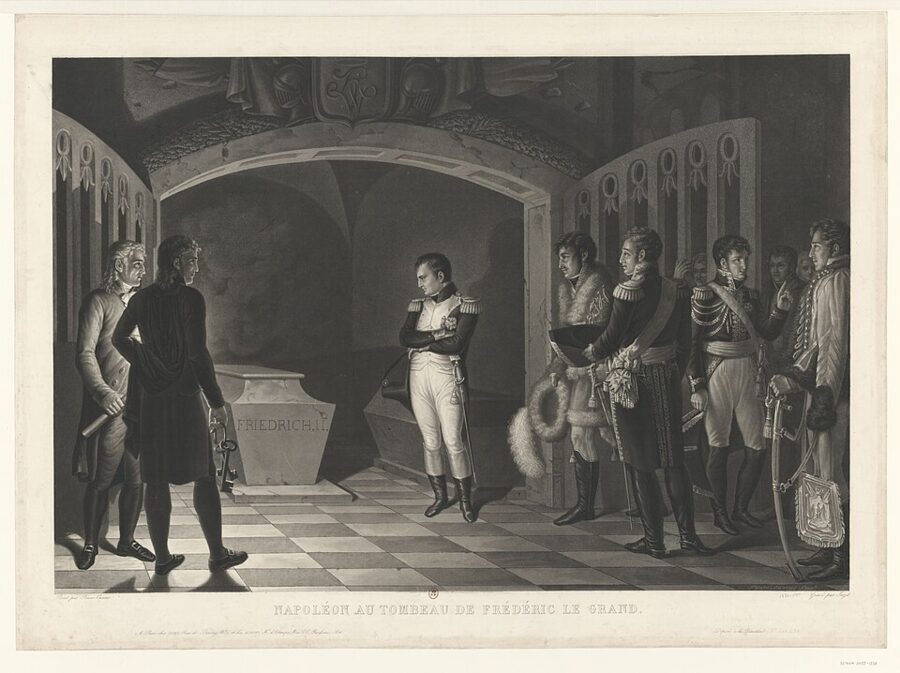
The crypt became a shrine. On November 4, 1805, Frederick William III and Queen Luise took Tsar Alexander I down to the coffin to seal their alliance against Napoleon. On October 25, 1806, after crushing the Prussian army at Jena and Auerstedt, Napoleon himself came, visited the crypt and put the church under his personal protection. His famous remark, that the French would not have got this far if Frederick were alive, was probably made not at the tomb but in Frederick’s apartment at the City Palace.
1943 to 1991
In March 1943, with Allied bombers over Berlin, soldiers moved the two royal coffins to “Kurfürst,” a Luftwaffe bunker in the woods at Wildpark-West outside Potsdam, and in March 1945, ahead of the Red Army, down a mine at Bernterode in Thuringia. American troops found the coffins and, because Thuringia was to become Soviet territory, took them west to Marburg, where they ended up in the Elisabethkirche in August 1946.
In August 1952 the head of the Hohenzollern family, Prince Louis Ferdinand, moved them to the chapel of Hohenzollern Castle near Hechingen, over the objection of the Marburg church council, which wanted no more “wandering of the bones.” After reunification he pushed for Frederick’s return. The vault on the terrace proved almost intact after nearly 250 years and got new masonry and a waterproof roof.
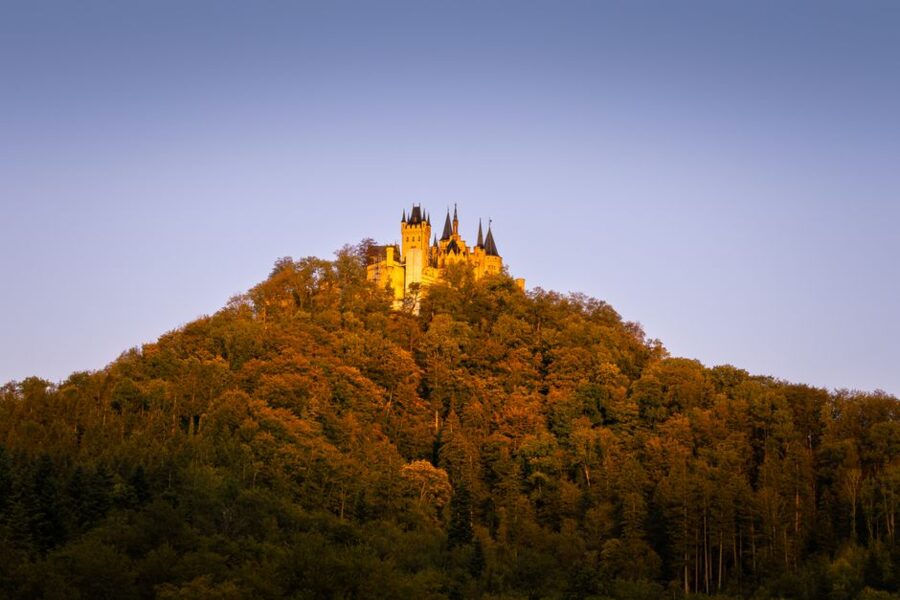
On August 17, 1991, the 205th anniversary of his death, the coffin lay in the courtyard of Sanssouci under a Bundeswehr honor guard. At midnight, with Chancellor Helmut Kohl present and television cameras running, Frederick was laid where he had asked to lie. “At night” was respected; “without pomp” was not. The same day his father went to the Emperor Frederick Mausoleum at the Church of Peace (Friedenskirche), down in the park.
Hero, warning, brand: arguing over Frederick
The dead king was useful to almost everyone who came after him. The nineteenth century made him the great Prussian of the history books. After 1918 the Garrison Church became a pilgrimage site for enemies of the Weimar Republic and their “spirit of Potsdam,” and 1920s cinema turned out a string of Fridericus films.
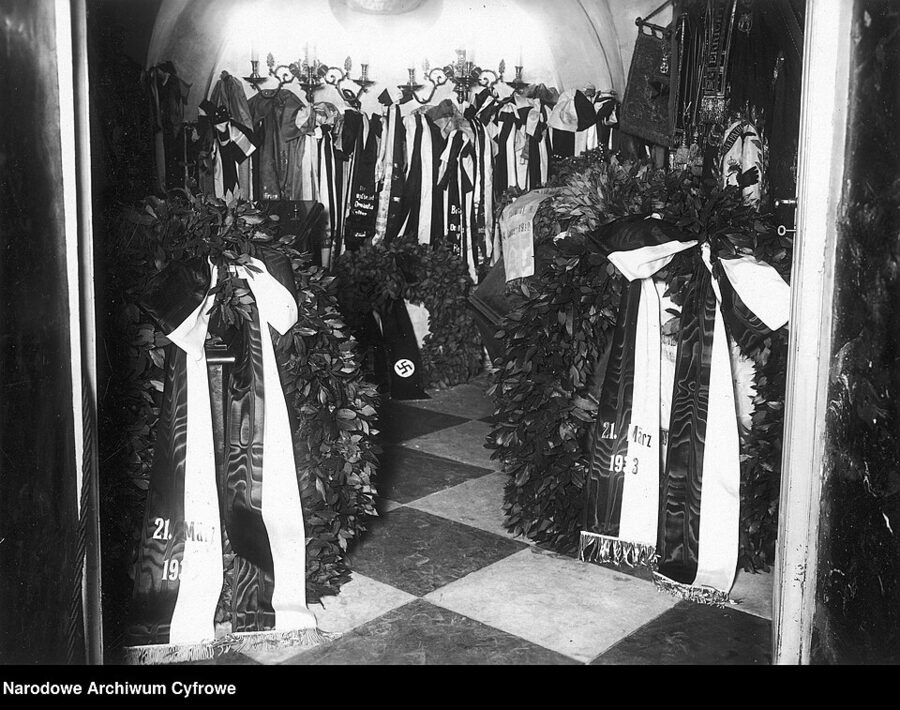
On March 21, 1933, the new government staged the opening of the Reichstag in the Garrison Church, broadcast across the country, with Hitler and President Paul von Hindenburg shaking hands for the cameras. Hindenburg then went down to the crypt, laid two wreaths at the coffins and stood in silence while guns fired a salute outside. Goebbels’s propaganda went on to call Frederick the “first National Socialist,” and in the last months of the war cited his fifteen-year-old lieutenants to justify sending boys to the front.
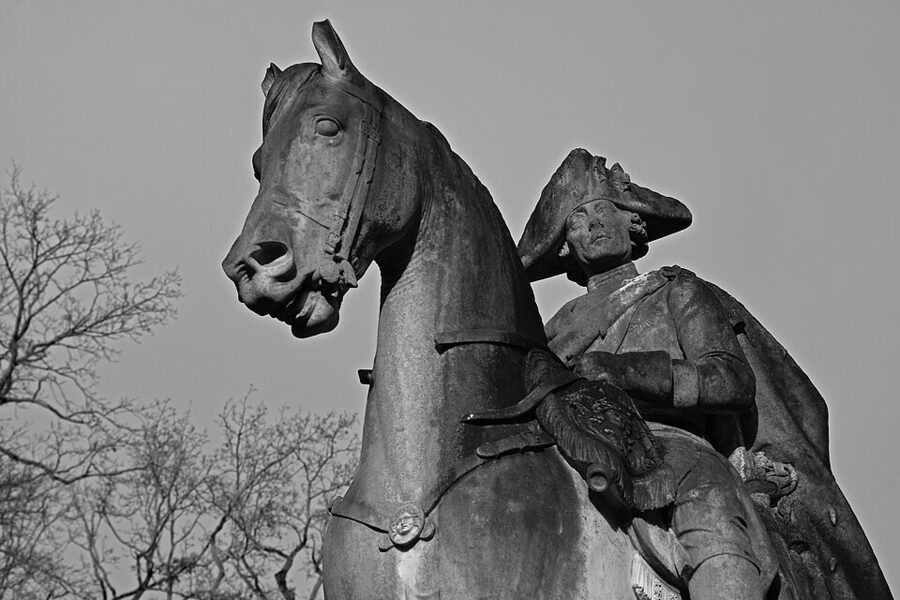
East Germany began by wanting him gone. “The royal rider has to go,” a Berlin museums official declared on October 1, 1949, “because he is riding east.” In 1950 Christian Daniel Rauch’s equestrian statue came down from Unter den Linden; Potsdam party members volunteered to scrap it and instead hid the pieces under straw in a builder’s yard opposite the New Palace. In the early 1960s it went up, unannounced, in the Hippodrome by Charlottenhof in Sanssouci Park, and in 1980 Erich Honecker ordered it back to Berlin as the official view of Frederick softened, a shift usually linked to Ingrid Mittenzwei’s East Berlin biography of the king.
Historians still disagree about him. Jürgen Luh’s Der Große (2011) puts a hunger for fame behind both the wars and the buildings, and Peter-Michael Hahn (2013) warns against taking Frederick’s writings about himself at face value; Karl Otmar von Aretin saw him as founder of a reckless Machiavellian streak in German foreign policy. On his private life, Wolfgang Burgdorf holds that Frederick lived out his homosexuality and made up for the heir he never fathered with glory and risk, while Reinhard Alings thinks his childhood left him incapable of any love affair, and Johannes Kunisch, in the standard German biography of 2004, dismisses much of the contemporary gossip as denunciation.
The argument has a building now, too. The rebuilt Garrison Church tower opened in August 2024 to protests outside: the rebuilding was first pushed by a former army officer, Max Klaar, later head of a far-right veterans’ association, before church and city took it up as a center of reconciliation. Its exhibition, “Faith, Power and Military” (Glaube, Macht und Militär), takes on 1933 directly. In 2025, its first full year, the tower sold 30,000 tickets, half the number expected.

Following Frederick today: from the Alter Markt to his grave
This walk runs east to west, from the square he remade to the hill where he wanted to end up: about 3.5 km to the grave, 2 km more to the New Palace. Give it a full day with Sanssouci Palace inside it. For the trip out from Berlin see the Potsdam day trip from Berlin, and for choosing interiors, the guide to Potsdam’s palaces.
Getting there. Take the S7 or the regional train RE1 to Potsdam Hauptbahnhof, the main station. A single ticket Berlin ABC costs €5.00 and a 24-hour ticket Berlin ABC €12.90 at BVG’s current fares; both cover Potsdam’s trams and buses, as does the Deutschlandticket.
1. The Alter Markt
Cross the Lange Brücke from the station and in about seven minutes you are on the square Frederick remade: the City Palace with its Fortuna Portal, now the Landtag, the obelisk, the Old Town Hall of 1753 and the Palais Barberini. Walk round the obelisk, then look at the palace fronts knowing that a carpenter and an innkeeper once lived behind the grandest of them.
2. The Garrison Church tower
Seven minutes west along Breite Straße brings you to number 7. The tower’s hours and prices are Monday to Friday 11:00–15:00 and weekends 10:00–17:00; the viewing platform and the exhibition cost €8 each or €12 together, and the chapel is free. A lift or 365 steps take you to 57 meters, high enough on a clear day to see Berlin. A block away on Lindenstraße rises the tower of the Military Orphanage his father founded, and Le Petit Café at the foot of the tower does quiche and cake.

3. North to the Brandenburger Tor
Go north up Dortustraße to Brandenburger Straße, the long pedestrian street, and turn left for the Brandenburger Tor on Luisenplatz, about 15 minutes in all; the Dutch Quarter is a ten-minute detour east along the same street.
4. Up the main avenue to the grave
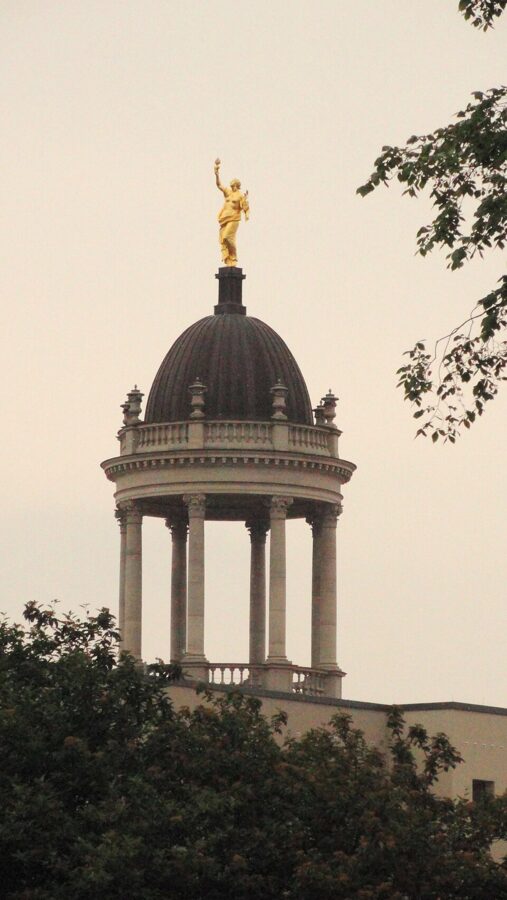
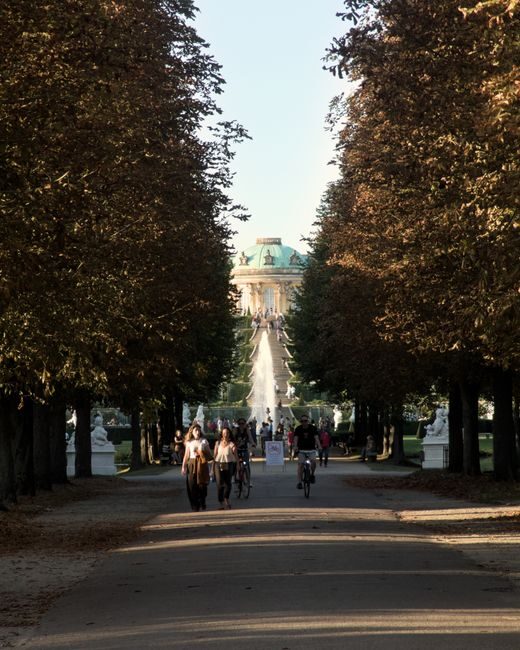
Five minutes on, the obelisk gate on Schopenhauerstraße opens onto the Hauptallee, the park’s main avenue. Follow it west to the Great Fountain, climb the steps up the middle of the terraces and turn right along the top one. The grave, the greyhound slabs and Flora and Zephyr are at the east end, between the palace and the Picture Gallery. Bring a potato if you like.
5. Sanssouci Palace
Visits run on fixed time slots with a daily limit, so book the Sanssouci+ ticket online, the only ticket that fixes a slot in advance; same-day tickets go on sale at the visitor center by the Historic Mill 30 minutes before opening. Sanssouci’s hours are 10:00–17:30 from April to October and 10:00–16:30 in winter, closed Mondays, with a self-guided tour on the free app. A single ticket is €14 (reduced €10). The Sanssouci+ ticket of the Prussian Palaces and Gardens Foundation (SPSG), good for all its Potsdam palaces on one day, costs €22 in 2026 and €24 from 2027, and pays off as soon as you add the New Palace.
6. The Historic Mill, the Picture Gallery and the New Chambers
The Historic Mill, two minutes west of the palace, opens daily 10:00–18:00 from April to October and on weekends 10:00–16:00 in November and from January to March; it is closed in December, and admission is €5. The Picture Gallery and the New Chambers open Wednesday to Sunday, 10:00–17:30, from April to October only; the €10 Pavilion Pass covers both, plus the Chinese House and the palace kitchen.
7. Through the park to the New Palace
From the foot of the terraces it is about 2 km west along the Hauptallee, roughly 30 minutes, with detours to the Chinese House, south of the avenue, and the marble equestrian Frederick below the Orangery Palace, north of it. The New Palace opens 10:00–17:30 from April to October and 10:00–16:30 from January to March, closed Mondays; in November and December it opens Mondays and closes Tuesdays instead. The Grand Tour of the festival halls and guest apartments costs €14 (reduced €10), and in winter it is a guided tour in German with information in other languages.
Park, palaces and town have been on UNESCO’s list as the Palaces and Parks of Potsdam and Berlin since 1990. For the boats, the film studios and the rest of town, see things to do in Potsdam.
If the light holds, walk back up to the top terrace before the palace closes. By late afternoon the crowds have gone down the steps, the sun is sinking toward the New Palace at the far end of the park, and the potatoes on the slab are just potatoes again, left by people who know the rest of the story. Bus 695 from the Schloss Sanssouci stop, a few minutes north of the palace, takes about a quarter of an hour back to the main station.