

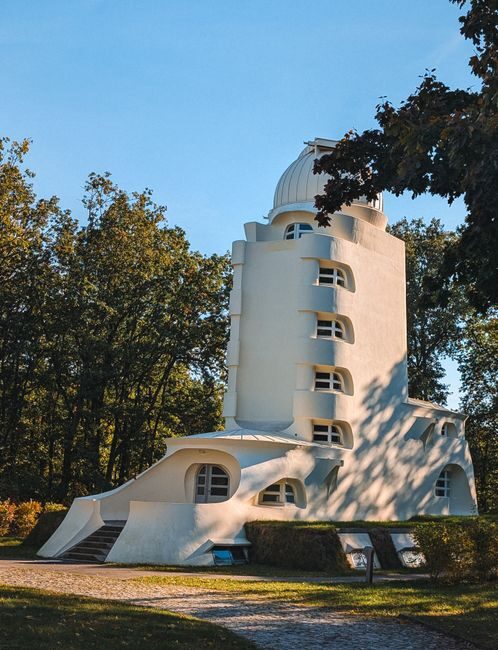
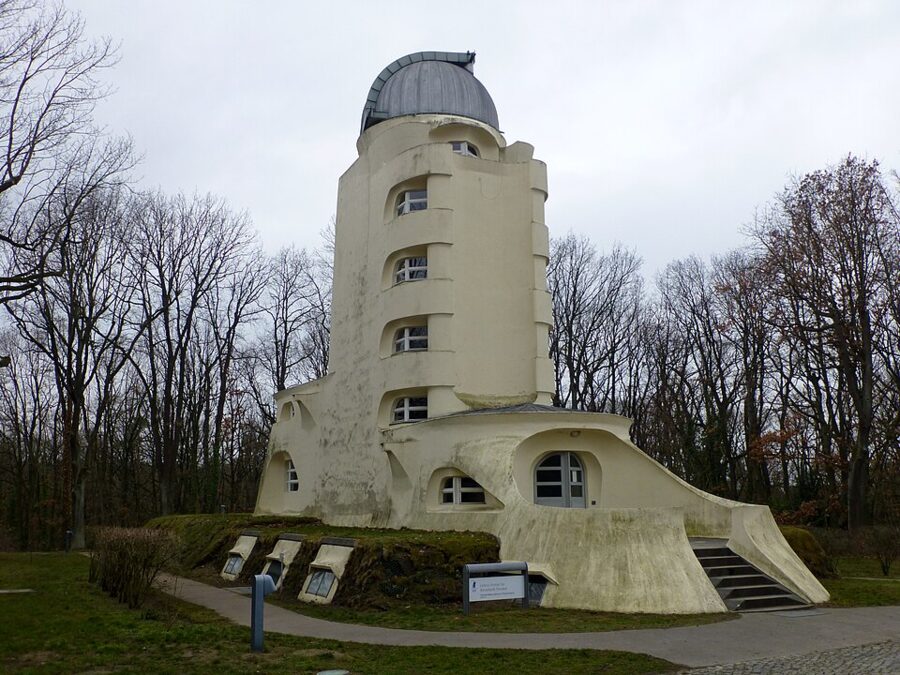
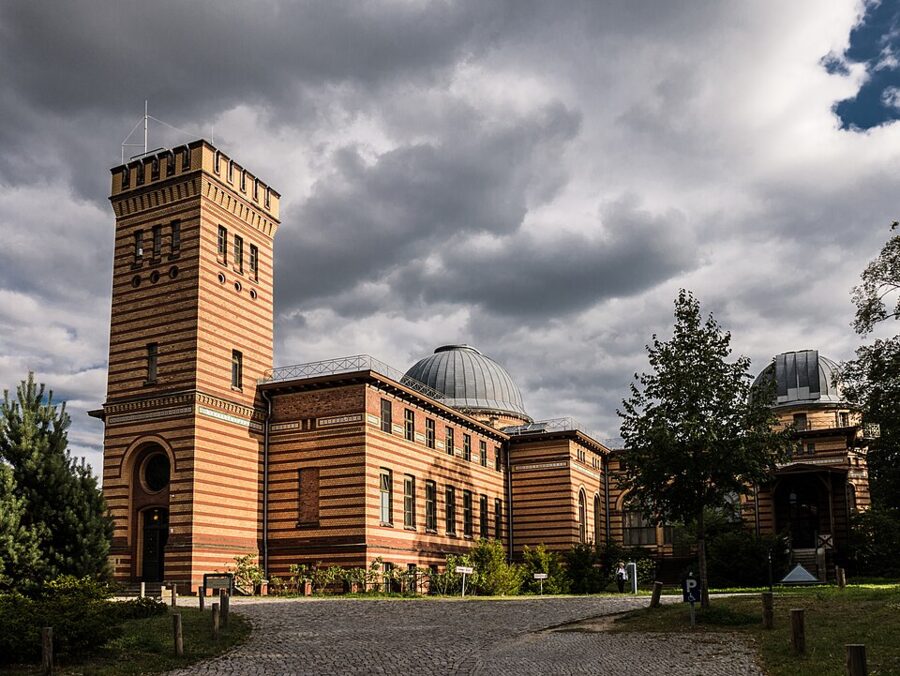
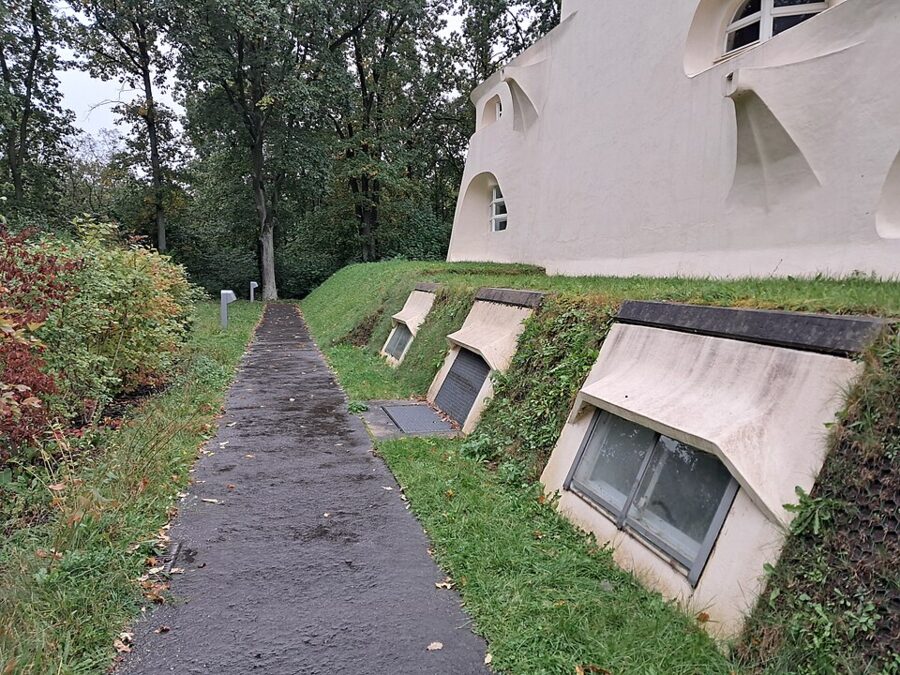
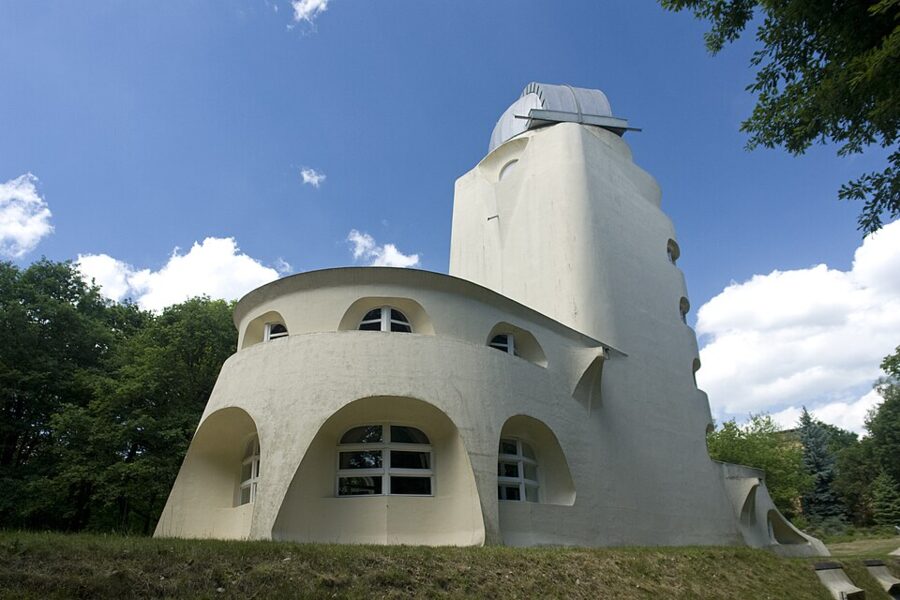
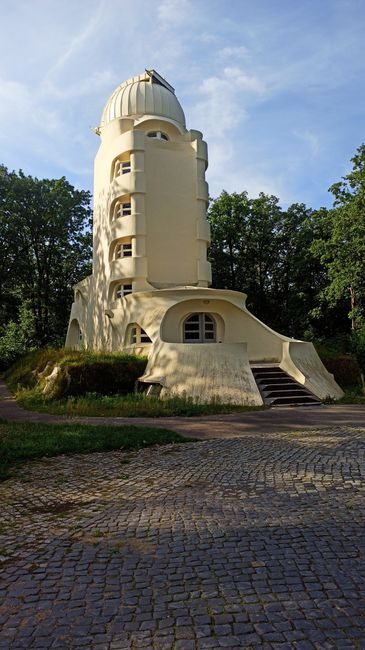
Stand on the path at the foot of the Einstein Tower and the building looks as if it was poured in one go, like wet sand squeezed through a fist and left to set. The window bays bulge, the entrance terrace swells out of the lawn, and the whole thing leans back from its doorway as though it has just landed. Everyone assumed it was concrete when it opened in 1924, and its architect, Erich Mendelsohn, did little to correct them.
Most of it is brick. Under that smooth ochre skin is an ordinary masonry tower with concrete used only where the shapes were too wild for bricklayers, and the mismatch between the two materials has been cracking the building open for a hundred years. That is the first thing to know about the Einstein Tower (Einsteinturm) on Potsdam’s Telegrafenberg. The second is that it still works: a solar telescope built to test general relativity, which failed at that job and has done useful science ever since.
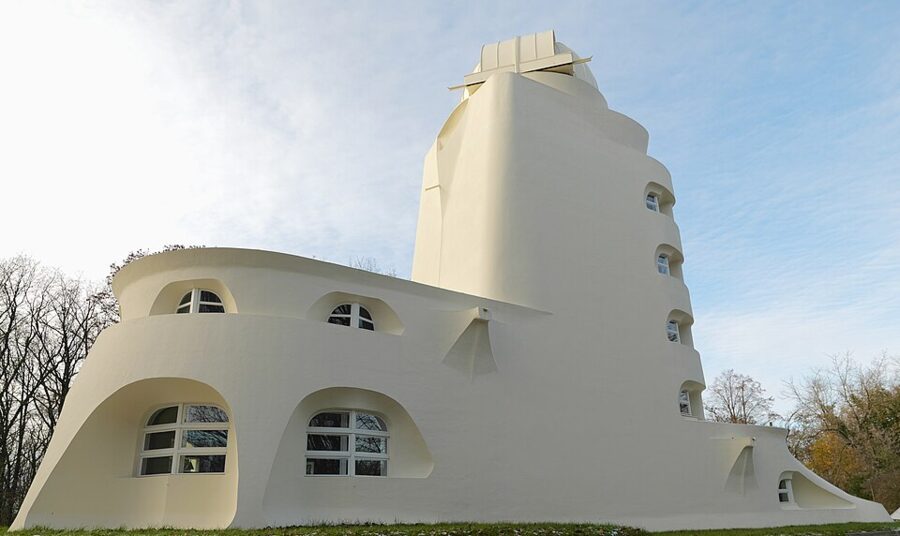
The tower stands in the Albert Einstein Science Park (Wissenschaftspark Albert Einstein), a campus of research institutes in an oak wood a short walk south of Potsdam Hauptbahnhof, the main station. You can walk the park by day for free and, on certain winter Saturdays, go inside the tower with a guide. It is the least palatial afternoon in Potsdam, and for me one of the best.
Contents9 parts
A hill named after a signal mast
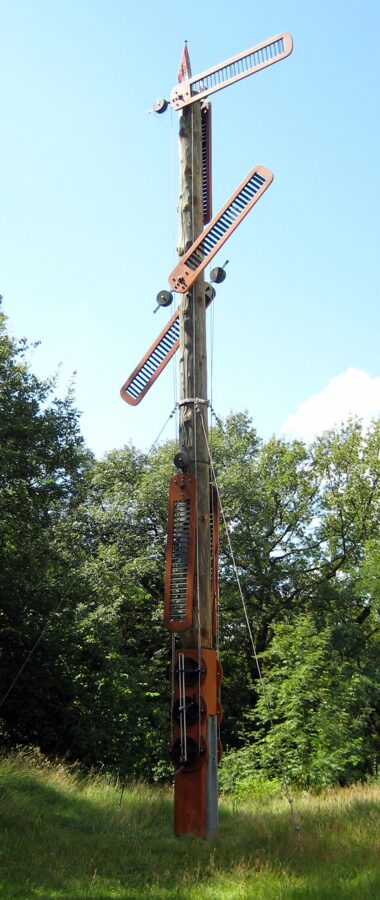
Before it was the Telegrafenberg, this 94 m rise at the edge of the Teltower Vorstadt was called the Hinterer Brauhausberg, the back of the brewery hill. It got its new name in 1832, when Frederick William III (Friedrich Wilhelm III) ordered an optical telegraph from Berlin to Koblenz so that dispatches could pass between the capital and the Rhine Province, Prussia’s distant western territory, far faster than any courier. Some sixty stations stood on hills and towers along the route, each in sight of the next, and the fourth was here, between the Schäferberg at Wannsee and the Fuchsberg at Glindow.
Each station had a wooden mast with three pairs of movable arms and an operator with a telescope who watched the next mast and copied what it showed. The line carried state dispatches only, in numbered code, and it was never open to the public. By 1849 the electric telegraph had made the Berlin to Koblenz line pointless, and the hill went quiet for a quarter of a century.
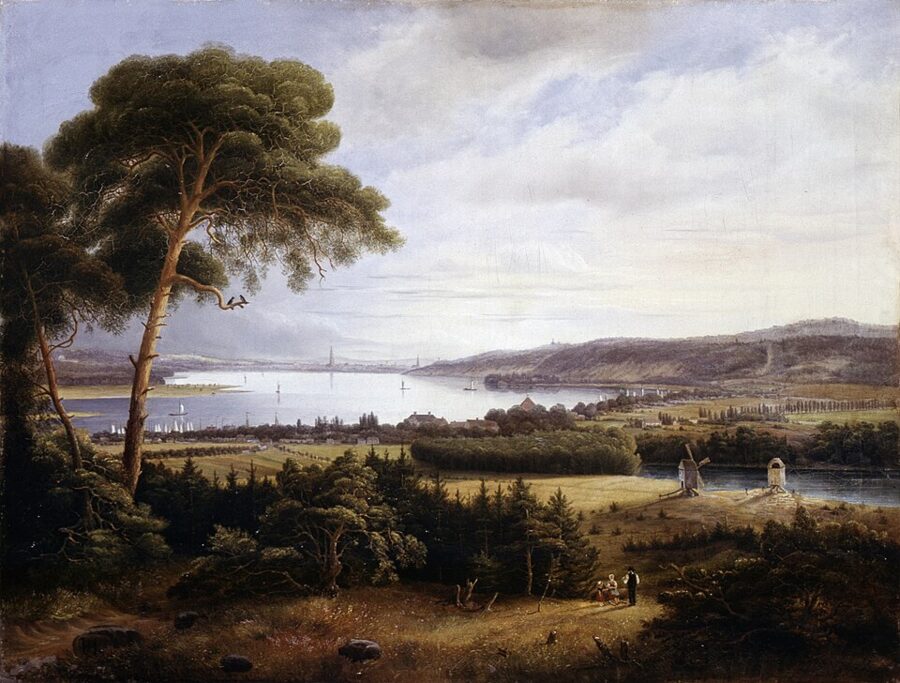
A replica mast went up in 2009 a few meters from the original site, west of the main building of the climate institute. The telegraph also explains the science: the hill was high, it was state forest with nobody living on it, and it had a clear horizon, exactly what an observatory needed when Prussia went looking for a site in 1873.
The first observatory built for astrophysics
In 1871 the director of the Berlin observatory, Wilhelm Foerster, sent the Crown Prince a memorandum about a new science. Spectral analysis, reading a light source’s chemistry from the dark lines in its spectrum, meant the sun could now be studied as a physical object. The Astrophysical Observatory Potsdam was founded on July 1, 1874, the first institute anywhere set up expressly for astrophysics, on a hill a kilometer from the railway.
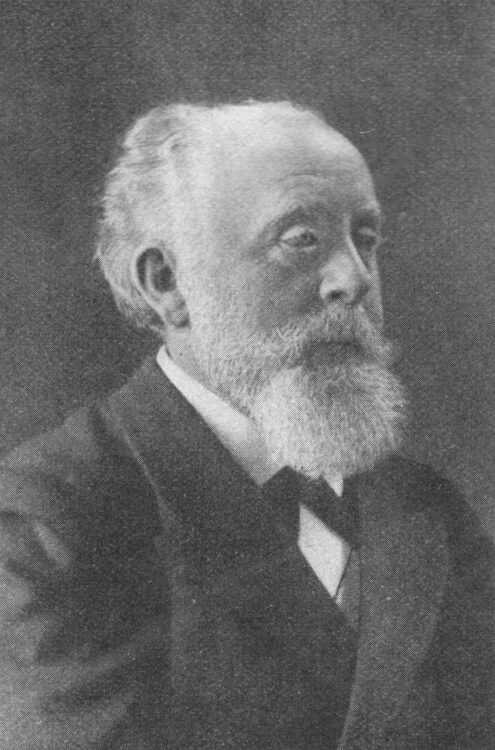
The architect Paul Emanuel Spieker laid out the hill as a science park inside an English landscape garden, with paths that curve through the oaks from one observatory to the next. His buildings are banded brick with friezes of glazed stars, a style that owes a lot to Karl Friedrich Schinkel. The Einstein Tower was dropped into this finished nineteenth-century composition, and its shock depends on the brick neighbors it refuses to resemble.
The Michelson building
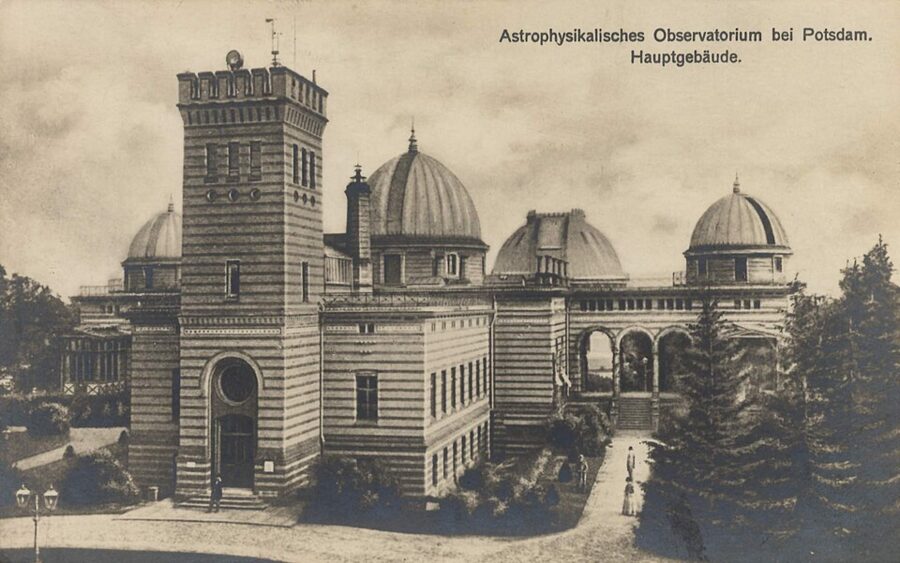
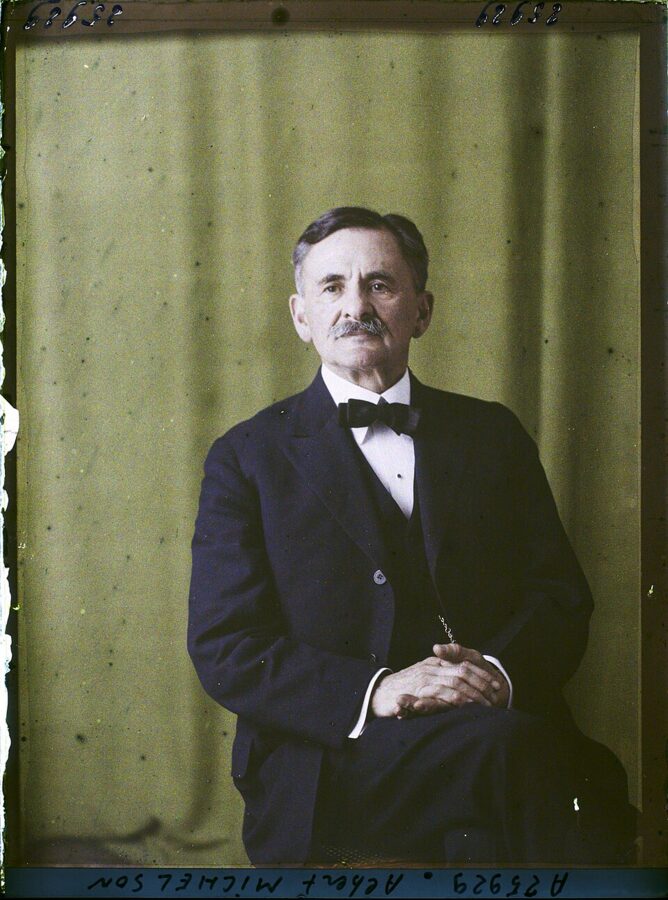
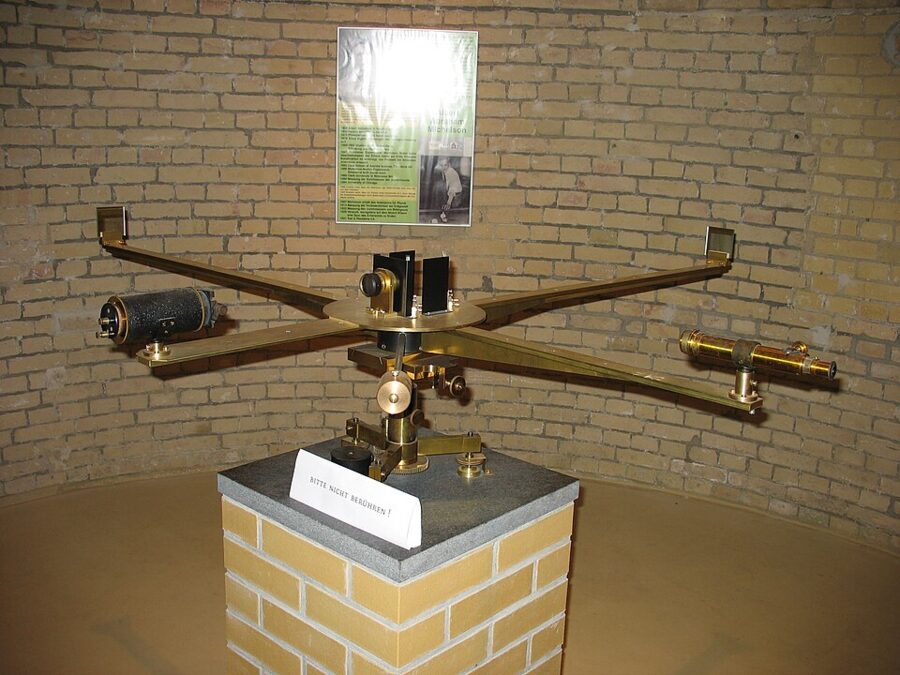
The main building, finished in 1879 on the summit, is now the Michelson building (Michelson-Haus) and houses the climate institute. It is named after a young American naval officer, Albert A. Michelson, who in 1881 set up an interferometer in the cellar under its east dome to measure the earth’s motion through the “ether” light was supposed to travel in. He found nothing, and that null result, refined later in the United States, became one of the foundations of Einstein’s special relativity of 1905.
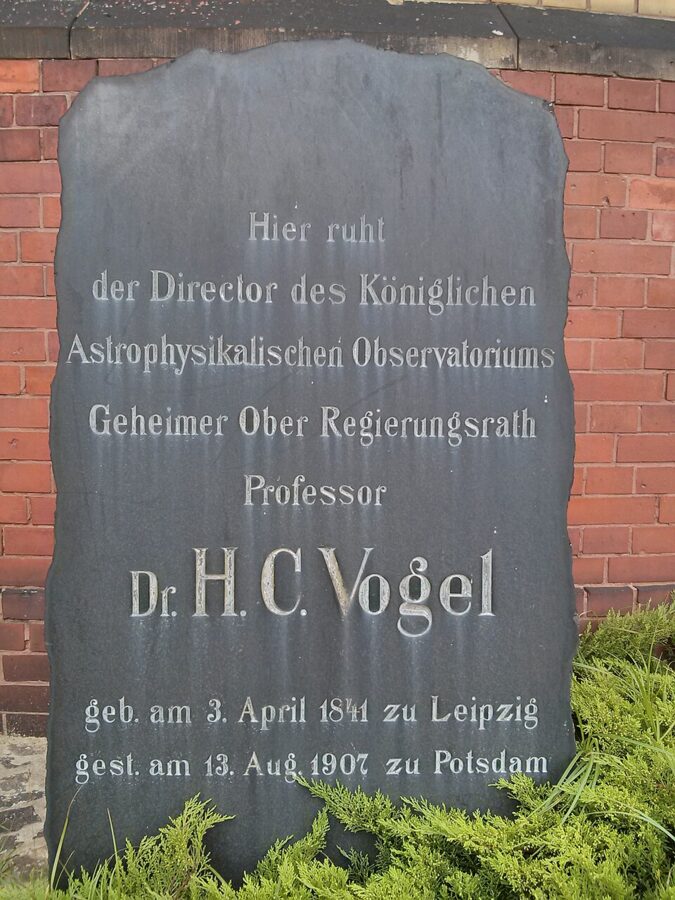
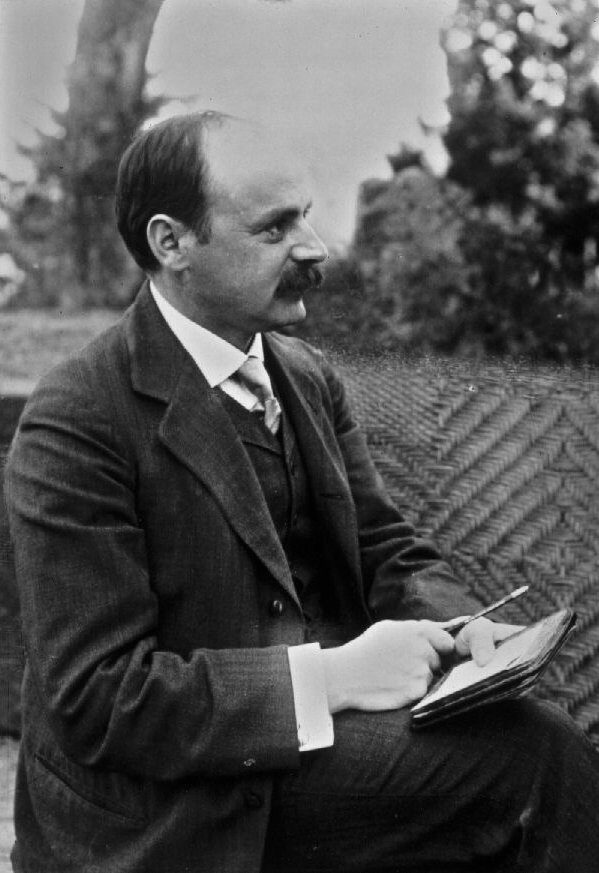
So the hill had a hand in relativity long before Einstein’s name was attached to it. Under Hermann Carl Vogel the observatory first measured stars’ speeds photographically, in 1888. Karl Schwarzschild became director in 1909, and in 1915, serving with the army in Russia, he sent Einstein the first exact solution of the equations of general relativity, the mathematics that later described black holes.
The Great Refractor
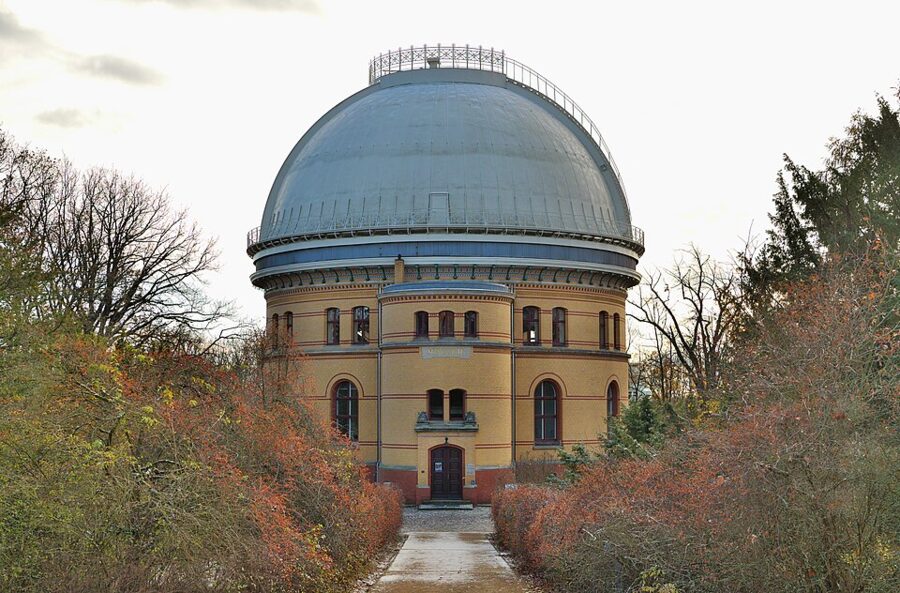
The dome you see across the lawn from the Einstein Tower belongs to the Great Refractor (Großer Refraktor), inaugurated on August 26, 1899 in the presence of Emperor Wilhelm II. It is a double telescope, two tubes bolted together on one mount: an 80 cm lens for photography and a 50 cm lens for looking through, with focal lengths of about 12 m. It is still the fourth-largest lens telescope in the world.
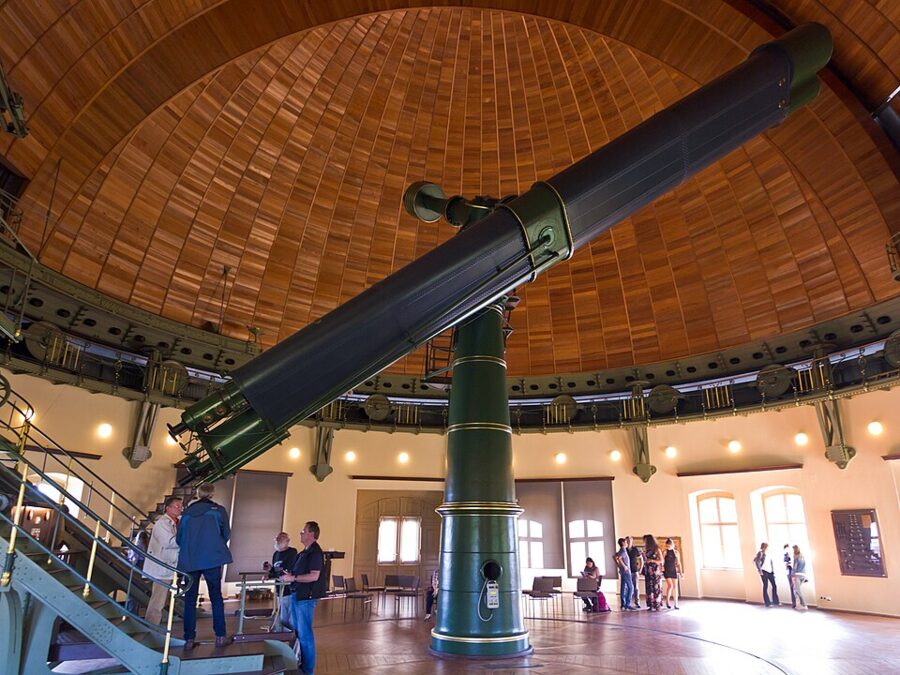
Bombs damaged the telescope and its building in 1945, Zeiss repaired it in the early 1950s, and observing stopped in 1968. A friends’ society founded in 1997, and a foundation it helped to set up, paid to have the instrument rebuilt in Jena, and it was re-inaugurated on May 31, 2006, fully working. Its dome is 21 m across and weighs 200 tonnes by the institute’s figure, about 250 by the friends’ society’s.
Geodesists and weather watchers
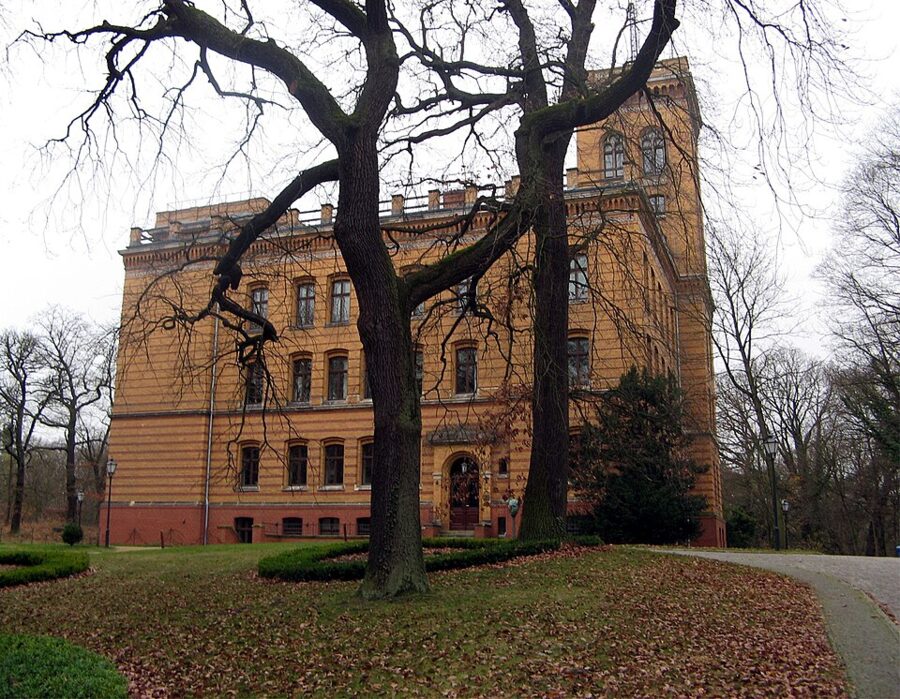
The other big brick houses on the hill, built around 1890, belonged to the Geodetic Institute and the Meteorological and Magnetic Observatory. Under Friedrich Robert Helmert the geodesists made Potsdam the center of their science: the gravity value they measured here with pendulums between 1898 and 1904 served as the world’s reference from 1909 to 1971. The weather observatory’s tower is still a climate station of the German Weather Service; the rest of it, the Süring-Haus, belongs to the climate institute.
Why build a tower to test Einstein
The man who brought Einstein to the Telegrafenberg was Erwin Finlay Freundlich, a young assistant at the Berlin observatory, which moved out to Babelsberg in 1913. Born in 1885 to a German father and a Scottish mother, he was bored by routine measurement and got in touch with Einstein in 1911, when the physicist was still in Prague. Einstein’s early theory of gravity made predictions that only astronomers could check, and almost every experienced astronomer thought them unmeasurable. Freundlich took them on.
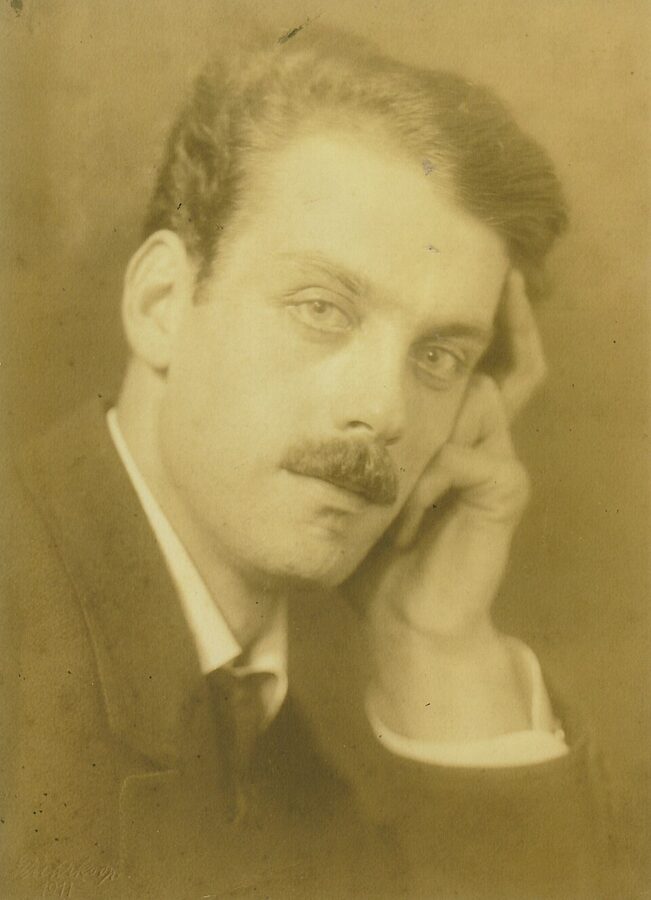
There were two tests. One was the bending of starlight around the sun, visible only during a total eclipse; Freundlich took an expedition to the eclipse of August 21, 1914 in Russia and was interned there when war broke out. The other was the gravitational redshift: light climbing out of the sun’s gravity should shift the dark lines in its spectrum very slightly toward red. Measuring that needed a big, stable solar telescope and a long, quiet laboratory, and Germany had neither.
Money was the problem. In December 1913 Einstein wrote to Freundlich that if the Academy would not pay, they would get “the bit of mammon” from private backers, and he kept pushing on Freundlich’s behalf. In 1918 Freundlich became the first scientist employed by Einstein’s new Kaiser Wilhelm Institute for Physics, then little more than a fund run from Einstein’s apartment.
Then, in November 1919, a British expedition led by Arthur Eddington announced that starlight photographed during that year’s eclipse had bent by about the amount Einstein predicted. Einstein became world-famous overnight, and in December a Berlin weekly put him on its cover beside a caption ranking him with Copernicus, Kepler and Newton. Freundlich’s appeal for an “Einstein Fund” told German industry that testing the theory on German soil was a matter of national honor, since the wartime enemies’ academies had just set up a relativity commission without Germany.
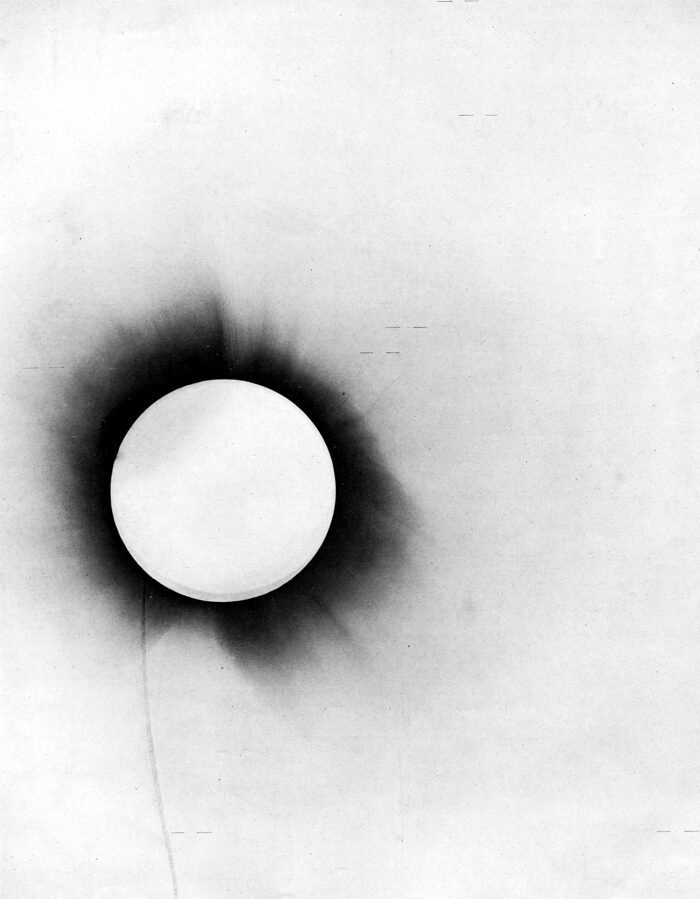
It worked. Industrialists including Carl Bosch of BASF sat on the fund’s board, which became the Einstein Foundation (Einstein-Stiftung) in 1921, and the Prussian state put in 150,000 marks and later another 50,000. Zeiss in Jena supplied the optics free or at cost, and the building’s costs were shared about half and half between the state and the foundation. Einstein lent his name and his seat on the board; the tower was Freundlich’s.
Mendelsohn’s sketches
Freundlich played the cello, and so did Luise Maas, a professional cellist who had married a young architect called Erich Mendelsohn in 1915. At musical evenings Freundlich told the Mendelsohns about relativity and the instrument he wanted, and in June 1917, at the Russian front, Mendelsohn wrote to his wife that after an hour’s nap he had been seized by “drawing fever.” The small sketches he sent home were of buildings nobody had commissioned: “telluric and planetary,” he called them.
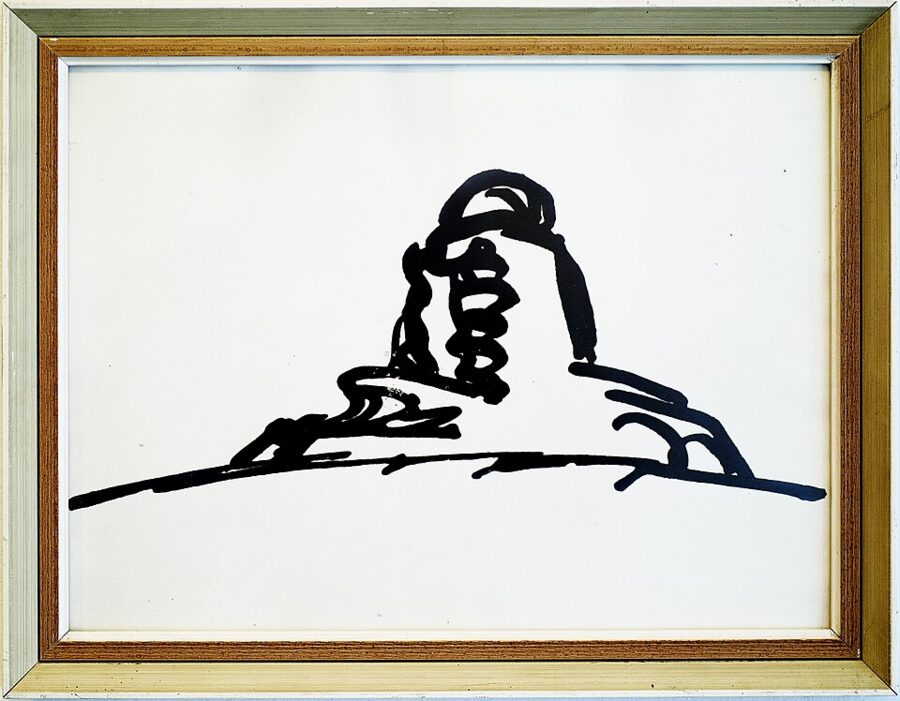
The brief arrived in a letter of July 2, 1918, when Mendelsohn had moved to the French front. Freundlich wanted a concrete tower about 15 m high carrying a small dome, double-walled, with an isolated inner column for the optics that touched nothing else. Mendelsohn’s sketches took the tower and wrapped it in a single flowing mass, with the laboratory and work rooms folded into its base.
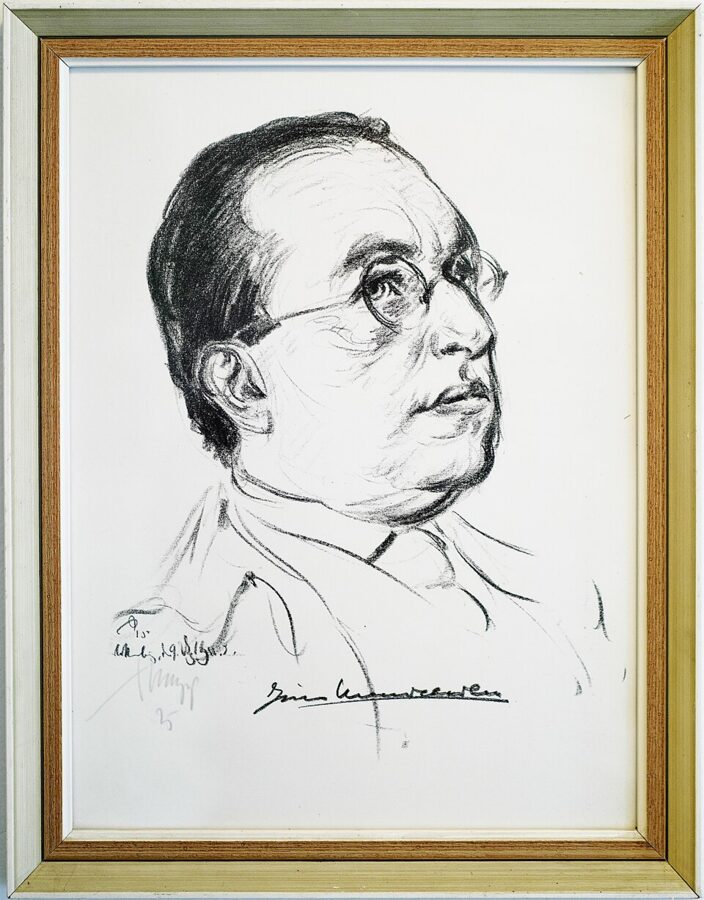
Luise Mendelsohn mattered more than the footnotes give her credit for. Her network brought her husband this commission and his next big one, a hat factory in Luckenwalde, and she argued with him about the drawings by letter. She liked the version with the laboratory raised high, she wrote in July 1918, because the tower stepped up into the air better.
The concrete that became brick
By May 1920 Mendelsohn was in Jena with the Zeiss engineers, still without a contract, fitting his tower around their optics. The tower, he wrote to Luise, was getting “a somewhat fatter belly.” At the end of the month he added that it might become an all-concrete building after all: the only evidence that he ever seriously considered it. Every later remark assumes a mix.
Mendelsohn blamed delivery problems; the restorers’ research points to formwork. Curved concrete needs curved molds, and here they had to be made by shipbuilders at enormous cost. Mendelsohn kept concrete for the places that could not be built any other way: the entrance terrace, the work and night rooms, and the ring at the top that ties the timber dome down against the wind. The tower shaft is solid brick, the vaulted roofs are hollow brick, and the walls vary from 30 cm to 180 cm thick.
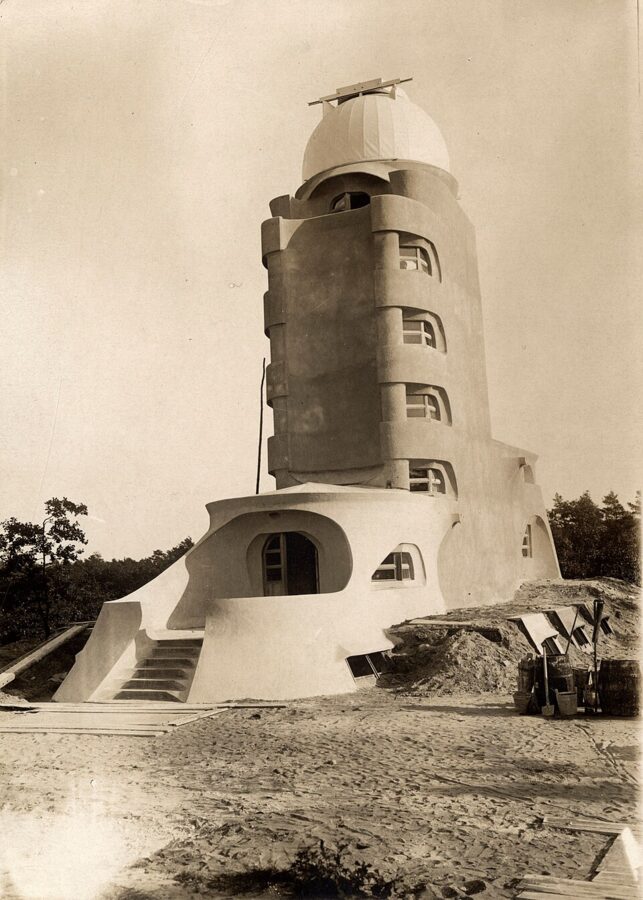
Then the plasterers came. Over brick and concrete alike they sprayed a fine-grained render, tinted a pale ochre, so that the whole building read as one cast object. It was so convincing that the tower went into the architecture books as a concrete building. When restorers took templates of the window bays in the 1990s, every one was different: the plasterers had shaped each curve freehand.
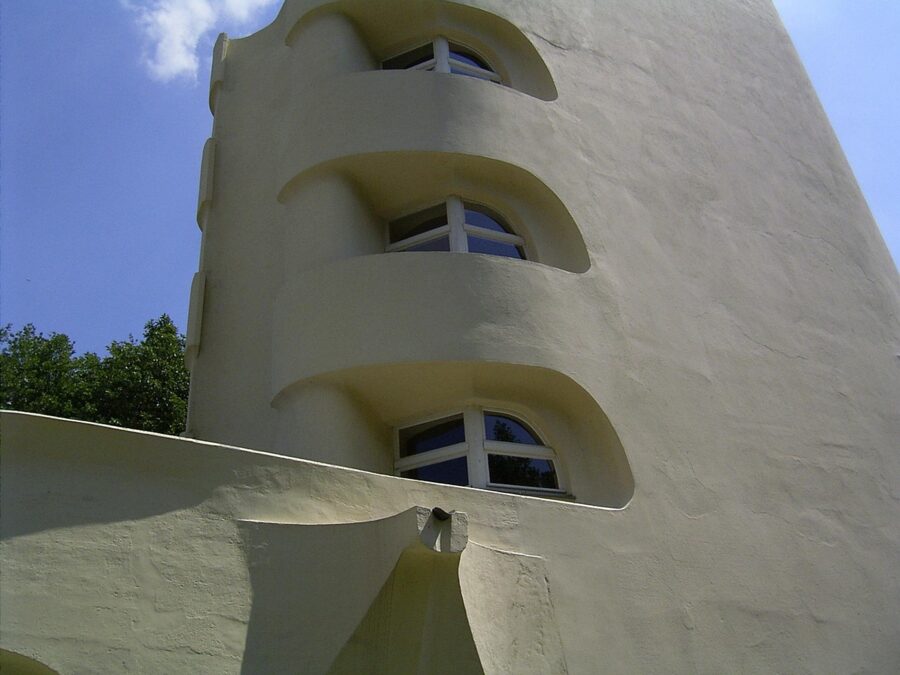
Building began in September 1920 and stopped almost at once because nobody had a permit. The city building office asked for basement windows to air the laboratories, and Mendelsohn added them, with a small night room for observers above the work room. Research began in spring 1922, though installing all the instruments took until 1924; the young Richard Neutra, later famous in California, drew the garden.
“Organic”
The story everyone tells is that Mendelsohn walked Einstein round the finished building and waited for a verdict that did not come. Hours later, at a meeting, Einstein leaned over and said one word: “Organic.” It may be polished in the retelling, but Mendelsohn liked it, and it fits better than “Expressionist,” the label the books gave the building. The institute itself is wary of that tag, pointing to the harmony of the form and Mendelsohn’s own view.
The date is not in doubt. On December 6, 1924, the board of the Einstein Foundation met in the tower’s work room with Einstein presiding, and the observatory officially opened. Within the year everyone was calling it the Einsteinturm.
How the telescope works
Inside, the building is a protective shell around an instrument. At the top, under the dome, two flat mirrors called a coelostat follow the sun across the sky and throw its light straight down the shaft. Only the mirrors move; the heavy lens stays fixed, the whole point of a tower telescope. Freundlich’s model was the tower telescope at Mount Wilson in California, the first of its kind.
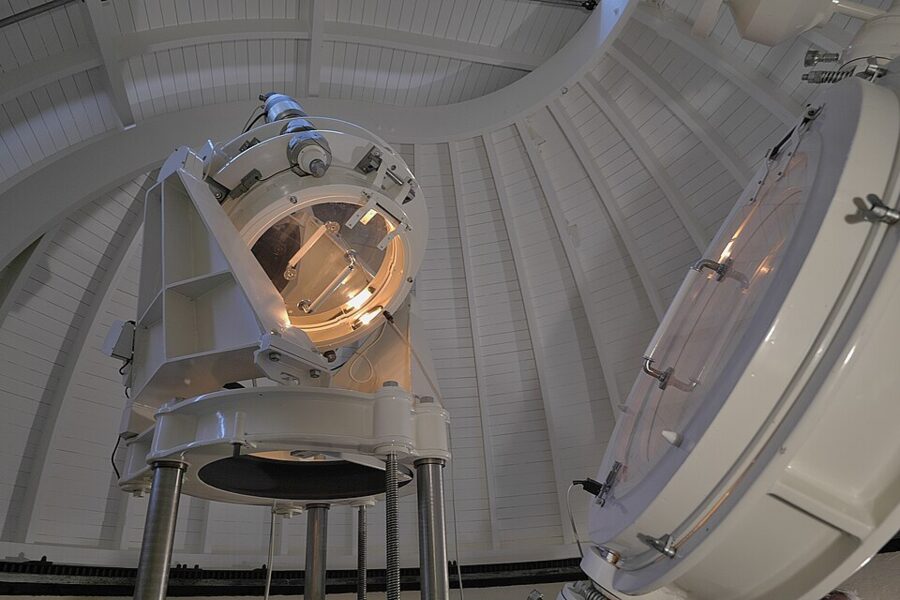
The lens, 60 cm across with a focal length of 14 m, sits in a frame of two stacked wooden towers, each 6 m high, standing on their own foundation inside the brick one. The frame touches the building nowhere, so a gust on the dome or the sun on the south wall does not shift the image. At the foot of the shaft another mirror swivels the beam sideways into the basement.
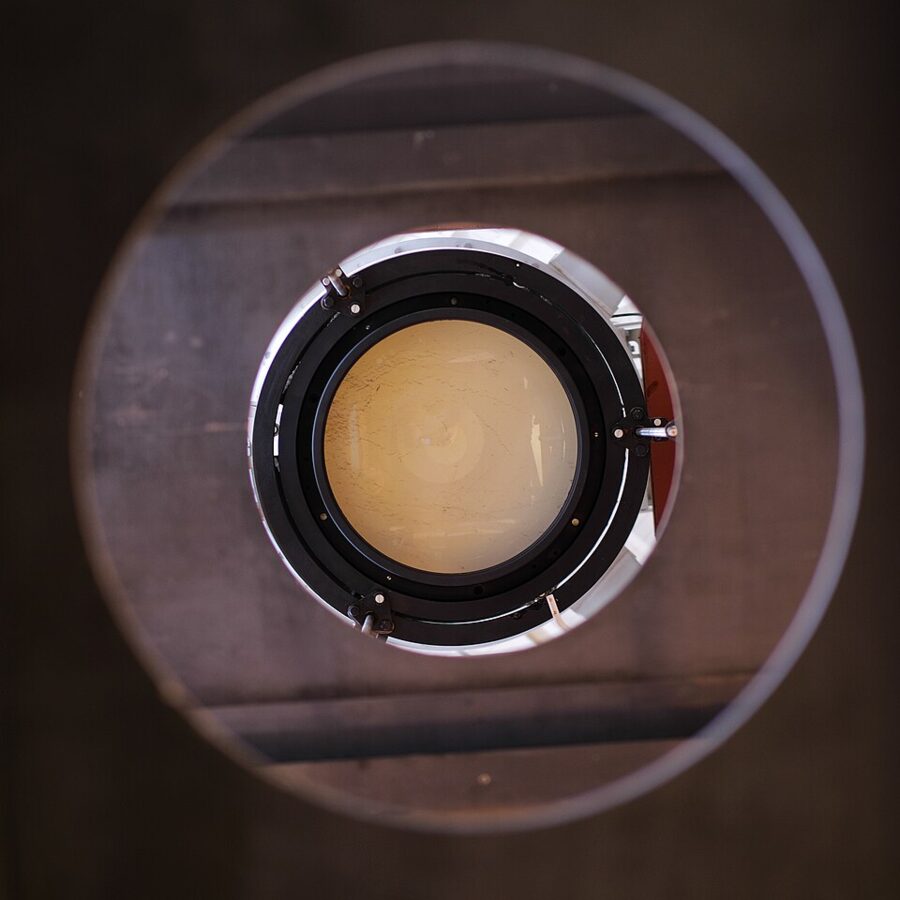
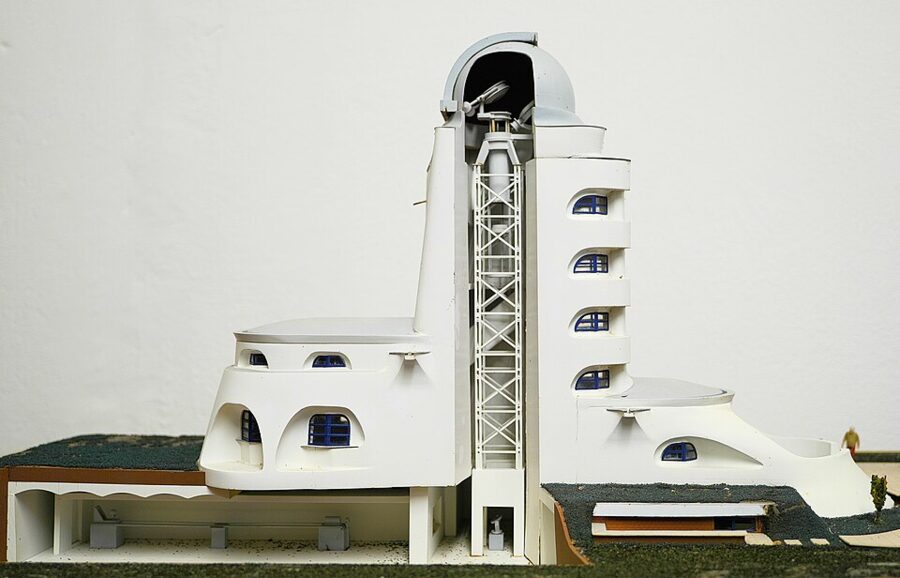
The laboratory is the reason the building is long. Mount Wilson stacked its labs vertically; Freundlich wanted his on one level, so Mendelsohn ran a thermally insulated spectrograph room about 14 m south from the foot of the tower and buried it under a bank of earth. There the sunlight is spread into its colors and analyzed.
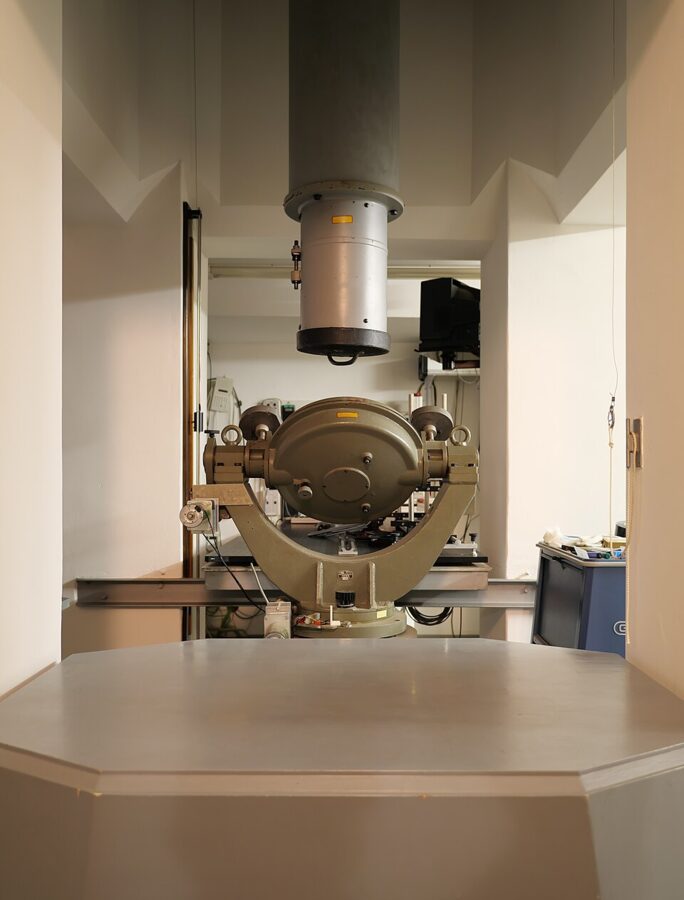
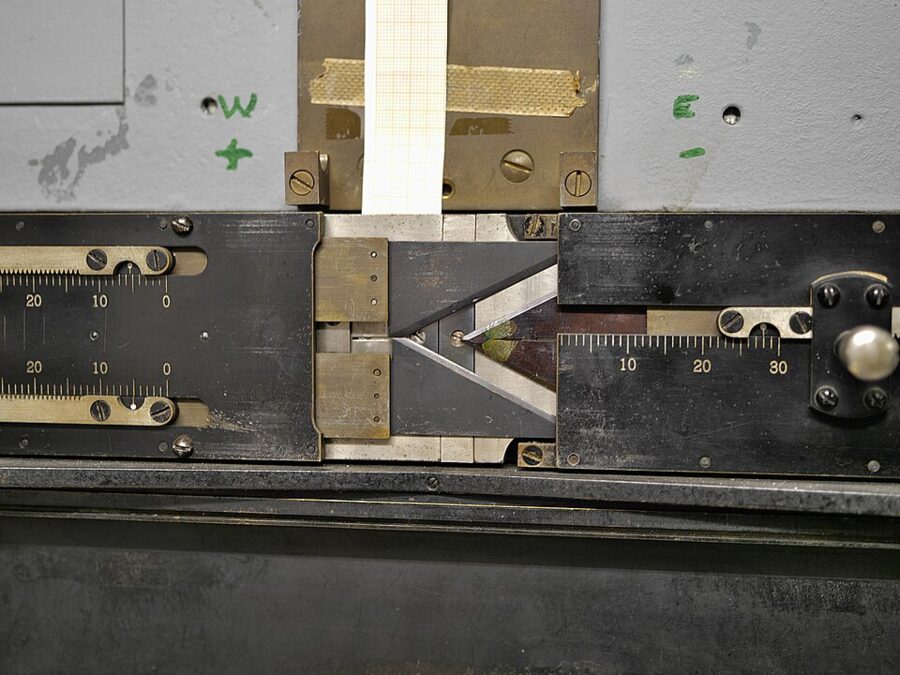
With its modernized equipment the spectrograph can tell apart about 400 million colors, and on a good day the telescope picks out features about 700 km across on the sun. On earth, the institute notes, that would mean a one-euro coin at 5 km.
What it found
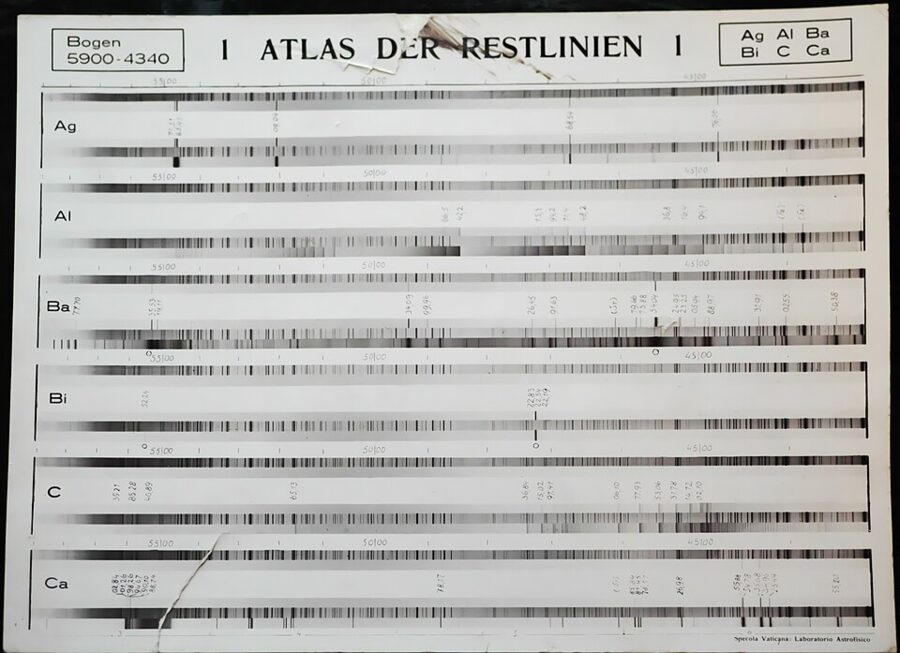
The test it was built for failed. The redshift Einstein predicted was real, but on the sun it is swamped: hot gas rising from the boiling surface shifts the lines toward blue by about the same amount, and in the 1920s nobody could separate the two. Confirmation only came at the end of the 1950s. But Freundlich had always planned for general solar physics too, and the laboratory was laid out for new instruments.
Until the Second World War it was the most important solar telescope in Europe. Walter Grotrian, working from spectra taken on Freundlich’s eclipse expedition to Sumatra in 1929, showed over the following years that the sun’s outer atmosphere, the corona, is hotter than a million degrees Celsius (about 1.8 million °F). Harald von Klüber developed a way to measure the strength and direction of magnetic fields in sunspots, and in 1960 Horst Künzel described the tangled “delta” sunspots that are still used to forecast solar flares.
Einstein broke off contact with Freundlich in 1925, but still defended the tower’s independence when it passed from the foundation to the state in 1931. The Nazis ended that independence. In 1933 the observatory lost its name, becoming the Institute for Solar Physics, and pictures of Einstein were taken down. Freundlich, whose grandmother was Jewish, was forced out under the new civil service law and left Germany at the end of October 1933 for Istanbul; Mendelsohn, who was Jewish, had already gone.
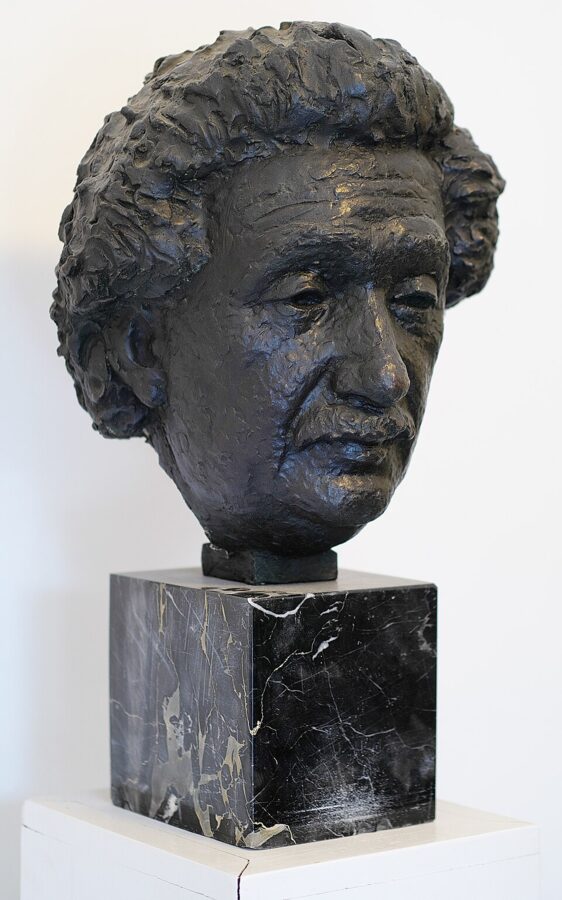
Some of the staff were braver than the regime expected. Kurt Harald Isenstein’s bronze bust of Einstein, which had stood in the work room, was supposed to be melted down. After 1945 it turned up hidden behind crates in the spectrograph room, and it now stands in the foyer. Solar research became “important to the war,” because flares disrupted radio, and the tower kept working even after officials discussed demolishing and rebuilding it in 1941.
The patient on the hill
The mixed construction began to fail almost at once. Brick and concrete, in walls of very different thickness, expand at different rates as the sun moves round a building that has to face north and south for the telescope, and the joints crack. In November 1926 the city building office recorded that the combination of reinforced concrete, brickwork and spray render had “not proved itself” against rain and rising damp.
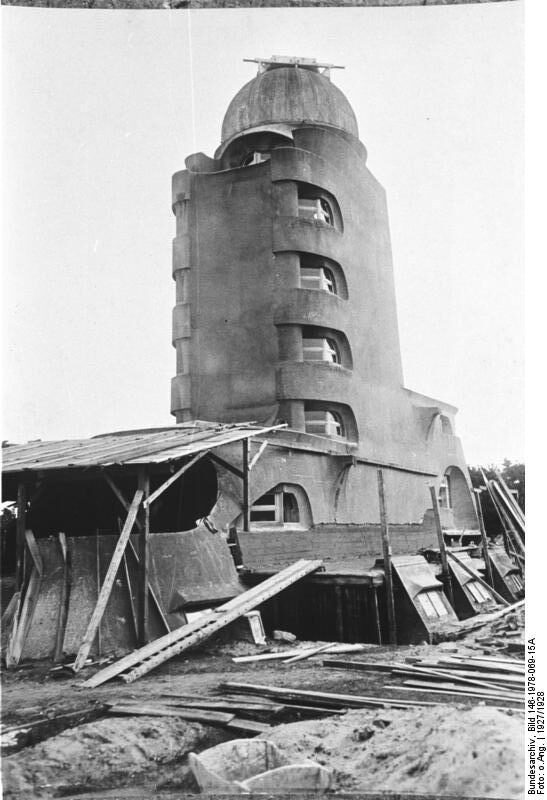
The 1927 repair made things worse. Sheet metal fixed over the window sills and parapets trapped condensation against the concrete, and the lead plugs holding it down split the concrete as they expanded. Cracks were packed with roof tiles, which soaked up water. Within three years the damp was back; fungus grew in the spectrograph room, and in 1937 the great prisms went back to Zeiss for two and a half years of cleaning.
In 1942 the tower was painted in green and brown camouflage. On April 14, 1945, the night British bombers wrecked Potsdam’s old town, an aerial mine exploded between the tower and the Great Refractor, tore out the windows and destroyed two thirds of the dome. An observatory employee who slept in the work room on bombing nights put out the fire that followed. The structure held, and work restarted that October under a makeshift dome.
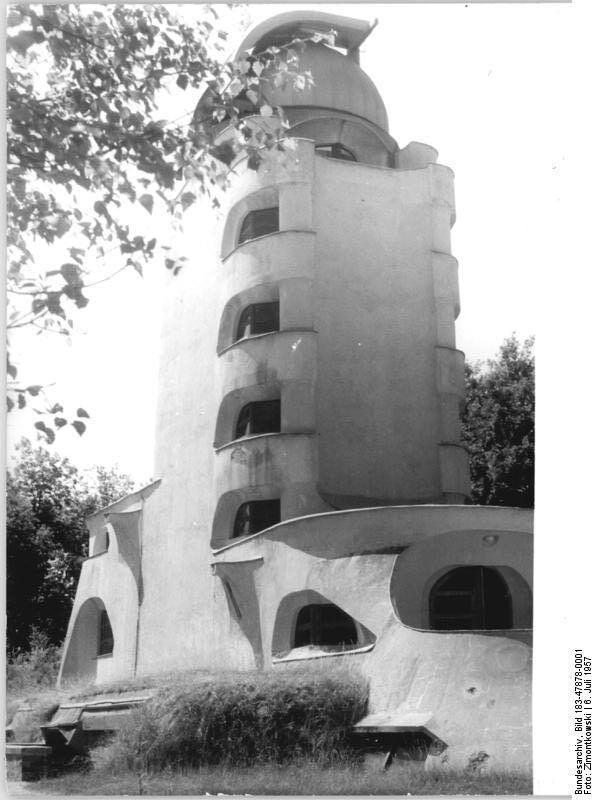
In 1950 the East German Academy of Sciences repaired the tower for the Academy’s 250th anniversary, probably replaced Mendelsohn’s entrance stairs with plainer ones, and painted it off-white with a wax paint meant to repel water. Two years later the damage was back. Zeiss supplied a new dome in 1953, and repairs followed every decade or so. In 1979 the cosmonauts Sigmund Jähn and Valery Bykovsky came down the steps of a freshly repaired tower for the cameras.
1997–99: finding the ochre
By the early 1990s the building’s survival was in doubt; after the winter of 1994–95 a large patch of render fell off the west side. The Wüstenrot Foundation (Wüstenrot Stiftung), a private foundation that restores monuments, paid for the first full survey of the building and then for a restoration from 1997 to 1999, which cost about €3 million; the foundation paid two thirds, the astrophysics institute the rest.
The survey settled where brick ended and concrete began, and what color the building had been. Under the 1927 sheet metal on the window sills the restorers found the original render, tinted ochre, and the tower went back to that color. The metal came off, the rusted window beams were cleaned and protected, and the stairs were rebuilt to Mendelsohn’s design, set off from the old work by a 2 cm joint. On the south side all the render had to be renewed; on the east, only 5 percent.
The architect of that restoration, Helge Pitz, called the building “Patient Einsteinturm,” and wrote it a care plan with check-ups once or twice a year. It worked better than anything before it. The gap between major repairs, about ten years until then, stretched to more than twenty.
2021–23: the latest repair
In 2017 Pitz found fresh cracks, in the render on the west side and in the concrete on the south and north. With Getty Foundation support, the Technical University of Dresden and the institute modeled how heat and moisture move through the walls, and the Potsdam architects Kühn von Kaehne und Lange planned small, local repairs rather than a new skin. The Wüstenrot Foundation again ran and paid for the work, from 2021 to 2023.
The facade was cleaned of algae, the cracks opened and closed again, and the joint at the top where the concrete dome ring sits on the brick shaft got a new, flexible bridge under the render. The roofs were stripped back to Mendelsohn’s hollow bricks and resealed, two ribs of the 1953 dome were replaced, and for the first time the roofs and the dome were painted the same ochre as the walls. The reasoning is that Mendelsohn modeled the whole thing as one mass; the old black-and-white photographs cannot settle it.
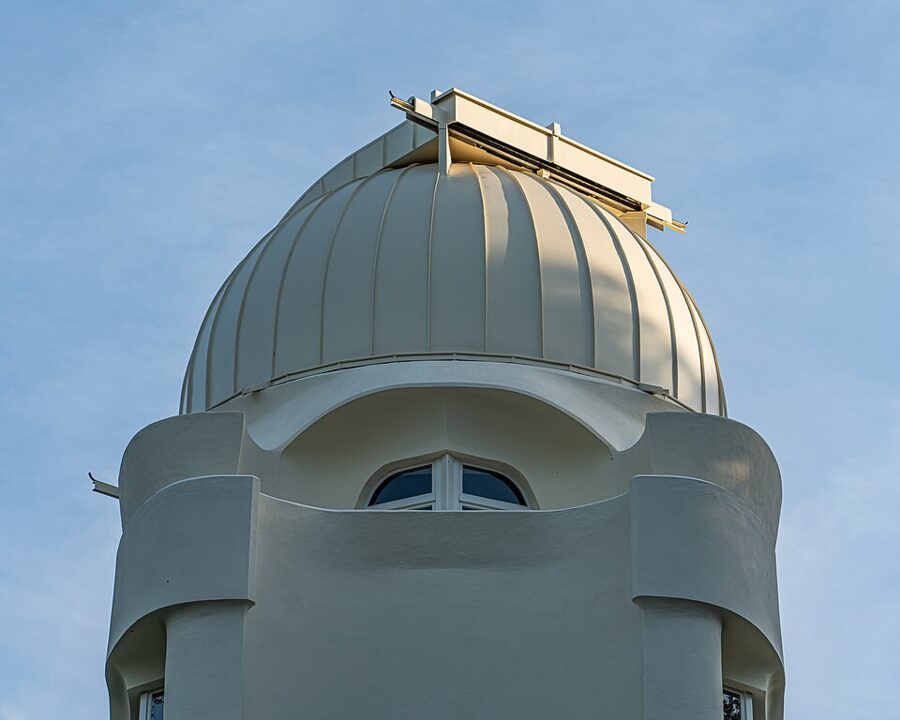
The tower reopened in September 2023, fully working as a solar observatory. What you see now is, to my eye, the closest the building has been to its first appearance since 1927: ochre all over, sharp-edged lawns, the hedges along the path replanted. It will crack again; everyone involved says so.
The Albert Einstein Science Park today
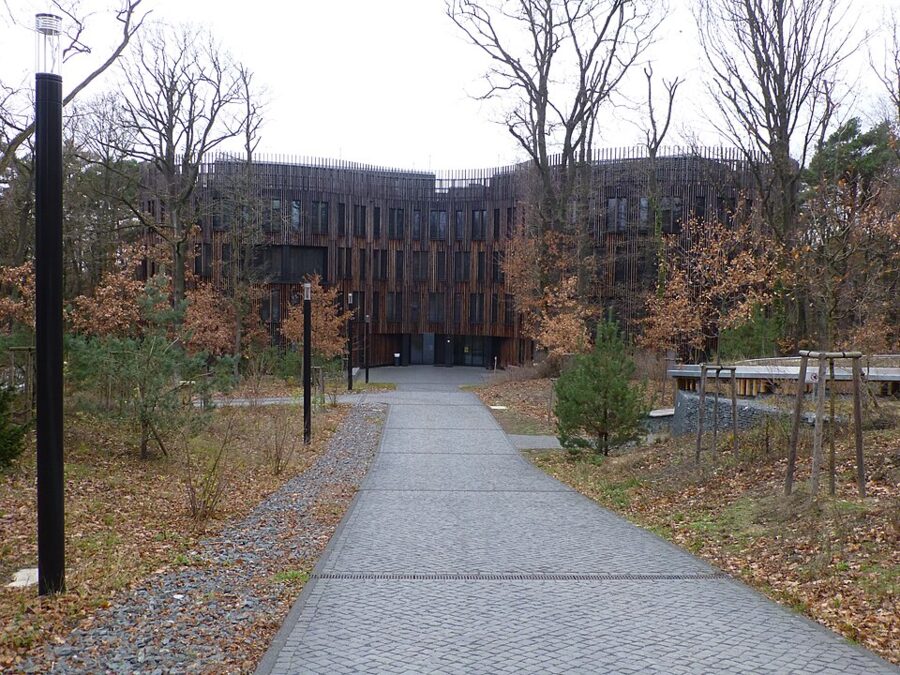
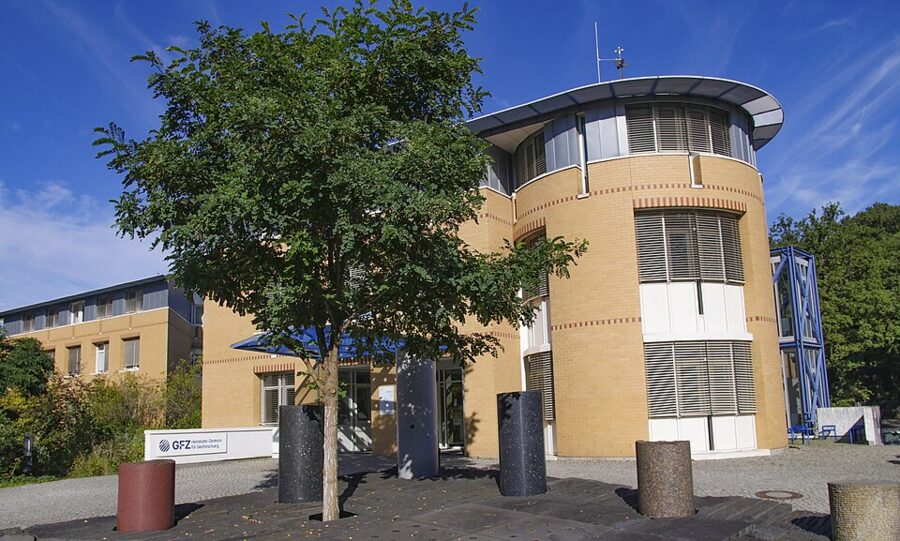
After reunification the East German academy institutes on the hill were wound up, and in 1992 new ones replaced them. The GFZ Helmholtz Centre for Geosciences (GFZ Helmholtz-Zentrum für Geoforschung) has the old geodetic buildings and several new ones; the Potsdam Institute for Climate Impact Research (PIK) has the Michelson building, the Süring-Haus and a timber-clad research building of 2015 known as the Kleeblatt, the clover leaf, after its plan. The Alfred Wegener Institute for polar research has a branch here too.
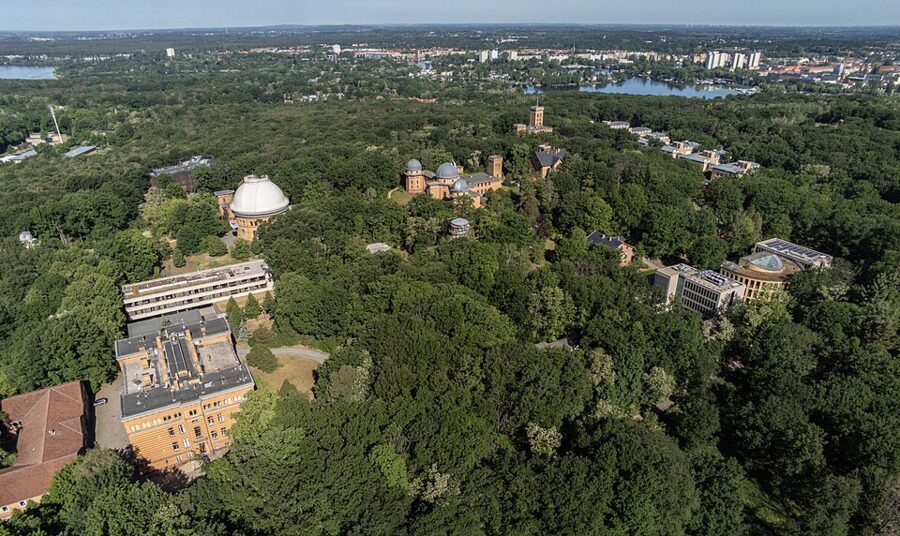
The Leibniz Institute for Astrophysics Potsdam (AIP), heir to the old observatories, has its headquarters in Babelsberg but still runs the Great Refractor and the Einstein Tower here. For the institute, the tower is its own working solar observatory: it measures the polarization of sunlight from sunspots to map their magnetic fields, trains students, and tests instruments before they go to the big solar telescopes on Tenerife. Parts of the X-ray telescope STIX, flying on the European Space Agency’s Solar Orbiter since February 2020, were developed and tested in the tower’s basement.
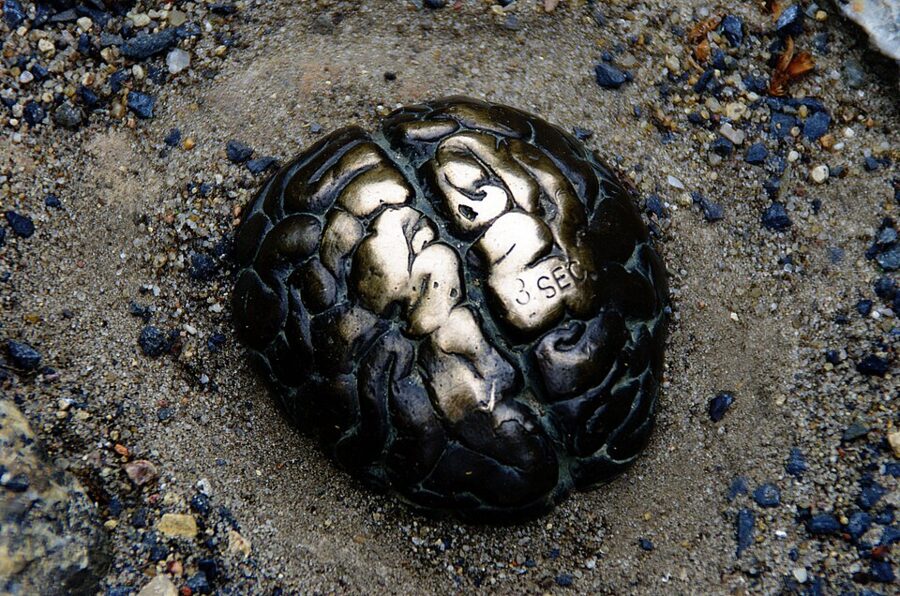
Hans Joachim Schellnhuber, the climate institute’s founding director, called the hill the most beautiful science campus on the continent, and on a quiet weekday I find it hard to argue. Fourteen information boards lead you round it, past busts of the scientists who worked here.
Visiting the Einstein Tower
The park is open by day and free; you sign in at the gate as a guest and then walk where you like on the paths. I’d come in the late afternoon, when low western sun rakes across the window bays and shows every curve. Cars are not allowed in.
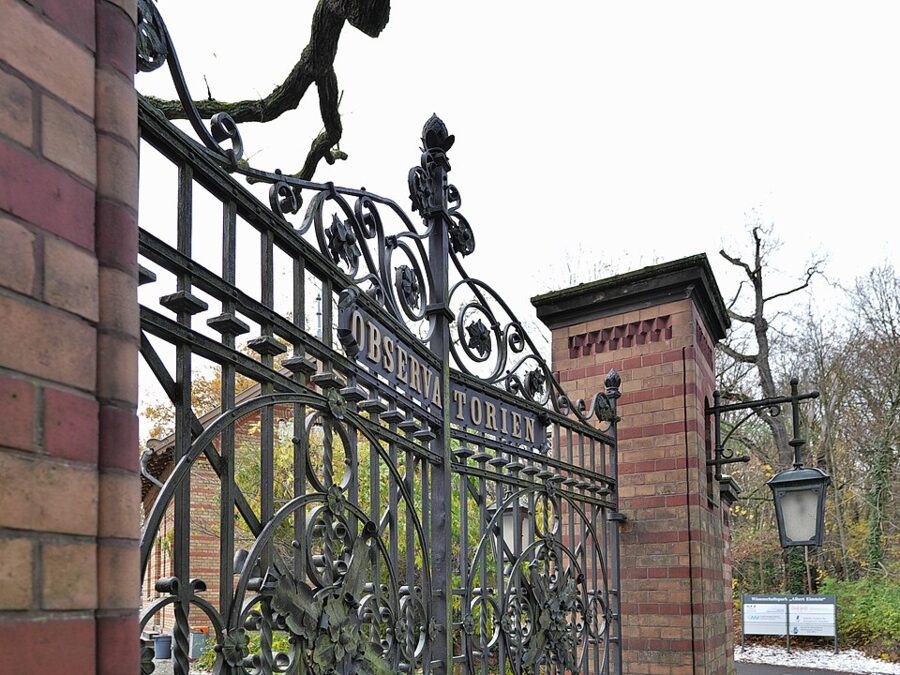
The inside is another matter. The tower is a cramped working laboratory with optics sensitive to dust and damp, so inside visits happen mainly in the winter half of the year, only with a guide, and only in small groups. The regular way in is the tour run by Urania Potsdam, a local science society, together with the institute.
The Urania tour of the science park and the Einstein Tower runs from September to May on the first Saturday of each month, 10:00–11:30, ending in the tower. It costs €12, or €10 reduced, with tickets sold in advance only, and meets at the science park entrance. The next date as I write is December 5, 2026. The listing is in German only; if you need the tour in English, ask the society before you book.
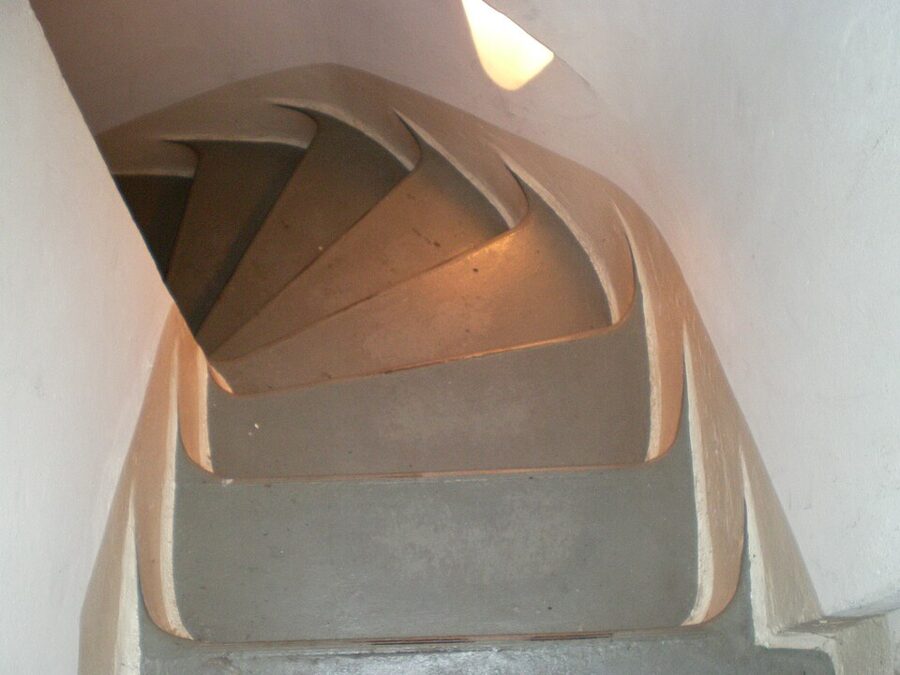
If you cannot get a place, the digital exhibition “Einsteinturm revisited”, created for the last restoration, has a 3D model and a scrolling history of the building, in German and English. The institute has also put together a centenary album of photographs from the scaffolding of 1921 to the reopening.
The Great Refractor by night
The other way inside a building here is the institute’s observing evenings at the Great Refractor. The winter 2026–27 dates are December 8 at 19:00, January 18 at 19:00, February 12 at 19:00 and March 9 at 19:30. Entry is free but only with registration, which opens two weeks before each date at 12:00 and has been filling within minutes. In cloud you see the telescope and the exhibition in the dome instead.
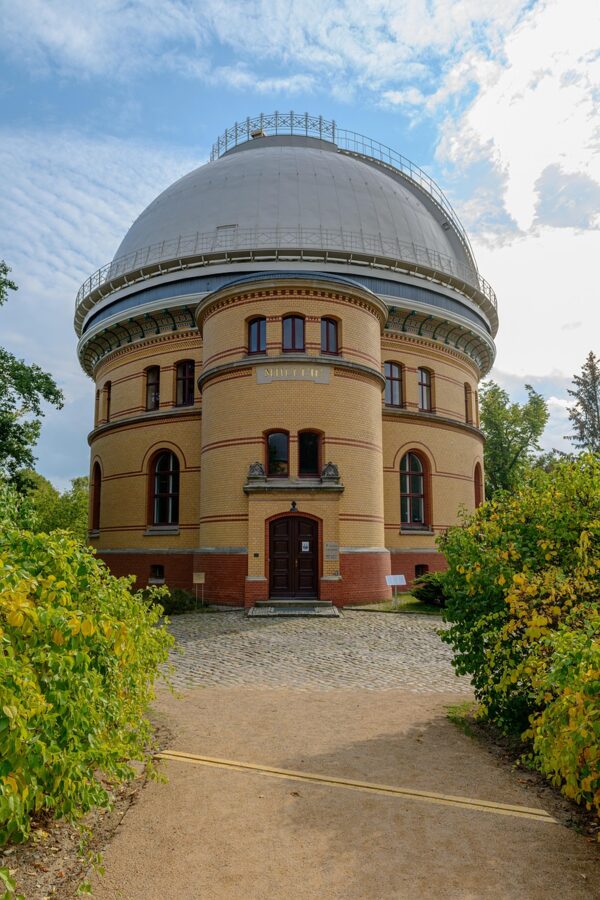
Groups of 15 or more can arrange a tour of the refractor through the Förderverein Großer Refraktor, the friends’ society that saved it. The institutes also hold an open day with the tower, the refractor and the Michelson cellar open; in 2026 it fell on September 26.
Getting there
Take the S7 or the RE1 to Potsdam Hauptbahnhof; trains and tickets from Berlin are covered in my guide to a day trip to Potsdam from Berlin. From the station it is about a 15-minute walk to the gate: leave on the south side, follow Heinrich-Mann-Allee briefly and turn up Albert-Einstein-Straße, which climbs to the entrance. The tower is a few minutes farther, past the Michelson building and the Great Refractor. Bus 691 runs from the station to the Telegrafenberg stop, but only on weekdays.
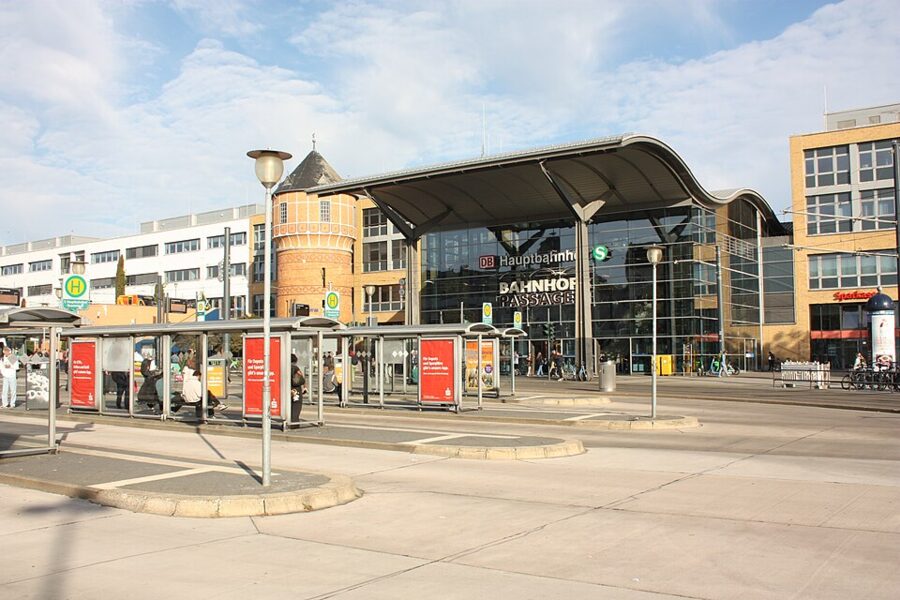
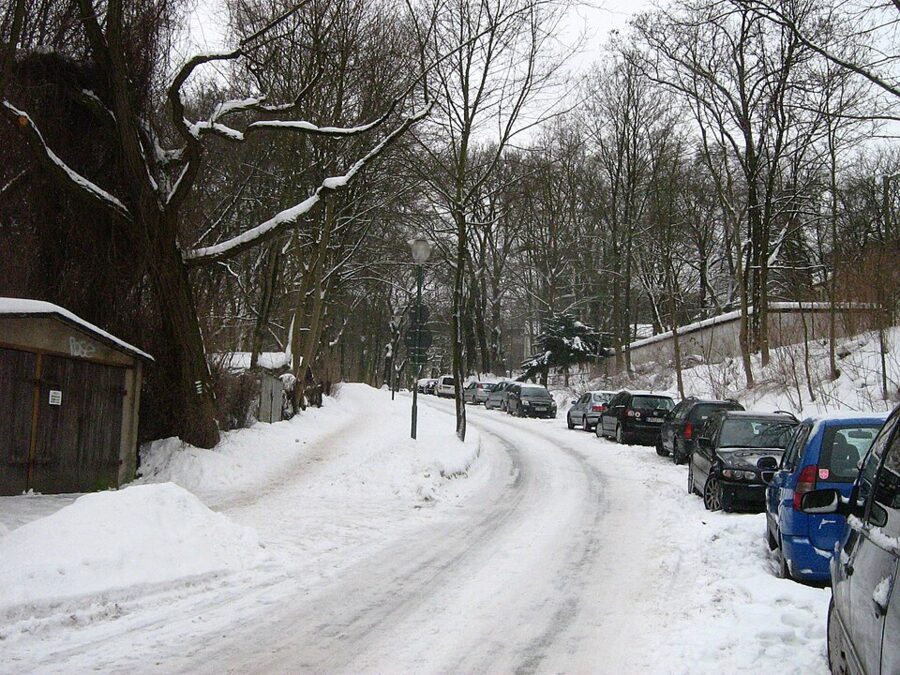
The hill fits easily into a day built around Sanssouci, a short ride from the station the other way. I’d do the palace in the morning, when the terraces are quiet, and come up here after lunch; my list of things to do in Potsdam has the rest.
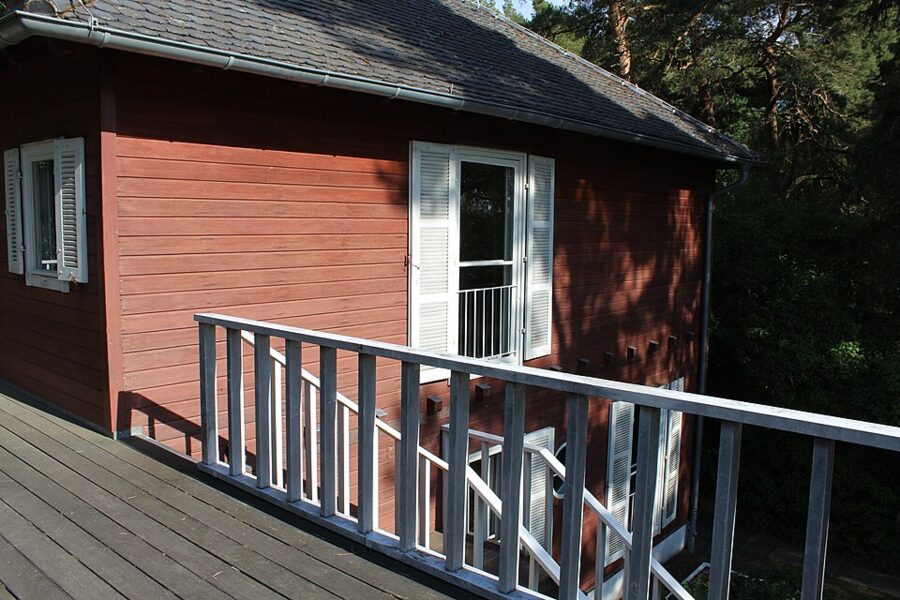
Einstein’s own retreat is about 6 km south of Potsdam: the wooden summer house in Caputh that Konrad Wachsmann built for him in 1929, where he spent his summers until 1932.
Walk back down Albert-Einstein-Straße toward the station as the light goes, and look round at the tower once more. It looks poured, it is mostly brick, and the ochre skin over it is a careful repair of a repair of a repair. Mendelsohn never fixed the fault in it, and nobody since has been allowed to, because the fault is the building.